Nationals Arm Race

"… the reason you win or lose is darn near always the same – pitching.” — Earl Weaver

Archive for the ‘ross detwiler’ tag

Nats Playoff Rotation & Bullpen Decisions

4 comments

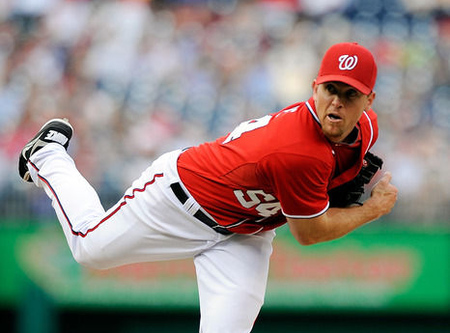
20-game Winner Gonzalez is our likely #1 starter in the playoffs. Photo Joy Absalon/US Presswire via usatoday.com

The Nats rotation has been incredibly stable this year; only a mid-season experiment with Chien-Ming Wang interrupted a near season-long quintet of starters unmarred by injury or poor performance.  The shutdown and playoff unavailability of Stephen Strasburg is well, well documented, so we won’t talk about him here.  But two important decisions await Davey Johnson in terms of his playoff roster construction: playoff rotation and bullpen construction.  Lets take these questions one-by-one:

1. What is your playoff rotation?  Here’s the evolution of our rotation this year:

  • The year started off with your starters in this order: Strasburg, Gonzalez, Zimmermann, Jackson and then Detwiler. The starters went R-L-R-R-L.
  • After the All Star Break, Johnson shuffled the starters and re-ordered them to go Zimmermann, Gonzalez, Strasburg, Jackson, Detwiler (still R-L-R-R-L), ostensibly to give Strasburg a bit more rest and extend his season a few days.
  • On August 3rd (around a double-header) Zimmermann and Gonzalez switched places.  Now you’ve got Gonzalez, Zimmermann, Strasburg, Jackson and Detwiler (L-R-R-R-L).  All three RHSPs are in order, as are the two LHSPs.
  • On August 15th around an off day, Detwiler and Jackson switched places, probably to keep Detwiler on regular rest and probably to fix the aforementioned issue of 3 RHSPs in a row (starters now Gonzalez, Zimmermann, Strasburg, Detwiler, Jackson for L-R-R-L-R).
  • On September 12th, John Lannan replaces the shut-down Strasburg in the rotation.  Now we’re Gonzalez, Zimmermann, Lannan, Detwiler and Jackson for L-R-L-L-R.

If we play out the rotation the rest of the season, barring any more rain-outs or injuries, the starters will be (Starting 9/21):

9/21: Jackson
9/22: Gonzalez
9/23: spot starter Wang, to give the rotation its regular rest.
9/24: Zimmermann
9/25: Lannan
9/26: Detwiler
9/27: Jackson
9/28: Gonzalez
9/29: Zimmermann
9/30: Lannan
10/1: Detwiler
10/2: Jackson
10/3: Gonzalez

At this point I’m going to assume that the Nats will win the division and go straight to the divisional series, which (per MLB’s playoff schedule) starts either Saturday 10/6 or Sunday 10/7.  Which day the Nats start will be critical; if the Nats are the #1 seed they’ll start Sunday; if they’re the #2 seed they’ll start Saturday.

But in either case I think we’re going to see some manipulation of the above schedule, because I think the team wants Gonzalez to start the opener.   And he cannot start an opener on 10/6 or 10/3 if he throws 10/3.   We may see him skipped on 9/28 and then throwing a start 10/1 (which I’d be happy for; that’s the last game I have tix for this year), which would put him on regular rest for either a 10/6 or 10/7 start.

After that though, there’s some decisions to be made.  The NLDS ridiculously gives the lower-seed the first two home games, so I think Johnson may want to have some options available to him for his 2nd, 3rd, and 4th starter (I think its a pretty basic assumption that Lannan is being left completely off the playoff roster; more on this later down when talking about the bullpen options).  Here’s the home/away splits of our 4 likely playoff starters (numbers as of 9/21/12).

Interesting; Zimmermann is far more effective away, Detwiler is far more effective at home, and Jackson is just about the same either way.  This seems to imply that Zimmermann is your best bet to take the 2nd start, away from home, then line up Detwiler-Jackson-Gonzalez (or some combination thereof) at home.

Here’s another take; Johnson likes to play match-ups with certain teams.  Will the Nats opponent factor into the equation?  Assuming the Nats are the #1 seed, your likely wild-card winners right now are Atlanta and St. Louis (its hard to see a scenario where St. Louis loses its current 3 game WC lead in the next 12 days, but it could happen, but for the purposes of this article we’ll assume these two teams hold on).  How do these teams fare against lefty versus righty starters?

  • Atlanta is hitting .247 as a team versus Lefties with an 86 wRC+.  That’s bad.
  • Atlanta is hitting .251 as a team versus Righties with a 97 wRC+.  That’s certainly better than they do versus lefties.
  • St. Louis is hitting .275 as a team versus Lefties with an 113 wRC+.  That’s basically 2nd in the majors behind the uber-hitting Rangers.
  • St. Louis is hitting .270 as a team versus Righties with a 104 wRC+.  That’s roughly a 10% difference in Run Creation.

So, it seems like if we play Atlanta, we want to load up on Lefties while if we play St. Louis we want to load up on Righties.  This would seem to indicate that, if Atlanta is our opponent we’ll want to go Gonzalez-Zimmermann-Detwiler-Jackson-Gonzalez again, meaning Atlanta has to face 2 lefties in the first 3 games plus 3 out of 5.  If we play St. Louis, you’d think that we’ll want to switch up Detwiler and Jackson so that St. Louis gets L-R-R-L-L.  The idea being that once we get home, even though we’re lefty-heavy we’ll have the advantage.

However, with the #1, #2 and #3 seeds far from settled with a week and a half to go, lets also look at the same logic for both Cincinnati and San Francisco, since its conceivable at this point we could be playing either of these teams (use the same links in the Atlanta links above to see these statistics):

  • Cincinnati is hitting .268 as a team versus Lefties with an 107 wRC+.   Both Tied for 6th in the majors.
  • Cincinnati is hitting .248 as a team versus Righties with a 89 wRC+.
  • San Francisco is hitting .268 as a team versus Lefties with an 96 wRC+.
  • San Francisco is hitting .270 as a team versus Righties with a 98 wRC+.

Conclusions?  Cincinnati matches up very well against lefties and struggles against righties, while San Francisco is a pretty well balanced team with no real weakness against either side.

One last factor is post-season experience, of which this group has very little.  Jackson is the sole guy with any post season experience, it being last year with potential opponent St. Louis.  I cannot see Johnson bumping any of the guys who are pitching better than him though, at least in a short series, based on this veteran experience (we’ll revisit this though in a 7-game series, where the identity of the 4th starter is incredibly important, as he only goes once in that series).

In any scenario, I think your first two starters away are going to be Gonzalez and Zimmermann.  After that will depend on the opponent.

2. What is your playoff bullpen?  By virtue of the fact that we don’t need a 5th starter, the team can carry an extra player.  Here’s the bullpen as it sits now, divided into “regulars” and 9/1 call-ups:

  • Regulars: Burnett, Clippard, MGonzalez, Gorzelanny, Mattheus, Stammen, Storen
  • Sept 1 callups: Duke, Garcia, Wang (and technically Lannan).

I think this decision is pretty simple; you keep the 7 “regulars” and add in power arm Christian Garcia, who has been lights out since arriving, as an extra middle-relief guy.  There’s no reason to have minor league starters Duke, Wang or Lannan on the post-season roster; the only function they’d have is as long-men, but the regulars include two such arms already in Stammen and Gorzelanny.

The possibility exists that Johnson will opt for an extra bench guy instead of an 8th bullpen arm, but I doubt he’d choose that route.  Your “extra” bench guys right now are Leon (3rd catcher), Brown and Perez (ofs), and one of either DeRosa or Tracy (technically it was DeRosa who got added off the DL after roster expansion; he likely would have been delayed in the minors had this happened earlier in the season).  I can’t see any reason to keep any of these guys on a post-season roster at the expense of an 8th reliever.  Tracy gets a few ABs a week and can only play 1B, while DeRosa can provide cover at multiple positions and seems to have more value.  I could be wrong though; Tracy continues to deliver timely pinch hits in the clutch (as he did this past weekend).

Man, it feels good to talk about playoff baseball!

Hagerstown/Low-A Pitching Staff Year in Review; 2012

7 comments

Closer Aaron Barrett was one of the best stories of the year for Hagerstown’s pitching staff. Photo unknown via thephilosophersstone2011.blogspot.com

Click here for the 2011 version of this post, for a look at how things were last year.

Here’s the Low-A version of the 2012 season pitching staff review.  I’m going down the line from top to bottom; AAA is here, AA is here, High-A is here. As with the other reviews, we’ll look at the main rotation, the substitute and spot starters, then focus on key relievers.  Rehab appearances are generally not mentioned.  The lower you get in the minors, the harder it is to really pass judgement on a player’s real capabilities or career outlook, so take some of these evaluations with a grain of salt.

The rotations in the lower minor leagues are also not nearly as clean as in the upper-levels.  Lots of times the “starter” is slated to go as many innings as the “reliever,” a way to get two starter candidates longer stretches of innings.  We’ll try to take that into consideration as we move forward.

Hagerstown starters.  The rotation started the season with Estevez, Dupra/Karns, Meyer, Turnbull/Hill, and McKenzie.   No less than 18 different guys started a game for Hagerstown this year (two of them on rehab assignments).  Lets see how the original rotation and other primary starters fared.

  • Wirkin Estevez was 5-2 with a 5.76 ERA in 12 low-A starts in the early and later parts of the season; he missed two full months with an unspecified injury.  He was no better after returning than before.  He was frequently victimized by the long ball, giving up 6 in 60 innings.    Outlook for next season: he’s young (turned 20 in March, if you trust D.R. birthdays) and he was effective last year in short-A.  He returns to low-A, but is dumped to the bullpen in the face of a glut of competition for rotation spots.
  • Brian Dupra got absolutely lit up in 11 appearances (8 starts) in April and May before suffering a season-ending injury 5/31.  Line on the season: 3-4 with a 7.17 era in 37 2/3 innings.  Outlook for next season: bullpen arm in Low-A.
  • Nathan Karns threw 44 outstanding innings in low-A before he was deservedly promoted to Potomac.  We discussed him at length there.  Outlook for next season: (from high-A post): AA rotation.
  • Alex Meyer was 7-4 in 18 starts for Hagerstown before getting promoted to Potomac.  We discussed him at length there. Outlook for next season: (from High-A post): High-A rotation again with an eye towards quick promotion to AA.
  • Kylin Turnbull got his first pro innings in 2012, being a relatively high draft pick (4th rounder) in 2011.  The 21-yr old lefty gave Hagerstown 89 mediocre innings, going 4-5 with a 5.16 ERA.  Not bad for a first full season.  He gave up a lot of hits though, and his whip was 1.51.  That’s lots of base-runners turning into lots of runs.  He was sent down mid-season to the rookie league to work on “mechanics,” returning the last day of the season (for some reason) to put in one relief appearance. Outlook for next season: Repeating low-A (in the rotation) looking for improvement.
  • Taylor Hill was the Hagerstown workhorse, leading the staff in innings pitched with 124.  He went 10-6 with a 4.92 era on the year.   Outlook for next season: I worry for the 2011 6th round college senior; unless he can be a bit more dominant on the mound, he’s not long for pro baseball.  He is relatively young for a college grad; he’ll be entering his 3rd pro season and turning 24 in March.  I’d guess he’ll get moved to the high-A bullpen in 2013 as a nod to his age/experience.
  • Chris McKenzie had his third straight rough year in the starting rotation, failing to improve on last year’s low-a showing.  Final stats: 2-3 with an ugly 8.64 ERA in 26 appearances and 8 starts.   Outlook for next season: the organization can’t give him a rotation spot again can they?  Low-A bullpen.
  • Bobby Hanson fared little better in low-A than he did in high-A, getting demoted mid-season.  After 11 starts and a 4.55 ERA he hit the DL, where he’s stayed the rest of the season.  Outlook for next season: As pointed out in the High-A post, he’s young but he’s entering his 6th pro season and has yet to really master low-A.  He’s a big lefty though (6’6″, 235lbs) so the team probably salivates at his potential.  He’s just not as dominant as he needs to be.  I’d guess he’s getting another shot at the low-A rotation in 2013.  But it may be his last shot.
  • Taylor Jordan was a favorite of mine after his stellar 2011 season in low-A.  Unfortunately he had to get Tommy John Surgery (done in mid September 2011), so 2012 is a come-back/rehab year.  He seemed to be back really, really early though; he got his first 2012 start 9 months after surgery.  On the year: 3-7 with a 5.13 ERA in 15 starts and 54 1/3 innings.  You can’t beat that for a rehab year.  Outlook for next season: leading the low-A rotation with an eye towards a quick high-A promotion in 2013.
  • Brian Rauh, the first 2012 draft pick mentioned in this series (and as it turned out one of only two 2012 draft picks to make it as high as low-A).  Rauh got 8 starts with Hagerstown in August after getting a quick bump up from short-A.  Results were ok: he was 3-3 with a 4.89 ERA in 8 games as a starter.  He only really had one bad start (his last) and would have had better season stats otherwise.  His K/9 rates were good and he may be an excellent find in the draft (he was an amazing 30-1 during his college career at Division III Chapman; check out his mini bio at milb.com).  Outlook for next season: low-A rotation.
  • Blake Schwartz, The 2nd, and last 2012 draftee pitcher to make it to Low-A this year was pretty good upon promotion to Hagerstown, going 1-1 with a 3.05 ERA in 7 late season starts.  The Nats have had some great luck with small-college pitchers (see Jordan Zimmermann and Ross Detwiler) and hope to continue with the likes of Rauh and Schwartz (from Oklahoma City University, an NAIA school).  Outlook for next season: high-A rotation, based on his status as a college senior grad.
  • Matthew Purke, as most Nats fans know, had three wild appearances in May before getting shut down on the season with continuing shoulder issues.  Outlook for next season: get healthy, try low-A rotation again.
  • Dixon Anderson, coming back from an injury that cost him all of 2011, looked good in a too-small-of-a-sample size of innings (26 between GCL and low-A).   He’s a big right-hander with good k/9 rates who was a little wild in low-A.  I wonder if he features more as an eventual reliever.  Outlook for next season: competing for low-A rotation, dropping to bullpen.


  • Other guys who got spot starts here and there (non-rehab):
    • Christian Meza had 36 appearances, 3 spot starts and a good 2.97 era in 88 low-A innings on the year.   A tall lefty with excellent K/9 rates, he excelled in 3 spot starts but remained mostly a middle-to-late innings reliever.  Outlook for next season: I’d try to feature him as a starter honestly, but i’d guess he ends up in the high-A bullpen.
    • Pedro Encarnation got a few innings in low-A after moving up from Short-A.  Outlook for next season: see short-A write-up.
    • Jason Smith got a call-up/spot start mid-season and got shelled.  Outlook for next season: see short-A write-up.

Hagerstown Relievers: taking a look at the relief corps at the end of the season.  These are done in order by IP for any reliever who didn’t get at least one start.

  • Gregory Holt gave the Suns 78 workman-like innings in 41 games, finishing the year with an era of 4.12.    Unfortunately it seems that result was rather lucky; his FIP was 5.18, a full point higher.   He’ll have to improve to stay in the organization.  Outlook for next season: high-A bullpen.
  • Ben Hawkins continues to be a late-round steal (he was a 36th round draft pick in 2011 out of baseball juggernaut West Florida) for the team, putting up a 3.55 ERA in 58 1/3 innings over 30 appearances, giving the team nearly a k/inning as a lefty.   He continues on a great 2011 as well.  He’s more than just a loogy, routinely putting in 2-3 innings per outing.   Outlook for next season: high-A bullpen.
  • Colin Bates closed a few games, was effective for most of the season (2.79 era in 51 2/3 relief innings) and has given the organization no reason not to move him up the chain.  He’s a little under-sized (6’1″, 175lb) and that may have him flying  under the radar as a prospect.   Outlook for next season: high-A bullpen.
  • Aaron Barrett got promoted to high-A after tearing through Low-A with 52 Ks in 34 innings.   See the high-A write-up for more. Outlook for next season: (as copied from high-A writeup) AA bullpen.
  • Richie Mirowski is another feather in the southwestern Nats draft staff’s hats; a 45th round pick in 2011 out of Oklahoma Baptist University was neat and effective upon reaching low-A this year.  He had a 2.00 era in 27 relief innings.  He had a few more walks than you’d like to see, but had over a K/inning to go with it.  45th round picks are usually throw-away picks on high schoolers who you don’t expect to sign; they’re not generally guys who put in sub 3.00 eras in successive seasons.  Outlook for next season: move him up; high-A bullpen
  • Other Relievers who appeared in Low-A (not including Rehabbing MLBers): Outlook for next season for all of these guys seems the same: another season in the low minors, struggling to make an impact.
    • Wilson Eusebio was inexplicably promoted after putting up a 6.78 ERA in 28 innings.
    • Bobby Lucas, GWU product and local kid, wasn’t good this year; a 7.67 ERA in 29 innings.  He was also incredibly wild; 36/31 k/bb in those 29 innings.
    • Alex Kreis had a 5.88 era in 26 innings for Hagerstown.  Nearly a 2.00 whip; he needs to improve.
    • Todd Simko, 2011 21st rounder, got 19 mostly wild innings in before going down with a season-ending injury in May.
    • Leonard Hollinshad a mostly nondescript 2012 season; he was a 29th rounder out of Juco in his first pro season.  He needs to show more swing-and-miss (only 8 Ks in 18 innings) capability to move up in this organization.
    • Travis Henke got lit up in 3 low-A innings and got dumped back to short-A.

Summary

Hagerstown had a mixed bag of starters early (some good, some bad), but got help down the stretch from 2012’s draft class.  It wasn’t enough for them in the end; losing out in the playoffs.

Wang gets stay of execution with latest “injury”

21 comments

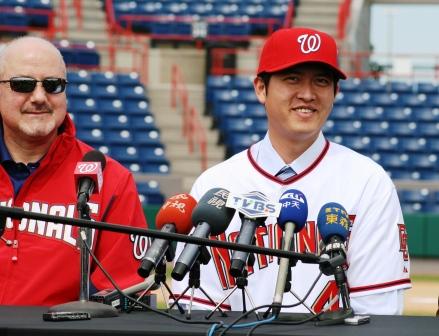
Wang on his signing day. There won't be a press conference on his release day. Photo Jeff Saffelle/Nats320 blog

Chien-Ming Wang‘s latest (and last) rehab start in Harrisburg ended with him “complaining of soreness in his right hip” and being pulled after the latest of his ineffective starts for AA Harrisburg.

This has to be the least surprising bit of news related to Wang’s injury and rehab assignment imaginable.

Do you mean to tell me that the Nats most ineffective starter, one who lost his starting role and was banished to the bullpen to do mop-up long man duty, and then was ineffective even in that role, was sent to the DL with a questionable hip injury, and when it came time to either re-instate the player to the active roster or to Desginate him for Assignment (since he’s out of Minor League Options) he suddently has a re-occurence of the same hip injury, meaning his rehab time clock resets to 30-days and allows him to wallow in the minors until the roster expansion date of September 1st (as I predicted in my July 3rd posting)?

I’m shocked.

Clearly there’s no place for Wang on the team, both in the short term and the longer term.  In his last three starts for Harrisburg he was alternatively lit up or highly ineffective (considering his pedigree and who he was pitching against).  Ross Detwiler has clearly grasped the #5 starter role and has a higher ERA+ than both Edwin Jackson and Gio Gonzalez for the season (hard to imagine, but Gio’s last 8-10 starts have really knocked his seasonal numbers down, even given last night’s CG and his excellent 7ip, 2H performance against the woeful Mets two weeks ago).   If/When Stephen Strasburg gets shut down (which honestly at this point I cannot believe will actually happen, given Mike Rizzo‘s cryptic statements about Strasburg having to pass an “eye-test” and backing away from any specific quantitiative innings limit), John Lannan has had two shots to prove he belongs and completely earned whatever work he will get.  Unless someone goes down with injury, Wang now sits easily as 7th on the starter depth chart and perhaps even further down, given Yunesky Maya‘s recent string of decent-to-excellent starts in Syracuse.

The Wang experiment was a worthy one, and certainly I supported his re-signing and the continued payment on the hope that Wang would return to his 19-win Yankees glory.  Maybe he’ll get a few more innings in September, as the team fights its way for a divisional title.  But you have to think he’ll be looking for work in another organization in 2013.

Written by Todd Boss

August 9th, 2012 at 11:05 am

Repost: Are the Nats suddenly a 100-win team? With this offense, yes.

7 comments

The return of Michael Morse has energized the offense. Photo Jacqueline Martin via federalbaseball blog

(Editor note; I attempted to publish this last Friday, then the server immediately went down all weekend.  Wanted to re-post it to get commentary from typical readers.  All numbers below were as of last friday, before the wild 4-game series against Atlanta).

There’s been lots of press this week, and to an extent all season, about Stephen Strasburg‘s innings limit.  Mike Rizzo came out this week and said (paraphrasing) that there’s not a hard-and-fast 160ip limit, but that he will be shut down, and it will be Rizzo’s decision when Strasburg doesn’t pass the “eye test.”

Nats pundits are already discussing this impact on a playoff race, who the replacement may be (with John Lannan getting an early audition during this weekend’s double header), and whether we should flip someone out of our “thinned” farm system for a rental SP like Zack Greinke or Ryan Dempster (I put “thinned” in quotes out of deference to those that don’t share my glass-is-half empty opinion on the state of our farm system right now as posted here earlier this week).

Inarguably, this team will be a worse team without Strasburg.  We’d be weaker in September once he got shut-down and we’d be hampered in a short series without our staff Ace.  I’m not worried about September though; remember last year?  Some teams were fielding 40-man roster specials, with lineups that mostly started the year in AAA.  And I’m not entirely worried about how we’d look in a playoff series, since playoff rotations go 4 deep (meaning whatever question mark we’re throwing out there as a 5th starter in September is in the bullpen in October), and a rotation of Gonzalez, Zimmermann (who, amazingly, is tied for the NL lead in pitcher bWAR right now), Jackson and Detwiler getting the game 4 start is still pretty durn good.

But, here’s some interesting stats that should give you (and anyone in baseball frankly) some pause; this team is positioned to get significantly better from here on out, despite the looming loss of Strasburg and despite the fact that they’re already in first place.  Why?

Because the offense is really starting to heat up.

Here’s some stats to give context: based on the Team Scoring page at baseball-reference.com, here’s the Nats scoring-based records:

  • When the Nats score 0,1,2 or 3 runs, they are 14-28, for a .333 W/L percentage. This is pretty common; even last year’s 102-win Philadelphia team rarely won when scoring 3 or fewer runs.
  • When the Nats score 4 or more runs?  They are 39-9 this season, a .795 W/L percentage.
  • Taking this a step further, when the nats score 5 or more runs, they’re 29-6, a .828 W/L percentage.

(For context, a record of 100-62 equates to a .617 W/L percentage).

Perhaps the above states the obvious; most teams have pretty good records when they score a bunch of runs.   For comparison sake’s, here’s the same analysis for the team with the best record in baseball, the Yankees:

  • Scoring: 0,1,2,3 runs: 5-23 for a .178 W/L
  • 4+ runs: 52-12, .813 w/l
  • 5+ runs: 44-10, .815 w/l

The Yankees and their superior offense leads to a ton of wins once they get above 4-5 runs.  The difference between the Yankees and the Nats is our current ability to win a pretty sizeable number of games when scoring 3 or fewer runs.  This difficulty in winning close games and depending on bashing your way to victory has been a theme for the Yankees for a few years now, and is one of the reasons they have only won one World Series since 2000 despite being in the playoffs nearly every year (only one missed playoff appearance during that span).  They are susceptable to getting shut down by a good rotation in a short series.  But I digress…

Getting back to the theme of this post: Here’s a look at the monthly W/L records for the Nats, along with average Runs scored and Runs Allowed (through July 19th’s game):

Month W/L W/L pct RS RA
April 14-8 0.636 3.36 2.68
May 15-13 0.535 4.21 3.85
June 15-11 0.576 4.46 3.73
July 9-5 0.642 4.78 3.57
season 53-37 0.588 4.166 3.488

Look specifically at the average number of Runs Scored by this team.  It is distinctly trending up; from 3.36 RS/game in April to a massive 4.78 RS/game so far in the month of July.   That’s almost 1 and a half more runs they’re scoring a game right now as compared to April (when their 14-8 record was mostly on the backs of one of the best opening months of starting pitching seen in the Majors since the dead-ball era).

Some reasons for this outburst of runs?

  1. Ryan Zimmerman‘s cortisone shot on June 24th: he had a .589 OPS in June (which should have been even worse, but he finished the last week of June on a tear, going 11-32 with 5 extra base hits after getting his shot), but has a blistering 1.280 OPS so far in July.
  2. The top of the order stepping it up: Danny Espinosa is hitting .327 in July and Lombardozzi is hitting nearly as well.
  3. The resurgence of Roger Bernadina, hitting at a .375 clip so far in July and leading to the DFA of Rick Ankiel (my wife’s favorite player; I havn’t broken the news to her yet).

Meanwhile, the rest of the sluggers in the lineup (Harper, LaRoche, and Tyler Moore doing his best effort to prove scouting pundits wrong who thought he couldn’t hack it against MLB pitching) are for the most part churning along and providing pop in front of and behind the 3-4-5 hitters in the order.

And, this offense could only get better when Jayson Werth returns.  Remember; he was quietly having a solid year at the plate, with an .810 OPS and a 121 OPS+.  You insert Werth and suddenly this team is rock solid and full of power from position 2-7.  You’d have to sacrifice Bernadina and Moore to the bench primarily, but they’re great insurance in case Werth’s wrist betrays him.

They’re averaging 4.78 runs a game, and on the season they’re 39-9 when they score 4 or more runs.  That spells a pretty serious run I expect this team to make in the next month and a half, especially against a slate of opponents that are mostly .500 or below.  Right now, sitting at 53-37 they’re on pace for a 95 win season … but, amazing as it is to say it, this team easily has the capability of reaching 100 wins if their offense continues its upward trend.

Wang to “DL” – See you in September

4 comments

Wang hits the DL. Photo via Washington Nationals.

The Nationals organization continued its loose interpretation of the “Disabled List” by placing ineffective starter-turned-mop-up guy Chien-Ming Wang on the 15-day DL, retroactive to July 1st, with what is being labeled a “hip strain.”

Has anyone else heard or read anything in the beat reporter’s works over the past week or so about Wang suffering from a hip strain?  I didn’t think so.  I’ve read lots about mechanics, ineffectiveness and an inability to work efficiently out of the bullpen, but nothing about a hip issue.

So be it; it works for the team and allows them to stash Wang in extended spring training for weeks instead of granting him his release (which would be the only other way to get him off the active roster, his having no further minor league options available).  I suppose it is fair to say that every professional baseball player has some sort of malady or another that could be diagnosed and serve as a reason to hit the DL.  I once heard an NBA player, when asked while he was rehabbing when the last time he was healthy was and he reportedly responded; “High School.”  Baseball is a grind; most players play through minor strains and bumps and bruises.  Luckily for the team, this procedural move allows Wang to be shipped out while he’s at his least effectiveness, awaiting his real reason for still being with the organization:

September 19th.

See, that’s just about the day that Stephen Strasburg is likely to hit his 160 inning limit for 2012.  He’s been averaging 5.8125 innings per start (93 IP in 16 starts).  That gives him about 12 starts left.  The team is thinking of making Strasburg the 5th starter in the rotation after the break.  That’d put his first start back on 7/17 at home vs the Mets, and counting 11 more starts after that roughly has Strasburg making his last start on 9/12, meaning the team would need Wang back and effective on 9/19.  Lots can happen between now and then of course; another starter could go down with injury and the team could have rain-outs that force their hands (they’re already looking at a call-up or a spot-start twice between now and mid September due to re-scheduled rainouts).  Or, the team could lose one of their long-men out of the pen and need a mop-up guy in the interim.

Either way, I think Wang’s career with the team may be at an end.  Ross Detwiler profiles more closely to the Mike Rizzo prototype pitcher; a power guy who gets lots of swings and misses.  Wang has admirably come back from shoulder surgery but he just hasn’t been able to put it together in 2012, and when his signature sinker isn’t working, he’s batting practice fodder.  Look for the team to make due with its current rotation as long as they can.

Written by Todd Boss

July 3rd, 2012 at 8:24 pm

Lidge DFA and a bullpen unravelling

4 comments

Lidge just couldn't regain his past glory with the Nats. Photo unknown via baseballasreligion blog

I was mildly surprised to see the news wire report today before the Nats-Yanks series finale; the Nats have designated Brad Lidge for assignment.  Not because Lidge didn’t “earn” this release; his numbers on the season are abysmal for a mid-to-late innings reliever (9 1/3 IP, 12 hits and ELEVEN walks for a ridiculous WHIP of 2.46.  And not because Lidge was singularly involved with both of the Yankess losses this weekend (he allowed Gio Gonzalez‘s inherited runner to score before allowing another three runs in on friday night, then wasting six shutout innings from his fellow bullpen members by giving up 3 hits and a walk in the 14th inning yesterday).

I say I’m mildly surprised because I honestly thought the next guy to get the axe out of our suddenly struggling bullpen would be the curiously called-up Mike Gonzalez, who may have decent ancillary numbers so far (no runs in 4 IP over 6 games) but he’s allowed a Doug Slaten-esque 4 of 9 inherited runners to score, including 2 in friday night’s bullpen implosion as well.  Gonzalez seemed to be a two week solution, signed off waivers only to provide cover until we got a couple of arms back off of the DL.  I certainly didn’t expect him to be seeing as much game action as he has lately.

The Nats are starting to see the real effects of losing two of their three best arms (Storen and Rodriguez); guys who should be the 5th or 6th guys out of the pen are now the 1st and 2nd guys out of the pen.  Clippard, who was doing just fine as the best 8th inning guy in baseball (he did lead the majors in Holds in 2011) now is, well not “wasted” as the closer but certainly not doing what he does best; being the guy who cleans up and fixes the highest leverage situations.

More to the point the team faces now; the loss of Storen and Rodriguez, as well as the trickle-down effects of stashing Ross Detwiler in the bullpen so the (so far) inferior Chien-Ming Wang can continue to put up sub-replacement player numbers out of the #5 starter role, combined with the presence of THREE swing-men/ex-starters (Gorzelanny and Stammen to go along with Detwiler) means that suddenly our bullpen has found itself ill-prepared to face the challenges that it was meant to face.  We really only had four true back-of-the-bullpen relievers who could close out games.

The team needs Ryan Mattheus back, now (Editor’s Note; about 2 minutes after I penned this the team announced that Mattheus was, indeed, back).  I know plantar fasciitis is painful but, hey, this is the majors.  Get a cortisone shot and get back out there.  We also need to think about giving some minor league arms a chance.  Or making a trade for some bullpen help.  Maybe we can flip one of our swing-men for a back of the bullpen arm from a team that needs starter help (Colorado anyone?)

The team’s still in first place, a third of the way through the season.  With no reason to think we can’t maintain the lead now that our big hitters are back and getting healthier.  We need to shore up this problem so it doesn’t derail the progress this team has made.

What are we going to do when Wang comes back?

8 comments

In a word: I have no idea.

While the rest of Nats nation talks about the fallout of Jayson Werth‘s broken wrist (most of this post was written before last night’s debacle), I had been thinking about this topic: when Chien-Ming Wang exhausts his 30 day rehab assignment, what in the world is this team going to do with him?

If I’m correct about rehab assignment rules while on the 15-day DL, players have 30 days once they appear in a minor league game.  Wang’s first ML appearance was in Potomac on Apr 29th, and then he pitched 6 innings on Friday night in Hagerstown.  As has been reported in both local media and national, Wang’s 6 inning stint represented a big step forward in the pitcher’s ability to return to the majors.  Now, perhaps this isn’t a problem for another month or so, but both these reports seemed to indicate that Wang was “nearly ready” to return to the majors.  Problem is, the Nationals really don’t have anywhere to put him.

As everyone knows, the Nats currently have the best pitching staff in baseball by most statistical measures.  We’ve rocketed out to an 18-10 start, winning 8 of our 9 series so far, on the strength of starting pitching.  And there’s no logical starter that we should replace right now.  Strasburg just won NL pitcher of the month, Gonzalez is making all the “Nats paid too much” pundits eat their words thus far with a stellar start, Zimmermann is allowing a miniscule .992 WHIP right now (even after counting for May 6th inflation), and Detwiler is pitching better than any of them now to little fan fare, with a 3-1, 1.59 era, .988 whip and a staff-best 241 ERA+.  Arguably the “worst” of our starters is also our most expensive: Edwin Jackson.  Of course, the word “worst” is only understood in context: if it weren’t for one first inning meltdown on April 19th, Jackson’s ERA would be 2.34 instead of its current 3.69.

If you’re Davey Johnson, you don’t possibly dare disrupt the existing rotation do you?  I wouldn’t.  But, Wang needs to go somewhere.  Can you put him in the bullpen?  Doubtful; he’s a starter coming off a shoulder injury and probably needs to be on a set schedule of throwing.  I doubt he’s able to jump up and be ready to enter a high-leverage reliever situation with 8 pitches to get ready.  Do you send Detwiler to the pen?  He’s the least experienced of the 5 starters we have; the other 4 have long since established their spots.  Do you move Jackson to the bullpen?  That’d make for an awful expensive middle reliever.  Wang has no options (nor does Detwiler or Gorzelanny for that matter, logical choices to move up or down to make way), so they all have to find room on the active roster.  I don’t think Wang is trade-bait; who would give up anything other than a marginal prospect for him based on his injury past?

Honestly, I’m expecting some 15-day DL hijinks to ensue if/when the situation comes to loggerheads.

Nats Rotation Cycle 2012 #1: good/bad/soso

9 comments

Surprise 5th starter Detwiler turned in your best outing of the first Rotation Cycle. Photo Cathy T via nationalsdailynews.com

It has been so long since I did one of these, that I nearly forgot that I used to do them 🙂

For the uninitiated, I try to do a quick recap of our starters each turn through the rotation, culminating in 33 “rotation cycle” posts that can be seen if you click on the “Nats Rotation Review” category tag to the right.  If I’ve seen the game, I’ll give more detailed analysis based on my observations.  Otherwise I’m recapping the box score and interpreting the stats to come to a conclusion.  The focus is on the starters, but there is a section for relievers and the offense.

The classifications are not very scientific; usually good, bad or mediocre/soso.  If someone is great or awful, we’ll note that as well.

Good

  • Stephen Strasburg looked healthy and in command on opening day 4/5 (box/gamer), getting a no decision after 7 complete innings.  His line: 7ip, 5 hits, 1 ER, 5K and 1BB.  More importantly he was only on 82 pitches through 7 innings, a very efficient work day.  A couple of these hits were relatively weak (one an infield pop fly that fell between 4 infielders, another a scoring issue that probably was a hit).  Its not difficult to look unhittable when its 41 degrees and the wind is blowing in, but Strasburg seems to be adopting the same strategy as his compatriot Jordan Zimmermann: pitch efficiently, pitch to contact, and keep your pitch counts down so you go deeper into games.  It may not be as flashy as a 14-K effort, but if it leads to wins everyone is happy.
  • Jordan Zimmermann‘s first start on 4/8 (box/gamer) was just as effective as Strasburg’s; unfortunately for Zimmermann he went up against a buzz-saw in Jeff Samardzija and his offense couldn’t help.  Zimmermann took the loss on a day when he went 7 complete innings on just 80 pitches, giving up 6 hits, 0 walks and one earned run.   This is the classic adage of why W/L records are misleading; if Zimmermann pitches this way all year as our #3 starter we’re going to go far.
  • Ross Detwiler‘s rotation spot won’t be going away any time soon if he continues outings like 4/10 (box/gamer).  5 innings, 2 hits and a walk with 6 Ks to earn the win.   Detwiler picks up where he left off last summer and gives immediate validation to the Lannan– demotion decision.

Bad

  • Yes, its bad when your marquee off-season acquisition Gio Gonzalez fails to get out of the 4th inning in  his debut start.  Gonzalez struggled with control and with effectiveness on 4/7 (box/gamer) and gave up 4 runs on 7 hits and 3 walks.  He did have 6 strikeouts in his 3 2/3 innings, so there’s that.  His fastball was hopping; 95mph in the first two innings, averaging about 93 on the day.  He threw mostly fastballs but wasn’t getting the swing-and-miss effect like he needed.  Of course, an outing like this isn’t helped in the analysts’ minds when Tommy Milone (the 4th best prospect sent the other way in the trade) pitched 8 shutout innings in his debut.  Lets hope this is first-start jitters.

Mediocre/Inconclusive

  • Edwin Jackson‘s 4/9 start (box/gamer) wasn’t bad, but it wasn’t as effective as we would have liked.  He was a victim of the long-ball, giving up 3 runs on 4 hits and a walk in 5 innings.  He did have 6 punchouts on a night where he threw a ton of off-speed stuff (only 42 of his 78 pitches were fast-balls; he threw a ton of sliders on the night).   The homer he gave up ended any chance of his getting a W on the night on a game that was more or less thrown away by replacement starter Henry Rodriguez.

Starter Trends

MLB Trends (through Detwiler 4/10 Cycle 1)

Strasburg    good
Gonzalez    bad
Zimmermann    good
Jackson    soso
Detwiler    good

Relievers of Note and other News

  • So far its looking like Brad Lidge may be the steal of the FA market.  He’s throwing well, his slider is back and he’s closing out save opportunities for just $1m.
  • So far, its looking like the “bad” Henry Rodriguez from 2011; a 0.00 ERA but a 2.25 whip and a loss by virtue of his own throwing error.
  • Ryan Mattheus isn’t doing himself any favors right now and may not be long for this bullpen.  Of course then again its looking like Drew Storen is closer to Tommy John surgery than returning to the field, having visited Dr. James Andrews this week.  Meanwhile, surprise 25-man roster includee Craig Stammen is performing decently in a swing-man role and looks to stick.

Thoughts on the offense

  • Adam LaRoche comes out on fire, a shock considering he’s usually a slow starter and the fact that he looked beyond awful in the first game, waving weakly at curveballs in the dirt.  Ian Desmond looks like the Desmond of September, which is great news.
  • Meanwhile, in a completely unsurprising development Roger Bernadina has started out the season 3-for-20.  Why aren’t we looking for a CF again?
  • Too bad Chad Tracy doesn’t have any OF flexibility; he’s looked great off the bench so far.

Overall Summary

Can’t argue with an away series win, despite the weakened nature of the opponent in Chicago.  We could get a second away-series win tonight if one stud young Ace (Strasburg) can beat one come-back Ace (Johan Santana).  That’s the way to go in baseball; play .500 on the road and play .600 ball at home and you’re a 90 win team in an era where 90 wins almost certainly guarantees post-season play.

Lannan option shocker

4 comments

Hope to see you back soon Mr Lannan. Photo Luis Alvarez/AP via www.timesunion.com

I was sort of curious why there was so much volume on my Nationals RSS feeds this morning; little did I know there was a relatively shocking piece of news to report and comment on; John Lannan has been optioned to AAA to start the 2012 season.

I’ll admit it: I had Lannan penciled in as the 5th starter as soon as Chien-Ming Wang went down with injury.  I didn’t give it a second thought.  When the Nats bought Edwin Jackson, they had 6 starters for 5 spots and my presumption was that Lannan was the default choice for the 5th starter once Wang proved not to be ready for the start of the season.  In the back of my mind I knew Lannan had an option … but never thought that he and his $5M salary would be dropped to Syracuse.

This action definitely sends some statements.  In no particular order:

1. Unlike past iterations of the team (notably the 2009 team and the bullpen construction decisions made at the end of spring training), this sends the message that roster spots are not entirely guaranteed by virtue of salary or options status.  We all knew Ross Detwiler had no options and was set to make the 25-man roster, but nobody thought he’d be beating out Lannan for the 5th starter spot.  Its hard to argue he didn’t earn it; his Spring Training ERA was half that of Lannan’s.

2. The team isn’t concerned about “wasting” salary: Lannan joins fellow multi-millionare Yuniesky Maya in Syracuse, meaning that the Syracuse rotation is set to earn a sizeable percentage per annum of the major league rotation (roughly $20M for the Nats starting 5 versus $7M and change in AAA).  In fact if it weren’t for Jackson’s $11M salary the two rotations would be roughly equal.  Amazing.

3. Was there a stated rotation competition still ongoing this late into Spring Training?  If so it certainly didn’t come out in the dozens of stories filed by the beat reporters from Viera.  Perhaps the real shock here is that nobody knew that Lannan’s job was in jeopardy.  Did Lannan?

4. Sending Lannan down isn’t the same thing as sending Bryce Harper down: I’ve seen some bloggers kvetching about the statement “we’re starting with our best 25” when explaining the demotion while the team breaks camp with 3 non-roster invitees (Tracy, Carroll, Nady), at least one of which is set to get major reps in the outfield, and none of which are as good as Harper right now.  The simple matter is this; there’s “money” considerations and then there’s “MONEY” considerations.  Just keeping Harper in the minors a couple of weeks guarantees us one more year of his service prior to FA eligibility, and that’s hugely important.  No-one will argue the WAR-value add of 2 weeks of a 19yr old rookie versus 162 games of a 25-yr old emerging slugger.

I can buy some of the argument, by the way, that the Super-2 status concerns may be moot with Harper, considering that the team is in its best interests to buy out Harper’s arbitration years before he hits them.  Other forward-thinking teams (Tampa, Colorado, Los Angeles, Milwaukee) have certainly been doing this with their younger stars (Evan Longoria, Matt Moore, Troy Tulowitzki, Matt Kemp, and Ryan Braun respectively for the above teams).  But, as far as I can tell none of the above players are advised by Scott Boras, who knows maximum value is obtained by waiting til the last minute, by playing all the angles, and by not giving “home town  discounts.”  So for me, there is still significant future value in keeping Harper in the minors until mid-to-late June.  The difference can be googled by the reader, as WP writers have done this analysis several times in the past and discovered that a superstar avoiding super-2 can mean $14-$18M in future salary.

5. Davey Johnson needs to get on the same page as his boss (aka, Mike Rizzo).  Johnson telling the press “John’s my guy,” as he reportedly did just last week, or Johnson prematurely announcing that Lannan had won the 5th starter spot and then revoking it is a serious breach of boss-employee trust.   No wonder Lannan “took the news hard;” how would you feel if you were blindsided by your employer a week after them telling you that you were doing a great job and that everything seemed fine?  In this respect, the team seemed to have done Lannan wrong.  I’ll caveat this by saying that none of us armchair pundits are in the clubhouse on a day to day basis, so none of us had any idea what conversations Johnson and Lannan may have had leading up to his demotion.

6. I will have to agree with others who think this sends a bad message to the rest of the team.  Lannan by all respects is the kind of player teams want.  He doesn’t make waves, he doesn’t get bad press.  He was our opening day starter twice in recent years, he was a great example of a middle-round player overcoming his draft position and potential to make the majors, and he frankly isn’t that bad a pitcher.  Does the team’s “treatment” of Lannan send the wrong message to its veterans?  If so, that’s a bad cloud to have hanging over a team with some serious money tied up with its veterans (namely Werth, Zimmerman and Gonzalez).  If these guys didn’t like the way the team handled this situation, the clubhouse could be lost fairly easily.

7. You would think this action kills what remaining trade value Lannan had; Rizzo had already spoken of how the trade market for him was “thin” to begin with.  Lannan is a tough asset to get equal value for; he doesn’t over power you, he has unimposing stats (career 101 ERA+, or exactly MLB average), and he doesn’t get a ton of Ks.  He is a durable lefty who can fit at the back of your rotation.  Is that worth $5M a year (and more next year when he hits arbitration again)?  Or, more importantly to the Nats, is that worth a starting position player?  Certainly the Angels aren’t giving up their promising CF Peter Bourjos (as an example) for Lannan straight up.  We’d have to sweeten the pot.  Except that at some point, the value of keeping a disgruntled Lannan in AAA as starter insurance will eventually be more important than whatever role player we could get in return.

The one precedent that gives me hope on the trade front is when the team somehow turned demoted and malcontented Lastings Milledge into Nyjer Morgan (yes I know there was two others involved, but in terms of like for like, Milledge essentially turned into Morgan).  Perhaps Detwiler will continue his late 2011 performance into April of 2012 and will remain our starter-in-waiting to cover for eventual injuries and what not.  This would give the team more confidence to shop the now-insurance policy Lannan and wait for the right deal.

All in all, just your ordinary Wednesday in Nats town.

NL East Rotation Preview

3 comments

Remember this guy? He’ll be 100% for next spring and may spell a changing of the guard in the division. Photo via AllansGraphics.com

With major moves being made this off-season for the rotations of the NL East teams, we seem set to be in store for some serious pitching duels intradivision in 2012.  How do the rotations stack up, right now?  If the season started tomorrow, here’s what we’d be looking at for rotations:

Philadelphia Atlanta Miami Washington New York
#1 Halladay Hudson Johnson Strasburg Santana?
#2 Lee Jurrjens Buehrle Gonzalez Dickey
#3 Hamels Hanson Sanchez Zimmermann Pelfrey
#4 Worley Beachy Nolasco Jackson Niese
#5 Pineiro Delgado Zambrano Wang Gee
In the mix Blanton, Kendrick, Willis? Minor, Teheran Vazquez?Volstad, LeBlanc Lannan, Detwiler, Gorzelanny Young? Schwinden?

By team, some observations:

  • Philadelphia plans on replacing Roy Oswalt‘s 2011 starts with a call-up who looked pretty good last year in Worley. Joe Blanton looks like the odd-man out and his $8.5M salary may be wasted by virtue of an underrated but saavy acquisition of Joel Pineiro.  The Oswalt trade didn’t give the team what it seeked (a World Series title) but it didn’t cost them a ton in prospects either (JA Happ didn’t exactly light it up for Houston).  They’ve signed Dontrelle Willis for rotation depth.  Still, you can’t argue with three Cy Young candidates at the top of your rotation, and this team remains the team to beat in the division despite injuries (Ryan Howard) and aging (every single projected starter not named Hunter Pence is 30 or older, and Pence will be 29).   The pitching staff was #1 in ERA in the NL and I can’t imagine them dropping far from that.    If Worley performs like he did in 2011, and if Pineiro returns to his St. Louis form, then this is just as tough a 1-5 as last year.
  • Atlanta should have won the wild card last year and seems set to roll out a rather similar rotation this year.  They’ll replace their worst starter Derek Lowe with starts from one of three up-and-coming rookies (I’ve got Delgado slated there now but likely Mike Minor wins the #5 spot in spring training) and should be improved.  Hudson is a year older and hasn’t missed a start in 2 years, but is slow coming back from off-season back surgery and may or may not be ready for opeing day.  The staff was #4 in the NL in team ERA and should do nothing but improve … but there’s some serious injury question marks.  Their incredible SP minor league depth should get them through.
  • Miami has a some major question marks, despite acquiring Mark Buehrle to slot into their #2 spot.  They will cross their fingers on Josh Johnson; if he’s not healthy this team will be really hurt.  Nolasco can be brilliant or awful from start to start.   We still don’t know if Vazquez is retiring or returning; my initial guess would have been that he was too good in 2011 (3.69 era, 106 era+) and too young (reportedly 34 but i’ve never heard of any age-questioning here) to retire.  To provide cover though, the team traded for the volatile but possibly still talented Carlos Zambrano to slot in at #5.  Which Zambrano will they get?  And will his notorious clubhouse antics gibe with new hot-head manager Ozzie Guillen? On paper, a 1-5 of Johnson, Buehrle, Nolasco, Sanchez and Zambrano spells an awful lot of power and a lot of Ks.  They could be tough.  They should improve on last year’s #10 team ERA ranking.
  • Washington just got a lot better, replacing 29 mostly awful Livan Hernandez starts with a healthy Stephen Strasburg and likewise replacing 35 combined mediocre starts out of Jason Marquis and Tom Gorzelanny with newly acquired power lefty Gio Gonzalez and power righty Edwin Jackson. They were 6th in the NL in team ERA, have mostly the same bullpen in place (5th best in the league in ERA in 2011) and seem set to improve.   Chien-Ming Wang seems set for the #5 spot, leaving John Lannan potentially being the most expensive pitcher in Syracuse.   The jeopardy the team now has is an utter lack of starting pitching depth; Peacock and Milone WERE our 2012 rotational safety nets; now we have just Detwiler, Gorzelanny and a couple guys who clearly seem to be AAA starters.  For this reason the team probably keeps Lannan around with the eventual goal of having him provide cover until our next wave of high-end pitching prospects develop.  Either way, this rotation and bullpen look to be improved from 2011.
  • New York faces a grim 2012, not only in the rotation but also in the front office.  We’re hearing reports that Johan Santana is still too hurt to make opening day (though he’s since spelled some of these concerns with his first spring training outing).  Converted knuckleballer R.A. Dickey spent his off-season in a nasty fight with management over his charity climb of Mt. Kilimanjaro.  All their other starters posted ERAs in the mid to upper 4’s (or worse) with ERA+ figures in the 78-82 range.  And there doesn’t seem to be help coming on the Free Agency front (since the team can’t afford to keep operations running without bank loans) or on the prospect front (a quick glance at their AAA and AA starting talent resulted in ONE starter who had a minor league era in the respectable range, an 18th rounder in AA).  I think this team is finishing dead last in 2012 and may lose 100 games despite their payroll.  And to add insult to injury, the owners were just forced to cough up $83 million in a pre-trial settlement over their Madhoff scandal involvement.  Tough times are ahead for the Mets.

What do you guys think?  In terms of Washington, more than a few pundits have stated that the addition of Gonzalez makes the Nats a wild card contender, right now, and that was before the Jackson move finally brought some plaudits from typically cynical national baseball writers when considering signings by this franchise.

Do you think the Nats have now supplanted the Braves as having the 2nd best rotation in the division (as ESPN’s Buster Olney is opining?)  I think they have; I think Atlanta’s starters may be taking a slight step back while our quintet looks to be a solid, young but relatively experienced core.