Nationals Arm Race

"… the reason you win or lose is darn near always the same – pitching.” — Earl Weaver

Archive for the ‘ian desmond’ tag

Ladson’s Inbox: 11/5/12 edition

one comment

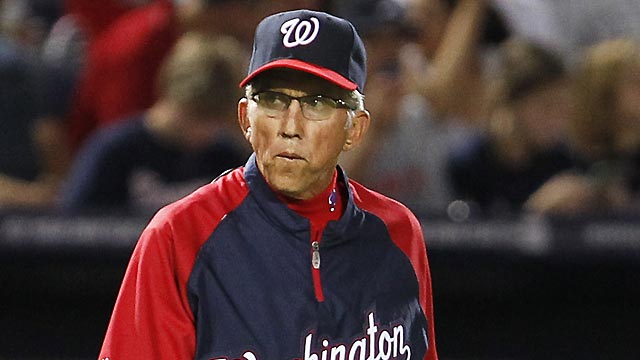
Would you bring back Johnson after his mis-steps managing the bullpen in the NLDS? Photo Getty via mlb.com

Welcome to another edition of MLB.com Nationals Beat reporter Bill Ladson‘s inbox, posted 11/5/12.  As always, I answer in this blog before reading his answer and sometimes edit the questions for clarity.

Q: Could the Nationals put a package of players together to pry away left-hander David Price from the Rays?

A: Unlike last off-season, when the Nats sent a bevy of top-end prospects to Oakland for Gio Gonzalez, I don’t perceive that the Nats have the depth of prospects nor the will to trade their biggest prospect names (Rendon, Meyer, Goodwin) in order to acquire David Price.  Tampa would likely want a combination of both prospects and MLB players, and you have to wonder if the Nats would be willing to ship so many pieces for Price (no matter how good a pitcher he is).  Now having said that about this theoretical trade, why do people think Tampa is actually LOOKING to move Price?  Yes they’ve been said to be looking to trade arms for bats this off-season, but they are far more likely to move James Shields if they’re looking to save money.  Shields has two more options at somewhat reasonable money ($9M for 2013, $12M for 2014) while Price is more than likely to only rise a few million above his 2012 salary of $4.35M.  Ladson says the Nats would have to deal a lot to Tampa to get Price and are more likely to go after Grienke.

Q: Do you expect Nationals to go after outfielder Josh Hamilton, who is a free agent?

A: I do not.  Josh Hamilton is injury prone (in his 5 seasons in Texas he’s only played more than 150 games once), is on the wrong side of 30, is prone to disappear at the plate for weeks on end, is going to command far more money than the team should be spending, and of course has the well-documented past daemon issues to constantly contend with.  I think Hamilton needs to stay with an AL team so that he can DH and continue to bat while he saves his body from the field.

Just see Philadelphia and New York Yankees rosters for prime examples of what happens when you guarantee $20M/year to guys in their 30s.  You end up with an expensive, aging and inflexible roster.  The Nats should do their best to avoid these kinds of contracts.  And I think Hamilton is going to age badly and be the kind of slugger who suddenly “loses it” once they hit their mid 30s.  Ladson essentially agrees.

Q: If the Nationals stay healthy, do you think they could win the World Series for the next several years?

A: “For the next several years?”  That’s a heady prediction; teams that win 3 World Series in short-orders are considered dynasties in the history of the sport.  Now, had this question been phrased, “do you think they could win the World Series within the next several years?”  I’d unequivocably say Yes.   They have a young talented core of starters all locked up for several years, they have a solid backbone of guys up the middle, they don’t really have any major trouble spots on the roster, and they have the payroll flexibility to adjust.

The real issue with guaranteeing World Series victories is the following (borrowing from Billy Beane); baseball playoffs are really such a crapshoot.   Anything can happen in a short series; how do the Tigers go from sweeping the Yankees to being swept them selves by the Giants?   I think Nats fans should hope for a continued streak of playoff appearances with the hopes that one of these years they put it together consistently through several short series and win a title.  Ladson also thinks they’re destined to win a title.

Q: Why are so many fans intent on trading Michael Morse? I don’t get it. He is one year removed from being team’s MVP in 2011.

A: I don’t know if fans WANT to trade Michael Morse as much as they’re resigned to the understanding that Morse represents a deviation from the way that Mike Rizzo wants to put teams together.  He’s clearly a defensive liability in left field, but the only other spot he can play (1B) is presumably being offered right now to Adam LaRoche for the next few years.  Therefore, I think the team looks to move Morse while he still has some value so they can put a better defender in left.

Now, is this what I’d do?  No not really; I’d probably let LaRoche walk, install Tyler Moore at first full time and leave Morse in left.  That takes away a huge middle-of-the-order lefty bat and leaves the team very right-handed (Zimmerman, Werth, Moore, and Morse are all RH), meaning Bryce Harper probably moves from #2 to #5 in the order to balance.  I’ve said it a million times; you can “hide” poorer defensive players in left field in this league, and in fact you have to in order to get enough bats in the lineup.

There’s no reason to think there’s any antipathy towards Morse; he’s clearly a clubhouse positive, he’s bright and cheery and seems to be a great teammate, and of course he’s got the best walk-on music (and subsequent crowd sing-along) on the team.  How can we want to get rid of that?

Ladson seems to think that fans were angry with Morse because of some extra bases taken by the Cards on hits down the line.  I don’t see that at all; yes he was slow to getting to those balls, but if you look at replays of all the doubles down the LF line you’d be hard pressed to find a ball that you’d immediately say, “See a better fielder throws the guy out at 2nd.”

Q: Has the organization soured on Danny Espinosa? And do you see Anthony Rendon on a fast track?

A: Two parter.  I don’t think the organization has “soured” on Danny Espinosa, no.  Why else would he get 160 games last year?  He’s a fantastic defensive player, covered more than ably at Short for Desmond and has 20-20 capabilities.  Now, that being said he’s a massive strike-out liability and really disappointed in the post season.  I think the organization, much as they did with Desmond, is showing some patience with their young middle infielder.  Desmond broke-out in his 3rd full pro season and perhaps so will Espinosa.  But, he needs to make some adjustments.  Perhaps its time to abandon switch hitting?  And his K rate must drop.

There are possible moves to be made though involving Espinosa, if it came to it.  He’s a natural short-stop, and his batting would be far more acceptable were he playing short.  We could move Espinosa to a team looking for a SS, install Lombardozzi at 2nd base and hope that he improves on his .317 OBP enough to be a decent lead-off options in the years to come.

Anthony Rendon should be on the fast track, absolutely.   The interesting question will be “where will he play” if he does push through to the majors?   Can’t play 3rd, could play 2nd but that leads to issues with Espinosa.  Could play LF, but see the previous Morse question.  Honestly, we should probably just wait to deal with this particular issue for that time at which Rendon is actually pushing for a MLB job.  This, by the way, is also another reason why I think re-signing LaRoche is foolish; I think the team needs to plan for the inevitable move of Ryan Zimmerman off of 3rd and to 1st Base, where his scatter-arm is no longer the major liability it is becoming.  Rendon makes for a natural 3rd replacement for Zimmerman, who can move to 1st and probably own the gold glove there for the next 5 years.

Ladson says the team hasn’t yet soured on Espinosa, and implies that something is afoot with either Espinosa or Lombardozzi this coming off-season.

Q: Why are you for keeping Davey Johnson around? Do you think that it’s smart to have your closer pitch the ninth inning of a game your team is losing by eight runs?

A: Wow, a shot across the bow of Davey Johnson for the little-mentioned usage questions surrounding Drew Storen in the NLDS.  Storen threw a meaningless inning in the game 3 blowout, meaning that he ended up pitching in three straight games.  My dad in particular believes this is the primary reason Storen was so wild in the game 5 meltdown, and puts the usage question directly on Johnson.  And I tend to agree.

That being said, Johnson is still a manager worth keeping around.  I just think he needs to learn from his mistakes in terms of bullpen usage in the coming seasons.

Ladson says he does not question Storen’s usage in game 3, but does question two critical non-moves in game 5 that many have mentioned; not using Mattheus and not walking Kozma.  Both are very fair points.

NLDS Game 1 Recap: Gonzalez the Escape Artist

10 comments

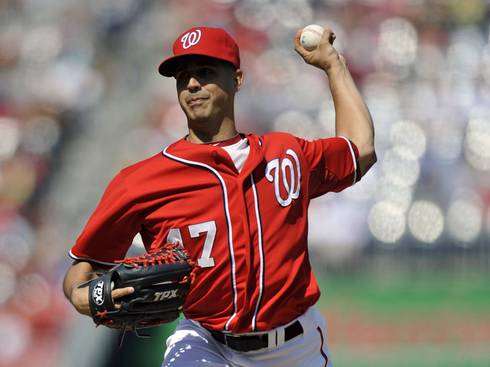
The team escaped Game 1 with a victory despite Gonzalez’s struggles. Photo Joy Absalon/US Presswire via usatoday.com

Nats take Game 1 of the NLDS 3-2.

You know your pitcher is having a rough day when the score line reads “2-0-0.”  As in, 2 runs, 0 hits and 0 errors.  That was the score at the end of the second, an inning in which Nats starter Gio Gonzalez had walked no less than four batters, thrown a wild pitch and given up a sac fly for the second run despite giving up zero hits.

TBS broadcast a stat showing Gonzalez’s ERA on various days of rest; the key stat was that he had a 5.80 ERA when he had more than 5 days rest.  His days rest entering Game one of the playoffs?  Nine days.  He last threw in Philadelphia on September 27th.

Being able to rest your starters and “set up” your post season pitching rotation can be a blessing and a curse.  Today it was a curse; clearly Gonzalez was overthrowing, missing his spots, and his pitching line showed it.  He didn’t trust his curve early, was relying solely on his fast ball and couldn’t locate it to his desire.  To his credit he settled down for a couple innings, got a couple of very timely plays in the field, and exited having given up a sole meaningless hit to go with seven walks in 5 innings.  To me it looked like he was over-throwing, that he was “too strong.”  Starters are creatures of habit; throw one day, rest the 2nd, toss the 3rd, bullpen work the 4th, rest the 5th and then repeat.  When too many extra days are thrown in, younger guys can get off schedule.

In the first inning I thought perhaps Gonzalez was trying to “save” his curve for later in the game; a great strategy for professional pitchers who can do it.  Instead of showing guys your whole arsenal the first time through the order, pound them with fastballs and make them hit your pitch.  Then, in their 2nd and 3rd at bats mix in curves and off-speed stuff as out pitches as needed.  If you play your cards right, you can work through each hitter’s 3 at-bats keeping them off-balance and suddenly you’re deep into the 6th or 7th inning as a starter.   As it turned out, he wasn’t trusting his curve at all, and suddenly he was pressing to hit his spots.

Craig Stammen escaped an incredible jam in the bottom of the 7th, having loaded the bases with none out.  Usually that situation has a run expectancy of somewhere greater than 2 runs but the Nats defense came through; an Ian Desmond force out at the plate for the first out then a clutch 5-4-3 double play to end the inning.  Despite Tyler Moore‘s late inning heroics, this was the key of the win.

Adam Wainwright showed exactly why he’s a Cy Young candidate when he’s healthy; his curve-ball was absolutely fantastic on the night.  The already-strike-out prone Nats fanned 10 times, many times on a fantastic curve that Wainwright was controlling and commanding to the outside corner.  I was surprised when he got the hook despite being on 100 pitches; as it turned out he probably wasn’t going to finish 7 complete regardless.  You can’t really fault the bullpen management by Cards manager Mike Matheny; he had his 8th inning guy on the mound (Mitchell Boggs) and the Nats beat him.

Other thoughts from watching the game:

  • I scoffed aloud when the TBS announcing crew spoke of Ryan Zimmerman‘s defensive prowness and said that “he rarely makes throwing errors.”  Really?  I know they don’t watch Nats games normally but the narrative behind Zimmerman’s throwing issues on non-pressure plays is well documented in DC.  He had 12 throwing errors on the year, and his 19 total errors tied him for 3rd in baseball.  Sure enough, a throwing error in the bottom of the 8th put the lead-off guy on board and caused the inning to be far more stressful than it needed to be for Tyler Clippard.  Guy on first with nobody out?  Roughly an 85% chance he scores.  For years I’ve defended Zimmerman and talked of the ridiculousness of “wasting” his defense by moving him to first, but the fact remains that every time he fields a routine ground ball I’m waiting for him to air-mail the throw.  When Anthony Rendon is ready to hit at the major league level, I think the talk is going to be about Zimmerman moving to first and not Rendon moving to another position.
  • For as clutch as Moore, Ian Desmond and Kurt Suzuki were on the day, Jayson Werth and Danny Espinosa were the opposite.  TWICE Werth squandered bases-loaded situations with two outs, leaving a total of 7 guys on base.  He may be our current lead-off hitter, but he’s normally a middle-of-the-order bat and he needs to capitalize on situations like that.  In Werth’s defense (no pun intended), the over-the-shoulder grab was a game-saver in its own right, so on a day when he disappointed at the plate he made up for it in the field.  Meanwhile it was not really shocking that Espinosa whiffed over and over; he led the NL in strikeouts on the season and was batting from his clearly weaker side.
  • How about Tyler Moore?  A fantastic job of hitting, hitting a pitcher’s pitch and not trying to do too much with it.  The old “game winning RBI” stat went the way of the Edsel, but tonight the clubhouse knows exactly who won that game.
  • Here’s to the return of “Clip-Store-and-Save.”  Clippard escaped Zimmerman’s throwing error in the 8th and Drew Storen dispatched two of the best St. Louis hitters in a 1-2-3 ninth.  The team has to feel great about its bullpen on the night.  No worries about using your 3 best guys; they’ll all be able to go tomorrow then get a travel day of rest.
  • The ridiculousness of the Hold stat: Boggs was credited with both a “Hold” and the Loss.  How is that possible?  Because he put on the go-ahead run that Mark Rzepcynski eventually allowed to score.  I think the Hold stat would carry more weight if it was withheld from relievers who don’t actually “hold” the game at bay and who contribute to the blown save and (if applicable) eventual loss.
  • The sideline reporter couldn’t help but compare the handling of Wainwright to Stephen Strasburg; both had Tommy John surgery last year.  He said the Cardinals “trusted” Wainwright more and let him pitch 200 innings.  But they didn’t really talk about the real difference: Wainwright is into the club option portion of his FA contract and is no sure thing to stay with the team beyond 2013.  He’s also 30.  Compare that to Strasburg; he’s 23 and is under team control for at least four more seasons, and is likely to be offered a multi-year contract that buys out those arbitration seasons and a couple of FA seasons beyond that (similar to the deal Gonzalez signed).  The point is; the Nats know they’ve got this guy for years to come and clearly played it conservative with his re-hab.  Why this point is glossed over by pundits and bloggers is beyond me.  Every time I hear some know-it-all say things like, “there’s no proof that letting him pitch more than 160 innings will harm him” my blood boils.  Well, there’s no proof to the other side either!  The fact is you can either be reckless with your major investment and overuse him, or you can play it safe and hope for the best.  There’s no guarantees in life and thus there’s no guarantee that Strasburg won’t blow out his elbow again in 2013.  But on this point I can guarantee; had the team continued to ride Strasburg down the stretch, push his innings to 190-200, and then he re-injures himself in the last week of September?  You can guarantee all those know-it-alls would immediately be clucking their tongues about how the Nats “mis-used” Strasburg and should have played it safer.  I don’t envy Mike Rizzo this post-season, because unless the Nats win the world series there’s going to be the inevitable stories about how the Nats would have won had they kept their Ace in the rotation.  To borrow a quote from Major League, “Well, I guess then there’s just one thing left to do … win the whole !?@& thing.”  (link NSFW)

Great comeback by the Nats, snatching a win in a game they probably should have lost.  They now have the split in St. Louis and are in a commanding position to win this short series.

Jimmy Rollins; time for Philadelphia to sleep in the bed they’ve made.

4 comments

Courtesy of Nat Enquirer; this video of Jimmy Rollins classlessly giving the Nats zero credit for having the best record in the majors in 2012.

Specifically, “With us healthy, they’re a second-place team. But we weren’t.”

But that’s the problem that Rollins needs to understand; when you build your team on the backs of aging players … you’re NEVER going to be as healthy as you expect to be.  There’s a reason the Nats didn’t lose ONE start to injury all year; our pitchers are younger and healthier.  Philadelphia has built a rotation of aging stars and free agents.  Cliff Lee missed 3 starts this year, Cole Hamels missed a couple, and Roy Halladay missed 7 or 8.  Those guys are 33, 28 and 35 this year.  They’re not getting any younger and likely will miss starts again in 2013.

How about Philadelphia’s positional players?  Ryan Howard only played 71 games.  Chase Utley only 83.  Placido Polanco just 90.   Carlos Ruiz missed all of August.  Maybe you can argue that the two big names from this list should start 2013 healthy and that may make a difference.  Fair enough, except that Howard is 32, Utley is 33, and both now have a slew of injuries on their resume.  Nobody should assuming those guys are playing 150+ next year.

Meanwhile, Washington had a TON of time lost to injuries in its offense.   Desmond missed a month.  Morse missed two.  Werth missed half the season.  Zimmerman lost a few weeks.  And we went through no less than SIX catchers on the season.  And the team persevered, struggled offensively most of the early part of the year, and maintained its lead.

Philadelphia made its choices, signing major dollar contracts to extend its own guys and to buy its rotation and its key bullpen members.  And now you have to live with those decisions, which leave you with an aging roster overpaying for the decline years of your players.  Meanwhile Washington rode the wave of 100-loss seasons, committed to building its farm system, didn’t overpay for Free Agents, and now sits with one of the youngest teams in baseball (3rd youngest pitching staff and youngest on-field staff), with a below-average payroll and the best record in the majors.

Sour Grapes Jimmy Rollins.  You should get used to 3rd place because its probably where the Phillies reside for the next several years, until you can jettison your ill-signed contracts and start over.

Nats Clinch on Lannan’s last Audition for 2013

8 comments

The Nats clinching was the story of the night. Photo MASN screen grab via Nats Enquirer blog

The story of the day is obviously the Nats clinching the NL East title, cementing a fantastic turnaround season for the traditionally moribund franchise.  This is a great achievement for a team that very few pundits gave a shot at competing for a playoff spot, with even the most ardent fans thinking that 2012 would be a great stepping stone for 2013 and beyond.  The team surprised us all with fantastic pitching all year (the pitching staff is in the top 5 in most statistical categories league-wide) and breakout offense performances from Ian Desmond and Bryce Harper.  The team boasts a lineup where batters 1-7 all have 20+ homer seasons on their resumes and have to be seen as a tough out by any eventual playoff opponent.

We were lucky enough to be in the stadium last night to see the clinch.  I can honestly say I’ve never seen the crowd as pumped up and vocal at any other time that I’ve been present at the stadium; not at the 2009 home stadium opener, not at the first game in RFK, not during the Yankees series over the years.  The crowd regularly came to its feet to cheer the team in critical situations, was loud and vocal from the first pitch, and (thanks to the proliferance of smart phones) knew the moment that the Atlanta loss was final.  The moment came just after the Nats got the last out of the top of the 9th, making for a very odd scene where the team was about to lose a game but was giving high-fives in the dugout ahead of their last at bat.

John Lannan took the loss, going 5 relatively mediocre innings and surviving 9 baserunners (3 by walk) to give up 2 earned runs on 6 hits.  Lannan was all over the plate; 80 pitches but only 42 for strikes and was lucky not to have given up more runs.  He got three double plays in his 5 innings, including a nifty first-to-home play from Adam LaRoche to get out of a bases loaded jam in the 4th.  It was an inauspicious final appearance from Lannan, who finishes the season with a 4-1 record, a 4.13 ERA and a slightly-worse-than average 97 ERA+ in 6 starts (2 spot starts during the season and 4 starts in September replacing Stephen Strasburg in the rotation).  The loss is slightly unfair to Lannan; the real story on the night was the offense’s inability to touch Kyle Kendrick, whom they had battered just 4 days ago in Philadelphia, allowing him to go 7 shutout innings and only allow 4 hits.  The team was 0-8 with runners in scoring position, and had several crucial called-3rd strike K’s in situations that called for clutch hitting.

The team didn’t end up needing Craig Stammen‘s amazing stint; 2 innings, 6 strikeouts.  Stammen has really surprised me; I never thought he’d go from 4-A starter to shutdown middle reliever in just a season.  But he is an excellent weapon for this team and I hope he continues his dominance into the post-season.

Where does Lannan go from here?  Clearly he’s not in the Nationals plans; he’s arbitration eligible and due to get a raise from his 2012 salary of $5M, meaning he’s a non-tender candidate since the team would rather get a Mike Rizzo preferred arm (i.e., a power pitcher, a high K/9 guy instead of a finesse lefty like Lannan).  I could see him getting cut loose and finding a one or two year deal for an AAV of $4M/year (maybe even more; remember the Nats signed Jason Marquis to a 2yr $15M deal after a series of comparable seasons earlier in his career).  Lannan is an effective 4th or 5th starter on most teams and likely would excel in an NL pitcher’s park like Los Angeles, San Diego or San Francisco. There will absolutely be teams looking for guys like Lannan on the FA market and he’d likely be a great fit for a team looking for Starter help (off the top of my head; Kansas City, Chicago Cubs, Cleveland and Minnesota).

Washington isn’t going to get to 100 wins like I predicted in August (they’ve sputtered in September, going just 16-12 after two great months preceeding it), but 97 or 98 should be good enough for Best in Baseball and (hopefully) a #1 seed in the playoffs.  Go Nats!

Nats all-star review (2012 edition)

6 comments

Gonzalez gets a very deserving NL All-Star selection. Photo unknown via WP.com

(Note: i’m copying a large chunk of 2011’s version of this post to give a running history of the Nats all-stars later on below).

MLB announced the 2012 all-star rosters and the Nats, for the first time in their history in Washington, have 3 representatives.  Here’s a discussion:

2012

  • Nationals All-Star representatives: Stephen Strasburg, Gio Gonzalez, Ian Desmond
  • Possible Snubs: Adam LaRoche, Bryce Harper, Craig Stammen
  • Narrative: The two starters Strasburg and Gonzalez were the obvious candidates, and my personal prediction was that they’d be the only two candidates selected.  The inclusion of Desmond is a surprise, but also a testament to how far he’s come as a player in 2012.  I entered the season figuring that Desmond would be closer to a demotion than the all-star team, and his power from the short stop position has been a huge shot in the arm to our challenged offense.  LaRoche has had a fantastic come back season but fared little shot against better, more well-known NL first basemen so his non-inclusion is not too surprising.  Stammen has been our best bullpen arm, but like LaRoche fared little chance of getting selected during a year when the Nats had two deserving starters.  Lastly Mr. Harper; he wasn’t on the ballot so fared little shot of being included, but has been put on the “last man in” ballot, up against a series of established veterans and future hall of famers.  We’ll see if celebrity wins out.  Before his slump the last two weeks he was clearly among the best hitters in the league despite his age.

(Editors Note: Harper was subsequently added on 7/7/12 to replace the injured Giancarlo Stanton).

Coincidentally, I thought Matt Kemp‘s decision to go public with his snub of Harper for the home run derby was both short sighted and disappointing.  If I was Bud Selig, I’d take the opportunity to make this year’s derby the most watched mid-season baseball event ever by forcing the inclusion of both Harper and uber-rookie Mike Trout.  Ask yourself this: 1) do you bother to watch the home run derby now?  And 2) if Harper and Trout were in it, would you watch this year’s version?  For me, even as an avid baseball fan I don’t bother to watch the event and wasn’t planning on it this year … but with these two guys in, it’d be must-see TV.  I hate it when Baseball misses such an obvious chance to showcase players and take advantage of the prevailing storylines of the season; it seems to happen year after year.

For a trip down Memory lane, here’s the Nationals all stars by year and talk about their selection, whether they were deserving, and who got snubbed each year.

2005

  • Nationals All-Star representatives: Livan Hernandez, Chad Cordero
  • Possible Snubs: Nick Johnson, John Patterson.
  • Narrative: The Nats went into the All Star break surprisingly in first place, having run to a 50-31 record by the halfway point.  Should a first place team have gotten more than just two representatives?  Perhaps.  But the team was filled with non-stars and played far over its head to go 50-31 (as evidenced by the reverse 31-50 record the rest of the way).

2006

  • Nationals All-Star representatives: Alfonso Soriano
  • Possible Snubs: Nick Johnson, Ryan Zimmerman
  • Narrative: Soriano made the team as an elected starter, the only time the Nats have had such an honor.  Our pitching staff took massive steps backwards and no starter came even close to meriting a spot.  Cordero was good but not lights out as he had been in 2005.  Soriano’s 40-40 season is a poster child for “contract year” production and he has failed to come close to such production since.  The team was poor and getting worse.  Johnson had a career year but got overshadowed by bigger, better first basemen in the league (a recurring theme for our first basemen over the years).

2007

  • Nationals All-Star representatives: Dmitri Young
  • Possible Snubs: Ryan Zimmerman, Shawn Hill (though I wouldn’t argue for either)
  • Narrative: Young gets a deserved all-star appearance en route to comeback player of the year.  Zimmerman played a full season but didn’t dominate.  Our rotation featured 6 primary starters, none of whom are still in the league now, though Hill showed flashes of dominance throughout the year.

2008

  • Nationals All-Star representatives: Cristian Guzman
  • Possible Snubs: Jon Rauch
  • Narrative: The first of two “hitting rock-bottom” seasons for the team; no one really merited selection.  Zimmerman was coming off of hamate-bone surgery in November 2007 and the team was more or less awful across the board.  Rauch performed ably after Cordero went down with season-ending (and basically career-ending) shoulder surgery.   Guzman’s selection a great example of why one-per-team rules don’t make any sense.  Guzman ended up playing far longer than he deserved in the game itself by virtue of the 15-inning affair.

2009

  • Nationals All-Star representatives: Ryan Zimmerman
  • Possible Snubs: Adam Dunn
  • Narrative: The addition of Dunn and Willingham to the lineup gave Zimmerman the protection he never had, and he produced with his career-best season.  His first and deserved all-star appearance en-route to a 33 homer season.  Dunn continued his monster homer totals with little all-star recognition.

2010

  • Nationals All-Star representatives: Matt Capps
  • Possible Snubs: Adam Dunn, Josh Willingham, Ryan Zimmerman, Steven Strasburg
  • Narrative: Capps was clearly deserving, having a breakout season as a closer after his off-season non-tender from the Pirates.  The 3-4-5 hitters Zimmerman-Dunn-Willingham all had dominant offensive seasons as the team improved markedly from its 103-loss season.  But perhaps the surprise non-inclusion was Strasburg, who despite only having a few starts as of the all-star break was already the talk of baseball.  I think MLB missed a great PR opportunity to name him to the team to give him the exposure that the rest of the national media expected.  But in the end, Capps was a deserving candidate and I can’t argue that our hitters did anything special enough to merit inclusion.

2011

  • Nationals All-Star representatives: Tyler Clippard
  • Possible Snubs: Danny Espinosa, Michael Morse, Drew Storen, Jordan Zimmermann
  • Narrative: While Clippard was (arguably) the Nats best and most important reliever, I think Zimmermann was a more rightful choice.  He was 10th in the league in ERA at the time of the selections and has put in a series of dominant performances.  Meanwhile Espinosa is on pace for a 28homer season and almost a certain Rookie-of-the-Year award (though a precipitous fall-off in the 2nd half cost him any realistic shot at the ROY), and perhaps both players are just too young to be known around the league.  Lastly Morse is certainly known and he merited a spot in the “last man in” vote sponsored by MLB (though he fared little chance against popular players in this last-man-in voting).

Rays not exactly Fundamental

2 comments

After watching the Nats take 2 of 3 from the Rays this week, I’m left with one major thought: The Rays are one of the worst fundamental baseball teams I’ve seen play here.  For all the rumors of how Joe Maddon is a genius, his team certainly made mistake after mistake defensively.  Just in the 3rd inning of the game tonight they made three basic defensive mistakes:

BJ Upton failed to properly prepare himself to throw home after catching a sac fly and was (for some inexplicable reason) surprised to see Danny Espinosa tagging up and scoring easily.

Carlos Pena took a cut-off throw and failed to pay any attention to Ian Desmond, who alertly scampered to 2nd base without a throw.

Matt Moore didn’t pay frankly any attention to Espinosa while on second base, allowing a double steal to occur, both runners of which eventually scored and proved to be the lead-changing runs that turned the game.

The Rays are the 2nd worst team in terms of errors in the league.  There’s specific questions about the constant shifts put in play by Maddon against players not necessarily known as pull hitters.   Their current third basemen situation is atrocious; a throwing error in the first game, a simple catch missed in the 2nd game (when Bryce Harper ran from 2nd on a ball to the shortstop) and a fielding error in the 3rd game.  Yes I know they’re missing Evan Longoria … but the Nats are missing their highest paid player right now too in Jayson Werth.  And, they clearly are pushing the limits of the rulebook as evidenced by the Joel Peralta pine-tar incident.

The Rays were probably lucky to avoid the sweep frankly; they got a win with their ace David Price giving up 4 runs in 7 innings while our soon-to-be-demoted #5 starter Chien-Ming Wang conspired to give away a game possibly for the last time for this team as a starter.

Seems to me the Rays need to tighten up their professionalism.

How long before Espinosa is benched?

12 comments

Espinosa is still great in the field ... but struggling at the plate. Photo AP via mlb.com

I’m not the only one tolling this bell right now.  Nats beat reporters Dave Nichols posted today on the same topic.  Despite being annointed the starting 2nd baseman, and for a while last year while Ian Desmond struggled serving as the shortstop in waiting, Danny Espinosa is really struggling to start off 2012.   He’s posting a 49 OPS+ right now, with a .188 batting average and (as Nichols points out), an alarming number of strikeouts.

Meanwhile, Steve Lombardozzi is more than ably filling in defensively at 3rd but is a natural 2nd baseman and is getting on base at a .383 clip.  He’s also batting nearly .300 (two 0-fers in Los Angeles dropped his BA below the .300 margin).  Sounds to me like a prototypical lead-off hitter, doesn’t it?

I’ve often used this mantra when complaining about Roger Bernadina‘s continued presence on the lineup: after more than 900 MLB plate appearances, isn’t it safe to say we know what his performance will be?  Well, Espinosa now has nearly as many PAs as Bernadina and seems regressing by the day.  His OPS+ is still decent for his career on account of his 21 homers last season.  But he’s only hit one so far this year and as a result the slugging component of his OPS and OPS+ has drug him down to below replacement level.

Most have noticed his severly bad switch-hitter splits from 2011; clear evidence that he may consider giving up switch hitting and just batting from the right-side.  Of course, its awful hard to do that after you’ve been switch hitting your entire life.

With our #3 and #4 hitters on the DL, and with the team ranked in the bottom 3 in MLB in most offensive categories right now … how long before the team makes a move and benches Espinosa in favor of Lombardozzi?  I like Espinosa; have always defended him.  And after watching Lombardozzi look absolutely lost at the plate last fall, I never thought i’d be saying this so quickly.  But he looks good, Espinosa does not, and the team needs to give itself the best chance to win and score runs.  They can’t win games 3-2 every night.

Written by Todd Boss

May 3rd, 2012 at 4:26 pm

Nats Rotation Cycle 2012 #1: good/bad/soso

9 comments

Surprise 5th starter Detwiler turned in your best outing of the first Rotation Cycle. Photo Cathy T via nationalsdailynews.com

It has been so long since I did one of these, that I nearly forgot that I used to do them 🙂

For the uninitiated, I try to do a quick recap of our starters each turn through the rotation, culminating in 33 “rotation cycle” posts that can be seen if you click on the “Nats Rotation Review” category tag to the right.  If I’ve seen the game, I’ll give more detailed analysis based on my observations.  Otherwise I’m recapping the box score and interpreting the stats to come to a conclusion.  The focus is on the starters, but there is a section for relievers and the offense.

The classifications are not very scientific; usually good, bad or mediocre/soso.  If someone is great or awful, we’ll note that as well.

Good

  • Stephen Strasburg looked healthy and in command on opening day 4/5 (box/gamer), getting a no decision after 7 complete innings.  His line: 7ip, 5 hits, 1 ER, 5K and 1BB.  More importantly he was only on 82 pitches through 7 innings, a very efficient work day.  A couple of these hits were relatively weak (one an infield pop fly that fell between 4 infielders, another a scoring issue that probably was a hit).  Its not difficult to look unhittable when its 41 degrees and the wind is blowing in, but Strasburg seems to be adopting the same strategy as his compatriot Jordan Zimmermann: pitch efficiently, pitch to contact, and keep your pitch counts down so you go deeper into games.  It may not be as flashy as a 14-K effort, but if it leads to wins everyone is happy.
  • Jordan Zimmermann‘s first start on 4/8 (box/gamer) was just as effective as Strasburg’s; unfortunately for Zimmermann he went up against a buzz-saw in Jeff Samardzija and his offense couldn’t help.  Zimmermann took the loss on a day when he went 7 complete innings on just 80 pitches, giving up 6 hits, 0 walks and one earned run.   This is the classic adage of why W/L records are misleading; if Zimmermann pitches this way all year as our #3 starter we’re going to go far.
  • Ross Detwiler‘s rotation spot won’t be going away any time soon if he continues outings like 4/10 (box/gamer).  5 innings, 2 hits and a walk with 6 Ks to earn the win.   Detwiler picks up where he left off last summer and gives immediate validation to the Lannan– demotion decision.

Bad

  • Yes, its bad when your marquee off-season acquisition Gio Gonzalez fails to get out of the 4th inning in  his debut start.  Gonzalez struggled with control and with effectiveness on 4/7 (box/gamer) and gave up 4 runs on 7 hits and 3 walks.  He did have 6 strikeouts in his 3 2/3 innings, so there’s that.  His fastball was hopping; 95mph in the first two innings, averaging about 93 on the day.  He threw mostly fastballs but wasn’t getting the swing-and-miss effect like he needed.  Of course, an outing like this isn’t helped in the analysts’ minds when Tommy Milone (the 4th best prospect sent the other way in the trade) pitched 8 shutout innings in his debut.  Lets hope this is first-start jitters.

Mediocre/Inconclusive

  • Edwin Jackson‘s 4/9 start (box/gamer) wasn’t bad, but it wasn’t as effective as we would have liked.  He was a victim of the long-ball, giving up 3 runs on 4 hits and a walk in 5 innings.  He did have 6 punchouts on a night where he threw a ton of off-speed stuff (only 42 of his 78 pitches were fast-balls; he threw a ton of sliders on the night).   The homer he gave up ended any chance of his getting a W on the night on a game that was more or less thrown away by replacement starter Henry Rodriguez.

Starter Trends

MLB Trends (through Detwiler 4/10 Cycle 1)

Strasburg    good
Gonzalez    bad
Zimmermann    good
Jackson    soso
Detwiler    good

Relievers of Note and other News

  • So far its looking like Brad Lidge may be the steal of the FA market.  He’s throwing well, his slider is back and he’s closing out save opportunities for just $1m.
  • So far, its looking like the “bad” Henry Rodriguez from 2011; a 0.00 ERA but a 2.25 whip and a loss by virtue of his own throwing error.
  • Ryan Mattheus isn’t doing himself any favors right now and may not be long for this bullpen.  Of course then again its looking like Drew Storen is closer to Tommy John surgery than returning to the field, having visited Dr. James Andrews this week.  Meanwhile, surprise 25-man roster includee Craig Stammen is performing decently in a swing-man role and looks to stick.

Thoughts on the offense

  • Adam LaRoche comes out on fire, a shock considering he’s usually a slow starter and the fact that he looked beyond awful in the first game, waving weakly at curveballs in the dirt.  Ian Desmond looks like the Desmond of September, which is great news.
  • Meanwhile, in a completely unsurprising development Roger Bernadina has started out the season 3-for-20.  Why aren’t we looking for a CF again?
  • Too bad Chad Tracy doesn’t have any OF flexibility; he’s looked great off the bench so far.

Overall Summary

Can’t argue with an away series win, despite the weakened nature of the opponent in Chicago.  We could get a second away-series win tonight if one stud young Ace (Strasburg) can beat one come-back Ace (Johan Santana).  That’s the way to go in baseball; play .500 on the road and play .600 ball at home and you’re a 90 win team in an era where 90 wins almost certainly guarantees post-season play.

Nats seem set to sputter out of the gate

10 comments

Morse's injury is starting to really concern me. Photo Jacqueline Martin/AP via federalbaseball.com

Why?

Because it seems like half the team is nursing a strain or an injury or a cold.

You can’t get ready for a 162-game season if you’re not getting ABsMichael Morse has a grand total of 7 ABs this spring.  Adam LaRoche?  8 Abs.  Rick Ankiel?  6.  That’s a big chunk of the presumed starting lineup for this team.   Chien-Ming Wang probably will start the season on the DL as a precaution after straining a hamstring; good thing we havn’t traded John Lannan yet.  Now we hear that Drew Storen has a cold.  He’s only got 2 IP all spring!

Of course we’ve gotten plenty of at bats for Ian Desmond to show us that he’s learned little from his late season improvements; he’s hitting .200 for the spring.

On the bright side, the rest of the rotation seems to be doing ok.  You never want to over-analyze spring training stats; players may go out one inning and work entirely on spotting their change up on the outside corner, not caring what the hitters do to the ball.  If a hitter knows the same pitch is coming 4-5 times in a row, he’s gonna put a charge into it.  Of course, that being said Gio Gonzalez has looked exceptional this spring, flashing more speed than had been previously reported and is pitching to a 1.42 era clip.

And, the Nats do open up with two of the weaker teams in the league.  They could very well take 2 of 3 from both Chicago and the Mets to come home 4-2 no matter who is batting.

Are you worried  yet?

Written by Todd Boss

March 20th, 2012 at 6:46 pm

Ask Boswell 3/5/12

4 comments

Here’s Tom Boswell‘s weekly Monday chat from 3/5/12.  Of the baseball questions he took, here’s how I’d have answered them.  While lots of questions pertained to the recent Gregg Williams “bounty” issues and whether or not the Redskins partook during his time here, the starting of spring training has got Nats fans pretty excited.

As always, questions are edited for clarity and I write my own answer prior to reading his.

Q: What do you think the Nats w/l record will be?  Can they win 90 games?

A: For a team that won 80 last year (though their pythagorean W/L record was slightly worse), I don’t think its a stretch to assume they can improve another 10 games.  Mark Zuckerman did a nice little WAR analysis and showed that full seasons from Zimmerman, LaRoche and Strasburg, along with the new additions of Gonzalez and Jackson *should* give the team at least another 10 wins, perhaps a bit more.  That’s assuming basically that everyone else performs at the same levels they did last year, and it assumes that the WAR stat directly translates to wins on the field.  In reality, you have to plan for some people to step up while others step back.  Can we assume that Morse will hit 30 homers again?  Its a tough one to assume; he could break a leg and suddenly our offense is in tatters.

That’s why I’ve been a bit more conservative, predicting 8 more wins for this team and have them at 88-74 with this squad.  If the team is in the WC hunt, and they augment the offense, or if Harper comes up and produces … suddenly that’s a 90-91 win team.  Boswell didn’t really answer this question, just went off on Strasburg tangents.

Q: Who is your opening day starter?

A: barring injury it has to be Strasburg.  I think your initial 5-man rotation goes like this, in this order: Strasburg, Gonzalez, Zimmermann, Jackson and Wang.  This gives you a decent righty-lefty matchup at the top.  Perhaps you replace Wang with Lannan and have Jackson go out 5th to get a true R-L-R-L-R rotation.  Or perhaps Davey Johnson doesn’t care about lefty/righty matchups.  I’m more interested to see who the home opener starter is, since it happens 7 games into the season.  Right now it looks to be Gonzalez, which would be great, but early season rain-outs can greatly affect rotation orders.  Boswell says Strasburg but had a good caveat; if its 30 degrees and snowing in Chicago on opening day Strasburg probably won’t go.

Q: Where is this team’s Lenny Dykstra-esque scrappy mean streak player?

A: Honestly, the Mets-to-Nats comparisons may not ever bee 100%.   I don’t see a Dykstra type on this roster.  Mostly because this roster still does not have a center fielder/lead off type, which is exactly what Dykstra was.  Boswell says that Werth may still fill this role.

Q: Why didn’t the team keep Bixler and Nix?

A: Bixler is a good question; for reasons unknown the team designated him for assignment in the off-season while still possessing 40-man room (inexplicably; they did this a number of times, losing Kimball at one point but also losing two decent players in the Rule 5 draft).   Nix they probably thought was replaceable on the FA market … or at least obtainable for cheap.  There does always seem to be a number of halfway decent corner outfielders on the market who are available for less than what Nix got.  Boswell says Nix’s 2yr contract was the problem … the Nats want flexibility for 2014.  No mention of Bixler.

Q: If Tyler Clippard is our “MVP,” why isn’t he being paid more?

A: Two reasons; clearly the questioner doesn’t understand the whole arbitration process.  Just because Clippard is our best pitches doesn’t equate to him being the highest paid player.  Veterans always make more than pre-arb guys; don’t forget the players belong to a Union, and Union members reward longevitiy.  Secondly; Clippard unfortunately is a commodity player; he’s a non-closer reliever who doesn’t rack up saves and thus won’t ever be compensated like a Jonathan Papelbon or a Mariano Rivera, despite his value to the team.  Its an unfair world in some respects, and I just hope that the Nats do him right and keep paying him while he’s productive for the team.  Boswell mirrors my two thoughts but then also says that relievers are starting to become aware of newer stats like WPA that value Clippard highly (1st in the NL last year, above big name starters like Roy Halladay).

Q: What are your thoughts on the extra wild card?

A: Baseball purists may whine and complain, but the modern professional sports scene in this country, fortunately or unfortunately, places a ton of emphasis on playoffs versus regular season accomplishment.  Even with these two additional WC teams, Baseball still has the fewest of its teams reaching the regular season of any of the four major sports.  And, in a sport where payroll disparities may not determine the World Series victor every year they clearly help predict the playoff contendors (Yankees: one missed playoff appearance since 1994), having more teams in competition for the playoffs is good for the sport.  Frankly I’d like to see Baseball go to a 32-team/8-division structure similar to the NFL and adopt the NFL’s exact playoff structure.  The problem there is finding two more markets without cannibalizing the NY or LA market.  Boswell says “time will tell,” but also admits that he hated the first WC round initially but likes it now.  He also points out something I hadn’t thought of; the importance of your #3 starter with a new round of playoffs.

Q: Should the team just skip Strasburg’s start every few times to extend his 160IP limit until the end of the season?

A: It isn’t a bad idea; Zimmermann skipped one start and hit his 160IPs at roughly September 1st.  So skipping a few more starts for Strasburg would put him well into September.  But I don’t think he’ll be served well by jacking around his days rest.  Starters depend on getting into routines in order to pitch their best.  Honestly I think this situation may very well play it self out naturally; even in 2010 Strasburg had two separate DL stints; if he spends 30 days or so on the DL at various times we’ll get a full season out of him.  Boswell agrees with me on the not-skipping-a-start theory.

Q: How secure is Ramos as the #1 catcher?

A: I’d say he’s pretty secure.  Flores may have had a good winter, but winter leagues aren’t exactly MLB quality.  Flores’ injury history has more or less derailed his career, and that’s unfortunate.  The team has found a solid #1 in Ramos and will stick with him, with Flores getting his typical 1 or 2 starts a week.  The inclusion of Derek Norris in the Gonzalez package also spoke volumes about where this team thinks it is in terms of catcher depth, as does the 40-man addition of Maldonado, a journeyman catcher who now benefits from a distinct lack of upper-level minor league catcher depth.  Look for the team to make catcher a focus in the 2012 draft to start back up the catcher pipeline.  In the mean time, I doubt Flores will be trade bait even if he performs amazingly well, at least until we find another catcher in the wings.  Boswell says Ramos is as #1 as any #1 can be.

Q: Who are the best catchers ever?

A: For a combination of defense, calling games, arm strength as well as offense, i’d go with Johnny Bench.  But you also have to throw in Ivan Rodriguez in his prime.  Mike Piazza was notoriously bad defensively.  Jorge Posada was subpar defensively in his later years but was a monster bat.  I’d include other names from the past few decades like Carlton Fisk. Before Fisk and Bench, there was a dearth of HoF inductees from the catcher position for some 30 years, to Yogi Berra who is probably the benchmark for all-around catchers (with Bench).   Boswell says Bench as well, but mentions Varitek with Posada.  Interesting.

Q: What is the team going to do with Ian Desmond?

A: I’d guess that 2012 is the make it or break it year for Desmond.  If he’s hitting .220 at the all-star break without significant value proven at the SS position, the team may make a change.  Move Espinosa to SS, install DeRosa as starting 2B, look to move Desmond and perhaps make Lombardozzi the utility guy.  I also find it very interesting that Anthony Rendon is getting reps at both 2B and SS; if that kind of hitter can slot in at short stop on even an as-needed basis he could be even more of a dangerous prospect than he already is.  Boswell agrees; this is a big year for Desmond.

Q: If catcher is so important, why did we move Bryce Harper away from the position?

A: one word: longevity.  Yeah he was a catcher growing up but catchers get the crap beat out of them, have constant injury concerns, and the wear and tear of catching affects their hitting.  With such a bat potential, he needs to be on the field and playing 162 games.  That being said, I was slightly surprised that he didn’t at least try to stick at C for at least a little bit of his career … but understand the reasoning stated.  Boswell said the same things I said, but added that scouts didn’t really think he was a natural catcher anyway, so he got moved to the OF quickly.

Q: What would MLB’s response be to the same “bounty” scandal going on in the NFL?

A: Hard one; its not like purposeful bean-balls without context are common in the MLB.  And the game is just too random to purposely try to spike someone, or slide into them on purpose, or to purposely hit a catcher.  These plays are so bang-bang and so naturally occurring to baseball players who have played all their lives that they’re hard to script.  If it was found out to be happening?  Long suspensions.  Boswell thinks such a situation would be lifetime bans, if proven.

Q: Strasburg has never pitched more than 7 innings, at any level, ever.  Is this a concern?

A: I have a hard time believing this, but won’t challenge the questioner since I’m not entirely in a position to go searching through the guy’s college career.  Is it a concern?  eh.  Its modern baseball.  No more 150 pitch games, no more 38 start seasons.    Little leaguers have pitch count/innings limits, high school teams only play twice a week.  College rotations you go once a week.  I’d only be concerned if he showed any inclination of slowing down later in games, which he doesn’t.  Boswell isn’t concerned.