Nationals Arm Race

"… the reason you win or lose is darn near always the same – pitching.” — Earl Weaver

Archive for the ‘Majors Pitching’ Category

Baseball Idiot of the Week

3 comments

Really?  Photo presumably Cleveland Police department via netnews5.com

Really? Photo presumably Cleveland Police department via netnews5.com

I thought this story was interesting.

Indians closer Chris Perez pled no-contest to a charge of mailing his dog 9 ounces of marijuana.  That’s right; his DOG.  That was really clever; no way anyone was gonna figure that one out.

His punishment?  A measly $250 and a year’s probation.

I think you get fined more if you cheat the HOV lanes on the Dulles Toll Road.

Frankly I think he should have gotten more punishment just for the stupidity of his actions.

Oh, by the way, Perez makes $7.3 MILLION dollars this year.  7.3M.  You think maybe perhaps he could have just paid whoever mailed him his weed to just drive the stuff up to him, making that kind of coin?

Now here’s a question: where’s Perez’s PED suspension??  Marijuana is clearly stated as a “Drug of Abuse” in section 2.A of the Joint Drug Abuse agreement, whose language says that players shall be “prohibited from using, possessing …” the drug.  Clearly Perez was caught possessing a rather large amount of the drug; whether or not he ever tested positive for it isn’t he warranted a suspension?  Or could legally everyone just claim it was all his wife’s idea?  Maybe so, but it was Perez who pled it out and seemingly should face the music from Bud Selig.


Written by Todd Boss

September 4th, 2013 at 8:02 am

August 2013 Monthly review of Nats rotation by Opponent

leave a comment

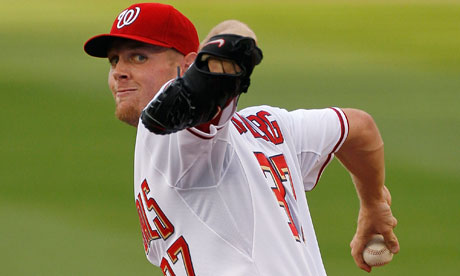
Strasburg has an nice bounceback month.  Photo unk via thewifehatessports.com

Strasburg has an nice bounceback month. Photo unk via thewifehatessports.com

Continuing a monthly series of look-backs at our starters (here’s Apr 2013May 2013June 2013July2013 posts), here’s a glance at how our rotation did for the last month. As with previous posts, we’ll have “Grades” per outing, the team’s performance per opposing starter sliced and diced a few ways, and other per-starter stuff that I like to track.

MLB Rotation Per-Start Grades (click here for Nats overall season stats)

Strasburg: A-,A+,F/inc,B-,A/inc
Gonzalez: B+,B+/inc,B+,F,A+
Zimmermann: A,D,A,F,A-,B+
Haren: A,A,A,A,C-,F-
Ohlendorf: D-,A-

Roark: A+ long relief stint

Quick Summary:  Stephen Strasburg remembered how to pitch again and had several strong outings.  His two “incomplete” starts were of course the Atlanta pay-back game and last week’s rain delay game.  Its pretty unfair to give him an “F” in a game where he failed to finish the 2nd inning but … you have to give some sort of grade there.  I’d give him an “A+” for being the first and only guy on the team to show any g*d d*mn backbone in the wake of the Bryce Harper bean-balls.  Dan Haren put together four great starts in a row after coming off the D/L and promptly laid an egg in his weekend start.  Ross Ohlendorf has been shaky, prompting many (including me) to replace him with Tanner Roark.   


Performance By Opponent Starting Pitcher Rotation Order Number

A look at the opposing team’s rotation ranked 1-5 in the order they’re appearing from opening day.  This table changes at the all-star break and honestly must be taken with a grain of salt, since guys like Clayton Kershaw are now the “#3 starter” on their teams because their turns were skipped coming out of the all-star game.  But here’s the table anyway:

Starter # Record Opposing Starter in Wins Opposing Starter in Losses
1 1-4 Kendrick Lohse, Samardzija, Santana, Gee
2 3-2 Bumgarner, Rusin, Eovaldi Wood, Wheeler
3 4-1 Lincecum, Minor, Arrieta, Alvarez Minor
4 4-3 Koehler, Davis, Lannan, Gorzelanny Teheran (2), Vogelsong
5 4-1 Hand, Lee, Wood, Chen Medlen

Quick thoughts:  Kyle Kendrick as #1 starter, yeah.  Lets just move on.

Performance By Opponent Starting Pitcher Actual Performance Rank Intra-Rotation

A ranking of opposing teams’ rotations by pure performance at the time of the series, using ERA+ heavily.

Starter # Record Opposing Starter in Wins Opposing Starter in Losses
1 4-3 Bumgarner, Minor, Lee, Wood Minor, Lohse, Santana
2 2-2 Rusin, Gorzelanny Teheran (2)
3 4-4 Chen, Alvarez, Hand, Lincecum Samardzija, Wood, Medlen, Wheeler
4 2-1 Lannan, Eovaldi Gee
5 4-1 Kendrick, Arrieta, Davis, Koehler Vogelsong

Quick Thoughts: Not much; the next table is the most useful.

Performance By Opponent Starting Pitcher League-wide “Rank”
My favorite analysis each month.  A team-independent assignment of a league-wide “rank” of what the starter is. Is he an “Ace?” Is he a #2?

1 2-0 Bumgarner, Lee
2 0-1 Samardzija
3 3-8 Wood, Minor, Lincecum Lohse, Santana, Minor, Teheran (2), Wood, Wheeler, Medlen
4 1-2 Kendrick Gee, Vogelsong
5 8-0 Rusin, Gorzelanny, Alvarez, Hand, Chen, Eovaldi, Arrieta, Lannan
5+ 2-0 Davis, Koehler

Quick thoughts:  The Nats showed some interesting results this past month when it came to the talent levels of their opposing starter.  They got the best of the two best arms they faced all month (Madison Bumgarner and Cliff Lee) but then faltered badly against what I call #3 starters.  Meanwhile they pummelled the starters they should have, going 10-0 against #5 or lower starters in this league.  This is what you want to see frankly.

Records by Pitching Advantage

Start-by-start advantages in my own opinion and then looking at the results.

Advantage Desc Record Matchups in Wins Matchups resulting in Losses
Wash 10-2 Zimm-Gee, Stras-Minor
Even 4-6 Ohl-Arrieta, Ohl-Eovaldi, Haren-Hand, Stras-Minor
Opp 2-3 Jordan-Lee, Gio-Bumgarner Jordan-Wood, Haren-Santana, Jordan-Lohse

Quick thoughts:  For the first time all year, the Nats really took care of business when I thought they had the starting pitching advantage.  They went about even when the stakes were even.  That’s good.

Matchup analysis

Looking at the opposing starter rank that our guys are going up against to see how their competition fares.

Nats Starters Opponents matchup analysis Nats Record under starter
Strasburg three #3s, a #4, a #5 4-1
Gonzalez An ace, two #3s, two #5/#5+ 3-2
Zimmermann A #2, two #3s, a #4 and 2 #5s 3-3
Haren Two #3s a #4 three #5s 3-3
Jordan An Ace and two #3s 1-2
Ohlendorf Two #5s 2-0
team ttl for month: 16-11

Quick Thoughts: A good month all things considered, going 16-11.   Too much one step forward/one step back though with the middle of their rotation.

Matt Harvey; just unlucky

7 comments

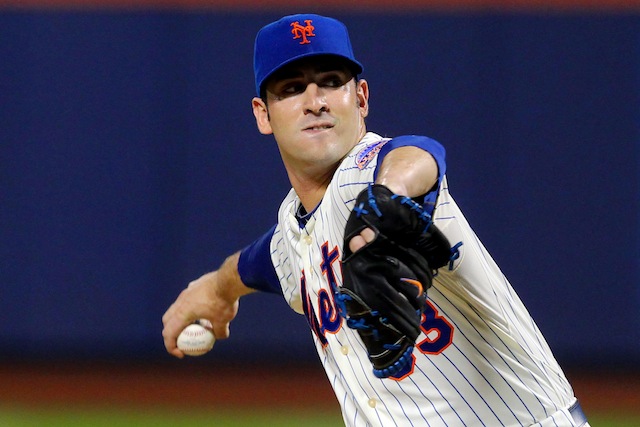
Harvey gets a really unfortunate diagnosis.  Photo: Brad Penner-USA TODAY Sports

Harvey gets a really unfortunate diagnosis. Photo: Brad Penner-USA TODAY Sports

What happened to Matt Harvey?
One of my friends speculated that his overuse at UNC may have contributed to his very unfortunate torn UCL/possible need for Tommy John surgery and drew a parallel to our own Stephen Strasburg in terms of young phenoms going down.  I don’t recall any accusations of overuse of Strasburg at SD State; in fact Tony Gwynn seemed to be hyper aware of the media outcry if there would have been overuse and handled him very carefully.   His workload in college was carefully monitored, the Nats brought him along very carefully and were hyper sensitive to any slight issues in his first pro years.  And Strasburg got hurt anyway.
UNC has a somewhat dim reputation among scouts for destroying pitcher arms (as does Texas, Rice, and a couple other programs), and you saw some evidence of that in this past CWS (where UNC’s “closer” suddenly was starting games and throwing 100s of pitches during the tournament after being a one-inning guy most of the year).  But Harvey left UNC in 2010.  A long time ago.
UCL tears are often point-source injuries; think about Strasburg’s torn UCL: he did it on one pitch.  Yes he probably “strained” the UCL before then (strain is medical term for “small tear” apparently, as we learned during the Lucas Giolito drafting), but it was very clear the exact moment Strasburg blew it out.  Meanwhile, shoulders seem to be more degenerative over time from overuse.  There doesn’t seem to be any video of a single pitch that blew out Harvey’s UCL, and I’m sure there’s arguments and counter-examples against this, but my observations seem to support this.  One day pitchers are healthy, the next day they have a blown elbow ligament.
What else could have caused Harvey’s injury?
Pitch counts?  Harvey’s game logs this year aren’t egregious: a couple of 120 pitch games (studies have shown that 120 pitches is about the threshold for pitches in the majors before workload effects are demonstratble in subsequent starts).  Lots of games in the 100-110 range.  But that’s to be expected; he’s a big guy, a workhorse, always has been.
Innings thrown?  Here’s a concern area.  96 college innings in 2010, 135.2 in 2011, 169.1 in 2012 and 178.1 in 2013 before this injury.  You generally don’t want guys to increase workloads more than 20% per year (the “Verducci effect,” so to speak)  He increased his workload 28% from college to his first pro year and another 20% from his first pro year to his second.  He was well on his way this year to another 20% increase and was set to be shut down before this injury.  He was definitely a risk for ramping up his innings too fast.
Mechanics: no evidence of any trouble spots; his mechanics have always been clean.  He threw hard but he wasn’t considered a “max effort” guy.  Too bad for the “inverted W” conspiracy crowd; they can’t have another poster child for their internet meme which is usually ignored by scouts and baseball professionals.  (as you can tell, I don’t believe in the inverted W b.s. as being anything other than coincidental.  For every pitcher with an arm injury and inverted W mechanics you can 1) find a pitcher with inverted-W who has NO injury history or 2) find a pitcher with impeccable mechanics who suffers the same type of injuries that the inverted W supposedly caused).
Is it the  Travel-league/year round baseball that prospects these days have grown up in?   If anything, you’d think that year-round baseball would help these kids, not hurt them, by building up arm strength and building up the muscles surrounding the critical points in a throwing arm (ucl, rotator cuff, labrum, etc).  This goes counter to recent advice from Dr. James Andrews, who advised that kids need an off-season from baseball to allow their arm muscles to rest and regenerate from the abuse that pitching causes.  Of course, you could also counter argue it and say that “the arm only has so many bullets in it” and each pitch is one pitch closer to an injury.
The “right” answer is probably some combination of all of the above, as well as genetic bad luck.  Some guys have absolutely perfect mechanics and get injured (Harvey), some guys have perfect mechanics and throw 10,000 innings (say, Nolan Ryan), some guys have crummy mechanics and get away with it for a long time (think Don Sutton or someone like that).
On the bright side; Tommy John surgery is now somewhere between 85-90% success rate.  And these TJ surgeries actually improve the arm action.  An amazing stat was tweeted by Rob Neyer in the wake of the Harvey injury; of the 360 pitchers who have started games this year, 124 have had Tommy John surgery.  124 of 360!  That’s one out of every three major league starters in the game.  Our own Nats experience exactly matches this: of the 9 guys we’ve had start a game this year 3 have TJ surgeries in their history (Strasburg, Jordan Zimmermann, Taylor Jordan).  The surgery doesn’t just repair, it improves the arm stability and strength.  TJ pitchers often come back with more break on their curve because the elbow has been improved.  They don’t just staple the tendon in place; they drill holes in the bones to attach the tendon so its got a stronger bond than what was naturally there.
In any case, it really is unfortunate to see such a great young guy suffer an arm injury so soon.  Hopeful for a full recovery.  The baseball world is a better, more fun place with young aces like Harvey out there every 5 days.

Tanner Roark where have you been all my life?

5 comments

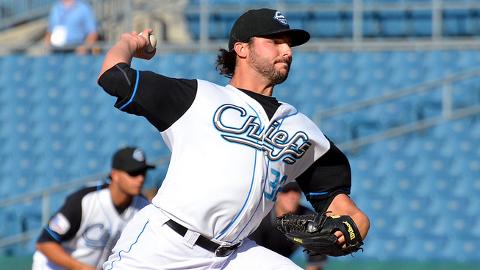
Tanner Roark living the dream.  Photo via milb.com

Tanner Roark is making a case to stick with the big club. Photo via milb.com

So, after yet another excellent outing Friday night in Kansas City, Tanner Roark now has 4 wins, a miniscule 1.10 ERA, a ridiculous 349 ERA+ and has pitched 16 innings and only given up 10 hits.  By way of comparison, in 12 MLB innings Nathan Karns gave up 17 hits, 6 walks and 10 earned runs.  On Friday night he stranded two runners he inherited from the wholly ineffective Gio Gonzalez and then pitched through the 8th inning giving up just one hit against a hot offense who had pounded our 2012 Cy Young candidate.

Tanner Roark, where have you been all my life??

Small sample sizes, yes.  But Roark has been effective in 5 of his 6 of his appearances thus far (his worst outing was in his hometown; understandable as his family looked on).  He hits corners, he doesn’t walk guys, he works inside, he gets a ton of jams and flairs.  He has decent enough velocity and stuff, which is less important than being able to command your pitches.  90mph at the knees on the black is better than 96mph over the middle of the plate (ask Greg Maddux what he thinks of command versus velocity).

Are we looking at a potential 5th starter for 2014?  At some point in the off-season we’re going to have this discussion.  Clearly the team has more than one viable candidate for a 5th starter.  The days of paying Edwin Jackson and Dan Haren tens of millions of dollars to be mediocre-to-ineffective 4th starters looks like it may be over.   Ross Detwiler‘s up and down career may put him in jeopardy of losing his rotation spot next spring.  At the very least Roark seems to have an inside track on the long-man/spot starter role that just a few weeks ago we thought was Ross Ohlendorf‘s to lose.

Stay tuned; with the Nats out of it September is going to be a great time to feature Roark in a starting role (along with perhaps Karns and maybe even someone like Danny Rosenbaum or even the surprising Caleb Clay) as an audition for 2014.

By way of comparison, in 12 MLB innings Nathan Karns gave up 17 hits, 6 walks and 10 earned runs.

Why aren’t the Nats getting Harper’s back??

19 comments

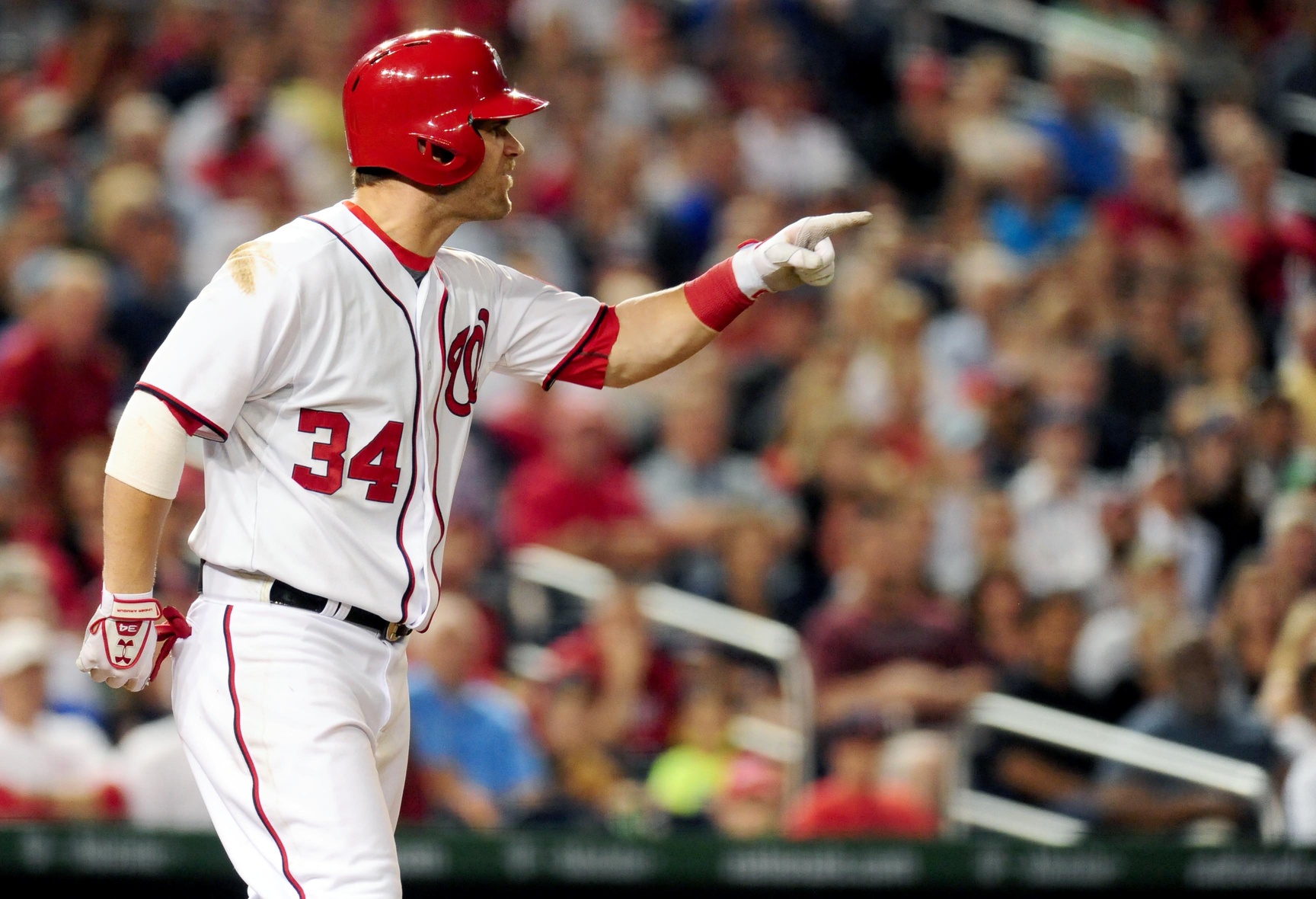
Harper reacts to his purposeful drilling by Julio Teheran on 8/7/13.  Photo HarperBryce hbp Teheran Aug2013 Evan Habeeb-USA TODAY Sports

Harper reacts to his purposeful drilling by Julio Teheran on 8/7/13. Photo Evan Habeeb-USA TODAY Sports

Julio Teheran blatantly drilled Bryce Harper after he thought Harper showed him up after hitting a long bomb on August 7th.  There was no question the pitch was purposely thrown at Harper.  (By the way; watch the video of that home run and try to find the objectionable action there.  Maybe he pauses slightly, maybe he tosses his bat away instead of dropping it, maybe he runs slower than normal.  Not one of these actions comes even close to what some guys in this league do on EVERY homer, ahem Yasiel Puig).

What did the Nats do in response?  Nothing.

Last night, Harper was hit not just once but TWICE.  First in the 4th inning on an errant Alex Wood curveball, then again in the 8th when Luis Avilan threw a ridiculous pitch behind Harper’s head.

What did the Nats do in response?  Again, nothing.

The Nats broadcast team (as heard in the link for last night’s game above) said it right: “What is going on??”

I don’t care if Harper got hit with a curve (not on purpose) and a wild fastball (probably not on purpose, since it put the go-ahead runner on base in a tight game).  I don’t care what the situation is; YOU HAVE TO RESPOND in kind.  Enough is enough.  That’s three straight plunkings of our best guy by the same team inside of a week.

The reaction of the Atlanta crowd was rather telling.  Pathetic in that they cheered the HBP and then gave Avilan a standing ovation.  However also telling because the message is clear; the Nationals ball club, for whatever reason, is not responding in kind to their best hitter getting repeatedly thrown at.

What is going on??  Why aren’t the Nats protecting Harper?  Why aren’t they responding to these HBPs?

The correct response to the August 7th event would have been to hit Justin Upton in the middle of the back the next time he came to the plate.  First pitch.  Plain and simple.  Why Upton?  Because it was Upton who just the night before did the exact same thing that Harper was accused of, only it took him LONGER to prance around the bases.  If Harper got hit because the Braves thought he was too slow around the bases, then how exactly do they excuse Upton’s trot, which was 4 seconds longer?  And the correct response last night was to absolutely drill the first guy up in the bottom of that inning.  No questions; first pitch, in the back.

I don’t know what the hell Davey Johnson is doing.  Why wasn’t he out on the field last night, defending his player?  Why wasn’t he calling out Atlanta’s manager Fredi Gonzalez?  Why isn’t he ordering a response??   Why isn’t he showing any of the passion you would expect from a hall of fame manager who should know better?  Better question; why aren’t Harper’s teammates taking any initiative here and doing what should be done?  Where’s the leadership on this team?  Where’s the leadership in this clubhouse??

If your answer is, “well it was a close game and the Nats couldn’t afford to purposely put a runner on base” then my response is this: 59-62.  That’s the team’s record right now.  You want another couple numbers?  15.5 (games out of first place with 6 weeks of the season to go), or how about 9.5 (games out of the wild card behind a team clearly better than them).  The point is this; the season is over.  They’re playing out the string.  Time to start standing up for yourselves, protect your teammate, show some g*d d*mn spine, and protect your best hitter for the future.

I can’t image what Harper is thinking about his manager and his teammates right now.  If it were me, I’d be asking my manager and my teammates point blank to their faces why i’m not being protected.  It almost makes you wonder if his teammates flat out don’t like him.  Is that what’s going on?  Is the Nats clubhouse, which I’ve accused many times of being dysfunctional, even worse than we thought?

If you don’t think beanball justice has a role in the game, then you’ve either never played the game or don’t understand this aspect of it.  The Nats are sending a message that its ok to go after their guys.  That’s a really bad precedent to create.


Written by Todd Boss

August 17th, 2013 at 12:19 pm

Lincecum’s pending Free Agency; what’s he worth?

20 comments

What would you pay Lincecum in 2014?  Photo via SD Dirk flickr via wikipedia

What would you pay Lincecum in 2014? Photo via SD Dirk flickr via wikipedia

An interesting question was posed in an ESPN chat a while ago that I made a note on to come back to.

Should the Giants offer Tim Lincecum a qualifying offer, or just cut him loose without any compensation ties this coming off season?  And a better question: if you were a GM looking for pitching this coming off-season, what would you offer him?

First some stats.  Lincecum is in the last year of a 2yr/$40.5M deal signed to avoid his last two years of arbitration.  This is on the heels of a 2yr/$23M deal that took out his first two years of arbitration.  He’s already north of $60M in career earnings before hitting his first pure free agent contract.  But he’s at a cross-roads.

Take a look at the progression of his career stat-wise: 2 straight Cy Youngs before even hitting his first year of arbitration (which, if you remember, was a Super-2 year because the Giants apparently cannot read a calendar; this little snafu cost them probably $20M in salary).  He went from an ERA+ of 171 in 2010 to last year’s bottoming out season, where he posted a 68 ERA+, a 5.18 ERA and was pulled from the rotation in favor of Barry Zito (an insult to end all insults) in the playoffs.

Garrett Hooe at FederalBaseball just posted a great analysis as well, including insight into Lincecum’s breakdown of mechanics, his velocity loss and other things.  His analysis is great; no need to replicate it here.

In 2013 he’s regained some of his performance but not enough; he’s still pitching like a 5th/6th starter.  His month-by-month splits give no help: he was decent to good in April, awful in May, decent to good in June, mediocre in July and so far has been lights out in August.  The offensively-challenged Nats just tagged him for 6 runs in 6 innings en route to his 12th loss of the season.

Overall, his velocity is down, he has weird mechanics, and he’s clearly deviating from those weird mechanics as of late.  What GM out there is willing to give him a shot, given those two parameters?  Probably more than a few frankly, given his pedigree, but at what cost?

The answer to the second question (what is his value on the FA market) drives the answer to the first question (whether to offer him a QO).   I went looking for some comparisons from last year’s FA market to try to estimate what his market may be this coming off season and found the following data points of interest:

  • Freddie Garcia pitched to an 80 ERA+ (matching Lincecum’s in 2013) but had a 5.18 ERA in New York.  He’s also older (35 versus 29).  He signed a combo minor/major league deal that pays him $1.3M this year.
  • Dan Haren had an 89 ERA+, as 12-13 record with a 4.33 ERA last year and signed a one-year, $13M deal with the Nats.    But he was a near Cy Young winner just two years prior and was hurt most of 2012 (that was what we kept telling ourselves when we all talked ourselves into this signing anyway).
  • Jorge de la Rosa, coming off a lost season to injury but a great 2011, signed a 1 year $11M deal.
  • Joe Saunders pitched to a 101 ERA+ between two teams, is slightly older and is almost the definition of a MLB average pitcher (career ERA+: exactly 100.  career ERA: 4.20).  He signed a 1yr $6.5M deal with Seattle.
  • Speaking of MLB average guys; Gavin Floyd also owns a career ERA+ of 100, and had exactly that for the White Sox in 2012.  His contract?  1yr, $9.5M.
  • Jason Marquis was awful last year; 8-11 with a 5.22 ERA and a 72 ERA+.  He got a 1year $3M deal to come back to San Diego and regain value.  Fun fact: Marquis is a career 94 ERA+ pitcher, has a career ERA over 4.50, has a CAREER bWAR of 5.5 (that’s about half of what Mike Trout had in bWAR just last season) and yet has more than $50 million in career earnings.  Wow.  I’m in the wrong business.
  • Joe Blanton was pretty awful for two teams in 2012, going 10-15 with a 4.71 ERA, yet somehow earned a 2yr/$15M contract extension from the Angels.  Blanton, by the way, is 2-13 this year.  I’m not sure how exactly Blanton got anything more than a couple million dollars, to say nothing of a 2 year contract.  I question the sanity of the Angels management.

Ok.  So using these examples from last year’s FA market … uh, I have no idea what Lincucum is worth.  I’d say he’s better than Blanton, so that mean’s he’s better than $7.5M/year.   But that was such an awful contract that I don’t see how you can use it as a benchmark. Meanwhile, if Gavin Floyd’s consistency year over year is  worth $9.5M, then how do you value the possible jeckyl and hyde that you’re going to get from Lincecum?

If I was a GM, looking at his body of work and his last two seasons, I probably would end up somewhere between Floyd’s $9.5M and de la Rosa’s $11M on a one-year deal.  As they say, there are no bad one-year deals, and if it goes south its just money.  1year, $10M on a career-saving flier taken by some NL team out there willing to roll the dice and spend some cash.

Probably not the Nationals though, not after the Haren experience and considering what Taylor Jordan has given the team in a 5th starter role this year.  You’d have to think Mike Rizzo heads into the off-season with his 3 big guns under contract, his 4th guy Ross Detwiler on the mend, with Jordan penciled into the 5th starter and with the likes of Nathan Karns, Taylor Hill, and Caleb Clay providing the first line of reinforcements in AAA.

So I predict the Giants will not offer him a qualifying offer, thus cutting ties with one of their most iconic players in the last 25 years.  It will be a sad time in San Francisco head-shops everywhere.

Would you rather have Houston or Durham’s rotation, revisited

leave a comment

At the beginning of the season, Houston’s MLB rotation looked so weak that I asked in this space whether you would prefer to have the Houston Astros MLB rotation or the Durham Bulls (AAA affiliate of Tampa) Opening Day rotation?

Now, more than 2/3’s the way through the season, lets take another look.  Here’s some quick links for reference: Houston’s B-R stats, Tampa’s B-R stats, Houston’s Fangraphs Stats, Tampa’s Fangraphs stats and MILB’s Durham stats.

All stats as of 8/6/13.

So, here’s how Houston’s opening day rotation has performed thus far:

Rank Name Age 2013 Stats as of 8/6/13 Notes
1 Bud Norris 28 (MLB) 7-9, 3.89 ERA, 1.394 whip, 106 ERA+, 3.95 fip Traded to Baltmore
2 Lucas Harrell 28 (MLB) 5-12, 5.37 ERA, 1.668 whip, 76 ERA+, 5.41 fip Demoted to bullpen July 9th
3 Philip Humber 30 (MLB) 0-8, 9.59 ERA, 2.019 whip, 43 ERA+, 5.81 fip Demoted to AAA May 11th
4 Erik Bedard 34 (MLB) 3-8, 4.29 ERA, 1.44 whip, 96 ERA+, 4.42 fip Team is 6-14 in his starts
5 Brad Peacock 25 (MLB) 1-4, 7.25 ERA, 1.583 whip, 57 ERA+, 6.57 fip Demoted to AAA April 30th

Here I see one #4 starter (Norris), one #5 starter (Bedard), one guy who wouldn’t make any other team’s rotations (Harrell) and two abject failures in Humber and our own former farmhand Peacock (though it should be noted, Peacock just got recalled, threw 7 innings of 3-run ball, struck out 10 guys and lowered his ERA nearly a full point).

Now, here’s the same stats for Durham’s opening day rotation, showing MLB stats where I could:

Rank Name Age 2013 Stats as of 8/6/13 Notes
1 Chris Archer 24 (MLB) 6-4, 2.65 ERA, 1.085 whip, 144 ERA+, 4.22 whip Promoted June 1, 12 starts thus far
2 Jake Odorizzi 23 (AAA Dur): 8-5, 3.73 ERA, 1.20 whip Has 3 spot starts in May and June with a 6.00 ERA in 18 MLB innings
3 Alex Colome 25 (AAA Dur): 4-6, 3.07 ERA, 1.31 whip 3 spot starts in May/June with a 2.25 ERA in 16 mlb innings
4 Mike Montgomery 23 (AAA Dur): 46-5, 4.28 ERA, 1.43 whip injured earlier in year, in minors all year.
5 Alex Torres 25 (MLB) 4-0 0.26 ERA, 0.612 whip, 1470 ERA+, 1.64 fip Has given up 1 ER in 34 MLB innings pitching out of the pen.

Durham’s opening day rotation has matriculated one mainstay to the Tampa rotation in Chris Archer (he has the best adjusted ERA+ of any of Tampa’s rotation right now) and a second guy in Alex Torres who has given up exactly one run in 34 mlb innings this year.  Alex Colome had three effective spot starts, Jake Odorizzi had 3 relatively ineffective MLB spot starts, and Mike Montgomery missed some time with an injury and has not yet debuted.  It should be noted that both Odorizzi and Montgomery are just 23 and still a bit young for the big stage.

So, which rotation would you rather have now?  It isn’t like the Ray’s AAA guys Montgomery or Odorizzi could do any worse than what Houston’s 4th and 5th starters did this season.  And you can clearly see that Archer’s performance trumps Norris’, and Torres’ amazing bullpen work is better than Bedard’s 96 ERA+ work.

The Rays continue to have the best pitching development system in the majors, even ahead of St. Louis, who turns out mid-90s hurler after mid-90s hurler.


First Look: Tanner Roark

17 comments

Tanner Roark living the dream.  Photo via milb.com

Tanner Roark living the dream. Photo via milb.com

A few days ago I was playing amateur GM and ended up predicting the 8/6/13 roster moves, where Ross Detwiler was transfered to the 60-day DL and Tanner Roark was called up to provide some bullpen cover while Ross Ohlendorf is on the mend.  Roark’s body of work both this season and over the past few warranted his call-up, and his mixture of success both in the starter role and in a long-relief role in AAA make him the perfect candidate to replace Ohlendorf for the time being.

A quick side note: whenever I see someone, after years and years of toiling in the minors, finally get the call-up I’m reminded of the storytelling of Dirk Hayhurst in his 2nd book Out of My League, where he described all the logistics and feelings of getting his first callup.  Of particular interest; the pay.  I’m sure Roark was compensated like a typical minor league veteran in AAA; probably making $1,500 a month or so (which was about what Hayhurst said he made).  Upon signing a MLB contract, you immediately start getting paid a pro-rated amount of a minimum MLB salary, which is $490,000 a season.  Well, you can quickly see that a guy getting called up immediately starts making significantly more money.   30-40 TIMES more money.  More money per day in the majors than he was making in a month in the minors.   So I say good for Roark and good for every guy who finally gets a shot at the bigs.

Lets take a look at Roark’s first appearance… which came last night on 8/7/13 in relief of a curiously ineffective Jordan Zimmermann, who needed 88 pitches to complete 4 innings as the Nats officially waved the white flag on the season, getting swept at home by the team they’re chasing for the division lead and falling to 15 1/2 games out of first.

Roark had a great MLB debut.  He came in to face Atlanta’s 4-5-6 hitters and pitched a 1-2-3 inning.  He got a Brian McCann to fly out on a relatively well struck ball, then badly jammed Chris Johnson to get a simple grounder to short, and then got Dan Uggla to reach for a first pitch fastball for an equally weak grounder to second.  Coming back out to face the bottom of the order he effectively jammed BJ Upton, who flared a flyball into shallow center field that Denard Span couldn’t quite come up with in a sliding catch attempt, then  he jammed Andrelton Simmons to get a simple pop-up to first.  Lastly for his coup-de-gras, he induced a popped-up bunt attempt from his opposite number Kris Medlen, made a diving catch and then doubled off Upton, who was (I guess) running on the play.

Not a bad debut, at all.

The scouting reports on Roark said that he’d work mid 90s in relief, low 90s as a starter, and that’s exactly what we saw.  Per the pitch f/x data, He threw 12 fastballs on the night which averaged 94.46, peaking at 95.52.  He only threw three sliders, bouncing the first and probably ruining his confidence in the pitch.  10 of 15 pitches were for strikes, and that ratio should have been higher; his first batter he didn’t get a borderline call on the outside corner and the ump flat out missed a low strike.  He seemed to have pretty good movement on the 4-seamer (-7.10″ average horizontal movement, which for comparison purposes almost as much as Medlen, a guy who relies almost exclusively on his movement, got on his 2-seamer last night).  He certainly worked the corners effectively, only really giving up one well hit ball (that to McCann, who benefitted from being way ahead in the count thanks to the ump’s missed strike calls).  You don’t have to throw 100mph if you can effectively work the ball inside and out.

He was almost too effective; 15 pitches to get through 2 innings meant he didn’t really work much of his repertoire.  I’m sure he has at least a third pitch, but we never got to see it.  Roark’s spot in the order was up, and he was out (as he was being pinch hit for, I wondered internally when the last time Roark got an at-bat was.  Turns out he has 18PAs for Syracuse this summer; I didn’t realize the minor league pitchers got any at-bats).

It was hard not to like what we saw from him last night.  Is he going to continue to be effective, can he stick in the majors?  Hard to tell.  Ian Krol giving up two hits and a walk in a third of an inning didn’t help his cause much, a similiarly ineffective appearance to his 7/31 outing.  Fernando Abad has basically blown the last two games in which he’s appeared.  But these two guys are blessed as being left-handers, so they possess value that a righty does not, and may not really be candidates to make way once Ohlendorf comes off the D/L.  So we’ll see.

Meanwhile Tanner, use some of that MLB meal money to go get a haircut!  🙂

PS.  One more thought on this series since i’ve got nowhere else to put it; I’m disappointed we didn’t see retaliation of some sort last night for the BS of the night before.  I’m sorry; you HAVE to protect your best player out there, and i’m not surprised to hear reports and see evidence that Bryce Harper was on edge last night with his own manager.  As J.P. Santangelo succinctly pointed out; not protecting one of your own players can and does blow up clubhouses.  I think somebody on Atlanta needed to get hit last night (likely McCann).  I’m more than a little worried right now about the state of the clubhouse, given this lack of reaction.

One lesson learned from 2013: you can never have enough starting pitching

17 comments

If Detwiler is out for the year, the Nats have a problem. Photo: Haraz Ghanbari/AP via federalbaseball.com

If Detwiler is out for the year, the Nats have a problem. Photo: Haraz Ghanbari/AP via federalbaseball.com

We all knew the Nationals had a glaring, acknowledged weakness heading into the 2013 season; almost no quality starting pitching depth in the high minors.  We non-tendered former opening day starter John Lannan in lieu of paying him somewhere between $5M-$6M dollars to toil in Syracuse again.  We non-tendered former starter Tom Gorzelanny despite his excellent 2012 season for us instead of paying him a few millions dollars a year to continue to be the 7th guy out of the pen.  We traded away top starting pitching prospect Alex Meyer to acquire a center-fielder that (in my oft-stated opinion) we didn’t need.  We were blinded by the excellent but short-sample-sized performance of Zach Duke upon his call-up last September and chose to make him not only the sole lefty in our 2013 pen, but the long-man/spot starter as well.

And we talked ourselves into it.

In 2012 our primary rotation made 150 of 162 starts.  Those 12 missed starts were made by Chien-Ming Wang (five starts) in a quickly-aborted glimpse to see if the many millions of dollars invested in his recovery over the past few years were going to pay off (they did not), by Lannan (six) for a couple of mid-season spot starts and his Stephen Strasburg replacement plan in September, and one by Gorzelanny the day after the team clinched the division (editor note: mistakely originally put “pennant.”  Duh).  That’s it; otherwise the rotation was solid, consistent, and one of the best in the majors by any statistical measure.

Was it just hubris that led us to believe that the same thing would happen in 2013?  That our vaunted rotation (which I certainly thought was the best in the majors before the season started) would steamroll through another 150+ starts in 2013 as we marched to the inevitable World Series title?  Maybe so.

The latest blow is the news that Ross Detwiler‘s herniated disk may very well keep him out for the rest of 2013.  Taylor Jordan has been more than ably filling in for Detwiler … but in a familiar twist Jordan is facing an innings restriction limit.  After August 4th’s start he’s got 40 2/3 major league innings in 2013 to go with 90 1/3 in the minors for 131 total on the year.  He only threw 54 1/3 all of 2012 coming back from Tommy John surgery, and this year easily marks a professional career high (he’s never thrown more than 100 professional innings).  He’s going to get shut down, soon (in about four more starts per the Washington Times’ Amanda Comak, which would put him just about at the same 160ip limit that both Strasburg and Jordan Zimmermann pitched to the year after their own TJ surgeries).  This leaves the team right back where they were on May 20th, when the whole “find a competent 5th starter” charade started.

Duke failed and was released.  Yunesky Maya got his last attempt at pitching in the majors and was outrighted (a move long overdue in the opinion of many Nats followers).  Nathan Karns got three bites at the apple and returned to AA with a 7.50 ERA.  Ross Ohlendorf gave us a fantastic spot start in a double header last week… and just went on the D/L after not being able to dial it up more than 85mph in his last appearance.  The only other 40-man starter in the whole of the minors is Matthew Purke, currently posting a 6.35 ERA in high-A.

Hey, at least Dan Haren suddenly resembles the 2009 version of himself, having tossed 14 innings oof one-run ball en route to winning his last two starts.  A month ago we were talking about releasing him.

So, what should the team do when Jordan is shutdown?  It sounds to me like in the short term we’ll go back to Ohlendorf as the 5th starter (assuming of course his recent “dead arm” injury doesn’t turn into much more than a quick D/L trip).   However, despite Ohlendorf’s excellent work for us thus far, lets not forget why he was available on a minor league deal in the first place; his ERAs in 2011 and 2012 were 8.15 and 7.77 respectively.  Odds are that he’s not likely to be that effective going forward.

Plus, Ohlendorf’s time in the rotation means the bullpen will need another guy … presumably one that can pitch long relief to replace Ohlendorf.  I’m not entirely sure any of the other relievers on the 40-man but in the minors (Drew StorenErik Davis or Tyler Robertson) fits the bill.  Craig Stammen has absolutely done that role in the past, but I think Stammen’s value to this team now lies in his 7th inning “bridge reliever” role, getting the team from a short start to the 8th/9th inning guys.

If Detwiler is indeed out for the year I think he should be immediately transferred to the 60-day D/L (opening up a spot on the 40-man roster) and I’d like to see Tanner Roark  get a look-see as the long man in the bullpen.  He’s put up very good numbers in AAA this season in a swing-man role and faces minor league free agency this off-season.  Or, I wouldn’t be opposed to keeping Ohlendorf in the pen and giving Danny Rosenbaum a shot at the 5th starter.  He’s been the most effective AAA starter all year and, despite not being that overpowering, could turn into another Tommy Milone-esque lefty starter that we could leverage in trade.  We may not have fantastic depth in the upper minors, but you never know who may suddenly be an effective MLB pitcher (see Krol, Ian).

(Editor’s note: after I wrote this mid-weekend MASN’s Byron Kerr wrote and posted almost identical analysis).

Atlanta’s pending starting pitching concerns

2 comments

Is Medlen quickly approaching an innings limit?  Photo unknown via totalprosports.com

Is Kris Medlen quickly approaching an innings limit? Photo unknown via totalprosports.com

When Atlanta lost bulldog staff Ace Tim Hudson to a gruesome ankle injury last week, the Braves were able to immediately plug in the promising Alex Wood to the rotation and not really miss a beat, at least in the short term.  But an interesting point mentioned by Buster Olney in his daily ESPN Baseball Tonight podcast highlighted a dilemna that the Braves may face later this season.

Specifically; they’re depending on a lot of young arms right now who are projected to blow past 2012 and/or career innings totals, and the team may be facing a critical decision when it comes to managing innings and workload as this season progresses.  This is very much of a Tom Verducci-effect concern, which admittedly some people do not subscribe to, but some of these potential workload increases are so substantial that they cannot be ignored.

Here’s a table showing the number of innings their current set of younger starters have thrown this year (in all levels) as compared to last year (innings as of 8/1/13).  The season right now is basicaly 2/3’s over (108 of 162 games played), so I’ve used a simple 33% addition to current workloads:

Starter Age 2013 Innings to date 2013 projected 2012 ttl innings Projected delta Projected delta % increase
Mike Minor 25 144 191.52 179.33 12.19 6.36%
Julio Teheran 22 126 167.58 137.33 30.25 18.05%
Kris Medlen 27 125 166.25 151.33 14.92 8.97%
Alex Wood 22 95.33 126.7889 154.33 -27.53 -21.70%

However, this may be too simplistic a projection.  Each of their starters has about 10 starts left.  Lets assume each of them goes an average of 6 innings in each of these starts.  Now the 2013 projected totals rise a bit;

Starter Age 2013 Innings to date 2013 projected factoring 6ip/start for 10 starts 2012 ttl innings New projected delta New projected delta %
Mike Minor 25 144 204 179.33 24.67 13.76%
Julio Teheran 22 126 186 137.33 48.67 35.44%
Kris Medlen 27 125 185 151.33 33.67 22.25%
Alex Wood 22 95.33 155.33 154.33 1.03 0.67%

Mike Minor has never had any injury concerns and only really faces a small increase in the number of innings he will throw, but if he gets much above 200 innings there may be some concerns.   If he hits 204 innings, that’s a 13% workload increase over last year.

Likewise with Kris Medlen; if he makes 10 more starts and averages 6 innings a start, he’s looking at more than a 20% workload increase over last year.  Medlen is technically still coming back from Tommy John surgery done on 8/18/2010, though it isn’t as much of a concern this year as it was last (when they worked him out of the bullpen before installing him in the rotation later in the year).  A potential 20% innings increase year to year has got to be concerning for a guy with a TJ surgery in his background.

Meanwhile, Julio Teheran doesn’t have any injury history to fend with … but he’s looking at a pretty significant jump over his 2012 inning totals.  His career high was in 2011 with about 160 between the minors and majors.   But if he continues in the rotation he’ll start to get up there towards the 180 innings range, a pretty significant jump over last year.

Lastly there’s Wood, their 2nd round pick in 2012’s draft.  He has rocketed up the farm system, dominating the Sally league in his draft year, skipping high-A, then dominating AA before getting the call-up.  When you add in his college workload to his 2012 minor league numbers, he may be right in line to pitch the same number of innings as lastyear.  There’s just the small concern of a guy who this time last year was making his professional debut in low-A continuing to be effective for a major league team in a pennant race.

This analysis doesn’t include any innings analysis for Hudson (out for the year), Paul Maholm (currently on the D/L) or Brandon Beachy (just coming back from injury and without innings limitations this late in the season) since they’re either unavailable or don’t have any inning limit concerns.  Beachy had his Tommy John surgery on 6/21/13 and, while he should be healthy, still may not be 100% (to this point, his first start back was a debacle, giving up 7 runs in 3 2/3 innings).   Maholm is on the D/L now but should be off within a couple weeks (he has a “Wrist Contusion”), but he’s also their least effective starter on the year.  And of course Hudson is out until at least next spring with his broken ankle at best; his career in jeopardy at worst.

What should they do?

As you can imagine, their problem may be exacerbated because somebody has to throw post-season games (I think its safe to assume the Braves are making the post-season at this point).

This is why some questioned the Braves lack of pursuing a starter in the trade market to replace Hudson and keep Wood in the minors.  Of course, the Braves probably didn’t want to do this knowing they had Beachy coming off the D/L and Maholm returning soon too (probably pushing Wood back to AAA).   But if Teheran runs out of innings, the Braves are looking at a post-season rotation that isn’t exactly a world-beater (Minor-Maholm-Beachy and Medlen?).  Then again, that hasn’t stopped them while building a double-digit lead in the NL East.

It should be interesting to see if the Braves end up with a Stephen Strasburg shutdown-gate of their own as we head into September.