Nationals Arm Race

"… the reason you win or lose is darn near always the same – pitching.” — Earl Weaver

Archive for the ‘Majors Pitching’ Category

One more reason I hate the WAR stat

5 comments

As pointed out in this Hardballtimes story by Matt Hunter, here’s two opening-day pitching lines:

Matt Harrison: 5.2 IP, 6 R, 5 ER, 9 K, 3 BB, 0 HR, 0.2 WAR
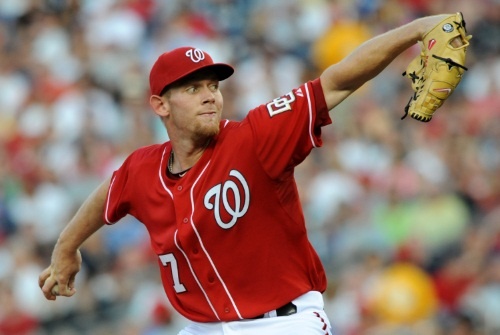
Stephen Strasburg: 7 IP, 0 R, 0 ER, 3 K, 0 BB, 0 HR, 0.2 WAR

Wait.  Strasburg’s 7 shutout innings in which he only allowed 3 base runners is somehow considered an “equal” performance in terms of FanGraphs WAR to Harrison’s 5 2/3 inning 5 earned run debacle??

The reason why (as explained much better in the Hunter link) is because Fangraph’s WAR is based on FIP, and despite Harrison’s line and despite the fact that Strasburg didn’t give up any runs Harrison’s FIP was actually lower than Strasburg’s for the day.  FIP only measures Ks, BBs and Homers, and because Harrison had many more K’s on the day his FIP is better.

Here’s my problem; how can you possibly trust a statistic that is this blatantly wrong on an individual game level?  Both WAR and FIP accumulate over the course of a season to arrive at a measure for a player’s performance, yet clearly they both have significant individual-game issues.  And as Hunter points out (paraphrased),  “if you can’t trust a stat on a per-game basis, you can’t *really* trust the stat on a full season level.”

I point this out because there are far, far too many stat-heavy baseball writers out there who will literally call you an idiot if you dare use “old time” statistics to measure a player’s season … but who also use the likes of WAR and FIP as the be all-end all replacements.  And that’s where I have a problem.

And all of this is to say nothing of the heavy reliance of defensive stats on WAR, defensive stats which didn’t exist 10 years ago (so how “good” or “bad” are our historical players?) and defensive stats which are admittedly flawed when it comes to doing what they’re supposed to do unless every player stands in exactly the same spot at every position on every play all year?  If your team employs lots of infield shifts (like say a Tampa Bay), guess what?  Your UZR rating looks fantastic.  If you play in a big pitcher’s park and have a fly-ball pitcher on the mound (think San Francisco and Matt Cain), your UZR looks awesome as you chase down lazy flyball after lazy flyball.  Defensive stats can’t take into account first basemen digging out throws or measure nearly any component of catching defense outside of the basic counting stats we already had (errors, caught stealing, passed balls).

I don’t know what the solution is.  But I know it isn’t to claim that WAR is the ultimate player measurement stat that lots of people believe it to be.
Written by Todd Boss

April 4th, 2013 at 1:37 pm

Are we too worried about pitch counts?

4 comments

Ohmygod Strasburg only threw 80 pitches on opening day what's wrong with him?! Photo: howtowatchsports.com

The Nats handling of Stephen Strasburg in 2012 certainly caused more than its fair share of discussion in the sports world, to the point where people (read, me) don’t really want to talk about it anymore because they’re too hunkered down into their own opinions on the matter.  Hence a sense of relief washed over Mike Rizzo defenders when 2013 rolled around, knowing that “the reins were off” (how many times have we heard that cliche so far this year?)

So what happens on Opening Day?  Strasburg gets lifted after 80 pitches and sets of another mini fire-storm of discussion (also witness here and here).   “Why’d he come out?  Is he hurt?  Are the Nats over-protective?  Are they limiting his pitches??”  *sigh*  No dammit; there’s about Zero good reasons to push any pitcher in April, the Nats have a strong bullpen that will need work, and if your guy isn’t going 9, why bother pushing him through 8 if you don’t have to?  Here’s an interesting observation for those who think he got pulled too early; check Strasburg’s 2012 game logs and look what happened on Opening Day 2012: he went 7 innings on 82 pitches and left.  Wow; its like deja-vu!  Except nobody heard a peep about it last year.  Baseball writers are such hypocrites sometimes (ok rant off).

Note: here’s a story on Grantland from last September from writer Rany Jazayerli, who writes the very good “Rany on the Royals” blog and who does possibly the best baseball podcast out there with Joe Sheehan, talking about pitch counts and the Strasburg situation.  I don’t want to bring back up the Strasburg shutdown situation (which he argues should have happened later than it did) but he has links to other studies on this topic.

Anyway; the situation got me thinking about an old draft post I had about Pitch Counts in general, that stemmed from a podcast conversation on the topic from months ago.  Just last week I posted about Johan Santana, who re-injured his surgically repaired shoulder in 2012 pretty much the day after he was allowed to go 134 pitches to complete a no-hitter.   The general consensus among baseball pundits and professionals is that 100 pitches per outing is a good “benchmark” for starters.  If you get much above 110-115 pitches in an outing you’re pushing it.

But do these pitch counts make sense?  In 2007 Little League established a new set of guidelines for youth pitching limits, going away from the old innings pitched per week limits and going by pitch counts.  Here’s the general guidelines for pitch count limits and for mandatory rest periods now in place for youth baseball:

Age Max Pitches per Day Mandatory Days rest if throw Max
7-8 50 2 days
9-10 75 3 days
11-12 85 4 days
13-16 95 4 days
17-18 105 4 days

Basically, if you throw 76 or more pitches in a day, you’re sitting for 4 days, and the max pitches you can throw gradually rises as you age, topping out at 105 pitches for 17-18 year olds.  There’s a graduating rest scale for throwing fewer pitches by the number and by age (see the above links for exact details if you’re interested).

But here’s the point of this list; If its “ok” for a 17 year old amateur to throw 105 pitches and then rest for four days …. are you really telling me that a Major League Starter, a professional athlete paid millions of dollars with access to the best coaching and training staffs available, a man who is conditioned and trains year round to do nothing BUT throw a baseball for a living … you’re telling me that this person also works more or less off of a 100 pitch limit??

Are we too worried about pitch counts?  If Strasburg hits 115 pitches, are we really going to start talking about how the world is ending and how Davey Johnson is abusing his pitcher?  What is a more realistic pitch count limit for professionals?

Research seems to show that there is a Pitch Count threshold at which even professionals seem to be affected.  And that limit seems to be right around 120 pitches per outing.  This Baseball Prospectus study in 2002 by Keith Woolner shows that a 120+ pitch outing will result in a distinct drop-off in subsequent pitching performances in pitchers for the next few weeks, supporting the notion that you can really “over-work” a pitcher to the detriment of his health (as we saw with Santana clearly; his ERA pre and post 134 pitch performance in 2012 was 2.75 and 8.27).  I just wish this research was updated: he based it off of stats from a decade ago and I feel like enough has changed in the game that the study needs revisiting.

I can’t find any “in-game” pitch count studies showing how much a pitcher’s performance dropped off after the 120th pitch, but the BP study mentioned here is really the concern.  If your performance is impacted for weeks after a long outing, that’s proof enough for me to yank a guy before he gets to 120 pitches in a game.

So perhaps we SHOULD be worried about pitch counts, but only if we get someone above 120 pitches.  Here’s a quick glance at the max pitches our 5 starters threw last year:

  • Strasburg: 119 pitches on June 8th in Boston, a season-high 13 Ks.
  • Gonzalez: 119 pitches on Aug 31st to finish off a 5-hit shutout against St. Louis.
  • Zimmermann: 112 pitches on Sept 29th against St. Louis, his final start of the regular season.
  • Jackson: 123 pitches on Aug 30th to complete 8 innings of 4-hit ball vs St. Louis.
  • Detwiler: 100 pitches on May 25th to labor through 4 1/3 in Atlanta.

and just for good measure:

  • Haren: 126 pitches on May 24th vs Seattle to finish off a 4-hit shutout with 14 Ks.

You can see how managers sometimes go against their better judgement to allow pitchers to finish off shutouts and no-hitters.  Two of these six pitchers had their highest totals trying to finish off shutouts.  How do you tell a guy with a shutout through eight innings that he’s done because he’s reached some arbitrary pitch limit?   Interestingly, Johnson allowed two of his guys to get their highest totals in the August show-down series with St. Louis.  What’s also interesting about the above numbers is just how little Detwiler was trusted; his MAX effort all year was 100 pitches; talk about being treated with kid gloves.  I wonder if he’s going to be trusted to go deeper into games this year.

Conclusion: I’ll now scoff anytime someone whines about a 100 or 110 pitch limit for a pro, but will go bananas if our guys broach 120 unless there’s mitigating circumstances.

(post-script: Counter point from Jeff Passan who talks about pitch count abuse done to the obscene in Japan).

Opening Day Starter Trivia

one comment

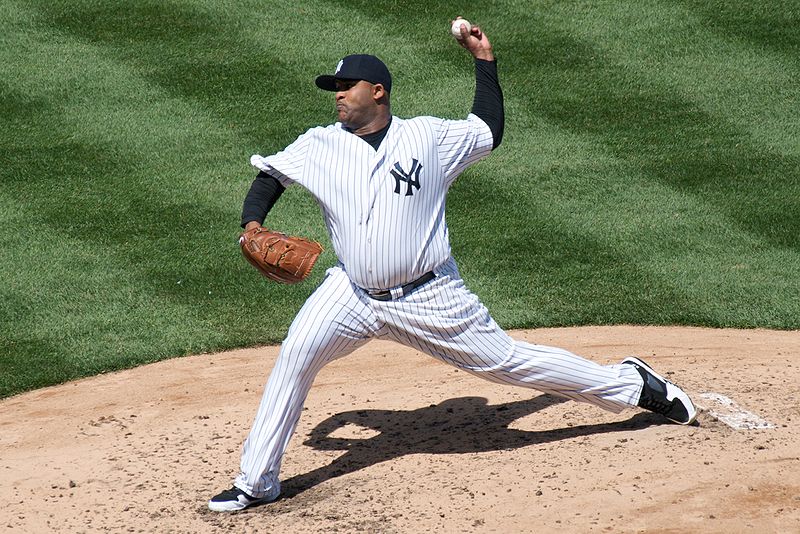
Sabathia is your current Active leader in Opening Day starts. Photo wiki/flickr chris.ptacek

One of my favorite annual trivia questions amongst my baseball buddies revolves around Opening Day Starters.  With another Opening Day in the books, here’s some useless trivia related to Opening Day starters for my readers.  I’ve uploaded my little Opening Day Starters spreadsheet to Google Docs and created a link in the “Nationals Arm Race creation” section along the right.

Current Active Leaders in Opening Day Starts

10 Roy Halladay
10 CC Sabathia
9 Mark Buehrle
6 Bartolo Colon
6 Derek Lowe
6 Tim Hudson
6 Felix Hernandez
6 Justin Verlander
5 Aaron Harang
5 Josh Beckett
5 Jered Weaver
5 James Shields
4 Jake Peavy
4 Barry Zito
4 Tim Lincecum
4 Yovani Gallardo

Those players bolded in the list above had 2013 opening day starts and added to their totals.  Roy Halladay‘s difficult spring training cost him his shot at Opening Day and thus CC Sabathia moves into a tie for first.  Mark Buehrle has given over the reigns of opening day starter possibly for good, based on his standing in the Toronto rotation (4th starter?).

Felix Hernandez and Justin Verlander have chances to broach the all-time records (see below) based on their ages, their current counts and their new long-term contracts.

Current Active Leader in consecutive Opening Day Starts: Verlander with 6 straight.

Most ever Opening Day Starts all-time: Tom Seaver with 16 in his career.

Most ever Consecutive Opening Day Starts: Hall of Fame lightning rod Jack Morris, who made 14 straight such starts.

Number of first-time opening day starters in 2013: no less than 13 first timers this year, nearly half the league.   Some guys got deserved first-time opening day starts (Jeff Samardzija, Matt Cain, and R.A. Dickey), some guys got Opening Day starts mostly out of attrition of other worthy pitchers (Jon Niese, Bud Norris, A.J. Burnett, Vance Worley and Jhoulys Chacin) and some guys are taking over as the new big-dog of their rotations (Brett Anderson, Chris Sale).

Who seems most likely to break Seaver’s Record at this point? Sabathia, who already has 10 opening day starts, is clearly the #1 in New York, is only 32 and still has five years on his current deal.  Question is, if he renews past 2017, can he still earn the #1 spot?   Meanwhile Hernandez already has 6, just signed a deal that takes him through 2019 with a relatively easy option for 2020.   That’s 8 more seasons on his existing 6 opening day starts and he’d only be 34 years of age.   He could be the standard holder if he stays healthy and continues to pitch like an ace.

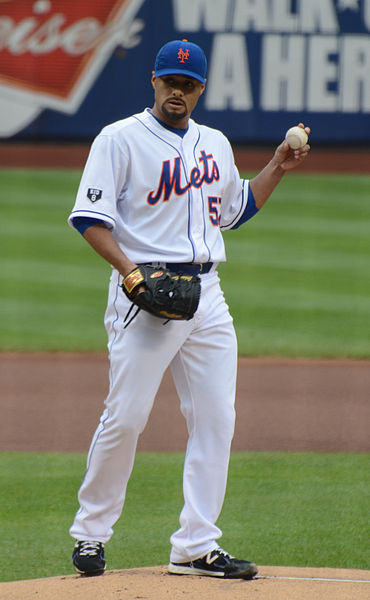
Johan Santana to miss 2013; a cautionary tale

9 comments

Santana to miss 2013 and end his Mets career on a sour note. Photo via wikipedia/flickr user slgckgc

Earlier this month I published an updated version of the “Starter Dollar per Win” analysis that I maintain and update on an annual basis.  In that post, I listed some of the worst free agent starter contracts ever signed (among them Kei Igawa, Jason Schmidt, Oliver Perez, Darren Dreifort).  However I did not mention Johan Santana among these awful deals because it looked like he could at least finish out the last year of his deal and increase his per-win values.

Last week we learned that Santana has a torn shoulder capsule and is likely to miss the entire 2013 season.  This is the last guaranteed year of the 6 yr/$137.5M contract that he signed with the Mets after his fantastic early-career stint with Minnesota and it seems almost certain that he’ll be looking for work elsewhere in 2014, if he continues to play at all (this being a re-tear of the same Anterior Capsule that sidelined him for all of 2011 and his third arm/shoulder surgery overall).

In his 6 years in New York, he had one great season (the first), two entirely missed due to injury, two with good results but still injury curtailed, and one (2012) that was entirely mediocre and injury curtailed after he (foolishly?) threw 130+ innings to chase a no-hitter.  That’s not entirely a great return on $137.5M.

Looking at my “Dollar per Win” analysis spreadsheet, and assuming that the Mets are going to pay him a $5.5M instead of his $25M option for 2014 (the $137.5M number only includes guaranteed money and thus already includes this $5.5M buyout), here’s how he ended up performing on a per-dollar basis for the life of this contract:

  • 109 starts over 6 years: $1,261,468 per start.
  • 72 Quality Starts: $1,909,722 per QS
  • 46 Wins: $2,989,130 per Win.

This contract is now officially “Worse” than the infamous Denny Neagle deal (19 wins for a 5yr/$55M deal) and significantly worse than the even more infamous Mike Hampton deal (56 wins for an 8yr/$121M deal) on a dollar per win basis.

The cautionary tale is a familiar one: we all know that pitchers are health wildcards to begin with.  But guaranteeing many years and tens of millions of dollars to these injury wildcards is lunacy.  (Ken Rosenthal wrote a similar story on 3/29/13 on this same topic).   I now count Thirteen 9-figure contracts that have been given out to starting pitchers in the history of the game, and of the contracts that are closer to the end or finished its hard to find any of them that the signing team would do over again.

  • Santana, Barry Zito, Hampton, Kevin Brown and Daisuke Matsuzaka were all 9-figure deals that did not live up to the money (Matsuzaka’s 9-figure haul includes the posting fee).
  • Matt Cain, CC Sabathia, Cliff Lee and Yu Darvish (again, including his posting fee) are all 1-2 years into longer term 9-figure deals with (admittedly) satisfying levels of performance thus far.
  • Felix Hernandez, Zack Greinke, Cole Hamels and now Justin Verlander as of 3/29/13 are all starting 9-figure deals in 2013 or later.  Adam Wainwright just missed the cutoff; his new deal totaled $97.5M.

How does this affect the Nationals?  Well, in 2017 Stephen Strasburg is likely to become a free agent (lets be honest with ourselves; his agent is Scott Boras, his agent is aggressive to the max, wants to explore every possible free agency aspect, and rarely if ever allows his clients to agree to contract extensions, team friendly or otherwise; Strasburg is going to hit the FA market).  Based on the list of arms above, and assuming Strasburg doesn’t get re-injured in the next few years you have to think he’s going to be in line for a 9-figure deal of his own.  What do you do if you’re the Nats?  Do you pay the man, knowing that the likelihood of a 9-figure deal being a good deal for the team is very slim, or do you let him walk and let some other team pay him that money and assume the franchise crippling risk?

At least it isn’t a problem we have to deal with for a few years 🙂

Happy 2013 season! Nats Win!

6 comments

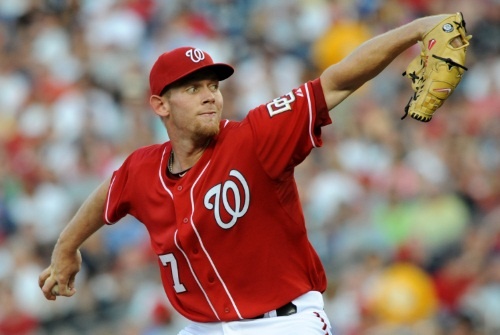
Strasburg gets the Nats off to a quick victory. Photo via centerfieldgate.com

A great opening to the Nats 2013 campaign.  A beautiful day at the park to sneak away for a 1pm game time (not that I got to; meetings, meetings).

Stephen Strasburg looked completely dominant, retiring 19 overmatched Marlins in a row after a game-opening single and departing after 7 complete innings on just 80 pitches.  He relied on location as opposed to power on the day, recording just three strikeouts but getting a ton of weak grounders for outs.  If this had been September in the midst of a playoff push he’d likely have thrown the complete game (or at least one more inning considering that the other two hits he gave up were to the middle of Miami’s order in the 7th; he was set to face 6-7-8 in the 8th for “easier” outs).  But its April; no need to burn pitches/IP now when we’ll need them later.

Tyler Clippard comes in, shaky at the start but gets the outs he needed for the hold.  And we get our first look at new closer Rafael Soriano in an ideal situation for a closer; 2 run lead, leading off the 9th inning.  He didn’t disappoint, punching out two to get the save.

On the offensive side, Bryce Harper continues right where he left off with his torrid Grapefruit league campaign by clubbing homers in his first two at-bats.  Wow; that’s a way to start your season.  Who says that Spring Training stats are meaningless?  🙂

Nothing more today.  A good first day of the season.

ps: 500th post!  I had to post something fun for the record books.

Written by Todd Boss

April 1st, 2013 at 4:50 pm

Starting Pitching Quality in the WBC

3 comments

I keep a little file, periodically updated, that keeps track of “Ace Starters” in the league.  There’s usually right around 20 of them at any one time.  There’s no hard and fast rule as to what defines an Ace; not every team has an Ace.  Some teams have more than one Ace.  Its essentially defined as a guy who, every time he goes to the hill, he is expected to win, a perennial Cy Young candidate, a guy who is acknowledged as being one of the best in the game.

Here’s my list of “Aces” in this league, right now; Strasburg, Gonzalez, Halladay, Lee, Hamels, Cueto, Wainwright, Lincecum, Cain, Kershaw, Greinke, Lester, Price, Sabathia, Dickey, Johnson, Verlander, Hernandez, Darvish and Weaver.    Twenty guys, some arguable with poor 2012 performances (Lester, Lincecum, Johnson, Halladay), some arguable for possibly being one-year wonders (Dickey, Greinke, Gonzalez), but by and large a quick list of the 20 best starters in the league.

How many of these Aces are pitching in the 2013 WBC?  TWO.  That’s it.  Gio Gonzalez and R.A. Dickey are starting for the US.  Not one other US Ace is taking the hill for their country.  The few foreign guys (Hernandez, Cueto and Darvish) aren’t pitching for their teams either for various reasons.

If you asked me to give you the 4 best US starters, right now, the four starters I’d throw in a World Baseball Classic to best represent this country, I’d probably go (in nearly this order) Verlander, Kershaw, Strasburg and maybe Cole Hamels.   If you asked me the NEXT four guys i’d want on the bump i’d probably go Sabathia, Cain, Price and Lee.   After that?  I’d probably still take the likes of Halladay and Greinke before I got to Gonzalez or Dickey.   And that’s only because of the poor 2012 showings by Lincecum, Lester and Johnson; if this was 2011, those three guys are absolutely in the mix for best arms in the league.  So by rough estimates, we have perhaps the 14th and 15th best American starters going for us right now.

Who else does the US team have starting?   Ryan Vogelsong and Derek Holland.  Vogelsong is the 4th best starter ON HIS OWN TEAM, and Holland isn’t much further up on the Texas depth chart.

I’m enjoying the WBC, don’t get me wrong, but you can repeat this exercise for a number of the positional players on this roster too.   Look at the post-season voting last year and look at who is playing on these teams.  No Buster Posey, Mike Trout, Bryce Harper, Andrew McCutchen, Josh Hamilton or Prince Fielder.  There is only one player who got an NL Cy Young vote in 2012 participating (Fernando Rodney for the D.R.).  I think this event needs its best players to play, and I think the league needs to come up with a way of making that happen.  No more injury dispensations, no more excuses for not having the best, most marketable guys out there.

Why in the hell aren’t Trout and Harper playing for the team USA??   This is the best duo of young, marketable players to this this league since the 1998 home run derby.  They’re on the cover of Men’s Health Magazine and Sports Illustrated in the last month.   You use what you have and market the league on the backs of players like this.  Look at the NBA; they market on top of their most recognizable names and they have grown because of it, from Michael Jordan to Kobe Bryant to LeBron James.  Why MLB can’t seem to see the forest for the trees sometimes is just frustrating.  The WBC is growing in popularity; its ratings in Japan eclipsed the TV ratings for the Olympics in that country, and the US games reportedly have gotten the highest ratings for a non-playoff game in TV history).  Team USA needs to catch on.

Pitcher Wins on the Free Agency Market; an analysis

3 comments

Is Greinke's big new deal going to pay off for the Dodgers? We'll see. Photo Jeff Golden/Getty Images

One of my pet projects of recent years has been to track “major” Starting Pitcher free agent contracts and then to do analysis of how they turned out, on a Dollar per win basis.  This post is an analysis of this work along with some interesting conclusions to determine some of the “best” and “worst” free agent contracts ever awarded.

This is mostly an analysis of past performance; there’s plenty of pitchers right now on major contracts that are just too soon into the deal to really draw any conclusions.  I’ve included in the spreadsheet all the major contracts signed this past off-season and will continue to do so if these guys get significant deals.  But we’ll have to wait a year to see how the first year of the contracts play out.  For all contracts that are in the middle of being played out, I’ve calculated how that contract is faring thus far.

Some caveats to the data:  For ease of analysis, I depend on the Average Annual Value (AAV) of the contracts as opposed to trying to figure out exactly how many wins were earned in which year of a varying contract amount.  Therefore (for example), Gio Gonzalez‘s contract may have only paid him $3.25M in 2012 but I’m using the full AAV of $8.4M for the purposes of the analysis (it would just be far too difficult to calculate each pitcher’s dollar per win on an annualized basis otherwise).  Also, I focus on dollars per Win, despite the known limitations of the “Win” statistic.  I have gone through and added in Quality Starts to the analysis, but that stat is also flawed in some respects (though it does do a pretty good job of indicating whether or not the starter has done his job).  Unfortunately the $/QS doesn’t work out as nicely as $/Win, since Pitcher Wins are still so prevalent in our player analysis.  I mean, after all, the goal of the game is to WIN the game, right?

Here’s a quick cut-n-paste from the spreadsheet (which is also available in the Links section to the right and on Google Docs) of some selected fields.  See the Google xls for everything.  Apologies if this doesn’t present well online.  The table is listed in descending order of $/year AAV.  Blanks in the Wins and $AAV per win indicate that the contract has yet to begin.  I also threw in a couple of non-FA contracts at the end to show what a MLB-minimum successful starting pitcher looks like in comparison.

Last Name First Name Total Value (includes club options) $/year AAV Contract Term Wins $ AAV per win
Clemens Roger $28,000,022 $28,000,022 2007 6 $4,666,670
Greinke Zack $147,000,000 $24,500,000 2013-2018
Sabathia C.C. $122,000,000 $24,400,000 2012-16 15 $1,626,667
Lee Cliff $120,000,000 $24,000,000 2011-15 23 $2,086,957
Hamels Cole $144,000,000 $24,000,000 2013-18
Sabathia C.C. $69,000,000 $23,000,000 2009-11 59 $1,169,492
Santana Johan $137,500,000 $22,916,667 2008-13 46 $2,989,130
Cain Matt $127,500,000 $21,250,000 2012-17 16 $1,328,125
Lincecum Tim $40,500,000 $20,250,000 2012-13 10 $2,025,000
Halladay Roy $60,000,000 $20,000,000 2011-13 30 $1,333,333
Darvish Yu $111,700,000 $18,616,667 2012-18 16 $1,163,542
Zambrano Carlos $91,500,000 $18,300,000 2008-12 50 $1,830,000
Zito Barry $126,000,000 $18,000,000 2007-13 58 $1,862,069
Clemens Roger $18,000,000 $18,000,000 2005 13 $1,384,615
Peavy Jake $52,000,000 $17,333,333 2010-12 25 $2,080,000
Matsuzaka Daisuke $103,000,000 $17,166,667 2007-12 50 $2,060,000
Beckett Josh $68,000,000 $17,000,000 2011-14 20 $1,700,000
Weaver Jered $85,000,000 $17,000,000 2012-16 20 $850,000
Lackey John $82,500,000 $16,500,000 2010-14 26 $1,903,846
Burnett A.J. $82,500,000 $16,500,000 2009-13 50 $1,320,000
Verlander Justin $80,000,000 $16,000,000 2010-14 59 $813,559
Sanchez Anibal $80,000,000 $16,000,000 2013-17
Schmidt Jason $47,000,000 $15,666,667 2007-09 3 $15,666,667
Hernandez Felix $78,000,000 $15,600,000 2010-14 40 $1,170,000
Wilson C.J. $77,500,000 $15,500,000 2012-16 13 $1,192,308
Hampton Mike $121,000,000 $15,125,000 2001-08 56 $2,160,714
Brown Kevin $105,000,000 $15,000,000 1999-05 72 $1,458,333
Lowe Derek $60,000,000 $15,000,000 2009-12 49 $1,224,490
Hamels Cole $15,000,000 $15,000,000 2012 17 $882,353
Kuroda Hiroki $15,000,000 $15,000,000 2013
Mussina Mike $88,500,000 $14,750,000 2001-06 92 $961,957
Oswalt Roy $73,000,000 $14,600,000 2007-11 61 $1,196,721
Buehrle Mark $58,000,000 $14,500,000 2012-15 13 $1,115,385
Peavy Jake $29,000,000 $14,500,000 2013-14
Buehrle Mark $56,000,000 $14,000,000 2008-11 54 $1,037,037
Martinez Pedro $54,000,000 $13,500,000 2005-08 32 $1,687,500
Halladay Roy $40,000,000 $13,333,333 2008-10 58 $689,655
Martinez Pedro $92,000,000 $13,142,857 1998-04 117 $786,325
Danks Jon 65,000,000 $13,000,000 2012-15 3 $4,333,333
Park Chan Ho $65,000,000 $13,000,000 2002-06 33 $1,969,697
Dempster Ryan $52,000,000 $13,000,000 2009-12 48 $1,083,333
Haren Dan $13,000,000 $13,000,000 2013
Jackson Edwin $52,000,000 $13,000,000 2013-16
Colon Bartolo $51,000,000 $12,750,000 2004-07 46 $1,108,696
Carpenter Chris $50,800,000 $12,700,000 2008-11 44 $1,154,545
Arroyo Bronson $25,000,000 $12,500,000 2009-10 32 $781,250
Dickey R.A. $25,000,000 $12,500,000 2013-14
Perez Oliver 36,000,000 $12,000,000 2009-11 3 $12,000,000
Silva Carlos $48,000,000 $12,000,000 2008-12 15 $4,000,000
Millwood Kevin $60,000,000 $12,000,000 2006-10 52 $1,153,846
Kuroda Hiroki $12,000,000 $12,000,000 2011 13 $923,077
Pettitte Andy $12,000,000 $12,000,000 2013
Haren Dan $47,750,000 $11,937,500 2009-12 54 $884,259
Kuroda Hiroki $35,300,000 $11,766,667 2008-10 28 $1,260,714
Arroyo Bronson $35,000,000 $11,666,667 2011-13 21 $1,666,667
Lincecum Tim $23,000,000 $11,500,000 2010-11 29 $793,103
Mussina Mike $22,141,452 $11,070,726 2007-08 31 $714,240
Dreifort Darren $55,000,000 $11,000,000 2001-05 9 $6,111,111
Meche Gil $55,000,000 $11,000,000 2007-11 29 $1,896,552
Lilly Ted $33,000,000 $11,000,000 2011-13 17 $1,294,118
Jackson Edwin $11,000,000 $11,000,000 2012 10 $1,100,000
Harrison Matt $55,000,000 $11,000,000 2013-17
Carpenter Chris $21,000,000 $10,500,000 2012-13 0 (0 wins)
Ryu Hyun-Jin $61,700,000 $10,283,333 2013-18
Neagle Denny $51,000,000 $10,200,000 2001-05 19 $2,684,211
Lilly Ted $40,000,000 $10,000,000 2007-10 54 $740,741
Darvish Yu $60,000,000 $10,000,000 2012-18 16 $625,000
Kuroda Hiroki $10,000,000 $10,000,000 2012 16 $625,000
Pavano Carl $39,950,000 $9,987,500 2005-08 9 $4,438,889
Wolf Randy $29,750,000 $9,916,667 2010-12 31 $959,677
Johnson Josh $39,000,000 $9,750,000 2010-13 22 $1,329,545
Greinke Zack $38,000,000 $9,500,000 2009-12 67 $567,164
Washburn Jarrod $37,000,000 $9,250,000 2006-09 32 $1,156,250
Igawa Kei $46,000,000 $9,200,000 2007-11 2 $23,000,000
Cain Matt $27,250,000 $9,083,333 2010-12 41 $664,634
Lowe Derek $36,000,000 $9,000,000 2005-08 54 $666,667
Matsuzaka Daisuke $52,000,000 $8,666,667 2007-12 50 $1,040,000
Beckett Josh $42,000,000 $8,400,000 2007-10 55 $610,909
Gonzalez Gio $42,000,000 $8,400,000 2012-16 21 $400,000
Guthrie Jeremy $25,000,000 $8,333,333 2013-16
Ortiz Russ $33,000,000 $8,250,000 2005-08 7 $4,714,286
Schmidt Jason $40,000,000 $8,000,000 2002-06 71 $563,380
Buchholz Clay $30,000,000 $7,500,000 2012-15 11 $681,818
Lester Jon $43,000,000 $7,166,667 2009-14 58 $494,253
Hamels Cole $20,500,000 $6,833,333 2009-11 36 $569,444
Wainwright Adam $36,000,000 $6,000,000 2008-13 64 $468,750
Ryu Hyun-Jin $36,000,000 $6,000,000 2013-18
Webb Brandon $28,000,000 $5,600,000 2006-10 56 $500,000
Lee Cliff $23,000,000 $4,600,000 2006-10 67 $343,284
Igawa Kei $20,000,000 $4,000,000 2007-11 2 $10,000,000
Jimenez Ubaldo $23,750,000 $3,958,333 2009-14 53 $298,742
Jimenez Ubaldo $10,000,000 $2,500,000 2009-12 53 $188,679
Price David $9,750,000 $1,950,000 2007-11 41 $237,805
Buchholz Clay $555,000 $555,000 2011 6 $92,500
Buchholz Clay $443,000 $443,000 2010 17 $26,059

Here’s some interesting facts, that come out of this analysis (some of these points can also be seen at the amazing Cots Salary database, now at Baseball Prospectus, and are confirmed in my spreadsheet tracking the same):

  • Largest total Starting Pitcher Contract ever signed: Felix Hernandez‘s brand new 7 year, $175M extension, beating out the previous record-holder CC Sabathia (7yrs/$161M in 2009).   Zack Greinke‘s just signed 6yr/$147M would be the 2nd biggest ever signed, and Cole Hamel‘s 6yr/$144M contract the third.  Will our own Stephen Strasburg come close to broaching these limits when he hits the FA market?  We’ll see.
  • Largest Single-Season AAV: Roger Clemen‘s 1yr/$28M deal in 2007.  The next closest are Hernandez’s $25M/year, Greinke $24.5M/year and Sabathia’s $24.4M figures.

(A couple of quick caveats to the above lists: CC Sabathia subseqently opted out of his 7/161 deal, so it basically got turned into a 3yr/$69M deal.  And, techncially Hernandez’s deal ripped up the last two years of his previous deal to replace it with the 7/175 deal; lots of people are looking at the new deal as a 5  year extension with an even higher AAV.  I don’t see it the same way; I see it as a replacement of the existing contract years).

What are some of the worst deals ever made?

  • Worst Ever Starting Pitcher Contract: Kei Igawa‘s 2007 deal with the Yankees, which was 5yrs/$20M but included a $26M posting fee, is the worst $AAV per Win contract ever signed.  Igawa went 2-4 in 13 starts over the life of this 5 year deal, equating to $23M per win for his team.  He spent the last two seasons of this contract buried in AAA.
  • Worst non-Posting fee Starting Pitcher Contract: Jason Schmidt‘s 3yr/$47M contract with the Dodgers.  Schmidt made 10 total starts and went 3-6, equating to $15.6M per win.

Other names on the “Worst Starting Pitcher Contract” category include Oliver Perez ($12M/win), Darren Dreifort (6.1M/win), Russ Ortiz (4.7M/win), Carl Pavano ($4.4M/win) and Carlos Silva ($4M/win).   Most of these contracts are well known to baseball fans and are commonly thrown around when talking about the worst historical FA contracts.

How about some of the “Best” Contracts ever signed?  Lots of players have signed small one year deals and won double-digit games, so those really cannot count.   Starting with an arbitrary floor of a $50M free agent contract, here’s the best value FA contracts ever signed:

  1. Pedro Martinez: 7yr/$92M, during which he went 117-37 for the Red Sox for a $786k/win total.
  2. Justin Verlander: He’s in the middle of a 5yr/$80M contract and for the first 3 years he’s 59-22 for $813k/win.
  3. Mike Mussina went 92-53 in his 6yr/$88.5M contract for $961k/win.

Jered Weaver and Yu Darvish deserve some mention here; they’re both in the first year of $50M+ contracts and are easily earning their pay in terms of $/win.


So what does this data mean?  Here’s some conclusions.

  1. It used to indicate that if you got about one (1) pitcher Win per million dollars spent on a player in the Free Agent market that you were doing great.  Look at our own Edwin Jackson in 2012: we signed him for $11M, he went 10-11 for us, equating to $1.1M/win.  Good value frankly.
  2. If you’re getting anything between $1.25M and $1.5M/win, there may be some complaints about the value of the contract.  Not always, but most of the time it indicates that either the pitcher is underperforming or is overpaid.
  3. Anything over $2M/win is usually considered a bust.  Nearly every contract in the $2M/win in AAV and above has been mentioned and criticized as being a bad contract; the list of “worst ever” above starts at $4M/win and goes higher.
  4. If you pay a starter anything more than about $18M/season,  you’re really going to have a hard time getting value back.  There’s only been a handful of 20-game winners over the past 5 years or so, but paying a starter $24M like Greinke is getting is almost certainly going to be regretted at some point.  An injury or a lost season completely blows the $AAV/win.
  5. It illustrates more clearly than anywhere else the value of a top-notch, pre-Arbitration starter.  Take Clay Buchholz for example; in 2010 he was 17-7 while earning the league minimum of $443k.  That equates to $26,059/win on the same staff that was busy paying Daisuke Matsuzaka $2.06M per win (when adding in the $52M posting fee).  Buchholz has struggled since then, but teams that depend on these pre-arb starters (Tampa, Oakland, Washington to a certain extent) save untold amounts of FA dollars as a result.
  6. Lastly, and this is the hard part, this analysis is getting nearly impossible to do across baseball eras because of the general inflation of contracts and especially because of the bonanza of FA dollars being thrown out there right now.  Pedro Martinez at the top of his game signed a 7yr/$92M deal.  Imagine what he’d get today?  It could be twice that.  He was coming off a 1997 season in which he struck out 305 batters, had a 1.90 ERA, a 219 ERA+ and won the Cy Young award.  So perhaps going forward a general $1.25M/win is a more accurate barometer for whether or not a pitcher has “earned” his contract.  But there’s no easy way to draw a line in the free agency sand and say that before yearX $1M/win was a good barometer while after yearY $1.25M/win is a good barometer.
  7. A caveat to the $1M/win benchmark; there are different standards for obtaining wins.   If you sign a $3M 1 year deal and then subsequently go 3-12 with a 6.00 ERA … while it looks like you reached the $1m/win threshold in reality you were, well, awful.  This analysis only really holds up for major FA contracts paying in excess of $10M/year.

Lastly, for comparison purposes, here’s the above analysis looks for the 2012 Nationals pitching staff.  Keep in mind that the $/win figures for pre-arbitration pitchers vastly skew the analysis.

Last Name First Name Total Value (includes club options) $/year AAV Starts QS Wins $ per QS $ AAV per win
Strasburg Steven $15,100,000 $3,775,000 45 28 21 $539,286 $719,048
Gonzalez Gio $42,000,000 $8,400,000 32 22 21 $381,818 $400,000
Zimmermann Jordan $2,300,000 $2,300,000 32 24 12 $95,833 $191,667
Jackson Edwin $11,000,000 $11,000,000 31 17 10 $647,059 $1,100,000
Wang Chien-Ming $4,000,000 $4,000,000 5 0 2 #DIV/0! $2,000,000
Detwiler Ross $485,000 $485,000 27 12 10 $40,417 $48,500
Lannan John $5,000,000 $5,000,000 6 2 4 $2,500,000 $1,250,000
Maya Yunesky $8,000,000 $2,000,000 10 1 1 $6,000,000 $6,000,000

The counting figures for Starts/QS/Wins/Losses are cumulative for the life of whatever contract the player is on.  So for Strasburg, he was basically in the 4th year of his original 4 year deal, hence the 45 total starts in those 4 years.  For guys like Zimmermann and Detwiler, the analysis is just for 2012 since they were playing on one-year deals.

The 2012 Nats have $AAV per win values all over the road:

  • Detwiler‘s $48k per win in 2012 is an amazing bargain; he got 10 wins while pitching for basically the MLB minimum.  And, Zimmermann‘s 12-win season while on a first-year Arbitration salary also represented about 20% of what those wins would have cost on the FA market.
  • Jackson produced almost exactly at the expectations for a FA starter; $11M contract, 10 wins, and $1.1M per win.  In 2013 if we get 12-13 wins from Dan Haren, we’ll be doing alright.
  • Lannan provided just on the borderline of bust production, as you’d expect for someone who got paid $5M to give the team 6 starts.
  • Wang: $4M salary, 5 starts, zero quality starts, 2 wins and a $2M/win price tag.  Yes; he was a bust.
  • Lastly Mr. Yunesky Maya.  The team has now paid him $6M over three years.  In that time he’s gotten 10 MLB starts and has produced exactly one Quality start and one win.  That’s $6M the team has paid for each win, in the range for one of the worst dollar-per-win contracts ever signed.  Of course, the Nats only signed him for $8M (not the $46M contract Igawa got), so the downside is limited.  But it does illustrated just how badly this deal has gone for the team.

7th Bullpen arm competition getting interesting

3 comments

Is Abad in line to make this team? Photo Houston 2012 official via espn.com

By and large the entire 25-man roster is mostly set for this team.  Only an injury is likely to change the names of our bench or our rotation.  The biggest spring training competition remains the name of the 7th man out of the bullpen.  And we got some interesting notes this week that may illuminate who that name may be.

Just for review, I’m considering these 6 guys locks to make the team, either due to their contract, their option status or their earning the spot: Soriano, Clippard, Storen, Mattheus, Stammen and Duke.

The leading candidate for the 7th spot has always been Henry Rodriguez: he has no options, the GM loves his arm and when he’s on, he is the embodiment of “unhittable.”  But there’s a slew of possible issues with Rodriguez, not the least of which is the fact that he’s not yet recovered from his off-season surgery.

I had been advocating (partly out of fond memories, partly for self-interest since I know his cousin and think I could swing some free tickets) for Bill Bray to make the team as a 2nd lefty out of the pen and a LOOGY-focused guy.  However, he struggled in his ST appearances and he was sent to minor league camp yesterday (3/3/13).  Davey Johnson was quoted as saying that Bray’s mechanics are still not right, and it seems more likely now that he’ll be working in Syracuse for at least the beginning of the season.

Meanwhile, Christian Garcia has succummed to yet another injury, this one a “partial tear” in his forearm that (so far) won’t be treated surgically.   For a guy who has already had 3 arm surgeries, you have to wonder if he’ll ever be healthy enough to pitch for this team.  For what its worth, apparently the words “partial tear” are the same thing as “strained tendon” in this case, so perhaps it isn’t as bad as it sounds.  In any case, i’m guessing this little setback makes it certain that Garcia is not going to be the 7th guy out of the pen.

Meanwhile, out of nowhere Non-roster/Minor league signing Fernando Abad has looked pretty good so far; in 3 appearances he’s given up just 1 hit and 2 walks against pretty decent competition (B-r rates his opposition as an 8.3, where 10=all major leaguers).  Abad doesn’t have the greatest MLB numbers (5.09 ERA for Houston in 2012), but has looked decent in small samples so far this spring.

We’ll see how things play out from here.

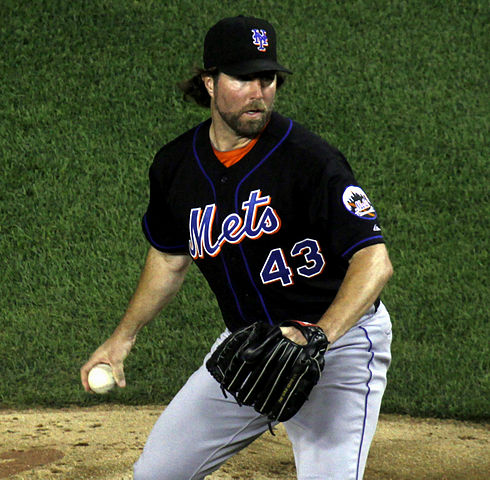
R.A. Dickey’s knuckleball POV style

2 comments

R.A. Dickey's knuckleball illustrated as best as I've seen it. Photo via wiki/flickr user dbking

From Dirk Hayhurst‘s blog (whose books you should absolutely order; they’re good reading), here’s a 1:35 minute video of R.A. Dickey‘s knuckleball being shot from directly over the shoulder of his bullpen catcher.

Serious question; how do you possibly hit this?  He throws it in excess of 80mph and it moves this violently?  Amazing.  Its no wonder he won the Cy Young last year, and I can’t see him being appreciably different in 2013.

Written by Todd Boss

March 4th, 2013 at 1:15 pm

Posted in Majors Pitching

Tagged with ,

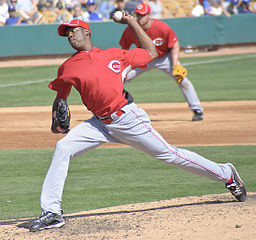
The better the pitcher … the smaller the strike zone?

4 comments

I'm surprised Chapman has ever had a strike called... Photo via wiki/flickr SD Dirk

Thanks to Rob Neyer, who pointed out this interesting study done at BaseballAnalytics.org by writer David Golebiewski, which showed how the faster the fastball, the LESS likely it was to be called a strike for “in-zone” pitches.  And its a significant margin (see the link for the percentages): a guy who throws 86-88mph gets nearly 10% more called strikes within the zone than a guy who throws 98mph.

That’s amazing.

The called-strike rate is also larger for out-of-zone strikes for softer-tossing pitchers, by about a 5% margin.  And to further add insult to injury, the missed strikes are more prevalent to left-handed hitters than to righies.

Both Neyer and Golebiewski imply that the reason for this phenomena is physical limitations in the Umpire, who struggles to “see” a 98mph fastball and thus misses it.  This leads (in comments sections) to inevitable calls for automated strike zones and the use of pitch f/x instead of humans.

I have a possible different theory; one that any of us that play amateur baseball can readily attest to; I believe that in the amateur game (whether it be little league or adult amateurs) a guy who throws harder is naturally given a smaller zone, while a softer-tossing guy generally gets a larger zone.  Not because the umps can’t see the ball, but because umps make the assumption that velocity equates with talent, and thus give the softer-tossing guy more benefit of the doubt when it comes to the strike zone.

Thoughts?  Maybe Mike Rizzo shouldn’t be spending as much time filling his rotation with power arms, if they have smaller strike zones as a result.  Or, more to the point, maybe this is all the argument we need to give Henry Rodriguez his walking papers.

Written by Todd Boss

February 28th, 2013 at 11:37 am