Nationals Arm Race

"… the reason you win or lose is darn near always the same – pitching.” — Earl Weaver

Syracuse/AAA Pitching Staff Year in Review; 2012

4 comments

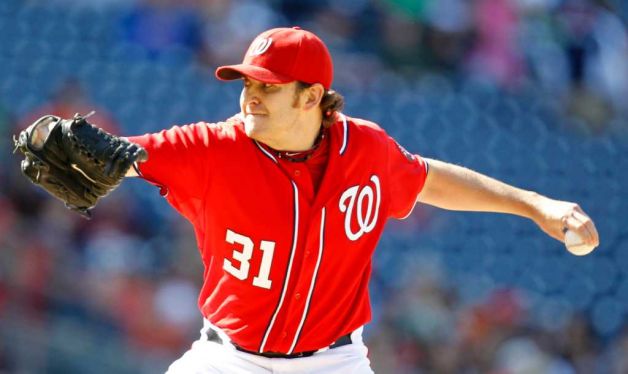
Free John Lannan! Photo Luis M. Alvarez/AP

Click here for the 2011 version of this post.
This is the first of 6 organizational reviews of the pitching staffs of our various affiliates for the 2012 season.  Unlike in 2011, I didn’t follow nearly as closely as I would have liked, so a lot of this is “analysis in arrears.”  This is also a lot of “scouting the scoreline,” which isn’t always a fair way to evaluate pitchers, but a full year’s worth of work is also a big enough sample size to pass some judgement.  I’ll try to evaluate pitchers at the level at which they spent the most time and will offer guesses for next season.  Also, rehab appearances are not mentioned or given analysis in these posts.  After reviewing all the staffs at each level, I’ll cull the above predictions into a summarized 2013 projected staff throughout the system.

Syracuse starters.  The rotation started the season with Atkins, Roark, Maya, Lannan and Duke.  This wasn’t exactly the way these guys would have lined up 1-5 (since Lannan was dumped to the AAA roster at the end of Spring Training unexpectedly) but this is the order in which they appeared to start the season.  Lets talk about these 5 guys plus other prominent starters for the year.

  • Mitch Atkins: Syracuse’s opening day starter stuck in the rotation for most of the year, posting a 5.28 ERA while going 6-9 in 20 starts.  He improved on his season numbers with a handful of relief appearances down the stretch, finishing the year with a combined ERA of 4.87 in 118 1/3 innings pitched.  This minor league Free Agent pickup from Baltimore’s organization never gave the team a reason to consider calling him up, and probably is out the door in the off-season.  Outlook for next season: Minor League Free Agent again, likely with another team.
  • Tanner Roark: He posted an ugly W/L of 6-17 on the year in 28 games (26 starts).  He had a 4.39 ERA with a 1.41 whip in 147 2/3 innings on the year.  He had pretty good K/9 numbers (130 Ks in those 147 innings) but also walked a goodly number of guys (47).  He mostly got promoted after a similar season statistically in AA by virtue of the AAA depth being shredded by the Gio Gonzalez trade.  Outlook for next season: He’s Rule-5 eligible but not yet a 6-year free agent.  I guess its possible he gets picked up, but he’s not worth protecting.  I think he gets one more season starting in AAA before reaching minor league free agency.
  • Yunesky Maya: After getting several shots at the major league level in 2011, Maya was buried in AAA for 2012.  There he toiled a complete season as a starter, posting an 11-10 record in 28 starts.  His era and whip were respectable (3.88 and 1.19 respectively), but his softer-tossing ways did not lead to the kind of swing and miss stuff craved by the current regime (just 89 Ks in 167 innings despite his ability to throw everything but the kitchen sink).  He improved upon a rough early start to the season with a series of gems in August … but would routinely follow up a gem with a stinker.  The big club has learned its lesson and left him off the expanded roster.  Outlook for next season: Maya has just one more year on his 4yr/$8m contract, after which he’ll be cut loose to try his wares elsewhere.  But he’ll be back toiling as AAA’s #1 starter in 2013.
  • John Lannan, as most Nats fans know, was the surprise cut from 2012’s major league team and basically served as injury insurance the entire year.  He did not necessarily help his own cause in AAA, putting up mediocre lines of 9-11, 4.30 era, 1.44 whip and barely 5 k/9 despite a MLB-average pedigree.  He did however perform excellently in two spot starts in the majors, setting himself up to be the Stephen Strasburg replacement in September’s stretch run.  I’d cough up his poor performance to  a season-long disappointment over his predicament; he’s got to be the highest paid guy in the minors (now that Kei Igawa‘s contract expired).  Outlook for next season: Lannan is just about a 100% guarantee to be non-tendered at the arbitration deadline and certainly looks to sign on with another club.
  • Zach Duke: Unlike Lannan, Duke took advantage of his time in AAA and DID regain some value; he posted a 15-5 record in 26 starts and 164 innings.  The rangy left-hander was cut loose by Arizona after the 2011 season and did enough with Syracuse this year to earn a September call-up.  Outlook for next season: Likely a free agent again and likely to use 2012’s performance as a springboard with another team looking for starter help.
  • Jeff Mandel, a long time Nats farm hand, started the year in AA to provide some starter depth before coming back to AAA and eventually replacing Atkins in the rotation.  He was 6-3 with a 2.41 ERA in 11 Syracuse starts and filled in effectively down the stretch. Outlook for next season: He’s finishing up his 6th minor league season and didn’t get a 40-man call-up (at least not yet).  He has one more year of team control before hitting minor league free agency.  AAA rotation.
  • Other guys who got spot starts here and there (non-rehab):
    • Erik Arneson, who continues his 2011 role of organizational swiss army knife, filling in with innings wherever possible.  Outlook for next season: probably continues to be the Nats org guy; he’s still effective in AAA.
    • Austin Bibens-Dirkx, who got a couple spot starts before getting released and eventually getting picked up by Colorado Springs (AAA affiliate of Colorado) to finish out the season.   Outlook for next season: with another organization.
    • Kevin Pucetas got called up from AA to make one spot-start.  Outlook for next season: See the AA wrap up for more details.

Syracuse Relievers: taking a look at the relief corps at the end of the season.

  • Christian Garcia has turned into one of the Organization’s great stories of 2012, posting a 0.86 ERA in 52 1/3 innings between AA and AAA after being claimed off waivers from the Yankees in late 2011.  This performance earned him a well-deserved call-up to the big club as rosters expanded.  Additionally, he’ll be featured in the Arizona Fall League as one of our three pitcher representatives.  Outlook for next season: He’s got a big arm, can bring it 97-98, and should be in the mix to be a middle-relief arm for the Nats bullpen in 2013.  He likely replaces what the team sought in Brad Lidge and provides insurance against injury (or, in Cole Kimball‘s case, failure to recover from injury).
  • Atahualpa Severino put in a decent season for Syracuse (2.81 ERA in 48 ip), but clearly he lost favor with the team.  Instead of considering Severino (who was on the 40-man at the time), the Nats picked up Mike Gonzalez off waivers and promoted him up to the big club.  Furthermore, Severino was DFA’d off the 40-man and passed through waivers without being claimed, never a good sign for a long-serving minor leaguer.  Outlook for next season: Minor League Free Agent, though the fact that nobody claimed him when he got DFA’d means he’s likely an Org guy from here on out.  But, LOOGYs live forever, and he can bring it, so maybe he gets a shot elsewhere.  He’s clearly been passed over in this organization.
  • GWU grad Josh Wilkie was having a so-so start to his Syracuse season (his 4th year in the league) before getting suspended 50-games in June.  [Editor Note: thanks to Mark L. for pointing this out].  Wilkie was summarily released after his suspension ended.  Outlook for next season: with another organization.
  • Ryan Perry failed to make the big club out of spring, pitched briefly in Syracuse’ bullpen before getting sent to Harrisburg to re-make himself as a starter.  Outlook for next season: see the AA version of this post.
  • Mike MacDougal made his “triumphant return” to the organization after washing out of Chicago’s AAA affiliate in Iowa.  He struck out 14 and walked 8 in 10 innings for Syracuse (about what I expected); no word on how many WP he threw.  Outlook for next season: minor league free agent again.
  • Erik Davis got 8 late season appearances after toiling mostly in AA and earning a promotion.  Outlook for next season: see the AA version of this post.
  • Other Relievers who appeared in AAA of note (not including Rehabbing MLBers): Outlook for next season for all of these guys seems the same: either continued “org guy” middle reliever or minor league free agent in another organization.
    • Hassan Pena improved on his 2011 stint in AAA but still looks like a middle-of-the-road minor league reliever.  He was suspended at the end of the season for suspected “team rules violations,” a question mark for him going forward with the organization.
    • GWU grad Pat Lehman continued his march up the organization, earning a quick promotion up to AAA and posting respectable numbers there.
    • Corey VanAllen got demoted and then hurt.
    • Rafael Martin also got demoted after a crummy start.
    • 2012 Minor League free agent signings Jeff Fulchino and Waldis Joaquin didn’t throw a single inning in 2012, spending it entirely on the 7-day DL.

Summary

Syracuse should have had a better record than it ended up with (70-74) given the quality of the starters on this team (a long time MLB starter in Duke, a career sub 4.00 ERA starter in Lannan and a guy on an $8M contract in Maya).  But at the same time, a combination of trades and a “gap” in organizational development led the team to have to fill a significant portion of this staff with minor league free agents, so it may have been inevitable that the team would have struggled.
Outlook for next season: S

What one game would you travel back in time to see?

9 comments

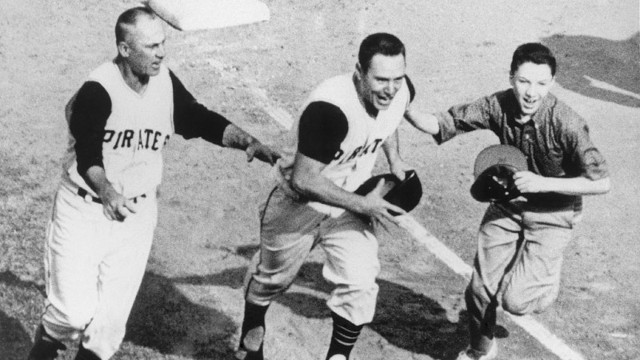
Bill Mazeroski rounding third after hitting his 1960 Walk off Homer. Photo Getty Images

This is a great topic and a great article from ESPN’s Jim Caple yesterday.  What single baseball game would you want to travel back in time to see?

Caple surveyed a variety of people, from movie stars to current players to fellow baseball columnists, and listed their choices.  His article makes for a great read.  Some of the choices were great.  I won’t spoil all of them here; you have to read the article.

For me, the knee jerk answer was immediately one of two games:

  1. Babe Ruth‘s “Called Shot” game from the 1932 World Series (Game 3), or
  2. Game 7 of the 1960 World Series, which may have been the greatest game in the history of Baseball, featuring Bill Mazeroski‘s walk off home run.

The Called shot game is kind of a baseball cliche; it is one of those lasting legends of the game.  But the only reason to go see that game would be to answer this question; the game itself wasn’t that great.  The box-score reveals a game where the Yankees jumped out to a quick 3-0 lead on the called shot, the Cubs fought back but then back-to-back homers from Ruth and Lou Gehrig put the game away and it was never close after that.  I’d want to go back for the first INNING of that game, see the homer, then go to the 1960 game :-).

As it turns out, I’m not really that interested in finding out whether Ruth really called his shot for this reason: the Boss family happens to have a bit of inside information, believe it or not, on the game itself and whether or not it really occurred.  You see, we’re family friends with none other than the son (and grandson, who is my age and who i’ve known since childhood) of former baseball commissioner Kinesaw Mountain Landis, and he was actually AT THE GAME as a child guest of his father.  And I’m pretty sure he’ll tell you that Ruth did call the shot.

So, for me, I’d want to see the 1960 game.  Check out the box score from Game 7 of the 1960 world series.  Here’s the Recap:

  • Pittsburgh jumps to a 4-0 lead early.
  • Yogi Berra and Mickey Mantle help spark a 4-run rally in the 6th to take a 5-4 lead.
  • The  Yankees extend their lead to 7-5 in the top of the 8th.
  • The Pirates rally for FIVE runs in the bottom of the 8th for a 9-7 lead.
  • The Yankees’ two hall of famers Berra and Mantle manage to drive in the tying runs in the top of the 9th to make it 9-9.
  • Mazeroski blasts a walk-off homer on a 1-0 count to lead off the bottom of the 9th and win the world series.

What a game!!  For all of us who thought last year’s Game 6 was amazing, this game looked even more amazing.  Plus you’d get to see two legends in Mantle and Berra.

Read the article and tell me in the comments what game you’d want to travel back for.  Disco Night?  1975 Game 6?  Don Larsen‘s perfect game?  Jackie Robinson‘s debut?  How about Game 7 of the 1924 series, a 12-inning affair featuring a slew of Hall of Famers and was also the last time Washington won a World Series?

Ewing theory and the Strasburg Shutdown

15 comments

How much will Strasburg's shutdown really affect the team? Photo allansgraphics.com

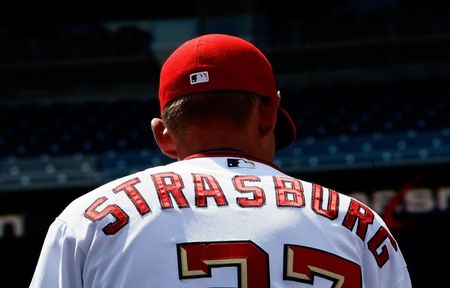
Here we are, September 1st, and every single columnist and blogger who covers baseball has, by law, added their 2 cents to the Stephen Strasburg shutdown debate. And as the imminent shutdown date approaches (I had predicted 9/12 being his last start either in a post or the comments section, and that date still seems to hold; 9/12 gives him 3 more starts, which seems to match what we’ve been hearing lately out of Davey Johnson and the front office), I’m honestly not looking forward to the coming blitz of additional opinions from the blogosphere talking about what idiots the Nationals are, blah blah.

My succinct opinion on the shutdown can be expressed in this metaphor; if you had open heart surgery, and your cardiologist says to you, “take it easy next season and only pitch 160 innings,” wouldn’t you follow his advice?   Both the doctor who performed Strasburg’s surgery (Lewis Yocum) and the famed James Andrews (together essentially the two leading experts on the injury and the surgery) have come out in support of the National’s conservative plan.  To every other pundit out there who says something like, “there’s no proof that shutting him down will protect him in the long run,” I’ll say this: I trust the guy with the M.D. behind his name over the internet dork sitting in his mom’s basement who thinks he knows better.

Even my wife has added her 2 cents; while watching Saturday’s game (a pretty amazing back and forth offensive outburst ending with St. Louis scraping a run against Drew Storen to take it 10-9), one of the telecasters added his opinion on the matter and my wife asked me why the Nats didn’t just “let him pitch less” earlier on in the season.  A common theme for Strasburg shutdown critics; to which I say this: if you think the whole shutdown thing isn’t playing will with the Veterans in the Nationals clubhouse, exactly how do you think it would have played out if the entire pitching rotation was manipulated all season on account of one guy?  Baseball is a team game; you have 25 guys out there who contribute to each win, and I’m pretty sure the veterans on this team wouldn’t have taken well to having their routines thrown off in an effort to squeeze 5 more starts out of a 24 yr old (no matter how promising he may be).

But I digress slightly from the point of this post.  I’m of the opinion that we may see an interesting phenomenon occur when Strasburg gets shutdown for the season.  We may see a theory that Bill Simmons has come to popularize called “The Ewing Theory.”  In essence, the theory says that teams with stars who receive an inordinate amount of media attention often perform better once that star has either left the team or gone down with injury.  Teams rally around each other after their star player either leaves or goes down with injury partly because of the “relief” they get from media questions, partly to show that they can win without the big name, and partly (in some cases) because the star player was “holding the team back” by virtue of his presence (this happens more in sports like Basketball, where one player can really command an entire team’s attention; less so in Football or Baseball).  It is named after Patrick Ewing because his 1998-99 New York Knicks ended up in the finals despite Ewing going down with injury.  The phenomena has repeated itself in a number of notable ways over the years; off the top of my head these situations fit the theory:

  • UVA basketball went as far in the NCAA tournament without Ralph Sampson in 1984 than they ever did with him.
  • The NY Giants won the super bowl the year AFTER Tiki Barber retired.
  • The Seattle Mariners won 116 games the year after Alex Rodriguez left as a free agent.
  • The Tennessee Volunteers won the National title the year AFTER Peyton Manning graduated.

I think this team may exhibit a bit of inadvertent Ewing Theory once Strasburg sits.  You have to think the players are tired of being asked about it; who’s to say they won’t just keep on rolling and play even better once Strasburg gets shutdown and the issue is done?  Plus, here’s some corroborating evidence that may help out;

1. After September 12th, the Nats will only miss three Strasburg starts.  The difference between Strasburg starting those three games and John Lannan is likely to be nearly negligible.  Strasburg’s Wins above Replacement (bWAR) figure for the season is 2.6 right now through 26 starts.  That’s .1 WAR per start that Strasburg gives the team over a replacement player.  And Lannan isn’t exactly a replacement-level pitcher; he owns a sub 4.00 ERA and a 103 ERA+ for his career.  Lannan’s WAR for his two spot starts this year?  Exactly .2, or the same .1 WAR contributed per game as Strasburg.

2. Lannan is the quintessential guy pitching for a contract, and in all likelihood will use these three spot starts to showcase himself for his eventual new team in 2013.  It isn’t that Lannan isn’t a good pitcher, its just that he isn’t the type of guy Mike Rizzo likes to have in his rotation (i.e., power arms with high k/9 rates).   So I’d bet dollars to donuts that Lannan pitches three quality games in mid-to-late September, then gets left off the post-season roster and eventually gets non-tendered at the arbitration offer deadline.

3. Of the 6 series that the Nats play between September 12th and the end of the season, at least 3 will be against teams with no playoff implications (home-and-home versus Philadelphia plus a 4-game home series against Milwaukee).  The Nats are also at St. Louis in the second to last series, by which time the Cardinals may very well be completely out of the Wild Card race.  If the end of 2011 showed us anything, its that teams out of playoff contention in September have a tendency to play really, really weak lineups of prospects and September 1 call-ups.  Look at some of the lineups that the Nats faced in September of last year (especially some of the New York line-ups): they were literally two regulars and 7 AAA guys.  There’s no reason to think that the Nats won’t improve on the .655 winning percentage they’ve had for the last two months despite not having Strasburg in the rotation.

But, the critic may say, wouldn’t you rather have Strasburg pitching Game 1 of your divisional series?  Well, yes of course.  In arguably putting out a playoff rotation of Strasburg-Gonzalez-Zimmermann-Jackson is better than Gonzalez-Zimmermann-Jackson-Detwiler.  But, our playoff rotation is still pretty darn good.  Using the probable playoff teams as of this writing, here’s how our playoff rotation would rank with other NL playoff teams (the ranking is league rank in ERA)

  • Washington: Gonzalez (12), Zimmermann (8), Jackson (17), Detwiler (13).  Strasburg, btw, is 10th.
  • Cincinnati: Cueto (1), Latos (27), Arroyo (29), Bailey (37).  Leake, their #5 starter, is 43rd.
  • San Francisco: Cain (4), Vogelsong (9), Bumgarner (11), Zito (42).  Except there’s no way they’d go with Zito in a playoff series, so you’d be seeing Lincecum, amazingly ranked 50th of 51 qualifying NL starters in ERA this year.
  • Atlanta: Maholm (14), Hudson (25), Minor (46).  Their likely 4th starter would be Medlen, who in 6 starts has a 1.71ERA.
  • St. Louis: Lohse (3), Wainwright (32), Westbrook (33).  Their likely 4th starter would be Garcia over Lynn, but Garcia’s era would rank him 45th or so if he qualified.

San Francisco’s rotation looks pretty tough.  Until you remember that the Nats swept them at home and just beat them 2 of 3 on the road for a 5-1 season split.  In fact, of probable playoff teams here’s the Nats current season records:

  • Cincinnati: 5-2.  We beat them 3 of 4 in April, then took 2 of 3 in Cincinnati in May.
  • San Francisco: 5-1.  Swept at home, took 2 of 3 on the road.
  • Atlanta: 10-5 at current, with 3 critical games in Atlanta in mid September.
  • St. Louis: 3-1 in the series just concluded, with a 3 game set in St. Louis in late September.

Wow.  I didn’t even realize just how well the Nats have played against the league’s best until I looked it up.  This has to give any Nats fan some serious confidence heading into a playoff series, no matter who we may end up playing.

Here’s hoping the Strasburg shutdown doesn’t affect the team as much as pundits seem to believe.

Giolito to have TJ surgery; Not good

17 comments

Giolito scheduled for TJ surgery, to the surprise of few apparently. Photo Eric Dearborn via win for teddy blog

Frequent readers of this blog have told me lately that i’m too pessimistic, that I’m “not having fun” with the team and its best record in baseball.  Fair enough; its kind of difficult to write opinion pieces on a team in first place.  But even given that, i’ve tried to write some more positive stuff lately.

However, beware; this is going to be another negative post.  Because we just learned that our 2012 #1 draft pick Lucas Giolito needs to have Tommy John surgery after just TWO professional innings.

I made my point the day we drafted Giolito; you can read this June 5th post or read this executive summary; Giolito by himself wasn’t a bad risk, but combining him with Matthew Purke (on the DL all year) and Anthony Rendon (who has had significant injuries in 3 out of the last 4 seasons) puts all of this team’s proverbial eggs into one dangerous basket.  I thought it was negligent to draft an injury risk, given the major injury risk drafted just the previous year in Purke and the ongoing injury issues of Rendon.

Make no mistake; the Nats essentially sacrificed most of this draft for the express purpose of freeing up enough money to sign Giolito out of his UCLA committment.  Check out the known bonuses paid in the top 10 rounds; most of them were below-slot and a number of college seniors (with no leverage) were picked.  Now, every team in the majors was also doing this (an unanticipated side effect of the new CBA draft rules that are not are good for the game, at all, as with most of the new CBA when it comes to amateur players), but the consensus in the industry was that the Nats essentially “punted” the 2012 draft in the hopes of signing Giolito.

Which would be great, if Giolito was healthy.  But he wasn’t.  Here’s a tidbit that I didn’t know: I listened to a Baseball Prospectus podcast two weeks ago and one of Kevin Goldstein‘s guests was none other than Lucas Giolito’s father.  The conversation/intervew was great; Giolito talked about what it was like having a superstar baseball kid growing up, what it was like having a little leaguer who could throw 78mph as a 12yr old, and what it was like having a 16-yr old rising HS junior at the Area Code games.  He also talked through their whole spring of 2012, from the injury to getting drafted to the decision to sign.  All interesting stuff.

One tidbit I learned though, having not heard it anywhere else previously, was this: Lucas didn’t have a “sprained UCL” as was widely mentioned at the time.  According to his father, he had a PARTIAL TEAR of the UCL, NOT a sprain.  And the Nats drafted him anyway.  Knowing this, is it ANY surprise whatsoever that the kid blows out the elbow 2 innings into his pro career??   Lets get this straight; a kid who throws 100mph has a partial tear of the main tendon that allows him to throw 100mph, and we think this tendon is just going to magically heal itself?  A normal person may heal that tendon to the point where you can live your life and not be bothered.  A professional pitcher, upon tearing that tendon, is always going to have a weakness that eventually will require surgical repair.

Lets face it; the Nats have had some good fortune with their pitchers having TJ surgery lately and coming back.  Zimmermann and Strasburg examples 1A and 1B.  Former top prospect Jack McGeary had it and is still in the low minors, struggling to regain his form, an example of a guy who didn’t exactly come back roses from the surgery.  Taylor Jordan and Sammy Solis both had it earlier this year, one representing a promising underrated arm and the other representing a significant blow to the farm system depth, and they’ll be more test cases.  And now we have Giolito.

I read another nats blog this morning who cheerily said something along the lines of, “Well, he’ll get the surgery and we’ll have a 20-yr old in 2014 who can throw 100mph.”  That statement represents the absolutely 100% best case scenario here.  Tommy John recoveries are pretty high percentage wise, but they’re not 100%.  18yr olds pitchers who get cut aren’t exactly 100% to return to their prior form either.  He may never come back from this surgery, he may never regain his velocity.

Prospect development in baseball is already risky enough; a huge percentage of first rounders never even make the majors.  But that being said … first rounders who DO make the majors are the core of the stars in this league (don’t believe me?  Get a list of the 20 best pitchers and look at their draft position; more than half of the “Aces” in this league were first round picks).  My point is (and was in June) that we should have drafted a safer guy, a known quantity, so that we actually have something to show for the 2012 draft in a few years time.

Mitch Williams on 106.7 inre Strasburg Shutdown, Mechanics

2 comments

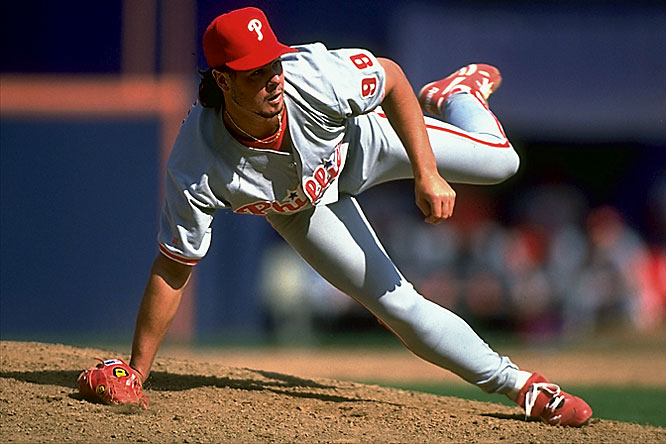
Would you listen if this guy was criticising your pitching mechanics? Photo unknown via insidesocal.com

I just happened to catch former MLB pitcher and current MLB.com analyst Mitch Williams calling into the morning show on 106.7 this am.  And I felt compelled to immediately call into the show to rebut some of the more arguable statements he made.  Of course, this being Washington DC they only took 2 calls (one of which immediately changed the subject to golf; nice screening there WJFK) before moving onto a football-related segment, so I’ll exhaust my need to speak up in this space.

Williams had lots to say about Stephen Strasburg‘s mechanics, Mike Rizzo‘s decision to shut him down, and other fun stuff.

First off, I find it ironic that a guy with some of the worst mechanics in the last 25 years has the audacity to question Strasburg’s mechanics.  Williams nearly dislocated his left shoulder on every delivery and fell off to the 3rd base side so badly that he nearly hit the ground on each pitch (as is displayed in the photo above).  Strasburg, on the other hand, was considered to have impeccable mechanics upon hitting the draft and you really had to squint to find flaws in his delivery.  Google searches on the topic are so muddied with opinions that its hard to find actual scouting reports from his amateur days versus “hindsight is 20/20” pieces that look for flaws to explain his 2010 injury.  But its ironic that Strasburg suddenly has all these mechanical issues according to pundits, because he got injured.

Speaking of that 2010 injury, Williams intimated that the infamous “Inverted W” was the reason Strasburg got hurt.  I just have an awful hard time with that theory.  First, its a THEORY and is merely a coincidental piece of evidence in pitcher injuries.  You can find examples of pitchers who get into this position pre-delivery who have never had any injury issues just as easily as you can cherry-pick guys like Strasburg or Mark Prior who have suffered injuries.  More importantly, the Inverted W is more indicative of SHOULDER injuries in pitchers, not elbow ligament tears.  Shoulder injuries in pitchers are by and large wear-and-tear injuries, caused by over use and over-throwing over hundreds and thousands of pitches.  You don’t generally throw one pitch and tear completely through your labrum or rotator cuff.   However, elbow injuries to the UCL are almost entirely singular, acute injuries caused on a specific pitch.  We all can remember the exact pitch Strasburg threw to injure his arm and the grimace on his face after he threw it (as well as the blowhard Rob Dibble comments …. but we’ll choose to ignore those).

I wrote at the time my opinion on why Strasburg got hurt, and it had nothing to do with his pitching mechanics (my pet theory: Ivan Rodriguez fell in love with Strasburg’s change-up, had him throwing too many of them, and the vastly increased stress on his elbow caused the injury.  See the Aug 2010 post linked above for more detail).  I think its irresponsible for Williams to get onto a local radio show and opine that Strasburg “needs to change his mechanics” because of the injury, or else he’ll always be an injury concern.  Because in reality, nobody knows.  Personally I think teams trying to “change mechanics” in pitchers is a mistake; you throw one way your entire life, from age 5-6 onwards, and your entire shoulder/arm combination becomes inured to that method of throwing.  How can anyone think that suddenly as a 25 yr old you can even change the fundamental way you throw a baseball and be successful?  Adjustments, no problem.  Fix slight timing issues or slight changes to your wind up?  Sure.  Core changes to arm slots and arm loading?  Problematic.

Williams continued with the same tired themes we’ve been hearing from National writers (i.e., the Veterans aren’t going to like this, its a team game, the Nats should have managed this better, the Nats are foolish not to go for it, etc).  But he fails to mention what most fail to mention; Rizzo arrived at this shutdown decision with Strasburg the SAME way he did with Jordan Zimmermann last year; he talked with the surgeon who performed the surgery (Dr. Lewis Yocum in LA, the same doctor apparently about to pronounce the same fate on our 2012 #1 draft pick Lucas Giolito) and arrived at a prescribed, pre-defined innings limit.  You notice we’re in the EXACT same position as we were with Zimmermann in 2011, yet without any of the national media interest.  (And so far, that limit has worked out pretty darn well for the Nats and Zimmermann; right now, he’s 2nd best in the NL in several macro pitching categories; bWAR, ERA and ERA+, while being top 10 in WHIP, K/BB, and BB/9).

The way I look at it is thus: if you or I had Heart Surgery, your Cardiologist probably would recommend a course of recovery.  For the first X months, avoid any activity, then ease your way back to vigorous activity over a period of Y more months.  And you’d follow that advice, right?  Well, the pitching arm of a Major League Starter pretty much is equivalent to the heart of a normal person; without that arm, you’re not a major leaguer any more.  So when you get surgery on it, you listen to your doctor and do exactly what he says.  If someone told that same heart patient that, well because we’re really close to the World Series, you should really ignore your surgeon and just go for it for the betterment of the team, what would you say?  You’d probably say, “well, this may help the team make this one short term goal but I may be dead a lot sooner because of it.”  In my mind, that’s what Strasburg/Rizzo are doing; they’re following the same advice that has now led to Zimmermann having a fantastic (and healthy) 2012 season.

And one caller, to his credit, did point out a very important fact: the story on Strasburg hasn’t really changed all year.  There was a communicated shutdown expectation to Strasburg and the team in spring training.  Its only the National media that is now catching onto this and thrusting microphones into our players’ faces and asking for reactions that are getting over blown and taken out of context.   I guess this is what its like day in, day out in New York and Boston…

There are no absolutes in life; Strasburg could absolutely re-injure himself in 2 years time and turn into this generation’s Mark Prior.  Or he could be like Chris Carpenter, who had the TJ surgery in 2007 then recovered to a 17-4 record in 2009 as a guy in his mid 30s.  But anyone who thinks they know otherwise is just stating an opinion.  And everyone has an opinion.  I support the shutdown, I think its prudent for the longer term position of this team, and I don’t think 2012 is a once-in-a-lifetime shot for this franchise.  Of the “core 15” of the Nats (8 positional players, 5 starters and 2 relievers) exactly ONE guy is a free agent or not presented with at least an option for 2013.  Most of these guys are either signed long term or under team control for at least another FOUR seasons.  So this team isn’t going anywhere.  You play it safe and get ready for a 4-5 year run.

That’s MY opinion.  🙂

Wang gets stay of execution with latest “injury”

21 comments

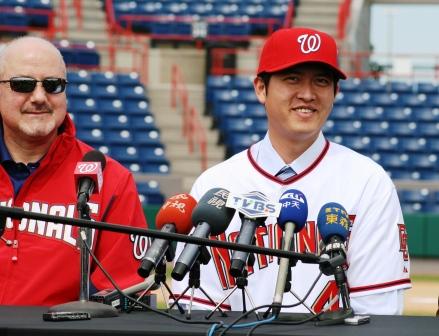
Wang on his signing day. There won't be a press conference on his release day. Photo Jeff Saffelle/Nats320 blog

Chien-Ming Wang‘s latest (and last) rehab start in Harrisburg ended with him “complaining of soreness in his right hip” and being pulled after the latest of his ineffective starts for AA Harrisburg.

This has to be the least surprising bit of news related to Wang’s injury and rehab assignment imaginable.

Do you mean to tell me that the Nats most ineffective starter, one who lost his starting role and was banished to the bullpen to do mop-up long man duty, and then was ineffective even in that role, was sent to the DL with a questionable hip injury, and when it came time to either re-instate the player to the active roster or to Desginate him for Assignment (since he’s out of Minor League Options) he suddently has a re-occurence of the same hip injury, meaning his rehab time clock resets to 30-days and allows him to wallow in the minors until the roster expansion date of September 1st (as I predicted in my July 3rd posting)?

I’m shocked.

Clearly there’s no place for Wang on the team, both in the short term and the longer term.  In his last three starts for Harrisburg he was alternatively lit up or highly ineffective (considering his pedigree and who he was pitching against).  Ross Detwiler has clearly grasped the #5 starter role and has a higher ERA+ than both Edwin Jackson and Gio Gonzalez for the season (hard to imagine, but Gio’s last 8-10 starts have really knocked his seasonal numbers down, even given last night’s CG and his excellent 7ip, 2H performance against the woeful Mets two weeks ago).   If/When Stephen Strasburg gets shut down (which honestly at this point I cannot believe will actually happen, given Mike Rizzo‘s cryptic statements about Strasburg having to pass an “eye-test” and backing away from any specific quantitiative innings limit), John Lannan has had two shots to prove he belongs and completely earned whatever work he will get.  Unless someone goes down with injury, Wang now sits easily as 7th on the starter depth chart and perhaps even further down, given Yunesky Maya‘s recent string of decent-to-excellent starts in Syracuse.

The Wang experiment was a worthy one, and certainly I supported his re-signing and the continued payment on the hope that Wang would return to his 19-win Yankees glory.  Maybe he’ll get a few more innings in September, as the team fights its way for a divisional title.  But you have to think he’ll be looking for work in another organization in 2013.

Written by Todd Boss

August 9th, 2012 at 11:05 am

More and more I’m liking the 2nd Wild Card

8 comments

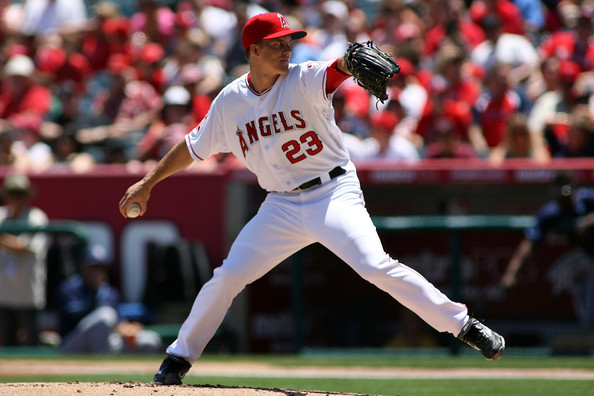
Will the Greinke acquisition get the Angels out of the WC game? Photo Jeff Golden/Getty Images

Baseball Purist Alert: this opinion piece may not entirely please you.

I have to admit; as a life-long baseball fan I find myself constantly being at odds with myself over the “purity” of the game dating to its roots versus the natural progression of modern baseball as it adjusts to the current  sports climate.  Every change we’ve seen, from divisional play to wild cards to instant replay seems like an attack on the sanctity of the National Pasttime, and the sport which routinely traces its roots to stars from 70 years ago.

The latest Collective Bargaining Agreement added a second Wild Card in each league, and a one-game playoff between the two wild-card teams to advance into the divisional series.  Some purists were aghast with the addition of yet another non-divisional champ to the post season party.  However, as we’ve seen this season play out the second wild-card inarguably has some side-effects that I think are good for the game.  Lets talk about these intended (or unintended) impacts:

1. The additional Wild Card has kept more teams in the Playoff Race.  Here’s the standings as of 7/31/12 (a fantastic new feature I found at baseball-reference.com; you can pull standings as of any date in the history of the game).  8 of the 16 teams in the NL and arguably 9 or 10 of the teams in the AL were technically still “in” the race for a playoff spot.  More teams in the playoff race means longer sustained fan interest and less tanking or selling off of assets.

2. By virtue of #1, more teams were trying to improve at the Trade Deadline.  You can argue that more teams in the playoff hunt meant that fewer teams were sellers, and that lead to gridlock at the trade deadline.  But, some surprise selling teams (namely Miami and Philadelphia) injected new life to the trade deadline and had some teams making significant and crucial pickups.

3. An additional Wild Card still leaves Baseball with the lowest percentage of its teams in Post Season Play.  Hey; at least we’re not the NBA, where more than half the teams make the playoffs.  It still means something to make the playoffs, which is important.

4. The play-in game will be fantastic.  Nothing is as amazing as a one-game playoff to advance, and some of baseball’s most historic moments have come during these games.  Who would know who Bucky Dent was if not for his amazing home-run in the 1978 playoffs?  Both teams will be sending their Aces, both teams will be playing like its Game 7, and the neutral fan will be in heaven.

5. The additional Wild Card will mean that teams will play harder, longer into the season.  Why do you think we’re seeing the massive trade-deadline arms race between Western divisional rivals in both leagues?  The Angels/Rangers and the Dodgers/Giants were by far the most active teams at the deadline because they all know that the difference this year between winning the division and the wild-card is significant.  In years past we’ve seen teams almost not care if they won the division or dropped to the wild card; you were guaranteed not to meet your divisional rival until the LCS and the home field advantage in baseball is so slight that sometimes you could argue that playing away in a short series is more advantageous.

Why?  In a short series, its pretty easy to “steal” a game on the road and then hold serve and win 2 straight at home, knowing that the pressure is on the favorite and knowing that the under-dog can drop a game at home but still get a 5th/deciding game on the road.  In a 7-game series the same rule of thumb applies; its really difficult to get a 3-game sweep, but its really easy to get a 2-game split.  Especially considering that the home-field advantage in baseball is only about 56% but has been as low as 52% in the past decade (see this link at Baseball-Reference.com, which has the home-team winning percentage over the years).

Now we see the immedicate impact; the Angels and Rangers absolutely do not want any part of a coin-flip game with the 2nd wild card for this reason.  Primarily because…

6. The one-game play-in will significantly impact the advancing Wild Card Team.  You have to think that teams will send their Ace/#1 starter to the hill in the play-in game.  Why possibly save him for a series that you may not get to?  As a result, the wild card winner advances to play either the #1 seed or the #2 seed (if the #1 team is in their same division) having already spent their big arm.

Why do I see this as a good thing?  Because one major beef I’ve always had with Wild Cards is their relatively easy path to advance to the World Series.  Up until the last day of last season, the Cardinals were not even set to be a playoff team, and then they run to the World Series title.  We’ve already talked about the relatively small home field advantage baseball teams have.  Wild Card teams, more often than not, come into the playoffs “hotter” than the divisional champ that they then face.  This results in a significant number of Wild Card “upsets” in our history of divisional play and having Wild Cards advance far further than I’d normally like to see them, at the expense of divisional winners losing short series.  In the 17 years of divisional play/wild cards we’ve had:

  • 5 Wild Card WS champions (including most recent St. Louis Cardinals plus 3-straight from 2002-4)
  • Another 5 Wild Card WS runner-ups (including 3 straight from 2005-7)
  • Overall, 10 of 34 World Series participants being Wild Cards, a rate of nearly 30%.
  • 18 Wild Cards overall who won their Divisional Series out of 68 such series being played, a success rate of more than 25%.

Perhaps this is one last vestige of “baseball purism” in me, but I think the game needs to have more World Series winners who not only won the 8-team (now 10-team) playoff derby, but who also succeeded all year long and won their divisions.  Only three times in the divisional era has the team with the best record also won the World Series, 3 times out of 17 (the spreadsheet linked here is also available in the links section to the right-hand side of the blog, called “Best versus Winner.”  It needs updating for 2011 and 2012 champions in all sports, but shows just how infrequently the best regular season team wins in any sport.  A side effect of expanded playoffs in all sports, true, but a concerning trend for any sport purist).

In any rate, I’m hoping that the diminishing of the Wild Card one-game winner means that fewer Wild Cards run through the playoffs, which will lead to more “deserving” World Series participants.


Do I wish that Baseball would revert to the old, old days where there was one division and two pennant winners?  No, of course not.  In fact, I think Baseball would be best served by adopting the NFL’s 8 division alignment with 2 wild cards for a very neat post-season tournament where the two best teams got byes (in the link above, I posted some possible alignment possibilities when the whole re-alignment discussions really took hold in July 2011; my two expansion target cities were San Antonio and Portland).  But expansion in Baseball seems like such a difficult proposition that it may never happen (for the reasons explained in this post).  But the 2nd wild card seems to be setting up baseball fans for an exiting and “fairer” post season in 2012 and beyond.

Written by Todd Boss

August 7th, 2012 at 1:47 pm

A look at Oakland’s amazing 2012 season so far

9 comments

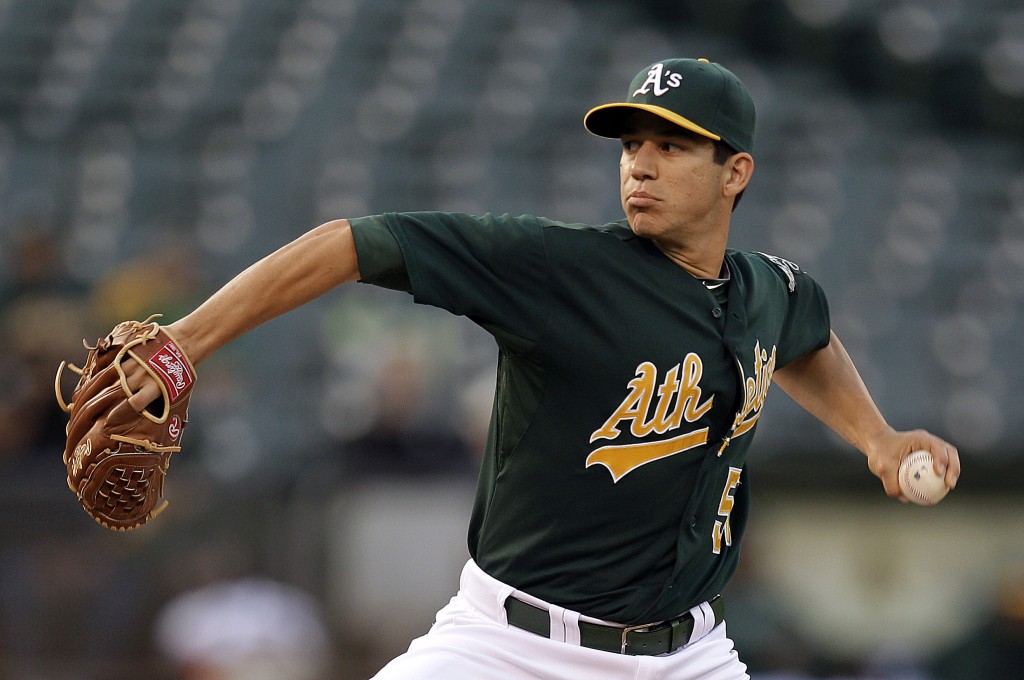
Tommy Milone has made Oakland’s 2012 rotation surprisingly good. Photo AP/Ben Margot via dailyrepublic.com

I’ll admit it; after watching Billy Beane wheel and deal this past off-season, trading away most of his starting rotation and letting most of his FA hitters walk, I was predicting a 55 win season for this team.  They were banking on a proposed move to San Jose and I saw these moves as a purposeful bottoming out while playing out the string in Oakland, ahead of a lucrative move to the South Bay.  Well, that move seems interminably stalled, and many pundits predicted a near record loss season for this team, especially considering the massive moves that the Angels had made, coupled with the 2-time defending AL champs Texas being in the same division.

Instead, they sit at 56-48 and if the season ended today, right now on August 2nd, the Oakland A’s and their $55M payroll (2nd lowest in the league by a couple hundred thousand dollars) would be the 2nd wild-card and would play the Los Angeles Angels, they of the $154M payroll (and counting, considering this was their opening day payroll and they’ve taken on with the Zack Greinke deal at the trade deadline).

How did this happen?  Lets look at the evolution of the Starting Rotation, because what this group is doing is nothing short of amazing.

In 2011, the Oakland had 10 different guys start games for them.  Here’s a quick summary (* indicates a left hander on baseball-reference.com pages):

Name Age W L W-L% ERA G GS
Trevor Cahill 23 12 14 0.462 4.16 34 34
Gio Gonzalez* 25 16 12 0.571 3.12 32 32
Brandon McCarthy 27 9 9 0.5 3.32 25 25
Guillermo Moscoso 27 8 10 0.444 3.38 23 21
Rich Harden 29 4 4 0.5 5.12 15 15
Brett Anderson* 23 3 6 0.333 4 13 13
Josh Outman* 26 3 5 0.375 3.7 13 9
Tyson Ross 24 3 3 0.5 2.75 9 6
Graham Godfrey 26 1 2 0.333 3.96 5 4
Dallas Braden* 27 1 1 0.5 3 3 3

Here’s what happened to each of these guys (good link for trade details from baseball-reference.com here; this link shows the latest trade between Oakland and all other teams but quickly shows all these 2011 deals listed here):

  • Cahill traded to Arizona
  • Gonzalez traded to Washington
  • Moscoso traded to Colorado
  • Harden left via free agency, and as far as I can tell he remains unsigned.
  • Outman traded (with Moscoso) to Colorado.
  • Anderson had Tommy John surgery in June of 2011 and is in the minors rehabbing now.
  • Braden had shoulder surgery in April of 2011 and has not pitched since.

They traded or released the starters who made nearly 80% of their starts in 2011.  That leaves 3 guys who had any MLB starts last year: Brandon McCarthy, Tyson Ross and Graham Godfrey, a total of 35 starts.  To add insult to injury, Oakland traded their 2011 closer Andrew Bailey to Boston last December.

So, what does the Oakland rotation look like this year?  Here’s the same data through August 1st:

Name Age W L W-L% ERA G GS
Tommy Milone* 25 9 8 0.529 3.68 21 21
Bartolo Colon 39 7 8 0.467 3.78 20 20
Jarrod Parker 23 7 5 0.583 3.44 18 18
Brandon McCarthy 28 6 3 0.667 2.54 12 12
Travis Blackley* 29 3 3 0.5 3.15 14 10
Tyson Ross 25 2 8 0.2 6.35 12 12
A.J. Griffin 24 3 0 1 2.51 7 7
Graham Godfrey 27 0 4 0 6.43 5 4

So, where’d all these guys come from?

  • Milone: acquired from Washington in the Gonzalez Deal
  • Colon: bottom-of-the-barrel FA signing (1yr/$2M).
  • Parker: acquired from Arizona in the Cahill deal.
  • McCarthy; signed a 1yr/$4.275M FA deal after accepting arbitration from the team after last year
  • Blackley: selected OFF WAIVERS from San Francisco earlier this year
  • Ross: homegrown: a 2nd round pick in 2008
  • Griffen: also homegrown; he was a 13th round draft pick by Oakland in 2010.
  • Godfrey: acquired from Toronto in the 2007 Scutaro deal

Ross and Godfrey got demoted after poor performance, and McCarthy currently sits on the DL, giving Oakland this current rotation: Colon, Blackley, Griffen, Milone, Parker.  All 5 guys with ERAs under 3.78 and all with ERA+ of at least 104 and mostly greater than that.  And, when McCarthy comes back he’s essentially the best pitcher of any of them.  AND, this is all being done with out Dalles Braden and Brett Anderson, two guys who were core components of the 2010 rotation and who would clearly be in the 2012 rotation if not for injury.  AND, Oakland just announced today they’re promoting one of their best starter prospects in Dan Straily for a spot start this coming friday.

Wow.

And, when Braden, Anderson and McCarthy come back, that gives Oakland a major surplus of pitching that can be flipped in the coming off-season for even more prospects and hitting (much as they did this past off-season).

Combine this pitching revolution with the schrewd Yoenis Cespedes signing (who immediately became the highest paid player on the team), the explosion of Josh Reddick (acquired in the Andrew Bailey deal from Boston), unexpected output from DH/FA signee (and ex-Nat) Jonny Gomes and a solid season from Seth Smith (acquired in the Moscoso deal) and you’ve got a team that is producing enough to win.  They’re not an offensive juggernaut (mostly ranked 12th-13th in the 14-team AL in the major offensive categories) but you don’t need to score 8 runs a game when you have a staff ERA of 3.47.

As much as Moneyball critics will hate to hear it, I think Billy Beane is your easy choice for AL Executive of the year right now.

Repost: Are the Nats suddenly a 100-win team? With this offense, yes.

7 comments

The return of Michael Morse has energized the offense. Photo Jacqueline Martin via federalbaseball blog

(Editor note; I attempted to publish this last Friday, then the server immediately went down all weekend.  Wanted to re-post it to get commentary from typical readers.  All numbers below were as of last friday, before the wild 4-game series against Atlanta).

There’s been lots of press this week, and to an extent all season, about Stephen Strasburg‘s innings limit.  Mike Rizzo came out this week and said (paraphrasing) that there’s not a hard-and-fast 160ip limit, but that he will be shut down, and it will be Rizzo’s decision when Strasburg doesn’t pass the “eye test.”

Nats pundits are already discussing this impact on a playoff race, who the replacement may be (with John Lannan getting an early audition during this weekend’s double header), and whether we should flip someone out of our “thinned” farm system for a rental SP like Zack Greinke or Ryan Dempster (I put “thinned” in quotes out of deference to those that don’t share my glass-is-half empty opinion on the state of our farm system right now as posted here earlier this week).

Inarguably, this team will be a worse team without Strasburg.  We’d be weaker in September once he got shut-down and we’d be hampered in a short series without our staff Ace.  I’m not worried about September though; remember last year?  Some teams were fielding 40-man roster specials, with lineups that mostly started the year in AAA.  And I’m not entirely worried about how we’d look in a playoff series, since playoff rotations go 4 deep (meaning whatever question mark we’re throwing out there as a 5th starter in September is in the bullpen in October), and a rotation of Gonzalez, Zimmermann (who, amazingly, is tied for the NL lead in pitcher bWAR right now), Jackson and Detwiler getting the game 4 start is still pretty durn good.

But, here’s some interesting stats that should give you (and anyone in baseball frankly) some pause; this team is positioned to get significantly better from here on out, despite the looming loss of Strasburg and despite the fact that they’re already in first place.  Why?

Because the offense is really starting to heat up.

Here’s some stats to give context: based on the Team Scoring page at baseball-reference.com, here’s the Nats scoring-based records:

  • When the Nats score 0,1,2 or 3 runs, they are 14-28, for a .333 W/L percentage. This is pretty common; even last year’s 102-win Philadelphia team rarely won when scoring 3 or fewer runs.
  • When the Nats score 4 or more runs?  They are 39-9 this season, a .795 W/L percentage.
  • Taking this a step further, when the nats score 5 or more runs, they’re 29-6, a .828 W/L percentage.

(For context, a record of 100-62 equates to a .617 W/L percentage).

Perhaps the above states the obvious; most teams have pretty good records when they score a bunch of runs.   For comparison sake’s, here’s the same analysis for the team with the best record in baseball, the Yankees:

  • Scoring: 0,1,2,3 runs: 5-23 for a .178 W/L
  • 4+ runs: 52-12, .813 w/l
  • 5+ runs: 44-10, .815 w/l

The Yankees and their superior offense leads to a ton of wins once they get above 4-5 runs.  The difference between the Yankees and the Nats is our current ability to win a pretty sizeable number of games when scoring 3 or fewer runs.  This difficulty in winning close games and depending on bashing your way to victory has been a theme for the Yankees for a few years now, and is one of the reasons they have only won one World Series since 2000 despite being in the playoffs nearly every year (only one missed playoff appearance during that span).  They are susceptable to getting shut down by a good rotation in a short series.  But I digress…

Getting back to the theme of this post: Here’s a look at the monthly W/L records for the Nats, along with average Runs scored and Runs Allowed (through July 19th’s game):

Month W/L W/L pct RS RA
April 14-8 0.636 3.36 2.68
May 15-13 0.535 4.21 3.85
June 15-11 0.576 4.46 3.73
July 9-5 0.642 4.78 3.57
season 53-37 0.588 4.166 3.488

Look specifically at the average number of Runs Scored by this team.  It is distinctly trending up; from 3.36 RS/game in April to a massive 4.78 RS/game so far in the month of July.   That’s almost 1 and a half more runs they’re scoring a game right now as compared to April (when their 14-8 record was mostly on the backs of one of the best opening months of starting pitching seen in the Majors since the dead-ball era).

Some reasons for this outburst of runs?

  1. Ryan Zimmerman‘s cortisone shot on June 24th: he had a .589 OPS in June (which should have been even worse, but he finished the last week of June on a tear, going 11-32 with 5 extra base hits after getting his shot), but has a blistering 1.280 OPS so far in July.
  2. The top of the order stepping it up: Danny Espinosa is hitting .327 in July and Lombardozzi is hitting nearly as well.
  3. The resurgence of Roger Bernadina, hitting at a .375 clip so far in July and leading to the DFA of Rick Ankiel (my wife’s favorite player; I havn’t broken the news to her yet).

Meanwhile, the rest of the sluggers in the lineup (Harper, LaRoche, and Tyler Moore doing his best effort to prove scouting pundits wrong who thought he couldn’t hack it against MLB pitching) are for the most part churning along and providing pop in front of and behind the 3-4-5 hitters in the order.

And, this offense could only get better when Jayson Werth returns.  Remember; he was quietly having a solid year at the plate, with an .810 OPS and a 121 OPS+.  You insert Werth and suddenly this team is rock solid and full of power from position 2-7.  You’d have to sacrifice Bernadina and Moore to the bench primarily, but they’re great insurance in case Werth’s wrist betrays him.

They’re averaging 4.78 runs a game, and on the season they’re 39-9 when they score 4 or more runs.  That spells a pretty serious run I expect this team to make in the next month and a half, especially against a slate of opponents that are mostly .500 or below.  Right now, sitting at 53-37 they’re on pace for a 95 win season … but, amazing as it is to say it, this team easily has the capability of reaching 100 wins if their offense continues its upward trend.

Are you concerned about the state of the Nats farm system?

26 comments

Will Giolito become the Nats #1 prospect? Photo Eric Dearborn via Win For Teddy blog

I know it seems silly to criticize the team with the best record in the NL, but I thought the question was worth asking, given a couple things I read this week prospects related.  Given the drain of prospects in the last 6 months (through the Gio Gonzalez trade and through graduation to the majors for several of the team’s better prospects), its safe to say that our cupboard is relatively thin right now.  This point was highlighted to me by two recent online articles;

1. ESPN’s Keith Law posted a mid-season review of farm systems on the Rise or Fall (sorry, insider only), and stated the obvious about our system.  His summary: Yes we got Lucas Giolito but it was essentially at the expense of any other high-end talent in the 2012 draft.  And, a lot of our high-end guys are taking significant tumbles on boards due to lack of performance or injury (see later on for a look at our top 10 prospect performances).

2. Baseball America’s Jim Callis posted an updated Midseason top 50 prospects post 2012 draft and included where he’d put the top-end talents drafted (including international signees) in his weekly Ask BA feature on July 16th.   Of note to me was the fact that Washington, even with the signing of the high-end Giolito, does not have a SINGLE player in his mid-season 50.   Luckily for us, our NL East competition didn’t fare too much better, with a grand total of 5 players between our divisional rivals.  This compared to teams like Seattle (5), Kansas City (4), and the rich-keep-getting-richer Rangers with 3 guys likely to become impact players within a year or two.

Why is this a concern if the team is in first place?  Two primary reasons:

1. If you’re not going to matriculate your prospects and depend on them for production, then you need to utilize them in trade to acquire needed talent.  There’s plenty of trade rumors right now mentioning the Nats desires for a starter to cover for Stephen Strasburg‘s innings limit.  But who are we going to trade to acquire said pitcher?   I’d go as far as saying that there’s not one guy on our 2012 top 10 prospect list (not including Harper and Lombardozzi of course) who, at this point in 2012, could be the centerpiece of a marquee acquisition.  Who is trading for our #1 prospect Anthony Rendon right now? 

2. This team has a LOT of money committed to players over the coming years, and won’t be able to depend on hefty production from salary controlled guys forever.  They will need a stream of up-and-coming players to offer cheap alternatives to free agents and players who have become too expensive.  For example; in the year 2016 the team has $47M committed to just THREE players right now, before considering at least that much in arbitration for just Strasburg, Bryce Harper and Jordan Zimmermann.  $47M is nearly the team’s payroll just a few years ago!  Yes we will naturally grow payroll and revenues with success and the renegotiation of the MASN contract, but constructing a 25 man roster is about making choices.  The last thing we want is to see this team become the 2012 Philadelphia Phillies; a bloated, old team with a ton of injuries and the 2nd highest payroll in the league at $175M, but mired in last place.

For context of this discussion, here’s a list of Baseball America’s top 10 prospects for this team for 2011 and 2012 (compiled after the Gonzalez trade), and a status of where they are as of now:

Year Nats Rank Name, pos Status
2011 1 Bryce Harper, of In majors
2011 2 Derek Norris, c Traded
2011 3 Danny Espinosa, ss/2b In majors
2011 4 A.J. Cole, rhp Traded
2011 5 Wilson Ramos, c Out for Season (two knee surgeries)
2011 6 Sammy Solis, lhp Out for Season (Tommy John)
2011 7 Cole Kimball, rhp 60-day DL (shoulder surgery)
2011 8 Eury Perez, of .299/.325/.342 in AA Harrisburg in his 6th pro season
2011 9 Chris Marrero, 1b 60-day DL (torn hamstring)
2011 10 Brad Peacock, rhp Traded

That’s 2 guys who are starters in the Majors, 3 traded for Gonzalez, 4 guys on long term DL stints and Eury Perez with his meager .667 OPS in AA, in his 6th pro season.  How about 2012’s list?

Year Nats Rank Name, pos Status
2012 1 Bryce Harper, OF In majors
2012 2 Anthony Rendon, 3B Out for Season (broken ankle, his 3rd major leg injury in 4 years)
2012 3 Brian Goodwin, OF .324/.438/.542 in low-A.  Stellar season so far
2012 4 Alex Meyer, RHP 7-4, 3.10 Era, 1.13 whip and 107/34 k/bb in 90IP in low-A Hagerstown.  Just promoted
2012 5 Matt Purke, LHP Long term DL (Shoulder concerns); hasn’t thrown in 5 weeks.
2012 6 Sammy Solis, LHP Out for Season (Tommy John)
2012 7 Steve Lombardozzi, INF In Majors
2012 8 Destin Hood, OF .223/.296/.313 in AA Harrisburg, in his 5th pro season
2012 9 Chris Marrero, 1B 60-day DL (torn hamstring)
2012 10 Michael Taylor, OF .225/.314/.333 in High-A Potomac in his 3rd pro season

2012’s list includes 4 major injury concerns, two guys under-performing (Hood and Taylor), and two guys matriculated to the majors.  The two players putting up good statistical seasons may come with astericks though; Alex Meyer was compiling his stats in low-A, going against guys 2-3 years younger than himself.  His promotion to High-A was overdue and should be telling, to determine if his future lays as a dominant 12-6 starter or a high-leverage reliever.  Brian Goodwin’s excellent season is a great sign of things to come … but again, in Low-A.  I know he was a Juco signee, but he’s 21 now, turning 22 in November and is the same age as college juniors getting drafted now.  If he continues to produce upon promotion to better competition, I’ll feel better.

Now, I know there’s guys in our system who are coming back from injuries (i.e. Nathan Karns), or who are putting up good numbers despite being lower draft picks (i.e. Matt Skole, Cameron Selik, Danny Rosenbaum), and we have some guys who we acquired through trades and who are having surprisingly good seasons in the minors (i.e., Zach Walters, Ryan Perry and Corey Brown) but are these kinds of players going to step up and either be a) next year’s top prospects or b) eventual productive major leaguers?  I know we all love Rosenbaum for example, but most scouts think he’s a marginal prospect at best (and his lack of inclusion on our top 10 lists reinforces that notion).

This sudden lack of depth was one of the reasons I wasn’t the biggest fan of drafting Giolito.  With the new draft rules and specific limits on bonuses, combined with the significant injury issues we’ve had with high end draftees Rendon and Purke in 2011’s draft, I thought the team should have gone the safer route.  Yes I’m sure Mike Rizzo did a ton of due diligence and was confident in Giolito’s long term health.  But missing on three first rounders (or in Purke’s case, a first round talent given a significant bonus and a 40-man deal) could lead to a significant hole in player development for this team right at a time a couple of years from now when they desperately need a MLB-minimum impact guy.