Nationals Arm Race

"… the reason you win or lose is darn near always the same – pitching.” — Earl Weaver

Archive for the ‘aj cole’ tag

July 2013: Minor League Monthly Rotation Review

25 comments

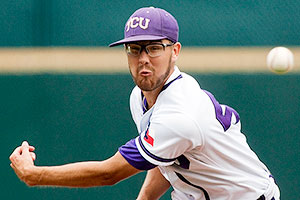
A.J. Cole is having a good 2013. Photo: AP Stock

A.J. Cole is having a rebound 2013 for sure. Photo: AP Stock

Here’s this month’s Minor League Rotation Review post.  Here’s April 2013May 2013, and June 2013‘s posts for history.

For each level, I’ll put out the rotation members, their “letter grades” per start for this month only, and then throw in a quick link to show their seasonal stats for context.  For each team there are 3 distinct groups of starters: the top group of 5-6 Starters per level is the “current rotation” as best as I can figure it, then the next section of pitchers are swing-men or spot-starters or guys who had “2nd start” or longer outings worthy of grading, followed by a 3rd group of guys who are generally no longer with the team (either by D/L, promotion, demotion or release).  I’ve only listed the third category if something transactionally has happened to the player this particular month.

All stats mentioned (ERAs, Whips, K/9 rates, etc) are as of 8/1/13 and may have slightly changed by the time of this posting.


AAA Rotation: click here for Syracuse Milb.com stats

  • Maya: B+,D,D-,A-,B+,A
  • Tatusko: D,A,B,C+,B,B
  • Rosenbaum: B,C-,A,D,D
  • Roark: B+,C+,C-,A-,A
  • Clay: A,A,D+/inc (rain),B,C
  • Mandel: D->back to bullpen
  • Robertson: F

Discussion: Syracuse has had the most stable rotation of the whole system.   Which is ironic because (if I’m interpreting their service time correctly) 4/5ths of this rotation are minor league free agents this coming off season.   Only Danny Rosenbaum is tied to the organization past this year, having already “survived” one rule-5 draft, but I think we can read the tea-leaves in terms of his future with the organization.  The bright side of this turnover will be the rightful promotion and challenging of several AA pitchers right now, to start grooming the true MLB injury replacements that we just did not have in-house this year (with apologies to Chris Young who really did not work out and Ross Ohlendorf, who has but in a non-starting role thus far).

Yunesky Maya has shown signs of life lately, putting up a few good performances in the latter part of the month.  Tanner Roark seems like he could be a useful swing-man on the MLB roster if called into action; he’s performed ably since returning to the rotation.  Caleb Clay continues to impress; how did he not success in Boston’s organization?

In the bullpen, Xavier Cedeno has excelled since his waiver claim from Houston but suffered from bad timing and bad luck; the two loogies called up (Abad and Krol) have both excelled.   Cedeno is likely another 6-year MLFA heading elsewhere this coming off-season.  (Note: Cedeno has just been called up to cover for Ohlendorf’s “dead arm” D/L trip).


AA: click here for Harrisburg Milb.com stats

  • Karns: A,A (inc),A,A,B-,B-
  • Gilliam: A-,A+,D+,B,B,C-
  • Cole: A+,A
  • Ray: B+,A++,D,D,B-
  • Hill: A,B,A-,B,B,D+
  • Herron: D
  • Swynenberg: A-
  • Grace: B
  • Demny: -> D/L, to bullpen, demoted
  • Treinen: D->d/l,C+,B+ -> D/L

Discussion: Harrisburg’s rotation is now down to just one of the 5 guys who opened the year there; Nathan Karns has recovered from his MLB stint and long layoff and is back to dominating; if it weren’t for the full-deck in AAA Karns may have been promoted by now.   Blake Treinen (another original rotation guy) is on his second D/L stint of the month but has kept his numbers respectable.  Robert Gilliam continues his up-and-down season, moving between stellar and sub-par starts (which is reflected in his 4.09 ERA in AA).

The next generation though seems upon us: A.J. ColeRobbie Ray and Taylor Hill are all on the same path this year: succeeded in High-A, pushed to AA and are now succeeding there.  Cole’s first two starts in Harrisburg could not have gone better, and Ray’s numbers are still good despite a couple of rough starts.  Remember; both Ray and Cole were “really young” at the season’s onset for High-A; now they’re among the youngest guys in all of AA and still producing.  This is great news going forward for this farm system, especially considering that another of the opening day Potomac starters (Taylor Jordan) is now effectively pitching in the majors.  I know this is the Harrisburg section, but think about the success of Potomac’s original 5 this year.


High-A:  click here for Potomac Milb.com stats

  • Purke: A-,F-,C-,D-,D,B+
  • Demny: D,D/inc (2 innings)
  • Solis: A-,D,A-
  • Schwartz: A,D,C-,B+,C+,B+
  • Rauh C,A,D,B+,A,D/inc (2/3 inning)
  • Fischer: A,B
  • Holt: A
  • Ray: -> promoted
  • Pineyro: A -> traded
  • Cole: D,B+/inc,A- -> promoted
  • Frias: B,F -> bullpen -> released 7/24/13

Discussion: The churn in the Potomac rotation continues.   They’ve not gotten starts from 15 different non-rehab assignment players.   And they keep on chugging, holding an 8 game lead in the division on August 1st after winning the first half.  Potomac’s two significant/important names of course are Matthew Purke and Sammy Solis.   Purke has looked hittable in High-A, his ERA skewed by one really bad outing but still not as dominant as you’d like someone with his pedigree to be.  Meanwhile Solis’ latest “return” seems to be going pretty well; he maintains a 2.65 ERA in Potomac while trying to build up arm strength.   Blake Schwartz is now the longest tenured rotation member and has pitched excellently so far in 2013.  He could be quite a find if he continues to develop (he was a 17th round pick who mostly pitched in Division II in college).

Meanwhile, Paul Demny‘s career faced a significant setback upon his demotion from Harrisburg.  He now sits back in High-A, a level at which he pitched a full season in 2011.  It may be time for Demny to try a conversion to relief, as it seems that he may be stalled as a starter.  He had great K/9 rates as a starter; it seems he may make a very effective reliever.


Low-A: click here for Hagerstown Milb.com stats

  • Turnbull: F,D,A,C-,A,D
  • Encarnation: A+,C,A,D,A-,B+
  • Mooneyham: B+,B-,D,B,A+
  • Dickson: A,F,C+,B+
  • Lee: A,B+,C-,B+,A-,B+
  • RPena: B,B+
  • Harper: | | | B,B+
  • Meza: B
  • Purke: -> promoted
  • Anderson: -> d/l

Discussion: with Dixon Anderson‘s D/L trip, Pedro Encarnacion now becomes the senior statesman of Hagerstown.   Both guys have pretty similar numbers; good ERAs (3.20-3.30) and good whips (1.17-1.19).   Encarnaction continues his slow march up the farm system, having gotten further along than most every DSL graduate in recent  years.   Brett Mooneyham continues to dominate a league that he’s over-qualified for.    Kylin Turnbull continues to get pounded in a league that he should be handling.  Ian Dickson (who we got in trade for Henry Rodriguez) has done decently well since being added to the rotation; outside of one blow-up he’s given up just 4 runs in 20 innings over 5 starts.  Not a bad return so far for a guy we were going to cut anyway (and who the Cubs took about 5 weeks to DFA themselves).


Short-A: click here for Auburn Milb.com stats

  • Johansen: A,A,B+,B+,A
  • Barrientos: D,C+,C- -> D/L,F
  • Orlan: F-,B-,A,A,F
  • DWilliams: B-,F,D,C-
  • Voth: A,C+,B/inc (1ip),A-
  • Ullmann: | | | F,B+
  • Hollins: B,B+
  • Bafidis: D+
  • Medina: A-
  • Selsor: B,D,D -> demoted to bullpen
  • Hudgins: D+,A- -> retired !?
  • Turnbull: C -> promoted

We’re seeing some big ERAs in Auburn so far.  Robert Orlan; 5.19 ERA.  Joel Barrientos: 4.66.  Deion Williams: 9.42.  Ugh.  More interesting to me are the 2013 draftee performances thus far.  2nd rounder Jake Johansen has been good; sub 1.00 ERA, sub 1.00 whip and about a K an inning so far.  He’s been a bit wild (28/14 K/BB ratio but has been consistently stingy when it comes to runs.  5th rounder Austin Voth has been sharp; 17/1 K/BB ratio in 14 innings so far in Short-A.  Lastly Ryan Ullman, a 30th round pick has had up and down starts so far in his 13 short-A innings.

I remain baffled with Will Hudgins abrupt retirement; he had 12 innings of relatively decent relief in 2013 and then tweeted out his retirement.   He hasn’t tweeted since, and when I mentioned it in the daily NationalsProspect.com post I didn’t get anyone who knew anything else.  Hopefully the retirement was not injury or illness related.


GCL: click here for GCL-Nationals Stats on MiLB.com

  • JRodriguez: F,A,A,B,B+
  • Silvestre: C-,A,F,A
  • Giolito: D/inc (only 1/3 inning),B,A-,D/inc (2/3 inings),D
  • Suero: B,B+,A
  • Valdez: A
  • Ott: B,B,C
  • DeRosier: B,B-
  • KRodriguez: B,B+,B+,C+
  • Pivetta: B-,B+,A
  • Spezial: A
  • Webb: A
  • Voth: A -> promoted
  • Ullmann: A,D+ -> promoted

It almost isn’t worth trying to grade out these GCL pitchers; most of the time they’re going 2-3 innings per “start” or per long relief stint.  If you pitch 3 scoreless innings, is that an “A?”   Lucas Giolito now has 6 “starts” but only a total of 12 combined innings thrown.   DSL grads Wander Suero and Jefry Rodriguez have looked promising.  Kelvin Rodriguez has good numbers in his combined mid-relief stints but relatively few strike outs (only 9 in 21 1/3 innings).


Taylor Jordan: Never too soon to think about the future…

4 comments

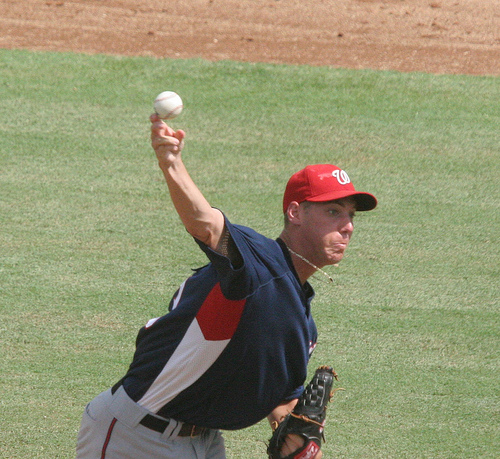
Jordan is making a case for his future with this organization.  Photo via wffn.net/hueytaxi on flikr.com

Taylor Jordan is making a case for his future with this organization. Photo via wffn.net/hueytaxi on flikr.com

I’ll file this as one of the “Patently Obvious” responses that have come out of Mike Rizzo‘s mouth in response to a reporter’s question, but Rizzo went “on record” as saying that Taylor Jordan will “get every opportunity to be in the mix for the rotation next year” per beat reports (this example from Byron Kerr) after Jordan got his first major league victory in Sunday 7/28/13’s 14-1 blow-out of the Mets.

Well, of course he’ll get a chance to compete for the rotation.   He’s pitching a hell of a lot better right now than $13M man Dan Haren, for approximately 1/30th of the cost.  What GM doesn’t want that??

One of the big reasons I started this blog was to talk about the development of Nats minor league pitchers.  Back in the dark days, when the team was spending $15M on the FA market to acquire 5th starters like Jason Marquis, I became convinced that the single most valuable commodity in Major League Baseball (in terms of talent development and acquisition) was the pre-arbitration starting pitcher.   Our farm system had the “Loria/Bowden” holes in terms of player development in the 2007-2009 time frame and for a few years the team couldn’t develop an effective starter, instead relying on guys like Marquis and on other minor league/low-end free agent signings (think Tim ReddingDaniel Cabrera, and the aging Livan Hernandez being examples).   Rizzo came in, put the emphasis on drafting and development, and now the opening day rotation features 3 home-grown guys and a fourth in Gio Gonzalez who was acquired by trading other home-grown guys.

One of my biggest data-collection projects was the information behind my regular “Pitcher Wins on the Free Agency Market” post.   After looking at pretty much every significant FA pitcher signing that baseball has ever had, and calculating salary versus wins, it became clear that teams are historically doing well if they get about one win per $1M spent on a FA pitcher.  Sign a guy for $13M a year?  You hope to get 13 wins out of him.

But this analysis also shows just how valuable the pre-arbitration, cost-controlled starter is.  Consider Clay Buchholz for Boston in 2010; he goes 17-7 in his 3rd active year, earning the MLB minimum of $443,000.  That 17-win capability eventually earned him a $12-$13M/year contract, but while he was getting the minimum he was winning games for Boston for pennies on the dollar versus what it would have cost Boston to purchase that capability on the open market.

Combine this point with the continually dwindling talent available on the FA market these as teams lock up their players earlier and more frequently, and the price for pitching just continues to go higher.  Zack Greinke signed a 6 year $147M contract paying him more than $24M annually last summer partly because he was the only significant pitcher out there.  Grienke is talented, don’t get me wrong, but outside of his unbelievable 2009 season he’s basically pitched like a #3 starter.   Even this year, he’s pitching to a rather pedestrian 103 ERA+, just barely above the league average of adjusted ERA for starters.  Not exactly what you expect for that kind of money.  The 2014 Free Agent Market in terms of pitching is looking equally as bare as 2013.   The best guy out there may be Matt Garza, who again is talented but is also injury prone and not exactly a league-wide Ace.   Get past Garza and you’re looking at inconsistent (Ricky Nolasco or Phil Hughes), injury plagued (Shawn Marcum or Colby Lewis), just old guys (Freddy Garcia, Hiroki Kuroda) and pure wild cards (Tim Lincecum or Scott Kazmir).

There’s a reason Tampa went nearly 8 full seasons without having a Free Agent acquisition start a game for them; they know exactly what it means to develop effective starters, and they have a stableful of them.  Trade away James Shields and Wade Davis?  No problem; just call up Chris Archer and Alex Colome (never mind the rest of their Durham rotation).

So, back to Jordan.  If the Nats can find an effective 4th or 5th starter from their farm system right now, it frees them from the one-year hired gun strategy of Haren and Edwin Jackson.  It gives them the flexibility to continue to allow their best prospects in the lower minors to develop (i’m thinking specifically of A.J. ColeRobbie RaySammy Solis, and Matthew Purke, though Cole and Ray aren’t exactly in the “low” minors anymore with their promotions to AA).  It gives them the depth they did not have this year to cover for a starting pitcher injury.   It gives them time to let Nathan Karns figure out if he’s going to be a starter or a reliever at the MLB level.  It gives them added payroll flexibility can go towards fixing holes in the short term.  Longer term it allows the team to spend money on extending the core guys, or allows them to consider whether the rising price tag on someone like Ross Detwiler is worth paying (much like they cut loose John Lannan last year).  If you’re going to pay market value for Strasburg and Harper, then you’re going to need some low-cost players who can contribute to counter balance the payroll.

Or, and it wouldn’t surprise me to see this either, it gives Rizzo interesting trade chips that he could package with other guys to acquire the Haren/Jackson hurler instead of buying him.

Two years ago we acquired Gonzalez for two near-to-the-majors starters, a surplus catcher prospect and a low-minors/high profile arm.  Right now it seems like we could put nearly the same package together (Jordan, Karns, Jhonatan Solano or Sandy Leon and then a decent arm from A-ball, or maybe even a Ray or Cole) and move them for such a resource.  I wouldn’t put it past Rizzo; Jordan may be looking good right now, but his peripherals don’t project as a “Rizzo Guy.”  Neither did Tommy Milone so he got shipped out; will Jordan be a 5th starter candidate in 2014 or trade bait?

Personally, I’d like to see Jordan succeed.  He’s a great success story; unhearalded 9th rounder coming off an injury that most of us thought was good, but who also thought that finishing the year successfully at high-A would have been a great achievement.  Instead he blows through high-A and AA ball and is now more than holding his own in the majors.

June 2013: Minor League Monthly Rotation Review

4 comments

Taylor Jordan is the big name in the Minor League Rotations this month.  Photo via wffn.net/hueytaxi on flikr.com

Taylor Jordan is the big name in the Minor League Rotations this month. Photo via wffn.net/hueytaxi on flikr.com

Here’s this month’s Minor League Rotation Review post.  Here’s April 2013 and May 2013‘s post for history.

For each level, I’ll put out the Rotation members, their “letter grades” per start for this month only, and then throw in a quick link to show their seasonal stats for context.  For each team there are 3 distinct groups of starters: the top group of 5-6 Starters per level is the “current rotation” as best as I can figure it, then the next section of pitchers are swing-men or spot-starters or guys who had “2nd start” or longer outings worthy of grading, followed by a 3rd group of guys who are generally no longer with the team (either by D/L, promotion, demotion or release).

All stats were as of 7/1/13 and may be slightly changed now with additional starts.


AAA Rotation: click here for Syracuse Milb.com stats

  • Maya: B+,D+,C+
  • Tatusko: C -> hburg spot start and back,B+,D-,D
  • Rosenbaum: B,B+,D,C-,B-,D
  • Roark: A-,A
  • Clay: B,C,A
  • Mandel: D-,A-,D,D-
  • Perry:  demoted
  • Young: still on the D/L; no starts in June
  • Demny: D- -> back down
  • Ohlendorf: B+ -> promoted
  • Torra: D,D-,C+->released

Discussion: The AAA rotation was rather tumultuous to follow in June.  Only Danny Rosenbaum made all of his expected starts.   Yunesky Maya nursed an injury and recognition of the looming ignomious end to his Nats career after his outright off the 40-man.  Ryan Tatusko continues to struggle in a starting role.  Tanner Roark always seems to do well in his spot-starts and may keep his gig in the rotation starting in July with the struggles of fellow swingman Jeff Mandel.   Caleb Clay has done very well since his promotion; he holds a 2.21 ERA in AAA and looks like quite a MLFA find so far.  Paul Demny wasn’t ready for AAA and got hammered in his one spot-start.  The team ran out of patience with Matt Torra and released him with a 5.53 ERA through 5 starts in April and May.  Ryan Perry‘s future in the organization is in question after being demoted to AA and successfully being outrighted off the 40-man roster.  Chris Young remains in organizational limbo, having not pitched in nearly 6 weeks.  Lastly the one success story: Ross Ohlendorf‘s patience has paid off with his promotion and his continued presence in the Nats bullpen.


AA: click here for Harrisburg Milb.com stats

  • Gilliam: D,A+,D,D,D-
  • Treinen: B+,B,B,A,C-
  • Demny: -> up/back,A-,A+,D,F-
  • Karns: returned/11 day layoff,C,A
  • Hill: A
  • Broderick: still on the D/L: no June Starts
  • Tatusko A (rain driven spot start->back to AAA)
  • Clay: A+,B,A -> promoted
  • Rauh: demoted
  • Jordan: A,A+,A+,A+,A- (pitch limit) -> promoted

Harrisburg’s rotation has now been picked twice by the Nats for a starter to promote; Nathan Karns struggled in 3 spot starts before being returned and looked rusty in his return, while Taylor Jordan‘s 2013 continues to be magical as he holds a sub 3.00 ERA through his two MLB starts (though he’s likely to be returned once all the Nats regular rotation guys return from D/L stints).  As for the rest of the Harrisburg Rotation in June: Rob Gilliam has mostly struggled since his promotion.  Blake Treinen continues to be the staff work-horse, leading the team in starts and innings.  Paul Demny got a spot start in AAA that seemed more due to schedule availability than performance; Demny continues to sport the same mid 4.00 ERA that he’s had essentially for his whole career in the Nats farm system.  Taylor Hill has had a couple of very nice debut starts on the heels of a sterling run of starts in Potomac.


High-A:  click here for Potomac Milb.com stats

  • Ray: A,A,F,D-,C+
  • Cole: B-,A+,A,B-,C+
  • Pineyro: D
  • Schwartz: A,F,D+,C-
  • Rauh F,A
  • Detwiler: C- rehab
  • Solis: C-,C- -> shelved for weeks
  • Sylvestre: D->demoted back to short/A spot start
  • Hill: A+,A,A+,A- -> promoted

Robbie Ray and A.J Cole continue to be the Potomac workhorses, both being high over-slot 2010 high school pitcher draftees and both with highly varying degrees of expectations both from Nats prospect followers and from the organization.  Both guys pitched in a double header that new Delaware resident Keith Law took in and he posted his 6/30/13 blog review of all the starters involved.   The link is insider-only (which everyone should be who wants to read ESPN’s premier content) but Law’s consensus seems to be this: Cole’s taken a step back since his last (2011) opinion and Ray is only projecting as a 5th starter at best.  You’d hope for more out of these two guys, given their draft pedigree and bonus money paid.  Sammy Solis threw 2 early June starts and hasn’t appeared since in a concerning development for the 2010 2nd rounder coming back from TJ surgery.   Ivan Pineyro‘s high-A debut went roughly, but he’ll presumably get a few more chances with few other viable candiates right now.  Despite a couple of up-and-down June starts Blake Schwartz maintains the best season-long numbers of any of Potomac starter right now.  And i’ll make mention of it here; its amazing to think that Taylor Jordan started 2013 as the #2 starter in Potomac and is now making (near) quality starts in the majors.


Low-A: click here for Hagerstown Milb.com stats

  • Anderson: D,A+,D+,D-
  • Mooneyham: D-/short,A-,B,D,A-
  • Lee: B-,A-,C,F,C+
  • Encarnation: B,F,D (took one for the team),C
  • Purke: A,D,B-,A-,A+
  • Rauh: C
  • Lopez: D+->back down from spot-start
  • RPena:  ->demoted to bullpen?->7 day d/l
  • Hudgins: -> demoted to short/A

Dixon Anderson and Pedro Encarnacion‘s monthly grade lines look poor, but their season-long stats are still decent (ERAs of right around 3.20, WHIPs of right around 1.2, about 2-1 K/BB ratios).   Brett Mooneyham‘s starts are looking dominant as they should be, repeating the level as a college draftee.  Matthew Purke‘s performances were a highlight for Nats farm system fans everywhere; after the month ended he was promoted to Potomac.   As for the rest of the starters, there’s room for concern.  Nick Lee and Ronald Pena both sport 1.50 WHIPs.   Hagerstown has already graduated a number of arms this season and may struggle to re-stock.


Short-A: click here for Auburn Milb.com stats

  • Turnbull: A,C-
  • Johansen: B+,C
  • Orlan: C+,A,C-
  • DWilliams: B,D,F
  • Barrientos: A-
  • Selsor: | | B-,F,C+
  • Hudgins: | | B-
  • Lopez: | | F- -> demoted

Auburn’s season kicked off June 17th, so we’ve only gotten a brief glimpse of the “Rotation.”  So far, some up and down.  Kyle Turnbull has looked good (as he very well should, having been demoted from full-season ball).  Robert Orlan‘s ERA looks great (1.38) but his walks are too high (9 in 13 innings).  Speaking of walks, Joel Barrientos has 12 walks against 3 strikeouts in his 11 2/3 innings so far; that’s not going to be sustainable.  Deion Williams has been hit hard thus far.  And 2013 2nd round (our first pick) Jake Johansen has three relatively wild outings under his belt; 8 innings, 8 walks, 8 strikeouts.  Of note; Reynaldo Lopez‘s “F-” outing was a 1 1/3, 7 run debacle giving him a nifty 47.25 ERA.


GCL: click here for GCL-Nationals Stats on MiLB.com

  • Suero: A,D
  • JRodriguez: B-,A
  • Silvestre: A,C
  • Valdez: C+
  • Voth: B-
  • DRamos: A

As with Auburn, the GCL season didn’t start until mid June (June 21st to be exact) so the “rotation” is still shaking out.  And frankly, those who get “starts” aren’t exactly pitching “starter” outings.  For example: the IP leader at the time of this writing is Jefry Rodriguez with 10 2/3 thrown over 3 starts.  So the letter grades here are mostly  misleading, given that they’re for 2-3 inning stints.  Nonetheless, Wander SueroRyan Ulliman, and Austin Voth look good in the early goings.

Ask Boswell 6/24/13

leave a comment

Lots of grief for Espinosa and Haren this week.  Photo Nats official.

Lots of grief for Espinosa and Haren this week. Photo Nats official.

We’re now almost 3 months in, the team is still stuck at .500 and the natives are getting restless (see Haren, Dan‘s forced D/L trip as penance for his performance lately and Danny Espinosa‘s forced demotion to work on his batting).  I wonder what the tone of Tom Boswell‘s weekly chat questions on 6/24/13 will be?

As always, I answer here before reading Boswell’s answers and edit questions for clarity.

Q: Should the Nats move Ian Desmond up in the order?

A: Ian Desmond has mostly been batting 5th or 6th (depending on injuries to the 3-4-5 guys).   Frankly there’s no place else to put him.  They bought Denard Span so he could bat lead-off, and now suddenly Anthony Rendon is the prototypical #2 hitter; hits to all fields, good bat control, high average and some pop.  3-4-5 are set in stone when they’re healthy.   The only question is whether Desmond merits batting before or after Jayson Werth.  I’d say he will stay in the #6 hole.  Boswell says #6 is the best spot for him and he’ll stay there until Adam LaRoche‘s contract is up.

Q: Why do fans boo home-town players who are struggling?

A: The genesis of this question is the cascade of Boos rained down on Dan Haren after his latest meltdown.   I think fans are fans: they pay good money and expect this team to be successful.  When a guy lets in 7 runs in 3 and a third innings … well that’s a game spoiled.  Are they booing the player or the team, really?  Should they boo?  Eh; you certainly hear “good baseball town” crowds booing players.  Boswell says he’d have booed Haren too, but also notes what a class act and competitor he is.

Q: Where do we go with Dan Haren now?/Will Ohlendorf get the spot start?/Is Haren getting DFA’d?

A: Just answered a lot of this myself in a post yesterday.  Short answer; spot start from someone, extended rehab assignment for Haren, and probably a long-man role in the bullpen if we find a competent starter replacement.   I don’t think he’s getting DFA’d because any one of a number of pitching poor teams would snap him up in a heartbeat despite his crummy numbers.  Boswell thinks the team is going out on the open market to replace Haren and notes he’s hearing Taylor Jordan is getting a shot this weekend, and thinks that summarily demanding that a struggling player be released is cruel.

Q: Is Ian Desmond a flawed player?

A: The question arises because of Desmond’s small delta between his BA and his OBP (.280 and .318) and his approach in clutch situations.  I think Desmond has taken a small step back from last year’s break out season but otherwise all three of his slash line numbers are right where they were last year and in the same relative ratio as last year. His 2012 OBP was about 40 points higher than his average (same as this year), and his slugging is about at the same slightly lower figure.  He’s on pace to hit the same number of homers and actually increase his total extra base hits.  I see no issues here.  I’ll take a 120 OPS+ shortstop who plays plus defense anyday.  Boswell agrees, saying Desmond is a complete player and an all-star.  Nuff said.

Q: Is Werth’s groin strain another example of a Nats player coming back too soon?

A: It doesn’t seem so.  Different injury, and one that does tend to bedevil older players like Werth.  Lets just hope it isn’t too long.  Boswell does kind of scoff at Werth’s excuse of “playing dehydrated.”  As if there wasn’t enough ways for a professional athlete to hydrate themselves during the day.

Q: Will either Haren or Espinosa get another start in 2013?

A: I think the answer is likely yes.  This team has shown itself to be incredibly brittle so far (Saw a stat that the opening day lineup hasn’t played together since the 2nd week of April).  The odds of another guy going down with injury and requiring the return of either guy seems high.  The better question is likely what happens after 2013.  Haren’s one year deal is clearly over, and the Nats can’t possibly offer him a Qualifying Offer.  Danny Espinosa will be sans position and will be traded (even more proof of this?  The fact that Espinosa is playing SS in Syracuse).  Boswell interpreted the question more of a “rest of their career question” and said that Espinosa clearly has more career but Haren, maybe not unless he adjusts his approach.

Q: Why is there a disagreement between Harper and Johnson on his rehab?

A: Much to-do about nothing?  Either way, it doesn’t sound good when you have media members scurrying from one guy to another to play “he said, she said” in the papers.  Those two need to get on the same page, whether Bryce Harper is going on a rehab assignment Tuesday, Wednesday or three Fridays from now.  turns out: he’s going out on rehab tonight.  Boswell thinks its just Davey Johnson being too positive on how long it takes guys to come back.

Q: Why hasn’t Espinosa gotten surgery, if it has so clearly impacted his performance?

A: Probably two words: “Anthony” and “Rendon.”  I think Espinosa’s been reading the tea leaves and knew that his spot was the most likely destination for Rendon, and that Rendon (once arriving) likely wouldn’t give it up.  So far, that scenario is playing pretty much exactly as in Espinosa’s worst fears.  Boswell talks about how the Nats evaluated Espinosa’s injuries now and at the time.

Q: If the Nats were to pursue someone like Lee or Gallardo in the trade market, what would it cost them?  And who is untouchable?

A: Cliff Lee is owed so much money that it may not take as much in prospects as one would think.  But, the Philles have to declare that they’re out of it first … and they’ve got basically the same record as the Nats right now.  Gallardo is signed through 2014 with a 2015 option for about the same money we’re paying Haren right now .. and he has limited no-trade.  The thing is; is he worth trading for?  He’s only so-so this year, better the last two years.  I think Yovani Gallardo probably rates a bit below Gio Gonzalez on the trade market b/c of his salary  and being slightly less on the field, so perhaps two good prospects plus a young guy.

Who is untouchable at this point?  Rendon, Karns (they like him too much), Jordan (gotta see what they have now).  Brian Goodwin (he’s Span’s replacement in two years).  A.J. Cole (they worked pretty hard to get him back).  I don’t think they want to part with Matt Skole either.  But that’s not leaving a lot to work with in terms of prospects.

Boswell doesn’t really talk much about these guys or who the Nats are keeping … but fantasizes about getting David Price.  Dream on; the Tampa Bay Rays don’t trade unless they know they’re winning the deal.


Time to pull the plug on Haren yet?

17 comments

How much longer is Haren going to be wearing this hat? Photo nats official via espn.com

The Nats management waited and waited, but finally gave in and dealt with season-long performance issues in Henry Rodriguez, Zach Duke, Danny Espinosa and Tyler Moore in the first two weeks of June, DFA-ing or demoting as needed and bringing in replacements to try to do a better job and turn this season around.

So, when will it be time to talk about the train-wreck season that Dan Haren is having?  For $13M, here’s what the team has gotten in his first 12 starts, including June 12th’s meltdown:

  • a 4-8 Record with a 5.70 ERA and a 67 ERA+ (his ERA is 6th worst in baseball for qualified pitchers).
  • A 6-10 team record in games in which he’s started
  • a league leading 17 home runs allowed

A quick glance at his advanced stats doesn’t give much credence to any apologists that may try to excuse his line either; his BABIP is slightly elevated but not overly so (.320) and his FIP is still an unsightly 5.06 (5th worst among qualified starters).  Only his expected xFIP and SIERA numbers are relatively respectable, but xFip is just an estimator stat and often times never comes to pass, since it assumes silly things like the fact that Haren can’t possibly keep giving up this many home runs… an assumption that continued to be disproven as he gave up two more in his most recent loss in Colorado.

Game-Log analysis: Haren has yet to have a start where he shut out the opponent.  He’s only got 5 quality starts out of 12.  In half his starts he’s allowed 4 or more runs (not good when your team’s offense is only scoring 3.4 runs a game).  Haren’s only really had a couple of starts that were “grade A” in my book (his best start of the year was an 8 inning 4 hit performance in Atlanta of all places).  In his defense, he has gotten awful run support (2.84 runs per start), heavily indicating team losses every time he pitches.

I’ll admit it; I talked myself into the Haren deal big time after it was announced.  I ignored his 2012 struggles, looked back to the near Cy Young guy he was in 2009 and thought this was the move that could push the Nats to a 105 win team.  Now clearly whatever excuses we made for his performance in 2012 (back injury leading to diminished velocity leading to loss of his sinker leading to crummy numbers) seem like they’re covering up for an aging sinkerballer who never had lights out velocity and who now looks dangerously close to extinct as his very-hittable fastball flattens out and gets hit harder and harder.

So what’s the answer here?

Don’t talk to me about his salary; that $13M is out the door already.  Kaput.  Gone.  Look up the definition of a “Sunk Cost” in economic terms.  If you were worried about $13M in annual salary then you shouldn’t have bought a $15M a year closer who isn’t exactly a complete shutdown guy (Tyler Clippard has almost identical stats this year to Rafael Soriano for a third of the price and he didn’t cost us a 1st round draft pick, which as it turned out could have been spent on one of two pre-draft top-10 talents).  The decision needs to be made; do you still want to try to “win now” in 2013 as all the other off-season moves seemed to indicate?  Because the solution likely is going to be a bit more money and a few more prospects.

Short term (as in, the next week): see how Ross Ohlendorf does in his spot start (Answer: uh, he did awesome, holding a good hitting team to two hits through 6 in the best hitters park in the league).  If he’s anything remotely close to effective, I think you look at an invented D/L trip for Haren and send him on a rehab assignment tour of the minors.

Mid-term (as in, for the next couple weeks): do we have anyone else in the minors worth checking out?  Not on the 40-man and not with enough experience.  Maybe we give Danny Rosenbaum a shot if another spot-start is needed after Detwiler and Strasburg come back.

Longer term (as in, the next two months); Look at the trade market and look at who may be available leading up to the trade deadline.  We’re already seeing some teams completely out of it and clearly some guys will be available:

  • The Cubs probably will look to move Scott Feldman and especially Matt Garza.
  • The Astros probably will cash in on Lucas Harrell and Bud Norris (nobody’s likely interested in Erik Bedard at this point).
  • The Marlins would listen for offers for Ricky Nolasco, though perhaps not intra-division.
  • The Mets aren’t winning this year and could be moving Shawn Marcum (though perhaps not intra-division).
  • I think eventually Seattle becomes a seller: Joe Saunders and Aaron Harang should be dangled.
  • I also think San Diego eventually realizes they’re not going to win the NL West: Edinson Volquez, waiver pickup Eric StultsClayton Richards and our old friend Jason Marquis all make for possible trade candidates.

A few other poorly performing teams are probably going to be too stubborn to wave the white flag, which cuts down on the number of guys that will be available (see the Los Angeles Angels, the Los Angeles Dodgers, Toronto specifically).

The only problem with a trade market move is this: all these teams are going to want prospects back.  And the Nats prospect cupboard has been cleaned out recently to acquire all these fools who are underperforming so far in 2013.  I’m not an opposing GM, so I can’t say for sure, but from a quick look at the Nats best prospects in the minors right now (basically in order: Giolito, Goodwin, Cole, Karns, Garcia, Skole, Purke, Solis, Perez, then guys like Hood, Taylor, Walters, Ray and Jordan round out the list) and I see a lot of injured guys or players on injury rehab, backups or guys barely above or still in A-ball.  I’m not trading a valued asset for an injury-risk guy who has never gotten above AA.  Who on this list is going to fetch us a quality major league starter?

Maybe we trade Haren along with a huge chunk of his remaining salary and multiple prospects to one of these teams in order to get one of these 5th starters back.  But that’d be an awful trade when it was all said and done (about as awful as, say, the Giants trading Zack Wheeler to the Mets for 2 months of Carlos Beltran in a failed effort to make the playoffs in 2012; with all the Giants 2013 pitching issues do you think they wish they had Wheeler back right now??)

Or, it very well may be that the Nats are stuck; we knew going into the season we had no starter depth and those MLFAs we did acquire (Ohlendorf and Chris Young basically) probably aren’t the answer.  But something has to give; we can’t give away every 5th start like we seem to be doing now and claw back into the NL East race.

MLB Draft Results for Players with Local Ties for 2013

5 comments

Virginia Tech’s Chad Pinder represents the highest ranked Virginia-tied player in the 2013 draft. Photo via dailypress.com

After checking in with some local prep players early in March 2013, and then taking a more in-depth look at all the local player draft prospects (with a focus on any Virginia-based player) in May, here’s how the draft ended up working out for these and a few other Virginia players (table in order of overall draft position).

Couple of useful links while reading here: Total Team Bonus Pool limits for 2013 draft and Slot Bonus Values for the first 10 rounds of picks.

(Sorry for the formatting of this table at the blog itself: it looks fine in the WordPress editor and in the RSS feed)

Player Name Pos Current School Klaw Rank BA rank Coll Cmmt Drafted #overall Drafting Team
Chad Pinder 3B Virginia Tech 86 53 n/a 2nd-Supp 71 Oakland
Kyle Crockett LHP UVA >100 93 n/a 4th 111 Cleveland
Matt McPhearson OF Riverdale Baptist (Upper Marlboro) 62 136 Miami 4th 120 Arizona
Bobby Wahl RHP Ole Miss (from West Springfield) 66 36 n/a 5th 161 Oakland
Jimmy Reed LHP U Maryland (From Gaithersburg, MD) >100 >500 n/a 6th 185 St. Louis
Alex Murphy C Calvert Hall College HS (Frederick) >100 >500 Wake Forest 6th 189 Baltimore
Tyler Horan OF Virginia Tech >100 293 n/a 8th 252 San Francisco
Jake Joyce RHP Virginia Tech >100 >500 n/a 9th 286 Washington
Austin Nicely LHP Spotswood (Grottoes) 78 342 Virginia 10th 287 Houston
Ryan Cordell OF Liberty >100 196 n/a 11th 340 Texas
Alec Grosser RHP TC Williams (Alexandria) > 100 158 George Mason 11th 343 Atlanta
Conner Jones LHP Great Bridge (Chesapeake) 29 33 Virginia (strong) 21st 628 San Diego
Scott Silverstein LHP UVA >100 >500 n/a 25th 745 Toronto
Andy McGuire SS/3B Madison HS (Vienna) 74 196 Texas 36th 1069 Colorado
Jack Roberts RHP James River (Richmond) >100 360 Virginia
Thomas Rogers LHP Lake Braddock (Fairfax) >100 >500 North Carolina
Errol Robinson SS St. Johns (DC) >100 >500 Ole Miss (strong)
Alec Bettinger RHP Hylton (Woodbridge) >100 >500 Virginia
Zach Rice LHP Suffolk (Norfolk) >100 >500 North Carolina

Note that this is not an exhaustive list of Virginia or Maryland-tied players who were drafted; it is merely a list of some of the more notable names in the state pre-draft.   You can surf to MLB’s excellent Draft Tracker tool for the 2013 draft and query by state, which gives you any player who has a connection to a state (whether they’re from the state or attend college there).

Some thoughts here:

  • We continue to see the drastic effects the new draft bonus limits have on team’s decisions.  No longer are you seeing any high-end high schoolers taken with speculative picks in the 4th-10th round (much as the Nats picked and signed the likes of A.J. Cole and Robbie Ray).  Now, if a high schooler projected to go in the first few rounds falls … he may as well fall all the way out of the draft.  Consider what happened to Andy McGuire; pre-draft ranked relatively highly by pundits and projected as a 4th rounder by Keith Law.  What happened?  He falls to the 36th round where Colorado makes a (frankly) wasted pick on him.  So McGuire is clearly going to school.
  • Continuing on this theme, the number of college seniors and slot-signing players in the 4th-10th rounds continued to be high.  A number of Virginia-based college players went in this range despite not even being in the BA top 500 list.
  • Conner Jones is going to get his wish to go to school, falling from his end-of-1st round projection all the way to being a 21st round pick.  The lesson; the penalty for picking and missing on an upper-end pick is no longer just “saved” money but “lost” bonus money, so these tough-sign high schoolers went from first three rounds to nothing.
  • Bobby Wahl reportedly set out his bonus demands early ($1.5M or he returns for his senior season per Keith Law), dropping him from a worst-case end-of-2nd round projection all the way to the 5th.  Will Oakland find the money for him or will he go back for his degree?  Likely the latter.  Post-script: Wahl signed for $500k.
  • A couple of local prep players did get picked relatively high; Matt McPherson went in the 4th round to Arizona; will he take that slot money ($425k) or will he honor his University of Miami commitment?   And TC Williams hurler Alec Grosser was selected in the 11th round, which has a slot value of $100,000 unless Atlanta coughs up additional dollars saved elsewhere.  McPherson may want to take the money but Grosser likely could earn himself some cash by gong to school.  Post-script: both guys signed above slot deals; McPhearson for $500k and Grosser for a hugely overslot $400k.
  • The collection of high-profile Virginia hurlers who went completely unselected (the bottom names in the list above) includes a couple of guys whose lack of being picked surprised national pundits.
  • Lastly thought on all these highly regarded prep arms not being drafted: both the University of Virginia and North Carolina made out like bandits with this draft result.  All four major local UVA pitching recruits (Austin Nicely, Conner Jones, Jack Roberts and Alec Bettinger) are almost guaranteed to be going to college.  And UNC’s Thomas Rogers and Zach Rice will join that squad for the next three years.   The ACC should have some pretty significant pitching battles if these guys live up to their scouting reports.   Post-script: only Nicely ended up signing, for a big overslot $610k deal with Houston.

First Look: Ian Krol

15 comments

Krol fired in some fastballs in his MLB debut. Photo unknown via theviewfromsw.com blog

One of the exciting aspects of the roster shakeup lately is the introduction of two new pitchers to the MLB bullpen that we’ve seen very little of (unless of course you live in Harrisburg, PA and stop by the Senators games all the time).  So lets take first look at newly promoted 22-yr old LHP Ian Krol.

A quick introduction: Krol was the PTBNL in the Michael Morse trade, coming over from the Oakland organization after a relatively tumultuous minor league tenure (he missed the entirety of the 2011 season after an elbow injury and then being suspended for an offensive tweet; ah a sign of the times).  After returning to the fold in 2012 he was relatively awful as a California league starter (not really that surprising; look what happened to A.J. Cole when he went there), then was bumped up to finish the season as a AA reliever with poor numbers in a short sample size in the Texas league.  Even for an organization like Oakland, apparently that was enough; they made him available in trade and he turned into the PTBNL.

He arrived in Washington and has immediately been significantly more effective as a reliver here: his AA numbers have been eye opening; 26IP, 14 hits allowed, only 2 earned runs for an ERA of 0.69, and a K/BB ratio of 29/7.  I thought these numbers would earn him a promotion mid-season; I didn’t think we’d be seeing him in the MLB bullpen in June.

Lets look at his performance in the 6/5/13 debacle loss to the Mets.   He pitched the 6th inning and faced the top of the order.  He gave up a fluke single when Daniel Murphy flailed his bat at an outside fastball and dinked the ball into LF, but otherwise he struck out the side, punching out the 3-4 hitters for New York with relative ease.   He threw 23 pitches, 19 of them fastballs.  Per his Pitch F/X data, his fastball averaged 95.28 and peaked at 96.88 on the night, quite a heavy ball from the left-hand side.  He has a relatively deceptive release point which makes that fastball look even faster.  A lot of the swings he got were very, very late.  With this kind of fastball and short-term effectiveness, he can easily serve as the “Loogy” that many pundits have been saying this bullpen needs.  He has clean mechanics, did not lose velocity pitching from the stretch, and didn’t seem like he was throwing with max effort.

Now, on the downside, the 4 pitches Krol threw that were not his fastball left something to be desired.  He attempted three curveballs and all three of them seemed almost to slip out of his hand and flayed way to the left-hand side of the plate.  In fact he nearly hit Lucas Duda with one attempt.  He also attempted one changeup that he managed to bounce about 5 feet from home plate for a wild pitch (I’m sure that’s going to end up on the weekly “wildest pitches” video on one national baseball blog).   So we now see some evidence of why he has been moved to the bullpen; no decent or trustworthy secondary pitches.

On the bright side, a 95mph left-handed fastball with deception is going to be darn hard to hit even if the hitters know its coming.  In this respect, he’ll make a good short-stint reliever even if he can’t trust his secondary stuff.  On the downside, the scouting reports are going to get out and eventually hitters will know to sit on a FB.  Even if a ball comes in at 100, MLB hitters can hit it.  So Krol is going to have to show he can throw a curve or change with effectiveness and control to stick.

That being said, it was pretty exciting to see a youngster like Krol punch out three pretty good hitters.  The one bright note on a crummy night for the Nats.

Written by Todd Boss

June 6th, 2013 at 7:57 am

Minor League Pitching Age Appropriateness for 2013

3 comments

Yunesky Maya is “Really Old” for AAA; but does it matter? Photo unknown

A recurring statement that you often hear when talking about prospects in the minors is “Age Appropriateness” for the level in which the player is playing.  And for good reason; a seasoned minor league player who is playing against younger, weaker competition should have dominant numbers, and when analyzing that player’s performance this should be taken into account.  On the flip side, if a guy advances quickly up the minors and is a “youngster” at a high level and performs poorly, he shouldn’t immediately be written off, since he’s likely overmatched and needs time to “grow” into the level.

This topic comes up here often when talking about pitchers and their performances, and I frequently talk about a guy “being old” or “being young” for his level as a way to either discount good performances or explain away poor ones.  But what is “Too old for a level?”

I have always used a rule-of-thumb measurement advocated by John Sickels at minorleagueball.com for looking at player ages (I cannot find the original Sickels posting but have seen it attributed to him in several forums).  That rule-of-thumb is as follows:

  • AAA: Typical Age range is 23-24.  Age 25 depends.  26+ is old
  • AA: 22-23.  24 depends.  25+ is old
  • High-A: 20-22.  23 depends.  24+ is old
  • Low-A: 19-21.  22 depends.  23+ is old
  • Short-A: 19-20.  21/22 for draft year guys only.  22+ is old
  • GCL: 17-19.  20 for draft year guys only.  21+ is old

Now, the caveats to the above are as follows:

1. This is specifically worried about prospect development; clearly we know that a former major leaguer on a minor league free agent contract in AAA is going to look like he’s really “old” for the level when we need understand his presence there differently.  A rising prospect who is in AAA at the age of 26 or 27 who hasn’t made it to the majors yet is absolutely “old” and is probably closer to minor league free agency or a release than he is to making the big team.

2. Injuries matter.  If a college grad loses a year to TJ surgery and then is sitting in high-A as a 24 year old in his second pro season (think Nathan Karns) you can’t really hold that against him.  But if he’s dominant, you can sort of explain why and say that he needs to be moved up.

Luke Erickson (with Brian Oliver‘s help) came up with similar looking ranges for the various levels and have made it a link off the main page of NationalsProspects.com.  And I talked about this topic a couple of years ago in this space in advance of this same analysis, which I last performed in 2011.


Without further ado, here’s a look at the actual age ranges of the Nationals four full season minor league teams as they stood on 2013’s Opening Day (yes, i’ve had this data in the can for a month and a half and am just getting around to publishing it).  I last did this analysis two years ago and it is interesting to see how the age ranges have changed slightly over the years.  Here’s 2011’s and 2013’s ranges (click here for a Google spreadsheet of all the detail to check my work and do your own sorting; this link is also in the Links to the right):

2011 AAA AA High-A Low-A
Really Young 25.54 or younger 24.44 or  younger 22.65 or younger 21.88 or younger
Young 25.54 – 26.93 24.44 – 25.37 22.65 – 23.83 21.88 – 22.84
Old 26.93 – 28.79 25.37 – 26.65 23.83 – 24.77 22.84 – 23.65
Really Old 28.79 or older 26.65 or older 24.77 or older 23.65 or older
2013 AAA AA High-A Low-A
Really Young 25.91 or younger 24.02 or younger 23.08 or younger 21.69 or younger
Young 25.92 – 27.75 24.02 – 25.17 23.08 – 24.00 21.69 – 22.66
Old 27.75 – 30.35 25.17 – 26.84 24.00 – 24.91 22.66 – 23.39
Really Old 30.35 or older 26.84 or older 24.91 or older 23.39 or older

Data Taxonomy: I’ve taken every pitcher on every team’s roster in each of the four leagues that the Nats have farm teams in (AAA = International, AA = Eastern, High-A = Carolina, Low-A = South Atlantic), put them into a spreadsheet, calculated their ages at the end of this season (9/1/13) and then calculated the four quartile figures in terms of age.  I only used pitchers in our leagues as opposed to the entire level across all of baseball thinking that different leagues may have different needs (I’m thinking how the California League and the Pacific Coast League has so many hitters parks and thus the pitchers may linger there longer, skewing the numbers).  I also standardized the numbers to be at the end of the season as opposed to the beginning, so that people can talk about a player’s “Age 25 season” for example.

So (using 2013’s AAA as an example): the 25th percentile age is 25.91, the 50th percentile or median age is 27.75, the 75th percentile age is 30.35.   For ease of labeling, anyone in the lowest quartile is “Really Young” for that level, 25th-50th is “Young,” 50th-75th is “Old” and anyone in the 75th percentile or higher is labeled “Really Old.”  I know some don’t like these labels; if someone just moves past the 50th percentile they go from being “Young” to “Old” in a hurry.  But I have to draw the lines somewhere.  The fractions are represented as fractions of an entire year of days, so .91 is 91/100ths of 365 days old.  This say, as opposed to the way that MLB service time is represented in Years.Days and you see numbers like “1.113.”

Looking at 2011 to 2013’s changes: notice how AAA is getting much older.  I think that is due to so many teams giving non-guaranteed MLFA deals to former starters and relievers and stashing them in AAA.  Look at our own team: we’ve got guys like Chris Young, Fernando Abad, and JC Romero all in their 30s, skewing the numbers northward.  Meanwhile both AA has gotten slightly  younger; its median age has dropped slightly.


Here’s a look at the Nationals’ four full season minor league pitching staffs, with the ages listed and the “age appropriate” label given. Note that I did this right at the beginning of the season so I havn’t captured all the moves made in the last month.

AAA Syracuse

Team Name DOB Age as of 9/1/13 Age Status
Syracuse (Washington) Bill Bray 6/5/1983 30.24 Old
Syracuse (Washington) Cole Kimball 8/1/1985 28.08 Old
Syracuse (Washington) Brad Meyers 9/13/1985 27.97 Old
Syracuse (Washington) Matt Torra 6/29/1984 29.17 Old
Syracuse (Washington) Sean West 6/15/1986 27.21 Young
Syracuse (Washington) Jeremy Accardo 12/8/1981 31.73 Really Old
Syracuse (Washington) Jeff Mandel 4/30/1985 28.34 Old
Syracuse (Washington) Patrick McCoy 8/3/1988 25.08 Really Young
Syracuse (Washington) J.C. Romero 6/4/1976 37.24 Really Old
Syracuse (Washington) Michael Crotta 9/25/1984 28.93 Old
Syracuse (Washington) Bobby Bramhall 7/13/1985 28.14 Old
Syracuse (Washington) Tanner Roark 10/5/1986 26.91 Young
Syracuse (Washington) Ryan Tatusko 3/27/1985 28.43 Old
Syracuse (Washington) Daniel Rosenbaum 10/10/1987 25.89 Really Young
Syracuse (Washington) Ross Ohlendorf 8/8/1982 31.07 Really Old
Syracuse (Washington) Fernando Abad 12/17/1985 27.71 Young
Syracuse (Washington) Erik Davis 10/8/1986 26.90 Young
Syracuse (Washington) Yunesky Maya 8/28/1981 32.01 Really Old
Syracuse (Washington) Ryan Perry 2/13/1987 26.55 Young
Syracuse (Washington) Chris Young 5/25/1979 34.27 Really Old

Discussion: Our “really old” guys are no surprise; they’re all basically guys on MLFA contracts.  Well, and Yunesky Maya, who is just playing out the string at this point.  I’m more interested in the “prospects” who are in AAA and their age status, and they mostly look good.   Pat McCoy and Danny Rosenbaum both rate as really young for the level.  Erik Davis and Ryan Perry both rate as young, even despite Perry’s MLB experience.  Otherwise are there even other “prospects” worth analyzing on the Syracuse roster at this point?  It seems that most everyone else on this team is a backup starter or a backup loogy.

Oldest Guy in the Int’l League: Miguel Batista with Toronto’s AAA affilliate.  Yes our own Mr. Batista from two years ago, still hanging around.  He’s yet to get called back up in 2013.  Ironically the 2nd oldest guy in AAA is also on Buffalo and is also an ex-Nat: Ramon Ortiz, who has gotten called up to help cover for Toronto’s injury-devistated staff and has a couple of apperances already.

Youngest Guy in the Intl’ League: Giovanni Soto with Cleveland’s AAA affilliate in Columbus.  He’s not considered a high-end prospect; he’s just a guy drafted out of HS who has made his way level-by-level and is now 22 in AAA.  The 2nd youngest guy in AAA is a more familiar name (Trevor Bauer, also with Cleveland’s team) and the ten youngest pitchers in the league reads like a top-50 Pitching prospects list MLB-wide.

Percentage of Int’l League pitchers on MLB 40-man rosters: 65/210 or 30.9%.   This shows just how much AAA is turning into a spare-parts holding league.


AA Harrisburg

Team Name DOB Age as of 9/1/13 Age Status
Harrisburg (Washington) Adam Olbrychowski 9/7/1986 26.98 Really Old
Harrisburg (Washington) Sammy Solis 8/10/1988 25.06 Young
Harrisburg (Washington) Rafael Martin 5/16/1984 29.30 Really Old
Harrisburg (Washington) Cameron Selik 8/25/1987 26.02 Old
Harrisburg (Washington) Paul Demny 8/3/1989 24.08 Young
Harrisburg (Washington) Marcos Frias 12/19/1988 24.70 Young
Harrisburg (Washington) Brian Broderick 9/1/1986 27.00 Really Old
Harrisburg (Washington) Trevor Holder 1/8/1987 26.65 Old
Harrisburg (Washington) Aaron Barrett 1/2/1988 25.66 Old
Harrisburg (Washington) Caleb Clay 2/15/1988 25.54 Old
Harrisburg (Washington) Neil Holland 8/14/1988 25.05 Young
Harrisburg (Washington) Rob Wort 2/7/1989 24.56 Young
Harrisburg (Washington) Pat Lehman 10/18/1986 26.87 Really Old
Harrisburg (Washington) Matt Swynenberg 2/16/1989 24.54 Young
Harrisburg (Washington) Ian Krol 5/9/1991 22.32 Really Young
Harrisburg (Washington) Blake Treinen 6/30/1988 25.17 Young
Harrisburg (Washington) Nathan Karns 11/25/1987 25.77 Old

Borrowing from my Monthly check-in on the Minor League staffs, who are we really interested in on this roster?  The rotation is Broderick, Treinen, Demny, Clay and Karns.  Broderick is really old for the level, but we already knew that (considering he was in the majors as our Rule-5 draftee two years ago).  Karns and Clay are “old” for the level but not overly so; the median age is 25.17 and they’re 25.77 and 25.54 respectively.  So just a few months older than the median.  Not bad considering Karns basically lost two years of development time due to injuries.   When the team gets Solis back, he’ll still be young.  And most interestingly is Ian Krol who is the 4th youngest guy in the Eastern League but has dominant numbers thus far in 2013.  Most of the “really old” guys are relievers who most would agree are “Org guys” and will naturally fall of the roster when their 6-year FA period arrives.

Oldest Guy in the Eastern League: Willie Collazo on Toronto’s AA team in New Hampshire, who had four years in the PCL and likely is only on a AA roster as a procedural location since he started the season on the DL.  In fact, most of that team’s roster is among the 20 oldest guys in the league.  And as with the AAA team there are ex-Nats all over their rosters.   I think we’re seeing the effects of former Nats front-office member Dana Brown now in Toronto helping to shape their minor league roster with guys he’s familiar with.

Youngest Guy in the Eastern League: One Dylan Bundy, Baltimore farm-hand who already has MLB innings and who some thought could have broken camp with the Orioles.  Unfortunatley for Bundy, he’s been sidelined with shoulder issues all year.  But he’s clearly an up-and-coming talent.  The 2nd youngest guy in the Eastern league is also a big-time prospect: Jamison Taillon in Pittsburgh’s org.  In fact, when Taillon and his fellow uber-prospect Gerrit Cole matriculate to the majors, Pittsburgh is going to suddenly find themselves with one of the league’s elite pitching staffs.

Percentage of Eastern League pitchers on MLB 40-man rosters: 15/182 or 8.24%.  Just a handful (Nathan Karns is one, Bundy is one).


High-A Potomac

Team Name DOB Age as of 9/1/13 Age Status
Potomac (Washington) Paul Applebee 5/17/1988 25.29 Really Old
Potomac (Washington) Robert Gilliam 11/29/1987 25.76 Really Old
Potomac (Washington) Josh Smoker 11/26/1988 24.76 Old
Potomac (Washington) Matthew Grace 12/14/1988 24.71 Old
Potomac (Washington) Robbie Ray 10/1/1991 21.92 Really Young
Potomac (Washington) Colin Bates 3/10/1988 25.48 Really Old
Potomac (Washington) A.J. Cole 1/5/1992 21.66 Really Young
Potomac (Washington) Ben Hawkins 11/4/1989 23.82 Young
Potomac (Washington) Tyler Herron 8/5/1986 27.07 Really Old
Potomac (Washington) Gregory Holt 6/19/1989 24.20 Old
Potomac (Washington) Taylor Jordan 1/17/1989 24.62 Old
Potomac (Washington) Christian Meza 8/3/1990 23.08 Really Young
Potomac (Washington) Richie Mirowski 4/30/1989 24.34 Old
Potomac (Washington) Derek Self 1/14/1990 23.63 Young
Potomac (Washington) Taylor Hill 3/12/1989 24.47 Old
Potomac (Washington) Kylin Turnbull 9/12/1989 23.97 Young

Discussion: Our starters at the time of this writing in Potomac are Ray, Jordan, Schwartz, Cole and Hill.   Schwartz wasn’t on this roster when I did the cut-n-paste jobs but he’s almost the same identical age as the man he replaced Turnbull.   Ray and Cole still rate as “Really Young” (they’re the 7th and 10th youngest guys in the Carolina league) despite both guys repeating this level, a testament to just how young these guys were LAST year.  Jordan rates as “old” but with the injury caveat.  Hill is four months older than the median age so frankly he’s right on schedule.   By and large though this is an older staff, which to me is indicative of the college-heavy pitcher drafts Mike Rizzo has done the last few years.  All of our staffs are going to trend old.

Oldest/Youngest Guys in Carolina League: Baltimore’s Frederick affiliate oddly has the two youngest guys (Eduardo Rodriguez, Zachary Davies) and the two oldest guys (Eunchul Choi and Rob Delaney) in the league.  I’ve never heard anything about any of these four, so I can’t really add much commentary here 🙂

Percentage of Carolina pitchers on MLB 40-man rosters: Just 2/115 for 1.74%


Low-A Hagerstown

Team Name DOB Age as of 9/1/13 Age Status
Hagerstown (Washington) Blake Schwartz 10/9/1989 23.90 Really Old
Hagerstown (Washington) Brett Mooneyham 1/24/1990 23.60 Really Old
Hagerstown (Washington) Brian Dupra 12/15/1988 24.71 Really Old
Hagerstown (Washington) Brian Rauh 7/23/1991 22.11 Young
Hagerstown (Washington) Bryan Harper 12/29/1989 23.67 Really Old
Hagerstown (Washington) David Fischer 4/10/1990 23.39 Old
Hagerstown (Washington) Dean Weaver 5/17/1988 25.29 Really Old
Hagerstown (Washington) Dixon Anderson 7/2/1989 24.17 Really Old
Hagerstown (Washington) Ivan Pineyro 9/29/1991 21.92 Young
Hagerstown (Washington) Matt Purke 7/17/1990 23.13 Old
Hagerstown (Washington) Pedro Encarnacion 6/26/1991 22.18 Young
Hagerstown (Washington) Robert Benincasa 9/5/1990 22.99 Old
Hagerstown (Washington) Ronald Pena 9/19/1991 21.95 Young
Hagerstown (Washington) Todd Simko 12/5/1988 24.74 Really Old
Hagerstown (Washington) Travis Henke 7/9/1988 25.15 Really Old
Hagerstown (Washington) Will Hudgins 2/12/1990 23.55 Really Old
Hagerstown (Washington) Wirkin Estevez 3/15/1992 21.46 Really Young

Discussion: as with Potomac, 9 of the 17 guys on this staff are in the “Really Old” category, again a testament to the college-heavy arm drafting of late.  Even Brett Mooneyham is now on the old side of the league median age, and he’s just got one full pro season under his belt.  The one guy listed as “Really Young” is DSL grad Wirkin Estevez

Oldest Guy in the Sally League: Miami’s low-A affiliate in Greensboro has a guy who is already 28 named Miguel Fermin.  He’s in low-A because he’s converting to be a Pitcher after 6 years as a middle infielder.

Youngest Guy in the Sally League: Atlanta’s Lucas Sims, their 1st round draft pick from 2012, who hasn’t even turned 19 as of today (but will have by the end of the season).  The 2nd youngest is a lefty prep draftee in Baltimore’s system named Josh Hader who has an interesting story thus far; he was a HS draftee in the 19th round who put up great numbers in short-season last year, broke with the low-A team and has a 1.74 ERA through four starts as of the time of this writing.  Sounds like a heck of a draft find for Baltimore so far.

Percentage of Sally League pitchers on MLB 40-man rosters: 1 of 196 pitchers.  That one?  our very own Matt Purke, who at this point, I’m not afraid to say, looks like he could be a draft bust.  Not a major one though mind you; the Nats bribed him out of his college commitment with a 3rd round pick but mid first round money in 2011.   But that could end up being a lost 3rd round pick unless Purke can show us something this year.  In some ways it was a great gamble to get a guy who was 15-0 as a freshman … and “its just money” right?  If this kind of draft money allocation were to have happened in the new system, and the team blew its entire wad of money on one injury-prone guy, we’d be much more concerned.

May 2013: Minor League Monthly Rotation Review

one comment

Welcome back Matt Purke. Photo AP/Nati Harnik

With the draft and the big early June roster shakeup and the College World Series going on (I’m apparently the only guy in Nats-land who cares about it), I’m a little late with this monthly quick glance at the Minor League starters.  Here’s April 2013’s version.

For each level, I’ll put out the Rotation members, their “letter grades” per start and then throw in a quick table to show their seasonal stats for context.  As with last month, the top group of Starters per level is the “current rotation” as best as we can figure it, then I’ve got a line for guys who got spot starts or (especially in the lower levels) guys who did long relief or “second start” stints.


AAA Rotation

  • Maya: A,D+,A–>promoted/dfa/back, D-/inc->injury
  • Tatusko: B+,A,C-
  • Ohlendorf: A,C-,D,D-,A,A
  • Torra:  D,D-
  • Rosenbaum: D,A,F,B+,B-,F
  • Roark: A
  • Mandel: B-,D+,A
  • Perry: F,B,F,F -> D/L
  • Young: B,C-,F-,C-,D-/inc -> D/L

Discussion: Syracuse YTD Stats are here for reference

May saw some interesting movement in the underperforming Syracuse rotation.  MLFA signing and supposed MLB rotation insurance policy #1  Chris Young continued to struggle before hitting the D/L.  Similarly, Ryan Perry put in a number of ugly appearances and also landed on the D/L.  This created an opeing for two new guys in the rotation, handled somewhat ably by Ryan Tatusko and somewhat less ably by MLFA Matt Torra.  Ross Ohlendorf righted the ship a bit and put himself in line for an earned callup on the strength of several good outings, only to have the weather in Washington conspire against him.  Yunesky Maya got a long-deserved DFA and outright, and now sits in limbo having not pitched since his aborted 5/31 start.  Lastly Danny Rosenbaum continues to have the best stat line of any starter in Syracuse, but (as often discussed here) he seems destined for life as a 6-year free agent plying his trade elsewhere in this Mike Rizzo-run organization that values power arms over finesse artists.


AA Rotation

  • Gilliam: D,A+
  • Treinen: A,F,D,B+,C-,B+
  • Demny: D+,A+,A-,D,A,B
  • Clay: C-,F,D,A-,A-
  • Jordan B,A+,D/inc->up and back,A
  • Swynenberg C+,C+
  • Holland: B+
  • Rauh: A
  • Holder: released (why?)
  • Broderick: C-,C+->D/L
  • Broadway: A->promoted
  • Karns: A-,B+,F,C+,C+->promoted

Discussion: Harrisburg YTD Stats are here for reference

The Harrisburg rotation continues to house a number of sub 4.00 ERA hurlers and we’re starting to see some movement among the ranks.  First and foremost Nathan Karns “earned” a callup to the big club probably mostly by his placement on the 40-man roster at the time, but also b/c of his excellent K/9 ratio.   Brian Broderick‘s D/L stint (will he return at this point or go straight from the D/L->release?) has opened the door for a couple new names.  Taylor Jordan continues his great comeback from his 2011 Tommy John surgery.  Paul Demny‘s string of excellent starts earned him a brief Syracuse call-up.   Robert Gilliam struggled in his AA debut but righted the ship and (as of this writing) has decent enough AA numbers that he seems to be capable of sticking on.  One odd personnel move was the abrupt release of Trevor Holder, who didn’t have bad numbers on the season and was immediately picked up by San Diego.  I wonder if there’s something to this story.


High-A Rotation

  • Ray: B-,A,A/Inc,A,C-,B+/inc
  • Solis: C+/inc,A/inc (pitch count limited)
  • Cole: A,B+,D-,D,B-
  • Hill: A,A-/inc,B+,F,F
  • Schwartz: B-,A+,B+,A+,C-
  • Fischer: C+,D+
  • Bates A,B+
  • Holt: A
  • Herron: D+,B+ -> Promoted
  • Jordan:  A+->promoted
  • Gillam:  B,F->promoted
  • Dupra: D,B- -> demoted
  • Grace: A

Discussion: Potomac YTD Stats are here for reference

Welcome back Sammy Solis; he’s slowly getting re-initiated to the rotation and spent his last May starts on strict pitch count limits.   After a disastrous 2012 Robbie Ray continues his excellent campaign and may be making a statement for the next promotion (as of this writing: 81Ks in 62 innings as one of the younger guys in high-A?  wow).  A.J. Cole continues to be frustratingly hit or miss; one night he’ll strike out 11 in 6, another night he gives up 5 runs in 5.  Speaking of inconsistent; Taylor Hill‘s last two May starts were awful, then his first two June starts were stellar.  All in all though, Potomac’s rotation has been a bright point for the farm system and has produced a number of promotions before the all star break.


Low-A Rotation

  • Anderson: A,A-,F,A,C-,B+
  • Encarnation: A,A-,C-,D-,B->bullpen for Purke?
  • Lee: B+,F
  • Pineyro: A-,C+,C-,A,C
  • Purke: A
  • Henke: | C
  • Rauh: D,B+->up/down
  • RPena: C-,A for effort,C,F,C-
  • Fischer: A,A–>promoted
  • Turnbull: D+,F,D-,C- ->demoted

Discussion: Hagerstown YTD Stats are here for reference

I’ll be honest; right now its hard to tell what the “rotation” is in Hagerstown.   The arrival of Matthew Purke seemingly had to bump someone, but its hard to tell who.  Purke’s showing some great swing-and-miss stuff in his first pro starts in half-of-forever; if this guy can turn back into the prospect he once was, the Nats will be ecstatic.  DSL grads Pedro Encarnacion and Ivan Pineyro continue to put up good numbers for the Low-A Suns.  As does Dixon Anderson, who is seemingly due for a promotion at this point.

Monthly Check-in with Minor League Pitching Staffs

10 comments

Robbie Ray is having a nice bounce-back 2013 so far. Photo: Natsnewsnetwork.blogspot.com

In 2011, I managed to do “Rotational Review” posts for both the MLB team and the minor league system for the whole summer.   That turned out to be a pretty hefty time commitment, and an endeavor that I couldn’t keep up with.  I managed to do all 33 MLB rotation reviews but gave up on the minor league systems around the all-star break. For the entirety of 2012 I never once published much of an in-season look at any of the minor league teams.  But I want to stay aware of the minor league pitchers; its basically the reason I started this blog.  I wanted to be up on the rising talent, always on the lookout for the next home grown pitching talent.

In 2013, I’ve modified my approach.  With the help of daily doses of Luke Erickson‘s NationalsProspects.com daily looks, I’m taking the time to give a quick “grade” to each Starter’s outing by looking at the stat-line and the peripherals, in order to gauge how guys are looking.  Instead of the previous “good-bad-soso” analysis, I’ve adopted somewhat of a letter grade system, from A+ to F.  It isn’t a hard and fast grading system, but generally speaking we start with a run-of-the-mill quality start being graded a C (lets face it, 3 earned runs in 6 innings for a 4.50 ERA is average) and then go from there.  6 shutout innings gets somewhere between an A+ and an A- depending on # of hits/walks/Ks, while a complete meltdown (e.g. 7 runs in 3 innings) earns an F.  You get the idea.

So, without further ado, here’s the April 2013 look at the starters by team, with grades for outings and some commentary.  We’ll do an expanded view of the MLB rotation in the next post.  The grades are through 4/30’s outings; the stats may be slightly off since I wrote the bulk of this prior to this morning.

AAA Rotation

  • Ohlendorf: A,B,D+,D,C-
  • Young: F,D
  • Maya: C,D,D,F,D-
  • Perry: D-,B+,C-,B
  • Rosenbaum: A-,A,C+,A
  • Roark: A,D,F->demoted to bullpen,A
  • Tatusko: D,A-

Discussion: Syracuse YTD Stats are here for reference

(A quick note explaining the notation; the top 5 pitchers are the current rotation, and guys who have been starters before promotions or demotions, or who have spot starts are noted below the current rotational members.  The rotation is listed in current appearance order).

So far, the AAA rotation (which i like to call the “desperately seeking to find an injury backup starter” group) has been mostly a mess this year.  Former Major league starters Ross Ohlendorf and Chris Young sport ERAs of 5.46 and 9.00 respectively.  Yunesky Maya has been even worse; a 7.45 ERA and a 1.62 whip.  Ryan Perry rebounded after a rough debut outing.  Tanner Roark was holding Young’s rotation spot and was either excellent or awful; even with two grade-A outings he’s sporting an 8.44 ERA in 21 1/3 innings.  Only Danny Rosenbaum has shown himself worthy of a potential call up; after trying out for the Colorado rotation all spring on a Rule-5 invitation, he was returned and has really thrown well in Syracuse.  (side note on Rosenbaum; is he now officially “Daniel?”  Sort of how we went from Tom Milone to Tommy?  I’ll have to update all my tags in the blog system).

In the Bullpen, Erik Davis, Fernando Abad and JC Romero each sport sub 1.00 ERAs in relief; the rest of the bullpen ranges from mediocre to awful.  As noted in a prior post comment, there’s not a lot of relief backup were one of our MLB arms to go down.  Davis is showing why the team protected him last November though.

AA Rotation

  • Broderick: C-,C+,B-,F,B-
  • Treinen: F,D,A,C,B+
  • Demny: A-,D,C,C-,F
  • Clay: D,A,A,C,B+
  • Karns: F,A,A,B+
  • Holder: C

DiscussionHarrisburg YTD Stats are here for reference

As with Syracuse, there’s a lot of up-and-down so far in Harrisburg.  Brian Broderick, who should be in AAA frankly, is barely holding on in AA.  He’s yet to have anywhere close to a dominant outing.  Blake Treinen (throw-in from the Michael Morse trade) started really slow and has clawed his way back to respectability.  Paul Demny has been up and down too.  Caleb Clay (a MLFA signing who spent 6 years in the Boston organization) has been surprisingly sucessful as an Eastern League starter; he was relatively UNsuccessful the last two years playing for Boston’s AA affiliate in the same league as a middle reliever.  We’ll see if he can keep this up.  Lastly Nathan Karns, who in my mind is the “next best Nats starter prospect” to keep an eye on (with apologies to Rosenbaum, AJ Cole and Lucas Giolito) himself rebounded from an awful 2013 debut to put in 3 dominant starts.  He now sits with a 3.80 ERA and 29 ks in 21 innings through 5 starts with nearly a 4/1 K/BB ratio.

Trevor Holder got a spot start and has been otherwise decent.  Ian Krol (the PTBNL in the Morse trade) has been lights out; one run allowed in 13+ innings so far.  Michael Broadway, who we picked up as a MLFA just a few days before the season started, has also been good in short sample sizes.   Aaron Barrett has 4 saves and 15 ks to just 3 walks in his 11 innings this month.  Most of the rest of the Harrisburg bullpen are showing great K/9 rates right now with good numbers thus far.

High-A Rotation

  • Ray: A-,B,B-,A,A
  • Jordan: A,B,B+,B-,B-
  • Cole: D,B,D,D,C+
  • Schwartz: A,A
  • Hill: C+,A-,A+,C,C-
  • Turnbull: D-,D,F->demoted

Discussion: Potomac YTD Stats are here for reference

Potomac is led by a series of guys who are all on good rolls.  Robbie Ray, Taylor Jordan and Taylor Hill each are sporting sub 2.00 ERAs at the end of the month.  Hill’s outings are a combination of excellent and mediocre; his stat line looks better than his Start grade line.  Kylin Turnbull turned out not to be ready for High-A, but his promoted replacement Blake Schwartz certainly looked like he was ready in his first start (6ip, 3hits, zero runs) and followed up that outing with another dominant outing on 4/30.   Only A.J. Cole has really struggled out of this group, a disappointing start so far for the re-captured prospect.   Is High-A going to turn out to be his tripping point?  The California league is tough on hitters, but the Carolina league isn’t; what is going on with Cole?

In the bullpen, Tyler Herron has an amazing 20 Ks in 10 1/3 innings, while Richie Mirowski has given up just 4 hits in his 10+ innings of work for the month.

Low-A Rotation

  • Anderson: B+,B+,A,B,A
  • Turnbull: A
  • Pineyro: D,D,Inc,C-,A+
  • RPena: B,F,D,A-,B+
  • Encarnation: B+,C-,C-
  • Schwartz: B+,A,B-,A+->promoted
  • Mooneyham: B-,A,A->dl
  • Dupra: B,A,B-,D->promoted
  • Rauh: C,C,B-,D-
  • Fischer: A+
  • Hudgins: A,A-

DiscussionHagerstown YTD Stats are here for reference

Hagerstown has a “rotation,” and then they have something akin to a “tandem” pitching plan in place, where the 2nd guy in goes nearly as long as the starter.  Hence the larger number of guys who are given grades on their “starts,” when in reality guys in the lower group don’t have any starts.  If a guy goes 3-4 innings in a game, they generally have a grade here.

Dixon Anderson is leading the way with 5 excellent outings and a 2.25 era/0.87 whip.  Brett Mooneyham had three good starts as well before hitting the D/L.  Schwartz proved too dominant in his 4 outings (21 Ks in 14 innnings) and was promoted; Dupra’s line earned him a promotion as well.  Pedro Encarnation is finally putting it together outside of short-season.  Turnbull looked very dominant in his low-A return as expected.   David Fischer and Wil Hudgins longer outings may have been good, but their other outings have drug down their stat lines.  DSL grad Pineyro is somewhat holding his own in full-season ball, with up and down nights that hopefully will even out.  Lastly Ronald Pena is living up to his “sleeper” potential; the 16th round 2012 draft pick has picked up right where he left off in full-season ball.