Nationals Arm Race

"… the reason you win or lose is darn near always the same – pitching.” — Earl Weaver

Archive for the ‘jayson werth’ tag

Ladson’s inbox 1/28/13

13 comments

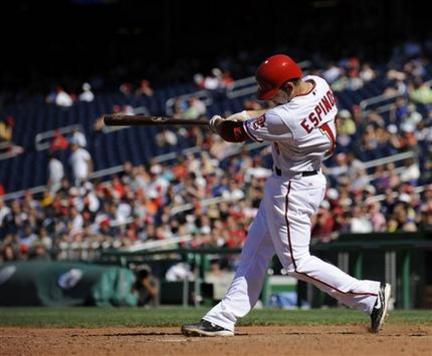
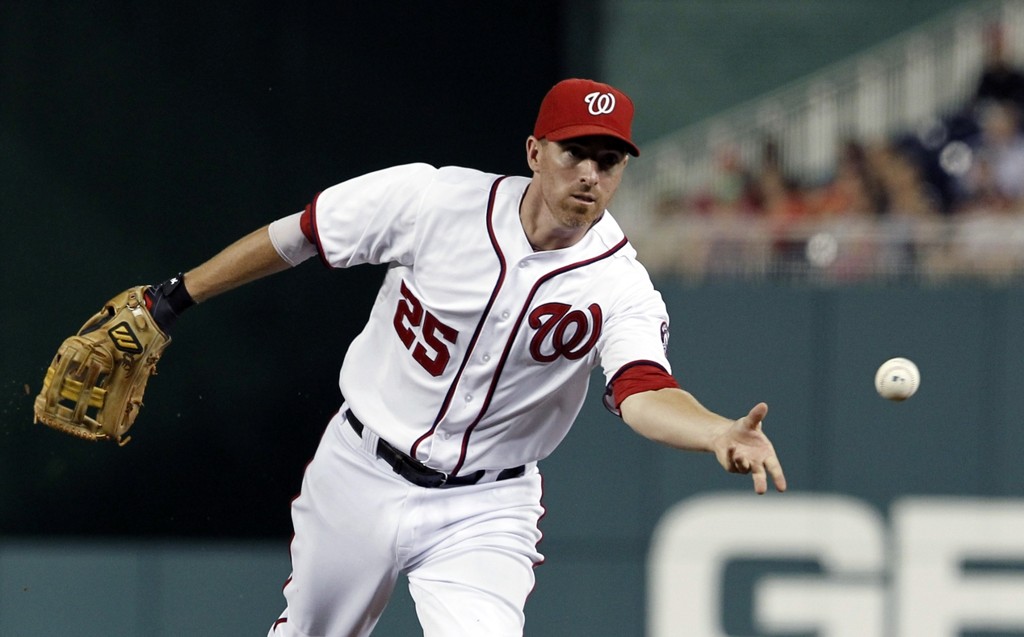
Espinosa's shoulder injury is the big news this week. Photo AP Photo/Nick Wass

These Inboxes are coming fast and furious!  Its almost like we’re just a few days away from Pitchers and Catchers reporting or something.  I should do an inbox response.  Except nobody emails me any questions.   Sometimes I wonder who emails Bill Ladson some of these questions, frankly, especially the people who keep asking about who the manager will be in 2014.  Anyway, here’s his 1/28/13 inbox and how i’d have responded.

Q: What is the status of Chris Marrero? Does he figure to contribute in the Major Leagues at all this year?

A: The phrase “what have you done for me lately” never seems more appropriate than when talking about Chris Marrero.   In November 2007 he was listed by Baseball America as our #1 prospect.   #1 over the likes of Detwiler, Zimmermann, Maxwell, Clippard, Desmond, Peacock, Norris and even Bernadina.    A season-ending injury in 2008, slow progress up our system and then last off-season’s torn hamstring have now dropped him to the Nats #23 ranked prospect overall.  #23 puts him behind “prospects” such as Corey Brown and right above 7-year minor leaguer Carlos Rivero.

The status of Marrero is this: he’s stuck at first-base, seemingly can’t play anywhere else, but doesn’t hit nearly enough homers in order to be a MLB first baseman.  So he seems sort of in a quandry.  Unless he suddenly turns into a 30-home run hitter over-night, or figures out how to play another position, he’s really in a tough spot.  On the Nats depth chart at 1B, he seems to be no better than 4th right now (LaRoche, Moore, Tracy).  That doesn’t bode well for him contributing at the MLB level.  It seems to me that the only way he’s playing meaningful minutes at first this year is if both LaRoche and Moore come down with season-ending injuries.

On the bright side; despite us hearing about him for years, he’s only 24.  But he’s running out of time.  He’ll burn his 3rd and last option in 2013 and isn’t going to be eligible for a 4th.  Marrero needs to hit lights out in AAA this year, get an injury on the big club and gets some big-league ABs, and build trade value.

Ladson has answered this question before and repeated his answer; he thinks Marrero needs to be traded.  Great idea!  Now, who exactly is going to trade for him right now?  And what exactly could the Nats get in return?  These sort of things matter when looking at trade candidates and it irritates me when they’re not taken into consideration by supposed “professionals” in the field.

Q: Given Danny Espinosa’s torn rotor cuff and disappointing second half last season, is there any chance Steve Lombardozzi will become the Opening Day starting second baseman?

A: Boy, the revelation that Danny Espinosa has a torn rotator cuff is big news to me.  Even though its in his non-throwing shoulder (obviously; if it was in his right shoulder he’d likely have had the surgery as soon as it happened), you have to think this affects his hitting.  In fact, the blog Nationals Review did just this yesterday in a great bit of analysis: before the estimated injury date Espinosa was hitting 255/.321/.416.  Afterwards (including his awful playoffs): .156/.241/.234.  That’s rather definitive, even if “after injury” only included a few weeks of the regular season and a 5-game series.

I think the injury gives the team a built-in excuse to replace him if he starts off the year struggling.  Opening Day though?  No way; Davey Johnson is a players’ manager, is old-school and will go with the team at hand unless someone gets hurt in Viera.  Ladson says lets see what happens in Spring Training.  I think that’s the baseball writer equivalent of an Economist saying, “It depends.”

Q: Do you think Johnson will sit Espinosa more often this season because of his injury?

A: Doubtful; he’s either going to produce or not.  If he doesn’t produce, look for him to be sent to the DL for surgery.  I don’t see him getting sat sporadically.  Ladson says that Espinosa won’t let that happen.  Last time I checked though, Espinosa was the player and Johnson was the manager.  So I’m not sure how he can make that command decision.

Q: What role do you foresee Christian Garcia playing this year?

A: I see Christian Garcia starting the year as a starter in AAA and then one of two things happening; either he hurts himself again, thus destroying the whole starter experiment.  Or, someone in the MLB bullpen gets hurt or gets ineffective (ahem, Henry Rodriguez anyone?) and Garcia-as-starter is scrapped as he’s brought up to pitch meaningful innings.  Ladson says he expects Garcia to be a bullpen member and doesn’t buy into the starter experiment.

Q: Assuming 2013 is Johnson’s final year, do you think his replacement will come from inside or outside the organization?

A: I just don’t get how people are obsessing over the 2014 manager.  Call me when the World Series is over and AFTER Johnson actually retires.  Ladson predicts someone from within.

Q: After Adam LaRoche’s contract runs out, could Ryan Zimmerman move across the diamond to first base and let Anthony Rendon play third?

A: This is exactly what I believe should happen.  My ideal world has Rendon hitting his way into a utility infielder role this year, pushing for more playing time next year (perhaps even forcing the Nats hand at 2nd base), and Zimmerman logically moving across the diamond to alleviate his mental issues with routine throws and to protect his body from the constant pounding he gets at 3rd.  Ladson wants Zimmerman at 3rd for a long time, apparently forgetting that Zimmerman increasingly has difficulty making routine throws and being incredibly fragile.

Q: What are the chances of the Nats opening the season with Bryce Harper in right field and Jayson Werth in left?

A: Zero.  But, honestly, Werth in left is a better defensive team.  Harper‘s so good in center while Werth‘s range is eroding in right, it just makes more sense to switch them up.  Why won’t it happen on opening day?  Deference to the veteran.  Deference to the contract.  I expect the OFs to switch around and get each of them playing time in all three positions.  Ladson says that Harper is more comfortable in left while Werth is an “above-average” right fielder.  Uh, not according to UZR/150, which had Werth at a very poor -14.2 in 2012.  Harper belongs in RF but it won’t happen overnight.

Soriano? Well at least its Rafael and not Alfonso

19 comments

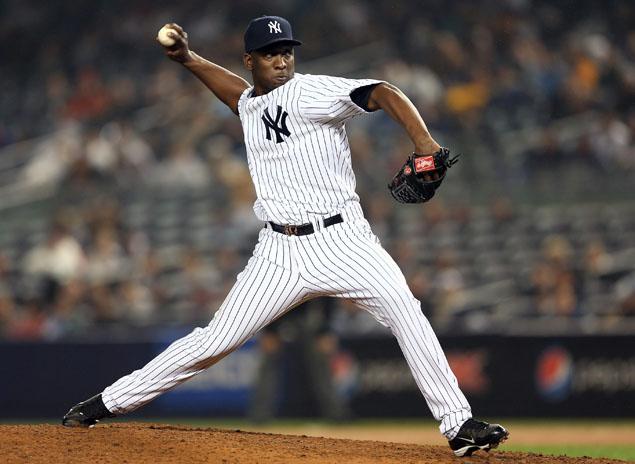
The Nats get some icing on the cake in Soriano. Photo Elsa/Getty Images via nydailynews.com

Jeff Passan broke the news, which I found out about only by chance late Tuesday afternoon (silly me, trying to do “work” or something).  Rafael Soriano to the Nats on a 2yr/$28M deal with a third option year that only vests with a relatively unattainable 120 “games finished” plateau reached.

Wow.  Did not see this coming.

Was this a reaction move to Drew Storen‘s meltdown in the 9th inning of NLCS game 5?  Adam Kilgore is reporting that the Nats owner Ted Lerner was “heavily involved” in the transaction, likely because of the amount of money involved and perhaps as a sign of the 2013 mandate to win it all.

Two quick reactions from a roster management perspective:

  1. First off, we can call off the need for lefty relievers.  Soriano’s so good against both righties and lefties that he can be the Loogy. 🙂
  2. Secondly, I’m guessing that either Tyler Clippard or Drew Storen is officially on the block.  The team certainly could have made the argument that they had too many right handed, back of the rotation candidates BEFORE today.  Now they’ve got three closer-quality arms but only one closer job.  And clearly Soriano is going to be the closer.  If you look at his career stats, when he’s closing he’s lights out.  185 ERA+ last year for New York, a 237 ERA+ as Tampa’s closer in 2010.  Clippard and Storen are good, but they’re not that good.  One or the other is likely traded now, so as to clear a log-jam of RH arms in the pen.   They *could* send down guys like Stammen or Storen (they have options available) but they’re too good to make way.  More likely is a trade.

New Look 2013 bullpen: Soriano closing, Clippard or Storen setting up, Henry Rodriguez and Mattheus in 7th inning roles, Duke as loogy/long-man, Stammen as 6th-7th inning/long man and Bray as the loogy.   Or perhaps Garcia makes the team while Bray pitches in AAA waiting for an injury.  Or perhaps Clippard and Storen both stay, and both Bray and Garcia start in AAA.  Or perhaps Clippard or Storen get packaged with Morse to bring back (as we’ve been saying for a while) both a lefty reliever AND some prospect depth.

I can see the blogosphere criticizing this deal for three reasons.

  1. That’s a lot of money for a closer (I think it makes him the highest paid closer in the game), and the deal is surprising in that Soriano now will easily earn more than the rest of the bullpen combined, a stark departure from Mike Rizzo‘s parsimonious methods of building bullpens lately.
  2. Yet another Scott Boras client for the Nats.  By my count that’s now seven Boras clients in the Nats system and five on the MLB roster (others: Espinosa, Werth, Goodwin, Harper, Rendon, Strasburg).  I hate the lazy narrative that Rizzo is somehow Boras’ b*tch, but we’re about to hear it again.  Check the agent database: yes we have a lot of his clients but so does Texas (7), Boston (8), Kansas City (6) and Detroit (6).  Boras just has a lot of good players, and the Nats are a good team where players want to come to play.
  3. This costs the Nats their 2013 first round pick.  It wasn’t nearly as high a leverage pick as before (#33 overall with a couple of compensation picks pushing it down from the #30 spot as last year’s best record would have indicated).  I’m sure the argument will be that Soriano > back-of-the first round pick.

$14M for a closer is a lot of money.  But hey, its not my money.  If we weren’t sure of it before, the Nats are now *really* officially saying that they’re going for it in 2013.  I’ll have to re-do both the salary and the WAR worksheets when I get some time to see how this factors in.

Ladson’s Inbox 1/14/13

16 comments

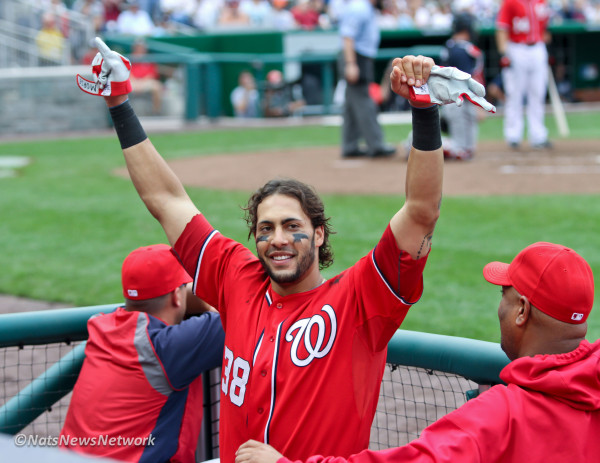
Free Michael Morse! Photo Jacqueline Martin/AP via federalbaseball.com

Another edition of Bill Ladson‘s Nats inbox, dated 1/14/13.

Q: Who will replace Davey Johnson once he retires after the 2013 season?

A: Who knows and who cares?  Can we wait until the end of the 2013 season to see if Davey Johnson actually retires?  I’m not convinced that he actually will retire if the Nats don’t win the World Series.  Even if he does retire, I think its pointless to speculate who in the baseball universe the team could possibly look to as a successor.  It could be a current TV pundit, a bench coach, someone elses manager, someone who just got fired, a minor league manager in our system, one of our current coaches, Mike Rizzo‘s uncle.  About the only person I think it will NOT be is Jim Riggleman.  Ladson says internal candidates Randy Knorr and Trent Jewett are good candidates, and throws out Joe Girardi‘s name based on his contract status coinciding with the end of next season.

Q: Is there any validity to the Nationals having interest in Javier Vazquez? If the Nats were to sign him, would they move Ross Detwiler to the bullpen so he could be their second lefty?

A: This topic as so irked me that I’m penning an entire post dedicated to it.  Check back later.

Q: If Michael Morse is only making $6.7 million, why not keep him around as insurance and a right-handed bat off the bench?

A: An excellent question.  Much like the team paid John Lannan to sit around in Syracuse for a year, they could do the same with Michael Morse.  Except that Morse is FAR more valuable in trade than in sitting around and wondering what he’s done to earn his fate.  He’s by all accounts a great clubhouse guy, but keeping him here would be detrimental to everyone involved.  I think the team needs to move him for lefty bullpen help and some farm system starting pitching depth.  Ladson says the team needs to do Morse a favor and trade him.

Q: Who do you see as the Opening Day closer — Tyler Clippard or Drew Storen?

A: Drew Storen.  Tyler Clippard had his shot at the title and lost it down the 2012 stretch.  I think the team goes back to its winning formula with Clip-Store-and Save in 2013.  Ladson thinks Johnson will go with “the hot hand” and split the role.  I don’t.  I think he’ll go right back to what he was doing before.

Q: With Adam LaRoche now signed, what are the Nats’ long-term plans for Tyler Moore?

A: Once Morse is traded, Moore becomes the big bat off the bench and does some fill-in work at 1st base and (maybe) LF.   I see his opportunities limited though unless we see some injuries.  Longer term, I think he’ll have to hit his way into full time playing time; if he does perhaps he’s the first baseman of the future.  I don’t see it though; I think he’s likely to find his way off the team through trade at some point.  The OF is full and 1B is blocked.  Ladson agrees, mentioning an interesting wrinkle; with Bo Porter now in Houston, perhaps a trade would be in order.

Q: Which Minor League player do you think will have a breakout season this year?

A: A good question.  Borrowing from Luke Erickson‘s NationalsProspects watchlist for 2013 (a very handy one-page summary of all the top/interesting prospects throughout the Nats farm system), I’ll pick three names that could press for quick promotion and big impact in 2013: Rendon, Skole and Goodwin.  Ok that’s a cop out.  I will say this: I *hope* that Rendon breaks out and finally hits like his draft pedigree.  Lets keep an eye this year on Nathan Karns and Erik Davis, two rising arms that could both feature in the bullpen in 2013.  I’d like to see Robbie Ray rebound.  For a deep-cut, i’m really interested to see what Kevin DiCharry does in 2013.   Ladson goes with the two obvious candidates Rendon and Goodwin.  I don’t think he follows the farm system that closely, so we’ll give him a pass.

Q: Is Ryan Zimmerman expected to be healthy for Spring Training?

A: I saw nothing in his surgery detail that indicated that the 2013 season was in jeopardy in any way.  Ladson confirms.

Q: If Jayson Werth bats in the middle of the order, what right-handed hitter is the best choice for No. 2 after Denard Span?

A: I’d probably say Jayson Werth is still the best option at #2.  The lineup that seems to make the most sense goes Span-Werth-Harper-Zimmerman-LaRoche-Desmond-Espinosa-Suzuki.  That allows the team to go L-R-L-R-L-R-S-R, a perfect balance.  Perhaps you switch Desmond and Werth.  Ladson thinks Harper is batting second most of the time.  Can’t see that; can’t see Johnson purposely going lefty with 3 of the first four guys in his rotation.  That seems to scream out easy Loogy matchups every night.

Q: Will Christian Garcia do any starting for the Nats next season? I know Johnson would love to see that.

A: A man can wish; I’d love to see Christian Garcia starting and bringing his stuff for 7 innings a night.  Unfortunately I don’t think he’s got the stamina in that arm (surgically repaired more than once) to start, no matter how much Johnson may want him as starter depth.  I think Garcia starts the year in AAA starting but soon finds himself back in the MLB bullpen.   Ladson says he’s getting stretched out and will provide cover for any injuries.


Ladson’s inbox 1/7/13 Edition

7 comments

r

Readers ask creative questions for keeping Morse around. It won't matter. Photo Cheryl Nichols/Nats News Network

Slow week for baseball news; I’m sure that will end tomorrow when the Hall of Fame class (or lack there of) is announced.  Meanwhile MLB.com’s Nats beat reporter Bill Ladson published a mailbag on 1/7/13.  Here’s how I would have answered his questions.

Update: after I wrote this, LaRoche signed.  So much for a slow news week for our Nats.  Some of the below may now be slightly dated analysis.

As always, I write the response here before reading his, and edit questions for clarity/conciseness.

Q: If Anthony Rendon stays healthy, could you see Ryan Zimmerman moving to first base and Rendon playing third base?

A: Yes, absolutely.  I’m now firmly on the following succession plan: Rendon hits his way to the majors, proves he can play excellent 3B defense, and we move Zimmerman and his nearing-Chuck Knoblock/Steve Sax issues with his throwing arm to first base.   Zimmerman would save the wear and tear on his body by not having to field bunts and dive for as many grounders, and would not have to make any more casual throws across the diamond (he’s proven that under duress or when hurried that he is very accurate, a clear indication that when he doesn’t think about the throw, he makes it).   And we install Rendon at third where by all accounts he’s just as good a defender as Zimmerman is.

However.  There’s a few things that need to happen for this plan to work.  Rendon (as the question mentions) needs to stay healthy.  He needs to prove he can hit MLB pitching.  And the Nats need to NOT lock up first base for the next three seasons with Adam LaRoche, else the position is blocked, Zimmerman stays at 3B for the duration of LaRoche’s deal and Rendon will have to push someone else off their position (Espinosa at 2b is the likely target … but Espinosa is nearly a 4 win player despite his strikeouts.  They don’t grow 4 win players on trees).   So Rendon may be stuck until another solution presents itself, perhaps by way of injury.

Update: with LaRoche’s signing,  we now know that Zimmerman isn’t moving to 1B for at least two  years, so now Rendon’s path is more complicated.

Ladson kind of hedges and says “well, lets just see what happens.”

Q: Why the talk of trading Michael Morse when trading Jayson Werth would be far better for the team? Besides all the money it would free up, Morse is three years younger, hits far better, especially with men on base, and has more power.

A: Because who in their right mind would take Jayson Werth with the massively backloaded contract he’s currently on while he’s in his decline years in his mid 30s and has shown himself suddenly to be injury prone??  That sentence is exactly the reason that the Werth contract was and is criticized as being one of the “worst in the game.”   Because its unmoveable.   He’s going to be paid $21.57 million dollars in the year 2017 when he’s 38.   If Werth was still producing at his last Philadelphia year level (he posted a 4.3 bWAR in 2010, which using a rough FA estimate of $5M/war would mean he was “valued” at exactly $21.5M), there wouldn’t be as much complaining.  But in the first two years of the contract, he hasn’t produced anywhere near that WAR value (bWARs of 1.0 and 0.6 in the first two years of the contract).  Yes he was hurt in 2012, but its not like he’s giving back the money for the 81 games he didn’t play.

This is such an ignorant question, you wonder why Ladson took it.

All that being said, yes I understand why the Nats made the Werth deal.  I think it was done fully well knowing what an albatross it was to be.  It was done to acquire the competitive nature of Werth and to send a message to the league that the Nationals were a new regime post Jim Bowden.

Ladson talks about Werth’s “non number” contributions to the team, saying he’s more valuable than numbers suggest.  I think that’s a really myopic viewpoint of Werth’s contract, his production and the point of the question.

Q: Any worries about losing three left-handers out of the bullpen? That was a big strength last year. What are the options?

A: Was our three lefties really that big of a strenth last year?  Other readers here have pointed out Michael Gonzalez‘s complete inability to deal with right-handers (they hit him for a .297/.378/.484 slash line in 2012), meaning that the team really could only trust Gonzalez for solely lefty-lefty matchups.  Tom Gorzelanny was the 7th guy out of the pen, the long-man/mop-up guy whose large majority of IP were defined as “low leverage,” implying that despite his excellent ERA in 2012 his production can be replaced relatively easily.  Sean Burnett was inarguably great … but also was commanding 3 year guaranteed contracts in a baseball management era where we now know that relievers should be treated as fungible assets and never guaranteed major money to.  So allowing him to leave was the right decision to make.

Gorzelanny has been replaced by Zach Duke, who (as I’ll begrudingly admit that “peric the troll” was right about, stemming from a conversation here last September) seems to be a better option and who seems to have been given all of Gorzelanny’s appearances last September (Gorzelanny didn’t appear in a game for nearly two weeks in the middle September).

However, I will admit that I am slightly worried about the fact that we seem set to replace the value of both Gonzalez and Burnett at this point with Bill Bray, who may or may not even make the team.  I really thought we’d win the J.P. Howell FA sweepstakes.  Now at this point, I’m guessing perhaps the team just trusts the matchups and remembers that Tyler Clippard is lights out against lefties despite being a RHP (lefties hit him for a .170/.260/.259 slash line in 2012, a year when Clippard was significantly worse than in 2011).  Maybe the team finds a MLFA or a career reclamation project out there (much as they did with Gonzalez and Duke last year).   Or (most likely) maybe the team demands a lefty bullpen arm in trade for the eventual Michael Morse transaction once LaRoche signs on for 2013 and beyond).  We’ll see; lots of hot-stove league left.

Ladson thinks there’s more acquisitions coming.

Q: Morse was drafted as a shortstop, so is there a way the Nationals could convert Michael into a second baseman?

A: If Morse’s mobility is that poor in LF, he’d be considered a statute at 2nd.  There’s just no way he could possibly move there at this point.  Besides, Espinosa is considered a very good defender and the Nats regime values plus defense.  He may have been a shortstop once, but that was long ago.  Ladson says its never going to happen.

Q: What are the chances the Nats try to make a trade for Giancarlo Stanton? Then they can put Werth or Bryce Harper at first base.

A: Hah.  Well, I’m sure the Nats (and most every other team in the league) would kill to have Stanton.  But Stanton is probably the most valuable resource in the game; a pre-arbitration premiere slugger.  The only thing more valuable probably is a pre-arbitration Ace starter (think Tim Lincecum before he hit arbitration).   Stanton is under team control for four more years and isn’t even arbitration eligible yet.  On the open market he’s worth $25M/year; he’s set to earn somewhere in the mid $500,000 in 2013.   It would have to take something well north of the prospect haul that Tampa Bay got in the James Shields trade, and that trade netted Tampa Wil Myers, basically the best propsect in the game.

The Nats (and most teams in the game) simply do not have enough prospect depth to pry Stanton away.  And, the Marlins would have to be crazy to trade him intra-division.  Just isn’t happening.  I think the penny pinching Marlins keep him for another year and trade him before he hits arbitration, making him someone elses’s escalating salary issue.   Ladson says that the team wouldn’t trade for Stanton because their outfield is set for the next two seasons.  Really!?  You wouldn’t trade away Span or Werth, even if you paid their entire ride, to acquire someone with the talent of Stanton?

Q: What are the Nats’ plans with Jhonatan Solano going forward?

A: Catcher depth.  Despite his .300+ BA in his short MLB stint, I don’t think he’s anything more than a 4-A player.  We keep him on the 40-man until his options expire and then DFA him, all the while he serves as a 3rd catcher in case Ramos/Suzuki gets hurt.   Ladson points out that Suzuki is a FA after 2013, so perhaps Solano becomes the #2 in 2014 and beyond.  However, Suzuki has a club option for 2014 that could move this schedule out a year.

How does the Nats WAR add up for 2013?

9 comments

How much WAR is Haren bringing to the 2013 Nats? Photo unknown via wikipedia

Mark Zuckerman posted a nice little Wins Above Replacement (WAR) analysis article in the wake of the Gio Gonzalez signing back in December 2011, showing that without any further moves and with the expected projections of WAR improvement the 2012 Nats should improve by nearly 12 wins if our injured stars return to the norm and produce as expected.  As it turned out, he was right … and wasn’t “right” enough.  He actually under-valued the WAR contributions of a newly healthy Adam LaRoche and of what Gonzalez would give the team (and of course nobody could have predicted what Ian Desmond would do nor how big an impact Bryce Harper would have) and the Nats ended up improving 17 games instead of a predicted 12 from 2011’s 81-81 team.

Here’s a similar analysis for your 2013 Nats, with some thoughts on players who may improve or regress from their 2012 WAR totals, and then using that analysis to predict how the team may fare in 2013.  I have uploaded my working 2013 fWAR spreadsheet to docs.google.com (also a link on the right-hand side of the page), which is the basis of the cut-n-paste tables below.  For the purpose of this article, we’re assuming that LaRoche is leaving and Michael Morse is playing 1B full-time, that Bill Bray is making the bullpen, and that Christian Garcia is starting in AAA.

A quick note before starting: the two leading baseball stats sites both have their own versions of the Wins Above Replacement stat.  Baseball-Reference’s WAR (usually abbreviated bWAR or rWAR) was developed by Sean Smith at BaseballProjection.com.  Meanwhile, fangraphs.com has developed their own version of WAR (usually abbreviated fWAR to distinguish from the Baseball-Reference version).  A good analysis of the differences between the two WARs is here: the main differences relate to the use of FIP versus ERA and TotalZone versus UZR for defensive additions.  In this article i’m using solely fWAR.  I think fWAR is slightly better and uses better component parts, though honestly the difference between the two is often negligible.

How many wins would an entire team of replacement level players win?  In other words, where do you start adding WAR figures to, in order to estimate how many wins you should expect out of your team?  Jim Breem of the Milwaukee-Wisconsin Journal Sentinel did just this study in Jan 2011 and discovered that the average of replacement level wins across MLB in 2010 was 45.5 wins.  In other words, you could expect a team of nothing but AAA-level veterans or 0.0 WAR players to win about 45-46 games in a season.  This is about on par with the figure’s I’ve heard in various chats, and is somewhat supported by last year’s awful Houston Astros (who finished 55-107 and had just a handful of players posting a 1.0 WAR or greater).   The 2012 Nats fWAR totaled exactly 50.0, the team finished 98-64 and they had a Pythagorean record of 96-66,  implying that a team of replacement Nats players would win between 46 and 48 games, right in line with Breem’s studies.  For the purposes of predicting the # of 2013 Nats wins we’ll use 46 as a floor.

How did our returning players fare in 2012, and what might they contribute in 2013?  Here’s my estimates for all returning players.  This table is sorted by 2012 fWAR from highest to lowest.  (b) after a pitcher’s name indicates the fWAR contributions (or lack thereof) of that pitcher at the plate.

2012 fWAR 2013 fWAR Est Trend from 2012
Ian Desmond 5.4 5 Down
Gio Gonzalez 5.4 4.8 Down
Bryce Harper 4.9 6 Up
Ryan Zimmerman 4.5 5 Up
Stephen Strasburg 4.3 5 Up
Danny Espinosa 3.8 3.8 Even
Jordan Zimmermann 3.5 4 Up
Roger Bernadina 1.9 2 Even
Ross Detwiler 1.8 2 Even
Jayson Werth 1 1.5 Up
Tyler Clippard 1 1 Even
Steve Lombardozzi 0.8 0.8 Even
Craig Stammen 0.8 0.8 Even
Stephen Strasburg (b) 0.7 0.8 Even
Drew Storen 0.7 1 Up
Tyler Moore 0.6 0.6 Even
Wilson Ramos 0.6 0.2 Down
Kurt Suzuki 0.6 1.5 Up
Chad Tracy 0.5 0.5 Even
Jhonatan Solano 0.4 0 Down
Jordan Zimmermann (b) 0.4 0.4 Even
Michael Morse 0.3 3 Up
Zach Duke 0.2 0.8 up
Corey Brown 0.1 0 Even
Eury Perez 0.1 0 Even
Christian Garcia 0.1 0 Even
Sandy Leon 0 0 Even
Ryan Mattheus (b) 0 0 Even
Zach Duke (b) 0 0 Even
Craig Stammen (b) -0.1 0 Even
Carlos Maldonado -0.1 0 Even
Ryan Perry -0.2 0 Even
Ryan Mattheus -0.2 -0.2 Even
Gio Gonzalez (b) -0.3 -0.3 Even
Henry Rodriguez -0.4 -0.4 Even
Ross Detwiler (b) -0.5 -0.6 Even

Here’s some discussion on my estimates:

Players who I’m trending Up: Harper, Zimmerman, Strasburg, Werth, Suzuki, Storen, Zimmermann, Morse and Duke.  I have Harper going from a 4.9->6.0 fWAR player, which frankly may be selling the kid short.  Lots of pundits think he’s going to explode in 2013 for a Mike Trout-like season.  I think both Zimmerman and Strasburg can achieve 5.0 fWAR seasons.  I think Werth can go from a 1.0->1.5 with a full healthy season, especially if he continues to hit as he did upon returning last year (we’ll ignore for a moment that he’s not “earning” his salary with fWAR seasons in the 5.0 fWAR range like he’s being paid to do).  Suzuki has a couple of 3.4 fWAR seasons under his belt; estimating him at 1.5 may be selling him short.  Storen returns to the closer role healthy, though an improvement to just 1.0 fWAR would be a career best for him.  I’m predicting an improved season out of Zimmermann, who seemed to tire at the end of last season in his first full season back from Tommy John surgery.  Morse has a huge increase predicted (from 0.3->3.0) but he posted a higher fWAR than that in his breakout 2011 season; if he’s here and playing full time, there’s no reason to not expect another season like 2011’s.  Lastly Duke’s 0.8 fWAR estimate may be exceedingly high, but he managed to add 0.2 fWAR in just a few weeks of work in September.

Players who I’m Trending Down: Desmond, Gonzalez, Ramos and Solano: I think Ramos and Solano’s contributions are now limited and/or blocked by Suzuki, so their fWAR contributions drop accordingly.  I’m building in some regression for both Desmond and Gio from last year’s fantastic performances.  Most every player with an estimate of 0.0 for 2013 is assumed to be spending the majority of the season in the minors (notably Ryan Perry and Garcia, but also the likes of Corey Brown,  Eury Perez and all the backup catchers we had to use last year).

Notable Players who I’m trending about Even: Espinosa, Bernadina, Detwiler, Clippard, Stammen, Henry Rodriguez: Even, meaning they’ll contribute about the same in 2013 that they did in 2012.  Is Clippard going to contribute 1.0 fWAR in 2013?  Maybe not.  Can Stammen repeat his stellar performance?  Will Rodriguez continue to drag down the bullpen with a -0.4 fWAR?  If anything, Espinosa should improve on his 3.8 fWAR; he’s trending up year over year.  I’ve listed almost all our backups (Bernadina, Lombardozzi, Moore, Tracy, etc) as being even year over year; there’s no reason right now not to expect the same performance we got out of them in the coming season.  For the moment I’m leaving Garcia in AAA, and have his fWAR at zero; if he were to join the bullpen on a full time basis he could contribute half a WAR or more.

Here’s a quick look at our new players acquired this off-season:

New Players for 2013 2012 fWAR 2013 fWAR Est Trend from 2012
Dan Haren 1.8 4.5 Up
Dan Haren (b) -0.1 -0.3 Down
Denard Span 3.9 3.9 Even
Bill Bray -0.6 0.3 Up
Bill Bray (b) 0 0 Even

Perhaps the most controversial estimate in this article is Haren‘s 2013 fWAR number.  I’m estimating that he’s going to return to his previous form and at least post a 4.5 fWAR.  If you look at his history before 2012, you’ll see he’s easily capable of posting a 6.0 fWAR or higher.   I think the team gave him the contract they did because they’re assuming he’s healthy and assuming he can return at least to his 2011 form.  A 4.5 estimate may end up being low.  Meanwhile, I’m assuming Span is going to just repeat his 2012 performance, and I’m assuming that Bray improves upon his own poor 2012 and returns to something closer to his 2011 form (where he posted a 0.7 fWAR).

Given the above breakdown, here’s how the summaries look:

2012 fWAR 2013 fWAR Est
sum of 2012 fWAR of returning players –> 42.6 49 <– Sum 2013 fWAR estimates existing players
sum of 2012 fWAR for departed players –> 7.4
8.4 <– Sum 2013 fWAR estimates new Additions
sum of 2012 fWAR –> 50.0 57.4 <– Sum 2013 Nats fWAR Estimates

Ok, what does the above table mean?

  • Sum of WAR Returning of 42.6: this is the sum of the fWARs of all pitchers and batters in 2012 who are returning to the team in 2013 (as broken down in the upper table).
  • Sum of WAR Gone of 7.4: this is the sum of the fWARs of all pitchers and batters in 2012 who are no longer with the team.  Adam LaRoche leads this list with a 3.8 fWAR in 2012, though also included in this list are a number of negative fWAR players who drug the team down last year (DeRosa, Wang and Nady especially).
  • Sum of 2012 Nats fWAR of 50.0: This is the sum of returning and departing 2012 players, and is the same number referenced above.
  • Sum fWAR estimates of existing players: 49: This is the sum of the fWAR for all our returning players for 2013; notice this is higher; I’m predicting that through attrition of poor players and some improvement over 2012, we can expect our team to be nearly 7 wins improved.
  • Sum fWAR new additions: 8.4: Span, Haren and Bray should add 8.4 fWAR (as shown in the second table).
  • Sum 2013 Nats fWAR estimates: 57.6

That’s right; I believe the team has an fWAR capability of 57.6, or 7.6 wins more than last year.  Adding that to the previously discussed fWAR floor of 46 games and you have a 103-104 win team.

What happens if LaRoche comes back?  If anything the team could be improved even more.  LaRoche posted a 3.8 fWAR in 2012, while Morse’s BEST fWAR season was his 2011 breakout of 3.3.  If we assume LaRoche can repeat his 2012 performance at least for one year into a 2-3 year contract, then the team’s fWAR estimates rise again.

Does this mean I’m predicting that the 2013 Nationals are going to win 104 games?  Well, no.  Every single one of these estimates implies a 100% best case scenario; no injuries and for the most part all our players playing at their capability levels of 2012.  In reality, we’re going to see some time lost due to injury from key players, and we’re going to see some regression from some players.  The hope is that those regression periods are matched by improvements from other players, or from breakout performances from players who were in the 1.0 fWAR range in the past (think Desmond in 2012).

One last note on WAR (which I’d love to see others’ opinions about): I admittedly have an uneasy and not always consistent opinion on the statistic.  On the one hand, I absolutely believe that career WAR values reward accumulator type players and skew career WAR figures (my favorite example to use is Bert Blyleven, who currently sits with the 39th largest career bWAR in the history of the game.  But no one in their right mind would claim that Blyleven was the 39th best player to ever play the game… so there’s a disconnect that I have a difficult time dealing with).  But, on the other hand, WAR usually does a nice job of quantifying individual seasons, and lending itself to the kind of analysis I’ve just done here.  Do I need to overcome my reservations of using the statistic?  How can I reconcile my concerns with the overall prevalence of the stat?

Ask Boswell 12/10/12 edition

9 comments

Denard Span's "best of 2012" defensive catch, highlighting more of what we can expect in 2013. Photo NYpost.com

I wasn’t expecting much baseball talk in Ask Boswell this week (12/10/12), not with the Redskins on a 4-game winning streak.  But there were some significant baseball moves to discuss, and a ton of baseball questions made their way in.  So here we go.  As always, I read the question and answer before reading Tom Boswell‘s response, and sometimes edit questions for clarity:

Q: I find it hard to imagine any starter of worth will sign with the Nats now that there are five rotation certainties in place.  Will the Nats get the starter depth they desire?

A: There is definitely a class of starter out there who absolutely would take a minor league contract with a team like the Nats in order to rehabilitate their FA value, which may have been eroded due to injury or a bad season.  Who would sign Erik Bedard (as an example) to anything guaranteed right now?  Or Jonathan Sanchez?   I would say though that more likely is the team acquiring guys on the minor league free agent market (where there’s 100s of guys available) and trading for farm system depth (I could envision both Michael Morse and Danny Espinosa being moved for prospect depth right now).  Boswell didn’t really address this part of the question, instead focusing on the next question.

Q: Why did Rizzo non-tender Gorzelanny, who as the LHP long man could spot start? He has been effective at times, the non-tender now seems like a false economy.

A: Simple econonmics; despite Tom Gorzelanny‘s salary being miniscule in the grand scheme of things, they couldn’t tender him and risk getting an un-acceptable award in arbitration.  I posted on the topic ahead of the non-tender deadline.  I’m hopeful that Gorzelanny re-signs with the team at something close to his 2012 salary.  But, that being said the bullpen looks awfully full right now and there might not be room for him.  5 returning RH relievers, new signing Zach Duke and only one spot left, likely being filled by Bill Bray in a pure LOOGY move.  Boswell points out that Duke exactly replicates what Gorzelanny would have given us at a fraction of the price.  Enough said.

Q: How do you like the Denard Span acquisition versus Philly’s acquisition of Ben Revere?   Should the Nats have acquired Revere instead of Span?  Do the Nats have an internal CF option after Span’s contract ends?

A: I posted my opinion on the Span deal here; quick analysis: liked the Denard Span deal but didn’t like that they made it.   Now, if I compare the Span to the Revere deals, I can’t help but say that I think Philadelphia overpaid, badly.  Trevor May was Philly’s #1 prospect in their system.  May for Revere may have been a decent deal (akin to our own Alex Meyer for Span), but throwing in a servicable starter with 46 decent MLB starts under his belt was questionable.  It isn’t like Ben Revere is the second coming of Joe DiMaggio; he had a 89 OPS+ last year in his third pro season.  Great defense absolutely, but at what cost at the plate?  At least Span profiles as a better-than-league-average hitter.   The Span contract is for 2 years, by which time the Nats have a slew of potential replacements (in likely order Goodwin, Perez, Hood, Taylor), so yes there’s plenty of rising talent in the system at center.  Boswell doubts the talent of Trevor May despite the consensus scouting opinion of the player, but he likes Worley and thinks the Phillies “took a flier on talent.”  He does think Span > Revere though.

Q: Have the Nats done enough to their roster to win it all?  Do they need another closer?

A: I believe the team has already done enough to re-qualify for the 2013 playoffs, especially in the NL East where Miami and the Mets are reeling, barring a slate of pitching injuries.  I can make a legitimate argument (tease for a future post) that the WAR improvements expected from our existing players (Strasburg, Harper, a full season of Werth, etc), plus addition by subtraction for players who hurt us last year (Nady, DeRosa, Henry Rodriguez, etc) alone will result in a better team than 2012.   Do we need another closer?  No, but I think one more right handed option out of the pen could help.   That being said, we don’t really have any 25-man room right now given the anticipated pen.  I liked last year’s Brad Lidge signing as a way to get some bullpen help, but doubt the team will do it this year.  As far as Drew Storen goes, he’s a top notch reliever and does not need to be replaced.  But I could see the team flipping him or Tyler Clippard as they get more expensive.  Boswell says the Los Angeles acquisitions change the game, and teams like the Nats may have to re-think their approaches.

Q: What do you think of the Shields trade? Who comes out ahead? Do the Rays have enough pitching to remain AL East contenders, even after trading their No 1 starter?

A: I believe Tampa Bay fleeced Kansas City; Shields was NOT their #1 starter (David PriceJeremy Hellickson) or honestly maybe not even their #3 (Matt Moore, at least on potential).  So the Rays traded a mid-rotation starter who they wanted to move anyway, along with a long-man in Wade Davis for the best prospect in the minors right now  (Wil Myers), the Royal’s #1 pitching prospect (Jake Odorizzi), another high-end pitching prospect (Mike Montgomery, a former highly regarded arm), and yet another minor league player.  That is just frankly ridiculous.  If you had told me the trade was simply Myers for both Shields and Davis, I could have squinted and understood.  But the addition of the other prospects made this a complete heist for Tampa.  You don’t trade the best prospect in the minor leagues for anything less than an ACE starter.  Does Tampa have enough to remain AL east contenders?  Absolutely yes; this was a trade of spare parts for Tampa (akin to the Nats trading Tyler Moore and Steve Lombardozzi for some other team’s two best prospects) and they didn’t give up anything that they weren’t already planning on replacing.  Dayton Moore has gone all in on this move; if the Royals do not win the division in 2013, he’s out of a job.  Boswell didn’t really offer an opinion, just saying that the Rays are still stocked and noting that the price in prospects was why the Nats stayed away.  Disappointed not to read an opinion on the trade.

Q: Will Harper be hitting cleanup this year and, if so, what’s your thinking on this?

A: Answer: It depends.  If the team does NOT re-sign Adam LaRoche, then they have precious little left-handed hitting in the lineup, and Harper will be forced to bat somewhere in the middle of the order.  Cleanup may have to be the spot.  If LaRoche does come back, then the team can spread out its lefty power and continue with a similar lineup to what they used last year (going Harper-Zimmerman-LaRoche-Werth for L-R-L-R).  I certainly don’t think that someone like Harper will have any issues batting clean-up in the major leagues; one thing he’s never been accused of lacking is pride.  Boswell agrees with the opinion here, and then talks about just how much respect Harper earned in his rookie season.

Q: Should I be worried about our pitching depth? Our pitching was remarkably healthy this year and if that doesn’t hold true, especially with questions about Haren’s health I am not sure we can assume that will hold true this season. Don’t we need another starter or two who could eat innings if needed?

A: Yes, we have a depth issue.  Especially given that we’ve traded nearly an entire AAA team worth of rotation insurance in the last two off-seasons (Milone, Peacock, Meyer, Rosenbaum all traded away or lost to rule 5 in the last two off-seasons).  But Dan Haren has been remarkably durable through his career, only missing 28 games in his entire career to injury.  So lets temper the whole “Haren is fragile narrative.”  He’s not; he just happened to have an injury in 2012.  I’m assuming, until proven otherwise, that Haren will return to his previous form and throw 220 innings.  Does this mean that we weren’t lucky in 2012 and should plan for someone to get hurt in the rotation?  Absolutely.  I believe this is why moving either Michael Morse or Danny Espinosa for starter depth is wise.  Boswell reminds the reader about Duke’s starting capability and the team’s plans for Christian Garcia.  There’s also Ryan Perry.  And there’s also the slew of guys who won’t get MLB jobs but who aren’t ready to hang them up who will be there for the taking.  You know, guys exactly like Duke was last year 2 days before the start of the season.

Q: Don’t you think that if LaRoche was going to re-sign that he would have by now? If he goes, have the Nat’s alienated Morse?

A: No; the baseball off-season moves slowly, and few moves happen before the Winter Meetings anyway.  LaRoche is right on schedule for his negotiations.  Now, the team’s overt coveting of LaRoche has to have Morse pissed.  I would be; clearly the team is planning for your exit on a day to day basis in the open press.  Which is a real shame, because I like Morse and don’t think he did anything to warrant being treated this way.  Boswell somehow thinks that this whole dance is a compliment to Morse.  I don’t get it.

Q: Rizzo has a 2 year offer on the table for LaRoche, and history says he’s not likely to budge. Moreover, with other options like Morse and Moore, there’s no reason for him to. If another team needed help at 1B and was willing to give LaRoche 3 years, wouldn’t they have done so already? You’ve said all along you see the Nats and LaRoche amicably parting ways. Still see it that way?

A: Rizzo can budge on his demands.  Hey; at least it isn’t a four year deal that LaRoche is demanding.  I think a 2year deal with a club option for a 3rd makes a lot of sense for the team.  For the player, not so much.  This is LaRoche’s last chance at the free agent bonanza; he has to get the biggest contract he can.  The market for LaRoche won’t completely clear until Josh Hamilton signs.  While they’re not apples-to-apples comparisons, they are both lefty power hitters.  If a team that wanted Hamilton doesn’t get him, they can come looking for LaRoche to fit a middle of the order lefty bat.  The team still needs and wants LaRoche for two main reasons; plus defense and lefty power.  They’ll take a step backwards in both categories by going with Morse at first and Moore as first guy off the bench.  At the beginning of the off-season I thought LaRoche was leaving, because he’d want (and get) a 4 year deal.  Now I think he may be back.  Boswell now thinks LaRoche may be back and the team may give a 3rd year.

Q: I realize that the life with LaRoche is much preferred by the Nats. However, do you think there will be much of drop off in the quality of Nats play? Even without him, I have no doubt that the Nats will still win their share of games and make the playoffs (assuming the starting rotation stays relatively healthy). All starters are strike out pitchers. Offensive production should be about eqaul (though not as balanced),and Morse/Moore will probably make a few more errors. I feel like moving Zimmerman to first in 2014 and have Rendon starting at third would be the ideal way to make sure the core stays in tact.

A: I mostly agree; we’ll live without LaRoche but will be righty-heavy.  Morse is healthy and has shown 30 homer capabilities in the past; why wouldn’t he do that again in 2013?  It is a contract  year for him after all.  Meanwhile. the “save first base for Ryan Zimmerman” plan is one I’m 100% for; we’re just waiting for Anthony Rendon to show up.  Boswell cautions to temper expectations for Rendon, who hasn’t had an injury-free season in years.

Q: Why does Shane Victorino get a 3 year deal before Adam LaRoche?

A: Because the Red Sox made a rash, poor signing?  The LaRoche market just hasn’t played out yet.  Plus, filling a first baseman versus a corner outfielder is more risky for teams, so they do more due diligence.  Boswell doesn’t like the Victorino deal.  At all.

Q: Michael Young had the lowest WAR of ANY position player last year, do you really think he’s an upgrade for the Phillies? Personally, I can’t wait for those fans to start booing him 2 weeks into the season.

A: Yes, Michael Young looked pretty bad statistically last year.  But i’m guessing that a change of scenery may help him.  Texas has spent the past several seasons acquiring players to overtly replace Young; the year after he won a gold glove at short the team asked him to make way for Elvis Andrus and he moved to third.  Then the team moved him off of third when they acquired Adrian Beltre.  Then the team moved him to first … but then gave most of the starts at first to Mitch Moreland Maybe his 2012 was just pure disappointment in his treatment by the club where he’d played his entire career.  I think though that at his age (36 next year) he’ll be lucky to be just replacement level.  Boswell states the obvious; the Phillies are hoping for the 2011 version of Young, not the 2012 version.


Nats 2013 Salary Status – Post Span, Post non-Tenders

8 comments

Werth is the highest paid Nat ... for now. photo: Mitchell Layton/Getty Images NA

Now that Denard Span has been acquired and the Nats have cut loose the expected non-tender candidates (saving about $9M in estimated arbitration salary), the next phase in the Nats off-season can commence.

A couple of larger question remains; is the team pursuing a major starter, either via free agency or in trade?  And, is the team going to commit large payroll dollars to Adam LaRoche? Perhaps that question can be answered by looking at the team’s payroll commitments and making educated guesses as to how large a 2013 payroll Mike Rizzo will be given to work with.

The Nats payroll as risen from roughly $66M in 2010, to $68M in 2011 to $92M at the beginning of last year.  $92M only ranked the team 20th in the league in payroll and we were rewarded with the best record in baseball.  Is it safe to assume that payroll will be allowed to rise again?  I think it is; Rizzo’s Span trade was clearly a “win now” move, looking to capture the team’s current shape (which is mostly locked in place for at least 3 years) and build on it towards a World Series title.  To that end, I think it is safe to say we can expect at least a rise to the $110M payroll plateau for 2013’s team.  Perhaps even higher.  (If you disagree, definitely discuss in the comments section).

Where do we stand now?  Using a combination of Cot’s pages and MLB Trade rumor’s arbitration salary estimates, here’s a guesstimate as to where the team stands, right now, in terms of 2013 payroll:

(note; this XLS is available in the Links section of this blog, as well as directly via this link.  There’s a bit more information online than I cut-n-pasted into the tables below, including salary workings for previous years).

Players currently under contract for 2013 under existing contracts: 12 players

Under Contract for 2013 (12) Current or 2013 Contract 2013 Salary
Werth, Jayson 7 yr/$126M (11-17) $16,571,000
Zimmerman, Ryan 5 yr/$45M (09-13) $14,100,000
Morse, Michael 2yr/$10.5M (12-13) $6,750,000
Suzuki, Kurt 4 years/$16.25M (2010-13), plus 2014 option $6,450,000
Gonzalez, Gio 5yr/$42M (12-16)+17,18 options $6,350,000
Span, Denard 5 years/$16.5M (2010-14), plus 2015 club option $4,750,000
Strasburg, Stephen 4 yr/$15.1M  (09-12) + 3.9M for 2013 $3,900,000
Maya, Yunesky 4 yr/$8M (10-13) $2,000,000
Harper, Bryce 5 yr/$9.9M (11-15) $2,000,000
Rendon, Anthony 4yr/$7.2M ($6M bonus) (12-16 w/ 17 opt) $1,800,000
Purke, Matthew 4yr/$4.15M (2.75M bonus) (12-16) with 2 club opts $1,037,500
Tracy, Chad 1yr/$1M (2013) $1,000,000

Total amount of payroll guaranteed here: $66,708,500

Arbitration Cases for 2013: 7 players.  Note that I don’t entirely agree with all these estimates, thinking some are high (Clippard) and some are low (Storen), but the model that estimated them is pretty good, so we’ll go with these numbers.

Arbitration Eligible Players for 2013 (7) 2013 MLBtraderumors Arbitration Salary Estimate
Clippard, Tyler $4,600,000
Zimmermann, Jordan $4,900,000
Desmond, Ian $3,200,000
Storen, Drew $1,700,000
Stammen, Craig $900,000
Detwiler, Ross $2,200,000
Bernadina, Roger $1,100,000

Estimated amount of payroll here: $18,600,000

Pre-Arbitration players with club-Assigned Salaries: 7 players.  I believe the 2013 MLB minimum salary is $490k; i’m guessing that the team will “give” a bit more salary to some of these guys, but the difference between $490k and $515k isn’t much in the grand scheme of things.

Pre Arbitration MLB players (7) Rough 2013 Salary estimate
Espinosa, Danny $525,000
Ramos, Wilson $505,000
Rodriguez, Henry $500,000
Lombardozzi, Steve $490,000
Marrero, Chris $490,000
Mattheus, Ryan $490,000
Moore, Tyler $490,000

Total amount of payroll guaranteed here: $3,490,000

Other 40-man Players pre MLB service (10): The list of guys below are all on minor league deals and (I believe) don’t collect a full MLB salary, and I don’t project any of them on the 2013 opening day roster.  They’re listed here to complete the 40-man roster members.

Other 40-man Players pre MLB service (10)
Davis, Erik 1yr Minor League deal
Garcia, Christian 1yr Minor League deal
Karns, Nathan 1yr Minor League deal
Kimball, Cole 1yr Minor League deal
Perry, Ryan 1yr Minor League deal
Leon, Sandy 1yr Minor League deal
Solano, Jhonatan 1yr Minor League deal
Rivero, Carlos 1yr Minor League deal
Brown, Corey 1yr Minor League deal
Perez, Eury 1yr Minor League deal

Total estimated 2013 payroll right now: $66,708,500 + $18,600,000 + $3,490,000 = $88,798,500.

So, going on the assumption that the team has about $110M to work with, can Mike Rizzo still acquire a 5th starter, a left-handed reliever and possibly Adam LaRoche with about $20M of free agency dollars?  I don’t think they can.  Now, if payroll were to rise to about $120M?  That’s $30M right now to acquire those three resources.  LaRoche at $15M/year, a lower-tier starter at $10-12M/year, and a lefty reliever at about $3M/year would fit perfectly.

Or, you trade Michael Morse, shed his $6.75M/year, and you could pursue a $16-$18M/year pitcher with the same $120M budget.

Or, you trade Morse for your 5th starter, assume the payroll implications are neutral, bring back LaRoche and a loogy, and you’re closer to a $110M payroll figure.

Or, you keep Morse, put him at first, let LaRoche walk and then go full-bore for Zack Greinke and use the whole of the $20M/year left right now on your FA starter.  We fill the loogy from within (re-sign Tom Gorzelanny or Michael Gonzalez?) and make do with the offense as it stands.

Which way will the team go?

Other 40-man Players pre MLB service (10)

Written by Todd Boss

December 3rd, 2012 at 2:41 pm

Span for Meyer; Understand it but don’t entirely like it

38 comments

The team gets the lead-off hitter it has needed for years in Denard Span. Photo Bruce Kluckhohn/Minnesota Twins via twitter

At least Nats fans can start understanding the team’s off-season plans a little more clearly now.  The first domino has fallen.  The Nats acquired Denard Span from Minnesota for Alex Meyer yesterday.

I’ve argued against a center field acquisition for a while now.  Here’s three primary reasons why:

1. I don’t feel the Nats needed a center fielder.  Bryce Harper put up a 17.6 UZR/150 in 715+ innings while showing a plus-plus arm (both statistically and for any casual observers).   He’s just turning 20.  There is no reason to think he cannot ably patrol center for at least the next few years.  I’ve used this analogy before, but I feel like its the Yankees approaching Mickey Mantle after his first season in center and saying, “Hey Mick, we like you in center but we have this barely above league average guy At least until point #2 possibly comes to play:

2. Brian Goodwin, along with Destin Hood, Eury Perez, Michael Taylor and any other marginal OF prospect the team has is now effectively blocked for at least the next 3 years and possibly longer.  Span is signed through 2014 (with a very affordable 2015 option), Jayson Werth signed through 2017, and Harper is under team control through at least 2017.   There’s your outfield for the next 3 years guaranteed, 2/3rds of which is locked up for the next 5.  I just feel that the better path would have been to let Harper play CF until Goodwin or Perez seems ready (clearly Godwin is an upper-end prospect who has impressed ever since he was drafted, and the team didn’t add Perez to their 40-man roster just to give him the extra salary) and just make do with a slugger in left field.

3. The loss of Alex Meyer represents the best healthy starter arm in the entire system, a system which is becoming thinner and thinner (with this trade on the backs of the Gio trade I’d guess the Nats are now going to be in the bottom 5 farm systems when rankings start coming out).  You can argue whether or not Meyer was going to stick as a starter (see the “bright side” points below), but inarguably this weakens the farm system in general and further weakens a specific problem that may pop up sooner than later; starting pitcher depth.  If one of our big 4 suffers a spring training injury, it is difficult to see who may step up and be counted on for starts.

This move clearly forces the Nationals hand on Michael Morse, and now the team may end up negotiating from a point of weakness if they need to move him.  The decision path for the team now is clearly “Morse or LaRoche” at first base.  If the team does bring back Adam LaRoche suddenly Morse is without a lineup spot and his trade value diminishes quickly.  If the rumors are true that LaRoche is “only” seeking a 3 year deal, the Nats should stumble over themselves to offer him a 3 year deal (3yrs $40M seems more than fair based on what LaRoche did for us last year) and lock up the plus-defender/middle of the order bat.

This move also cannot be a happy day for Tyler Moore; he’s clearly set on being a backup now in 2013 no matter what happens with Morse/LaRoche, despite promising numbers in 2012.   Well, unless the team fails to re-sign LaRoche AND moves Morse (which I suppose is still possible but would make little sense), which would then install Moore as the every day first baseman.  Between Moore, Morse possibly being out of a position and Goodwin being blocked for years to come, you have to think we’re going to see some more moves involving these players (hopefully to acquire a starter, or some starter depth in the minors).


Now, on the bright side (since I’ve been accused of being too negative in my analysis), I will say the following:

1. We did not give up a ton for Span.  I like Meyer, but I’m afraid he may not stick as a starter.  The scouting knock on him has always related to his tall frame and repeatability of his delivery.  He has a funky leg kick and slightly weird mechanics, further muddying the waters.  Lastly he’s a huge guy and he (at first glance in videos) seems to really throw standing up and doesn’t use a ton of his lower body.  All of this spells “reliever” in his future.  If Meyer tops out as a fireballing reliever, this trade looks even better.

2. Span inarguably fills a need; a high OBP leadoff hitter.  He’s a .357 career OBP guy with speed and who hits lefty, a nearly perfect fit for what this lineup needs at the top.  Leadoff hitters generally come from one of three positions: CF, SS and 2B.  If the team decided it NEEDED a leadoff guy, and with Desmond and Espinosa locked into the SS and 2B slots for the time being, clearly the only place the team could go was a center-fielder.  The USAToday article linked at the top said it best (paraphrasing): this move is as if you bought a new chair for your living room, which forced you to have to move around your furniture.  You didn’t necessarily need the new chair, but it certainly makes your living room look better.  This move enables Werth to move further down in the lineup and return to his power stroke.

3. We didn’t spend good money after bad on BJ Upton or Michael Bourn, who’s 5yr/$75M demands would have been a real waste of money.  Span’s contract is great: 5yrs for $16.5M guaranteed plus a $9M option in 2015.   The Nats acquired a desired resource without appreciably increasing payroll, allowing them to focus (perhaps) on a FA starter.

Initial reaction to the trade in the Baseball World seems mixed, which is great since it probably indicates that this is a pretty fair trade all in all.  Keith Law doesn’t like it of  course, but that’s because Law believes every low-minors big arm is turning into Justin Verlander (Law also thought the Gio Gonzalez trade was a “huge win” for Oakland because they got AJ Cole, the same AJ Cole who put up a 7.82 ERA in high-A this year and was forced to repeat Low-A).  Meanwhile Dave Cameron calls this a “huge win” for Washington, focusing on Span’s numbers and mentioning the same concerns about Meyer that I do.  Rob Neyer pays a complement to Mike Rizzo and the Nats and says the team is well-positioned for several years.  Ken Rosenthal talks about the about-face the franchise has done in the last 3 years in the eyes of potential Free Agents, specifically Zack Greinke, who declined the Nats trade offer 2 years ago but now could be the final piece in building a juggernaut.


Coincidentally, those who think this moves Harper to LEFT field may be mistaken.  Werth’s defense in right has inarguably slipped (he posted a -14.2 UZR/150 in right this year, a significant drop from his previous decent-to-good seasons there).  I think Harper should play right field, with his gun for an arm protecting against 1st-to-3rd runners while Werth should immediately put up great UZR numbers in left.  Possible lineup in 2013 (assuming for now that LaRoche is leaving):

  1. Span (L) – CF
  2. Werth (R) -LF
  3. Zimmerman (R) – 3B
  4. Harper (L) – RF
  5. Morse (R) – 1B
  6. Desmond (R) – SS
  7. Espinosa (S) – 2B
  8. Suzuki (R) – C
  9. Pitcher.

L-R-R-L-R-R-S-R for good balance.  I could also see Desmond and Werth switching spots in the lineup.  Harper to cleanup may be a bit early, but without adding another lefty bat the lineup could have too many right-handed hitters in a row.

Now, what if LaRoche re-signs?  Then suddenly this lineup has pretty good balance.  With LaRoche in the fold i’d probably go like this:

  1. Span (L) – CF
  2. Werth (R) -LF
  3. Harper (L) – RF
  4. Zimmerman (R) – 3B
  5. LaRoche (L) – 1B
  6. Desmond (R) – SS
  7. Espinosa (S) – 2B
  8. Suzuki (R) – C
  9. Pitcher.

That’d be a slight modification over where these guys hit last year, but would give nearly perfect lefty-righty balance.


In the end, you have to give up something you value to get something you value.  The Nats made a good trade, despite my thinking they didn’t need to make the trade in the first place.  They’re an improved team on the field for 2013.

Nats Franchise FA history; biggest, best, worst deals

23 comments

Jayson Werth is certainly our most expensive FA, by a considerable sum. Photo Mitchell Layton/Getty Images NA

The second in a series: The first looked at the Biggest/Best/Worst Trades of the Washington Nationals era and was posted in late March.  Yes, it took me 8 months to return to this series, despite writing most of this post in July.  Here in Part 2, we’ll look at the biggest, best and worst Free Agent signings in the tenures of both Jim Bowden and Mike Rizzo. In the last section we’ll look at Draft picks.

Ground rules for this article:

1. When considering a Free Agent we’ll only consider the FIRST signing in this list.  So, for guys who have signed multiple one-year free agent contracts in a row (guys like Rick Ankiel and Chien-Ming Wang), we’ll only consider them as a single signing.  For others who signed here and then left, only to come back (example: Livan Hernandez) we’ll consider them as separate signings.

2. We are considering extensions given to existing players (since they don’t fit elsewhere).  You can consider an extension just a pre-emptive free agent contract.

3. We’re mostly focusing here on Major League free agents; each year we sign many minor league FAs ahead of camp.  If a Minor League FA signing ends up having a decent impact on the major league team, we’ll note him (good recent example being Laynce Nix).

Just for review, here’s the tenure period of both GMs:

  • Nov 2004 – Mar 2009: Jim Bowden
  • Mar 2009 – present: Mike Rizzo

The team has made dozens and dozens of signings: I won’t try to go through them all here.  For those interested, here’s my List of Free Agents from over the years (also available on the links section to the right of this blog).  I put up a similar notes file (List of Trades and Trading Partners) from the first post of this series, also available in the list of resources on the right-hand side of the blog.

Jim Bowden Tenure: Nov 2004 – Mar 2009

Bowden’s Biggest Free Agent Signings

  • 2006: Nick Johnson 3yr $16.5M
  • 2007: Austin Kearns 3yr $16.5M
  • 2008: Cristian Guzman 2yr $16M
  • 2009: Adam Dunn 2yr $20M

I wonder sometimes if Bowden doesn’t sit in his ESPN office as he writes his blogs and ask himself what he could have done here had he had more money to spend.  Look at this list; Bowden’s biggest deal in 5 off-seasons was a 2yr/$20M contract for a slugger who really had nowhere else to go that off-season.  Jayson Werth will make more than that annually starting in 2014.

Bowden’s Best Free Agent Signings

  • 2006: Brian Schneider 4yr extension, $2.9M
  • 2007: Ronnie Belliard 1yr ML deal
  • 2007: Dmitri Young 1yr ML deal
  • 2008: Willie Harris 1yr $800K
  • 2009: Adam Dunn 2yr $20M

Bowden’s 2007 off-season was pretty amazing, looking back.  He assembled a team on the backs of Minor League Free Agents galore, one of which (Dmitri Young) ended up being our lone All-Star.  The team went 73-89 and gave 145 of its 162 starts to guys who aren’t even in the league any more (exceptions: Joel Hanrahan‘s 11 starts with 6.00 ERA and late-season call up John Lannan‘s 6 starts as a 22-yr old).  He was the master of the scrap heap and spun a team that should have lost 100 games into a respectable 73 win team.  Too bad that luck ran out in 2008 as the team bottomed out.  But you have to hand it to Bowden for these three 2007 signings; Hanrahan didn’t really pay off for the Nationals, ever, but did enable us to eventually get Sean Burnett, a valuable member of the team’s bullpen these last few years.

All things considered, I’d have to say that Adam Dunn may have been his best FA signing.  Dunn’s bat was mostly wasted during his two years here, considering the unbelievably bad pitching staffs that Bowden assembled.  But the combination of Zimmerman-Dunn-Willingham was a pretty fearsome 3-4-5.  Ironically, NOT re-signing Dunn may also have been one of Rizzo’s best non-moves, considering Dunn’s amazing 2011 collapse and the subsequent rise of Michael Morse (who would have continued to be a bit player if the Nats still had Dunn in LF).

Bowden’s Worst Free Agent Signings

  • 2007: Austin Kearns 3yr $16.5M
  • 2008: Paul Lo Duca 1yr $5M
  • 2008: Rob Mackowiak 1yr $1.5M
  • 2008: Johnny Estrada 1yr $1.25M
  • 2008: Cristian Guzman 2yr extension $16M
  • 2009: Daniel Cabrera 1yr $2.6M

2008 was as bad as 2007 was good for Bowden.  Nearly every move he made back-fired, some spectacularly.  Paul Lo Duca hadn’t been signed for a week when his name showed up prominently in the Mitchell Report; he was released before July.  Rob Mackowiak and Johnny Estrada were just stealing money; its still not clear what Bowden saw in these guys.  I hated the Kearns deal, never understood what Bowden saw in the guy.  Daniel Cabrera was so bad for us it was almost comical, and it was a relief when we DFA’d him after 8 starts.

But the worst FA signing has to the Guzman extension.  He seemed decent enough after coming back from an injury that cost him all of 2005 and most of 2006, but Bowden inexplicably extended him for 2 years for the same amount of money that he had earned the previous four … and almost immediately his production tailed off.   Its not that Guzman was that BAD in 2009 and 2010, its just that he was so vastly overpaid for what he gave the team.  We flipped him for two minor league pitchers, he promptly hit .152 in 15 games for Texas and he was out of the league.

Mike Rizzo Tenure: Mar 2009 – present

Rizzo’s Biggest Free Agent Signings

  • 2010: Ryan Zimmerman 5yr $45M
  • 2011: Jayson Werth 7yr $126M
  • 2012: Ryan Zimmermann 8yrs $100M
  • 2012: Gio Gonzalez 5yr $42M

Its ironic that I had to remove three deals from this list (LaRoche, Jackson, Marquis) that would have qualified for Bowden’s “biggest deal” list.  That’s because the size of these deals are just dwarfing what the team was willing to do under Bowden.  Lots of pundits have (and continue to) criticized the Jayson Werth deal, and it routinely appears on anyone’s list of “Worst Baseball Contracts.”  And his 2011 season confirmed just how bad this may have turned out for Washington.  But a bounceback 2012, which featured Werth putting up a 125 OPS+ despite missing a ton of time with a broken wrist, showing the flexibility of batting lead-off when the team needed him, plus providing the veteran leadership and professionalism that this young team needs certainly would earn back some of that contract value.  In hindsight, I think the team made this deal as a strawman, to send a message to the rest of the league that we were NOT a low-budget, poorly run team, and to pave the path back to respectability in the minds of other professionals out there that Washington can be a destination franchise.

Rizzo’s Best Free Agent Signings

  • 2009: Julian Tavarez 1yr ML
  • 2009: Joe Beimel 1yr $2M
  • 2010: Livan Hernandez 1yr ML 900k
  • 2011: Jerry Hairston 1yr $2M
  • 2010: Matt Capps 1yr $3.5M
  • 2010: Joel Peralta 1yr ML
  • 2011: Todd Coffey 1yr $1.35M
  • 2011: Laynce Nix 1yr ML

In terms of impact-per-dollar, I think the first Livan Hernandez year of his return was probably the best FA signing that Rizzo has done.  Hernandez went 10-12 with a 3.66 ERA and a 110 ERA+ for less than a million dollars on the FA market.  That’s roughly $90k a Win, when most teams are paying more than $1M/win for free agent starting pitching.   However clearly Rizzo’s most shrewd FA deal was the Matt Capps signing.  He took Capps off the scrap heap; he was released by Pittsburgh after a horrid 2009, and his half season of excellent relief for us turned into Wilson Ramos and a minor leaguer (Joe Testa), returned in trade from Minnesota.  I will also mention that the value that minor league signings Julian Tavarez, Joel Peralta, and Laynce Nix gave the team was also fantastic, considering where these players were in their careers prior to joining us.

Rizzo’s Worst Free Agent Signings

  • 2010: Yunesky Maya 4yr $8M
  • 2010: Ivan Rodriguez 2yr $6M
  • 2010: Jason Marquis 2yr $15M
  • 2011: Matt Stairs 1yr ML
  • 2012: Brad Lidge 1yr $1M
  • Chein Ming Wang: all of them.

2010, Rizzo’s first FA class, didn’t turn out very well did it? Yunesky Maya has been a pretty big disappointment, giving the team just one MLB win for an $8M investment.  Ivan Rodriguez just proved to be slightly too old to be worth the starter money he was paid; you could argue that the leadership he provided was worth the money.   And Jason Marquis, bought as a stop-gap for a failed farm system, was god-awful in 2010.  I won’t completely kill Rizzo for the Brad Lidge experiment; it was worth a $1M flier to see if he had anything left in the tank.  Matt Stairs would have been another fine, low-cost experiment except for the fact that the team kept giving him at-bats for weeks/months after it was clear he was washed up.

For me the worst FA signing was related to the money poured down the Chien-Ming Wang rathole for three years running.  The Nats ended up investing $8M total over three years to get 16 starts, 6 wins and a 4.94 ERA.

Rizzo’s Too Early to Tell Free Agent Signings

  • 2011: Jayson Werth 7yr $126M
  • 2012: Ryan Zimmermann 8yrs $100M
  • 2012: Gio Gonzalez 5yr $42M

So far, Werth’s contract is trending as an over-pay, Zimmerman’s as an injury concern, and Gonzalez trending as a complete steal (21 wins for $8.4M AAV in 2012?  That’s a fantastic return for the money).  Pundits have stated that the Nats have “two 9-figure contracts but zero 9-figure players” (I read it at the time of the Zimmerman signing but cannot find the link).  I think that’s slightly unfair to these players, but until Zimmerman can stay healthy enough to produce at his 2009 level, you have to admit that he may be overpaid as well.  Perhaps Zimmerman’s brittle health issues can be alleviated if he makes the move to 1B, where he can continue to play gold glove calibre defense but have less of a tax on his body.  This analysis obviously does not take Zimmerman’s “value” to the franchise into account, which may be unfair when considering this contract (nobody really said Derek Jeter‘s latest contract was a massive overpay considering his service to the Yankees,  his “stature” as the captain and his eventual Hall of Fame induction; for the Yankees to cut him loose would have been a massive public relations gaffe).

Coincidentally, I didn’t view the contracts of guys like LaRoche, Jackson, or Morse as being specifically “good” or “bad.”   I think LaRoche’s one bad/one good season plus Jackson’s MLB average season was just about on-par with expectations for their contracts.  Morse’s 2011 production was pre-contract, so we’ll see how his 2013 goes.

Thoughts?  Any FA signings or extensions out there that stick in your minds that you thought should be mentioned?

Ask Boswell 11/26/12 Edition

22 comments

The Nats entire off-season plan revolves around what Adam LaRoche does. Photo Alex Brandon/AP via wp.com

I havn’t done a “how would I answer this chat question” from The Washington Post’s Tom Boswell in a while, but on the back of his 11/26/12 “Stay the Course” opinion piece in the Washington Post (where he basically advises that the team should stay out of the major FA market this off-season), I thought I’d chime in and read/respond to his 11/26/12 chat.

My opinion on Boswell’s piece; I don’t think you can stand pat in today’s baseball world.  Yes this team won 98 games last year.  But does anyone think we’ll win 98 games again by doing little to nothing to address the team’s needs?  Trying to replace Adam LaRoche and Edwin Jackson‘s departures internally has a large chance of weakening the team, and I believe we need to explore a significant FA purchase (or a trade) this off-season.  Now, inarguably TV deals and the rising revenue streams are fueling the FA market, and we’re already seeing contracts that heretofore would have been immediately labeled as “over pays.”  Therefore, even if the Nats go after a 2nd or 3rd tier player in free agency, they’re going to be compensated far more than we ever thought their value represented.  But this is just the way the baseball world is going; we can no longer say that someone is “overpriced” … we need to remember that everyone is going to be “overpriced.”  Perhaps Jayson Werth‘s $126M/7yr deal will look like a bargain in a few  years.

And this is before even addressing the impact that the amazing new Los Angeles Dodger’s TV deal, reportedly worth between $6 and $7 billion dollars over 25 years, will have on the baseball world.  Even at the low-end estimate, that’s $240M a year in RSN revenue.  $240M a year!  They could field a $200M team, pay luxury taxes and still have money to spare under this deal, and that’s before a single dollar in gate, game-day revenues, suites, parking or merchandising comes in.  To call this a “game-changer” is an understatement; I think this could be a serious issue facing Baseball in the coming years.  We’re already seeing what the new ownership group is capable of doing in terms of acquiring talent without much regard to payroll.  What happens if they also acquire the likes of Josh Hamilton and Zack Greinke this coming winter?  A quick check of Cot’s page shows that Los Angeles has $169.5M committed to its top 14 players right now, with three guys making > 20M and nine total with pay > $11M/year.  And they’re reportedly in the mix for the top FAs this off-season, potentially adding 20-30M more to that base number.  That’s amazing.  Just more revenue sharing for Jeffrey Loria to pocket I guess (Thanks Bud!).

Anyway, back to the chat responses.  As always, I write my response before reading his, and sometimes edit questions here for clarity/conciseness.  I’m only answering baseball-related questions, ignoring the slew of Redskins issues.

Q: Are the Nats positioning themselves to make a strong push in the next two drafts?

A: This is what I whittled down a long-winded, rambling “question” to.  The gist is that a comp pick from Adam LaRoche leaving, plus another potential comp pick if Michael Morse leaves next year could help re-stock the farm system.  I’d tend to say, “maybe.”  The Nats are no longer where they were in 2009 and 2010, getting franchise players by virtue of back to back awful seasons.  So the likelihood of finding an impact player is far less.  That being said, having multiple first and supplemental first round picks is a great way to find players and to get guys who “slipped” due to signability/injury issues (as Lucas Giolito did this year).

The Nats farm system has taken some hits in the last two seasons; one from trade (losing 4 top-10 players in the Gio Gonzalez trade) and then another from injury concerns for its top guys (Sammy Solis, Matthew Purke, Lucas Giolito, and Anthony Rendon all representing 1st and 2nd round talents who suffered either season-ending injuries or significant injuries curtailing their progression in the last calendar year, to say nothing of injuries to lower-level guys like Taylor Jordan who will provide depth rising up).  This thinned farm system may prevent Rizzo from making the kind of deal he made last summer, and he may want to focus on getting some more depth in the 2013 draft, as much as is possible from drafting so low.

Here’s the issue writing my own response before reading Boswell’s: he didn’t even talk about the draft portion of the “question,” instead talking about the FA pitcher angle.

Q: What do you think the team is planning on doing to replace Edwin Jackson?

A: I’d guess the team is working on two fronts: one looking at possible trade angles with teams that have surplus starting pitching (Arizona, Tampa Bay, Oakland, Los Angeles Dodgers and perhaps even Atlanta) and seeing if he can swing a deal.  Then I’d guess he’s looking at a 2nd tier of starters, looking to avoid the Greinke sweepstakes (despite his affinity for the hurler).  I do NOT think the team is going to tender John Lannan, instead looking to get a better pitcher for slightly more money than the $5M he’d likely earn at a minimum in 2013.  Of course, with the prices we’ve seen for lefties already perhaps we will tender Lannan and consider another $5M insurance policy a bargain.  Boswell scrolls through the same 2nd tier of starters, noting that there’s definitely someone out there who could work.  He also mentioned the team may look at re-signing Zach Duke, though I’d be surprised by that.  Why would we re-sign Duke but non-tender Lannan, if Lannan clearly is a better pitcher?

Q: Is the lack of a MASN deal hindering the Nats FA plans?

A: You have to think it is.  If the Nats knew what they were getting next year, they’d certainly have a better idea of how much they could spend.  The fact that Bud Selig has allowed Peter Angelos to hijack this MASN revenue negotiation for this long is deplorable.  Of course, by waiting this long with the negotiations Angelos has only cost himself money, as the price we can command as a franchise certainly skyrocketed between the end of 2011 and now.  So there’s that.  But its clear the team is getting a pittance as compared to other comparably sized markets (Houston, Philadelphia) and needs a larger share.  Boswell doesn’t think the lack of a deal is affecting the team’s plans, mostly because there’s not a $250M player on the market this year as there was last year.

Q: Were you invited to any of the seven off-season Nationals player weddings?

A: I wasn’t.  Boswell wasn’t either.  🙂

Q: Why did the MLB allow the Marlins trade to go through? It poisons Miami against baseball probably for a decade and will surely be seen as a cautionary tale for city governments for at least as long.

A: Simple reason: Selig is buddies with Jeffrey Loria and has enabled his crummy behaviors for nearly 2 decades.  More complex reason: on the face of it, from a purely baseball sense this trade was little different than the Boston-Los Angeles trade, and I’d guess you would have a hard time accepting one and denying the other.  Loria’s position with Miami is not Selig’s concern; he got the new stadium that Selig claims is necessary in every market and Loria clearly will continue to profit from the team.  To an owner, that’s the primary concern.  And Selig works for the owners.  All of us bloggers and columnists to deplored the trade and Loria in general (including me, in this space in September and again in November) and talk about the sanctity of the game are just blowing hot-air.  Selig doesn’t care.  Boswell didn’t really answer the question, just saying that baseball is dead in Miami for a long, long time.  Hey, it only helps the Nats to have a 110 loss team in the division, right?

Q: Is Adam LaRoche destined for the AL as an aging 1st baseman?

A: I don’t think so; the questioner compared LaRoche to Adam Dunn, who can DH and is more valuable in the AL.  Inarguably aging sluggers fare better in the AL … but LaRoche just won a gold glove for his defense at first base.  He isn’t exactly a plodding first baseman slowed by age.  He should be able to capably play the position for several more  years, through whatever contract he’s about to sign.  Boswell agrees that this is the trend, and says that Baltimore is a possible destination … but mentions nothing about LaRoche’s plus defense.

Q: Why aren’t the Nats making a bigger play for Edwin Jackson?

A: A good question.  I questioned the Nats lack of a Qualifying Offer being extended to Jackson and surmised it was because the team was afraid he’d take it (having a history of working on one-year deals).  So clearly the lack of the Q.O. indicates a new direction for the team.  I don’t think its related to his meltdown in the post-season; that can happen to anyone (see most of our pitching staff not named Ross Detwiler).  I’d guess that it relates somehow to Jackson’s maddening capabilities; shutdown power pitcher one night, gopher-ball machine the next.  I think they’re just going in a different direction.  Boswell says Jackson wants a 5-year deal … which if true even more reinforces my questioning of the lack of the Q.O.  I disagree with his sentiment that the team is “saving room” for the rising farm system arms; to me a prospect starter is not a solution until the day he arrives in the majors and gives you 30 starts.

Q: Why did Tampa extend Evan Longoria?

A: The team had him under baseball’s most team-friendly contract (6yrs, $17.5M with three team options, locking him to Tampa from 2008 til 2016).  One of baseball’s best players, he made just $2M and $4.5M in the last two seasons.  Which is just ridiculous.  I feel Tampa did the extension to show good faith to the player who was just so woefully underpaid.  Boswell didn’t really answer the question, just saying its a good move because hitters come back from injury better than pitchers.

Q: Should the team be worried about losing LaRoche and his lefty power?

A: Yes absolutely.  Which is why the team should either try to get him to sign a reasonable deal (3 years max) OR the team should let him walk and try to replace the lefty power on the FA market (perhaps in the form of someone like Nick Swisher, who won’t be cheap but also can stick in LF for a while and should fit in nicely to the clubhouse).  Or maybe the team swings a deal for a lefty outfielder in trade and sticks Morse at first.  Boswell agrees, thinking that LaRoche’s hot FA market will get him a 4 year deal for more money than the Nats are willing to pay.

Q: Is there any chance that MASN just cuts ties with the Nats and frees us from the awful deal?

A: No. Chance. In. Hell.  Angelos stands to get such massive, major profit from this deal that he’ll die before giving in.  There is just no way.  And more and more its looking like this pact with the devil, which enabled the team to move here, will be a limiting factor in the years to come.  People talk about how Atlanta has the worst TV deal in the MLB?  Well what about the Nats?  Boswell asked Selig about this and was told that “everything is on the table.”  I highly doubt that, but I’m not going to call Boswell a liar.  I’ll just say, “Don’t hold your breath” that the Nats will be allowed to extract themselves from MASN and create their own RSN.  This would be the absolute dream scenario, but I just cannot see Selig backpeddaling on this deal less than a decade after it was signed.

Q: Will the Nats learn the lessons heeded by other big-money teams who got saddled with old, expensive players?

A: Hopefully so.  Not giving LaRoche 4 years would be a signal to that end.  But it can be difficult; what happens when the whole core of our young team hits free agency?  That’s a lot of big checks to write, and the fan base will bemoan every star that is allowed to walk.  Boswell thinks LaRoche is consistent enough to warrant the contract, but also notes that he’s several years past the typical hitter prime.

Q: Is Morse really the better choice at 1B if it’s between him and Moore? Is he really just that bad in the OF?

A: I’m convinced this narrative is overplayed.  Morse was a shortstop coming up through the minors, so he’s not exactly immobile, and suddenly nobody remembers that Tyler Moore was a plodding minor league first-baseman who only tried LF for the first time in spring training of last year.  Now suddenly Morse isn’t the better LF option?  I don’t buy it.  Neither are great LF choices; Morse had a -23.3 UZR/150 in 493 innings while Moore had a -22.7 in 229 innings this past season (small sample sizes both).  So it seems they’re both awful out there.  But then again (as I’ve said many times) you can “hide” guys in LF if they’re big bats.  You take the lesser defense in order to get a middle-of-the-order hitter.  The last thing you want is a #8 hitter (think Xavier Nady) bumbling around in LF and hitting .190.  If we lose LaRoche, I think the team should put Moore back in his natural position at 1B and let Morse get one more season out there.  Boswell didn’t answer the question, instead rambling about something else.