Nationals Arm Race

"… the reason you win or lose is darn near always the same – pitching.” — Earl Weaver

Archive for the ‘drew storen’ tag

Nats Arbitration Decisions/Non-Tender deadline 2012; my predictions

10 comments

Tyler Clippard faces what could be a very interesting arbitration case this offseason. Photo Jonathan Newton/wp.com

Once the dust settled on this year’s Super-2 cutoff (and we discovered that Drew Storen will be arbitration eligible this year while Ryan Perry will not), the Nats will have no less than TEN arbitration-eligible players this off-season, setting the stage for some non-tender decisions, some possible contract extensions, and (hopefully not) some arbitration cases.  The Non-tender deadline isn’t until November 30th, but its never too soon to talk about what the team may do.

Here’s the 10 players eligible, a discussion as to what kind of salary they may obtain and whether or not the team will even tender a contract.  Note: the salary estimates are from mlbtraderumors Matt Swartz‘s arbitration projections model, with my own thoughts adjusting up or down based on opinion and noted as such).  Arbitration salaries essentially try to project the full FA value of a player and then award 40%/60%/80% of that FA salary in each of the three typical arbitration years.  For guys getting a 4th, I generally assume they’re getting nearly 100% of their FA value in the last year.

Locks to get a Contract Tender

  • Ian Desmond. 1st year Eligible/$3.2M estimate: Breakout season in 2012 will earn him plenty of dollars in his first and subsequent arbitration cases.  $3.2M equates to nearly a $10M/year full FA value, probably fair for now but could escalate if Desmond continues to provide Gold Glove calibre defense to go along with middle-of-the-order power.  It may be slightly early to think about a longer-term contract extension for Desmond; I’d want to wait and see if his 2012 production continues into 2013.  Remember; he’s just one year removed from a time when most Nats fans wanted him replaced.
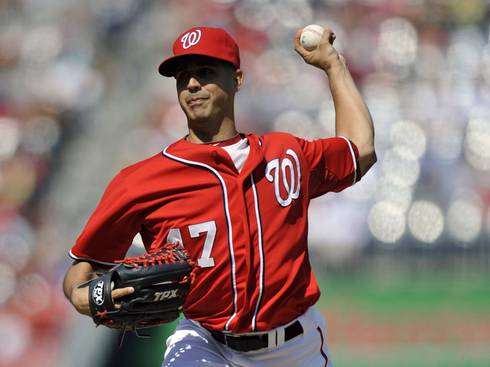
  • Drew Storen: 1st year Eligible/$1.7M estimate: Storen will get a 4th year of eligiblity by virtue of a quick call-up after getting drafted.  $1.7 over 4 arb years equates roughly to a FA value of $7M/year, which seems a bit low for a good closer.  I’d guess Storen could get slightly more money, though the team probably argues that his injuries in 2012 prevented him from giving full value, and is probably why he’s estimated at $1.7 instead of nearer to the $4M that Chad Cordero got his first arb year with this team.  Rizzo has dangled Storen in trade talks in the past, but seems likely to keep him (at the possible expense of Clippard) for the coming season.
  • Craig Stammen: 1st year Eligible/$900k estimate: Another super-2 guy who was incredibly valuable to the team this year.  I’d guess he’ll get more than 900k despite his role as a middle reliever, since 900k is barely more than the typical veteran minimum (which is roughly $800k, what Mark DeRosa made in 2012).  Though, 900k equates to roughly a $3.5M FA value, which seems high for the kind of middle relief right-hander that are a dime a dozen in this league.  I’d guess Stammen is the right kind of guy for the team to buy out a couple of arbitration years, much as they did with Sean Burnett a couple years ago.   But, being a fungible middle-relief arm, don’t look for anything other than a 2 year deal so the team is protected in case of injury.
  • Jordan Zimmermann: 2nd year eligible, $4.9M estimate: Another super-2 guy who will get a 4th year of arbitration, this estimate also seems low considering the season that Zimmerman just put in.  It also roughly equates his FA value at roughly $10M a year, which I’d guess is also undervaluing Zimmermann.  Ask yourself; if he was on the open market, you’d have to think he’s getting more than $10M/year (point of comparison: Kyle Lohse turned down a 13.3M qualifying option and may get 4/60; who would you rather have?)
  • Tyler Clippard: 2nd year eligible, $4.6M estimate: I see this estimate as high frankly, as being too much of a raise over his 2012 salary of $1.625 despite his being the closer most this year.  Clippard said it himself; its better to be the closer, get the saves and get the salary.  But $4.6M for a setup guy is way too hefty.  If Clippard comes in this high with his demand, look for an ugly arbitration hearing.  Honestly, I could see Clippard being a trade candidate and making this arbitration decision someone else’s headache, and the team goes into 2013 with Storen firmly entrenched as the closer with the likes of Mattheus, Garcia and Henry Rodriguez vying for the 8th inning role.
  • Ross Detwiler: 1st year eligible, $2.2M estimate: This seems right in line with what Jordan Zimmermann got last year ($2.3M in his first eligible year).  A successful young starter going through this process the first time.
  • Roger Bernadina: 1st year eligible, $1.1M estimate: A year ago I thought Bernadina was going to get DFA’d at the end of spring training.  Now I wonder if he’s got enough value to be flipped in trade after a standout season for this team as its 4th outfielder.  $1.1m is very reasonable for a 4th outfielder with his defensive skills, so don’t be surprised to see Bernadina remain in this role with the team for several years.

Most likely Non-Tender candidates

  • Jesus Flores: 4th year eligible, $1.2M estimate.  Flores represents an interesting test case.  Clearly he no longer has a 25-man catcher spot, having fallen behind both Wilson Ramos and Kurt Suzuki on the depth chart.  The team also has shown itself to have decent rising catcher depth in the likes of Sandy Leon and Jhonatan Solano.  And Flores really regressed this year both offensively and defensively, so much so that the team had to go out and acquire Suzuki late in the season.   So I completely understand those that think that Flores is a non-tender candidate.  BUT, you don’t just cut loose valuable commodities, and a healthy catcher who can serve as a backup in the majors is still worth keeping.  That being said (as I reported in an earlier post), Flores seems to have achieved 5 service years, meaning that despite his option availability he’d have to agree to be assigned to AAA.  Which means his flexibility is completely compromised for this team in 2013.  The only remaining reason to sign him would be as insurance in case Suzuki or Ramos get hurt in spring training.  If he doesn’t get traded in the next two weeks, look for a non-tender.
  • Tom Gorzelanny: 4th year eligible, $2.8M estimate.  I’m not sure I agree with the MLBtraderumor estimate here, because the likelihood of players getting pay DECREASES in arbitration is pretty slim.  Its not like Gorzelanny posted a 6.00 ERA in 2012 after all.  Gorzelanny made $3M in 2012, where he predominantly served as our long-man/mop-up guy out of the pen.   The question the team has to ask itself is this; is $3M too expensive for the last guy out of the pen?  I believe it is, and thus I believe Gorzelanny is destined to get non-tendered.  I believe the team likes him but his salary isn’t matching up to his role any longer, so I see him being forced to take a significant salary cut if he wanted to stay here.  Were I the Nationals, I’d rather take a shot at a MLB-minimum guy (or even a rule-5 guy) in that mop-up role.  The only thing that gives me pause in declaring that the team is ready to cut ties with a lefty reliever is the apparent sky-high cost of lefty relievers on the market; Jeremy Affeldt just signed a 3 year $18M deal to stay with San Francisco.  Would this contract convince the Nats management that perhaps Gorzelanny is a player worth hanging on to?
  • John Lannan: 3rd year eligible, $5M estimate.  There are two schools of thought with Lannan in the Natmosphere right now.  One group believes that the team will let Edwin Jackson walk, Lannan will naturally take his place as the 5th starter and the team won’t pursue any starter talent in trade or in free agency.  The other school of thought (and the one to which I subscribe to) states that Mike Rizzo values power arms and doesn’t rate Lannan at all, that $5M (which I think is a low estimate if he were to actually reach arbitration) is far too expensive for a soft-tossing 5th starter, and that the team will be actively searching for a 5th power arm to replace Jackson in the rotation.  I think the team would rather take that $5M+ and use it to pay an acquisition versus continuing to fund Lannan’s sub 100 ERA+ exploits.  This opinion ignores the rising cost of lefty starters, and the relative dearth of quality starts on the FA market, so perhaps the Nats hang on to him one more year.

Having so many arbitration eligible guys means that the Nats payroll will take a significant hit.  Assuming that the team tenders the above 8 players (including Flores), here’s what the payroll implication will be:

Player 2011 salary 2012 estimate
Desmond $512,500 $3,200,000
Storen $498,750 $1,700,000
Stammen $485,000 $900,000
Zimmermann $2,300,000 $4,900,000
Clippard $1,650,000 $4,600,000
Detwiler $485,000 $2,200,000
Bernadina $493,500 $1,100,000
Flores $815,000 $1,200,000
subttl $7,239,750 $19,800,000
Gorzelanny $3,000,000 $2,800,000
Lannan $5,000,000 $5,000,000

The team needs to plan on paying more than twice it did in 2013 for the services of the top 8 arbitration eligible players in 2012.  Most of that money can be made up by non-tendering both Gorzelanny and Lannan … except that those players would need to then be replaced on the roster.   Still, getting these 8 players for less than $20M a year while the Yankees owe Alex Rodriguez $28M for 2013 alone sort of puts things in context.  It is a good problem to have, having to pay your arbitration-eligible stars more and more each year.
Ladson’s Inbox: 11/5/12 edition

one comment

Would you bring back Johnson after his mis-steps managing the bullpen in the NLDS? Photo Getty via mlb.com

Welcome to another edition of MLB.com Nationals Beat reporter Bill Ladson‘s inbox, posted 11/5/12.  As always, I answer in this blog before reading his answer and sometimes edit the questions for clarity.

Q: Could the Nationals put a package of players together to pry away left-hander David Price from the Rays?

A: Unlike last off-season, when the Nats sent a bevy of top-end prospects to Oakland for Gio Gonzalez, I don’t perceive that the Nats have the depth of prospects nor the will to trade their biggest prospect names (Rendon, Meyer, Goodwin) in order to acquire David Price.  Tampa would likely want a combination of both prospects and MLB players, and you have to wonder if the Nats would be willing to ship so many pieces for Price (no matter how good a pitcher he is).  Now having said that about this theoretical trade, why do people think Tampa is actually LOOKING to move Price?  Yes they’ve been said to be looking to trade arms for bats this off-season, but they are far more likely to move James Shields if they’re looking to save money.  Shields has two more options at somewhat reasonable money ($9M for 2013, $12M for 2014) while Price is more than likely to only rise a few million above his 2012 salary of $4.35M.  Ladson says the Nats would have to deal a lot to Tampa to get Price and are more likely to go after Grienke.

Q: Do you expect Nationals to go after outfielder Josh Hamilton, who is a free agent?

A: I do not.  Josh Hamilton is injury prone (in his 5 seasons in Texas he’s only played more than 150 games once), is on the wrong side of 30, is prone to disappear at the plate for weeks on end, is going to command far more money than the team should be spending, and of course has the well-documented past daemon issues to constantly contend with.  I think Hamilton needs to stay with an AL team so that he can DH and continue to bat while he saves his body from the field.

Just see Philadelphia and New York Yankees rosters for prime examples of what happens when you guarantee $20M/year to guys in their 30s.  You end up with an expensive, aging and inflexible roster.  The Nats should do their best to avoid these kinds of contracts.  And I think Hamilton is going to age badly and be the kind of slugger who suddenly “loses it” once they hit their mid 30s.  Ladson essentially agrees.

Q: If the Nationals stay healthy, do you think they could win the World Series for the next several years?

A: “For the next several years?”  That’s a heady prediction; teams that win 3 World Series in short-orders are considered dynasties in the history of the sport.  Now, had this question been phrased, “do you think they could win the World Series within the next several years?”  I’d unequivocably say Yes.   They have a young talented core of starters all locked up for several years, they have a solid backbone of guys up the middle, they don’t really have any major trouble spots on the roster, and they have the payroll flexibility to adjust.

The real issue with guaranteeing World Series victories is the following (borrowing from Billy Beane); baseball playoffs are really such a crapshoot.   Anything can happen in a short series; how do the Tigers go from sweeping the Yankees to being swept them selves by the Giants?   I think Nats fans should hope for a continued streak of playoff appearances with the hopes that one of these years they put it together consistently through several short series and win a title.  Ladson also thinks they’re destined to win a title.

Q: Why are so many fans intent on trading Michael Morse? I don’t get it. He is one year removed from being team’s MVP in 2011.

A: I don’t know if fans WANT to trade Michael Morse as much as they’re resigned to the understanding that Morse represents a deviation from the way that Mike Rizzo wants to put teams together.  He’s clearly a defensive liability in left field, but the only other spot he can play (1B) is presumably being offered right now to Adam LaRoche for the next few years.  Therefore, I think the team looks to move Morse while he still has some value so they can put a better defender in left.

Now, is this what I’d do?  No not really; I’d probably let LaRoche walk, install Tyler Moore at first full time and leave Morse in left.  That takes away a huge middle-of-the-order lefty bat and leaves the team very right-handed (Zimmerman, Werth, Moore, and Morse are all RH), meaning Bryce Harper probably moves from #2 to #5 in the order to balance.  I’ve said it a million times; you can “hide” poorer defensive players in left field in this league, and in fact you have to in order to get enough bats in the lineup.

There’s no reason to think there’s any antipathy towards Morse; he’s clearly a clubhouse positive, he’s bright and cheery and seems to be a great teammate, and of course he’s got the best walk-on music (and subsequent crowd sing-along) on the team.  How can we want to get rid of that?

Ladson seems to think that fans were angry with Morse because of some extra bases taken by the Cards on hits down the line.  I don’t see that at all; yes he was slow to getting to those balls, but if you look at replays of all the doubles down the LF line you’d be hard pressed to find a ball that you’d immediately say, “See a better fielder throws the guy out at 2nd.”

Q: Has the organization soured on Danny Espinosa? And do you see Anthony Rendon on a fast track?

A: Two parter.  I don’t think the organization has “soured” on Danny Espinosa, no.  Why else would he get 160 games last year?  He’s a fantastic defensive player, covered more than ably at Short for Desmond and has 20-20 capabilities.  Now, that being said he’s a massive strike-out liability and really disappointed in the post season.  I think the organization, much as they did with Desmond, is showing some patience with their young middle infielder.  Desmond broke-out in his 3rd full pro season and perhaps so will Espinosa.  But, he needs to make some adjustments.  Perhaps its time to abandon switch hitting?  And his K rate must drop.

There are possible moves to be made though involving Espinosa, if it came to it.  He’s a natural short-stop, and his batting would be far more acceptable were he playing short.  We could move Espinosa to a team looking for a SS, install Lombardozzi at 2nd base and hope that he improves on his .317 OBP enough to be a decent lead-off options in the years to come.

Anthony Rendon should be on the fast track, absolutely.   The interesting question will be “where will he play” if he does push through to the majors?   Can’t play 3rd, could play 2nd but that leads to issues with Espinosa.  Could play LF, but see the previous Morse question.  Honestly, we should probably just wait to deal with this particular issue for that time at which Rendon is actually pushing for a MLB job.  This, by the way, is also another reason why I think re-signing LaRoche is foolish; I think the team needs to plan for the inevitable move of Ryan Zimmerman off of 3rd and to 1st Base, where his scatter-arm is no longer the major liability it is becoming.  Rendon makes for a natural 3rd replacement for Zimmerman, who can move to 1st and probably own the gold glove there for the next 5 years.

Ladson says the team hasn’t yet soured on Espinosa, and implies that something is afoot with either Espinosa or Lombardozzi this coming off-season.

Q: Why are you for keeping Davey Johnson around? Do you think that it’s smart to have your closer pitch the ninth inning of a game your team is losing by eight runs?

A: Wow, a shot across the bow of Davey Johnson for the little-mentioned usage questions surrounding Drew Storen in the NLDS.  Storen threw a meaningless inning in the game 3 blowout, meaning that he ended up pitching in three straight games.  My dad in particular believes this is the primary reason Storen was so wild in the game 5 meltdown, and puts the usage question directly on Johnson.  And I tend to agree.

That being said, Johnson is still a manager worth keeping around.  I just think he needs to learn from his mistakes in terms of bullpen usage in the coming seasons.

Ladson says he does not question Storen’s usage in game 3, but does question two critical non-moves in game 5 that many have mentioned; not using Mattheus and not walking Kozma.  Both are very fair points.


2013 Projected Pitching Staffs and Rotations; entire Nats system

7 comments

After finishing the evaluation of all 6 minor league pitching staffs, plus finally finishing (and posting yesterday) the MLB season review,  here’s an entirely too-early projection of what the staffs and rotations may look like in 2013.  This post assumes for the time being that all major and minor league FAs will opt out and we’ll be looking to fill spots.  In these cases I’ll mark FAs to be as needed, though we very well may acquire these players in trade.

Note: some of these projections are slightly different from the original reviews posted in the per-level links, to account for moves, performances and roster moves that have already happened or seem set to happen this off-season.  I’ve also made some slight adjustments in order to make the rotations and bullpens work at each level.

(notations: FA = free agent, MLFA == Minor League Free Agent)

Staff Review links: MLB is here, AAA is here, AA is here, High-A is here, Low-A is here, Short-A is here, GCL is here.

  • MLB Rotation: Strasburg, Gonzalez, Zimmermann, Detwiler, FA or other acquisition
  • MLB Bullpen: Clippard, Storen, Mattheus, Stammen, Garcia, a FA left-hander (possibly Burnett), a FA long-man (possibly Gorzelanny).
  • MLB notables Out of Organization: Jackson, Burnett, Gonzalez, Lannan, Wang

MLB Narrative: 4/5ths of the rotation are no-brainers.  The 5th starter is the question mark for 2013.  Do we re-sign Jackson and pay him more as a 5th starter than our big 3 guys?  It doesn’t seem so after the team declined to give him a Qualifying Offer.  Do we trade from depth (RH relief, middle infield) and find a 5th starter that way?  Do we find a 5th starter from within?  Meanwhile the bullpen is now full of hard throwing righties, but we could lose all 3 of our lefties.  We may need to work the phones to retain these guys, or else we’re on the FA market.  I think (despite my discussion about converting Garcia to a 5th starter) that he’ll remain in the bullpen and may bump Henry Rodriguez out of a job.  One of our two closer-quality guys (Clippard and Storen) could be moved, cashing in on their value, which could open up a spot for a FA acquisition or a promotion from AAA.

Lots to be decided this off-season for Mike Rizzo, and this hasn’t even mentioned the dominos that will fall if/when the team makes a contract decision on Adam LaRoche.

  • AAA Rotation: Roark, Maya, Broderick, Meyers, Perry
  • AAA Bullpen: Tatusko (swingman), Arneson (swingman), Severino (loogy), Davis, Lehman, Nelo (closer), Martin,  Mandel

AAA Narrative: We have a lot of long-serving minor leaguers here; as it stands now only a few of them are even 40-man roster guys (Maya, Perry, Garcia).  The modern AAA roster construction is one of “spare parts” and prospects; do we have enough prospects to cover for injuries at the MLB level?  Which one of these AAA starters would Nats fans feel comfortable filling in were one of our starters to go down with injury?  Perhaps the Nats need to work on some starter depth via trade.  Brad Meyers was just returned from the Yankees after a season-long DL stint after being Rule-5 drafted, and seems likely to slot right back into the AAA rotation when he’s healthy.  Perry seems set to get a 4th option and should slot in here, looking to convert back to being a starter.  Broderick is a former Rule-5 pick and was claimed from St. Louis, who dumped him late last season.  I don’t think he’s anything more than a 4-A starter, but the organization seems to like him.

  • AA Rotation: Rosenbaum, Holder, Gilliam, Karns, Grace, Demny (swingman?) or MLFA?  Solis if he’s healthy?
  • AA Bullpen: Frias, McCoy, Selik (maybe high-A again), Holland (setup), Wort (closer), VanAllen (loogy), Demmin (maybe high-A again), an org arm or two to fill in.

AA narrative: We have a couple of interesting candidates in the AA rotation to start, but what may be more interesting is to see whether the likes of Gilliam and Demny hold onto their spots with the talent ready to rise up out of high-A.  Meanwhile, the bullpen has some interesting arms to keep an eye on.  I forgot to mention Solis in the AA write-up but remembered him here.  Two big questions for me in this AA rotation for 2013: 1) is Rosenbaum for real or is he going to sputter out before reaching MLB potential?   And, 2) Is Nathan Karns ready to make the leap?  I think Karns can quickly put his name in the mix to get promoted to AAA based on his performance in 2012.

  • High-A Rotation: Swynenberg, Ray, Meyer (maybe AA?), Schwartz (maybe low-A), Rauh (maybe low-A)
  • High-A Bullpen Competition: Barrett (maybe AA) , Testa, Smoker (loogy), Hill, Meza (perhaps a starter?), Holt, Hawkins, Bates, Mirowski
  • High-A bullpen Release candidates: Olbrychowski, McCatty, Applebee

High-A narrative: there’s too many arms for too few slots right now in all three of the A-levels.   There’s a ton of release candidates, and some guys who could be higher or lower.   I’d love to be a fly on the wall at the organizational meetings where all this evaluation is done.  Meyer dominated High-A last year; could he start in AA?   Barrett (by virtue of his AFL appearance) may also be AA material.

The same goes for the Low-A team below: I’ve got 5 logical rotation candidates, another 4 guys who make sense to be in the low-A rotation, and a slew of guys who seem to have earned their way to the low-A bullpen.  But there’s only 7 slots to go around.

  • Low-A Rotation: Turnbull, Jordan, Purke (if healthy), Monar, Mooneyham
  • Low-A Rotation Competitors: Hansen, Lee (loogy if not), Encarnation, McGeary (if finally healthy)
  • Low-A Bullpen Competition: Anderson, Estevez, Dupra, McKenzie, Henke, Davis, Boyden, Benincasa, Hudgins, Dicherry, Mudron

We acknowledge the folly of trying to predict short-season staffs which will mostly be populated with 2013 draftees, especially under the new CBA that shortens negotiation times, making it more likely college seniors are drafted (who sign quickly with zero leverage) and get playing.  That being said, there will definitely be guys who stay in extended spring training for a couple months and then get placed on these rosters along with new draftees.  Here’s some guesses based on 2012 performances; all blank spots filled by 2013 draftees or by some of the guys who drop down from low-A.

  • Short-A Rotation: Baez, Pineyro
  • Short-A Bullpen: Smith (if not released), Fischer, Medina, Pena, Mendez

GCL blank spots filled by younger 2013 draftees (HS, Juco and college juniors/seniors from smaller schools) and by rising DSL grads.

  • GCL Rotation: Mieses (if not released), Barrientos, Vasquez
  • GCL Bullpen: Heredes

Washington/MLB Pitching Staff Year in Review; 2012

leave a comment

The Nats staff was led start to finish by 21-game winner Gio Gonzalez, even if Strasburg was the lead story all year. Photo Joy Absalon/US Presswire via usatoday.com

This is the final post in a series of posts reviewing the Nats pitching staffs at various levels, and has been about 5 weeks in the making.  Since the minor league seasons end September 1st, all the minor league versions have already been posted.  Here’s links for the farm system: AAA is hereAA is hereHigh-A is hereLow-A is hereShort-A is hereGCL is here. Tomorrow I’ll post the organization-wide far-too-early predictions for who will be at what level (and in what role) in 2013, summarizing all of the “Outlook for Next year” points for every pitcher in the system.

Washington starters.  The rotation started the season with Strasburg, Gonzalez, Zimmermann, Jackson and Detwiler.  These 5 starters ended up making 150 of our 162 starts, a number that could have risen to somewhere in the 159-160 range had Strasburg not been shut-down and had the team resisted the Wang experiment.  This starter consistency is a huge part of why Washington was so successful this year.  Lets review each pitcher’s season:

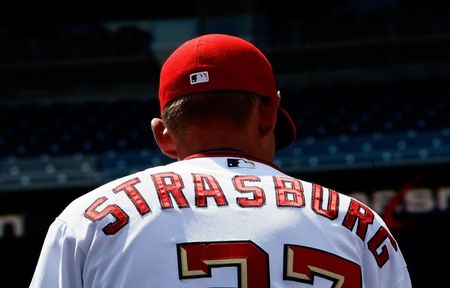
  • Stephen Strasburg:  Somewhat lost in the season-long soap opera of “Shutdown-Gate” was the excellent return that Strasburg had.  Final season stats:  15-6, 3.16 ERA and 1.155 whip in 159 1/3 innings, good for a 125 ERA+.   His FIP and xFIP were 2.82/2.81 respectively, meaning his ERA was slightly unflattering on the season.  He dialed back his fastball a little bit as compared to the past two seasons, but can still throw a 95mph 2-seamer and an 88.7mph change-up with 8 inches of horizontal break, leading him to an 11.1 K/9 rate (which would have led the NL by nearly 2 K’s per 9 had he qualified).  Just a few stats for you in case you forgot just how awesome Strasburg can be.   He tired towards the end of the season (4.50 ERA in his last 5 starts combined, including a couple of downright ugly outings) and the shut-down probably came at just the right time.  Yes its too bad we don’t have him for the playoffs; we just have to hope this was the right decision and hope the team continues to make the playoffs. Outlook for next season: Washington’s 2013 opening day starter.
  • Gio Gonzalez came over in the much maligned trade in the off-season and promptly dropped his bb/9, increased his K/9 rates, dropped his ERA and finished the year leading the league in wins.  Final 2012 line: 21-9, 2.89 ERA, 1.129 whip.  He led the league (among qualifiers) in K/9.  He led the league in terms of fewest home-runs allowed.  He should get some consideration for the Cy Young (I’m predicting he comes in 3rd).  Just an all around fantastic debut for Gonzalez in Washington.  His goal in 2013 should be to improve on his post-season performances.  Outlook for next season: same as this year: Robin to Strasburg’s Batman.  Washington #2 starter.
  • Jordan Zimmermann toiled in the background of Washington’s two more well known aces and put up a season that had him being mentioned in Cy Young talks mid season.  Final numbers: 12-8, 2.94 ERA, 1.17 whip.  Some of his ancillary numbers were slightly worse in 2012 than in 2011 (his BB/9, his fip and xfip and his BABIP all trended the wrong way) and he seemed to drift on the mound in the latter part of the season.  It is perhaps explained by his increased workload two years removed from Tommy John surgery, or perhaps just the randomness that baseball is known for.  Either way, Zimmermann is tied to the club for at least 3 more seasons and forms the core of one of the best rotations in baseball.  Outlook for next season: same as 2012: #3 starter and underrated Matt Cain-esque performances for years to some.
  • Edwin Jackson was the man that Mike Rizzo wanted, and he got him, surprisingly signing a one-year deal for 2012 in the face of other multiple year offers and sliding into the Nats #4 starter role (despite being its highest paid pitcher).  Jackson’s military background and frequent moves seem to have led to his itinerant baseball career: he’s now pitched for 7 teams in 10 seasons.  The Nats got pretty much what was expected out of Jackson in 2012: hard-throwing MLB average production with flashes of brilliance (a 2-hit shutout against Cincinnati in April) and flashes of awfullness (8 earned runs given up in just 1 1/3 innings in St. Louis in September), and a .500 record inbetween.  Final year stats: 10-11, 4.03 ERA and a 1.218 whip.  Jackson switched agents this season, possibly indicating a disagreement over the way that Scott Boras has been handling his affairs, and seems set to finally cash in on his stability and fastball in a very weak starter market this off-season.  Which is what makes the team’s decision to NOT give him a Qualifying Offer this past week slightly curious; perhaps the team was worried that Jackson, having lived on year-to-year deals and seemingly comfortable gambling his long-term financial future by accepting these one-year deals, would have just taken them up on the $13.3M offer (it representing a nice raise from 2012’s $11M) and suddenly the Nats would be “stuck” with a guy they didn’t want.  That’s the only way I read the tea-leaves here.  Other than that, perhaps it just wouldn’t play well in the locker room to have the team’s highest paid pitcher as its 5th starter (though, that didn’t hurt the San Francisco Giants much as they won two of the last three World Series in the same boat).  Outlook for next season: pitching somewhere else.
  • Ross Detwiler surprisingly won the #5 starter job out of spring training, struggled in May, leading to his being replaced in the rotation by eternal experiment Chien-Ming Wang, then playing the good soldier and waiting out Wang’s inevitable injury relapse to regain his starting spot and keep it the rest of the way.  He pitched relatively effectively most of the season, resulting in a 10-8 record with a 3.40 ERA and 1.223 whip in 164 1/3 total innings.  Detwiler, after years of ineffectiveness and injury-prone disappointment, seemed to finally put things together for the team in 2012.  Unfortunately, a ridiculous 2007 call-up from Jim Bowden pre-maturely is forcing the Nats hand on Detwiler in terms of options status (he’s out of them) and arbitration pay (he’s a first time arbitration eligible player perhaps a couple seasons before he needed to be).  Nonetheless, even his escalating pay for next year will make him a bargain if he produces at this level again.  And we havn’t even mentioned the fact that he was the SOLE nats starter who redeemed himself in the post-season, a point that won’t be forgotten in subsequent years.  Outlook for next season: firmly entrenched as the #4 starter, pending any major subsequent FA or trade acquisitions.

Other guys who got spot starts here and there (non-rehab):

  • Chien-Ming Wang suffered a fortuitiously timed “injury” at the end of spring training and spent the first 6 weeks pitching in the minors on “rehab.”  He was recalled, replaced Detwiler in the rotation and gave the team four increasingly awful starts before the team realized that Detwiler was the solution all-along.  Wang hung around long enough to prove he was incapable of pitching out of the bullpen, had another injury, and spent the next two months touring Washington’s minor league affiliates (Wang ended up making no less than 15 minor league starts this year, more starts than he had major league appearances) before getting recalled for a few late-season outings.  I think it is safe to say that the Wang experiment, after 3 years, $7M in pay and probably nearly that much in airfare taking Wang to-and-from his various rehab assignments, is officially over in Washington.  Outlook for next season: Minor League Free Agent with another organization.
  • John Lannan was Washington’s starter insurance policy this year, surprisingly getting beat out for the #5 starter job in spring training (this, two years removed from being the Nats opening Day starter) and then spending most of the year pitching ineffectively in Syracuse.  Lannan made two double-header starts during the season and then four “replacing Strasburg” starts in September, finishing up with a 4-1 record, a 4.13 ERA and a 97 ERA+ for the year, numbers slightly lower than his career averages but pretty typical for Lannan.  Lannan is who he is; a softer-tossing lefty with a clean medical record (the only time I believe he’s ever missed was in 2010 when his elbow was sore; he never went on the DL and only missed one start).  Lannan just doesn’t seem to be Rizzo’s kind of starter, and the rotation will undoubtedly be weaker just replacing Jackson one-for-one with Lannan.  Plus, Lannan’s arbitration cost will certainly be north of his 2012 $5M pay, which virtually guarantees that Lannan will be non-tendered on or before November 30th of 2012.  Lannan stated publically he wanted to be traded when he was demoted in April, and his non-tender opens a clean path for him to sell his wares to another organization that would guarantee him a rotation spot.  Outlook for next season: I believe Lannan’s time in Washington is done; look for him to sign a 1yr, $3M offer to be a back-of-the-rotation starter on a rebuilding team (Houston, Kansas City, Chicago perhaps).
  • Tom Gorzelanny got a spot start the last week of the season to save Gio Gonzalez’s arm once the Nats clinched the NL East.  We’ll talk about Gorzelanny in the reliever section.

Washington Relievers: taking a look at the relief corps at the end of the season.  We’ll review from the back of the rotation “forward,” starting with the closers and ending with the mop-up guys.

  • Drew Storen missed the first 3 1/2 months of the season from surgery to remove bone spurs from his elbow (which may or may not be related to his inverted-W mechanics, a tease on a future blog post on the topic…).  Upon his return, he patiently waited for his chance while roommate Clippard struggled in the closer role and entered the post-season as the established closer.  We all know what happened in Game 5 of the NLDS unfortunately, but a 4-run blow-up looks like an aberration for Storen’s season in general: a 2.37 ERA and sub 1.00 whip in 30 1/3 mostly high-leverage innings.  His achieving super-2 status is worrisome for the team in perhaps 2015 when his salary has escalated, but for 2013, he will remain a relative bargain in the estimated $1.7-2M range.  Outlook for Next Season: unlike in previous seasons, I think Storen’s injury makes him less likely to be traded; teams would want to see a full injury free season.  He remains with the team as the established closer heading into 2013.
  • Tyler Clippard grabbed the reigns of the closer job after others failed to do so and stuck with it most of the season, collecting 32 saves in 37 save opportunities.  However, two losses and a bad blown save in September ballooned his ERA a full point in just 3 weeks and resulted with Clippard reverting to his 2011 role as 8th inning specialist.  He gave up a critical solo home run in the fateful game 5 NLDS loss but otherwise looked decent in the post-season.  The big decision the team now faces with Clippard is a large potential arbitration award; he will argue that he should be paid like a closer and will point at 32 saves as evidence that he’s a closer-quality player.  MLBtraderumors estimates Clippard’s salary rising from 1.625M to $4.6M on the strength of his season.  I suspect the team will return a far lower value and there could be an ugly arbitration hearing as a result.  Clippard’s decline in form from 2011 also cost him some trade value, though the Nats could still make the argument that he’s a closer-quality guy and look to move him to a team needing a closer.  Of course, that being said he’s an incredibly valuable member of this bullpen, a big reason the team won 98 games, and there’s no urgency to move him unless offered something great. Outlook for next season: Back in the 8th inning role, barring a surprise trade.
  • Ryan Mattheus‘s first full season with the club resulted in an excellent find for the bullpen, providing great RHP middle-relief in the 6th and 7th innings.  Final results: a 2.85 ERA, 1.146 whip and a 139 ERA+ in 66 1/3 innings.   I think Davey Johnson will be rueing the decision not to use Mattheus in the NLDS game 5 middle-relief situation for the entirey of the off-season.  Outlook for next season: firmly entrenched in the MLB bullpen.
  • Craig Stammen‘s conversion from 4-A starter to excellent middle reliever is complete; his 169 ERA+ showing in 88 1/3 2012 innings was fantastic.  As with a number of the Nats prominent bullpen arms, Stammen’s arbitration eligiblity may force the team’s hand at some point, but he seems set for a reasonable pay increase in 2013.  Outlook for next season: also firmly entrenched in the MLB bullpen.
  • Sean Burnett rebounded dramatically in 2012, returning to his excellent 2010 numbers and was an effective middle-to-late innings lefty reliever for the team.  2012 numbers: 2.38 ERA, 1.235 whip and a 167 ERA+ figure in 56 2/3 innings.  Burnett pitched out his contract year as best as could be expected, and subsequently declined his side of a mutual option for 2013.  This was an expected move; Burnett is arguably the best or 2nd best lefty reliever on the FA market (along with Jeremy Affeldt) and should look to cash in.  Will the Nats match his price on the open market or will they look elsewhere for solutions?  The team really doesn’t have much in the way of quality lefty relievers in either AAA or AA and face losing both Burnett and Michael Gonzalez this off-season.  Outlook for next season: Washington re-signs Burnett to a 3 year deal, possibly overpaying him but ensuring he remains with the team.
  • Mike Gonzalez was on the street in May, signed a minor league FA deal and ended up giving the Nats nearly a full season of high-quality lefty relief.  What a great signing.  Final 2012 numbers: in 35 2/3 innings he had a 3.03 ERA, greater than a K/inning, and a .179 BAA versus lefties.  I think it is safe to say Gonzalez made himself some money this season; apparently 10 teams have already inquired about his services.  Outlook for next season: Washington backs out of a FA bidding war for the 34-yr old and he signs a 2  year deal elsewhere.
  • Tom Gorzelanny served as the long-man/mop up guy for the year and continued his trend of excellent relief appearances (as compared to his numbers as a starter) in 2012.  He gave the team 72 innings, posted a 2.88 ERA and was constantly available for spot starts if needed.  The problem with Gorzelanny is the same problem the team probably will have with Lannan; he’s going to command more in arbitration than the team wants to pay.  Gorzelanny made $3M in 2012 and clearly will earn a raise after his 138 ERA+ season.  However, you just cannot pay mop-up guys that kind of money.  Look for the team to non-tender Gorzelanny on or before November 30th.  From there, once he hits the open market anything could happen, but teams know he’s no longer a starter.  Outlook for next season: Washington brings him back on a contract of similar value to the one he played under this year.
  • Henry Rodriguez continued his Jeckyl-and-Hyde career with this team, mostly on the “Hyde” side in 2012, pitching 29 1/3 mostly awful innings before hitting the DL to remove bone spurs from his elbow in August.  His injury report for 2012 is all over the road; he slammed his fingers in a bathroom door, then subsequently hit the 15-day DL for a strain in that same hand, then hurt his back (which is why he was on the 15- and then 60-day DL), then finally had the elbow procedure at the end of August.  Was his performance all related to his various maladies this year?  Possibly.  But it is safe to say that my patience has run out with H-Rod, and possibly management’s has as well.  He’s out of options and faces the competition of a slew of high-performing right-handers with great stuff and better control for the likely 5 bullpen spots in 2013.  Outlook for next season: Rodriguez fails to make the MLB bullpen out of spring training, gets stashed on the DL again, and eventually gets DFA’d as he shows a Steve Dalkowski inability to find the plate.

Other Relievers who appeared for the Nats in 2012

  • Brad Lidge signed a 1yr $1M deal in the off-season which I thought was a steal.  However, the 35-yr old wasn’t able to hold onto either the closer job or a bullpen job in general after posting a 9.64 ERA in his first 11 appearances.  Lidge was released in late June and (as far as I can tell) did not get picked up by another team.  Outlook for next season: Likely out of baseball and facing retirement.
  • Christian Garcia blew through the minors, earned a 9/1 call up after years of injury issues and pitched well enough to earn the 8th bullpen spot on the post-season roster.  That’s quite a rise from where Garcia was in July 2011, when the Nationals signed him as a minor league free agent after the Yankees gave up on the once electrifying prospect.   He threw well enough in his short MLB stint that the team has made noise about converting him back to a starter.  While I’d love to see Garcia’s stuff in a starting role, the odds of him converting back successfully are slim; he has twice had elbow surgery (2009 and 2010) and had an additional knee issue before that.   I think the team will take the safer route and keep him as a middle-relief candidate who throws his nasty stuff.  Outlook for next season: MLB middle reliever.
  • Ryan Perry was ineffective in 7 appearances in relief and was subsequently dumped to AA and converted back to a starter.  His AA season was reviewed here: he was good in AA, but how does that translate to his 2013?  His lack of options and probable lack of a 25-man roster spot may  conspire against him unless he gets an extra option.  A commenter here claims that Perry will get a 4th option because he got to the majors so quickly.  A quick google of the rule indicates this may be the case; the rule is explained here by BaseballAmerica’s Jim Callis, and Perry, by virtue of being drafted in 2008 and then making the majors by 2009 may indeed qualify.  Lets hope so.  Outlook for next season: (assuming he gets an extra option): AAA rotation.
  • Zach Duke was awareded a 9/1 call-up after an excellent season toiling in AAA for the club.  He was a minor league FA signee and seems to have done enough to earn another shot at a major league starting job.  Just not for Washington.  Outlook for next season: MLFA with another club.

Summary

The Nats pitching staff led the league in ERA while being its 3rd youngest squad.  The 5 core starters made 150 of 162 starts and we used just 8 starters all year, a fantastic turn around from the likes of 2010 (14 different starters) or 2009 (12 different starters).  Consistency in the rotation is a huge key to success for major league teams, and the Nats experienced just that in 2012.

Tweaks are needed for 2013.  We’re potentially losing all three of the lefties in the pen.  We have two closer-quality arms but only need one.  And we’re likely looking for a 5th starter.  Our AAA and AA teams aren’t quite ready to deliver replacements, so one-year deals may be in order.  Not much else to complain about after a 98 win season.

How does Nats-Cards NLDS Game 5 rate historically?

7 comments

How “good” of a game historically speaking was Game 5 of the Nats-Cards NLDS?  How will this game be remembered historically?

I realize of course how difficult it is to objectively view the Nats meltdown in Game 5 from a baseball stand-point for Washington fans.  It was too much of a gut-punch game, too sudden, too unbelievable of a collapse by our closer Drew Storen.  And we’re all immediately on the defensive because the inevitable back-seat driver columns from hither and yon about how Stephen Strasburg would have won the series for us in the face of more than enough evidence to the contrary (as in, how exactly would Strasburg have factored into a 2-run lead given up by our closer in Game 5?)  But I wonder if this game goes down into the pantheon of great games, or if it will remain known as just an amazing collapse by Nats bullpen.

I touched on the topic of “Greatest Games” last fall, when I wrote in this space that I thought game 6 of the 2011 World Series was instantly among the best games of our lifetime.  The trap that we all fall into as sports fans is to immediately assume that the player or game we are watching today is immediately “better” than historical figures in each sport.  I see far too many articles in the sportswriting world that immediately declare that Such-and-Such a sports news item is the “worst trade” or “best game” ever played.   Strasburg is “the best pitching prospect the game has ever seen,” that is until the next “best there ever was” guy shows up.  We’re prone to hyperbole to get hits and sell papers, unfortunately.  But Game 6 last year was different; as I was watching it I was saying to myself that it was the best game I’d ever witnessed.

In that same post I also reviewed MLB Networks’ fantastic “Best 20 games of the last 50 years” series for context.  Going back to that list, the breakdown of games is as follows:

  • Regular Season: one game
  • Regular Season One-Game playoffs: Two games; from 1978 and 2009, both classic games.
  • Divisional Series: One game: the 1995 Seattle-New  York series with a walk-off win.
  • League Championship Series: Seven Games
  • World Series: Nine of the twenty games.

So, only one game of the 20 best from the last half century occurred in a Divisional Series, and it featured an upset over the historical Yankees and an amazing walk-off win at home with the crowd going wild.  I think baseball historians don’t give as much credence to divisional series games, no matter what the context of the game.  The Cardinals in Game 5 of this year’s NLDS may have just overcome the largest deficit in any elimination game in the history of the sport … but there was no walk-off win, no home crowd going berserk at the end.  In the Seattle/New York ALDS game on the top 20 list, two moments of individual brilliance by Hall of Fame quality players led to the win.  In the Nats-Cards game, two no-name middle infielders from St. Louis poked run-scoring singles to spoil a 2 run ninth inning lead against a young team with no post season experience and no baseball history.

So, perhaps thankfully, Drew Storen isn’t going to be unfairly remembered in the same vein as Bill Buckner and Steve Bartman; singular people unfairly blamed by an entire fan-base for failures by their team unfairly (If you think Buckner was solely responsible for the Red Sox collapse in that game, you need to watch the ninth inning again and pay attention to how badly Calvin Schiraldi pitched in the 10th.  And if you think Bartman is responsible for the Cubs pitchers giving up EIGHT runs in an inning, or blowing a 2-run lead in the 6th inning of game 7, then I’d suggest you check the game footage to prove that Bartman was in the stands and not on the field).  This game will stick in Nats fans memories for quite a while of course, but at least we won’t be seeing our failures on highlight shows for decades to come.

Written by Todd Boss

October 31st, 2012 at 10:54 am

Ladson’s Inbox: 10/22/12 edition

15 comments

LaRoche's status with the team will dictate a number of cascading roster moves. Photo Rob Carr/Getty Images via bleacherreport.com

I havn’t seen mlb.com beat reporter Bill Ladson do an inbox response since February.  So I was excited to see one pop in this past Monday, 10/22/12.  As a reminder, I write my response before reading his, and sometimes edit questions for clarity.

Q: What are the Nationals’ plans for Tyler Moore? He is a power hitter who deserves to play every day. If Adam LaRoche returns next year, where does Moore fit in?

A: Tyler Moore indeed had excellent numbers in limited action, getting called up at the end of April to cover for a dearth of outfielders on the Nats roster.  His slash line was .263/.327/.513 for an OPS+ of 124 with 10 homers in 156 Abs.   Thats a homer ever 15.6 ABs and correlates to nearly a 40 homer pace for a full season of roughly 600 at-bats.  That is of course if you believe in what we saw in 2012 versus the continued lack of respect for Moore from the scouting pundits (who think his minor league power numbers were more a function of age than talent, and who continued to think that Moore had too many holes in his swing to be an impact MLB player).

Unfortunately though for Moore, if Adam LaRoche is re-signed there may not be an immediate place for Moore in the lineup.  LaRoche can only play 1B, Michael Morse is signed through 2013 and has become a club and fan favorite in LF.   Those are basically the only two positions Moore can play.

I think the better question here is, “Will the Nats extend Adam LaRoche?”  Because that’s the question that drives several other roster moves for 2013.  If LaRoche comes back and the team favors giving Moore more playing time, maybe they package Morse in trade.  Perhaps Moore sits and waits for another injury to give him playing time; LaRoche was incredibly healthy in 2012 and could regress for 2013.  Or, perhaps LaRoche (as basically the leading 1B power hitter on the FA market) will get a 3-4 year deal (likely) and the Nats won’t over-pay for his decline years, will install Moore at first and keep Morse in left.   Honestly, I think this last scenario is what plays out, and we’ll see Moore as your starting first baseman in 2013.

Ladson basically echos exactly what I say above.  Glad we’re on the same page.

Q: Do you think the Nationals will go after Michael Bourn this offseason?

A: No no no!  As I opined on September 13th, after seeing yet another Jim Bowden article intoning last off-season’s mantra of “the Nats need a center fielder,” the Nats HAVE a center fielder, and a darn good one, in Bryce Harper.  Harper finished the season with the 4th best UZR/150 for any CF with 500+ innings, even better than the vaunted defensive wizard Mike Trout.  It took about 5 games for his arm to be respected league wide, and he’s only 19 and will only get better.  Why would we possible move Harper off CF in the next 4-5 years?  Yes, eventually we expect a bulked up power hitting Harper to move to a corner spot, but not at age 20.  Besides, if Harper moves off CF … who makes way in left or right?  Do you move Jayson Werth to left field?  If so, then what happens to Michael Morse?  Do you move him?  Harper’s defensive value is wasted in right field.  Werth’s defensive value (while inarguably slipping) is also wasted in left field, where you can “hide” a poor defensive player who is plus-plus power.

*sigh* I wish this rumor would go away.  I’m pretty sure the Yankees never said to Mickey Mantle at age 19, “Hey Mick!  We like you in center but we to move you to a corner outfielder so we can sign a sub-average hitter to lead-off and play in your position.”  Of course not, so why would the Nats do so?

Unfortunately Ladson perpetuates the ridiculous myth himself and says he thinks the team goes after Bourn and puts Harper in LF.  Just ridiculous.

Q: Any news on Cole Kimball’s recovery?  Will we see him in a Nats uniform in 2013?

A: Shoulder injuries in power pitchers are never an easy recovery.  That’s why we never really saw Kimball in the summer and why he’s currently in the AFL getting some extra time on the hill.  As of this writing he only has 3 2/3 innings, so not much to go by.  We are seeing some reports that he looks decent.  2013 prognosis?   He faces an uphill battle to make the bullpen; there’s several right handers that are now clearly ahead of him on the depth chart.  Storen, Clippard, and Stammen are locks (if not traded).  Rodriguez has no options.  Mattheus has pitched his way onto this team.  That’s your 5 righties out of the pen (Davey Johnson likes 2 lefties).   And we havn’t even talked about Christain Garcia, who pitched well enough to make the post season roster.   So the answer may be that Kimball starts in AAA and waits for an opportunity.  Ladson says he thinks Kimball can make the 2013 bullpen.  How exactly?  Who is he going to be ahead of?  Not much provided in the way of deep analysis, Bill.

Q: Do you think there is any chance the Nationals bring up Corey Brown to play center and bat second?

A: No.  Brown looks to me like the definition of a 4-A guy, and will be stashed in AAA as outfield depth until further notice.  Batting second?  Really?  We’re currently batting Werth at leadoff despite his having middle-of-the-order power.  What makes anyone think Brown deserves to bat anywhere in this lineup, let alone ahead of the power guys?  And, if Brown makes the 25-man roster which outfielder does he replace?  Certainly not the starters in Morse, Harper and Werth.  Certainly not Roger Bernadina, who more than earned his stay.  And certainly not above Moore.   Ladson agrees.

Q: What do you think about the addition of Kurt Suzuki to the roster?

A: Somewhat of a panic/reactionary move at the time, but it has worked out great for both sides.  Jesus Flores wasn’t stopping the one-way street for opposing base-runners, and we needed more of a plus-defensive guy behind the plate.  Flores did himself  no favors batting .213 either.  Suzuki immediately upped his batting stroke too,  batting .267 here after hitting just .218 in Oakland in 2012.  Clearly Suzuki and Wilson Ramos are your two catchers heading into 2013.  What do we do with Flores?  Do we dare non-tender him and give him away?  Do we tender him and try to trade him?  I’d hope for the latter, thinking that even a .213 hitting catcher has value in this league.  I hate to say it, but Ramos can’t stay on the field and we needed the insurance.  Ladson agrees, but doesn’t mention Flores’ fate.

Q: The Shark, aka Roger Bernadina, had a career year and will probably get a raise this offseason. Do you think the Nats are going to try to move him, or can we expect to see The Shark with the team next year?

A: Great question.  Do we sell-high on Bernadina and make-do with a 4th outfielder like Corey Brown or Eury Perez in 2013?  We could, if it brought us back something worth having.  We do have some rising quality OF depth that would replace Bernadina (Brian Goodwin comes to mind, perhaps even Anthony Rendon if he hits his way to the majors in 2013).    Ladson thinks Bernadina will be back.  I have no problem with that; he hit great this year, knew his role and is fantastic defensively.

Q: Do you think Davey Johnson is the best manager in Nationals/Expos history? Felipe Alou is tough to beat, but Davey has my vote on this one.

A: Why not Jim Fanning?  He led the franchise to its only prior post-season appearance.  I dunno; what exactly makes a “good” manager?  I think Johnson has absolutely done better with this team than anyone thought, so yeah that makes him a great manager (and my favorite for winning NL Manager of the Year).  Best ever for the franchise?  Why do people think Felipe Alou was so great?  His last three Expos teams each lost 90 or more games.  Who can really talk intelligently about how well Buck Rodgers mangaged the team in the mid 1980s?  The team improved 19 wins from 1978 to 1979 under Dick Williams.  Those are good managers too.  Ladson thinks Johnson is the best ever but says Alou was great.  I don’t get it.

Game 5 Recap: Leaky bullpen and a Gutwrenching Ninth

13 comments

Not the best outing for Storen. Photo Andrew Harnik/washingtontimes.com

What a gut-wrenching game.

It started out as great as you could hope; scoring 3 runs in the first inning and igniting the largest crowd in Nats history.  The offense finally strung together a series of big hits from the top of our order against the same pitcher (Adam Wainwright) who shut us down so easily in the first game of the series.  The Nats offense woke up again in the 3rd and bounced Wainwright (the same guy that pundits expected to completely shut the team down again).  You can’t blow a 6-0 lead, can you?  Here’s a stat; on the Season the Nats were exactly 45-6 when scoring 6 or more runs.  But they’ve also coughed up larger leads; they blew a 9 run lead in Atlanta in July in a game that looked eerily similar to last night’s game; get a big lead, your starter gives up a few innocuous runs, then the bullpen slowly leaks runs until its all over.

Gio Gonzalez wasn’t really that effective, all told.  His final line: 5ip, 5 hits, 4 walks and 3 runs (all earned).  In the first inning he honestly looked startled on the mound, scared to be there.  He scuffled through the first inning looking tentative and got bailed out by some slightly over-aggressive hitting from the top of St. Louis’ order.  He did pitch with better confidence the next couple of innings (who wouldn’t with a 3-0 first inning and 6-0 third inning lead?).   He was definitely commanding his curve ball far better than in game 1 and was keeping St. Louis at bay.  However a lead-off walk burned him in the 4th for the first run, and then a complete meltdown in the 5th from Gio turned into two more runs.   His 5th inning line is as ugly as it gets for a starter; Double-Single-Walk-run scoring wild pitch-walk-walk to force in a run before finally getting the 3rd out.

Here’s where the bullpen just failed to get the job done.  Edwin Jackson walks the lead-off guy and he scores, making it 6-4.  The Jordan Zimmermann experiment from game 4 couldn’t be replicated, costing the team a run.  I can’t second-guess the move though; it had worked so well the night before.  Tyler Clippard gives up a home-run to Daniel Descalso to make it 6-5.  And of course we know what happened to Drew Storen, who picked a really bad time to match his career worst outing, giving up 4 runs on 3 hits and 2 walks in the 9th.  And the big hits didn’t come from the middle of St. Louis’ order; it was Descalco and Pete Kozma of all people getting the clutch hits.

My dad pointed out an interesting question; Storen was sharp last night but not tonight; could it be because he threw three straight games?  Storen had appeared in 3 straight games twice before this season but didn’t pitch full innings each time.  In this series he threw an inning each in games 1, 3,4 and 5.  His pitch count by game?  10,11, 26, and last night’s 33 pitch debacle.  Dad’s specific complaint was about the use of Storen in the blow-out game 3.  Why waste an inning there when you pretty much well know you’re going to need your 8th and 9th inning stars both subsequent nights?   Is it possible that Storen was just a bit gassed from the cumulative effects of a 26 pitch outing the previous night AND having pitched three consecutive days?

Another pet peeve of mine; how do you let Descalso steal second base un-challenged in the 9th?  Yes there’s two outs, but that put him in scoring position to tack on an extra run on the subsequent single.  If you hold that guy on, maybe you throw him out and get the 3rd out right there before the Cards get the lead.  He certainly doesn’t score on a single to RF.  This isn’t a problem just with Storen; the Nats pitching staff is notoriously bad at holding runners.  In the end, that extra run didn’t really matter … but it could have mattered if Suzuki threw the guy out before the go-ahead single, right?

There’s not much else to say in the way of analysis; the Nats should have been able to hold onto a 6 run lead, and Storen just had a bad night.  The fact that it came in such an important game is a shame.  If we want to look at a critical issue with the pitching staff on the night, it is probably this; the Nats pitchers put the Cards lead-off guy on in SIX of the nine innings, and that runner scored 5 of those times.  They got the lead-off hitter on base every inning after the 3rd.  That’s just a failure to execute by your pitching staff.  Of course it’s also a testament to the hitting ability of this St. Louis team up and down the lineup.

There goes the season; I had tickets for Game 1 of the NLCS.  I guess we have to wait til next year.

NLDS Game 1 Recap: Gonzalez the Escape Artist

10 comments

The team escaped Game 1 with a victory despite Gonzalez’s struggles. Photo Joy Absalon/US Presswire via usatoday.com

Nats take Game 1 of the NLDS 3-2.

You know your pitcher is having a rough day when the score line reads “2-0-0.”  As in, 2 runs, 0 hits and 0 errors.  That was the score at the end of the second, an inning in which Nats starter Gio Gonzalez had walked no less than four batters, thrown a wild pitch and given up a sac fly for the second run despite giving up zero hits.

TBS broadcast a stat showing Gonzalez’s ERA on various days of rest; the key stat was that he had a 5.80 ERA when he had more than 5 days rest.  His days rest entering Game one of the playoffs?  Nine days.  He last threw in Philadelphia on September 27th.

Being able to rest your starters and “set up” your post season pitching rotation can be a blessing and a curse.  Today it was a curse; clearly Gonzalez was overthrowing, missing his spots, and his pitching line showed it.  He didn’t trust his curve early, was relying solely on his fast ball and couldn’t locate it to his desire.  To his credit he settled down for a couple innings, got a couple of very timely plays in the field, and exited having given up a sole meaningless hit to go with seven walks in 5 innings.  To me it looked like he was over-throwing, that he was “too strong.”  Starters are creatures of habit; throw one day, rest the 2nd, toss the 3rd, bullpen work the 4th, rest the 5th and then repeat.  When too many extra days are thrown in, younger guys can get off schedule.

In the first inning I thought perhaps Gonzalez was trying to “save” his curve for later in the game; a great strategy for professional pitchers who can do it.  Instead of showing guys your whole arsenal the first time through the order, pound them with fastballs and make them hit your pitch.  Then, in their 2nd and 3rd at bats mix in curves and off-speed stuff as out pitches as needed.  If you play your cards right, you can work through each hitter’s 3 at-bats keeping them off-balance and suddenly you’re deep into the 6th or 7th inning as a starter.   As it turned out, he wasn’t trusting his curve at all, and suddenly he was pressing to hit his spots.

Craig Stammen escaped an incredible jam in the bottom of the 7th, having loaded the bases with none out.  Usually that situation has a run expectancy of somewhere greater than 2 runs but the Nats defense came through; an Ian Desmond force out at the plate for the first out then a clutch 5-4-3 double play to end the inning.  Despite Tyler Moore‘s late inning heroics, this was the key of the win.

Adam Wainwright showed exactly why he’s a Cy Young candidate when he’s healthy; his curve-ball was absolutely fantastic on the night.  The already-strike-out prone Nats fanned 10 times, many times on a fantastic curve that Wainwright was controlling and commanding to the outside corner.  I was surprised when he got the hook despite being on 100 pitches; as it turned out he probably wasn’t going to finish 7 complete regardless.  You can’t really fault the bullpen management by Cards manager Mike Matheny; he had his 8th inning guy on the mound (Mitchell Boggs) and the Nats beat him.

Other thoughts from watching the game:

  • I scoffed aloud when the TBS announcing crew spoke of Ryan Zimmerman‘s defensive prowness and said that “he rarely makes throwing errors.”  Really?  I know they don’t watch Nats games normally but the narrative behind Zimmerman’s throwing issues on non-pressure plays is well documented in DC.  He had 12 throwing errors on the year, and his 19 total errors tied him for 3rd in baseball.  Sure enough, a throwing error in the bottom of the 8th put the lead-off guy on board and caused the inning to be far more stressful than it needed to be for Tyler Clippard.  Guy on first with nobody out?  Roughly an 85% chance he scores.  For years I’ve defended Zimmerman and talked of the ridiculousness of “wasting” his defense by moving him to first, but the fact remains that every time he fields a routine ground ball I’m waiting for him to air-mail the throw.  When Anthony Rendon is ready to hit at the major league level, I think the talk is going to be about Zimmerman moving to first and not Rendon moving to another position.
  • For as clutch as Moore, Ian Desmond and Kurt Suzuki were on the day, Jayson Werth and Danny Espinosa were the opposite.  TWICE Werth squandered bases-loaded situations with two outs, leaving a total of 7 guys on base.  He may be our current lead-off hitter, but he’s normally a middle-of-the-order bat and he needs to capitalize on situations like that.  In Werth’s defense (no pun intended), the over-the-shoulder grab was a game-saver in its own right, so on a day when he disappointed at the plate he made up for it in the field.  Meanwhile it was not really shocking that Espinosa whiffed over and over; he led the NL in strikeouts on the season and was batting from his clearly weaker side.
  • How about Tyler Moore?  A fantastic job of hitting, hitting a pitcher’s pitch and not trying to do too much with it.  The old “game winning RBI” stat went the way of the Edsel, but tonight the clubhouse knows exactly who won that game.
  • Here’s to the return of “Clip-Store-and-Save.”  Clippard escaped Zimmerman’s throwing error in the 8th and Drew Storen dispatched two of the best St. Louis hitters in a 1-2-3 ninth.  The team has to feel great about its bullpen on the night.  No worries about using your 3 best guys; they’ll all be able to go tomorrow then get a travel day of rest.
  • The ridiculousness of the Hold stat: Boggs was credited with both a “Hold” and the Loss.  How is that possible?  Because he put on the go-ahead run that Mark Rzepcynski eventually allowed to score.  I think the Hold stat would carry more weight if it was withheld from relievers who don’t actually “hold” the game at bay and who contribute to the blown save and (if applicable) eventual loss.
  • The sideline reporter couldn’t help but compare the handling of Wainwright to Stephen Strasburg; both had Tommy John surgery last year.  He said the Cardinals “trusted” Wainwright more and let him pitch 200 innings.  But they didn’t really talk about the real difference: Wainwright is into the club option portion of his FA contract and is no sure thing to stay with the team beyond 2013.  He’s also 30.  Compare that to Strasburg; he’s 23 and is under team control for at least four more seasons, and is likely to be offered a multi-year contract that buys out those arbitration seasons and a couple of FA seasons beyond that (similar to the deal Gonzalez signed).  The point is; the Nats know they’ve got this guy for years to come and clearly played it conservative with his re-hab.  Why this point is glossed over by pundits and bloggers is beyond me.  Every time I hear some know-it-all say things like, “there’s no proof that letting him pitch more than 160 innings will harm him” my blood boils.  Well, there’s no proof to the other side either!  The fact is you can either be reckless with your major investment and overuse him, or you can play it safe and hope for the best.  There’s no guarantees in life and thus there’s no guarantee that Strasburg won’t blow out his elbow again in 2013.  But on this point I can guarantee; had the team continued to ride Strasburg down the stretch, push his innings to 190-200, and then he re-injures himself in the last week of September?  You can guarantee all those know-it-alls would immediately be clucking their tongues about how the Nats “mis-used” Strasburg and should have played it safer.  I don’t envy Mike Rizzo this post-season, because unless the Nats win the world series there’s going to be the inevitable stories about how the Nats would have won had they kept their Ace in the rotation.  To borrow a quote from Major League, “Well, I guess then there’s just one thing left to do … win the whole !?@& thing.”  (link NSFW)

Great comeback by the Nats, snatching a win in a game they probably should have lost.  They now have the split in St. Louis and are in a commanding position to win this short series.

Nats Playoff Rotation & Bullpen Decisions

4 comments

20-game Winner Gonzalez is our likely #1 starter in the playoffs. Photo Joy Absalon/US Presswire via usatoday.com

The Nats rotation has been incredibly stable this year; only a mid-season experiment with Chien-Ming Wang interrupted a near season-long quintet of starters unmarred by injury or poor performance.  The shutdown and playoff unavailability of Stephen Strasburg is well, well documented, so we won’t talk about him here.  But two important decisions await Davey Johnson in terms of his playoff roster construction: playoff rotation and bullpen construction.  Lets take these questions one-by-one:

1. What is your playoff rotation?  Here’s the evolution of our rotation this year:

  • The year started off with your starters in this order: Strasburg, Gonzalez, Zimmermann, Jackson and then Detwiler. The starters went R-L-R-R-L.
  • After the All Star Break, Johnson shuffled the starters and re-ordered them to go Zimmermann, Gonzalez, Strasburg, Jackson, Detwiler (still R-L-R-R-L), ostensibly to give Strasburg a bit more rest and extend his season a few days.
  • On August 3rd (around a double-header) Zimmermann and Gonzalez switched places.  Now you’ve got Gonzalez, Zimmermann, Strasburg, Jackson and Detwiler (L-R-R-R-L).  All three RHSPs are in order, as are the two LHSPs.
  • On August 15th around an off day, Detwiler and Jackson switched places, probably to keep Detwiler on regular rest and probably to fix the aforementioned issue of 3 RHSPs in a row (starters now Gonzalez, Zimmermann, Strasburg, Detwiler, Jackson for L-R-R-L-R).
  • On September 12th, John Lannan replaces the shut-down Strasburg in the rotation.  Now we’re Gonzalez, Zimmermann, Lannan, Detwiler and Jackson for L-R-L-L-R.

If we play out the rotation the rest of the season, barring any more rain-outs or injuries, the starters will be (Starting 9/21):

9/21: Jackson
9/22: Gonzalez
9/23: spot starter Wang, to give the rotation its regular rest.
9/24: Zimmermann
9/25: Lannan
9/26: Detwiler
9/27: Jackson
9/28: Gonzalez
9/29: Zimmermann
9/30: Lannan
10/1: Detwiler
10/2: Jackson
10/3: Gonzalez

At this point I’m going to assume that the Nats will win the division and go straight to the divisional series, which (per MLB’s playoff schedule) starts either Saturday 10/6 or Sunday 10/7.  Which day the Nats start will be critical; if the Nats are the #1 seed they’ll start Sunday; if they’re the #2 seed they’ll start Saturday.

But in either case I think we’re going to see some manipulation of the above schedule, because I think the team wants Gonzalez to start the opener.   And he cannot start an opener on 10/6 or 10/3 if he throws 10/3.   We may see him skipped on 9/28 and then throwing a start 10/1 (which I’d be happy for; that’s the last game I have tix for this year), which would put him on regular rest for either a 10/6 or 10/7 start.

After that though, there’s some decisions to be made.  The NLDS ridiculously gives the lower-seed the first two home games, so I think Johnson may want to have some options available to him for his 2nd, 3rd, and 4th starter (I think its a pretty basic assumption that Lannan is being left completely off the playoff roster; more on this later down when talking about the bullpen options).  Here’s the home/away splits of our 4 likely playoff starters (numbers as of 9/21/12).

Interesting; Zimmermann is far more effective away, Detwiler is far more effective at home, and Jackson is just about the same either way.  This seems to imply that Zimmermann is your best bet to take the 2nd start, away from home, then line up Detwiler-Jackson-Gonzalez (or some combination thereof) at home.

Here’s another take; Johnson likes to play match-ups with certain teams.  Will the Nats opponent factor into the equation?  Assuming the Nats are the #1 seed, your likely wild-card winners right now are Atlanta and St. Louis (its hard to see a scenario where St. Louis loses its current 3 game WC lead in the next 12 days, but it could happen, but for the purposes of this article we’ll assume these two teams hold on).  How do these teams fare against lefty versus righty starters?

  • Atlanta is hitting .247 as a team versus Lefties with an 86 wRC+.  That’s bad.
  • Atlanta is hitting .251 as a team versus Righties with a 97 wRC+.  That’s certainly better than they do versus lefties.
  • St. Louis is hitting .275 as a team versus Lefties with an 113 wRC+.  That’s basically 2nd in the majors behind the uber-hitting Rangers.
  • St. Louis is hitting .270 as a team versus Righties with a 104 wRC+.  That’s roughly a 10% difference in Run Creation.

So, it seems like if we play Atlanta, we want to load up on Lefties while if we play St. Louis we want to load up on Righties.  This would seem to indicate that, if Atlanta is our opponent we’ll want to go Gonzalez-Zimmermann-Detwiler-Jackson-Gonzalez again, meaning Atlanta has to face 2 lefties in the first 3 games plus 3 out of 5.  If we play St. Louis, you’d think that we’ll want to switch up Detwiler and Jackson so that St. Louis gets L-R-R-L-L.  The idea being that once we get home, even though we’re lefty-heavy we’ll have the advantage.

However, with the #1, #2 and #3 seeds far from settled with a week and a half to go, lets also look at the same logic for both Cincinnati and San Francisco, since its conceivable at this point we could be playing either of these teams (use the same links in the Atlanta links above to see these statistics):

  • Cincinnati is hitting .268 as a team versus Lefties with an 107 wRC+.   Both Tied for 6th in the majors.
  • Cincinnati is hitting .248 as a team versus Righties with a 89 wRC+.
  • San Francisco is hitting .268 as a team versus Lefties with an 96 wRC+.
  • San Francisco is hitting .270 as a team versus Righties with a 98 wRC+.

Conclusions?  Cincinnati matches up very well against lefties and struggles against righties, while San Francisco is a pretty well balanced team with no real weakness against either side.

One last factor is post-season experience, of which this group has very little.  Jackson is the sole guy with any post season experience, it being last year with potential opponent St. Louis.  I cannot see Johnson bumping any of the guys who are pitching better than him though, at least in a short series, based on this veteran experience (we’ll revisit this though in a 7-game series, where the identity of the 4th starter is incredibly important, as he only goes once in that series).

In any scenario, I think your first two starters away are going to be Gonzalez and Zimmermann.  After that will depend on the opponent.

2. What is your playoff bullpen?  By virtue of the fact that we don’t need a 5th starter, the team can carry an extra player.  Here’s the bullpen as it sits now, divided into “regulars” and 9/1 call-ups:

  • Regulars: Burnett, Clippard, MGonzalez, Gorzelanny, Mattheus, Stammen, Storen
  • Sept 1 callups: Duke, Garcia, Wang (and technically Lannan).

I think this decision is pretty simple; you keep the 7 “regulars” and add in power arm Christian Garcia, who has been lights out since arriving, as an extra middle-relief guy.  There’s no reason to have minor league starters Duke, Wang or Lannan on the post-season roster; the only function they’d have is as long-men, but the regulars include two such arms already in Stammen and Gorzelanny.

The possibility exists that Johnson will opt for an extra bench guy instead of an 8th bullpen arm, but I doubt he’d choose that route.  Your “extra” bench guys right now are Leon (3rd catcher), Brown and Perez (ofs), and one of either DeRosa or Tracy (technically it was DeRosa who got added off the DL after roster expansion; he likely would have been delayed in the minors had this happened earlier in the season).  I can’t see any reason to keep any of these guys on a post-season roster at the expense of an 8th reliever.  Tracy gets a few ABs a week and can only play 1B, while DeRosa can provide cover at multiple positions and seems to have more value.  I could be wrong though; Tracy continues to deliver timely pinch hits in the clutch (as he did this past weekend).

Man, it feels good to talk about playoff baseball!

Ewing theory and the Strasburg Shutdown

15 comments

How much will Strasburg's shutdown really affect the team? Photo allansgraphics.com

Here we are, September 1st, and every single columnist and blogger who covers baseball has, by law, added their 2 cents to the Stephen Strasburg shutdown debate. And as the imminent shutdown date approaches (I had predicted 9/12 being his last start either in a post or the comments section, and that date still seems to hold; 9/12 gives him 3 more starts, which seems to match what we’ve been hearing lately out of Davey Johnson and the front office), I’m honestly not looking forward to the coming blitz of additional opinions from the blogosphere talking about what idiots the Nationals are, blah blah.

My succinct opinion on the shutdown can be expressed in this metaphor; if you had open heart surgery, and your cardiologist says to you, “take it easy next season and only pitch 160 innings,” wouldn’t you follow his advice?   Both the doctor who performed Strasburg’s surgery (Lewis Yocum) and the famed James Andrews (together essentially the two leading experts on the injury and the surgery) have come out in support of the National’s conservative plan.  To every other pundit out there who says something like, “there’s no proof that shutting him down will protect him in the long run,” I’ll say this: I trust the guy with the M.D. behind his name over the internet dork sitting in his mom’s basement who thinks he knows better.

Even my wife has added her 2 cents; while watching Saturday’s game (a pretty amazing back and forth offensive outburst ending with St. Louis scraping a run against Drew Storen to take it 10-9), one of the telecasters added his opinion on the matter and my wife asked me why the Nats didn’t just “let him pitch less” earlier on in the season.  A common theme for Strasburg shutdown critics; to which I say this: if you think the whole shutdown thing isn’t playing will with the Veterans in the Nationals clubhouse, exactly how do you think it would have played out if the entire pitching rotation was manipulated all season on account of one guy?  Baseball is a team game; you have 25 guys out there who contribute to each win, and I’m pretty sure the veterans on this team wouldn’t have taken well to having their routines thrown off in an effort to squeeze 5 more starts out of a 24 yr old (no matter how promising he may be).

But I digress slightly from the point of this post.  I’m of the opinion that we may see an interesting phenomenon occur when Strasburg gets shutdown for the season.  We may see a theory that Bill Simmons has come to popularize called “The Ewing Theory.”  In essence, the theory says that teams with stars who receive an inordinate amount of media attention often perform better once that star has either left the team or gone down with injury.  Teams rally around each other after their star player either leaves or goes down with injury partly because of the “relief” they get from media questions, partly to show that they can win without the big name, and partly (in some cases) because the star player was “holding the team back” by virtue of his presence (this happens more in sports like Basketball, where one player can really command an entire team’s attention; less so in Football or Baseball).  It is named after Patrick Ewing because his 1998-99 New York Knicks ended up in the finals despite Ewing going down with injury.  The phenomena has repeated itself in a number of notable ways over the years; off the top of my head these situations fit the theory:

  • UVA basketball went as far in the NCAA tournament without Ralph Sampson in 1984 than they ever did with him.
  • The NY Giants won the super bowl the year AFTER Tiki Barber retired.
  • The Seattle Mariners won 116 games the year after Alex Rodriguez left as a free agent.
  • The Tennessee Volunteers won the National title the year AFTER Peyton Manning graduated.

I think this team may exhibit a bit of inadvertent Ewing Theory once Strasburg sits.  You have to think the players are tired of being asked about it; who’s to say they won’t just keep on rolling and play even better once Strasburg gets shutdown and the issue is done?  Plus, here’s some corroborating evidence that may help out;

1. After September 12th, the Nats will only miss three Strasburg starts.  The difference between Strasburg starting those three games and John Lannan is likely to be nearly negligible.  Strasburg’s Wins above Replacement (bWAR) figure for the season is 2.6 right now through 26 starts.  That’s .1 WAR per start that Strasburg gives the team over a replacement player.  And Lannan isn’t exactly a replacement-level pitcher; he owns a sub 4.00 ERA and a 103 ERA+ for his career.  Lannan’s WAR for his two spot starts this year?  Exactly .2, or the same .1 WAR contributed per game as Strasburg.

2. Lannan is the quintessential guy pitching for a contract, and in all likelihood will use these three spot starts to showcase himself for his eventual new team in 2013.  It isn’t that Lannan isn’t a good pitcher, its just that he isn’t the type of guy Mike Rizzo likes to have in his rotation (i.e., power arms with high k/9 rates).   So I’d bet dollars to donuts that Lannan pitches three quality games in mid-to-late September, then gets left off the post-season roster and eventually gets non-tendered at the arbitration offer deadline.

3. Of the 6 series that the Nats play between September 12th and the end of the season, at least 3 will be against teams with no playoff implications (home-and-home versus Philadelphia plus a 4-game home series against Milwaukee).  The Nats are also at St. Louis in the second to last series, by which time the Cardinals may very well be completely out of the Wild Card race.  If the end of 2011 showed us anything, its that teams out of playoff contention in September have a tendency to play really, really weak lineups of prospects and September 1 call-ups.  Look at some of the lineups that the Nats faced in September of last year (especially some of the New York line-ups): they were literally two regulars and 7 AAA guys.  There’s no reason to think that the Nats won’t improve on the .655 winning percentage they’ve had for the last two months despite not having Strasburg in the rotation.

But, the critic may say, wouldn’t you rather have Strasburg pitching Game 1 of your divisional series?  Well, yes of course.  In arguably putting out a playoff rotation of Strasburg-Gonzalez-Zimmermann-Jackson is better than Gonzalez-Zimmermann-Jackson-Detwiler.  But, our playoff rotation is still pretty darn good.  Using the probable playoff teams as of this writing, here’s how our playoff rotation would rank with other NL playoff teams (the ranking is league rank in ERA)

  • Washington: Gonzalez (12), Zimmermann (8), Jackson (17), Detwiler (13).  Strasburg, btw, is 10th.
  • Cincinnati: Cueto (1), Latos (27), Arroyo (29), Bailey (37).  Leake, their #5 starter, is 43rd.
  • San Francisco: Cain (4), Vogelsong (9), Bumgarner (11), Zito (42).  Except there’s no way they’d go with Zito in a playoff series, so you’d be seeing Lincecum, amazingly ranked 50th of 51 qualifying NL starters in ERA this year.
  • Atlanta: Maholm (14), Hudson (25), Minor (46).  Their likely 4th starter would be Medlen, who in 6 starts has a 1.71ERA.
  • St. Louis: Lohse (3), Wainwright (32), Westbrook (33).  Their likely 4th starter would be Garcia over Lynn, but Garcia’s era would rank him 45th or so if he qualified.

San Francisco’s rotation looks pretty tough.  Until you remember that the Nats swept them at home and just beat them 2 of 3 on the road for a 5-1 season split.  In fact, of probable playoff teams here’s the Nats current season records:

  • Cincinnati: 5-2.  We beat them 3 of 4 in April, then took 2 of 3 in Cincinnati in May.
  • San Francisco: 5-1.  Swept at home, took 2 of 3 on the road.
  • Atlanta: 10-5 at current, with 3 critical games in Atlanta in mid September.
  • St. Louis: 3-1 in the series just concluded, with a 3 game set in St. Louis in late September.

Wow.  I didn’t even realize just how well the Nats have played against the league’s best until I looked it up.  This has to give any Nats fan some serious confidence heading into a playoff series, no matter who we may end up playing.

Here’s hoping the Strasburg shutdown doesn’t affect the team as much as pundits seem to believe.