Nationals Arm Race

"… the reason you win or lose is darn near always the same – pitching.” — Earl Weaver

Archive for the ‘ross detwiler’ tag

2014 Projected Pitching Staffs and Rotations; entire Nats system

22 comments

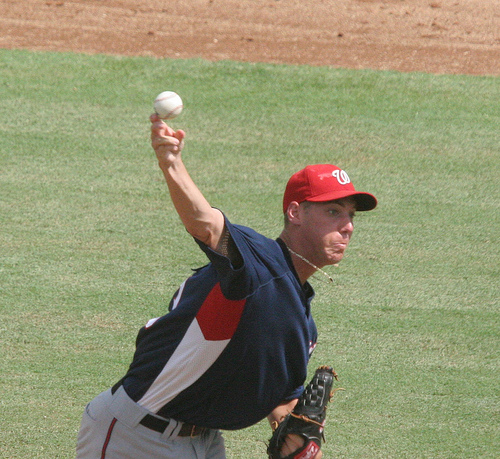
Mr. Detwiler's 2014 assignment will have cascading effects for MLB and AAA.  Photo Haraz Ghanbari/AP via federalbaseball.com

Mr. Detwiler’s 2014 role will have serious cascading effects for MLB and AAA. Photo Haraz Ghanbari/AP via federalbaseball.com

OK here we are.  We did seven comprehensive pitching staff reviews (the GCL review is here, which has links to the other 6 reviews) in order to arrive at this post.

So, without further ado, here’s what I’m predicting for all seven systems right now, absent any more deals (like say for a MLB lefty or another starter or trading a closer to Chicago):

 MLB Level

  • MLB Rotation: Strasburg, Gonzalez (L), Zimmermann, Fister, Detwiler (L)
  • MLB Bullpen: Soriano, Storen, Clippard, Stammen, Blevens (L), Ohlendorf, Roark
    MLB out of Org: Haren, Duke (L), Abad (L), Krol (L), HRodriguez

Discussion: the 5th starter competition could shake out so many different ways, that it almost is not worth predicting.  I can see any of the following scenarios playing out:

  • Detwiler gets one last shot at the 5th starter as the incumbent, pushing Jordan to AAA and Ohlendorf/Roark to the bullpen (my current prediction).
  • Jordan wins the 5th starter, pushing Detwiler to the bullpen as a power lefty by virtue of his lack of options.  This would push (likely) Roark to AAA.
  • Roark wins the 5th starter, continuing his blistering sub 2.00 ERA pace from September, pushing Detwiler to the bullpen and Jordan to AAA.
  • Less likely, Karns wins the 5th spot, which pushes Detwiler to the bullpen and Roark & Jordan to AAA.
  • Even more less likely, Ohlendorf wins the spot, which pushes Detwiler to the bullpen but lets Roark stay as the long man/spot-starter.
  • Mike Rizzo shocks us again with another starter acquisition; Detwiler goes to the bullpen, Ohlendorf stays as long man, and Roark & Jordan are in AAA.

Why am I predicting Detwiler will win the rotation spot?  Partly because of options, but partly because I’ve sort of come back around on him after looking more closely at his 2013 season.  He had a decent to good 2012; he posted a 118 ERA+ and even if his advanced FIP/SIERA didn’t indicate he was quite that good, he was still more than a servicable 5th starter.  Then in his first seven 2013 starts he was also very good (he had a 2.53 ERA in his first 7 starts and 42 2/3 innings … he got hurt in his 8th start).  The rest of his season was a mess, with him fighting injury and ballooning his seasonal ERA from 2.53 to more than 4.00 in five more starts.   If he comes back healthy to start 2014, why wouldn’t we expect more of the same performance that he had at the start of 2013?  For these two reasons, I think Detwiler breaks camp as the 5th starter.  Now …. I have zero confidence that he’ll remain healthy enough to keep his spot in the rotation, but that’s a problem for another day.  And a problem for which this team has plenty of coverage.

Another scenario that could affect this predition: Rizzo acquires yet another lefty reliever (latest rumors were about Scott Downs before he signed elsewhere, but I’m sure a trade could be arranged), which complicates any of these predictions because it means one less spot for either Ohlendorf or Roark.  For a team that seems so obsessed with left-handed relievers, we sure have let a bunch of them go in recent years (Duke, Abad, Krol this year, Gorzelanny, Lannan, Burnett and Gonzalez last year).  Maybe we should just hang on to one or two of these guys?  I will say this: I do NOT believe that the Nats will choose Xavier Cedeno and his 6 2013 MLB innings for the Nats over Roark just because he’s left handed at this point.

Personally, I think Roark and Ohlendorf pitched like big leagers last year and deserve to stay in the majors until they prove otherwise.  Ohlendorf’s recent $1.25M deal seems to indicate he’s more likely to stick than Roark, but perhaps the long-man/spot starter competition is open as well.  This pushes previous stalwards in the bullpen (specifically Ryan Mattheus ) to AAA.   I will say this though: if you expect to win, you have to go north with your 25 best guys no matter how much they make or their option status.  And at the end of last year, that undoubtedly included Tanner Roark.  So thats why I’m going with Roark in the pen to start the season.

One other wrinkle; does Rizzo trade one of Storen or Clippard to Chicago, who desperately needs a closer?  This seems less likely, especially for a team that has World Series aspirations, but the truth is this team is paying a LOT of money into its bullpen ($25M and counting), has three closer-quality guys, and potentially a log jam of righties (see the AAA bullpen prediction for more).  I see this as less likely unless Chicago sends back pieces that we really need, but rumors get started because GMs are talking, so maybe this still happens.  But if a guy like that is traded, then that re-opens a slot for the deposed Mattheus or possibly the newly healthy an electric Garcia.   I think these are lesser possibilities and both those guys are pushed to AAA to begin the season.

I’m sure this section garners plenty of discussion; have at it in the comments 🙂

AAA Level

  • AAA Rotation: Jordan, Karns, Rosenbaum (L), Young, MLFA or two?
  • AAA Bullpen: Barrett, Mattheus, Garcia, Davis,  Cedeno (L), Robertson (L), Herron (AA?), Alfaro, Stange, Delcarmen
  • AAA Release candidates: Meyers, Lehman
  • AAA out of Org: Maya, Tatusko, Clay, Mandel, Torra, Broadway, Crotta, Lowe, Kimball, Accardo, Bramhall, Romero (L)

Discussion

So, the projected AAA rotation has one hold over in Rosenbaum, two “promotions” in Jordan and Karns, and then a whole bunch of question marks.  Is Chris Young healthy enough to pitch this year?  Is Brad Meyers?  Right now i’ve got Meyers as a release candidate, figuring that he hasn’t been healthy in two years and may be finished.  I have to think that the team will give a couple of lower-level free agents minor league contracts to try to pitch their way back into the league, much as they have done with the likes of Zach Duke, Ross Ohlendorf and Young in the last couple of off-seasons.  There’s plenty of guys out there who may make sense; a quick glance at the current list of free agents offers intriguing names (think of someone like a Joe Saunders or a Barry Zito or an Aaron Harang; do you think these guys are getting guaranteed contracts for 2014?).  I’m predicting that at least one or two of these types of guys get MLFA deals and end up in the AAA rotation, though I suppose at least one guy i’m projecting from the AA rotation could start in AAA.

The AAA bullpen has a couple of MLB-quality arms in Ryan Mattheus and Christian Garcia who we know can contribute at the MLB level but who end up here because of a numbers game at the big club.  The AAA closer likely is Aaron Barrett, newly added to the 40-man and looking to make his mark.  Erik Davis is here, who I kind of soured on last season but his numbers in small MLB samples were good and I think he can contribute in a Craig Stammen sort of way going forward.  We have a couple of hold-over loogies in Xavier Cedeno and Tyler Robertson, the latter of which successfully passed through waivers and was outrighted to Syracuse last month.   We already have three off-season MLFA signings (Gabriel Alfaro, Daniel Stange, Manny Delcarmen) who all project as righty middle relievers, making it seemingly less likely that the team will retain some of its own MLFAs (the likes of Ryan Tatusko and Jeff Mandel being longer serving Nats minor leaguers who pitched decently in 2013).

But as you can see there’s more candidates here than there is room on the Syracuse roster (10 for 7 spots, and that’s assuming that Pat Lehman doesn’t make the cut either).  There will be injuries and D/L stints among these guys, but there may also be some releases next March.

Still, a AAA rotation led by Jordan and Karns (and possibly Ohlendorf and/or Roark if another move is made at the MLB level) leaves Syracuse with a pretty good staff to start the season.  And I like the fact that we have one reasonably accomplished MLB starter (Jordan) waiting in the wings to go along with a guy who might get there soon (Karns), to go with potentially a couple other former major league guys who are working their way back.

AA Level

  • AA Rotation: Cole, Hill, Solis (L), Schwartz, Treinen (AAA?)
  • AA Bullpen: Benincasa, Mirowski, Holland,  Swynenberg, Grace (L), Bates, KPerez, Gilliam (swingman), Spann (L)
  • AA release candidates: Perry, Selik, Demny, RMartin
  • AA out of Org: Broderick, Ray, McCoy, Frias, Holder, Bray

Discussion

We’ll see this trend again and again; despite the fact that the likes of A.J. Cole and Taylor Hill reached AA last year, the organization seems to like seeing these guys “beat the level” a second season in a row before moving guys up.  And so I see these guys in AA again.  Sammy Solis here is no surprise; he’s nearly 26 and has been mentioned as a MLB bullpen candidate already.  Meanwhile for the time being i’ve got Blake Treinen here, repeating the level, but can also see him moving up to AAA.  His numbers were good but not *that* good last year, and I left him in AA assuming that the team will try out some re-treads in the AAA rotation.  Lastly Blake Schwartz gets a deserved promotion after leading Potomac in IP, wins and starts last year.

In the bullpen I think Robert Benincasa is your closer to start, with Richie Mirowski and Neil Holland continuing to put up dominating late-innings relief.  All three guys should be pushing for promotions to AAA.  We’re a little light on lefties here admittedly.  A couple of injury-prone guys in Ryan Perry and Cameron Selik are listed as release candidates in the face of a number of guys meriting placement here.  Paul Demny and Rafael Martin have been around forever and may also be release candidates at this point, but they also could (at least in Demny’s case) convert to relief and try to rekindle their careers.  Lastly, there’s newly acquired Matthew Spann, the bounty for the Nats gambit on David Dejesus near the end of last season.   He’s a lefty who looks like he could start but i’ve got him in the bullpen for now.

High-A Level

  • High-A rotation: Purke (L), Anderson, Mooneyham (L), Encarnacion, Bacus, Turnbull (bullpen?) (L)
  • High-A bullpen: Wort (AA?), Holt (AA?), Fischer, Henke, Mendez, Harper (L), Davis, Thomas (L), RPena (swingman), Dickson (swingman)
  • High-A release candidates: Dupra, Rauh (starter?), Meza (L)
  • High-A out of org: Pineyro, Hawkins

Discussion

I don’t think there’s too many surprises in this rotation: Matthew Purke leads the line and should push for a promotion mid-season.  If he doesn’t dominate High-A at this point it may be time to think about moving him to the pen.   The same can be said about Brett Mooneyham and especially Kylin Turnbull, two guys who (by now) should have accomplished this level.   Otherwise the rest of this projected rotation are three guys who succeeded in Low-A in 2013: Dixon AndersonPedro Encarnacion and Dakoda Bacus.

In the bullpen, at this point i’m not sure who the closer candidates are to start the season.  Perhaps Greg Holt starts in the role.  Perhaps low-A phenom Gilberto Mendez gets a shot at closing.  Both Holt and Rob Wort may belong in AA at this point; Wort began 2013 there but there’s a lot of relievers in that AA section who would have to get hurt/be released to make room for these two guys right now.  There’s a couple of decent swingmen candidates here in Ronald Pena and Ian Dickson both started for long stretches in Hagerstown and could be useful guys in Potomac.    There’s a lot of names in the mix here for this bullpen; from here on down there could be plenty of releases come the end of spring.


Low-A Level

  • Low-A rotation: Giolito, Johansen, Voth, Lee (high-A?) (L), Orlan (L)
  • Low-A bullpen: Self (high-A?), Selsor (swingman), Ullmann, Pivetta, Simms, Hollins, Napoli (L), Bafidis (L), Suero (swingman), Valdez, Walsh (L), Aries
  • Low-A release candidates: Joyce, Waterman, Boyden
  • Low-A out of org: McKenzie, Smith

Discussion

I like this rotation, a lot.  Two of our best prospects, a third guy in Austin Voth who impressed last year, a guy in Nick Lee who probably deserves a high-A rotation spot and then Auburn’s staff leader in Robert Orlan.  Jake Johansen may find himself needing a promotion quickly, if he’s all that he’s cracked up to be.

The bullpen is going to be tough; basically every college aged short-season guy who pitched well in 2013 is named in this bullpen competition.  There’s a couple of interesting DSL graduates in Wander Suero and Phillips Valdez, some big arms in Ryan Ullmann and Nick Pivetta, and some polished college-aged lefties in David Napoli, Cory Bafidis and Jake Walsh.   I have 15 names here for 7-8 spots; Viera’s extended spring training could be busy this year.


Short-A Level

  • Short-A rotation: Barrientos, JRodriguez, Silvestre (high-A?) (L), and then 2013 draftees and/or drop-downs from Low-A
  • Short-A bullpen: DWilliams, Cooper, KRodriguez, Derosier, Webb (L), Spezial (L), 2013 draftees and drop-downs from Low-A
  • Short-A release candidates: Sylvestri, Grisz
  • Short-A out of org: Hudgins, Simko, Dicharry

GCL Level

  • Rookie Rotation: Ott (L), 2013 draftees and DSL graduates
  • Rookie bullpen: RLopez, 2013 draftees and DSL graduates
  • Rookie release candidates: DRamos, MRodriguez

Discussion

Its frankly impossible to predict the short-season squads, since (especially Auburn) they exist to park newly signed draftees.  However, I do see a ton of guys who competed and succeeded in the GCL this year who won’t necessarily make the Hagerstown squad, and I see them forming a good chunk of the Auburn squad.   The rest of the Auburn squad will be populated with upper-end 2014 draftees and losers from the Hagerstown pitching staff competition.  More of the same with the 2014 GCL squad, which was heavily tilted with DSL graduates this year.  The Nats tend to focus on college arms and thus only small college guys are generally put in the GCL in their draft year.

Ladson’s inbox 12/19/13

9 comments

Harper behind the plate?  Photo GQ magazine Mar 2012

Harper behind the plate? Photo GQ magazine Mar 2012

Well, it isn’t like I didn’t have enough content to publish this week (with 7 seasonal reviews coming out, each of them between 1500 and 3000 words).  But Nats mlb.com beat reporter Bill Ladson had to come out with an inbox on 12/19/13, so lets do some rare weekend posting so we can talk about the system-wide pitching staff projections on monday.

As always, these are real questions from (presumably) real people.  I write my response here before reading his to avoid bias, and edit questions for clarity.  Here we go:

Q: Are the Nationals done as far as improving the team for next year?

A: I don’t think so: I still see a veteran catcher, a better backup infielder, and another lefty in the pen as possible acqusitions.  On my little “off-season Nats todo-list” the only one of these that I think *must* happen is the backup catcher.  Per mlbtraderumors.com 2014 FA Tracker I see some names still out there that could work: John Buck i’ve heard in rumors somewhere, and someone like Kelly Stoppach could work.  Honestly I havn’t done a ton of research on veteran backup catchers, so these may be awful suggestions.

Right now whose your backup infielders?  Are you ready to go to war with either Zach Walters or Danny Espinosa in that role?  Steve Lombardozzi got 300+ plate appearances in 2013, more the year before.  Jerry Hairston got 238 PAs in 2011 while Alex Cora ot 172.  Basically the point is this: your backup infielder is going to get a LOT of at-bats.  You need to have someone reliable.  I would not entirely call either Walters (lack of experience) or Espinosa (apparent lack of capability) proven right now.

I don’t see the need to go all out for another lefty reliever, but i’m also not Mike Rizzo.  We have some options internally that we could use.

Ladson mentions middle infield and a backup catcher as well, and then surprises me with his mention of Shin-Soo Choo, a personal favorite of mine who I’d love to see here hitting lead-off and playing LF in the short-term.  But not in center, where he proved he was awful last year, and not for 7 years and 9-figures like he seems to be set to get.  I’d be absolutely shocked if the Nats committed those kind of dollars for Choo, given his age and likely fall-off.

Q: With MLB looking to ban home-plate collisions, could you see the Nats giving Bryce Harper a chance behind the plate if Wilson Ramos can’t stay healthy? 

A: No way.  It isn’t just about collisions; its the wear and tear, its taking a guy’s bat out of the lineup once or twice a week.  Harper was never going to be a full time catcher, not with his once-in-a-generation premium bat.  Ladson agrees.

Q: Do you think pitchers Nathan Karns, Lucas Giolito and A.J. Cole will be used in spot starts this season?

A: Karns yes, Cole doubtful and Giolito no way.   It all comes down to 40-man roster manipulations.  Right now Karns is on the roster so he can get called up and down every week and it has no effect on anything but his service time accumulation (which teams have shown lately that they’re less and less concerned about).  Cole, if he dominates in AA could see a similar call-up to what Taylor Jordan and Karns got last year … except that the team has significantly more starter depth this year.  Maybe Cole can be a 9/1/13 call-up; he is rule-5 eligible after the 2014 season and will have to be added to the 40-man roster anyway.  As for Giolito, there’s just no way he’s sniffing the majors until he’s ready.  Right now he’s the prize asset in the farm system and he needs to develop so that he can arrive in the majors right as the team needs to make some key decisions on personnel.   Ladson agrees.

Q: Could you please explain to me why Zach Walters is only No. 11 on the list of the Nats’ top prospects? The numbers he put up last season are pretty amazing.

A: Mostly people seem to be concerned about his OBP, which has dropped at every level and was only .286 in Syracuse last  year.  He has always struck out a ton; 134 in 134 games last year, more or less averaging a K/game for his ML career.  That being said … you don’t find guys who can hit 29 homers and play Shortstop on trees.  And last I checked, you trade off some OBP and some excessive K’s for guys who can hit a ton of bombs.  Maybe scouts are just in denial.  Lots of people think the team should flip him now based on his 2013 season, but if he can do anything close to those numbers in the majors he’s doubly-valuable.  Ladson thinks he’ll be ranked much higher in the 2014 rankings.

Q: Who do you think will win the fifth spot in the Nationals’ rotation?

A: That’s the question of the off-season.  We’ve argued about it over and again here, and will again next week when I post system-wide predictions.  We’ll save the arguments for then.  Ladson says Tanner Roark, which surprises me frankly.  Lets save arguments on this for my big prediction piece next week.

Q: Do you think Espinosa will be a valuable backup for the Nats?

A: Boy I hope so.  But something holds me back; what has changed from the point he was demoted til now?  He hasn’t gotten his shoulder fixed.  He hasn’t stopped switch hitting.  All he did was go to Syracuse and continue to hit poorly.  Why at this point would we think he’s going to do anything better than what he’s already shown us he can do?  Ladson expresses some doubts too.


Potomac/High-A Pitching Staff Year in Review; 2013

3 comments

Taylor Jordan's phenomenal rise from A-ball to the majors is this year's high-A story of the year.  Photo via wffn.net/hueytaxi on flikr.com

Taylor Jordan’s phenomenal rise from A-ball to the majors is this year’s high-A story of the year. Photo via wffn.net/hueytaxi on flikr.com

This is the 4th in the 2013 Pitching staff review series, here’s a review of Potomac/High-A’s pitching staff for 2013.  Other parts of the 2013 series:

For some historical perspective, here’s 2012’s version (Nathan Karns the feature pitcher) and 2011’s version (Danny Rosenbaum the feature pitcher) of this post specifically for Potomac/High-A.

All stats are courtesy of either milb.com’s Potomac 2013 Stats page or via Fangraph’s Potomac 2013 page.   Also useful here are the Big Board and the Nats Draft Tracker since so many of these lower-minors guys are recent draftees.

Note: from here on down, there’s more than a few examples of small sample sizes.  Plus, I know many readers here were frequent Potomac game attendees and may have different/better opinions than I.  Please comment if you disagree with the sentiments here.

Potomac starters.  The rotation started the season with Ray, Jordan, Cole, Turnbull and Hill.  It ended with Purke, Demny, Mooneyham, Solis and Schwartz.   There were quite a few changes along the way; I counted 9 promotions throughout the year.  Lets take a look at the High-A starters for 2013, starting with the original five and then counting down by the number of starts.  Because there were so many promotions, we’ll be referring to the AA and MLB posts frequently here for more detail.

  • Robbie Ray got the ball opening day and never looked back: he dominated high-A in the first half of the season (10.71 K/9 in 16 High-A starts) and continued the great work as one of the youngest starters in all of AA by the time the season was over.  See the AA-writeup for more. Outlook for next season: in the Detroit organization.
  • Taylor Jordan gave up just 5 earned runs in his first 6 Potomac starts of the year, quickly earning him a promotion to AA.  We all know the story from here; he blew up AA and then gave the MLB team 9 good starts before hitting his post TJ surgery innings limit.  See AA’s and the MLB post for more detail.   Outlook for next season: AAA rotation.
  • A. J. Cole made his triumphant return to the Nats organization, escaping his hellish 2012 season in the California League by coming back to Washington as bounty for Michael Morse.  Cole threw about 100 innings in High-A across 18 starts and was 6-3 with a 4.25 ERA.  His FIP was considerably better and he averaged more than a K/inning, and the team pushed him to AA as a 21 year old.  See AA’s post for more.  Outlook for next season: AA rotation to start, looking for a mid-season promotion to AAA.
  • Kylin Turnbull lasted just three high-A starts, giving up 10 runs in 17 innings and was demoted to low-A.  See low-A’s post for more.   Outlook for next season: Attempting High-A’s rotation again.
  • Taylor Hill threw 84 innings of sub 3.00 ball across 14 starts in Potomac, earning a promotion to AA mid-season.  See AA’s write-up for more.  Outlook for next season: AA rotation.
  • Blake Schwartz blitzed through 4 starts in low-A and was quickly promoted to Potomac, where he led the staff in starts, wins and innings.  He finished the year with an 11-4 record with a 2.65 ERA in 132 innings.  His ERA was a bit masked by a low BABIP, resulting in a FIP that was a point higher.  He had a nice 4/1 K/BB ratio, a relatively small WHIP, and a decent enough K/9 rate.  Another excellent small college find by the Nats scouting staff.  Outlook for next season: You have to think he’s in the AA rotation; what more does he have to prove in high-A?
  • Sammy Solis made it back from Tommy John and gave Potomac 57 innings over 13 apperances with a decent 3.43 ERA.   He did miss some time mid-season but came back pretty strong.  He was also the P-Nats’ #1 starter in the playoffs, giving them one great and one not-so-great start in the post season.   Solis was added to the 40-man ahead of the Rule-5 draft by virtue of his being eligible; now there’s talk about him possibly featuring as a lefty-matchup guy at the major league level.   I can see that eventually, but not from the start of the 2014 season.  I can see Solis going to AA to get some reps against better hitters and possibly covering for injuries/need later this year.  Outlook for next season: AA rotation for now.
  • Brian Rauh started the year in Hagerstown’s bullpen as an 8th inning guy, didn’t really pitch that well but was pushed up to Potomac anyway, where he suddenly slotted in as a starter and ended up giving the team 12 starts over 16 appearances with a 4.22 ERA (4.81 FIP) over 64 innings.  He made way in the rotation late in the season for Brett Mooneyham and worked out of the pen again for the playoffs.   Outlook for next season: High-A bullpen, perhaps a starter.  Perhaps a release candidate.
  • Matt Purke finally looked healthy after years of shoulder issues.  He over matched low-A and was pushed to Potomac in early July.  In 12 starts he was 5-3 with a 4.43 ERA, 1.39 whip, and 3.58 FIP.  He got the ball in the ghird playoff game and pitched decently enough.  What concerns me is his lack of dominance of A-ball hitters; he sported just a 6.05 K/9 rate as a starter in High-A this year.  This from a former first round pick, a dominant lefty who was undefeated as a freshman in college in a good baseball conference.   What are we to make of him at this point?  On the bright side, he’s only 22 and still has a couple of option years left, so the Nats have some time to see what they have (unlike, say with Solis, who is 25 and needs to show something like right now).  Outlook for next season: High-A starter once again, looking for a quick promotion to AA.
  • Paul Demny couldn’t make the jump to AA as a starter, and was demoted back to Potomac mid-season.  He ended the season in Potomac’s rotation but (likely out of respect for what the Potomac guys accomplished this year) did not participate in the High-A playoffs.  In 8 Potomac starts, he was 2-2 with a 3.69 ERA with about a K/inning, which he should have done considering that he’s in his 6th pro season.   See the AA post for more.  Outlook for next season: AA bullpen.
  • Brett Mooneyham pitched most of the year in Hagerstown before a late-season bump up to Potomac, where he promptly got shelled.  See the low-A post for more.   Outlook for next season: High-A rotation.
  • Other guys who got spot starts here and there:
    • Ivan Pineyro got 3 starts in High-A before he was flipped for Scott Hairston.  See the low-A post for more. (Editor’s note: corrected for the right Hairston thanks to John C comment).
    • Brian Dupra got a few spot-starts; see the reliever section.
    • Marcos Frias posted a 7.59 ERA in two starts and a few relief appearances and was released 7/24/13.   See the AA post for more.
    • Rob Gilliam made two forgettable starts in High-A before getting pushed up to AA.  See the AA post for more.
    • Hector Sylvestre got called up from the rookie league to make one spot start.  See GCL post for more.
    • Ross Detwiler and Ross Ohlendorf both made one rehab start for Potomac.  See MLB post for more.

Potomac Relievers: taking a look at the relief corps.  We’ll organize relievers by looking at closers first, then by innings pitched.

  • Robert Benincasa earned 17 saves in 25 apperances for Potomac to lead the team in saves.  He earned his promotion after starting the season as Hagerstown’s closer.  His numbers on the year: 34/9 K/BB in 30 innings, 3.30 ERA, 1.23 whip, 2.80 fip.  His performance earned him a placement in the Arizona Fall League, where he posted a 4.00 ERA in 9 innings of work.  Outlook for next season: Depending on the numbers, I could see him in the AA bullpen or beginning in High-A with a look for a quick promotion.
  • Richie Mirowski dominated to the tune of a 1.50 ERA across 48 high-A innings and earned his promotion.  See the AA post for more.  Outlook for next season: AA bullpen again, looking to force another promotion.
  • Rob Wort started the season in AA, struggled, missed 5 weeks with an injury, but then settled in as a back-of-the-bullpen guy for Potomac.  In 34 innings he posted a 3.71 ERA but more impressively had a 48/29 K/BB ratio.  Well, ok, the 29 walks in 34 innings wasn’t that impressive, but the 48 Ks was.  Unfortunately for Wort, this is the FOURTH season in a row he’s been in Potomac.   He had absolutely fantastic numbers in 2012 but couldn’t back them up.  It may be safe to say he’s hit his limit organizationally.   Outlook for next season: Another shot at AA bullpen but may end up back in High-A.
  • Greg  Holt put up solid numbers as a middle reliever for Potomac, leading the bullpen in innings while going 9-0 with a 3.71 ERA in 70+ innings.  I’m concerned with his 55/33 K/BB ratio in those 70 innings; that just seems like too many walks and not enough K’s.  He’s progressed each of his three pro seasons; will he keep moving on up to AA for 2014?  Outlook for next season: Possibly in AA’s bullpen, more likely back as high-A middle reliever.
  • Colin Bates had a really nice season for Potomac this year, posting nearly a 6-1 K/BB ratio while still striking out nearly 7 guys per 9 innings pitched.  He posted a 2.61 ERA over 62 innings pitched, his second straight season advancing a level and posting a sub 3.00 ERA in the bullpen.    Outlook for next season: AA bullpen.
  • Brian Dupra earned two promotions on the season to end up in Potomac’s bullpen, where he put up pedestrian numbers (1-7, 4.96 ERA, 1.49 whip).  A college senior draftee with very little bonus money investment, Dupra’s usefulness to the organization may be at a limit.  Outlook for next season: High-A bullpen competition, possible release.
  • David Fischer started the year in Hagerstown but was quickly bumped up to Potomac, where he served as a long-man out of the pen.  He hit the D/L in mid August and never returned.  On the year his numbers were pedestrian; 4.30 ERA in 44 innings.  He did maintain a great K/9 rate (10.84).  But Fischer’s problem is the same as his fellow low-bonus/college senior draftees currently toiling in A-ball; its move up or ship out.  Outlook for next season: High-A bullpen.
  • Matt Grace threw 28 innings of quality relief and was bumped up to AA.  See the AA write-up for more.  Outlook for next season: AA bullpen to continue as the lefty matchup guy.
  • Rafael Martin didn’t make his first appearance until July, and when he got to Potomac he was great; a 1.04 ERA in 26 innings.  As well he should; two years ago he was a closer in AA and posted a 1.77 era.  What is he doing in A-Ball?  The Mexican league free agent signing in 2009 seems like he should be back in AA, where he’s shown he can compete in the past.  Outlook for next season: AA bullpen.
  • Derek Self couldn’t make the leap to High-A, getting demoted to Hagerstown after putting up a 6 ERA in 29 innings.  See the low-A post for more.   Outlook for next season: trying the high-A bullpen again.
  • Tyler Herron quickly showed he was too good for High-A and was promoted to Harrisburg after 20 innings.  See the AA post for more.  Outlook for next season: AAA bullpen.
  • Christian Meza lasted about 5 weeks in Potomac, putting up a 6.62 ERA and greater than a 2.00 whip before getting demoted back to Hagerstown.  See the low-A post for more.  Outlook for next season: trying the high-A bullpen again, possible release candidate.
  • Travis Henke toiled most of the season in Hagerstown and got a late-season promotion.  See the low-A post for more.   Outlook for next season: high-A bullpen.
  • Cameron Selik struggled through 10 appearances and 11 innings throughout the course of the season, missing a ton of time as he struggled with injury.  He can’t go back to Potomac for the fourth straight season, can he?   Outlook for next season: AA bullpen if healthy, otherwise perhaps an unfortunate release candidate.
  • Other guys who had short stints with Potomac this year:
    • Ben Hawkins threw 8 innings and was released.
    • Justin Thomas threw just one inning in Potomac during his tour of the low-minors this year; see the Low-A post for more.

Summary

No less than 18 guys got starts this year for Potomac, in a 142 game season.   All five of their opening day starters were moved out (four up, one down) by mid-season, and yet the team still made the playoffs.  That’s a great testament to the pitcher development going on in our low minors, and I think it is going to show on the big club very soon.  Its not hard to see potential in a whole slew of the starters who passed through Potomac this year.

On the reliever side, there’s a couple of guys here who may make an impact, but there’s also a whole slew of right handed middle relievers who were college senior graduates who may very quickly find themselves pushed out by the later crops of college senior draftees.

Syracuse/AAA Pitching Staff Year in Review; 2013

4 comments

Roark was the story of the year from Syracuse. Photo via milb.com

Roark was the story of the year from Syracuse. Photo via milb.com

2nd in a series: here’s the opener, reviewing the Major league squad.

For some historical perspective, here’s 2012’s version (featuring John Lannan) and 2011’s version (featuring Tommy Milone) of this post for AAA Syracuse.

All stats are courtesy of either milb.com’s Syracuse Stats page or via Fangraph’s Syracuse Stats page.   Also useful here are the Big Board and the Nats Draft Tracker.

Syracuse starters.  The rotation started the season with Ohlendorf, Roark, Maya, Perry and Rosenbaum.  It finished the year with Maya, Tatusko, Rosembaum, Mandel and Clay.  Here’s an overview of the starters Syracuse used, starting with the original 5.

  • Ross Ohlendorf took a minor league gig with the Nationals to try to revitalize his career and went a somewhat pedestrian looking 4-6 in 13 starts.  His FIP (3.49) was better than his ERA (4.22) and his K/9 was good as he revamped his windup.  A streak of good starts led to his June call-up, where he basically spent the rest of the season as the Nats’ long-man/spot starter.  He tired as a starter, only going past the 5th inning three times, and Davey Johnson seemed hesitant to use him because of it.  Outlook for next season: he did enough to get tendered a contract (which he quickly signed; 1yr/$1.25M), and seemingly he will slot back in as the long-man/spot-starter role for the MLB team.  He doesn’t seem to have enough to compete and win the 5th starter competition.  Will the team dump him to AAA as an inexpensive starter insurance policy?  I doubt it for now; they probably opt to keep Ohlendorf as the last guy out of the pen.
  • Tanner Roark started in the rotation, got shelled in his 2nd and (especially) his 3rd starts, and got dumped to the bullpen.  He toiled there for weeks before getting another shot in the rotation, and when he did he did very well.  By the time he got called up in August he had recovered from his 3 2/3 inning 10-run debacle in early April to post a 9-3 record with a 3.15 ERA and a 0.99 whip in AAA.  All he did upon arriving in the majors is pitch lights-out (a 252 ERA+) in 50 innings mixed with starts and relief appearances.  Outlook for next season: he’ll compete for the 5th starter job in spring but may not win it.  Its hard to imagine a guy who threw 50+ innings of 1.50 ERA ball to NOT make the team the following spring; he could end up replacing Ohlendorf as the long-man/spot starter for the MLB team.
  • Yunesky Maya made nearly a complete season worth of starts for Syracuse, going 8-8 with a 3.87 ERA.   However in his third (and last) opportunity to pitch for the major league club he got hammered, which led to a DFA in late May and an outright to Syracuse.  Maya pitched out the string, was not called up in September and was released in late November.  Outlook for next season: he has signed a minor league contract with Atlanta, closing the book on an unsatisfying tenure with the Nationals organization.
  • Ryan Perry started the year in the rotation under the National’s grand plan to make him a starter, and the experiment failed.  8 starts later, he boasted a 7.93 ERA.  He hit the D/L, then was demoted to Harrisburg.  There, he was outrighted off the 40-man roster and returned to the bullpen, where he was mediocre (4.43 ERA).  How odd; last year we were worried about Perry getting that needed 4th option; now he’s an org arm in AA.  This guy was pitching in a playoff team’s bullpen at 22, now he’s turning 27 and banished in the mid-minors.  Amazing.  Outlook for next season: he has to show he can get AA hitters out; you have to think he’s starting in the AA bullpen again, unless a numbers dearth pushes him by attrition to the AAA bullpen.
  • Danny Rosenbaum had a whirlwind spring, getting rule-5 drafted by Colorado and then subsequently returned in late March, just in time to pack his bags for upstate New York and take his spot in the back end of the Syracuse Rotation.  Rosenbaum led the 2013 rotation in starts and innings, going 7-11 with a 3.87 ERA.  He did not earn a September call-up, nor was he selected in 2013’s Rule-5 draft.  Unfortunately, Rosenbaum seems to have found his ceiling and may need a change of scenery to see if he can move forward.  Outlook for next season: one more season as Syracuse’s innings eating lefty, then a minor league free agent at the end of 2014.
  • Ryan Tatusko gave Syracuse a full season of swing-man production, starting in the pen and then ending in the rotation.  Final season stats: 5-8 with a 4.33 ERA in 28 appearances (18 starts).  Nothing special here: I just wish I knew what happened to the guy who was a lights-out starter for Texas’ AA franchise when we acquired him in 2010.  Outlook for next season: Minor League Free Agent, likely pitching in another organization.
  • Caleb Clay gave both AA and AAA 13 starts a-piece, finishing the year in Syracuse with excellent numbers (5-2, 2.49 ERA in 13 starts in AAA).   He turned out to be an excellent minor league FA signing for the organization; too bad they couldn’t keep him for 2014.  I was somewhat disappointed to see  him signing elsewhere, thinking that he could be a sneaky good pitcher for the Nats someday.  Outlook for next season: signed with San Francisco as a minor league free agent for 2014, where he stands a halfway decent chance of contributing at the MLB level, considering how bad Ryan Vogelsong and Tim Lincecum were in 2013.
  • Jeff Mandel continued to serve as the rubber arm swing man for Syracuse, a role that he’s essentially played for the Nats AAA affiliate in one way or another since 2010.  This year he got 10 starts and 100+ innings and continued to show unfortunately that his peak is as an organizational/innings eating arm.  Outlook for next season: Minor League Free Agent; he could sign on again with Washington as he did last off-season but he has to think that his path to the majors is easier with another team.
  • Chris Young was signed to a combo deal last off-season to give the team some starter insurance.  Instead he started hurt, pitched horribly in 7 starts, then went back on the D/L for essentially the rest of the season.   He gave up 50 hits in 32 AAA innings and was smoked for a 7.88 ERA.  Outlook for next season: the Nats must have seen something they liked during his rehab assignments, because they’ve already signed him to a minor league contract for 2014.  AAA rotation, hopefully healthy this time.
  • Brad Meyers was rule-5 drafted by the Yankees in 2012, got hurt for them, and was eventually returned in time for the 2013 season, but spent the entire year on the D/L.  He’s got enough time to be a MLFA but isn’t on BA’s list so I presume he’s still in the organization.  Outlook for next season: competing for a rotation spot in AAA; likely to be released if he doesn’t make the team.
  • Other guys who got spot starts here and there:
    • Matt Torra had 5 starts in June/July then got released.
    • Taylor Hill got a couple of spot starts in August and was sent back to AA; see Harrisburg’s writeup for more on him.
    • Christian Garcia got a couple of “starts” doing re-hab assignments; see the reliever section.
    • Tyler Robinson had a spot start and an extended outing; see the reliever section.
    • Paul Demny got a spot start call-up and was sent back down; see Harrisburg’s writeup for more.

Syracuse Relievers: taking a look at the relief corps.  We’ll organize relievers by looking at closers first, then by innings pitched.

  • Erik Davis was Syracuse’s closer in name for a bulk of the season, earning 15 saves while posting a 3.10 ERA in 52+ innings.  He was a Sept 2012 pre-rule5 40-man addition and spent a week in the MLB pen in June before getting recalled for September.  Out of his 10 MLB appearances he gave up zero runs in 9 of them and showed excellent middle-reliever stuff (12/1 K/BB ratio in 8 2/3 innings).  Outlook for next season: I don’t think he can crack the 7-man MLB bullpen so he’ll be in Syracuse again, but there’s a reason he got added to the 40-man and I think he features as MLB bullpen insurance throughout the year.
  • Michael Broadway was a MLFA signing who gave the organization excellent back-of-the-bullpen production the whole year, starting with Harrisburg and ending with Syracuse.  Outlook for next season: he has already signed a MLFA deal with Toronto for 2014, somewhat of a disappointment.  Like Clay, I would have liked to have kept this guy around if possible.
  • Michael Crotta was another organizational-filling MLFA signing in 2013 who, like Broadway, toiled well and ate innings in Syracuse.   Outlook for next season: MLFA again, likely signing elsewhere.
  • Tyler Robertson was a June 2013 waiver claim off of Minnesota, grabbed to help address the team’s lack of left-handed relievers.  Robertson pitched decently for Syracuse but was passed on the Loogy depth chart by several others.  He was outrighted in November ahead of the Rule-5 draft.  Outlook for next season: Syracuse bullpen, though if i’m not mistaken he’s got enough service time to be a MLFA.  I wonder if his outright and acceptance of assignment to Syracuse was effectively the Nats signing him to a 2014 ML contract?  This is a frequent question and I’m not enough of an expert on baseball transactions to know the answer.
  • Xavier Cedeno was an April 2013 waiver claim off of Houston (of all teams), who spent most of the season in Syracuse (save for a quick June call-up).  In September, he pitched pretty effectively, giving up just one run in 9 outings and 11+ innings for the big team.  He clearly hasn’t shown the team enough to be counted on as the go-to loogy, considering the Nats off-season trade for Jeremy Blevens and their talk of using the likes of Ross Detwiler and/or Sammy Solis as lefty reliever help in 2014.  And I know that many here think Cedeno is making the MLB roster; I just don’t see it right now.    Outlook for next season: Syracuse bullpen.
  • Mark Lowe was a mid-season MLFA pickup after getting released by the Angels.  He opted out of his contract at the end of the minor league season when he wasn’t getting added to the 40-man or called-up.   Outlook for next season: MLFA
  • Cole Kimball just never made it back from shoulder surgery and was outrighted in July.  He had an 8.06 ERA this year in 25 2/3 innings.   Outlook for next season: MLFA, likely out of baseball unfortunately.  Shoulder surgeries are just a killer.
  • Fernando Abad was a MLFA signing last off-season who pitched great for Syracuse and earned a call-up in May.   He toiled in the pen decently most of the year for the big-club but wasn’t considered valuable enough to keep.  The team DFA’d him ahead of this year’s rule-5 draft and then worked out a trade with our favorite GM Billy Beane.  Outlook for next season: in Oakland’s organization.
  • Christian Garcia got just 8 1/3 AAA innings this year (and 13 1/3 total in the minors on all rehab assignments) after getting hurt in spring training as the team tried to stretch him out as a starter.  I think the team now sees the error of its ways with Garcia, a fragile guy who has survived multiple surgeries to this point.  His stuff is so good, he’s a shoe-in for a MLB job if he’s healthy, but who can count on him to be healthy at this point?   Outlook for next season: if healthy, he’s competing for a 6th/7th inning role in the MLB bullpen.   He’s got plenty of options left though, so its likely he starts in the AAA bullpen given the crowded nature of the MLB pen right now.
  • Other Relievers who appeared in AAA of note (not including Rehabbing MLBers): Outlook for next season for all of these guys seems the same: either continued “org guy” middle reliever or minor league free agent in another organization.
    • Jeremy Accardo: signed in February, released in June after a 5.56 ERA in 22+ innings.  He did not resign anywhere and may be done.
    • Bobby Bramhall was signed in November, and released 3 weeks into the season after posting a 6.75 ERA in 16 innings to make room for Cedeno & Young on the roster.   He was picked up by Philadelphia and ended the season demoted to their AA team.
    • J.C. Romero opted out of his contract after 2 months despite 15 decent apperances; it was clear the Nats weren’t calling him up and were favoring other loogy candidate acquisitions.  He was picked up by Cleveland, threw two innings and apparently went on the D/L.
    • Pat McCoy failed to make the jump from AA to AAA and was demoted back after 7 ineffective appearances; see the Harrisburg write-up for more.
    • Brian Dupra was called up for one game oddly; he spent most of the season in low- and high-A.  See Potomac’s write-up for more.

Summary

Despite the nature of AAA these days as being a “spare parts” storage team, Syracuse produced a couple of very pleasant surprises for this team.  Ohlendorf went from being a throw-away MLFA signing to a productive MLB long man.  Roark was one step from the dreaded “org guy/MLFA” category, and when given a chance pitched fantastically at the MLB level.  Plus, the development of loogy depth in the form of Robertson and Cedeno will serve the organization well.


Nationals/MLB Pitching Staff Year in Review; 2013

7 comments

Jordan Zimmermann was the real "ace" of the 2013 Nats.  Photo Unk.

Jordan Zimmermann was the real “ace” of the 2013 Nats. Photo Unk.

I began thinking about system-wide predictions for the pitching staffs for the 2014 teams and realized that I heavily depend on doing staff-by-staff analysis to do the predictions.  I wasn’t going to do these review posts this year (mostly because they’re incredibly time consuming) but I also realize they’re a) the best way to do predictions for the coming year and b) the best way to becoming more vigilant in really forming an opinion on all the short-season guys.

So, without further ado, and despite the fact that its mid December and this post should have been done two months ago, here’s the first of many organizational reviews of the pitching staffs of our various affiliates for the 2013 season.  We’ll start with the Majors and move downwards.

Here’s the same version of 2012’s post for a historical review.

I think we all know how the major league squad did, so I’ll try to be brief here for the stalwarts we know are going to be with the team in 2014.  (Editor’s note: “brief” has turned into nearly 3,000 words.  oh well).  A lot of this analysis is for the “Outlook for next season” sections, which help me drive the predictions for all the pitching staffs next year.  All stats are courtesy of either Baseball-Reference’s Washington 2013 page or via Fangraph’s Washington 2013 page.  Also useful here are the Big Board and the Nats Draft Tracker.

Washington starters.  The rotation started the season with Strasburg, Gonzalez, Zimmermann, Detwiler and Haren.  At season’s end it was Strasburg, Gonzalez, Zimmermann, Haren and Roark, though not necessarily in that exact order thanks to skipped starts, ejections/washed out outings and some re-ordering at the all-star break.

  • Stephen Strasburg  had a down year for a supposed “Ace” in this league by conventional stats (8-9, 3.00 ERA) but by most advanced measures Strasburg was still in the top 10-15 pitchers in the league.  He still averaged more than a K/inning, he had the 2nd highest fastball velocity for any starter in the majors (only behind Matt Harvey).  He suffered from incredibly bad run support all year; the Nats scored 2 runs or less in 16 of his 30 starts and he got Losses or No-Decisions no less than 13 times when he allowed two or fewer earned runs and pitched enough to qualify for the decision.  That’s crazy.  With normal run support of 3-4 runs a game Strasburg easily could have had a record like 17-6 with a 3.00 era and been in the running for Cy Young votes.  On the bright side; he made 30 starts in year two post Tommy John surgery, and he should be in full force for 2014. Outlook for next season: 2014’s opening day starter.
  • Gio Gonzalez took a step back from his magical 2012 season and more closely resembled the starter that he was for Oakland in 2010-2011.  Which isn’t a bad thing; he still posted a 3-war season, he was still a 113 ERA+ guy, and he answered the bell every time his spot was up for the 4th year running.   He was a bit more hittable this year, gave up nearly twice as many homers as in 2012 (but in line with his years prior) and we got a glance of what we can probably expect from him going forward.  On the year he was 11-8 with a 3.36 ERA, and like Strasburg he had a number of no-decisions where the team just didn’t score him any runs.  Outlook for next season: 2014’s #2 starter.
  • Jordan Zimmermann had his best season as a pro, posting a 19-9 record with a 3.25 ERA and a 1.088 whip.  This earned him a 7th place Cy Young award finish and likely earned him tens of millions of dollars on his eventual contract extension.  Zimmermann maintained a 4/1 K/BB rate, good for 13th among all qualified starters and even better considering the velocity at which he pitches (9th in the league in vFA at 93.9mph).  A side note on just how amazing Matt Harvey is: he was 2nd in the league in K/BB and FIRST in vFA; that’s a pretty special combination.  Zimmermann seems set to broach 8 figures in arbitration and it may behoove the team to try to work out a contract extension before he hits the open market.  Outlook for next season: 2014’s #3 starter.
  • Ross Detwiler made 8 decent starts in April and May before missing a month thanks to an oblique strain, then made 5 mostly mediocre starts in June before being lost for the season thanks to a herniated disc in his back.  Detwiler’s injury exposed the one glaring weakness in the construction of the 2013 Nationals; absolutely no starting pitching depth.  Much ink has been spilled here and elsewhere on Detwiler’s status for 2014, but I will say this: look at his game logs from the early part of the season and you’ll find that his performance was north of expectations for a #5 starter.  Because of this (and his option-less status frankly), I am predicting for now that he’ll win the 5th starter battle in the spring (more on this after all the organization reviews are done and we talk about 2014 predictions).  The question will be; can he stay healthy and can he keep the job?  Outlook for next season: 2014’s #5 starter.
  • Dan Haren was, as we all know, awful in April, mostly awful in May and god-awful in June.  He hit the D/L for a brief stint in what was an obvious “forced” trip, for when he was asked he didn’t even know for what injury he was being shelved for.  At the time of his D/L trip he literally was the worst or close to the worst starting pitcher in the game by nearly any statistical measure.   Yes he picked up his performance after the D/L trip, but by that point the damage had been done.  He had game after game where suddenly the offense was down 5-6 runs and the game was basically over.  For the year the team was 11-19 in his starts.  Not a great return for the $13M contract he signed.  The Nats didn’t dare to offer him a qualifying offer and his tenure ended with an ironic slap in the face as he pitched one of his best games in his final Washington appearance.   Outlook for next season: signed with Los Angeles Dodgers for 1yr/$10m to be their 4th or 5th starter.
  • Nathan Karns was the first minor league reinforcement starter to get the call (here’s my “first look” post at his 5/28/13 debut).  In three starts he got hit hard: 17 hits and 5 homers that resulted in a 7.50 ERA and a return to AA.  We’ll talk more about Karns in the Harrisburg review.  Based on what I saw, it may be that he’s eventually bound for the bullpen, where he can throw harder for shorter bursts.  But his value as a starter is obvious if he can corral all of his pitches.  Outlook for next season: AAA rotation.
  • Taylor Jordan got the call-up when the team finally lost patience with Haren and sent him to the D/L in June (here’s my “first look” post at his 6/28/13 debut).  Jordan looked pretty good in his 9 starts, posting a 3.66 ERA and a 3.49 FIP.  Not bad considering where he started the year (in Potomac’s rotation).  Jordan was shut down in Mid-August thanks to the organizational innings limit for post-Tommy John surgery pitchers (he threw a total of 142 across 3 levels on the  year).  Now the big question; what to do with him for 2014?  Unfortunately for Jordan (and as we’ll talk about in a moment), his departure opened the door for other opportunistic pitchers and he may have been passed on the organizational depth chart.  For now, I’m predicting that Jordan won’t win the 5th starter job over Detwiler and will be sent to Syracuse to get starts and serve as the organizational starter depth that we struggled with in 2013.   Outlook for next season: AAA rotation.
  • Ross Ohlendorf took a minor league gig with the Nationals to try to revitalize his career and went a somewhat pedestrian looking 4-6 in 13 starts at AAA.  He re-vamped his wind-up and mechanics, threw with some good pace and eventually a streak of good starts led to his June call-up.  He spent the rest of the season as the Nats’ long-man/spot starter, getting 16 apperances and 7 starts in posting a servicable 3.28 ERA.  He seemed to tire when featured as a starter, only going past the 5th inning three times, and Davey Johnson eventually seemed hesitatant to use him because of it.  Eventually, a shoulder strain 15 day D/L trip and a poor spot-start in early September opened the door for others to grab starts (see below), but Ohlendorf remained the emergency starter for the rest of the season.  Outlook for next season: he did enough to get tendered a contract (which he quickly signed; 1yr/$1.25M), and seemingly he will slot back in as the long-man/spot-starter role for the MLB team.  He doesn’t seem to have enough to compete and win the 5th starter competition.  Will the team dump him to AAA as an inexpensive starter insurance policy?  I doubt it for now; they probably opt to keep Ohlendorf as the last guy out of the pen and keep Jordan on regular starts in AAA.
  • Tanner Roark toiled in AAA most of the season, and seemingly was set to exit the organization as a MLFA before earning a call-up in August.  Roark’s body of work both in 2013 and over the past few seasons warranted his call-up, and his mixture of success both in the starter role and in a long-relief role in AAA made him the perfect candidate to replace Ohlendorf when he hit the D/L.  All Roark did upon arriving in the majors is pitch lights-out (a 252 ERA+) in 50 innings mixed with starts and relief apperances.  Here was my “first look” post on his relief debut, and by the end of the season he was putting in a series of effective starts in the rotation.  Outlook for next season: he’ll compete for the 5th starter job in spring but may not win it.  Its hard to imagine a guy who threw 50+ innings of 1.50 ERA ball to NOT make the team the following spring;  I see him as the 6th guy in the bullpen and the first emergency starter in case someone gets hurt.
  • Zach Duke got one spot-start but was mostly a reliever; see the next section.

Washington relievers.  We’ll work the relievers backwards from the closer down the pen, starting with the original 7 guys in the pen to start the season and work from there.

  • Rafael Soriano was a surprise FA signing late in the 2012-2013 off-season, seemingly a Scott Boras special for the Nats.  His signing unsettled the bullpen, brought in a veteran with a history of malcontentness and under-performance when he wasn’t closing (just look at his stats in closer and non-closer seasons), cost a ton of money, and cost the team their 1st round draft pick (which could have netted them quite a prospect, as discussed in my draft review post here).  Other than that, I thought it was a fantastic signing (sarcasm).  For the year he went 43 for 49 in save opportunities, finished 58 games (important b/c his 2015 option vests if he “finishes” more than 120 games), and pitched relatively pedestrian stats for a highly paid closer: 3.11 era, 122 ERA+, 1.230 whip.  Certainly he wasn’t putting up the kind of lights out numbers we saw from other such highly paid closers.   Outlook for next season: back in the closer role, hopefully finishing fewer than 62 games so we can jettison him and his $11M salary.
  • Tyler Clippard returned to his dominant ways of 2011, throwing 71 innings of 2.42 ERA/158 ERA+ ball.  He showed why he’s best suited to keep in the 8th inning role even if it costs him money in arbitration.  He remains the most effective reliever in the pen and is well worth the $6M he seems set to attain in arbitration.  A more interesting question eventually awaits the team; is Clippard going to price himself out of our bullpen?  Perhaps not this off-season but maybe next, he should be moved to a team to assume their closer role and provide value commensurate with his rising salary.  Outlook for next season: back in the 8th inning role.
  • Drew Storen seemed to be the most unsettled by the Soriano acquisition, perhaps coupled with PTSD from his meltdown in the 2012 NLCS game 5.  He was ineffective in April, got it together for a while but then just blew up in July, giving up 14 runs in 9 innings and earning a demotion to work on his (admittedly) inconsistent mechanics.  To his credit, when he returned he was back to normal, giving up just 3 runs in 20 innings to finish out the season.  Lets hope he’s back to normal and can contribute for 2014.  Thanks to his inconsistent 2013, his name isn’t being mentioned as much in trade rumors, so hopefully that gives him some peace of mind this off-season. Outlook for next season: back in the 7th/8th inning role.
  • Craig Stammen continued his excellent workhorse performance as the classic right-handed middle reliever.  He put up a 2.76 ERA in 81 innings over 55 appearances.  Nothing much to say here; the biggest question with Stammen may be what happens NEXT off-season, when he faces the third and fourth arbitration years.  What kind of contract would you pay for him?  Is he going to price himself out of our bullpen?  We’ll see.  Outlook for next season: back in the 6th/7th inning middle relief role.
  • Ryan Mattheus was putting up the expected decent middle relief numbers when he imploded in San Diego in late May, giving up 5 runs in an inning.  In a fit of pique he punched a wall, broke his pitching hand (didn’t he ever see Bull Durham?  Never swing with your pitching hand!) and was sent to the D/L.  More importantly, I think the organization lost quite a bit of respect for him.  He returned two months later but pitched relatively poorly the rest of the season, finishing with a 6.27 ERA.   That’s just not going to cut it, not with the kind of arms who are pushing for spots lower down in the organization.  I think Mattheus will lose the competition for middle relief coming out of spring and will be sent to AAA as reliever depth.  Outlook for next season: AAA bullpen.
  • Henry Rodriguez was his typical self for the Nats early in the season; wild, ineffective and out of options, limiting the team’s flexibility.  Somewhere along the line the team finally gave up; DFA’ing Rodriguez  and somehow working out a trade to get something back (Ian Dickson from the Cubs).  Thus ends a long, frustrating tenure with the team.  The Cubs, for what its worth, DFA’d Rodriguez just 6 weeks after acquiring him, outrighted him to AAA Iowa, where apparently he got hurt after just 3 games and finished the season on the D/L.  He’s pitching in winter ball now so it must have been a minor injury.  Outlook for next season: on Chicago’s AAA team presumably.
  • Zach Duke was inexplicably ineffective for the team in the early parts of 2013, and was subsequently released in early June after the team presumably lost patience with him after an awful spot start and an even more unnerving 4 walk relief outing.   It goes to show you; sometimes you cannot trust small sample sizes.  Duke pitched great in September 2012, awful in April 2013 … but then was absolutely fantastic for Cincinnati down the stretch working primarily as a loogy.  Go figure; maybe our loogy solution was in the pen the whole time.  Outlook for next season: he’s not listed as a FA, so presumably he’s still under contract to Cincinnati right now.
  • Fernando Abad was a MLFA signing last off-season who pitched great for Syracuse and earned a call-up in May.   He toiled in the pen decently most of the year for the big-club but wasn’t considered valuable enough to keep.  The team DFA’d him ahead of this year’s rule-5 draft and then worked out a trade with our favorite GM Billy Beane.  This somewhat surprised me given Abad’s macro numbers for 2013 (3.35 ERA in 37 innings) but not when considering his lefty splits (a .306/.338/.452 lefty-lefty split for the year).  Outlook for next season: in Oakland’s organization.
  • Ian Krol exploded onto the scene for this team, getting a surprise  call-up in June from AA that coincided with the Duke and Rodriguez DFAs.  Here’s my “first look” post on him, pointing out the issue (he really has just one pitch) that would eventually drive him back to the minors.  Still, for a 22-yr old who had no experience above AA, he pitched pretty well; he maintained a sub 3.00 ERA until mid August and finished the year with a 3.95 ERA in 27 innings.  His lefty split numbers: .220/.273/.320.  This was good enough to intrigue Detroit, and Krol was included in the package that acquired Doug Fister.   Outlook for next season: in Detroit’s organization.
  • Erik Davis was Syracuse’s closer in name for a bulk of the season, earning 15 saves while posting a 3.10 ERA in 52+ innings.  He was a Sept 2012 pre-rule5 40-man addition and spent a week in the MLB pen in June before getting recalled for September.  In 10 MLB appearances he gave up zero runs in 9 of them and showed excellent middle-reliever stuff (12/1 K/BB ratio in 8 2/3 innings).  Outlook for next season: AAA bullpen again; he won’t beat out the names above him for the MLB bullpen.
  • Xavier Cedeno was an April 2013 waiver claim off of Houston (of all teams), who spent most of the season in Syracuse (save for a quick June call-up).  In September, he pitched pretty effectively, giving up just one run in 9 outings and 12+ innings for the Nats.  He clearly hasn’t shown the team enough to be counted on as the go-to loogy, considering the Nats off-season trade for Jeremy Blevens and their talk of using the likes of Detwiler and/or Sammy Solis as lefty reliever help in 2014.    Outlook for next season: Syracuse bullpen.
  • Lastly, Yunesky Maya got a call-up to provide bullpen relief, got blitzed, DFA’d and outrighted.  See the Syracuse writeup for more.

Summary

Washington’s rotation was by most measures a top 5-6 rotation in the majors (7th in starter ERA, 6th in starter FIP and 3rd in starter xFIP/SIERA).   Clearly we look to be improved on the rotation side, with Haren’s starts being replaced by the underrated Doug Fister, with a healthy Detwiler and with plenty of reinforcements to back the starters up.  Look for this to continue to be a source of strength in 2014.

The bullpen however was not a source of strength last year, ranking between 17th and 19th in the macro pitching categories (17th bullpen ERA, 19th bullpen xFIP and 18th in bullpen SIERA).  Has the team done enough to improve the bullpen for 2014 by just replacing the under-performers with call-ups and signings?

What part of Detwiler’s career makes him assume he has a rotation spot??

28 comments

Detwiler may be in denial about his job.  Photo Haraz Ghanbari/AP via federalbaseball.com

Detwiler may be in denial about his job. Photo Haraz Ghanbari/AP via federalbaseball.com

Washington Post beat reporter Adam Kilgore called Ross Detwiler for a reaction to the Doug Fister acquistion and Mike Rizzo‘s follow-up comments on the pending 5th starter competition next spring.  Here’s the story:

http://www.washingtonpost.com/blogs/nationals-journal/wp/2013/12/05/ross-detwiler-wants-to-start-feeling-100-percent-healthy/

I call out one quote from Detwiler in particular:

“I didn’t know there was going to be an open competition for the last spot,” Detwiler said. “Oh, well. I’ve gone into every year since I got here like that.  So why change that now?”

I’m sorry; what part of Detwiler’s career, or his performance last year in particular, is such that he should be surprised that he’s going to be competing for a rotation spot??  I’ll just note a few key points:

  • He’s thrown more than 75 innings ONCE in his MLB career.  In fact in his entire professional career he’s only thrown more than 75 innings twice; 2012’s 164 MLB inning season and 2008’s 124 inning Potomac season.
  • He was 2-7 with a 4.04 ERA (a 94 ERA+) and even worse advanced stats (his 4.44 SIERA ranked him 176th out of 206 MLB pitchers who threw 70+ innings last year).
  • He never goes deep into games; per Kilgore’s article he’s pitched past the 7th inning once, and a look at his game-logs shows that he rarely throws even a 100 pitches in an outing.
  • As others have stated, he basically throws one pitch … and batters begin to tattoo him when they see it enough; again per Kilgore’s article opposing batters are hitting .314/.366/.493 the third time through the order against him.
  • He had two separate D/L stints in 2013, and a season ending stint in 2010.

What part of those statistics inspires confidence that a) Detwiler is actually durable enough to count on for an entire season in the rotation, or b) he’s going to be better than one of our many alternatives at this point?  Or c) is he even good enough to be a starter for this team any more?

To the c) part, I used to be a big proponent of Detwiler’s, especially after his 2011 and 2012 seasons with their stellar looking ERA+ figures and after hearing anonymous scouting reports that gush about Detwiler’s “stuff” being the best on the staff.   But a look deeper (especially at 2012) shows that his ERA+ is a mirage; his advanced metrics put him far back on the leader boards of qualified starters.   His bullpen stats are phenomenal (albeit short-sample-sized); maybe its time to accept that he’s a better bullpen weapon.

Perhaps I’m overreacting to one quote in this article in particular since the rest of the article seemed to have him saying “the right things.”  But this quote shows a rather misguided opinion of his capabilities, given what his performance has been and given how much time he’s missed.  He has to be more aware of the possibility that the team no longer can count on him to be there to answer the bell 32-33 times with better than league average performance.

Written by Todd Boss

December 6th, 2013 at 8:10 am

Nats Player Option status for 2013-2014

10 comments

I took a moment to update my own little internal spreadsheet that tracks Player Options for the Nationals, now that Cots’ site has updated service time numbers for 2013.

This spreadsheet is in Google Docs at this link, as well as being in the “NatsArm Creations list along the right hand side of the blog.

Springfieldfan also maintains an options page on the Big Board with a bit more detail for other players in our system outside of the 40-man players that i’ve focused on.

Interesting Options developments for 2014:

  • First and foremost, 40-man member Corey Brown exhaused his 3rd and last option in 2013.  Does anyone think he’s going to be on next year’s 25-man roster as a bench player?   Ironically the team needs lefty power off the bench, and Brown is a lefty with two straight power-filled seasons in AAA.  But somehow me-thinks he’s going to lose out on this competition and faces a DFA sometime between now and April 1st 2014.  He’s cleared waivers before and stayed in the organization, but with more teams purposely tanking right now I wonder if he’ll survive another exposure to waivers.
  • A reminder that Ross Detwiler remains out of options, though the Nats have shown that limitation is easily worked around by virtue of “soft tissue” D/L trips as needed.  Nonetheless, if Detwiler is healthy in spring training, he’s either your 5th starter, a lefty in the pen, or facing a transaction.  It seems like we have this conversation every spring.
  • Denard Span has achieved 5 years of cumulative service time, meaning he can refuse an option to the minors.  Not that he’s in grave jeopardy of such a thing.

The bulk of the team remains very options-flexible, with 30 of the 39 guys on the current 40-man roster capable of being sent down if needed.  This proved to be very handy last year when a number of guys under-performed, and may prove to be handy this year.

Frankly, Spring Training 2015 is going to be a big options showdown for a lot of guys on this team; I count at least four guys and perhaps more who are almost guaranteed to use their last options in 2014.  But this is a topic for a post a  year from now.

Written by Todd Boss

December 5th, 2013 at 9:42 am

Fister acquisition thoughts and fallout

24 comments

What a steal; Fister joins the Nats rotation.  AP Photo/Paul Sancya via cbssports.com

What a steal; Fister joins the Nats rotation. AP Photo/Paul Sancya via cbssports.com

Wow; I got into work today and opened up the Washington Post and saw that the Nationals pulled off what I think is a huge steal of a trade, getting Detroit’s Doug Fister for three fringy guys in Steve LombardozziIan Krol and Robbie Ray.

Taking the very glass is half empty view of the guys we just sent away: we get an accomplished starter for (frankly) two edge-of-the-25 man roster players in Lombardozzi and Krol, and a prospect who I like but who scouts never have really taken to in Ray.  Lombardozzi took a step back this year offensively and despite being the kind of flexible, multi-positional player that teams crave this year (think of how Tampa Bay uses Ben Zobrist) he was exposed at the plate and may have already shown what his peak is (backup infielder).   Krol flashed up the farm system and looked fantastic in his early MLB appearances, but slumped enough to be demoted back to the minors in search of some consistency; he’s got a great arm but clearly is a one-out lefty.  Robbie Ray is a very young and accomplished starter who has operated in the shadow of his fellow high school draft-class mate A.J. Cole and has mostly out-pitched him, but the scouting reports on Ray seem bearish on his eventual ceiling (4th starter at best?).  

If i’m a Detroit fan, I’m scratching my head here.  A backup infielder, a matchup-lefty with just a few months of MLB experience, and a AA prospect who is probably still 2 years away?  That’s the return for a cost-contained, effective 4th starter for a team who’s oft-repeated mantra is Win now?  I just don’t get this deal for the Tigers.  Yes Fister faces arbitration, and his salary may rise up to the $6-$7M range, and yes I guess Detroit has a ready-made replacement in Jose Alvarez or perhaps Drew Smyly, but why are you trading away depth at a time like this?  Is this simply a money-saving deal?   The team saves somewhere in the range of $6M in arbitration for Fister (paying MLB mins or less for all three guys they got back).  As others have pointed out, the Tigers really must have liked what they saw in Robbie Ray to make him the clear centerpiece of this deal.

Some other quick responses in the Baseball analysis world: Keith Law hates the deal for Detroit with this quote summing it up nicely: “A lefty reliever, a backup at second and a non-top-100 prospect is just not a good return for two years of one of the top 30 starters in baseball.”   Jayson Stark thinks Detroit made this deal for payroll relief and seems to indicate that Detroit’s GM Dave Dombrowski is already on the defensive.  Matt Fillippi at HardBallTimes questions Detroit’s mindset.   Grant Brisbee wishes his team (the Giants) could have done this deal.  Dave Cameron says the Nats “stole” Fister in this deal.    So, I’m not being a homer in saying that, on the face of it, this is a fantastic deal.

Fister posted 3.67 ERA in 2013 pitching in front of a horrible Detroit defense in the American League, so you would have to think that he’s going to immediately get that typical 1/3 to 1/2 point improvement on his ERA moving to the NL and facing weaker lineups and pitchers on a regular basis.   Not to mention going from one of the worst infield defenses to one of the better ones.  Meanwhile, despite being called a “4th starter” Fister quietly has been one of the best pitchers in the league over the last three years; in Cameron’s fangraphs post he has a list of the top pitchers by various measures over the last three years and Fister easily makes the top 15 arms in the game by most measures.  He’s a 4-WAR arm slotting into a near-replacement level WAR slot (Dan Haren) for half the price.  And the team basically gave away spare parts and a decent but not elite prospect to get him.

Other positional fallout from this for the Nats off-season:

  • Lombardozzi was still penciled in a backup infielder/utility guy.  Does this open up an opportunity for Zach Walters to earn a spot?  Will the team buy a cheap utility guy on the FA market to couple with Scott Hairston?  Does this pave the way for Danny Espinosa to return to the majors?
  • Krol’s departure thins the already thin internal loogy ranks to choose from, which to me indicates that one of two things now happens.  We either try to buy one of the limited remaining professional lefties on the market or we go into 2014 planning on converting a here-to-fore starter (either Ross Detwiler or Sammy Solis) into a left-handed option out of the pen.  Unless we think Xavier Cedeno is the answer.

Summary; Great move by Mike Rizzo, and I have to immediately agree with Law’s sentiment that this easily gives the Nats one of the 2-3 best rotations in either league heading into 2014.  I didn’t think Starting Pitching was an area of greatest need necessarily … but boy he’s upgraded over the 4th starter/$13M experiments the team has been running out for the past two years in a hurry.


Nats 2013 Arbitration cases; (Non-Tender deadline 2013) candidates and salary analysis

16 comments

Ohlendorf's old-school/new-look windup has resurrected his MLB career. Mandatory Credit: Evan Habeeb-USA TODAY Sports

Ohlendorf’s old-school/new-look windup has resurrected his MLB career. Mandatory Credit: Evan Habeeb-USA TODAY Sports

In 2012, the Nats had no less than 10 arbitration candidates once the dust settled on the Super-2 cutoff.  The team cut ties with three of the players (Jesus Flores, Tom Gorzelanny and John Lannan) and then subsequently struggled in areas where Gorzelanny (left handed matchups) and Lannan (5th starter) may very well have helped during hte 2013 season.  We predicted these three non-tenders and mostly agreed with the thought process behind each decision at the time.  This is a complete “hindsight is 20-20” analysis, but it does go to show that perhaps instead of dumping $11M/year onto a mediocre closer they could have fortified their ranks and kept all three players (who together wouldn’t have totaled the $11M Rafael Soriano got) and perhaps wouldn’t have struggled in these areas for so long.  Or perhaps not.  I digress.

For 2013, the Nats have 8 Arbitration-eligible players.   They had a few other candidates before some demotions (Danny Espinosa, Ryan Perry) and releases (Roger Bernadina and Henry Rodriguez) cleared out potential non-tender/additional arbitration candidates early.  Unlike last year there’s really not much argument about nearly any of our arbitration-eligible players (even mlbtraderumors does not list any Nats in its non-tender candidate list).  Lets take a look at the 8 guys, their 2013 salaries, their 2014 estimates, and discuss.  The salary projections are from Matt Swartz‘s mlbtraderumors model, and I’ll discuss if I think they’re slightly over- or under-representative.  As with all salary discussions, all information comes from Baseball Prospectus’ Cots page.

Player Arb Status 2013 Salary 2014 Swartz Estimate
Jordan Zimmermann Arb 3 $5.3M $10.5M
Tyler Clippard Arb 3 $4.0M $6.2M
Stephen Strasburg Arb 1 $3.9M $3.9M
Ian Desmond Arb 2 $3.8M $6.9M
Drew Storen Arb 2 $2.5M $3.6M
Ross Detwiler Arb 2 $2.3M $2.8M
Wilson Ramos Arb 1 $501k $2.1M
Ross Ohlendorf Arb 2 ? $1.3M

Frankly, the only possible non-tender candidate I see here is Ross Ohlendorf.  He signed a minor league free agency deal with Washington whose terms were never released, so one can only assume it was for the major league minimum or near it.   He went through arbitration once already, earning more than $2M/year from Pittsburgh in 2011 before bottoming out as a starter.  He’s reinvented himself this year though and merits a tender.  Paying anything less than $2M/year for what we got from Ohlendorf would be a bargain.  If the Nats got him for Swartz’s estimate of $1.3M that’d be fantastic.

Speaking of Swartz’s estimates, lets take a look at his 10 predictions from last year versus what transpired:

Swartz’s arb salary model for our 2012 candidates
Player Swartz Estimate Actual Salary
John Lannan $5.0M NT $2.5M
Jordan Zimmermann $4.9M $5.3M
Tyler Clippard $4.6M $4.0M
Ian Desmond $3.2M $3.8M
Tom Gorzelanny $2.8M NT $2.6M
Ross Detwiler $2.2M $2.3M
Drew Storen $1.7M $2.5M
Jesus Flores $1.2M NT ML
Roger Bernadina $1.1M $1.2M
Craig Stammen $900k $875k*

(* Stammen signed a 2 yr/2.25M deal paying him 875k and $1.375M his first two arb years.  After non tenders Lannan signed a 1yr/$2.5M deal with Philadelphia, Gorzelanny signed a 2yr/$5.7M deal that pays him $2.6M and $2.8M and which gave him a $300k signing bonus.  Flores signed a minor league deal).

I’m not sure I’d call Swartz’s model the self-titled “very accurate” based on these numbers.  He was significantly wrong on the three biggest cases the Nats faced last year but proved be much more accurate on the lesser players.   It sounds to me like his system does a great job of predicting arbitration figures for bit players but struggles with significant players.  I also get the feeling that the Nationals are less willing to argue with their players than other teams, after a series of brusing and self-defeating fights over a few hundred thousand dollars under the previous regime (relative pennies, all things considered).

With that in mind, lets do a little arbitration salary analysis for our 8 guys.   The general rule of thumb with arbitration salaries is that they are intended to ramp up the full FA value of the player over the three arbitration periods.   So in the first arbitration year, the salary should be roughtly 40% of the full FA value.  60% in the second year and 80% in the third year.  Players with a fourth year are tricky; generally i’ve just assumed that by the 4th year you’re paying them nearly full FA value (we don’t have any 4th year arbitration cases this year, so we don’t have to guess).  The table below contains the Swartz estimates, then has calculations of the player’s full FA value based on the Swartz estimate, then my own personal estimate of each player’s full FA value, and a working-backwards arbitration salary guess for each guy:

Player Arb Status 2013 Salary 2014 Swartz Estimate Full FA Value based on Swartz Estimate My Est of full FA value Arb estimate based on my full FA value
Jordan Zimmermann Arb 3 $5.3M $10.5M $13.125M $15M $12M
Tyler Clippard Arb 3 $4.0M $6.2M $7.75M $8m $6.4M
Stephen Strasburg Arb 1 $3.9M $3.9M $9.75M $15M at least $6M
Ian Desmond Arb 2 $3.8M $6.9M $11.5M $15M $9M
Drew Storen Arb 2 $2.5M $3.6M $6M $6M $3.6M
Ross Detwiler Arb 2 $2.3M $2.8M $4.66M $5M at best $3M
Wilson Ramos Arb 1 $501k $2.1M $5.25M $8M if healthy $3.2M
Ross Ohlendorf Arb 2 ? $1.3M $2.16M $2.5M at best $1.5M

Lets go player by player:

  • Jordan Zimmermann: 2013 Salary was $5.3M.  Swartz guesses he’ll get $10.5M while I think he’ll get more.  If Zimmermann hit the open market right now you have to think he’s at least a $15M/year guy, and I think the team will have to pay him as such after his 2013 season.   The Nats face an interesting decision with Zimmermann; they clearly waited one season too long to lock him down and he now may cost double what it cost the team to secure Gio Gonzalez‘s services.
  • Tyler Clippard: 2013 salary $4.0M.  Swartz guesses he’ll get $6.2M.  Clippard represents a different arbitration case; by virtue of the fact that Clippard went from being the 2012 closer to being the 2013 setup guy, he’ll have a harder time arguing for additional money despite his excellent season.  Why?  Because arbitration is driven by the same old-school stats (Wins, Saves, ERA, RBI) that drive sabrematricians crazy, and unfortunately Clippard didn’t get them in 2013.  So even though I think he’s a $8M/year closer for a team that gives him that opportunity, he won’t get that value in arbitration.  I’ll be surprised if he gets near to Swartz’s estimate of $6.2M.  Honestly the team should look to buy him out of his last two arbitration seasons and look to move him to a team in need of a closer.
  • Stephen Strasburg; 2013 Salary $3.9M.  Swartz guesses he’ll get $3.9M again?  Clearly something is wrong with his system.  No matter what you think about Strasburg’s 2013 season … by nearly any measure available he’s one of the 10 best pitchers in the game.   If he hit the open market right now I’d guess he’d command at least $20m/year, but for simplicity’s sake I’m putting his FA value at a conservative $15M, which would equate with a $6M valuation for his first arbitration season.   Do the Nats just buy him out of his arbitration figures, much as the Giants did with Tim Lincecum?
  • Ian Desmond: 2013 salary $3.8M.  Swartz guess: $6.9M.  Again, I feel like Swartz is undervaluing a significant player here.  Desmond has now established himself as one of the best shortstops in the game.  If you want a comp, look no further than Elvis Andrus‘s $15M/year contract.  I think Desmond is absolutely worth a 6/$90M deal or higher right now, and I think we’ll see it in his arbitration case.
  • Drew Storen: 2013 salary $2.5M.  Swartz estimate: $3.6M.  Here I think Swartz is right on; because Storen’s not getting saves right now, and because of his crummy 2013, I’ve got his FA value pegged at a mid-range closer cost of $6M/year.  Which puts him right in line for a $3.6M payday in his second arbitration year.  As with Clippard, I think Storen’s value is limited as long as he doesn’t get saves, and the team should look to move him before he gets too expensive.
  • Ross Detwiler: 2013 salary $2.3M.  Swartz Estimate $2.8M.  Frankly Swartz may be over-estimating on Detwiler, based on his 2013 season.  At this point in Detwiler’s career its hard to say he’s any more valuable on the FA market than John Lannan was last year (getting a 1yr $2.5M deal).  Which means that any arbitration award above $2.5M may mean Detwiler enters non-tender territory if he struggles in 2014.  Nonetheless, I think he’ll end up getting just a modest raise and an organizational ultimatum for 2014.
  • Wilson Ramos: 2013 salary $501k.  Swartz Estimate: $2.1M.   Here, despite my thinking that Ramos is eventually going to be more valuable than Swartz’s estimate indicat es, I believe that his number will be about right.  Ramos needs to stay on the field consistently to realize his full FA value, and right now that just hasn’t happened.
  • Ross Ohlendorf: 2013 salary unknown.  Swartz Estimate: $1.3M.  This guess is as good as any; at best Ohlendorf is a $2.5M player on the FA market and even that might be a stretch.  A right-handed long-relief guy isn’t going to command a ton of money.

Total payroll hit: $37.3M if all of Swartz’s estimates come true exactly.  $44.7M if all of my estimates above come true.  Honestly I think my calculated estimates are slightly high in a couple of cases, so I think the arbitration bill will come in at around $42.5M.  Which, by the way, would put 2014’s payroll at around $122M before signing a single free agent.  So think about that and think about what the Nats “real” payroll budget is before thinking that they’ve got some significant signing in their back pocket.

What is the “ceiling” of various Nats pitching prospects? (Updated for 2013)

41 comments

Can Giolito live up to his potential? Photo unk via federalbaseball.com

Can Giolito live up to his potential? Photo unk via federalbaseball.com

Two off-seasons ago, I did an analysis piece discussing the “ceilings” of the various pitchers (focusing on starters in the system) on our major and minor league rosters.   That led to some good discussions in the comments about what the definition of a pitcher’s ceiling is, about what a “#3” starter is, etc.

Now that the 2013 season has ended, I thought it’d be a good topic to revisit and factor in recent performances and the last couple year’s worth of player movement in and out of the organization.

This post mostly focuses on the Starters we have in the organization.  There’s no real mention of guys who are already in the bullpen (either in the majors or the minors) unless we have heard rumors of them converting back to being starters at some point or another.


Some setup

What do I mean by a #1, #2, #3, #4 or #5 starter?  With some simple examples (from the 2011 post)

  • A #1 starter is a MLB-wide “Ace,” one of the best 15-20 pitchers in the league, someone who you’re genuinely surprised if he performs badly on a given day, opten mentioned in Cy Young conversations.   Guys like Clayton Kershaw and Justin Verlander.
  • A #2 starter is a  slight step down from your elite “Aces,” but still an excellent starter.  Can challenge for the top awards if they put everything together for a season, but remains consistently above average.   I see guys like Madison Bumgarner, Homer Bailey or James Shields in this category
  • A #3 starter is better than your league average pitcher, someone who is solid, consistent innings eater and who routinely gives you quality starts but not much more than that.   I think of guys like Mark Buehrle, Kyle Lohse, or John Lackey here.
  • A #4 starter is basically someone defined as someone who’s a slight step above the back-of-the-rotation guy, usually a veteran guy who knows how to pitch but doesn’t have the best stuff to really go much beyond or a younger guy who is establishing a foothold of a career.   Good examples from this year could include the likes of Kyle Kendrick, or Edwin Jackson or Bronson Arroyo.
  • A #5 starter is just good enough to fill out your rotation.  Starters at the back end who all you’re hoping for is 6 innings and keeping your team in the game.  Think of someone like Jason Marquis at this point in his career, or Ryan Vogelsong.

For clarity; if your team has three excellent pitchers, it does not mean that a league-wide ace is defined by these standards as a “#3” starter.  When the Phillies big 3 of Roy HalladayCliff Lee and Cole Hamels were all healthy and firing on all cylinders a couple of years back, all three were #1 starters in my book.  Just because Hamels pitched third in the rotation didn’t mean he was a “#3 starter.”

Also before getting going, a quick discussion on “ceiling” versus “predictions” and what I’m trying to do here.  As was pointed out when I posted on this topic in 2011, a pitcher’s “ceiling” is quite literally the highest level of capability that we can expect that pitcher to accomplish given a perfect set of circumstances.   Scouts routinely talk about player “ceilings” and “number X” starters as a convenient way to speak a common language when describing a pitcher.   I like to be a bit more grounded in predicting what may happen to pitchers, so this analysis is less about the perfect-scenario “ceiling” as it is a thoughtful prediction on where a guy may eventually fit in given his talents and his performances as compared to scouting reports and industry buzz.


Updated ceiling predictions for Nats pitchers post 2013 season:

Nationals Starter Ceilings (per scouting reports, personal observations).  I’m not going to include any MLFAs here, assuming that they’re all either 4-A or minor league starters as a ceiling.  I’m also only really going down to full-season ball guys, throwing in a couple of our higher-end prospects.  Its just impossible to really project guys in rookie ball unless you’re a professional scout.

  • #1: Strasburg, Giolito
  • #2: Gonzalez, Zimmermann
  • #3: Cole, Ray
  • #4: Jordan, Roark
  • #5: Detwiler, Solis
  • MLB bullpen: Purke, Karns, Ohlendorf, Garcia, Johansen, Treinen
  • 4-A starter: Hill, Mooneyham, Schwartz, Voth, Meyers
  • Minors starter: Rosenbaum, Maya, Gilliam, Rauh, Anderson, Encarnacion, Bacus, Turnbull
  • Minors bullpen: Perry, Demny, RPena

Discussion:

#1 Starters: Stephen Strasburg is already an “Ace” starter in this league, ranking up among the 15-20 best arms out there.   However he’s no longer considered in the same class as the likes of Kershaw, thanks to injury and a curious lack of dominance this year (have a draft post on this topic that i’ll expand on later).  Lucas Giolito is widely considered the Nats top prospect and an easy future #1 pitching prospect.  Big guy, big arm, and by all accounts has come back post TJ surgery.  The BA guys think that he could be the #1 prospect in the entire minors with another dominant 2014.  How quickly can he move through the minors?  Can he stay healthy?  Right around the time Giolito arrives, the Nats “3 big names” could all be at the end of their current contracts and an interesting conundrum could face the team; keep the band together?  Or let these guys go and re-load/re-build?

#2 Starters: Just as Gio Gonzalez made the leap to a #2 starter with his Cy Young challenging 2012, Jordan Zimmermann has made that leap by virtue of his near-20 win season in 2013.  I believe these two guys can stay as #2 starters for the next few years, until they hit the regression stages of their careers.

#3 Starters:  A.J. Cole has regained his mojo after bouncing around the California league and advanced to AA this year.  He features a significant fastball and but complaints in the scouting world about his secondary stuff lead him to a #3 starter prediction.  I think he should be a #2 ceiling, and perhaps a spring training working with the Nats staff can get him back where we thought he was when we drafted him.  I’m sure picking Robbie Ray to have a higher likely ceiling than his 2013 AA counterparts would be mocked.  But look at the evidence: he’s the same age and same draft class as Cole and has consistently out-performed him when they’ve been on the same team.  He’s lefty, he averaged well over a K/inning this year, and suddenly he’s 22 and he may be “done” with AA.  Why aren’t his credentials higher with prospect-watchers?  It isn’t has if he’s a soft-tosser; he throws decent stuff from the left side.  I continue to think he’ll move along with Cole and they’ll be promoted to the majors within a couple of weeks of each other, perhaps mid 2015.

#4 Starters: If you want to say I’m crazy for thinking that Tanner Roark can maintain his September pace as a starter for this team, I can understand.  I’m not personally convinced that he’s going to be a mediocre 6th inning reliever or continue to be a Kris Medlen-in-2012 anomoly who continues to get guys out.  For now, i’m rooting for the better story.  Meanwhile I’m also not convinced that I have Taylor Jordan pegged properly; I think honestly he could be a #3 pitcher in the league.  This lack of real punch-out capabilities is what’s holding him back for now.  That being said, guys don’t just come up to the majors and post a 3.66 ERA.  For now, a #4 ceiling sounds good.

#5 StartersI’ve come to believe that Ross Detwiler‘s reached his ceiling; his 2012 season is as good as we’re going to see him.  Not because of a lack of talent; its because he just can’t stay healthy.  I’ve seen and heard reports that Detwiler’s stuff is fantastic; that’s great on paper but he just can’t seem to translate that to the big club on a consistent basis.  I would not shed a tear if he headed to the bullpen, other than to think that its a waste of his talents.   I also feel like Sammy Solis will stay as a starter and continue to climb up the ranks, and tops out as a 5th starter just by virtue of his being left handed.  There’s just something to be said about being a lefty with decent stuff being able to hang around the league (think of someone like Eric Stults).  

MLB Bullpen: Right now i’m projecting a whole handful of our good minor league starters to eventually get transitioned to the bullpen.  Which is good and bad; good for this team as they continue to develop arms and continue to have quality guys in the pen.  But bad in that it predicts a severe thinning of the starting pitching corps.  First off, I think the Christian Garcia as starter experiment is over; he needs to focus on being a reliever so that he can stay healthy and contribute.   I believe that Ross Ohlendorf‘s time as a starter is over, but he should slot in nicely as the 7th guy/long-man/spot-starter that this team will need here and there in 2014.  The more I think about Nathan Karns, the more I think he’d make an excellent setup guy.  Big arm, big fast-ball, not really that much secondary stuff.  He got hit hard as a starter; in shorter stints he could dial it up more and focus on his limited arsenal.   Unfortunately I think Matthew Purke may be headed to the pen as well, but his gun-slinger action could make him an excellent later-innings pitcher, perhaps even a closer, if he can translate that to a bit more velocity.  Lastly the reported two biggest arms in the minors (Jake Johansen and Blake Treinen) project for now as bullpen guys.  Again, I hope I’m wrong, but so far the evidence seems to point at big velocity and little else.

What is a 4-A starter?  A guy basically who looks good in AAA but who, for whatever reason, can’t translate that success to the Majors.  They may get a call-up here and there but never pitch well enough to stick.  This is how I see a handful of guys ending up: Brad Meyers has been hanging around this status for several seasons and just can’t get a break.   I’ve also tagged some guys with good numbers in the lower minors but with fringy scouting reports with this for now, thinking that a lack of a dominant fastball means they’ll stay as a starter until they reach their peak.  Taylor HillBlake Schwartz, and Austin Voth all seem to fit this bill.  Lastly the curious lack of dominance of Brett Mooneyham lends me to believe he’ll end up in this predicament as well.  I hope I’m wrong here; I’d love to see these guys take the leap, or (save that) find success in the bullpen.

Career Minors Starter: Unfortunately, I think we’ve seen the best that Danny Rosenbaum and Yunesky Maya can give; they’ve both had shots at a major league roster and couldn’t stay.  I think they’ll retire as AAA starters.  The rest of these guys listed are mediocre-to-decent starters in the system who don’t seem to be listed as true prospects.  I’m specifically disappointed thus far in Kylin Turnbull, who couldn’t make the leap to high A and seems like he needs to make some sort of adjustment in 2014.

Career Minors Bullpen guys: When Ryan Perry passed through waivers off the 40-man roster, his chances of ever making it back to the majors took a huge dent.  Paul Demny‘s precipitous drop this season also seems to spell doom for his career.  And apropos of nothing else, Ronald Pena seems like he has achieved the dreaded “organizational arm” tag.


On the bright side, the top-heavy nature of this list gives fans optimism for the power of this rotation for years to come.  In 3 year’s time (if Giolito, Ray and Cole all matriculate as expected) you’d have two Aces, two #2s and two #3s to choose from for your rotation.  That’s significant, considering that lots of teams are scraping the bottom of the barrel for their 5th starter.  If Ray and Cole turn into servicable major leaguers, you could trade/let go a guy who gets too expensive (Gonzalez or Zimmermann) with an able, cheap replacement.  Maybe I’m too high on Ray and Cole (who are both youngsters) … but then again maybe i’m too low on Jordan and Roark (both of whom have already shown the ability get major league hitters out).

Agree/Disagree/Hate what I’ve written?  I’m open to criticism.