Nationals Arm Race

"… the reason you win or lose is darn near always the same – pitching.” — Earl Weaver

Archive for the ‘jayson werth’ tag

Ask Boswell 6/24/13

leave a comment

Lots of grief for Espinosa and Haren this week.  Photo Nats official.

Lots of grief for Espinosa and Haren this week. Photo Nats official.

We’re now almost 3 months in, the team is still stuck at .500 and the natives are getting restless (see Haren, Dan‘s forced D/L trip as penance for his performance lately and Danny Espinosa‘s forced demotion to work on his batting).  I wonder what the tone of Tom Boswell‘s weekly chat questions on 6/24/13 will be?

As always, I answer here before reading Boswell’s answers and edit questions for clarity.

Q: Should the Nats move Ian Desmond up in the order?

A: Ian Desmond has mostly been batting 5th or 6th (depending on injuries to the 3-4-5 guys).   Frankly there’s no place else to put him.  They bought Denard Span so he could bat lead-off, and now suddenly Anthony Rendon is the prototypical #2 hitter; hits to all fields, good bat control, high average and some pop.  3-4-5 are set in stone when they’re healthy.   The only question is whether Desmond merits batting before or after Jayson Werth.  I’d say he will stay in the #6 hole.  Boswell says #6 is the best spot for him and he’ll stay there until Adam LaRoche‘s contract is up.

Q: Why do fans boo home-town players who are struggling?

A: The genesis of this question is the cascade of Boos rained down on Dan Haren after his latest meltdown.   I think fans are fans: they pay good money and expect this team to be successful.  When a guy lets in 7 runs in 3 and a third innings … well that’s a game spoiled.  Are they booing the player or the team, really?  Should they boo?  Eh; you certainly hear “good baseball town” crowds booing players.  Boswell says he’d have booed Haren too, but also notes what a class act and competitor he is.

Q: Where do we go with Dan Haren now?/Will Ohlendorf get the spot start?/Is Haren getting DFA’d?

A: Just answered a lot of this myself in a post yesterday.  Short answer; spot start from someone, extended rehab assignment for Haren, and probably a long-man role in the bullpen if we find a competent starter replacement.   I don’t think he’s getting DFA’d because any one of a number of pitching poor teams would snap him up in a heartbeat despite his crummy numbers.  Boswell thinks the team is going out on the open market to replace Haren and notes he’s hearing Taylor Jordan is getting a shot this weekend, and thinks that summarily demanding that a struggling player be released is cruel.

Q: Is Ian Desmond a flawed player?

A: The question arises because of Desmond’s small delta between his BA and his OBP (.280 and .318) and his approach in clutch situations.  I think Desmond has taken a small step back from last year’s break out season but otherwise all three of his slash line numbers are right where they were last year and in the same relative ratio as last year. His 2012 OBP was about 40 points higher than his average (same as this year), and his slugging is about at the same slightly lower figure.  He’s on pace to hit the same number of homers and actually increase his total extra base hits.  I see no issues here.  I’ll take a 120 OPS+ shortstop who plays plus defense anyday.  Boswell agrees, saying Desmond is a complete player and an all-star.  Nuff said.

Q: Is Werth’s groin strain another example of a Nats player coming back too soon?

A: It doesn’t seem so.  Different injury, and one that does tend to bedevil older players like Werth.  Lets just hope it isn’t too long.  Boswell does kind of scoff at Werth’s excuse of “playing dehydrated.”  As if there wasn’t enough ways for a professional athlete to hydrate themselves during the day.

Q: Will either Haren or Espinosa get another start in 2013?

A: I think the answer is likely yes.  This team has shown itself to be incredibly brittle so far (Saw a stat that the opening day lineup hasn’t played together since the 2nd week of April).  The odds of another guy going down with injury and requiring the return of either guy seems high.  The better question is likely what happens after 2013.  Haren’s one year deal is clearly over, and the Nats can’t possibly offer him a Qualifying Offer.  Danny Espinosa will be sans position and will be traded (even more proof of this?  The fact that Espinosa is playing SS in Syracuse).  Boswell interpreted the question more of a “rest of their career question” and said that Espinosa clearly has more career but Haren, maybe not unless he adjusts his approach.

Q: Why is there a disagreement between Harper and Johnson on his rehab?

A: Much to-do about nothing?  Either way, it doesn’t sound good when you have media members scurrying from one guy to another to play “he said, she said” in the papers.  Those two need to get on the same page, whether Bryce Harper is going on a rehab assignment Tuesday, Wednesday or three Fridays from now.  turns out: he’s going out on rehab tonight.  Boswell thinks its just Davey Johnson being too positive on how long it takes guys to come back.

Q: Why hasn’t Espinosa gotten surgery, if it has so clearly impacted his performance?

A: Probably two words: “Anthony” and “Rendon.”  I think Espinosa’s been reading the tea leaves and knew that his spot was the most likely destination for Rendon, and that Rendon (once arriving) likely wouldn’t give it up.  So far, that scenario is playing pretty much exactly as in Espinosa’s worst fears.  Boswell talks about how the Nats evaluated Espinosa’s injuries now and at the time.

Q: If the Nats were to pursue someone like Lee or Gallardo in the trade market, what would it cost them?  And who is untouchable?

A: Cliff Lee is owed so much money that it may not take as much in prospects as one would think.  But, the Philles have to declare that they’re out of it first … and they’ve got basically the same record as the Nats right now.  Gallardo is signed through 2014 with a 2015 option for about the same money we’re paying Haren right now .. and he has limited no-trade.  The thing is; is he worth trading for?  He’s only so-so this year, better the last two years.  I think Yovani Gallardo probably rates a bit below Gio Gonzalez on the trade market b/c of his salary  and being slightly less on the field, so perhaps two good prospects plus a young guy.

Who is untouchable at this point?  Rendon, Karns (they like him too much), Jordan (gotta see what they have now).  Brian Goodwin (he’s Span’s replacement in two years).  A.J. Cole (they worked pretty hard to get him back).  I don’t think they want to part with Matt Skole either.  But that’s not leaving a lot to work with in terms of prospects.

Boswell doesn’t really talk much about these guys or who the Nats are keeping … but fantasizes about getting David Price.  Dream on; the Tampa Bay Rays don’t trade unless they know they’re winning the deal.


Ask Boswell 6/17/13 Edition

leave a comment

Anthony Rendon - What a draft day steal.  Photo: Brett Coomer/Houston Chronicle via chron.com

He’s continued to hit in the pros like he used to in college.  Photo: Brett Coomer/Houston Chronicle via chron.com

The Nats continue to struggle offensively.  They’re generally only above the Mets and the Marlins in key offensive categories, two teams that have basically given up for 2013.  They’re hitting worse than the Astros, a team that also had given up on 2013 before it started and whose payroll is 1/6th of ours.   Our best hitter Bryce Harper languishes on the D/L, but the team has (finally) made some adjustments and shed some of the underperforming players on its roster and rookie Anthony Rendon has been living up to his expectations.

So, what is Tom Boswell‘s weekly chat is going to be about?   Here’s his 6/17/13 version.  As it turned out many of the questions were about the US Open, and a few about Hockey and Football.  But lots about baseball.  As always I answer here before reading Boswell’s response and edit questions for clarity.

Q: Is Davey Johnson the problem with the Nats in 2013?

A: Despite some complaints about his Starting Pitcher and bullpen usage earlier this year, Davey Johnson isn’t the reason this team is losing.  Not with a team whose offense ranks 28th in the league in all the basic run-creating categories (Runs, Batting Average, OBP, and OPS+).   Changing the manager won’t help; all you can do is change the personnel.  And the Nats have done what they can; sending Tyler Moore and Danny Espinosa to the minors, calling up Rendon (slash line as of 6/16/13: .361/.426/.525; yeah that’s pretty darn good), giving Chris Marrero some at-bats.  The obvious: they need Harper back, they need the bench to start producing like it did in 2012, and they need Wilson Ramos to come back and spell the quietly falling-apart Kurt Suzuki (he’s now hitting just .215 with little power).  Boswell agrees; its the offense.

Q: Did Johnson screw up by not loading the bases in the Friday loss?

A: Situation: 2nd and 3rd with none out; do you load the bases?  I’d normally say that it depends on the matchups; a fly ball beats you anyway, so you’re looking for a pitching matchup that you can either get a punch out or a ground ball.  Well, they got their groundball; it just wasn’t enough to get the guy at the plate, who broke on contact and was fast.  A bases-loaded situation there means Suzuki doesn’t have to make the tag, just get the force out.  I guess Johnson could have loaded the bases.  Boswell points out the similarities to this and the NLCS Game 5 situation with Pete Kozma but doesn’t give an answer.

Q: Is Rick Eckstein culpable for the Nats Offensive woes?

A: Boswell answered an identical question on 5/28/13.   I’ll say the same thing again: I just don’t see how a hitting coach is responsible for players who suddenly hit 200 OPS points below their career averages as we’re seeing with a huge percentage of this team.  Rick Eckstein isn’t in the batter’s box; these guys are.  Boswell agrees, saying it isn’t Eckstein who is waving at balls a foot outside.

Q: Are the Nats just mentally fragile?

A: Possibly.  I think the weight of expectations is causing them to press.  But you have some veteran guys in that clubhouse (Jayson WerthAdam LaRoche especially) who should be leading the team and helping to manage this.  Maybe these guys just aren’t “Captain” material?  Notice too that the two most senior guys on the pitching staff (Dan Haren and Rafael Soriano) aren’t exactly the best role models either; Haren is struggling too much to command any respect, and Soriano doesn’t appear to be a big clubhouse influence (and I privately wonder if there isn’t lingering animosity towards Soriano’s signing from the rest of the bullpen, which seems relatively close in age and experience).  Boswell notes that the team leaders need to step up.

Q: Why is Dan Haren pitching again?

A: Asked and Answered here four days ago.  Boswell didn’t really answer.

Q: Should we eliminate pitcher Wins and Losses?

A: Well, if you’re a sabrematrician we should.  A pitcher can give up one hit in 5 innings (as Stephen Strasburg did on sunday) and take the loss, while a pitcher can give up 5 runs in 5 and get a win if his offense bails him out.  That in a nutshell is the issue most people have with the Win and Loss statistics.   I saw a stat on billy-ball.com today that Chad Billingsley took the loss in an 8-inning one-hit outing in 2011 (the run was un-earned to boot).  That’s pretty unlucky.  Bill James said recently that he continues to use W/L records simply because they’ve been the default way to express stats for pitchers for 100 years.  I now view them sort of as throw-away stats written ahead of the meaningful measurements for pitchers, things like Fip and xFip, perhaps Siera.  I like ERA+ and K/9 as good short-hand measurements too, but realize that every one of these stats has flaws.  The pitcher “Win” used to mean a lot more than it does now; when a guy went 9 innings every day instead of going 5 2/3 and having a bullpen close out more than a third of the game it becomes harder and harder to equate one with with another.  Boswell agrees.

Q: How much of Rendon’s hitting is a reflection of his talent, and how much of it is a product of teams not having a book on him yet? Certainly he’s not a .350 hitter, but is he a .300-.310 hitter?

A: Great question.  I think its part column A and part column B.  For one, he’s an exceptional hitter.  He wasn’t College Player of the Year as a sophomore at Rice by accident.  He should have been a 1-1 pick had it not been for lingering issues that dropped him into the Nats lap in 2011.  And in his short sample size so far in 2013 we’re seeing his great approach; fast hands, ability to use the whole field, opposite field power.  Now, a new hitter hasn’t had “the book” written on him (that’s what advance scouts do) so yes, we’ll expect to see teams identify weaknesses in Rendon’s swing and start pitching him accordingly.  The great players then adjust to the adjustments.  In the ESPN documentary Bryce Begins there was a very telling quote from Braves pitcher Kris Medlen, who commented that Harper had “already made the adjustment” to the way the Braves were pitching him from one series to the next.  The film then showed Harper fanning at a pitch to strike out .. and then clobbering the same pitch in a subsequent game.  That’s what pro hitters do to stay good, and that’s what Rendon is going to have to eventually do to keep his lofty average.  Boswell raves about his stat lines all the way up the minors.

Two months in; Stuck in Neutral

13 comments

So my dad calls me the other day and immediately exclaims, “What’s wrong with this team?!?

Today, the season is 57 games old.  Two months old.  Almost exactly 1/3 old.  And the Nationals, the supposed power houses, next-coming-of the 1927 Yankees, the possible 110 win Nationals, are a .500 team.  Actually, a game under .500 with the weekend series loss to Atlanta.

We’ve talked about the Nats early schedule (as has Tom Boswell recently), chock full of 2012 playoff contenders.   But 2013 is a new season and in reality the Nats as of two months in have played the 14th ranked schedule of 30 teams (3 days ago it was 19th ranked … so these rankings move fast).   We’ve talked about the injuries, the offense in general, defense, the bench, Drew StorenDanny Espinosa, and Dan Haren all as contributing factors. A couple of prominent national baseball writers pipped in on 5/31/13 on this topic: Jay Jaffe on si.com and then Rob Neyer on BaseballNation.com, offering some suggestions, possible trades (Ian Kinsler?) and possible call-ups (the obvious Anthony Rendon).

But here’s my scary thought, as proposed to my dad.  What if .500 is exactly what this team is?

The 2011 Nationals finished .500.  The 2012 Nationals surprised us all and won 98 games.  Now the team is back to its 2011 levels.  Is it possible that this was always a .500 team for whom everything went perfectly right in 2012?  All the stars were in alignment in 2012 in terms of hitting, bench play and coming out parties for guys like Ian Desmond and Bryce Harper and Gio Gonzalez.   Now in 2013 are we just seeing all these guys revert to their normal production levels?

Were we just spoiled by the amazing bench production we got last year?  Here’s a quick table (stats as of 5/31/13):

player 2012 OPS+ 2013 OPS+ Career OPS+
Bernadina 113 34 85
Moore 125 27 90
Lombardozzi 83 55 74
Tracy 112 19 97

In other words, all four primary bench guys outperformed their career OPS+ values (mostly by a 25-30% factor) in 2012, and now all four guys are hitting so far below replacement level as to be drastically hurting the club.

I think the answer to the above questions goes along the following, topic by topic:

  • No, this is better than a .500 team.  The 2013 team is absolutely better than the 2011 team that rallied in September to finish 80-81.  The rotation now is leaps and bounds better than the 2011 rotation.  The offense (on potential anyway) is better.
  • This team is by-and-large the exact same team as the 2012 98 win team.  You can quibble about the loss of Michael Morse‘s charisma and power versus the fire-starting abilities of Denard Span at the top of the order, but then you also have to acknowledge the runs-saved so far this season by having an additional plus-plus defender in the outfield.  Haren versus Edwin Jackson?  At least a wash.  Bullpen additions and subtractions?  Perhaps replacing Burnett, Gorzelanny and Gonzalez with just Zach Duke and Rafael Soriano has weakened the bullpen.  Perhaps not, considering Soriano’s pedigree as a closer and its cascading effect on the rest of the bullpen.
  • The bench over produced in 2012 and is underproducing thus far in 2013, per career averages.  A bit of expected regression to the mean should indicate rising bench offensive production from here on out.  It almost has to; there’s just no way that these four guys are going to hit THIS badly the rest of the season.

But, the early season damage as been done.  At this point, just for the team to match its 2012 win total they’d have to finish the season 70-35.  That’s a .667 winning percentage.  That’s a 110-win pace for a season.  The NL Central right now has three teams with better records than either Atlanta or Washington, the two pre-season NL favorites, meaning there may not even be a NL Wild-Card to fall back on.  This team needs to focus on winning the division or there may not be an October.

This sounds like something Yogi Berra would say, but here goes: you have to score to win.  For me, if they start scoring runs and out-hitting teams, the issues we have with defense, the bullpen and injured starters will become secondary concerns.  As we speak, these Nationals are hitting .229 AS A TEAM.  That’s unbelievable.   Almost amazingly bad.  They’re 28th in batting average.  They’re dead last in team OBP (on a pace for a modern seasonal low OBP in fact), 27th in team slugging, 29th in wOBA and 28th in wRC+.

They need Werth back in the middle of the order.  They need a healthy Harper, who hasn’t been the same since the LA wall crash but really hasn’t been the same since hitting the wall in Atlanta in late April (from a tweet by Mark Zuckerman: Bryce Harper’s stats before April 29 collision in ATL: .356/.437/.744. His stats since: .183/.315/.350).  They’re finally getting LaRoche back on track, and Zimmerman is hitting well.  They need to stop giving at bats to Espinosa, and they need Ramos back to help spell Suzuki (he’s catching nearly every game and his offense has bottomed out in the last month).

I’m going under the assumption, by the way, that Strasburg misses at most one start and that Detwiler returns straight away.  I don’t think Nathan Karns is ready for the big time and the team needs to find another spot starter in the short term (Stammen?).

June is here; a weak schedule and an opportunity to get some wins.  If we’re still .500 on July 1st, then we’ll probably have run out of excuses and decided that we are who we are.

Ask Boswell 5/13/13 edition

16 comments

Zimmerman keeps making news for the wrong reasons. Photo AP via tbd.com

I was out all last week, hence the radio silence here.  I couldn’t help posting yesterday though about the Nats blowing another excellent start.  So lets get back into the swing of things with another episode of Tom Boswell‘s weekly chats, this one for 5/13/13.  As always I write my response here before reading his, and sometimes edit questions for clarity.

Q: With the technology we have today, do we really need umpires anymore?

A: You know, the answer is probably “Yes, we could replace Umps with robots” and have a better product on the field … but the implementation details seem so difficult that I doubt it ever really fully happens.  You have to have real people on the field to deal with all the randomness that occurs in baseball games.  I think the best eventual solution will be to have challenge systems put in place like we have with Football, only hopefully done much much faster.  Sort of like the NHL’s New York-office based replay officials.  The strike zone issues we’re seeing lately though are troubling; can you automate a strike zone call with players who move and bend over in mid-swing?  How do you establish a strike zone for these guys?  Inside and outside are no problem, but up/down is tough.  Boswell supports robot strike zones.

Q: If Harper had been just a normal everyday player, coming up through the system, would that swing of his — namely the left foot coming up and the seemingly wild attack at the ball — have been beaten out of him by now by the coaches?

A: Not necessarily.  But if Bryce Harper had been a “normal” prospect instead of an uber-prospect then I think he would have had adjustments pushed onto him.  There have been successful players with that trailing foot off the ground; Frank Thomas and Roberto Clemente come to mind.  I always have a pet peeve personally when I see a  hitter who lifts his back leg; I have the same issue in my own swing and was told by a high school coach that it was a flaw.  Well, I don’t think guys like Clemente and Thomas were flawed hitters.  I think it is what it is; if you feel comfortable hitting off your front foot and are successful, then so be it.  Boswell notes Clemente and a few others who have this trait, and agrees with me that it’s an overstated issue.

Q: Is this the breakout season for Jordan Zimmermann? Is it the changeup? I’ve never seen him look so in control out there.

A: Can it be as simple as Jordan Zimmermann has finally fully recovered from Tommy John surgery?  Fangraphs shows pretty consistent frequencies and speeds of his pitches from last year to this year.   One thing that jumps out for me right now is his very low BABIP (.209 so far this year).  That smells like some regression.  So while he can’t sustain his ridiculous numbers (1.59 ERA through 7 starts), he does seem to be on track for a very good season.  Cy Young capable?  With his current W/L streak and peripherals, he may pitch his way into the conversation.  Boswell notes that Zimmermann would have been in top 10 of league ERA last year with a few more IP, and that poor run support has cost him wins for years … so this all likely is Zimmermann finally getting the full package.

Q: How concerned are the Nats about Zimmerman’s shoulder?

A: Can’t speak for the team, but is anyone happy with Ryan Zimmerman‘s throwing issues right now?  Nothing has changed from what I wrote in Mid-April about the situation.  And I don’t know what the team is going to do with him.  Jon Heyman quoted an anonymous competing Front Office executive after Zimmerman signed his big deal that the Nationals “now have two $100M contracts but no $100M players.”  It pissed me off at the time … but is really hard to argue against now.  Will these contracts hamper this team’s development and/or ability to sign all its players in a few years time?  We’ll see.   Boswell mirrors what i’ve written before; the team has no place to put Zimmerman and they have to just ride it out.

Q: Drew Storen looks like a different pitcher this year. ERA is up to 4.73, and for the first year since his debut I’m nervous when he takes the mound. What gives?

A: A great question.  Others here have predicted that Drew Storen may be demoted this season due to performance.  His blowing of the Gonzalez gem was just one more nail in his coffin.  But a look at the stats shows that he’s basically been unlucky so far this year.  Most of his peripherals are improved in 2013 over last year; his K/9 is up, BB/9 is down.  His BABIP is incredibly high right now (.370).  Despite an ugly ERA his fip/xfip numbers are normal and low.   His velocity is a tick lower this year but not appreciably so.  I think he’s just been unlucky and will improve with more innings as he regresses downwards to the expected mean.  The one thing stats can’t measure though is his mentality; is he “depressed” because he’s not the closer?  Any way you spin it, the acquisition of Rafael Soriano represented a “demotion” for Storen, and it comes on the back of a pretty demoralizing NLCS game 5 meltdown last year where Storen single handedly lost the series for a team that most thought was the best in the game.  Boswell says his stuff is still “plenty good” but that he’s screwing around with too many pitches in his outings, relying on his sinker too much.  He needs to just go after hitters.  I agree; young guys have a tendency to nibble and work backwards if they’re too clever (see Bauer, Trevor) and need to listen to their pitching coaches.

Q: When errors occur or a bad call is made, Strasburg appears to have a difficult time making the necessary pitches to get out of an inning. Is this just an example of him being 24 and still learning or is there a bigger long term issue?

A: Great question again (lots of good ones here).  We’ve all played behind pitchers who lost their composure when a simple error occurs behind them (in adult leagues, this pretty much happens on every other ground ball, so you have to learn to go with it).  Stephen Strasburg‘s mental breakdown after Zimmerman’s latest throwing error, leading to 4 unearned runs and a loss in a game where I thought perhaps he had no-hitter stuff, was really disappointing.  Is it him being young and immature?  Could be, though I have never gotten the impression that Strasburg ran on the immature side.  How can you, when you have so much career hype?  But the evidence speaks for itself; when your manager and your catcher call you out in the press for losing your composure, you have some work to do.  Boswell posted a fantastic stat; 15% of Strasburg’s career runs allowed were unearned, twice what Justin Verlander has allowed in his career.  That’s incredibly telling.  Strasburg needs to work on his mental approach after bad things happen behind him.

Q: So Bryce has cooled off some, but what concerns me more is that even when he was scalding hot, he was hitting LHP. Should we be concerned? His OPS against LHP is .502.

A: I’m not concerned about Harper’s Lefty split, since nearly every left-handed batter in the game has a bad lefty split.  He looked downright awful against lefties in 2012 (highlighted by his 5-K game against Andy Pettitte and the Yankees), but has made adjustments.  Now it seems that the league has re-adjusted, so Harper needs to re-adjust.  So far in his young career, Harper has shown how well he adjusts (he’s years above his age in this regard), so I have confidence he’ll be ok.  Boswell prints some great numbers so far for Harper and says he’ll be ok.

Q: I recently read two articles that said that sabermetics considers a strikout to be no better or worse than any other out. This fact does not seem to make sense because missing the ball completely with two strikes eliminates any chance for productive outs, for foul balls leading to another chance, or reaching base due to normal batting average on balls in play. Also, psychologically, a strikeout has to be more deflating to the individual and team than another out.  Thoughts?

A: There’s a weird dichotomy in sabremetrics in this regard: batter K’s are “not that bad” but Pitcher K’s are what everyone strives for.  Doesn’t this seem at odds with itself?  The only reason I can think that a K is “ok” if you’re going to make an out is if it somehow prevents a double play.  But this is a research-worthy topic.  I also heard a great stat on a podcast; 3 players struck out 40 or more times in April of this year (if memory serves it was Jay Bruce, Chris Carter, and Mike Napoli).  Joe DiMaggio didn’t strike out 40 times in a season his whole career.  The league is just different now.  Boswell doesn’t really say much on the question other than the DP angle.

Q: Yesterday’s game was as strong an argument as I could make for the National League to use the Designated Hitter. Gio should have been allowed to finish the game with his low pitch count and excellent throwing, but he was pulled for a batter (who did nothing). Forget tradition! If we had the DH, we could have kept Michael Morse! And we probably would have won yesterday.

A: A good ancillary point to my rant on Gio Gonzalez‘ replacement the other night.  I support a DH across both leagues and posted many good reasons in this space in March 2013.  No reason to repeat them here, but this question goes to points #2 and #4 in my March post (fan experience and NL pitcher’s getting limited).  Boswell talks about the Gio decision and not really about the DH.

Q: Is Zim still among to the top 5 or top 10 3rd baseman in the majors in your opinion?

A: Interesting question.  A quick glance at the Third Basemen on depth charts around the league leads to this list of players who I would take right now over Zimmerman: Miguel Cabrera, Evan Longoria, Adrian Beltre, David Wright, and maybe even Chase Headley or David Frese. Now counting contract status/potential at this point given Zimmerman’s money owed and his declining performance on both sides of the ball, I’d think hard about Manny Machado, Bret Lawrie, Todd Frazier, Nolan Arenado, Pedro Alvarez and Pablo Sandoval.   Of course, potential is potential and Zimmerman already has a long list of accomplishments in this game, so on the whole of his career i’d put him just behind Wright in the above list.  So yeah I think its safe to say he’s a top 5 third baseman right now.  Ironically in my Yahoo Fantasy list, he’s also #5 and listed exactly behind the four guys in that upper grouping, in that exact order.  Boswell says no, not defensively.  But i’m not sure that’s entirely how you judge players these days.  Cabrera isn’t exactly a gold glover at third but would anyone say he’s not the “Best Third Baseman” in the game?

Q: No doubt that Jayson Werth is a phenomenal locker room presence and his home run in the playoffs last year was one of the highlights of the year, but he missed half the season last year and is on the DL now. He turns 34 next Monday and the Nats have him on contract for 4 more years. What do you think they can legitimately expect from him?

A: I think you expect Jayson Werth to contribute in the same ways he did in 2012; around a 125 OPS+ with some power and a lot of OBP.  Eventually he moves to left field, where he should be a excellent defender in the latter years of his contract.  It is what it is: the Nats paid him for his four years of unbelievable offense in Philadelphia, and he’ll be lucky to get back to that level in his mid 30s.  Boswell agrees.

Q: Is Denard Span the best centerfielder we’ve had since Clyde Milan? I don’t recall seeing a smoother Washington centerfielder.

A: Easily the best “all around” player to play center since the team moved here.  I’d probably argue that Rick Ankiel was better defensively and clearly had a better arm, but Denard Span‘s consistency at the plate gives him the easy nod overall.  Can’t speak to years prior to 2005.  Boswell agrees and signs off.

Ladson’s Inbox 4/8/13

leave a comment

Ramos has started hot; how long will he platoon w/ Suzuki? Photo Al Bello/Getty Images via federalbaseball.com

One week down, one serious over-reaction to a series loss against  Cincinnati, and we have our next installment of Bill Ladson‘s inbox, dated 4/8/13.  Lets see what Nats fans have on their mind this early in the season.  Hopefully it isn’t “they sky is falling” because we lost 2 of 3 to a very good Cincinnati team.

As always, I answer here before reading his response and sometimes edit “questions” for clarity/levity.

Q: Even though catchers Wilson Ramos and Kurt Suzuki are in the lineup every other day, it seems to me like Gio Gonzalez’s personal catcher is Suzuki. Does that play into Johnson’s decision making?

A: Is Kurt Suzuki Gio Gonzalez‘s personal catcher?  I never noted that.  Gonzalez was caught by every catcher on the roster last year but had Suzuki 10 times.  Based on when Suzuki came over, that seems an awful lot.  But last night 4/9/13 Gonzalez was caught by Ramos.  So who knows.  If Gonzalez has asked for Suzuki to be his catcher, then yes absolutely this factors into lineup decisions.  Luckily both Suzuki and Wilson Ramos are right handers, so there’s no matchup considerations right now.

Coincidentally, I was really surprised to see Ramos sit the day after he hit two bombs over the weekend.  I know Suzuki is the vet, Ramos is theoretically on the mend and they’ve said they’re splitting time … but I want my hot bats in the lineup, not sitting on the bench because of some even-odd playing time split that’s been promised.

Ladson doesn’t think there’s a personal catcher situation going on.

Q: Is Johnson letting Harper’s throwing mistakes slide?

A: I doubt it.  But i’m glad its being handled in private and not in the press.  Ironically the Sports Junkies asked Johnson about this very topic this morning 4/10/13 and Johnson definitely seemed to indicate that he believes Harper is just over-excited, needs to keep his game emotions in control, and that the coaching staff is constantly talking to him to fix mental errors like these.   Ladson doesn’t think Johnson is letting it slide either but says we’ll have to see “how it goes.”

Q: If one of the current five starters goes down with an injury, who will get the callup to start for the Nationals?

A: A week ago I would have said Zach Duke, but he looked pretty awful in his one appearance so far.  I would bet that if someone went down tomorrow the team would call up Ross Ohlendorf.  But in a couple of weeks time the #1 replacement would have to be Chris Young.   Ladson says Young.

Q: Do you see the Nats releasing reliever Henry Rodriguez if he is ineffective after a month or so?

A: I don’t think they’ll release him; i’m sure they’d try to DFA him and sneak him through waivers to AAA so they could keep him.  Mike Rizzo loves his arm.  But he’s been short on results and long on frustration for a lot of his tenure here.  Every once in a while you see players who the manager/GM just won’t give up on despite results (Austin Kearns and Manny Acta/Jim Bowden being one good example); I wonder if we’re getting to that point with H-Rod.   Ladson says no way.

Q: After 2013, would general manager Mike Rizzo consider Jayson Werth as a player-manager?

A: No way.  Werth needs to focus on hitting and not being a player manager.   The team will get a professional manager to guide the team going forward.  Ladsons says Werth may be a Team Captain but never the manager.  He also names Joe Girardi as his guess for the next manager.  Interesting.

Q: What plans do the Nats have when it comes to incorporating the designated hitter into their roster this season? Would they consider having Anthony Rendon added to the roster and DHing Ryan Zimmerman?

A: Interesting question.  I’d guess that initially they’d go with a platoon DH split of Tyler Moore and Chad Tracy for any interleague games in the AL park.  Rendon is staying in the minors until needed to keep his service time down.  Ladson writes almost exactly what I wrote.

My top 5 Nats Games seen in person

6 comments

As we get started for a new season of Nats baseball, one with incredible promise and high expectations, I thought I’d put out a fun post for retrospection for all us Nats fans.  What are some of the best Nats games you’ve seen in person?  This post is inspired by a post from William World News, he himself inspired by another post (so this is transitive blog post inspiration here).

Here’s my Best 5 Nats games seen in person, in no particular order:

1. Nats Park Opener 2008: I caught a 4am flight from a Vegas bachelor party to make it.   We had nosebleeds up in the left field bleachers but Dad and I stayed for the whole game.  Jon Rauch blew the save and gave up the lead in the top of the 9th and we all groaned; it was late on a Sunday night and very cold.  Dad and I had metro’d down and started making our way back to the train, thinking that with the cold there may be a long set of extra innings when suddenly Ryan Zimmerman blasted a walk-off homer to win the game.  Very special game.

2. Ramon Ortiz taking a no-hitter into the 9th on September 4th, 2006 at RFK.  We basically saw the greatest game of Ortiz’s career as he shutdown the powerful St. Louis Cardinals on zero hits through eight.  Ortiz also managed to hit the SOLE home run of his career that night.  In the top of the 9th he gave up a hit … and then promptly served up one of the longest home runs I’d ever seen to Albert Pujols, who blasted a ball to dead-center field at RFK that landed in the upper bleachers.  Before Pujols had rounded first base Frank Robinson was out of the dugout to pull Ortiz and let Chad Cordero get the save.  Looking at the box score it was an awfully fast hook; there were 2 outs in the 9th, the Nats were ahead 4-1 and Ortiz was only on 95 pitches.  Why not let him get the CG?  Still a special game.

3. Fathers Day versus the Yankees 2006: Zimmerman walk off again for come-from behind victory, closest RFK ever came to being full outside of the 2005 opener.  The stadium was absolutely buzzing that day and I was dutifully in tow with my own father (along with good friend Pat Boyd and his dad, a diehard yankee fan).  The same group was also at the 2012 Nats-Yankees series, and we saw the game where Bryce Harper struck out 5 times.

4. NL East clincher Oct 1st, 2012; entire crowd singing “Take On Me” when Michael Morse came to the plate, and then despite being behind in the 9th the Nats clinched the division when the Braves lost, which was announced in the middle of the 9th inning as the mobile-phone enabled crowd started cheering and the announcers were forced to post it on the scoreboard.  The Nats were listless that game, getting just 4 hits off of Kyle Kendrick in 7 innings and seemed distracted.  But it was all worthwhile for the champagne celebration afterwards.

5. First home game as a franchise: April 14 2005.  The new Washington franchise played its first 9 games on the road, ostensibly to give the Nats their own stage for their first home opener.  Thanks to George W. Bush‘s attendance, the line to get into the stadium was an hour long and we missed the first inning entirely.   But we got in, the team won behind 8 strong innings from Livan Hernandez and a tradition was started.

Coincidentally, Zimmerman now has 8 career walk-off home runs, a distinct penchant for the dramatic.  Which is a ton considering that the career record is 13, belonging to Jim Thome.  Can Zimmerman keep getting these marquee home runs and put his name on this list?   He seems to have a long career ahead of him and plenty of time to hit a handful more walk-offs (myworldofbaseball has a nice description of each of Zimmerman’s 8 walkoffs).

Games I wish I had been to:

Strasburg‘s debut: June 8, 2010; my family was in South Africa for the World Cup 2010 so we missed it.  However, I remember my dad distinctly telling me Strasburg’s line on the day.  7ip, 14Ks, 0bbs.  And I thought he was kidding.

– Teddy Wins!  After years of losing, many people had given up hope that Teddy would ever win.  I thought personally his best shot was his Bobblehead day, when “secret service” members guarded him as he tried to finally cross the finish line first.  But it was not to be and I thought perhaps he’d never win.  As it turned out, the prerequisite to Teddy winning was the Nats themselves winning a title, a fitting end to his losing streak.

– Any of the 2012 playoffs, but especially NLDS Game 4 walk-off.  Probably the most special moment in the Nats short history.  I did not “win” any playoff tickets out of my season ticket groups and watched the game from home, on tape delay.  Amazing finish.  I have a photo of Jayson Werth stomping on home plate framed in my son’s room now; ironically its the same photo that now adorns the side of Nats Stadium.

– Final game at RFK: I may have been there frankly.  That was a long time and a lot of losses ago.  If I was there, It didn’t turn out to be nearly as special as it could have been.

What are your best Nats game memories?

Ladson’s Inbox 3/14/13

5 comments

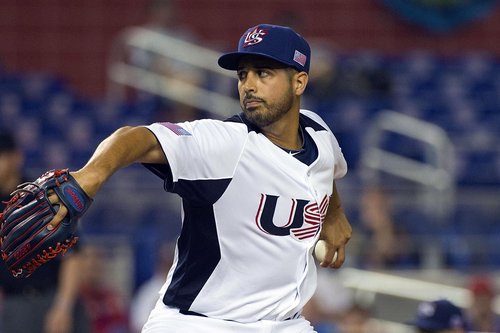
Mar 12, 2013; Miami, FL, USA; United States pitcher Gio Gonzalez (47) delivers a pitch against Puerto Rico at Marlins Park. Mandatory Credit: Scott Rovak-USA TODAY Sports

It’s been a while since Bill Ladson did an inbox; strange because you’d think with Spring Training in full swing he’d be getting a ton of emails.  Here’s his 3/14/13 edition.  Lets see if he takes a question on who will be the 2014 manager for the 5th consecutive time.

As always, I write my own answers before reading his, and edit questions for clarity as needed.

Q: Should the Nats be worried about sending their pitchers to the World Baseball Classic? Will there be pressure on them to pitch too many innings too soon?

A: Yes, this organization may be worried, as discussed in depth in Feburary in this space.  We’ve never had a pitcher throw in the WBC who hasn’t come back either injured or less effective, and league-wide studies show the same trend.  However I will say this: all 5 pitchers we’ve sent in years past were relievers.  This year we sent two starters in Gio Gonzalez and Ross Detwiler.  So maybe things will be different.  Yes the concern basically is that these guys are more interested in getting outs than getting ready for the regular season, causing them to overthrow, to not prepare as they normally would in the spring, to not focus on specific things that they would normally do in spring training games.  It is less about innings or pitch counts (which are strictly monitored).   Ladson says the team isn’t worried about their arms, but is worried about the lack of playing time Eury Perez is getting.  And they have a great point; Perez is sitting on the DR bench instead of getting ABs in spring training games.  His chances of making the team dropped to zilch and he’s already been re-assigned to AAA.

Q: Who are going to be the lefties for the Nationals by Opening Day?

A: I’m assuming he means the “Lefty relievers.”  At this point its looking like we’re going to break camp with just one lefty reliever in Zach Duke. Bill Bray needs more minor league time, Bobby Bramhall and Sean West are in minor league camp slated for AAA jobs, Brandon Mann got one inning and was awful, Pat McCoy got some innings but isn’t ready.  Only Fernando Abad has stuck with the big-league team and looks good.  But, if Henry Rodriguez is ready to go there’s no room for Abad.  I’m guessing Abad goes to AAA and bides his time.  Ladson agrees, and points out that our righties can get lefties out.

Q: With Tyler Moore on the big league roster, what do you think will happen to Chris Marrero?

A: I’m going to answer this my way, then i’ll predict what Ladson says.  Chris Marrero goes back to AAA, burns his last option in the process, and bides his time waiting for injuries to take out the likes of Adam LaRoche and/or Tyler Moore. That seems to be the only way he gets opportunities this year.  The team will hope for a strong AAA season to build up trade value and then will move him if they can.  Otherwise he’s looking at a waiver wire trip this coming off-season.  Now, before I read Ladson’s answer i’m going to guess that he says something along the lines of “The Nats will look to trade him for valuable assets” but he’ll neglect to mention that Marrero has zero trade value right now, having missed all of last year.  Lets see if i’m right: I stand corrected; Ladson has finally come around on his stance on Marrero and says he’ll be in AAA all year.

Q: Would the Nats ever consider adding Kyle Lohse to the roster?

A: Consider?  Perhaps.  Actually do it?  I don’t see it.   Kyle Lohse is becoming the poster child for the problem with the Qualifying Offer in the new CBA.  He foolishly declined it (on the advice of Scott Boras, who probably told him he could get 3-4 years guaranteed on the open market), and now sits unsigned 3 weeks from opening day.  Its amazing; this guy was 16-3 last year!  Lohse is seen as a product of his environment, a great coaching staff in St. Louis who do wonders with mediocre pitchers.  And make no mistake; 2012 aside Lohse is a career 97 ERA+ pitcher with a .500 record and a 4.45 ERA.  He doesn’t fit into the mold of what Mike Rizzo generally wants in a starter; power arm, high K/9 capabilities.  Now, if the team bus crashed and we lost our starting rotation to injury tomorrow … yeah i’m guessing we’d give him a call.  But there’s no way the Nats (or likely any other team) is going to give 3 guaranteed years to a 34-year old soft-tossing guy.  Boras really, really miscalculated here and it looks like its going to cost his client millions.  Ladson agrees.

Q: Please find out where Cole Kimball is in his rehab. I would like to know if he’s anywhere close to pre-surgery velocity.

A: I only saw Cole Kimball in one game, but his velocity was down.  Perhaps its ramped back up later into spring training.  In either case he’s bound for AAA to burn his last Option and await bullpen issues for his shot.  Ladson says he’s “close to throwing 95-mph.”  I wish more of these games were televised.

Q: Having heard earlier in the offseason that general manager Mike Rizzo feels Steve Lombardozzi and Danny Espinosa are both starters and not bench players, do you feel one of them will be traded prior to Opening Day? Lombardozzi was an extremely clutch pinch-hitter last year in my opinion.

A: Traded prior to Opening Day?  Almost impossible; nobody makes trades at this point in the season.  You make trades prior to spring training and then after a couple months are past in the season to address off-season or intra-season needs.  We’ll save the Espinosa vs Lombardozzi vs Rendon discussion; we all know it by heart by now.   Ladson says a trade is not coming.

Q: Considering he had a very good year with Triple-A Syracuse in 2012, what are the chances of outfielder Corey Brown making the team?

A: Zilch.  He may have hit in AAA, but he didn’t hit squat with Washington last September.  He’s at least 6th on the Washington OF depth chart (Werth, Harper, Span, Moore, Bernadina and then Eury Perez.  Perhaps even lower; I think the team would give Carlos Rivero and Erik Komatsu chances before Brown at this point.  And its just a matter of time before uber-prospect Brian Goodwin passes him by as well.  Brown’s looking at another year of AAA time, burning his last option, and then getting the MLFA treatment.  Ladson says no chance.

Hey!  No question on the 2014 Nats manager this time! I stand corrected.

Ask Boswell 2/25/13 Edition

8 comments

When is Anthony Rendon going to be ready for the Majors? Photo Nats Official via espn.com

With the first couple of Spring Training games in the books, its fitting that Tom Boswell did a Monday morning chat on 2/25/13.

Here’s how I’d have responded to the Baseball-specific questions he took.  As always, questions are edited for clarity and I write here before reading his response so as not to “color” my answer.

Q: Given that the Nats know almost every player making the roster out of Spring Training, do the players/coaches approach the 6 weeks differently?

A: Good question; I was taking with someone about this exact topic this weekend.  The 25-man roster is essentially already solidifed; perhaps the only question remaining is whether or not Henry Rodriguez makes it onto the team or does the team carry a second lefty reliever (Bill Bray?).  So I think the answer has to do with looking more at the AAA talent, looking at minor league FA signings like Micah Owings and Chris Snyder to see if they’re going to be better options than the guys we already had slated at AAA.  And the coaching staff gets to look at up-and-coming guys like Anthony Rendon, Zach Walters, and the like.  Boswell reiterates what I said here, naming other ML signings of interest like Chris Young, but also says that this ST has a lot of “wasted time.”

Q: I’ve spent the offseason reading Ball Four to help get my baseball fix. Do you have a sense about how different things are now?

A: It has been a while since I read Jim Bouton‘s seminal baseball book Ball Four.   But the season he chronicles (1969) happened before a number of rather important moments in Baseball history.  Expansion, divisional play, the Designated Hitter, the aftermath of the Curtis Flood and Andy Messersmith decisions (aka, Free Agency) and of course the massive increase of money in the game (both from a revenue stand point and from a player salary stand point).  One thing that seems certain to have changed; players can now earn enough in a season to be set financially for life.  And, the players union’s power is now such that players have the upper hand in a lot of negotiations with the league and the owners when it comes to labor unions.  Boswell notes that managers, coaches and GMs are far “smarter” now than they were in the Bouton era.

Q: How the Nats will do at the gate this year?

A: The season ticket base is back to where it was in 2005 apparently, broaching 20,000 season tickets.  The team averaged 29,269 fans last year.  Clearly the attendance seems set to rise significantly.   I think they’ll average 35,000 a night if they continue to be a first-place club.  Boswell agrees, noting that the team also has a couple of very marketable stars to help with attendance.

Q: Other than obvious injuries, are there any things that can happen in the first quarter of the year that you would find to be troubling?

A: I’d be troubled if Danny Espinosa started off slow.  I’d also be concerned if we saw significant regression out of our WBC participants Gio Gonzalez and Ross Detwiler, confirming my fears.  But the most important factor may be the performance of Dan Haren: is he the 2012 Haren or the 2009 Haren?  If he approaches 2009 version, this team may be set for the season.  Boswell notes they have a tough early schedule, that winning 98 games is tough, and that we should be patient.

Q: Gio Gonzalez; did he or didn’t he?

A: I think the prevailing opinion in the sport now seems to be that he did NOT take or receive PEDs from the Miami clinic, and that he was an unfortunate bystander.  His passing a surprise PED test given two days after the scandal seems to have also bolstered his case.   Boswell agrees.

Q: Are the Nats a 98 win team again, or was last year a fluke?

A: Barring a significant injury in the rotation, I think the Nats are easily a 98-win team and perhaps better in 2013.  Statistical WAR “proof” offered in this space back in January, and that was before the LaRoche re-signing and the Soriano pickup, both of which marginally should improve the team a few wins.  Most national pundits that I’ve read think the same thing, that this team could win 103 games.  The various estimator stats out there (Zips, Pecota, etc)  the team much closer to 90 wins, but those predictors are by and large incredibly conservative.  Boswell also says it comes down to health of the rotation.

Q: How would you rate the Nats starting rotation, spot by spot, compared to the rest of the Major Leagues?

A: Spot by Spot, its hard not to think that each of our guys are each at least in the top 5 by position in the league.  Drawing from my Rotational Rankings post from January 7th, 2013, I’d say that:

  • Strasburg is clearly among the best arms in the game (in the discussion along with Verlander, Kershaw, and Hernandez).  He’s not as accomplished as this group of course, but his talent is unquestionable.
  • Gonzalez matches up as a top 5 number two starter (other candidates: Greinke, Hamels, Lincecum or Cain, depending on who you think SF’s “ace” is).
  • Zimmermann is traditionally underrated but is at least a top 5 number three starter (along with Scherzer, Johnson/Morrow, Bumgarner, Lee and Moore).
  • Haren on potential could be the best number four starter in the game, though Buehrle, Miley, and Lynn could also fit in here.
  • Detwiler is often mentioned as being the best number five starter out there, and its hard to find competitors (best options: Zito, Romero, Garcia, and whoever Oakland and St. Louis settle upon for their #5 starters).

Boswell seems worried that these five guys can handle the workload all year, only really trusting Gonzalez in terms of repeatability.

Q: What future do you see for Anthony Rendon, and when will he debut in the majors?

A: I have been of the belief that Zimmerman should move to 1B for Rendon at some point.  But with LaRoche signed for two years, that won’t happen for a while (2 years, perhaps 3 if we pick up his 2015 option).  So now i’m starting to come around to the the possibility of Rendon pushing someone else off their position.  The most likely candidate seems to be Espinosa at 2B.  Despite having Lombardozzi on the 25-man, Rendon is a higher-potential player.  If Espinosa starts slow, and Rendon starts fast, I could see Rendon getting called up in June and starting to get reps at 2nd while Espinosa goes on the DL for his shoulder.  Otherwise, a Sept 1 call-up seems in order.  Boswell predicts a post-all star game call-up.

Q: Is there any way the Nats can stop Detwiler and Gio from pitching in that baseball ‘classic’? I see a disaster waiting to happen. Luis Ayala was never the same after getting hurt pitching in that thing.

A: There’s no way legally the team can prevent either guy from pitching, since neither suffered any injuries in 2012.  And yes I agree (as discussed in this space on 2/11/13) this is bad news for the Nats.  Washington has never had a pitcher play in the WBC who didn’t regress badly, and the stats seem to show that most every pitcher who does participate in the WBC pitches poorly the next two seasons (links in my post).   Boswell says cross your fingers.

Q: Do you think Bryce has it in him to be National League mvp?

A: Yes I do.  MVP voting generally starts with the “Best Player” on the “Best Teams” and creates a short list from there.  It is why it is relatively easy to predict the MVPs.  If Washington is the best team in the league and makes the playoffs again, and Bryce Harper has a break out season, it won’t be hard to see him getting serious MVP consideration.  Now, let me also say that a “Harper for MVP” prediction is NOT the same as predicting that Harper is set to become the best player in the game.  That’s not what the MVP measures.  If the question was, “Is Harper set to become the best player in the National League” i’d then say, “No, he’s a few years away from that distinction.”  Boswell thinks it may be a bit early.

Q: How many wins per year would you estimate a a stellar defense adds to a teams win total over the course of a season?

A: I’m sure there’s a good statistical answer for this, based on the percentage of WAR added by defense.  But it seems like a very difficult answer to come by.  Boswell says “a few.”

Q: Any reason to think he’s NOT going to be the GM for a long time?  Because I can’t think of many others who have done as good a job in all of baseball.

A: I can see no reason for Rizzo not to be the GM for at least the next 4 years.  His next big challenge will be dealing with the inevitable payroll demands of Harper and Strasburg (both of whom project to be $25M players) while also keeping a competitive team on the field.   2017 could be an interesting year for this team; Strasburg projects to hit Free Agency that year, and Harper should be in his 4th arbitration year.  They already have Zimmerman and Werth at $14M and $21M respectively in the 2017 year, with possibly another $40-$45M out the door to keep Harper and Strasburg.  They better start working on the farm system again.  Boswell didn’t really answer the question, just mentioned how Rizzo’s options have yet to be picked up.

Q: How is Ramos looking thus far? 100%? Suzuki is a professional and seems to be a good guy, do you get a feel for how well he and Ramos interact? How great would it be to generate some power/runs from the catcher spot this year.

A: I’ve been assuming that the catcher job is Suzuki‘s to lose for now; its still early but no word has come out negatively on Ramos‘ recovery.  Either way, yes it would be nice to get some production out of the #8 hole.  Suzuki was pretty good after he came over here, but Ramos healthy was a middle-of-the-order bat.  Boswell suggests that Ramos stop blocking the plate.

Q: If Rendon tears it up after September call-up, what does the Nats 2014 infield look like?

A: Wow; hard not to say Rendon replaces Espinosa like-for-like right now.  But, just as Desmond broke out in his 3rd full time season, so could Espinosa.  It could make for a log jam.  Lets hope for the best, hope for a rebound Espinosa season and a good-problem-to-have situation of having to trade a strength to make way for another strength.  Boswell has no idea where Rendon will play if he merits a call-up.

Q: I think the Nats, and Danny Espinosa are whistling past the graveyard if they think a completely torn left rotator cuff will not seriously affect Danny’s play. Your take?

A: A fair assessment.  I too believe a torn rotator cuff absolutely has to be affecting his swing, especially from the right side.  I think Espinosa should have gotten the thing surgically repaired in the off-season.  I wonder how much the team knew of the injury, because when it was reported in the off-season it sure seemed like a surprise.  Boswell says its a concern and that Espinosa should take more days off.

Q: Is McCatty working with Strasburg on correcting his inverted W delivery? Strasburg also has footstrike issues, as he tends to plant his foot and then whip his arm, which puts a ton of strain on his shoulder. I’m concerned if he doesn’t correct this, his shoulder will give out this season or next. Are the Nats worried about this? Are they working on cleaning up his delivery at all?

A: I’m beginning to think that this whole “Inverted W” thing is a bunch of BS.  Keith Law stated as much when prompted in a chat recently; he says that the problem with the Inverted W theory is that its difficult to “state” with authority that certain pitchers do or don’t have the phenomena.  And its true; if you see some shots of Strasburg he has it, in others his arms are more bent behind his back.  Its the same with Gio Gonzalez (I can show you stills of him landing with his arms clearly in an “inverted W” position and you don’t hear anyone talking about Gonzalez’s mechanics.   The leading inverted-W site on the internet (Chris O’Leary‘s page linked here) uses an opportunisitic example set of pitchers with that motion, but I can find plenty of examples of guys who have similar mechanics but zero soft-tissue injury history (on the Nats two quick examples are Drew Storen and Craig Stammen).  Meanwhile one of his examples was John Smoltz … who only threw 3400 MLB innings in his career and basically didn’t miss a start until he was 32.  Not the best example of proof that his mechanics were somehow “awful.”  I think the entire phenomenon is an observation of coincidence, that pitchers get injuries all the time no matter what their mechanics, and that we need to move onwards.  Wow; Boswell thinks exactly what i think; these proofs are nonesense.

Washington is a “Football” town; what’s yours?

15 comments

(Editor’s Note: I first started writing this post in May of 2011, came back to it in August of 2012.  Suddenly in Feb of 2013 this whole post got “scooped” by Craig Calcaterra on HardballTalk.   Don’t you hate it when a post you’ve had in draft mode forever is essentially duplicated while you sit on it?   At least it gave me some reason to finish it and finally publish it).

In early 2011, After watching a re-run of “Four Days in October” of the fantastic 30-for-30 series I got to thinking about the “leading” sports obsession, per city, around the country.  There were numerous shots of the town of Boston, its fans, the bars, etc, and one clearly got the impression that Boston is a “Baseball town.”  This got me thinking: what is the Leading Sport in every pro town in America?

(coincidentally,  if you’re also a fan of the 30-for-30 series, I posted a review and ranking of all 30 original episodes in December 2010.  ESPN’s 30 for 30 site also has a ranking page where, after you vote, you can see the results.  I put in my own rankings on the Dec 2010 post, which I may re-publish at some point).

Here in Washington, clearly we are a Football town.  The Redskins are king; every local sports radio show dedicates large portions of its programming to the Redskins in season or out, because that’s what draws.  The other pro teams in town are of only passing interest to casual fans, are mostly followed by die-hards (like me and the Nationals of course), but if they have a run of success (as with the Capitals now and the Nationals in the first half of 2005 or in 2012) then suddenly they’re popular.  But Football will always be king here.  Some local sportswriters have mentioned the Jayson Werth walk-off in game 4 of last year’s NLDS as the moment that “Washington became a baseball town,” but I just don’t see it.

How about the other major sports towns in America?  I took every town that has 2 or more pro franchises (since obviously, if you live in Jacksonville with only one major franchise, the answer is usually pretty clear) and put my thoughts down.  Feel free to debate, criticize, or tell me I don’t know what i’m talking about.  The towns are listed by category, in descending market size.

Four (or more) Sports towns

1. New York: Baseball.  Despite having so many sports choices, I think the history and continued dominance of the Yankees makes NYC primarily a baseball town.  That’s not to say that a city of 8 million people doesn’t support its football, basketball or hockey teams, but none of the other NY-based franchises have consistently been as good or in the news as much as the Yankees.

2. Los Angeles: Basketball.  As with the Yankees of New York, the Lakers status as one of the marquee franchises (if not THE marquee franchise) of the NBA makes this a basketball town first and foremost.  The Dodgers have 50+ years of history in the town, but the Lakers rule.  Note; of all its major city counterparts, Los Angeles is also the closest to a “college town” that you’ll see.  USC and UCLA both have major sports programs, the area hosts the Rose Bowl every year, and other lesser sports schools such as Loyola Marymount, Pepperdine, and Long Beach State all have had their moments in various college sports.

3. Chicago: Baseball (but open for debate).  The Baseball history is obvious, with both teams having 100+ years of history and the Cubs being one of the marquee franchises in the sport.  The Bulls clearly made the town a Basketball town for a sustained period of time, but I don’t get the impression they’ve supplanted the Cubs.  The Blackhawks are an Original Six hockey team, and the Chicago Bears have been around since the beginning of organized professional football (In fact, they won the first NFL championship in 1933).  So there’s a ton of sports history in this town.  But do the other sports supplant the baseball culture?

4. Philadelphia: Football.  The Phillies have re-made themselves into a dominant force in Baseball over the past few years (2012 notwithstanding), but nothing stokes the fire of Pennsylvanians as much as the E-A-G-L-E-S.

5. Dallas/Fort Worth: Football.  Can’t get much more important to a town’s psyche than the Cowboys.  Even if the Mavericks win a title and the Rangers make the World Series.

6. Miami: Football by attrition.  The South Florida populace is so irritated with Jeffrey Loria that they’ll probably never be baseball diehards.  The Heat?  LeBron is johnny-come-lately.  Hockey?  In a town where it never gets below 60?  Can’t see it.  In fact, Miami may really be the most apathetic sports town out there.  The rise of the U of Miami football team helped, but that fad has passed and Miami football barely draws any more.  I don’t think you’d really say that the town is crazy over its Dolphins, but is it crazy about any of its teams?

7. Washington: Football.  The Redskins rule (as discussed above), and the other teams are only of passing interest if they’re winning (which, in the Wizards case, hasn’t happened since the late 70s).

8. Detroit: Hockey.  The Red Wings are an institution, and they don’t call Detroit “Hockey Town, USA” for nothing.  The Tigers were a laughingstock for years, the Pistons had a slight run of glory under Isaiah Thomas, and the Lions are in the midst of a horrible period.  Even with Detroit’s run of glory in the past decade, the Red Wings keep on rolling.

9. Boston: Baseball. The hold the Red Sox have on the psyche of New Englanders in general is legendary.  Boston’s other teams have had sustained runs of greatness lately, and of course the Celtics rival the Lakers in terms of legendary franchises.  But if you have to pick one team I still think its the Red Sox.

10. Atlanta: Football, I think.  The Braves made the playoffs 15 straight years but the team couldn’t sell out its playoff games.  I don’t think the town really cares about its hockey or basketball teams that much (in fact, the Hockey team moved to Winnipeg).  How about the Falcons?  Does the rise and fall of the Falcons drive sports talk in Atlanta?  Perhaps the presence of Georgia Tech and SEC football makes the town more apathetic about its Pro teams.

11. Phoenix: Debatable as well.  I’d guess Basketball as being the longest tenured professional team in Arizona.  But, a number of teams now have spring training in Arizona and the Diamondbacks have a relatively recent World Series victory.  The Arizona football team may have made a run to the 2009 Super Bowl but Arizona didn’t even have a football team for a number of years with the Rams relocation.

12. Minneapolis: Has to be Football.  The Twins are contenders now but it wasn’t too long ago that the team was in supposed danger of contraction (thanks to their penny-pinching billionaire owner Jim Pohlad and his father).  The basketball team is a punchline in the league.  One of the few major northern/cold weather cities would be a natural for Hockey, but the North Stars left town and I had to look up the current pro hockey team’s franchise name.  The Vikings current stadium is in dis-repair, and there’s rumors that the team may move from the area (perhaps to Los Angeles to continue a trend the Lakers started in 1960).  There’s a voter backlash against paying for billion dollar properties that serve only to further enrich billionaire NFL owners, so the natural move for the Vikings may be to move out of town.  Which is a shame for football diehards in the Twin Cities area.

13. Denver: Football.  They only got baseball and hockey within the past 20 years, and i’m pretty sure the Nuggets don’t outweigh the successful Broncos.

Three Sport Towns

1. Houston:  I’d say Football, if only because its Texas (where football rules) and because the baseball team has a history of underperforming.  Houston is definitely a destination spot for NBA players (tax purposes, warm-weather city) but does it out-shine the Texans?  Clearly it isn’t the Astros, who may lose 115 games this year.

2. Toronto: Hockey.  One of the original 6 NHL franchises, a troubled basketball squad and the general dissatisfaction in Canada re: professional baseball since the strike.

3. Oakland: Football. Raider-nation is psychotic.  The A’s lack of expenditure and outright politicking to move to San Jose has soured the community on baseball to the point where large swaths of the outfield are tarped over during regular season games.  Golden State has reached the playoffs once in the past 18 years.

4. St. Louis: Baseball.  Perhaps Football, with the run-and-gun Rams and the incredible noise they generate in their indoor stadium. But St. Louis has the 2nd most successful baseball franchise in the sport (in terms of World Series victories) and a continual line of success.

5. Pittsburgh: Football.  No one can trump the Steelers, not even the owned-by-team-legend Penguins.  In most other cities this would be a hockey town.

6. Tampa Bay: Football.  Despite a recent run of success, the Rays barely draw (though have great TV ratings).  The Lightning are a great team … but I can’t see such a warm weather city really dedicating itself to a cold-weather sport.  So by default we have Football.

7. Cleveland: Football. The moving of the original Browns franchise was one of the true tragedies of sports relocation; a beloved team that was well supported picking up and moving.  So controversial was the move that the city was allowed to keep its name and almost immediately an expansion team was “invented” to give back to the city.

8. Milwaukee: Football, if you count Green Bay as being in the Milwaukee Market.  And I do, which may or may not be considered “correct” in the opinion of Wisconsin natives.

Two Sport Towns: these towns are either-or, and mostly football wins.

1. San Francisco: Football.  Despite all the history with the Giants, going to 49ers games reinforces the notion that the Bay Area loves its football.  This is the single city for which I disagree with Calcaterra, perhaps because I’ve seen 49er games and, well, they’re just as crazy as Raider fans.

2. Seattle: Football. Seahawks games are notorious for being amongst the loudest in the league despite an open-air stadium.  The Mariners have some history of success, and a great following, but don’t out-weigh the Football team.

3. San Diego: Football again; the baseball team doesn’t really draw and this beautiful-weather city doesn’t like to commit to spending its sunny evenings at baseball games.  Of course, it would help if their owner would open up his pocketbook once in a while.

4. Baltimore: Football. It was a travesty when the Colts left town, but the team has embraced its Ravens.  The Orioles had their shot to take over the town during the no-football period, and it looked as if they just might.  With one of the crown jewel stadiums in the league they shot to the top of the baseball world (for a time in the mid 90s it was Baltimore with the highest payroll in the league, not the Yankees).  Unfortunately owner Angelos has run the team into the ground, and the changing baseball market forces now mean that Baltimore is destined to be a 2nd tier team for the extended future.

5. Cincinnati: Baseball.  Both pro teams (Reds and Bengals) have respected histories and long line of success.  And yet both teams have struggled as of late.  The Reds have 3 World Series victories since 1940 but none since a shock win in 1990, and its been a long time since the Big Red Machine was in effect.  But the Bengals have never won a superbowl and havn’t even reached it since 1988.   By virtue of the Reds recent run of success I’ll go with Baseball.

6. Kansas City: Football all the way.  The Royals may look dangerous this season, but they’ve lost an entire generation of fans to ineptitude.  Meanwhile the Chiefs are an original AFL landmark and make Arrowhead one of the best home field advantages in the league.

7. Indianapolis: Arguable.  Indiana is the heart of Basketball middle-america, the home of Hoosiers and major basketball pride in the high schools and colleges.  So are the Pacers the leading sports interest?  Not with the sustained success of the Colts football team, led by possible best-ever player Peyton Manning.  But Manning is gone, and I think Basketball is still king.

8. Charlotte: none?  Charlotte is home to the Panthers and to the Bobcats.  Because of the college-basketball crazy state of North Carolina, one would think that Basketball would be king.  But the new franchise has one playoff appearance in its history and seems to be going backwards under new owner Michael Jordan (at least in the opinion of basketball pundits and observers).  The Old franchise was so abhorred due to owner’s George Shinn’s personal conduct that the community more or less boycotted the games, forcing their move to New Orleans.  Meanwhile are the Panthers the hot name in town either?  They’ve made one super bowl appearance but finished last year 2-14.  I’m going with Basketball just by default.

9. New Orleans: Football!  With an exclamation point; the “Who-Dat” Saints have always been the soul of this sports-town.  2010’s Super Bowl victory was just icing on the cake.  The basketball team shouldn’t have been moved there to begin with, and struggled so badly that the league bought out Shinn’s interest in order to keep them (for whatever reason) in New Orleans.  (Perhaps a move to Seattle is in the cards?)

10. Nashville: Football. The Predators are never going to out-live the pull of the Titans.

11. Buffalo: Tough one.  I’d go Football if only because the city still holds on to its great run of super bowl appearances, except that the team is playing “home games” in Toronto every year.  The hockey team has never won the league but has been a pretty strong lately, so I’m going with a Hockey town.


Summary by sport:

  • Football: 20
  • Baseball: 5
  • Basketball: 4
  • Hockey: 3

Thoughts?  Feedback?  Do you think I have some of these cities mid-pegged?
Written by Todd Boss

February 21st, 2013 at 10:39 am

Ladson’s Inbox 2/5/13

16 comments

Lots of questions about Gonzalez and Garcia this week. Photo unknown credit.

Hey, what great timing for another Bill Ladson inbox (posted 2/5/13).  Baseball news is light, pitchers and catchers report in a week or so, and I’m not quite ready to continue my Stats series.

As always, I write my answer before reading his, and sometimes edit questions for clarity:

Q: Do you think general manager Mike Rizzo will add starting pitching depth before Opening Day? Does the lingering possibility of a Gio Gonzalez suspension change whom the Nationals would consider acquiring?

A: In Ladson’s 1/22/13 mailbag, some one asked what could prevent the Nats as constructed from winning the World Series in 2013.  I answered Rotation Injuries and Luck.  Well, in the wake of the Miami PED scandal, I guess the third answer may be “PED scandal.”

This is a tough question to answer; Gio Gonzalez has denied the rumors, but the newspaper in question (the Miami New Times) clearly only named Gonzalez because they felt like the evidence they had in hand was irrefutable.  Many other players have not been named.  So as a GM; how do you go about preparing for 2013 at this point?   If Mike Rizzo knows that Gonzalez is getting suspended, you have to think he’s on the horn to his buddy Scott Boras about possibly buying Kyle Lohse, which is clearly the best remaining FA starter.  But Lohse isn’t coming cheap, and likely isn’t coming on a one year deal, and would cost another draft pick (I believe).  The Nats are already topping $120M in payroll; would they go to $135M?

If we think Gio at least gets a pass and the suspension is put off, maybe Rizzo’s recent activities of signing random starters to minor league contracts is going to be sufficient.

Ladson mentions Javier Vazquez and the ever-present rumors of Christian Garcia going to the rotation as possible Gonzalez replacements if he gets suspended quickly.  Probably fair; Vazquez may be a great, cheap alternative.

Q: Everyone is saying that it’s going to be a two-team race in the National League East between the Nationals and Braves. Do you think the Phillies have a shot to contend with both these teams, or is their time done?

A: Boy, its hard to look at the aging, expensive Phillies lineup they had in place in 2012, which suffered injuries and setbacks and creaked their way to a .500 record, and then look at the highly questionable slew of acquisitions and signings this off season (Ben Revere, John Lannan, Michael YoungDelmon Young and everyone’s favorite anti-gay advocate Yuniesky Betancourt) and not, well, giggle at where this team is going.  My favorite baseball joke from the off-season goes like this: “The Phillies wanted to get Younger this off-season, so they signed Michael Young and Delmon Young.”

The two Youngs were both negative WAR players last year, Lannan is a 5th starter, Revere was a backup centerfielder who the Phillies traded some decent assets for, and Betancourt is who he is (though admittedly he’s on a minor league deal and seems at best set to be a utility infielder behind starters Jimmy Rollins and Chase Utley).  I see the Phillies being a very bad defensive team with the two Youngs in the starting lineup, I see some serious questions in the back side of the rotation, and I see continued regression and louder complaints about Ryan Howard‘s contract.  Fun times a-coming in Philadelphia.  Ladson actually says that the Phillies will “be improved with Michael Young.”  Bill!  Have you seen Young’s WAR figures from 2012??  He was a NEGATIVE WAR player at both major War sites.  That means he makes your team worse!    Now, he was completely servicable in 2011 … so if you want to make the argument to me that 2012 was an aberration for an aging hitter playing in a hitter’s park, well I guess that’s a stance you can take.  But pretty much every other pundit in the blogosphere has loudly criticized the Philadelphia moves this off-season.

Q: What is the status of Lucas Giolito? When do you see him pitching in D.C.?

A: Tommy John surgery in Late August (I can’t remember the exact date; it was 8/24/12 when I posted this highly-critical article about Lucas Giolito and the situation), so figuring a typical 12-month rehab session before he’s actively throwing again in pro-games basically puts him at the end of the 2013 minor league season.  Which means he’ll be 20 before he really is ready to start his pro career in the spring of 2014.  Figure 4-5 years average case for typical high schoolers to work their way up the systems (perhaps fewer years given his talents and pedigree, as we’ve seen with someone like Dylan Bundy in 2012, who made his way from low-A to AA in his first pro season out of HS and got a late Sept callup to the majors) and we’re probably looking at 2016-2017 before seeing him in the majors.  If, of course, he recovers from surgery, hasn’t destroyed his mechanics, is effective, matures, doesn’t get re-injured, or any of the million other pitfalls that typically befall high school arms drafted in the upper rounds.  Ladson thinks he’s pitching pro games “after the all-star break” and is in the majors in 3 years.  Wow.  That is optimistic.

Q: How do you think Henry Rodriguez will do? And what do you think his role in the bullpen will be?

A: I am, and always have been, pessimistic on Henry Rodriguez.  I hated the Willingham trade that got him here.  He’s forced the team to invent injuries to stash him on the DL coming out of spring training b/c he has no options.  He led the league in wild pitches in 2011 in just 65 innings.  He had a 69 ERA+ in 2012.  At some point when does the team say, “OK, its nice that he throws 100mph.  But enough is enough; we need a reliable pitcher who can deliver when called upon.”  Perhaps Spring Training 2013 is that time.

What do I think his role will be?  I’m sure he’ll look great in Spring Training again, will break camp with the team, and very well may look halfway decent for a while.  But just like every other season, he’s going to have those 3-walk outings where he pitches a 1/3 of an inning and gives up 4 runs, and then the manager will be afraid to use him unless the team has a 5-run lead.  And eventually we’ll call up Garcia to replace him and move on.  That’s my prediction for Rodriguez.  Ladson says the team should “attempt to trade him if he is not impressive this spring.”  Wow, that’s sage advice; if only every team could trade its under-performing players and actually get value back whenever it wanted.

Q: Can you predict Washington’s Opening Day lineup if all available players are healthy?

A: Easy.  I’ll even predict the batting order.  Span-Werth-Harper-Zimmerman-LaRoche-Desmond-Espinosa-Suzuki-Strasburg.  Ladson predicts the same names but in a lineup order that makes no sense from a lefty-righty balance perspective.

Q: After announcing his retirement, do you think Brian Schneider is a possible candidate to replace Johnson as manager of the Nationals?

A: Wow, yet another speculative question about the future Nationals Manager.   He took a question about the manager on 1/28/13, and on 1/22/13.  And on 1/14/13.   I guess people like speculating on the Nats next manager.  Not repeating what i’ve said on the topic before, is Brian Schneider a candidate?  Why would he possibly be a candidate to manage the major league team of a system he left 5 years ago?  Why would the Nats pick a manager who’s never managed a day in his life?   Ladson breathes some common sense on this one.

Q: I think Garcia has to be on the Opening Day roster, so is he in the bullpen or someplace else? Can the 25-man roster accommodate him and all the other pitchers?

A: “Someplace else?”  Like where?  In the outfield?   I like Garcia too, but the team has a numbers problem in the bullpen.  Storen, Clippard, Mattheus, and Stammen have all more than earned their spots.  Soriano is being paid a ton of money.  Duke is guaranteed a spot (he’s the only lefty and he’s got enough service time to refuse a demotion).  Oh, and Rodriguez has no options.  So there’s your 7-man bullpen.  Notice there’s only one left-hander out there; if you believe that you need left-handers to get left-handed batters out, then the bullpen needs to sacrifice one of the righties in order to have a second lefty (Bill Bray?) in there.

The only way I see Garcia making this bullpen is if the team runs out of patience with Rodriguez and DFAs/DLs him, or if the team trades away one of their closer-quality surplus guys, or if maybe someone like Mattheus/Stammen (both of whom do have options) struggles or gets hurt.  Otherwise look for Garcia to get stretched out and get looks as a starter in AAA.  Ladson says he’s confident Garcia is on the 25-man roster …. ok explain it to me then based on the above paragraph.  Who is he replacing?