Nationals Arm Race

"… the reason you win or lose is darn near always the same – pitching.” — Earl Weaver

Archive for the ‘michael morse’ tag

Roster Construction Analysis of 10 Playoff Teams; 2012 edition

5 comments

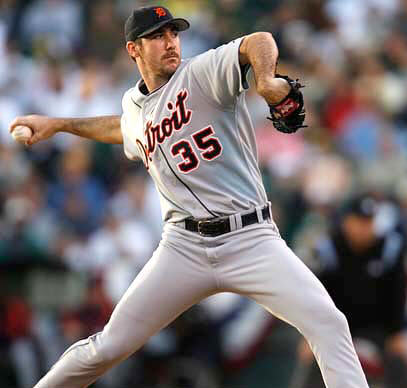
Justin Verlander is one of the most important home-grown players in the 2012 playoffs. Photo unk via rumorsandrants.com

Every year I do a bit of “Team Construction” analysis to kind of gauge the trends in roster construction.  Last year’s post is here, and the links to the side have the underlying spreadsheet of player acquisition methods so you can see the pure details.  This topic was also covered in-depth by John Sickels on his minorleaguebaseball.com blog for another viewpoint.

Borrowing from last year’s post, there are four main ways teams can acquire players:

  1. Draft: The player is with the original team that drafted him.  In the case of international free agents, if they’re signed as 16-year olds they are considered in this category as well (i.e., Ichiro Suzuki is not a developed player, but an international Free Agent).  It could be better defined as “Club developed players.”  Simple examples for the Nats: Stephen Strasburg and Bryce Harper.
  2. Traded MLBers: The player was acquired by the team by virtue of trading an established MLB player.  Most of the time these days, this means the player was acquired as a prospect (since most trades seem to be of the prospect-for-established player kind).  Example for the Nats would be Michael Morse, who was acquired by our trading an established MLB player in Ryan Langerhans for Morse while he was still (essentially) a minor leaguer.
  3. Traded Prospects: The player was acquired by the team by virtue of trading prospects.  This is essentially the reverse of #2.  The Nats key example is Gio Gonzalez.
  4. Free Agent: The player was acquired in free agency.  This category also includes two other types of acquisitions: waiver claims and cash purchases.  These three categories are lumped together since all three indicate that a team has acquired a player with zero outlay in terms of development or prospects.  Examples for the Nats: Edwin Jackson, Adam LaRoche.

Here is the summary of roster construction and “Construction Strategy Category” that we’ll talk about next.  Note that I only count the “core players” on a team for this analysis.  The core players is defined as the 5-man starting rotation, the setup and closer, the 8 out-field players, and the DH for AL teams.  I didn’t extend this all the way to the 25-man roster, figuring that these core 15 players are the main reasons teams win and advance.  That and huge chunks of the bullpen and the bench are either fill-in FAs or draftees and it would skew the analysis of how teams really got to the playoffs.  Here’s the summary (the table is sorted by count of Draftees):

Season Team Drafted/Developed Traded Prospects Traded MLBs FA/Waivers Ttl Constr Method
2012 Atlanta 11 1 3 0 15 #1
2012 St. Louis 9 0 2 4 15 #1/#4
2012 Washington 8 3 1 3 15 #2
2012 San Francisco 8 2 2 3 15 #2
2012 Cincinnati 8 2 3 2 15 #1
2012 New York Yankees 5 2 1 8 16 #4
2012 Detroit 5 5 2 4 16 #2/#4
2012 Texas 4 2 7 3 16 #3/#4
2012 Baltimore 3 1 8 4 16 #3
2012 Oakland 2 1 7 6 16 #3

So, what are the four construction methods I’ve identified? Again borrowing from last year’s version of this post, they are (with this year’s examples).  The complication this year is that some of the 10 playoff teams don’t fall neatly into one specific category.

Method #1: Build from within 100%: (Cincinnati, Atlanta).   Atlanta, amazingly, didn’t use a single Free Agent among its core 15 this year.  They made a couple of key trades to acquire a few starters, but the rest of their lineup is home-grown draftees.  That may change next year as they try to replace Chipper Jones, Michael Bourn and possibly Brian McCann, who may leave via free agency.  Meanwhile Cincinnati has just a couple of free agents and mostly rely on guys they’ve grown as well.

Method #2: Ride your developed Core and use your prospects to acquire big names: (Washington, San Francisco and Detroit to an extent): The Nats have transformed themselves over just a couple of seasons, relying less on FAs to plug holes caused by an awful farm system to having most of their core team developed at home (See the table further below to follow the transformation of our team over the past few seasons).  Those spots they couldn’t depend on have been filled by trades (three guys acquired by flipping prospects for them; in addition to Gonzalez Kurt Suzuki and Tyler Clippard also count here).  San Francisco has seen their payroll skyrocket as they extend their home-grown talent, but for the most part they have stayed true to the team development concept.  Their one major Free Agent (Barry Zito) is notoriously one of the worst contracts in baseball and it is somewhat surprising to even see him on the post-season roster.  He wouldn’t be if Tim Lincecum was pitching in 2012 like he has regularly done in previous seasons.  Detroit was entirely in method #2 until they decided to spend money like the Yankees; we’ll revisit in #4.

Method #3: Go Young and grow up Strong (Baltimore, Oakland and Texas to an extent): Baltimore acquired a massive chunk of their rosters by flipping major leaguers for prospects and watching them blossom into a surprise playoff team.  Oakland has made a habit of getting rid of guys before they hit arbitration; fully 7 of their squad was acquired this way.  The difference is that Oakland has been forced to buy a big chunk of their core group on the FA market, depending on cast-offs like Brandon Inge and Jonny Gomes to plug leaks and get production on the cheap.  I’m guessing that Oakland will transform more into Category #1 as the vast amount of prospects they’ve landed lately continue to matriculate.  Lastly Texas was entirely in this category before they dropped major money on the likes of Adrian Beltre and Yu Darvish, transforming them into a spending power to go with their still-excellent farm system.

Method #4: Spend what it takes to win: (New York fully with St Louis, Texas and Detroit partially here): The Yankees are the class-A example of this method (along with Boston and the Dodgers frankly), but the spending that St. Louis, Texas and Detroit cannot be overlooked.  The Yankees more and more are depending on expensive FA purchases to replace what their farm system is not developing, and the problem is only being brought into more focus this off-season.  Their 3 primary starters are FA acquisitions, their biggest FA is looking like a contract catastrophe, and their developed guys are not stepping up and taking over major roles (especially on the pitching staff).  The other three teams mentioned here are mostly built on home-grown talent, but have spent so much money on the FA market lately that they are broaching into the upper echelons of MLB payroll.  St. Louis is almost entirely built from within (as noted by other columnists doing this same type of analysis) but still has depended on a couple of key FAs to advance as far as they have.

Conclusions:

  • There’s no real formula to building a playoff team, as we see from the spread of the 10 teams among the four methods defined.
  • I think its safe to say that the most difficult methods to depend on are #1 and #3.  You need to have a very good farm system to depend on the #1 method to work for you, and over the past few years only a couple of teams really have had success using this method (Atlanta and Tampa Bay).  Kansas City has tried #1 for years and has gone nowhere.  The #3 method is also frought with issues, since it requires a ton of patience from your fan base and may not be sustainable.  Would anyone be surprised if both Oakland and Baltimore collapsed next season?  Probably not; you really need to build on a base of players once you’ve established yourself as a good team and continue to augment, either through trade or through FAs.  But even that can be dangerous; just ask Philadelphia this year, owners of the 2nd biggest payroll in baseball and just a 3rd place team.
  • Is Category #1 and #3 the same?  No, not really. #1 teams rely much more heavily on personally developed prospects, while #3 teams purposely set out to acquire prospects in trade to combine with their own development mis-fortunes.  If Baltimore had a better farm system, they wouldn’t have needed to jettison so many established MLBers to acquire prospects, and they’d probably be closer to a #2 team (a wealthy team who supplements developed players with key FAs, much like what Washington is doing).
  • Oakland is really a unique case; they do develop players but get rid of them because of a self-imposed incredibly restrictive salary cap.  Imagine what Billy Beane could do with that team if he could have purchased just $30M of players on the open market (which would have still left Oakland in the bottom third of payroll).
  • Buying your way to a team (method #4) can work, but only if you have nearly unlimited money and everything goes right for you.  There’s almost no excuse for a $175M payroll to get beat to the playoffs by a $55M payroll team (Oakland).  That is unless you overpay for poor FA targets, install the wrong manager and saddle yourself with the worst clubhouse in baseball.  In case you were wondering, the 2012 Boston Red Sox were a classic case of why money cannot buy happiness, and why unlimited funds do not necessarily guarantee playoff baseball.  The Angels are another example; owing most of their season’s turnaround and success to Mike Trout and his MLB minimum salary providing nearly 10 WAR despite having the 3rd largest payroll in baseball and having just purchased the games pre-emminent hitter in Albert Pujols.
  • Frequent commenter Clark has a good point; classifying Mark Teixeira and Raul Ibanez as the same type of player (acquired via free agency) is a bit mis-leading.  Clearly a $150M player isn’t the same as a $1M player.  But, for the purposes of analyzing how much of your team is “bought” versus “developed” the point remains the same whether its a bargain basement guy or a $20M/year player.

So, if I had just purchased a new team, what construction method would I follow?  I guess it depends; if I thought I had a patient fan base, I’d probably do exactly what is going on in Houston.  I’d gut the MLB roster, trade every tradeable asset and start over payroll-wise.  I’d follow strategy #1 until I was at least competitive, and then i’d probably switch over to a #2 strategy or a #3 strategy, depending on just how good my developed players were.  You hope for #3; it implies you’ve got so much in-house talent that all you need to do is keep extending your key guys and you’ll keep winning.

I don’t think #4 is a sustainable way of building rosters.  The Yankees have gotten away with it for years, but only because they initially had a banner crop of developed players (the “core four”) to depend on up their spine.  Would anyone be surprised if the Yankees fail to make the playoffs next year?  Alex Rodriguez looks incredibly old, Derek Jeter just broke his ankle, they’re losing a number of hitters to FA and they only have a couple of starters locked up.  Where’s their starting pitching for 2013?  And what happens if they finally get hit with injuries to their rotation to the extent that Boston did this year?  I think this is why you see $80M payroll teams beating out $170M payroll teams all the time; teams get bloated, they over pay their own players and suddenly are old, inflexible and unable to adjust financially to buy what they need.

Lastly, here’s what the Nats roster has done over the past few seasons:

Season Team Drafted/Developed Traded Prospects Traded MLBs FA/Waivers Ttl Constr Method
2010 Washington (end of 2010) 7 1 2 5 15 #2
2011 Wash (2011 opening day) 6 2 1 6 15 #2
2011 Wash (primary Roster for season) 6 2 2 5 15 #2
2011 Wash (end of season) 9 1 2 3 15 #2
2012 Washington (playoff roster) 8 3 1 3 15 #2

The team has been slowly replacing Free Agents with home-grown or acquired talent, and as we all know is well on its way towards a strong, home grown team.  This year’s core team only uses 3 pure FAs: Adam LaRoche, Jayson Werth and Edwin Jackson.  We could very well see LaRoche replaced outright with the home grown Tyler Moore, and if the team replaced Jackson with someone like John Lannan (not that we’ll possibly see that happen), we could be down to just one FA in the core squad.
Game 3 Recap: Jackson makes one mistake, offense misses in the clutch

5 comments

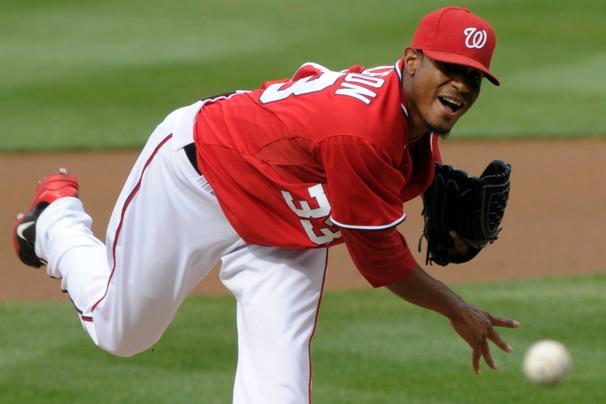
Jackson gets hit for 4 runs in 5 innings. Photo AP via wjla.com

The title says it all.  Edwin Jackson missed his target in the 2nd inning, it turned into a 3-run homer (from a #8 hitter no-less) and that was more than enough offense than the Cards needed en route to peppering the Nats pitching staff for 8 runs and 14 hits in a game 3 romp 8-0.  One mistake is all it took, but you can’t make a mistake middle-in with two guys on base to a professional hitter.  There was no need to watch the game after the 5th inning; it was clear this team wasn’t going to get to Chris Carpenter nor whoever else the Cardinals brought in after he hit his pitch limit.

Where is the Nats offense?  More to the point, where is all our clutch hitting?   We had the lead-off hitter on three times; a runner on first with none out has an Run Expectancy of about .84; meaning we’d expect that runner to score 84% of the time.  Instead we got 0 runs out of any of those situations.  The team has to get something out of that bases-loaded first inning, has to get something out of the third inning rally.  We went 0-8 with runners in scoring position, leaving 11 guys on base.  Where is Adam LaRoche this series?  Or Michael Morse?  We need these middle-of-the-order guys to produce if we’re going to win games.  The St. Louis #8 hitter was clutch yesterday; our guys havn’t been clutch (arguably) in 3 weeks.

It doesn’t matter if we still had Stephen Strasburg in the rotation if you don’t score runs.  We’ve scored 7 runs in 3 games, four of which were essentially meaningless as we were getting killed in game 2.  Meanwhile the Cards now stand at 22 runs and counting, an eerie repeat of the late September blasting we took in the 3-game series in St. Louis.

Ross Detwiler gets a shot in a do-or-die game tomorrow.  Lets hope he finally gets some run support.

Written by Todd Boss

October 11th, 2012 at 9:20 am

Jimmy Rollins; time for Philadelphia to sleep in the bed they’ve made.

4 comments

Courtesy of Nat Enquirer; this video of Jimmy Rollins classlessly giving the Nats zero credit for having the best record in the majors in 2012.

Specifically, “With us healthy, they’re a second-place team. But we weren’t.”

But that’s the problem that Rollins needs to understand; when you build your team on the backs of aging players … you’re NEVER going to be as healthy as you expect to be.  There’s a reason the Nats didn’t lose ONE start to injury all year; our pitchers are younger and healthier.  Philadelphia has built a rotation of aging stars and free agents.  Cliff Lee missed 3 starts this year, Cole Hamels missed a couple, and Roy Halladay missed 7 or 8.  Those guys are 33, 28 and 35 this year.  They’re not getting any younger and likely will miss starts again in 2013.

How about Philadelphia’s positional players?  Ryan Howard only played 71 games.  Chase Utley only 83.  Placido Polanco just 90.   Carlos Ruiz missed all of August.  Maybe you can argue that the two big names from this list should start 2013 healthy and that may make a difference.  Fair enough, except that Howard is 32, Utley is 33, and both now have a slew of injuries on their resume.  Nobody should assuming those guys are playing 150+ next year.

Meanwhile, Washington had a TON of time lost to injuries in its offense.   Desmond missed a month.  Morse missed two.  Werth missed half the season.  Zimmerman lost a few weeks.  And we went through no less than SIX catchers on the season.  And the team persevered, struggled offensively most of the early part of the year, and maintained its lead.

Philadelphia made its choices, signing major dollar contracts to extend its own guys and to buy its rotation and its key bullpen members.  And now you have to live with those decisions, which leave you with an aging roster overpaying for the decline years of your players.  Meanwhile Washington rode the wave of 100-loss seasons, committed to building its farm system, didn’t overpay for Free Agents, and now sits with one of the youngest teams in baseball (3rd youngest pitching staff and youngest on-field staff), with a below-average payroll and the best record in the majors.

Sour Grapes Jimmy Rollins.  You should get used to 3rd place because its probably where the Phillies reside for the next several years, until you can jettison your ill-signed contracts and start over.

Who still thinks the Nats will pursue a CF in the off-season?

24 comments

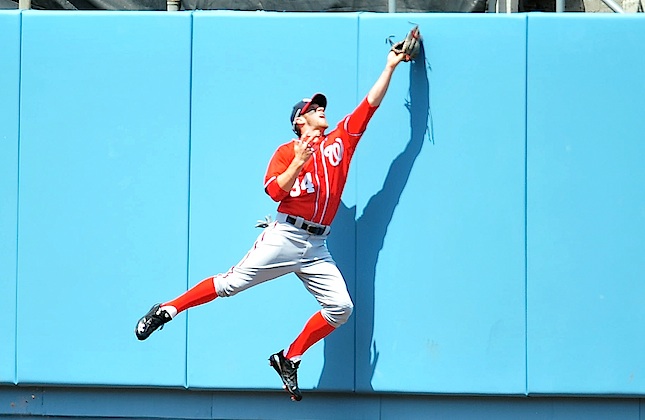
Harper has turned into a very good defensive CF. Photo Gary Vasquez/US Presswire via Natsinsider.com

Jim Bowden was the latest pundit to repeat the often-mentioned mantra “The Nats need a Center Fielder,” but this isn’t entirely a “pick on Jim Bowden” post.  Most pundits think the Nats are still in love with BJ Upton or newly in love with Michael Bourn and will aggressively pursue one or the other this coming off-season.  Now, that tired statement may have been true in the 2011 off-season, but anyone who still prints this now hasn’t been watching what has been going on in the Nats outfield this season.

To put it simply; Bryce Harper has turned into a very good defensive center fielder.  And there’s no reason to move him off the position for a number of years.

It only took about a week for rumors of Harper’s arm to circulate around the league; within a week or so 3rd base coaches were already playing it conservatively and refused to challenge his arm.  It only took a couple of Sportscenter highlight throws from the outfield to earn that praise.  Harper has 3 outfield assists on the year and probably won’t get too many more given the reputation he’s already earned.

But his arm is just one part of the equation.  Click here for the advanced fielding measure “UZR/150” for all 2012 center-fielders with at least 500 innings played.  Harper currently possesses a 28.6 UZR/150, good for 2nd in the league and far above vaunted defensive outfield wizard (and fellow Rookie phenom) Mike Trout.  In fact, he’s just ahead of Bourn and only behind reserve outfielder Craig Gentry.  To put this into english; right now Harper is just about the best defensive center field in the league.  He’s very fast, shows great range on the ball, and his errors have generally been on over-aggressive throws instead of dropped balls.

By way of UZR/150 comparison, Bourne is clearly a top defender, but the other rumored target Upton actually boasts a -1.3 UZR/150 right now, indicating that he’s actually costing his team runs.

The common narrative is that the Nats want a lead-off/center fielder type so they can move Harper to one corner and Jayson Werth the other and have a plus outfield all the way around.  But lets face it; that’d be a monumental waste of Harper’s defensive talents right now.  An .850 OPS hitting center fielder with 30 homer capabilities is one of the rarest commodities in baseball, and usually good ones only come around once in a generation.  We already knew Harper was such a generational talent, but even I was surprised to see just how well statistically he has played CF thus far.  Do the Nats need a prototypical lead-off hitter?  Yes …. but not as long as Werth is willing to be in that role.  Here’s a fact; Werth has an OBP of .426 hitting lead-off this year, which would be the 2nd best OBP in the league (behind the amazing Joey Votto) if he qualified.  When you have almost an entire lineup of guys who have 20-hr power, someone has to bat lead-off.

The other problem with the “Nats get a free agent CF” scenario is that it leaves no room in the outfield for Michael Morse.  Buying another outfielder pushes Morse to 1B, which pushes Adam LaRoche out the door.  Now, this scenario may happen regardless (LaRoche absolutely should parlay his 2012 season into a multi-year FA deal, or at least explore the possibility), but I’d rather have the positional flexibility to give someone like Tyler Moore more starts, or to give the resurgent Roger Bernadina starts against right-handed starters, or even keep LF the rotating door between Moore, Bernadina and Lombardozzi so that all three valuable players can get playing time.  And if you don’t think the team really wants to give Moore playing time, then you havn’t been paying attention to his season.

Lastly there’s this: spending money on an unneeded CF means less money to spend on pieces that we WILL need; money towards either Edwin Jackson or his rotational replacement, money towards some bullpen reinforcements, or perhaps money to extend a trade target that we leverage to free up some positional log-jams (middle infield for example, between our current starters and the upper-end reinforcements on the way in the high minors).

There’s been comparisions of Harper to the vaunted Mickey Mantle in the past; if Harper sticks in CF for the next decade, those comparisons will just be all the more viable.

Nats all-star review (2012 edition)

6 comments

Gonzalez gets a very deserving NL All-Star selection. Photo unknown via WP.com

(Note: i’m copying a large chunk of 2011’s version of this post to give a running history of the Nats all-stars later on below).

MLB announced the 2012 all-star rosters and the Nats, for the first time in their history in Washington, have 3 representatives.  Here’s a discussion:

2012

  • Nationals All-Star representatives: Stephen Strasburg, Gio Gonzalez, Ian Desmond
  • Possible Snubs: Adam LaRoche, Bryce Harper, Craig Stammen
  • Narrative: The two starters Strasburg and Gonzalez were the obvious candidates, and my personal prediction was that they’d be the only two candidates selected.  The inclusion of Desmond is a surprise, but also a testament to how far he’s come as a player in 2012.  I entered the season figuring that Desmond would be closer to a demotion than the all-star team, and his power from the short stop position has been a huge shot in the arm to our challenged offense.  LaRoche has had a fantastic come back season but fared little shot against better, more well-known NL first basemen so his non-inclusion is not too surprising.  Stammen has been our best bullpen arm, but like LaRoche fared little chance of getting selected during a year when the Nats had two deserving starters.  Lastly Mr. Harper; he wasn’t on the ballot so fared little shot of being included, but has been put on the “last man in” ballot, up against a series of established veterans and future hall of famers.  We’ll see if celebrity wins out.  Before his slump the last two weeks he was clearly among the best hitters in the league despite his age.

(Editors Note: Harper was subsequently added on 7/7/12 to replace the injured Giancarlo Stanton).

Coincidentally, I thought Matt Kemp‘s decision to go public with his snub of Harper for the home run derby was both short sighted and disappointing.  If I was Bud Selig, I’d take the opportunity to make this year’s derby the most watched mid-season baseball event ever by forcing the inclusion of both Harper and uber-rookie Mike Trout.  Ask yourself this: 1) do you bother to watch the home run derby now?  And 2) if Harper and Trout were in it, would you watch this year’s version?  For me, even as an avid baseball fan I don’t bother to watch the event and wasn’t planning on it this year … but with these two guys in, it’d be must-see TV.  I hate it when Baseball misses such an obvious chance to showcase players and take advantage of the prevailing storylines of the season; it seems to happen year after year.

For a trip down Memory lane, here’s the Nationals all stars by year and talk about their selection, whether they were deserving, and who got snubbed each year.

2005

  • Nationals All-Star representatives: Livan Hernandez, Chad Cordero
  • Possible Snubs: Nick Johnson, John Patterson.
  • Narrative: The Nats went into the All Star break surprisingly in first place, having run to a 50-31 record by the halfway point.  Should a first place team have gotten more than just two representatives?  Perhaps.  But the team was filled with non-stars and played far over its head to go 50-31 (as evidenced by the reverse 31-50 record the rest of the way).

2006

  • Nationals All-Star representatives: Alfonso Soriano
  • Possible Snubs: Nick Johnson, Ryan Zimmerman
  • Narrative: Soriano made the team as an elected starter, the only time the Nats have had such an honor.  Our pitching staff took massive steps backwards and no starter came even close to meriting a spot.  Cordero was good but not lights out as he had been in 2005.  Soriano’s 40-40 season is a poster child for “contract year” production and he has failed to come close to such production since.  The team was poor and getting worse.  Johnson had a career year but got overshadowed by bigger, better first basemen in the league (a recurring theme for our first basemen over the years).

2007

  • Nationals All-Star representatives: Dmitri Young
  • Possible Snubs: Ryan Zimmerman, Shawn Hill (though I wouldn’t argue for either)
  • Narrative: Young gets a deserved all-star appearance en route to comeback player of the year.  Zimmerman played a full season but didn’t dominate.  Our rotation featured 6 primary starters, none of whom are still in the league now, though Hill showed flashes of dominance throughout the year.

2008

  • Nationals All-Star representatives: Cristian Guzman
  • Possible Snubs: Jon Rauch
  • Narrative: The first of two “hitting rock-bottom” seasons for the team; no one really merited selection.  Zimmerman was coming off of hamate-bone surgery in November 2007 and the team was more or less awful across the board.  Rauch performed ably after Cordero went down with season-ending (and basically career-ending) shoulder surgery.   Guzman’s selection a great example of why one-per-team rules don’t make any sense.  Guzman ended up playing far longer than he deserved in the game itself by virtue of the 15-inning affair.

2009

  • Nationals All-Star representatives: Ryan Zimmerman
  • Possible Snubs: Adam Dunn
  • Narrative: The addition of Dunn and Willingham to the lineup gave Zimmerman the protection he never had, and he produced with his career-best season.  His first and deserved all-star appearance en-route to a 33 homer season.  Dunn continued his monster homer totals with little all-star recognition.

2010

  • Nationals All-Star representatives: Matt Capps
  • Possible Snubs: Adam Dunn, Josh Willingham, Ryan Zimmerman, Steven Strasburg
  • Narrative: Capps was clearly deserving, having a breakout season as a closer after his off-season non-tender from the Pirates.  The 3-4-5 hitters Zimmerman-Dunn-Willingham all had dominant offensive seasons as the team improved markedly from its 103-loss season.  But perhaps the surprise non-inclusion was Strasburg, who despite only having a few starts as of the all-star break was already the talk of baseball.  I think MLB missed a great PR opportunity to name him to the team to give him the exposure that the rest of the national media expected.  But in the end, Capps was a deserving candidate and I can’t argue that our hitters did anything special enough to merit inclusion.

2011

  • Nationals All-Star representatives: Tyler Clippard
  • Possible Snubs: Danny Espinosa, Michael Morse, Drew Storen, Jordan Zimmermann
  • Narrative: While Clippard was (arguably) the Nats best and most important reliever, I think Zimmermann was a more rightful choice.  He was 10th in the league in ERA at the time of the selections and has put in a series of dominant performances.  Meanwhile Espinosa is on pace for a 28homer season and almost a certain Rookie-of-the-Year award (though a precipitous fall-off in the 2nd half cost him any realistic shot at the ROY), and perhaps both players are just too young to be known around the league.  Lastly Morse is certainly known and he merited a spot in the “last man in” vote sponsored by MLB (though he fared little chance against popular players in this last-man-in voting).

Did the Nats call up the wrong OF?

10 comments

Harper knows he's ready; is the Media? Photo GQ magazine Mar 2012

As the rest of the free world now knows, Bryce Harper has gotten called up to give the incredibly weakened Nats lineup some potential offense.  Sometimes moves can be planned and orchestrated (such as keeping Stephen Strasburg in the minors in 2010 past the super-2 deadline), and sometimes your hand is called.  With Michael Morse out indefinitely, and with the most fragile $100m player this side of Carl Crawford (aka, F.O.T.F. Ryan Zimmerman) heading to the DL yet again, this team suddenly is without 55-60 homers and 200 RBIs in the middle of its order.

So, we’ll roll the dice with the 19-yr old Harper.

But, should the team really have called up a much more mature, much more MLB-ready member of the Syracuse Chiefs?  A guy who is currently putting up this line in AAA: .278/.354/.556 with 6 homers in 20 games?  A guy who has hit 30+ homers in two successive seasons, at two successive levels of the minors and is currently on a pace for more than 40 in AAA?  Yes I’m talking about Tyler Moore, a 16th round draft pick who has come out of nowhere to become (arguably) this team’s 3rd best hitting prospect in the minors today.

Yes, I know he’s a 1B primarily, and he’s just started taking reps in LF.  But after watching Xavier Nady lumber towards balls in LF and watching Mark DeRosa turn routine RF fly balls into adventures, how much worse could it be to stick him out there instead and juggle Harper with Werth and Ankiel in CF and RF (matchup dependent)?  Scouts and pundits have routinely discounted Moore’s abilities, and Mike Rizzo‘s scouting trip last week apparently made his mind up for him, so perhaps there’s a method to his madness.  Maybe Moore really isn’t an OF option despite his LF experiments.  We’re not watching him game in and game out, just typing out blog posts from our dining room table.

Either way, the Nats should get at least a more competent batter in the line-up.  If Harper comes up and starts blasting the ball all the better.

Nats Rule-5 lossee Spring Training Update pt 2

12 comments

So long Komatsu; you've made the Cards 25-man roster. Photo Chris Lee/Stl Post Dispatch via stltoday.com

As has been published by both Luke Erickson/NationalsProspects and Mac/Capitolbaseball in recent days, its looking more and more likely that both our Rule 5 draftees Erik Komatsu and Brad Meyers may not be coming home any time soon.

  • Meyers has still yet to appear in a Minor League game for the Yankees, meaning the team is well within their rights to stash Meyers on the DL and keep him in their extended Spring Training while he rehabs.  This gives the team ample time to evaluate Meyers while waiting for an opportunity to call him up.  Kinda like what the Nats did with Elvin Ramirez for the entirety of the 2011 season.

As I opined here prior to the Nats failing to protect Komatsu, I thought he was worth protecting prior to last December’s rule 5 draft.  And as I’ve stated in the comments section here and there, I thought the team made a mistake not protecting him.  The Nationals STILL have not broached a full 40-man roster (they sit at 39/40 by  my count after adding Rick Ankiel this week), meaning they could have retained Komatsu and kept the trade bounty they received for Jerry Hairston last July.

Now, in a relatively not surprising, Murphy’s Law kind of way, the Nats really could use Komatsu.  Ankiel’s hurting, Bernadina has been banged up, Morse is starting the season on the DL.  The team is probably going to break camp with TWO non-roster invitees on the 25-man roster to fill outfield spots (Xavier Nady and Brett Carrol).  Its not that Komatsu was an answer for us this spring, but considering the lack of outfield depth and the failure to address the CF situation in the off-season, it seems like the team should have done a better job retaining its own outfielders this past off-season.

Nats Franchise Trade history; biggest, best, worst

14 comments

Was getting Gonzalez the "biggest" trade the franchise has ever made? Photo Jed Jacobsohn/Getty Images via nydailynews.com

In response to a topic that came up in the comments section, I’ll do a 3-part series reviewing the biggest/best/worst moves by the franchise since arriving here in Washington.  We’ll differentiate between Jim Bowden and Mike Rizzo moves as we go through.  We’ll talk about trades, then draft picks, then FA signings.

First up: Trades.

The Nats have made dozens of trades since 2005, and by my records have traded with every team in the league save for three: Baltimore, Cleveland and the Los Angeles Angels.  In fact, the franchise has not done business with Baltimore in any capacity since the year 2000, a testament perhaps to the difficulties of dealing with Peter Angelos even before the team moved to Washington.  Now post-relocation, the conventional wisdom is that the two teams would never do business on the off-chance that one team ended up “winning” a trade with the other.

I’ll divide this post into into 3 sections: the “biggest” deal (not the most players, but the biggest impact/most news worthy), the “best” deal(s) and the “worst” deals.  For Rizzo, we’ll add a 4th category for “Too Early to Tell,” since the big off-season trade of last season probably won’t shake it self out for a few more years.

Jim Bowden Tenure: Nov 2004 – Mar 2009

Biggest Trades

  • 2005: Soriano deal
  • 2006: Kearns/Lopez deal
  • 2007: Milledge deal
  • 2008: Willingham/Olsen deal

The Alfonso Soriano move made all sorts of news; he wouldn’t move to LF, threatened not to play at all, then ended up putting in a 40/40 season in a pitcher’s ballpark and then resulted a host of national news as the team debated whether to trade him, re-sign him or let him go.  Bowden held firm on his demands in the trade market, never traded him and landed two compensatory draft picks (which the Nats turned into Jordan Zimmermann and Josh Smoker).

The Kearns/Lopez deal, in the end, was more about moving deck chairs than making progress for either team.  Bowden was obsessed with players that he knew from his Cincinnati days, and showed a proclivity to trade for or acquire them throughout his tenure here, and this deal was just the biggest example.  The only player in the deal who still remains with his original team is Bill Bray, and most of the players in the deal have become large disappointments for their careers or are out of baseball.  The Reds accused Bowden publically of selling them damaged goods (Gary Majewski got injured about 5 minutes after the trade was completed) and Kearns/Lopez never really lived up to anything close to their potential.

We’ll talk about the other two deals below.

Best Trades

  • 2007: Getting Tyler Clippard
  • 2009: Getting Michael Morse
  • 2008: Getting Willingham/Olsen

Bowden gets major credit for obtaining two core members of the current Nationals squad for almost nothing.  He obtained Tyler Clippard from the Yankees for Jonathan Albaladejo in a like-for-like trade of under-performing minor league relievers.  Of course we all know what’s happeend since; Clippard has become a super-star setup man, the 2011 league leader in holds.   Getting Michael Morse in return for sending the feeble Ryan Langerhans to Seattle in what most thought was a mercy trade at the time (i.e., trying to send good-guy Langerhans to a team that would actually play him) seems like one of the steals of the decade.  Nobody thought Morse had a fraction of the potential he’s now shown to have.

I include getting Josh Willingham and Scott Olsen as a win based on who we gave up: PJ Dean, Emilio Bonifacio and Jake Smolinski.  I’ve always had a soft spot for Willingham and thought his offense potential was the key to this deal; we got two major leaguers for two dead-end minor leaguers plus a backup infielder.  Luckily for the Nats, Florida was always ready to give up arbitration candidates to save a buck.

Worst Trades

  • 2007: Milledge deal

Honestly, I had a hard time really saying that I thought one of Bowden’s trades was egregiously bad.  Most of his deals (outside the deals mentioned above as biggest or best) were minor leaguer swaps or dumping veterans at the trade deadline.  Even the acquisition of Elijah Dukes wasn’t really that “bad” based on who we gave up (Glenn Gibson, who was released a couple years later by Tampa Bay and ended up back with us anyway).

However, the acquisition of Lastings Milledge for Ryan Church and Brian Schneider might be the one trade that I’d most quibble with.  Bowden showed his obsession with “toolsy” and “potential” players in this deal, acquiring the malcontent Milledge and giving the Mets two immediate starters.  At the time I certainly defended the deal; neither Church or Schneider were slated to be starters for the 2008 Nats so you could argue that we got a plus prospect for two backups.  I know I certainly argued that point.  Church seemed to be a brooding platoon outfielder who wouldn’t be happy unless he was starting and Schneider had lost his starting spot to Jesus Flores and was a relatively weak hitter.

As it has worked out Church was a very productive player for New York, Flores got hurt and left the team in a very serious catcher-dearth position, and Milledge turned out to be not nearly the talent that we thought we were getting.  By the time we flipped him to Pittsburgh in 2009 he was barely hitting his weight in AAA and was completely out of the picture for this team.

Mike Rizzo Tenure: Mar 2009 – present

Biggest Trades

  • 2011: Gio Gonzalez deal

  • 2009: Morgan/Burnett deal

  • 2010: Ramos for Capps deal

  • 2011: Henry Rodriguez/Willingham deal

  • 2011: Gorzelanny deal

You have to hand it to Mike Rizzo; he’s not been afraid to make deals.  In his 3 year tenure he’s made 5 significant deals that have vastly changed the way this team is constructed.  Two of those deals (Morgan/Burnett and the Willingham deals) were mostly about cleaning up the roster to get it more in his image of pro-clubhouse guys and pro-defense.  Trading away Milledge and Willingham succeeded in moving the team towards these goals.  The Gorzelanny and Gonzalez trades were about acquiring power arms to shore up the rotation, another tenant of Rizzo-constructed teams.

Best Trades

  • 2010: getting Wilson Ramos

Clearly Rizzo’s best move was stealing Wilson Ramos for a closer (Matt Capps) that we had ample candidates for internally.  The Twins panicked post-Joe Nathan injury and overloaded their bullpen with closer candidates.  Meanwhile Rizzo turned an astute FA signing (a minor league signing that turned into an All Star) into an even more astute trade by getting a nearly MLB-ready catcher in return for a guy who the team wouldn’t be re-signing anyway.  Great move.

Worst Trades

  • 2011: Gomes for Rhinehart/Manno
  • 2009: Bruney for ptbnl (eventually rule5 top pick Jamie Hoffman)

Most readers here loved Christopher Manno and the promise he was showing in A-ball.  Most were also aghast to see Manno go the other way to Cincinnati for a 4th outfielder Jonny Gomes.  At the time, the argument was that Davey Johnson wanted a bat off the bench and that the team needed some OF depth.  What really happened was that Gomes hit his way out of his type-B arbitration status and played so poorly the 2nd half of 2011 that the team couldn’t dare offer him arbitration to get a compensatory draft pick.  So we traded two decent prospects for a half season of awful production.  Not a good move.

Even worse, trading anything to acquire Brian Bruney.  The team acquired Bruney, promptly argued against him and beat him in arbitration, and then (unsurprisingly) Bruney vastly underperformed until being flat out released a few months into the 2010 season.  For me this is a lesson in what not to do with your arbitration eligible players.  It wasn’t so much what we gave up (the first pick in the rule-5 draft *could* have been used to acquire someone of value), it was what we got in return.

Too Early to Tell Trades

  • 2011: Gio Gonzalez deal

Pro-prospect pundits (anyone at Baseball Prospectus, Keith Law, etc) will already tell you that the Nats vastly overpaid for Gio Gonzalez.  That’s because they value the potential of prospects more than the proven commodity of the major league player.  But the fact is this; you KNOW what you’re getting in Gonzalez but you have no idea how a low-A prospect will play out.  The Nats rolled the dice that AJ Cole isn’t going to turn into the next incarnation of Justin Verlander and that Brad Peacock‘s promise will peak as a middle reliever.  The only way to tell how this trade turns out is to track the progress of those players we gave up versus what Gonzalez does for this team over the next 3-4 years.

Thoughts?  Any trades out there that stick in your minds that you thought should be mentioned?

Nats seem set to sputter out of the gate

10 comments

Morse's injury is starting to really concern me. Photo Jacqueline Martin/AP via federalbaseball.com

Why?

Because it seems like half the team is nursing a strain or an injury or a cold.

You can’t get ready for a 162-game season if you’re not getting ABsMichael Morse has a grand total of 7 ABs this spring.  Adam LaRoche?  8 Abs.  Rick Ankiel?  6.  That’s a big chunk of the presumed starting lineup for this team.   Chien-Ming Wang probably will start the season on the DL as a precaution after straining a hamstring; good thing we havn’t traded John Lannan yet.  Now we hear that Drew Storen has a cold.  He’s only got 2 IP all spring!

Of course we’ve gotten plenty of at bats for Ian Desmond to show us that he’s learned little from his late season improvements; he’s hitting .200 for the spring.

On the bright side, the rest of the rotation seems to be doing ok.  You never want to over-analyze spring training stats; players may go out one inning and work entirely on spotting their change up on the outside corner, not caring what the hitters do to the ball.  If a hitter knows the same pitch is coming 4-5 times in a row, he’s gonna put a charge into it.  Of course, that being said Gio Gonzalez has looked exceptional this spring, flashing more speed than had been previously reported and is pitching to a 1.42 era clip.

And, the Nats do open up with two of the weaker teams in the league.  They could very well take 2 of 3 from both Chicago and the Mets to come home 4-2 no matter who is batting.

Are you worried  yet?

Written by Todd Boss

March 20th, 2012 at 6:46 pm

Ask Boswell 3/5/12

4 comments

Here’s Tom Boswell‘s weekly Monday chat from 3/5/12.  Of the baseball questions he took, here’s how I’d have answered them.  While lots of questions pertained to the recent Gregg Williams “bounty” issues and whether or not the Redskins partook during his time here, the starting of spring training has got Nats fans pretty excited.

As always, questions are edited for clarity and I write my own answer prior to reading his.

Q: What do you think the Nats w/l record will be?  Can they win 90 games?

A: For a team that won 80 last year (though their pythagorean W/L record was slightly worse), I don’t think its a stretch to assume they can improve another 10 games.  Mark Zuckerman did a nice little WAR analysis and showed that full seasons from Zimmerman, LaRoche and Strasburg, along with the new additions of Gonzalez and Jackson *should* give the team at least another 10 wins, perhaps a bit more.  That’s assuming basically that everyone else performs at the same levels they did last year, and it assumes that the WAR stat directly translates to wins on the field.  In reality, you have to plan for some people to step up while others step back.  Can we assume that Morse will hit 30 homers again?  Its a tough one to assume; he could break a leg and suddenly our offense is in tatters.

That’s why I’ve been a bit more conservative, predicting 8 more wins for this team and have them at 88-74 with this squad.  If the team is in the WC hunt, and they augment the offense, or if Harper comes up and produces … suddenly that’s a 90-91 win team.  Boswell didn’t really answer this question, just went off on Strasburg tangents.

Q: Who is your opening day starter?

A: barring injury it has to be Strasburg.  I think your initial 5-man rotation goes like this, in this order: Strasburg, Gonzalez, Zimmermann, Jackson and Wang.  This gives you a decent righty-lefty matchup at the top.  Perhaps you replace Wang with Lannan and have Jackson go out 5th to get a true R-L-R-L-R rotation.  Or perhaps Davey Johnson doesn’t care about lefty/righty matchups.  I’m more interested to see who the home opener starter is, since it happens 7 games into the season.  Right now it looks to be Gonzalez, which would be great, but early season rain-outs can greatly affect rotation orders.  Boswell says Strasburg but had a good caveat; if its 30 degrees and snowing in Chicago on opening day Strasburg probably won’t go.

Q: Where is this team’s Lenny Dykstra-esque scrappy mean streak player?

A: Honestly, the Mets-to-Nats comparisons may not ever bee 100%.   I don’t see a Dykstra type on this roster.  Mostly because this roster still does not have a center fielder/lead off type, which is exactly what Dykstra was.  Boswell says that Werth may still fill this role.

Q: Why didn’t the team keep Bixler and Nix?

A: Bixler is a good question; for reasons unknown the team designated him for assignment in the off-season while still possessing 40-man room (inexplicably; they did this a number of times, losing Kimball at one point but also losing two decent players in the Rule 5 draft).   Nix they probably thought was replaceable on the FA market … or at least obtainable for cheap.  There does always seem to be a number of halfway decent corner outfielders on the market who are available for less than what Nix got.  Boswell says Nix’s 2yr contract was the problem … the Nats want flexibility for 2014.  No mention of Bixler.

Q: If Tyler Clippard is our “MVP,” why isn’t he being paid more?

A: Two reasons; clearly the questioner doesn’t understand the whole arbitration process.  Just because Clippard is our best pitches doesn’t equate to him being the highest paid player.  Veterans always make more than pre-arb guys; don’t forget the players belong to a Union, and Union members reward longevitiy.  Secondly; Clippard unfortunately is a commodity player; he’s a non-closer reliever who doesn’t rack up saves and thus won’t ever be compensated like a Jonathan Papelbon or a Mariano Rivera, despite his value to the team.  Its an unfair world in some respects, and I just hope that the Nats do him right and keep paying him while he’s productive for the team.  Boswell mirrors my two thoughts but then also says that relievers are starting to become aware of newer stats like WPA that value Clippard highly (1st in the NL last year, above big name starters like Roy Halladay).

Q: What are your thoughts on the extra wild card?

A: Baseball purists may whine and complain, but the modern professional sports scene in this country, fortunately or unfortunately, places a ton of emphasis on playoffs versus regular season accomplishment.  Even with these two additional WC teams, Baseball still has the fewest of its teams reaching the regular season of any of the four major sports.  And, in a sport where payroll disparities may not determine the World Series victor every year they clearly help predict the playoff contendors (Yankees: one missed playoff appearance since 1994), having more teams in competition for the playoffs is good for the sport.  Frankly I’d like to see Baseball go to a 32-team/8-division structure similar to the NFL and adopt the NFL’s exact playoff structure.  The problem there is finding two more markets without cannibalizing the NY or LA market.  Boswell says “time will tell,” but also admits that he hated the first WC round initially but likes it now.  He also points out something I hadn’t thought of; the importance of your #3 starter with a new round of playoffs.

Q: Should the team just skip Strasburg’s start every few times to extend his 160IP limit until the end of the season?

A: It isn’t a bad idea; Zimmermann skipped one start and hit his 160IPs at roughly September 1st.  So skipping a few more starts for Strasburg would put him well into September.  But I don’t think he’ll be served well by jacking around his days rest.  Starters depend on getting into routines in order to pitch their best.  Honestly I think this situation may very well play it self out naturally; even in 2010 Strasburg had two separate DL stints; if he spends 30 days or so on the DL at various times we’ll get a full season out of him.  Boswell agrees with me on the not-skipping-a-start theory.

Q: How secure is Ramos as the #1 catcher?

A: I’d say he’s pretty secure.  Flores may have had a good winter, but winter leagues aren’t exactly MLB quality.  Flores’ injury history has more or less derailed his career, and that’s unfortunate.  The team has found a solid #1 in Ramos and will stick with him, with Flores getting his typical 1 or 2 starts a week.  The inclusion of Derek Norris in the Gonzalez package also spoke volumes about where this team thinks it is in terms of catcher depth, as does the 40-man addition of Maldonado, a journeyman catcher who now benefits from a distinct lack of upper-level minor league catcher depth.  Look for the team to make catcher a focus in the 2012 draft to start back up the catcher pipeline.  In the mean time, I doubt Flores will be trade bait even if he performs amazingly well, at least until we find another catcher in the wings.  Boswell says Ramos is as #1 as any #1 can be.

Q: Who are the best catchers ever?

A: For a combination of defense, calling games, arm strength as well as offense, i’d go with Johnny Bench.  But you also have to throw in Ivan Rodriguez in his prime.  Mike Piazza was notoriously bad defensively.  Jorge Posada was subpar defensively in his later years but was a monster bat.  I’d include other names from the past few decades like Carlton Fisk. Before Fisk and Bench, there was a dearth of HoF inductees from the catcher position for some 30 years, to Yogi Berra who is probably the benchmark for all-around catchers (with Bench).   Boswell says Bench as well, but mentions Varitek with Posada.  Interesting.

Q: What is the team going to do with Ian Desmond?

A: I’d guess that 2012 is the make it or break it year for Desmond.  If he’s hitting .220 at the all-star break without significant value proven at the SS position, the team may make a change.  Move Espinosa to SS, install DeRosa as starting 2B, look to move Desmond and perhaps make Lombardozzi the utility guy.  I also find it very interesting that Anthony Rendon is getting reps at both 2B and SS; if that kind of hitter can slot in at short stop on even an as-needed basis he could be even more of a dangerous prospect than he already is.  Boswell agrees; this is a big year for Desmond.

Q: If catcher is so important, why did we move Bryce Harper away from the position?

A: one word: longevity.  Yeah he was a catcher growing up but catchers get the crap beat out of them, have constant injury concerns, and the wear and tear of catching affects their hitting.  With such a bat potential, he needs to be on the field and playing 162 games.  That being said, I was slightly surprised that he didn’t at least try to stick at C for at least a little bit of his career … but understand the reasoning stated.  Boswell said the same things I said, but added that scouts didn’t really think he was a natural catcher anyway, so he got moved to the OF quickly.

Q: What would MLB’s response be to the same “bounty” scandal going on in the NFL?

A: Hard one; its not like purposeful bean-balls without context are common in the MLB.  And the game is just too random to purposely try to spike someone, or slide into them on purpose, or to purposely hit a catcher.  These plays are so bang-bang and so naturally occurring to baseball players who have played all their lives that they’re hard to script.  If it was found out to be happening?  Long suspensions.  Boswell thinks such a situation would be lifetime bans, if proven.

Q: Strasburg has never pitched more than 7 innings, at any level, ever.  Is this a concern?

A: I have a hard time believing this, but won’t challenge the questioner since I’m not entirely in a position to go searching through the guy’s college career.  Is it a concern?  eh.  Its modern baseball.  No more 150 pitch games, no more 38 start seasons.    Little leaguers have pitch count/innings limits, high school teams only play twice a week.  College rotations you go once a week.  I’d only be concerned if he showed any inclination of slowing down later in games, which he doesn’t.  Boswell isn’t concerned.