Nationals Arm Race

"… the reason you win or lose is darn near always the same – pitching.” — Earl Weaver

Archive for the ‘aj cole’ tag

Nats Major & Minor League Pitching Staffs vs Predictions

leave a comment

First off, this is partly a post of self-flaggelation, to show how far off my various predictions of what the 2013 minor league staffs would look like by doing 2012 season-ending analysis.  Such is the nature of minor league pitching staffs in the modern day; they’re a combination of spare parts, rising stars and hangers-on and they can change rapidly with trades and spring training performances.  Every trade and every MLFA signing trickles down and fouls up predicitons.

Here’s my End of Season 2012 post with predictions for each of the 2013 minor league pitching staffs.   We’ll use that as a basis for the Opening Day 2013 rosters of the four full-season minor league teams.  Just for fun we’ll throw in (and start with) the MLB prediction.  Note that this early in the season we don’t really know who’s shaking out as starters and relievers necessarily for these minor league teams; i’m just going on first week usage right now.  As always, Luke Erickson and nationalsprospects.com, the Nats Big Board and the tireless work by “SpringfieldFan” is much appreciated here.


MLB Nov 2012 Prediction

  • MLB Rotation: Strasburg, Gonzalez, Zimmermann, Detwiler, FA or other acquisition
  • MLB Bullpen: Clippard, Storen, Mattheus, Stammen, Garcia, a FA left-hander (possibly Burnett), a FA long-man (possibly Gorzelanny).
  • MLB notables Out of Organization: Jackson, Burnett, Gonzalez, Lannan, Wang

MLB April 2013 Actual

  • MLB Rotation: Strasburg, Gonzalez, Zimmermann, Detwiler, Haren
  • MLB Bullpen: Clippard, Storen, Mattheus, Stammen, Duke, Rodriguez, Soriano
  • MLB notables Out of Organization: Jackson, Burnett, Gonzalez, Lannan, Wang, Gorzelanny

MLB Discussion: It wasn’t going to be that difficult to predict the 2013 Nats pitching staff make-up by looking at our staff and their FA status heading into the off-season.  The rotation filled its one spot with Dan Haren.  The bullpen was 5/7ths predicted correctly (if you count Zach Duke as a FA left-hander acquisition).  Christian Garcia‘s injury opened the door for one more season of Henry Rodriguez, and of course nobody could have predicted the Rafael Soriano purchase.  Lastly all 5 of the predicted departures occured, in addition to Tom Gorzelanny being let go.


AAA Nov 2012 Prediction

  • AAA Rotation: Roark, Maya, Broderick, Meyers, Perry
  • AAA Bullpen: Tatusko (swingman), Arneson (swingman), Severino (loogy), Davis, Lehman, Nelo (closer), Martin,  Mandel

AAA Apr 2013 Actual

  • AAA Rotation: Ohlendorf, Roark, Maya,Perry, Rosenbaum ( eventually Young)
  • AAA Bullpen: Tatusko, Mandel,  Davis, McCoy, Crotta, Abad, Romero, Bramhall
  • AAA D/L: Kimball, Bray, Meyers, Torra, West, Garcia (technically XLS), Accardo
  • AAA cut/released/FA: HPena, Mann, Zinicola, Arneson, Atkins, Ballard
  • AAA Missing: none

AAA Discussion

We were 3/5s correct on the rotation, and probably would have been 4/5ths right if Brad Meyers was healthy.  Ross Ohlendorf and (eventually) Chris Young are new faces here, both being former MLB starters who are taking the Zach Duke route of signing on for full seasons as AAA starter insurance for the big club in the hopes of rebuilding value and finding a MLB job for next year.  Brian Broderick is indeed back; its just that he’s starting for AA instead of AAA.  Lastly Danny Rosenbaum was returned to the team after his spring Rule-5 adventure and was put in AAA instead of AA, where (as we’ll see in a second) I would have predicted he would start.  Once Young is ready to go, I see Tanner Roark turning into the swingman/long-man.

On the bright side (pun intended), when was the last time a professional baseball team had TWO Ivy League alumni pitching in its rotation??  Both Young and Ohlendorf went to Princeton.  I wonder if they have NYTimes crossword puzzle competitions instead of (assumedly) video game competitions on off-days in the clubhouse.

As far as bullpen predictions go, next year I’m paying more close attention to who are 6-year free agents.  Arneson, Severino and Nelo were all MLFAs and have either signed on elsewhere or are facing forced retirement.  Tatusko, Davis and Mandel are onboard.  Lehman is (surprisingly?) in AA, perhaps a victim of the numbers game of the Nats signing (and keeping) a number of minor league lefty relievers this off-season.  I would guess, looking at the names in the bullpen, that Erik Davis is the closer but who knows what the usage will be like.  Lastly Bramhall was a MLFA signing over the off-season who just got placed on the AAA roster to replace the injured Accardo.


AA Nov 2012 Prediction

  • AA Rotation: Rosenbaum, Holder, Gilliam, Karns, Grace, Demny (swingman?) or MLFA?  Solis if he’s healthy?
  • AA Bullpen: Frias, McCoy, Selik (maybe high-A again), Holland (setup),  Wort (closer), VanAllen (loogy), Demmin (maybe high-A again), an org arm or two to fill in.

AA Apr 2013 Actual

  • AA Rotation: Broderick, Treinen, Demny, Clay, Karns
  • AA Bullpen: Holder, Frias, Holland, Wort, Barrett,  Krol,  Lehman, Swynenberg
  • AA D/L: Solis, RMartin, Olbrychowski, Selik
  • AA Cut/released/FA: VanAllen
  • AA Missing: none

AA Discussion

We got, well, not much of this right.  Of my starter predictions: Rosenbaum is in AAA, Holder is here but seems to be the long-man right now, Gilliam is hurt, Solis is still on the DL, and Grace is back in High-A.  We do seem to have at least gotten Karns and Demny right.  Broderick was a surprise FA signing, his being a favorite of the Nats organziation per our Rule-5 experiment with him a couple years back.  I’m surprised he’s not in the AAA rotation though.  Treinen was a trade-throw in from the Morse deal and takes a spot in this rotation, while Clay was a 2013 MLFA signing who (surprisingly?) made the rotation over the likes of other candidates.

The bullen prediction is all over the place: We got Frias, Holland and Wort right.  McCoy is in AAA, Selik is on the AA D/L and VanAllen and Demmin were MLFAs who were left unsigned (and per the big board are still unsigned).   I thought Barrett and Swynenberg would be in high-A instead of AA, I (and most others) thought Lehman would be in AAA, and Krol arrived as the PTBNL in the Morse trade.


High-A Nov 2012 Prediction

  • High-A Rotation: Swynenberg, Ray, Meyer (maybe AA?), Schwartz (maybe low-A), Rauh(maybe low-A)
  • High-A Bullpen Competition: Barrett (maybe AA) , Testa, Smoker (loogy), Hill, Meza(perhaps a starter?), Holt, Hawkins, Bates, Mirowski
  • High-A bullpen Release candidates: Olbrychowski, McCatty, Applebee

High-A Apr 2013 Actual

  • High-A Rotation: Ray, Jordan, Cole, Turnbull, Hill
  • High-A Bullpen Competition: Herron, Mirowski, Holt, Hawkins, Meza, Bates, Self, Grace
  • High-A D/L: Smoker, Applebee, Gilliam
  • High-A Cut/FA/Released: Demmin, Consuegra, Samuel, Testa
  • High-A Missing: McCatty, Olbrychowski

High-A Discussion

The Potomac rotation guess was already light; a couple of the guys I was guessing might be in low-A are indeed there (Schwartz and Rauh).  Swynenberg is in the AA bullpen.  Meyer was traded.  Only Robbie Ray returns.  I thought Jordan was going to repeat Hagerstown.   We got Cole back in the Morse trade and bumped up Turnbull from short season (over Mooneyham, interestingly) Lastly Hill seems to have beaten out Grace for the 5th starter spot.

The Bullpen prediction looks pretty good: 7 of the predicted guys are here (Smoker on the DL, Meza, Holt, Hawkins, Mirowski and Bates).  Barrett indeed is in AA.  Testa was released.  Of my release candidates McCatty is in XST, Applebee and Olbrychowski are on the DL.  Lastly both Samuel and Consuegra were off-season MLFA signings who didn’t pan out and have already been released.


Low-A Nov 2012 Prediction

  • Low-A Rotation: Turnbull, Jordan, Purke (if healthy), Monar, Mooneyham
  • Low-A Rotation Competitors: Hansen, Lee (loogy if not), Encarnation, McGeary (if finally healthy)
  • Low-A Bullpen Competition: Anderson, Estevez, Dupra, McKenzie, Henke, Davis, Boyden, Benincasa, Hudgins, Dicherry, Mudron

Low-A Apr 2013 Actual

  • Low-A Rotation: Anderson, Mooneyham, Pineyro, RPena, Encarnation
  • Low-A Swingmen: Rauh, Schwarz, Dupra
  • Low-A Bullpen: Fischer, Harper, Henke, Hudgins, Benincasa
  • Low-A D/L: Estevez, Purke, Simko, Mesa, Weaver
  • Low-A Cut/FA/Released: Kreis, Lucas, Upperman, Hansen, Monar
  • Low-A Missing: Hollins, Hicks

Low-A Discussion

Historically the hardest to predict, the Low-A team.  Of the guesses for the rotation last fall, we only got Mooneyham right.  Turnbull and Jordan were bumped up a level.  Purke is still hurt.  Of the “competitors” the team flat out released Monar and Hansen to my surprise.  Monar was really good in Auburn last year, and while Bobby Hansen wasn’t nearly as dominant as a starter, I thought he’d at least get a shot at being a loogy after so many years in the organization.  Jack McGeary was selected out of the org during the minor league phase of the rule-5 draft.  Lee is in XST limbo right now.

So who are these surprising Low-A rotation guys?  I thought Anderson would be relegated to the bullpen in Low-A; instead he’s the opening day starter.  I thought Pineyro would repeat short-season ball but he made the full-season team.  And lastly I thought Pena was destined for another season in short-A.

Rauh and Schwartz, after I thought they had shots in the rotation in high-A, seem to be taking the roles of “2nd starters” for now, each having gone multiple innings in relief of the starter.  I wouldn’t be surprised to see them becoming full time starters if one of the 5 guys ahead of them falter.

Most of the rest of the predicted bullpen are 2012 signees who are currently amongst a large group of extended spring training guys who will be battling it out for short-season jobs with 2013 signees.   And we seem to have a very large group of them; the big board lists in excess of 30 hurlers who are currently still in the organization, who are not on the D/L officially, but who are not assigned to one of the four full season teams.   That’s a lot of arms for just a handful of spots in short-A and the rookie league after the 2013 draft occurs.
Written by Todd Boss

April 11th, 2013 at 8:41 am

Posted in Majors Pitching,Minor League Pitching,Rule-5

Tagged with , , , , , , , , , , , , , , , , , , , , , , , , , , , , , , , , , , , , , , , , , , , , , , , , , , , , , , , , , , , , , , , , , , , , , , , , , , , , , , , , , , , , , , , , , , , , , , , , , , , , , , , , , , , , , , , , , , , ,

DC-IBWA Pre-2013 Season Predictions

leave a comment

I took part in the DC-IBWA’s pre-season survey this year (despite this blog being missing from the “participants” page on the result link…) along with many of our fellow Nats bloggers.  The full results are here; I gave both a player and a guess on the totals, and compared my guesses to the poll results.

1) Who will lead the Nats in home runs in 2013? Bryce Harper, 35hrs.  Makes sense that Harper takes the lead; Morse is gone, Zimmerman has only shown 30-homer power in one injury-free season and I think Harper is a dangerous bet for a 30/30 season in 2013.  (Harper was the poll leader as well).

2) Who will lead the Nats in RBI?: Adam LaRoche, 105rbi.  The #5 hitter behind a slew of high OBP guys in front of him is going to get plenty of RBI opportunities.  Most people said Zimmerman; I just constantly worry about his ability to play 162.

3) Who will lead the Nats in stolen bases? Ian Desmond, 25sbs.  Most people guessed Span, but he hasn’t been the SB machine that people think.  Desmond is a better bet.

4) Who will lead the staff in wins? Stephen Strasburg, 20wins.  As good a guess as any.  It wouldn’t surprise me to see any of our top 3 pitchers broach 20 wins.

5) Who will make more appearances for the Nats this season: Rafael Soriano, Drew Storen, Tyler Clippard or Craig Stammen? Tyler Clippard, 70games.   The addition of Soriano allows Clippard to go back to his work-horse self, and he’ll lead the team in appearances again.  Soriano will only get save opps, Storen is too close to being the closer to get the workhorse treatment, and Stammen isn’t going to throw unless the starter gets yanked early.   (Clippard was the poll leader as well)

6) Who will get more at bats for the Nats this season: Kurt Suzuki or Wilson Ramos? Hmmm.  Tough one.  I’ll go with Suzuki with 400ab.  I don’t think Ramos can stay healthy.  I could be wrong; Ramos seems to have won the starter role at least from the onset.  Poll favored Ramos.

7) Which minor leaguer are you most interested in keeping tabs on this season? Matt Purke.   We know what our top two guys can do for the most part (Rendon and Goodwin).  Giolito is basically out all year and Cole needs a full season in A-ball to regain confidence.  Purke needs to show us something in 2013.  He seems to be healthy, and we need to know if the monetary investment is going to pay off.  A close second may be Matt Skole; can he make the leap from over-aged low-A slugger to a legitimate power prospect who could take over 1st when LaRoche’s contract ends?  So far from spring training, it seems like the answer could be a yes.  (Poll winner was Rendon easily).

8 ) Date of Anthony Rendon’s Major League debut? July 1.  Long enough to ensure one additional year and avoid super-2.  The club gives Espinosa 3 full months to show he’s healthy and can hit better than .240.  I could easily see more Espinosa struggles, a DL trip to repair his shoulder and Rendon taking over 2B for the 2nd half.  I hope not; he’s my fantasy shortstop :-).   Poll winner was Sept 1.

9) How many all-stars will the Nats have? Who? 4; Strasburg, Gonzalez, Harper and Desmond.  The Poll results were all over the road, but lots of support for Zimmerman to re-gain his all-star stature.  Problem is … there’s a few big names at third base in the NL that Zimmerman would have to out-perform to get votes.  David Wright and Pablo Sandoval first among them, perhaps David Freese and Chase Headley as well.

10) Total wins and what place in the division? 100 wins, 1st in division.  Most people have the team pegged for slightly fewer.

Essay: What should be the single most important development for the Nats this season?

I think the overall health of the Rotation is going to be the biggest factor for the team.  We have no starting pitching depth to speak of, and a lengthy injury to any of the front line pitchers will affect our win total.

Ladson’s inbox 1/22/13

7 comments

Does Boras run the Nats? The national narrative certainly seems to think so. Photo Ezra Shaw/Getty images via espn.com

I love a diversion.  Bill Ladson’s inbox is always a diversion.  Here’s 1/22/13’s edition.

Q: Why do the Nationals need another closer in Rafael Soriano?

A: My posted opinion about the deal from 1/15/13.  Did they “need” another closer?  Probably not.  But, innings sent to Rafael Soriano cascades downwards and means that innings that would be given to lesser relievers will now be pitched by Clippard and Storen (assuming one of them isn’t moved of course), and overall the bullpen is improved.  I wonder if Ted Lerner didn’t pull a George Steinbrenner/Dan Snyder-esque move and force a player signing as a reaction to a singular event (aka Storen’s NLDS game 5 meltdown).  Its possible I suppose.  If so, you hate to see moves like this, because it undermines the GM and leads to poorly constructed rosters.  Ladson belives this is a reactionary move to the NLDS bullpen meltdown in total, not just Storen’s misfortunes.

Q: It seems like Washington takes all of Scott Boras’ clients and puts them on its roster.

A: I hate this Urban Myth that now pervades anyone’s analysis every time the Nats sign a Scott Boras client.  Check the proof: MLBtraderumors keeps a player agent database and guess what?  The Nats don’t even have the most clients of Boras.   The Nats have 7 Boras clients but Boston has 8.  Plus, three of the 7 Boras clients the Nats have were no-brainer 1st round draft picks (Harper, Strasburg and Rendon, and you could even argue a 4th such Boras pick in Goodwin that the team would have taken at that point in the draft irrespective of his representation) that the team was likely going to draft and sign no matter who represented them.  The fact is this: the Nats have become a premier FA destination, Boras represents a lot of good players on the FA, and the Nats have hired some of his players.  When Boston or Texas hires a Boras client, you don’t suddenly hear people sarcastically asking, “Does Boras run the Red Sox?” now do you?  I think its great that Rizzo and Boras have a good working relationship, because other teams/GMs do not, and it affects the quality of their teams as a result.  Ladson defends my point as well, saying similar things to what I’ve pointed out.

Q: Does the Nationals’ front office regret not making Edwin Jackson a qualifying offer? It seems he would have signed elsewhere and the Nats would have received a compensation pick that would help the farm system.

A: Great Question!  One I asked in this space myself on 11/5/12.  I honestly think the team believed that Edwin Jackson, who had a history of signing one year deals, would have taken the contract.  Either that or there was a hand-shake deal in place stating that the team wouldn’t extend the offer.  I don’t truly believe the latter part of this, because (as others have pointed out) it’d be illegal as per the latest CBA.  Either way, I thought it was a mistake at the time and the Nats indeed missed the opportunity to gain an extra pick.  Ladson believes point #1; he thinks the team was afraid that Jackson would take the deal.

Q: If there was one thing that could hold the Nationals back from winning the World Series this year, what would it be?

A: I’ll give you two things that could prevent the team from winning.  1) Injuries in our Rotation and 2) bad luck.  We’re very thin in terms of starters and a season-ending injury to one of our big names would be a bad impediment.  And, the playoffs are crap-shoots; 83 win teams (St. Louis in 2006) can get hot and win it all while 116 win teams (Seattle in 2001) get beat easily before ever getting to the World Series.   That being said, even a starter injury probably wouldn’t be fatal to this team’s chances of making the playoffs; the Mets and Marlins are moving backwards, the Braves seem to be treading water, and the Phillies are getting older by the day.  The division is there for the taking even without winning 98 games again.  Ladson says injuries.

Q: Is it true that the Nationals are interested in Kyle Lohse and plan to put Ross Detwiler in the bullpen?

A: Man, I hope not.  I like Kyle Lohse but there’s a reason he’s still on the FA market despite a TON of teams needing pitching help (and it isn’t just because of the lost draft pick).  He’s really not THAT good.  He had (easily) his best season last year, the definition of a contract year if there ever was one.  Career 98 ERA+.  I think he’s a good fit for a team that needs a 3rd starter, but the Nats aren’t that team.  I made my arguments for keeping Ross Detwiler in the rotation on 1/16/13, when rumors swirled about the team looking at Javier Vazquez.  Who would you rather roll the dice with?  A young, up and coming power lefty or a soft-tossing righty who’ll be 34 next year?  I think buying another $12M/year starter and pushing Detwiler to the bullpen just for the reason of “needing another lefty” in the bullpen is arbitrary and would be a waste of Detwiler’s promising 2012.  Ladson agrees, saying that Davey Johnson likes Detwiler in the rotation.

Q: Would Mark DeRosa be a viable managerial candidate for the Nationals in 2014?

A: Random question.  What makes you think Mark DeRosa won’t still be playing in 2014?  Plus, what ties does he have to this organization that would make you think that the Nats think he’s the heir apparent?  I mean, if we’re talking about former players who have put in the time with this organization, look no further than Matt LeCroy, who played for the team and has been managing in our minor league system for years.  Personally, I think the team will go with a “celebrity manager” when the time comes.  Ladson expresses some surprise at the question as well.

Q: After he was acquired from the Athletics for Michael Morse, where does A.J. Cole fall on the Nationals’ list of prospects?

A: I’d say he’s probably 3rd in line, after Rendon and Goodwin.  That’s about where he was when he was still in the system, and despite his rough 2012 in the California league he’s still very promising.  Ladson says 3rd, as does mlb.com’s rankings for the team.

Q: What did you think of what the Nationals received for Morse? Could they have gotten more — a Major League lefty reliever in addition to a starting prospect? Is the problem that Morse only had a total of two good seasons?

A: I think the Nats got what they could for Morse, frankly.  I would have liked to have seen a MLB lefty and a starting pitcher prospect in the lower-to mid minors.  Lots of people were using the Josh Willingham trade as a comp; both players are similar (both are good offense, no defense type guys in the last year of an affordable contract).  Willingham netted us a mlb reliever and a high-minors OF prospect.  However Morse’s defensive inabilities preceed him reputationally, and many scouts perceive his 2011 as a one-off instead of a ceiling of potential.  Ladson says they made a great deal.

Nats Franchise Draft history; biggest, best, worst Draft Picks

10 comments

Face of the Franchise Zimmerman easily represents the best player drafted in the Washington era (by WAR). Photo team official

This is the Third in a long-delayed series of “Best of” posts, breaking down the transactions of both the club’s General Managers.  Previously:

1. Biggest/Best/Worst Trades in Nats History (March 2012)

2. Biggest/Best/Worst Free Agent signings in Nats History (November 2012).

Here’s Part 3: looking at the Biggest, Best and Worst Draft picks the team has made since arriving here in Washington.

Ground rules for this article:

1. Unlike the trades and free agent posts, assiging “credit” or “blame” for draft picks on the General Manager is not entirely straightforward.  Baseball teams rely heavily on Scouting Directors and their staffs when it comes to the draft, especially once you get past the first few rounds.  So, perhaps for the purposes of this article it is better to talk about the “Reign of Jim Bowden” and the “Reign of Mike Rizzo” instead of insinuating that every draft decision was made by the GM during these times.  Much like the President of the US gets credit/blame when  the US economy as a whole rises or falls (whether or not you’d like to argue that a president’s decisions can influence a multi-trillion dollar economy), so does the GM get the credit/blame for his staff’s draft picks.  Most baseball pundits that I’ve read generally say that the GM/Team Ownership is always directly involved in making any 1st round and supplemental first round picks (because of the money), and will be involved if over-slot bonuses come up in later rounds, but that by the 5th round or so the entire draft is being conducted without the GM’s involvement.  Which leads us to point #2…

2. Related to #1; Mike Rizzo, whom Bowden hired in July of 2006, may not have been the Scouting Director but he certainly had a say in the drafts (coming from a scouting background in Arizona).   I’ll list scouting directors tenure here as well, related to #1 and #2.  But, it probably isn’t going to be entirely fair to the GM to say that such-and-such a pick was “good” or “bad” if it was actually being done by his staff.

3.  It is entirely “hindsight is 20/20” in nature.  But, it is what it is.  If you draft a 1st rounder who flames out in low-A, he’s a failure.  If you draft a major leaguer in the 21st round, he’s a fantastic success.  Mostly here in judging the “best draft picks” I’m looking for value in later rounds.  As it turns out judging “worst” draft picks mostly will be around first round busts.

Just for review, here’s the tenure period of both GMs:

  • Nov 2004 – Mar 2009: Jim Bowden
  • Mar 2009 – present: Mike Rizzo

And here’s the tenure period of Scouting Directors during our time here in Washington:

  • Mid 2002 – Mar 2009: Dana Brown
  • Mar 2009 – Present: Kris Kline

The quintessential Nats Draft resource is the Draft Tracker Spreadsheet, initially created by NatsFarm.com’s Brian Oliver and now maintained by “SpringfieldFan. ” It has all our draft picks, where they came from and signing bonuses.  A file I’ve kept recently (The Draft Prospects Worksheet) is a file I started to create when the Nats started getting some upper-end draft picks as a way to track who we may take.  Lastly, you can query the entire amateur draft results per team at baseball-reference.com (the link will go to the 2009 draft by way of example).

Jim Bowden Tenure: Nov 2004 – Mar 2009

Bowden’s Biggest Draft Picks (in terms of dollars committed).

  • 2005 1st rnd: Ryan Zimmerman, $2.975M
  • 2007 1st rnd: Ross Detwiler, $2.1M
  • 2007 6th rnd: Jack McGeary: $1.8M
  • 2006 1st rnd: Chris Marrero: $1.6M
  • 2006 1st rnd: Colten Willems: $1.4M

Bowden’s Best Draft Picks

  • 2005 11th rnd: John Lannan out of Siena College.  A durable and servicable lefty starter with MLB average numbers out of a small college in the 11th round is a great find.
  • 2005 12th rnd: Craig Stammen out of Dayton.  He didn’t look as if he’d be successful until his transition to the bullpen, where his arm action and movement have baffled hitters during his shorter reliever stints.
  • 2006 41st rnd: Brad Peacock out of a Florida HS as a “draft and follow” guy (which enabled teams to take late round fliers on good talent, so this isn’t exactly the same as finding a true 41st round player who made the majors, since Peacock likely wouldn’t have been taken without the DDE rules in place and would have been an upper round draft pick the next season he was eligible).
  • 2007 2nd rnd: Jordan Zimmermann out of U Wisconsin Stevens Point (not because of his draft position, but because of the scouting out of such a small school).  Zimmermann survived TJ surgery and now looks like a hidden Ace in the making.
  • 2007 4th rnd: Derek Norris out of a Kansas HS: possibly the best HS player the team has drafted since arriving in DC.
  • 2008 10th rnd: Tommy Milone out of USC.  Rizzo may not have rated him, but he looks to be in Oakland’s rotation for many years to come.
  • 2008 16th rnd: Tyler Moore out of Mississippi State.  Scouts continually have downplayed Moore’s power; I have never read a scouting report on Moore that didn’t focus on “holes in his swing” or “defensive liabilities.”  All he’s done is mash the ball at every level he’s been challenged with in his career.
  • 2008 19th rnd: Steve Lombardozzi out of St. Petersburg JuCo.  Despite his pedigree (his father played in the Majors in parts of 6 seasons), Lombardozzi was lightly pursued and surprisingly signed as a late round JuCo draftee.  He’s scraped his way to the top though and could find himself starting if the team decides to move Espinosa.

Despite the issues at the top of the 2008 draft, it may have been Bowden’s best.  He took no less than 6 guys who now are on 25-man rosters in this league (Milone, Moore, Lombardozzi, Espinosa, and Crow).  2005 wasn’t bad either, with 7 guys that have MLB appearances (though only 3 remain with the team).

Bowden’s Worst Draft Picks

  • 2006: almost the entire draft.  Bowden blew the first 6 picks on high schoolers, the best of whom was Chris Marrero, who has contributed -0.7 WAR in his career thus far.  First round pick Colten Willems flamed out and just gave up playing in the middle of the 2010 season, Stephen Englund was released (but not before earning a 50-game suspension for Amphetemine usage), Sean Black didn’t sign and Stephen King has yet to succeed above A-ball despite being in his his 6th pro season (and, just for good measure, had his own 50-game drug suspension in 2009).  Only one player in the top 12 rounds of picks even played a day in the majors.  Just a complete debacle of a draft.
  • 2007’s high schoolers: Smoker, Souza, Burgess, and Smolinkski: all top 3 round picks, all busts.
  • 2007’s Jack McGeary, who insisted (admirably) on also going to college, but probably at the detriment of his baseball career.  I’m sorry; if someone pays you $1.8M dollars in cash, you probably should work for that money.   McGeary never was able to master anything above rookie ball and was so under-valued by the team that they failed to protect him in the minor league phase of the 2012 Rule 5 draft (where he was subsequently taken by Boston).
  • The 2008 Aaron Crow debacle.  Yes I know that this pick turned into 2009’s Drew Storen.  And yes I know that Crow has now been turned into a middle reliever while Storen has turned into an effective closer.  At the time, this move helped continue the “incompetent” labels that the organization was earning, as Bowden reportedly refused to negotiate with Crow’s agents and failed to do his due diligence before drafting the player.  Who is to say whether Crow’s electric arm wouldn’t have turned into a regular rotation member in our organization (Kansas City doesn’t exactly have a stellar record of developing pitchers).  In the end, getting Storen and also not losing the opportunity cost of missing a year’s development time of a first round pick (by virtue of the rest of the team being so awful) ended up not hurting the team.  But it still goes down as a draft failure for Bowden.

Mike Rizzo Tenure: Mar 2009 – present

Rizzo’s Biggest Draft Picks (in terms of dollars committed).

  • 2009 1st rnd: Stephen Strasburg: $7.5M bonus, 15.1M guaranteed
  • 2010 1st rnd: Bryce Harper: $6.25M bonus, $9.9M guaranteed
  • 2011 1st rnd: Anthony Rendon: $6M, $7.2M guaranteed
  • 2011 3rd rnd: Matthew Purke: $2.75M bonus, $4.15M guaranteed
  • 2011 1st rnd (supplemental): Brian Goodwin: $3M
  • 2012 1st rnd: Lucas Giolito: $2.9M
  • 2011 1st rnd: Alex Meyer: $2M
  • 2010 4th rnd: A.J. Cole: $2M
  • 2009 1st rnd: Drew Storen: $1.6M

As we saw with the Free Agent post, Rizzo clearly had more money to work with from Ownership than Bowden did.  Spending $2M on a 4th round pick (AJ Cole) would have been unheard of in the Bowden reign.

Rizzo’s Best Draft Picks

  • 2009 12th rnd: Nathan Karns out of Texas Tech: Karns got 4th/5th round money in the 12th round but has been bedeviled by injuries until this year.  By now we know what he’s capable of; our organization’s Minor League pitcher of the Year earned a spot on the 40-man roster and could be in line for a 2013 late season call-up.  It could be too-early to tell, but right now this is looking like one of Rizzo’s best.
  • 2009 22nd rnd: Danny Rosenbaum out of Xavier; despite the team not protecting him and losing him in Rule-5, he had come out of no-where to be one of our best pitching prospects.
  • 2010 12th rnd: Robbie Ray out of a Tennessee HS; he had a great debut and has been steadily rising up the ranks.  The team was able to buy him out of a committment to the University of Arkansas by offering 2nd round money.
  • 2010 22nd rnd: Cameron Selik as a U Kansas senior has made it to AA and looks like a great later-round steal, especially for a college senior this low in the draft.
  • 2011 5th rnd: Matt Skole out of  Georgia Tech looks like he could be an excellent hitting prospect and is making it into the top 5 lists of Nationals prospects.
  • 2011 1st rnd supp: Brian Goodwin out of a Miami JuCo looks more advanced than anyone would have thought at this point, and could be pressing for playing time in 2013.  I don’t normally give plaudits for 1st round talents, but the team aggressively pursued and captured Goodwin at a time when it looked like he was heading to UNC.

Rizzo’s Worst Draft Picks

  • 2009 2nd rnd: Jeff Kobernus out of Cal Berkeley.  Perhaps less because of his production (which was mostly poor for his career), but moreso because the decision not to protect him and value your investment in the player, leading to his departure in the 2012 rule-5 draft.  No worries for Nats fans: Rizzo drafted almost the doppelganger of Kobernus in 2012: again taking a 2nd baseman from California in the second round (Tony Renda).  Lets hope it works out better this time.
  • 2009 3rd rnd: Trevor Holder out of Georgia.  A blatant punt on the draft pick to save money, Holder was a college senior with zero leverage and should have been offered closer to $1,000 instead of the $200,000 he got.  Holder has struggled for years in our system.  He did have a decent 2nd half in Harrisburg, so there is hope yet.  But 3rd round picks should have more promise than Holder has shown.
  • 2010 3rd rnd: Rick Hague out of Rice.  He hasn’t lived up to his 3rd round billing yet, though (to be fair) he has struggled with some injuries.

Rizzo’s Too Soon to Tell Draft Picks

  • 2010 2nd rnd: Sammy Solis was looking promising out of U San Diego, but has been side lined by Tommy John Surgery.
  • The 2011 college-arm gamble: Rizzo drafted dozens of college players this draft, stocking the system with experienced amateurs.
  • 2012 1st: the Lucas Giolito gamble won’t play itself out for a couple of years, but it is safe to say Rizzo went “all in” on this player.  A 1-1 talent but damaged goods upon drafting, the team is putting a lot of faith into its experience in dealing with hurlers going through Tommy John.
  • 2011 3rd: Matt Purke got a MLB deal and a whole lot of money, and has done relatively nothing to earn it because of lingering shoulder injuries.  I’m listing him as too early to tell, but the signs are not good.


Rule 5 Losses: odds of them coming back?

7 comments

Danny Rosenbaum gets drafted by Colorado in the Rule 5 draft. Photo Jeff Mankie via insidenova.com

The Rule 5 draft was conducted on 12/5/12, the last day of the Winter meetings, and the Nats farm system took a hit.

In the Major League Phase (full results from mlbtraderumors.com), we lost:

  • Danny Rosenbaum, who was drafted 3rd overall by the Colorado Rockies.
  • Jeff Kobernus, who was taken 7th overall by the Boston Red Sox, and immediately flipped to Detroit for a utility player.

Rosenbaum’s drafting isn’t a huge surprise, given his stature as the leading lefty starter prospect in our system and consistently being mentioned in top 10 lists and all-star teams.  Rosenbaum’s problem is that he projects as a classic back-of-the-rotation lefty; decent but not eye-popping velocity, good control, keeping the ball in the park and giving you consistent innings, and the Nationals current management has little use for such a player.  He projects almost exactly like John Lannan and Tommy Milone, two lefties that Rizzo didn’t covet and who were either flipped or non-tendered.  Now, before bemoaning Rosenbaum’s loss too much, the odds of him being returned seem nearly 100%: Colorado is absolute hell on pitchers.  He joins a team which lost 98 games and whose BEST starter last year posted a 4.43 ERA.  Colorado is stock piling young starter prospects, running them through an unconventional pitch count limit system, and (I guess) seeing who stands out.  Is Rosenbaum any better than the large handful of starters there already?  I don’t think so; I suspect he’ll be back.  Lets just hope he doesn’t return as damaged goods, as Brad Meyer was late last season.

Kobernus has to be excited; he goes from presumably being stuck in the minors for another year to getting a chance to make the 25-man roster team of the defending AL champs as a utility infielder.  Our 2009 2nd round pick signed an under-slot deal (as did nearly everyone else in that draft thanks to the monies paid to Strasburg and Storen) and has posted decent if not flashy numbers in a steady progression through the system.  In 2012 his slash line in AA was .282/.325/.333 and he was a mid-season all-star.  I guess the team decided it just didn’t need a middle infielder who had little to no power (his best OPS season was in 2011 where he just reached .700).  Can he stick in Detroit?  I suspect he could, given the role he’s asked to perform.  However, I worry that (much like Erik Komatsu in 2011, who it should be noted was NOT picked this year despite still being rule-5 eligible) he won’t be able to hit consistently enough to stay with the big team and may eventually be returned.

In the AAA phase, the team also lost:

  • Jack McGeary, taken by Boston.
  • Hector Nelo, taken by the Los Angeles Dodgers.

The departure of McGeary represents the end of a relatively tumultuous relationship between the one time upper-end prospect and team, and serves as a continuing cautionary tale of the risks behind drafting and paying high-end high school arms.  McGeary wanted to attend Stanford and worked out a part-time playing deal to allow him to attend school.  Admirable, but not exactly what a team expects for a $1.8M investment.  After a couple of years he decided to finally focus on baseball first, but blew out his elbow in June 2010.   His late 2011 return looked promising, but injuries cost him most of 2012 as well, pitching a grand total of 9 1/3 innings this year.   After 6 full pro seasons he had yet to advance further than Low-A.   Nats prospect fans have waited years and years for the likes of McGeary, Josh Smoker, Colton Willems and other top-5 talent High school arms to pan out, and have been left wanting.  Arguably the best HS arm the team has drafted since relocating to Washington is Patrick McCoy, a lefty with halfway decent numbers in AA this past year and who has been passed over in two successive rule 5 drafts.  At least the current regime seems to understand this; they’ve signed exactly three HS arms in the last three drafts combined and they’re all familiar names (Giolito, Cole, Ray).

Nelo ended the year as the AA closer, with pretty decent numbers, but himself was a 2011 minor league free agent and seemingly was considered nothing more than an organizational arm for the team.  He was a right handed reliever in a system filled with such players , and his departure shouldn’t be missed too much.


In the end, the Rule 5 draft was as we expected it; it was rather anti-climactic for Nats fans who thought we may get a new player or two to try out.  But as has been stated elsewhere, when the 25-man roster is nearly finalized for the 2013 season, there exists little need to experiment with a rule 5 draftee.

Span for Meyer; Understand it but don’t entirely like it

38 comments

The team gets the lead-off hitter it has needed for years in Denard Span. Photo Bruce Kluckhohn/Minnesota Twins via twitter

At least Nats fans can start understanding the team’s off-season plans a little more clearly now.  The first domino has fallen.  The Nats acquired Denard Span from Minnesota for Alex Meyer yesterday.

I’ve argued against a center field acquisition for a while now.  Here’s three primary reasons why:

1. I don’t feel the Nats needed a center fielder.  Bryce Harper put up a 17.6 UZR/150 in 715+ innings while showing a plus-plus arm (both statistically and for any casual observers).   He’s just turning 20.  There is no reason to think he cannot ably patrol center for at least the next few years.  I’ve used this analogy before, but I feel like its the Yankees approaching Mickey Mantle after his first season in center and saying, “Hey Mick, we like you in center but we have this barely above league average guy At least until point #2 possibly comes to play:

2. Brian Goodwin, along with Destin Hood, Eury Perez, Michael Taylor and any other marginal OF prospect the team has is now effectively blocked for at least the next 3 years and possibly longer.  Span is signed through 2014 (with a very affordable 2015 option), Jayson Werth signed through 2017, and Harper is under team control through at least 2017.   There’s your outfield for the next 3 years guaranteed, 2/3rds of which is locked up for the next 5.  I just feel that the better path would have been to let Harper play CF until Goodwin or Perez seems ready (clearly Godwin is an upper-end prospect who has impressed ever since he was drafted, and the team didn’t add Perez to their 40-man roster just to give him the extra salary) and just make do with a slugger in left field.

3. The loss of Alex Meyer represents the best healthy starter arm in the entire system, a system which is becoming thinner and thinner (with this trade on the backs of the Gio trade I’d guess the Nats are now going to be in the bottom 5 farm systems when rankings start coming out).  You can argue whether or not Meyer was going to stick as a starter (see the “bright side” points below), but inarguably this weakens the farm system in general and further weakens a specific problem that may pop up sooner than later; starting pitcher depth.  If one of our big 4 suffers a spring training injury, it is difficult to see who may step up and be counted on for starts.

This move clearly forces the Nationals hand on Michael Morse, and now the team may end up negotiating from a point of weakness if they need to move him.  The decision path for the team now is clearly “Morse or LaRoche” at first base.  If the team does bring back Adam LaRoche suddenly Morse is without a lineup spot and his trade value diminishes quickly.  If the rumors are true that LaRoche is “only” seeking a 3 year deal, the Nats should stumble over themselves to offer him a 3 year deal (3yrs $40M seems more than fair based on what LaRoche did for us last year) and lock up the plus-defender/middle of the order bat.

This move also cannot be a happy day for Tyler Moore; he’s clearly set on being a backup now in 2013 no matter what happens with Morse/LaRoche, despite promising numbers in 2012.   Well, unless the team fails to re-sign LaRoche AND moves Morse (which I suppose is still possible but would make little sense), which would then install Moore as the every day first baseman.  Between Moore, Morse possibly being out of a position and Goodwin being blocked for years to come, you have to think we’re going to see some more moves involving these players (hopefully to acquire a starter, or some starter depth in the minors).


Now, on the bright side (since I’ve been accused of being too negative in my analysis), I will say the following:

1. We did not give up a ton for Span.  I like Meyer, but I’m afraid he may not stick as a starter.  The scouting knock on him has always related to his tall frame and repeatability of his delivery.  He has a funky leg kick and slightly weird mechanics, further muddying the waters.  Lastly he’s a huge guy and he (at first glance in videos) seems to really throw standing up and doesn’t use a ton of his lower body.  All of this spells “reliever” in his future.  If Meyer tops out as a fireballing reliever, this trade looks even better.

2. Span inarguably fills a need; a high OBP leadoff hitter.  He’s a .357 career OBP guy with speed and who hits lefty, a nearly perfect fit for what this lineup needs at the top.  Leadoff hitters generally come from one of three positions: CF, SS and 2B.  If the team decided it NEEDED a leadoff guy, and with Desmond and Espinosa locked into the SS and 2B slots for the time being, clearly the only place the team could go was a center-fielder.  The USAToday article linked at the top said it best (paraphrasing): this move is as if you bought a new chair for your living room, which forced you to have to move around your furniture.  You didn’t necessarily need the new chair, but it certainly makes your living room look better.  This move enables Werth to move further down in the lineup and return to his power stroke.

3. We didn’t spend good money after bad on BJ Upton or Michael Bourn, who’s 5yr/$75M demands would have been a real waste of money.  Span’s contract is great: 5yrs for $16.5M guaranteed plus a $9M option in 2015.   The Nats acquired a desired resource without appreciably increasing payroll, allowing them to focus (perhaps) on a FA starter.

Initial reaction to the trade in the Baseball World seems mixed, which is great since it probably indicates that this is a pretty fair trade all in all.  Keith Law doesn’t like it of  course, but that’s because Law believes every low-minors big arm is turning into Justin Verlander (Law also thought the Gio Gonzalez trade was a “huge win” for Oakland because they got AJ Cole, the same AJ Cole who put up a 7.82 ERA in high-A this year and was forced to repeat Low-A).  Meanwhile Dave Cameron calls this a “huge win” for Washington, focusing on Span’s numbers and mentioning the same concerns about Meyer that I do.  Rob Neyer pays a complement to Mike Rizzo and the Nats and says the team is well-positioned for several years.  Ken Rosenthal talks about the about-face the franchise has done in the last 3 years in the eyes of potential Free Agents, specifically Zack Greinke, who declined the Nats trade offer 2 years ago but now could be the final piece in building a juggernaut.


Coincidentally, those who think this moves Harper to LEFT field may be mistaken.  Werth’s defense in right has inarguably slipped (he posted a -14.2 UZR/150 in right this year, a significant drop from his previous decent-to-good seasons there).  I think Harper should play right field, with his gun for an arm protecting against 1st-to-3rd runners while Werth should immediately put up great UZR numbers in left.  Possible lineup in 2013 (assuming for now that LaRoche is leaving):

  1. Span (L) – CF
  2. Werth (R) -LF
  3. Zimmerman (R) – 3B
  4. Harper (L) – RF
  5. Morse (R) – 1B
  6. Desmond (R) – SS
  7. Espinosa (S) – 2B
  8. Suzuki (R) – C
  9. Pitcher.

L-R-R-L-R-R-S-R for good balance.  I could also see Desmond and Werth switching spots in the lineup.  Harper to cleanup may be a bit early, but without adding another lefty bat the lineup could have too many right-handed hitters in a row.

Now, what if LaRoche re-signs?  Then suddenly this lineup has pretty good balance.  With LaRoche in the fold i’d probably go like this:

  1. Span (L) – CF
  2. Werth (R) -LF
  3. Harper (L) – RF
  4. Zimmerman (R) – 3B
  5. LaRoche (L) – 1B
  6. Desmond (R) – SS
  7. Espinosa (S) – 2B
  8. Suzuki (R) – C
  9. Pitcher.

That’d be a slight modification over where these guys hit last year, but would give nearly perfect lefty-righty balance.


In the end, you have to give up something you value to get something you value.  The Nats made a good trade, despite my thinking they didn’t need to make the trade in the first place.  They’re an improved team on the field for 2013.

We miss you; How Oakland’s Gio Gonzalez haul did in 2012

3 comments

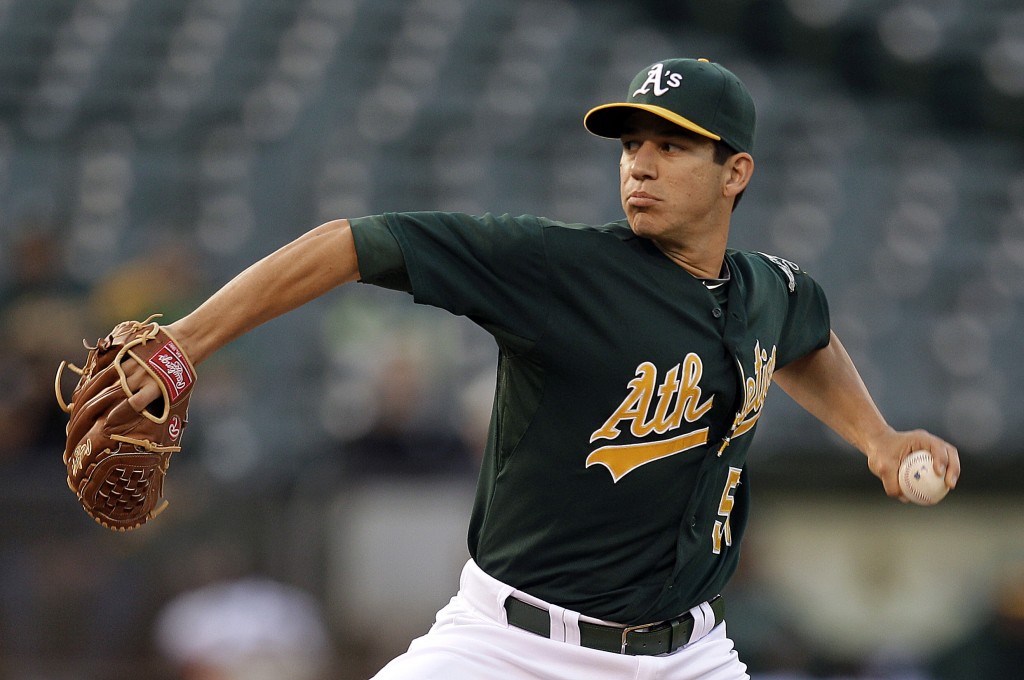
We miss you Tommy; Glad to see you're doing well. Photo AP/Ben Margot via dailyrepublic.com

Nationals farm system observers certainly knew we gave up a ton of talent to acquire Gio Gonzalez back in late 2011.  Most of the pundits I read at the time thought the Nats overpaid for a high-walk guy who overly benefited from playing in the “pitcher friendly” Oakland Coliseum (I say that in quotes since the multi-year park factors for that stadium can be nearly neutral depending on which statistic and which time period you choose).  We know what we’ve gotten in Gonzalez so far; a gregarious, pro-team guy who pitched lights out in 2012, increasing his K/9 and decreasing his BB/9 from both last season and from his career norms and who led the majors in wins.  He struggled in the playoffs of course, but his 21 wins were a big reason we were in the playoffs in the first place.

How about our 4 former Nats?  How are they doing so far?  In rough order of impact:

1. Tommy Milone: 13-10 with a 3.74 ERA and 1.279 whip in 31 starts after winning Oakland’s #5 starter job out of camp.   His debut was a sterling 8-inning 3 hit gem, and his season was a series of sterling outings interrupted by blow-out starts.  Scouts routinely pegged him as a 4-A starter, with not enough stuff to last in the majors, but he got results for us last year and continued to get results this year.  He helped lead Oakland to an improbable AL West crown and was the team’s #2 starter in the playoffs.  For a guy that I thought was a 4-A starter, Oakland has to be happy to have him on their squad.

2. Brad Peacock: Oakland is keeping him as a starter for now, and he toiled the entire season in AAA in Sacramento.  However, Peacock took a significant step backwards in 2012, posting a 12-9 record with an astounding 6.01 ERA.  Even accounting for the known hitters parks in the Pacific Coast League, to go from a 3.19 ERA in Syracuse to nearly double that in Sacramento spells issues.   I still think he’s bound for a middle-relief role on account of his only really having two pitches, and on account of the amazing starter depth Oakland possesses in their system.  But, starter or reliever, Peacock has to pitch better in 2013.

3. Derek Norris returned to the hitting form that we all knew and loved a couple years back once he reached Oakland’s AAA squad.  He hit .271/.329/.477 in about a half season in Sacramento and was then called up.   His MLB numbers weren’t great (.201/.276/.349) but he’s young and the team traded away its 6 year starter in Kurt Suzuki (to the Nats as we all know; sending Oakland yet another catcher prospect in the process) so Norris could be getting his chance sooner than later.

4. AJ Cole, the “gem” of the trade completely melted in the High-A California league, with a 0-7 record and a 7.82 ERA in 8 starts.   He returned to form upon his return to low-A, going 6-3 with a 2.07 ERA in 19 starts in the Midwest league.  All is not lost; he’s only 20, and there’s no shame in a 20-yr old failing at his first shot at high-A (where you see a lot of college draftees in their second pro year).


One year later, how does this trade look for both teams?  My trade reaction post from December 2011 talked about how this trade would come down to how closely the four traded guys came to matching their “ceilings.”  One year later, I think its safe to say that Milone has surpassed his ceiling, Peacock is in danger of never even fulfilling his “floor,” Norris is somewhere in the middle and its just way too early to judge Cole.

Meanwhile Gonzalez has surpassed what anyone could have hoped for in his first season; I thought he was a #2 starter but he put in an “Ace” year.  He may not win the Cy Young but he’ll be in the top 3 in voting.  He’s clearly a great clubhouse guy, a skill that you cannot put a dollar figure on.

I think both teams probably do this deal again.  There were no “winners” and “losers” thus far; both teams got exactly what they wanted out of the trade.

Written by Todd Boss

October 15th, 2012 at 3:20 pm

Nats 2012 Minor League Rotations: Guesses and Results

5 comments

Yunesky Maya led the Nats minor league starters for the 2nd straight summer. Photo Jim McGregor/Syracuse Chiefs via milb.com

I stumbled across this post, titled “Updated Minor League Rotation Predictions for 2012,” posted March 1st 2012, while looking for something else last week.  And I thought to myself, hey now that I’ve finished the reviews of the minor league teams, lets see how I did predicting the rotations at the beginning of the season!   I’ve also culled through the post-2011 season review posts for some preliminary guesses at the time.

(Note: I linked to NationalsProspects.com Luke Erickson‘s guesses in the above link for another perspective in the 2012 spring training).

Players are bolded the first time they’re mentioned, but not afterwards.

AAA:

  • Sept 11 Guess: Maya, Milone, Stammen, Meyers, Peacock, Martis
  • Mar 12 Guess: Stammen, Maya, Arneson, Ballard, Buschmann
  • Opening Day Rotation: Atkins, Roark, Maya, Lannan and Duke
  • 5 guys with the most starts in 2012: Maya, Roark, Duke, Lannan, Atkins

What happened?  My prediction was way, way off; only Maya was the constant, but we knew that the second he proved he couldn’t get out MLB hitters last fall.  The team traded two of its probable AAA starters (Peacock and Milone), lost a third to the Rule-5 draft (Meyers, who honestly we probably will get back once the Yankees are done screwing around with him) and a 4th to Minor League Free Agency (Martis).  Meanwhile, who knew that Lannan wasn’t going to make the MLB opening day roster?  Then, the team released Buschmann before he appeared in a game (he played 2012 in the Tampa Bay organization).  Ballard was a starter, just not in AAA.  Stammen, in a surprise to me, made the conversion from AAA starter in 2011 to MLB bullpen guy and had a great  year.  Lastly, instead of using more internal options like Roark the team signed two MLFAs in Duke and Atkins.  I suppose I could have guessed that the team would go with Roark before Arneson as a starter (given Arneson’s rubber-armed handling in 2011).  It just goes to show how much the creation of AAA teams has changed over the years.

AA:

  • Sept 11 Guess: Rosenbaum, BronsonDemny, Olbrychowski,  Solis
  • Mar 12 Guess:  Rosenbaum, Bronson, Demny, Olbrychowski, Gilliam
  • Opening Day Rotation: Gilliam, Demny, Mandel, Rosenbaum and Ballard
  • 5 guys with the most starts in 2012: Rosenbaum, Demny, Gilliam, Perry, Ballard/Pucetas

We were a bit closer here, getting 3 of the 5 guesses right.  Sammy Solis would absolutely have been in this rotation if not for his Tommy John surgery; we’ll cross our fingers for him to return in 2013.  When Solis went out, org-arm Mandel filled in.  Evan Bronson is still with the organization on Milb.com but never threw an inning in 2012 and isn’t on the Big Board.  I can’t find a single bit of google information indicating if he’s still with the team or not.  Weird.  Meanwhile I had just guessed too high for Olbrychowski; he spent most of 2012 as a starter in Potomac.  Nobody could have guessed that we’d have traded Balester for Perry, that Perry would have stunk as a reliever, and then would show up in AA remaking himself as a starter.  Ballard and Pucetas were MLFA pickups designed to fill holes in the system, though based on his prior experience I had Ballard pegged in the AAA rotation.

High-A:

  • Sept 11 Guess: Selik, Grace, Purke, Meyer, Hill, Karns
  • Mar 12 Guess:  Selik, Grace, Purke, Meyer, Hill
  • Opening Day Rotation: Winters, Hansen, Olbrychowski, Grace and Swynenberg
  • 5 guys with the most starts in 2012: Grace, Ray, Swynenberg, Olbrychowski, Karns

I was far off here as well; Purke got hurt, Meyer, Hill and Karns started lower than I would have guessed  and Selik was converted to a reliever.  I was right only on Grace (thought technically I thought Olbrychowski would be a starter, just not back in Potomac).  Winters was a MLFA (the fifth such MLFA who has appeared as a primary starter in our top three levels; is this a statement of some sort?).  As we’ll see in a moment, I was right about Hansen, just wrong about the level.  Lastly Swynenberg came out of nowhere; he was effective in middle-relief in low-A; who knew he’d win a spot in the high-A rotation?  I thought Ray would have done a few turns in low-A; instead he debuted in Potomac and struggled to make the jump.  I lost faith in Karns between September 2011 and March 2012; as it turned out he was one of the 5 top starters (in terms of appearances) for the year while putting in a career season.

Low-A:

  • Sept 11 Guess: Hansen, Jordan, Cole, Ray, Estevez, McGeary
  • Mar 12 Guess:  Turnbull, Hansen, Ray, McGeary, Karns
  • Opening Day Rotation: Estevez, Dupra/Karns, Meyer, Turnbull/Hill, McKenzie
  • 5 guys with the most starts in 2012: Hill, Meyer, Turnbull, Estevez, Hansen

What happened?  The team traded Cole.  Jordan was injured more than we were led to believe in late 2011 (he had Tommy John surgery after the season was over).   I predicted Hansen, Ray, Hill, Estevez, Meyers and Dupra would be starters, just got the levels wrong.   My Mar 12 guesses were somewhat accurate in that we got Turnbull and Karns right.  McGeary struggled through yet another injury filled season and may be nearing the end of his baseball career.  I thought Estevez was getting squeezed out with all these high-profile starters rising up.  I figured McKenzie had lost his starting shot; clearly his performance in 2012 should end his chances at getting another 2013 starting shot.  I guess the lesson here is that it can be awful difficult to determine the difference between a High-, Low- and Short-A guy.

Short-A:

  • Sept 11 Guess: Manny Rodriguez, Dupra, Baez and two draft picks.
  • Mar 12 Guess:  Manny Rodriguez, Dupra, Baez and two draft picks
  • Opening Day Rotation:  Jordan/Medina, Baez, Monar, Encarnation, and Smith
  • 5 guys with the most starts in 2012: Encarnation, Monar, Lee, Mooneyham, Fischer/Pineyro

My guess of 3 returners and 2 draft picks wasn’t entirely accurate; there wasn’t a single 2012 draft pick in the 2012 opening day rotation.  We got Baez pegged correctly but the rest of the predictions were off.  Manny Rodriguez, a converted infielder, spent the whole year on the 60-day DL.  Dupra was in high-A.  Meanwhile, a couple of guys dropping down from Low-A (Jordan, Encarnation) comprised the rotation at the beginning of the season.  Monar was a repeater from 2011 who didn’t get a ton of innings last  year.  Eventually some 2012 draftees (Mooneyham, Fischer and others) got starts as expected, and helped drive Auburn to the playoffs.

GCL:

  • Sept 11 Guess: Mieses, King, Encarnation, Medina, Marcelino
  • Mar 12 Guess:  Mieses repeating plus 4 guys from DSL and the 2012 draft.
  • Opening Day Rotation:  Mieses, Barrientos, Pineyro, Vasquez, and Schwarz
  • 5 guys with the most starts in 2012: Vasquez, Mieses, Hudgins, Selsor, Pineyro/Schwartz

Finally we got one right (well, right from Mar 12 guess anyway).  The GCL rotation was Mieses, 3 DSL graduates and one 2012 draftee.  Eventually more 2012 draftees (Hudgins, Selsor and others) consumed most of the rest of the starts.  King disappeared from the rosters; he’s still in the organization but was never assigned this season.  Injured?  Disciplinary issues?   There seems to be so much inconsistency in the DSL graduates that it almost isn’t worth tracking them until they appear in a higher level.  Honestly, this is why I don’t really follow the Dominican Summer League teams either.

Phew; that’s a lot of Nats minor league starters.  As it showed, its really, really difficult to predict this stuff from a computer in Northern Virginia, scouting the stat lines.  But its really fun, so we’ll continue to do it :-).

Nats Franchise Trade history; biggest, best, worst

14 comments

Was getting Gonzalez the "biggest" trade the franchise has ever made? Photo Jed Jacobsohn/Getty Images via nydailynews.com

In response to a topic that came up in the comments section, I’ll do a 3-part series reviewing the biggest/best/worst moves by the franchise since arriving here in Washington.  We’ll differentiate between Jim Bowden and Mike Rizzo moves as we go through.  We’ll talk about trades, then draft picks, then FA signings.

First up: Trades.

The Nats have made dozens of trades since 2005, and by my records have traded with every team in the league save for three: Baltimore, Cleveland and the Los Angeles Angels.  In fact, the franchise has not done business with Baltimore in any capacity since the year 2000, a testament perhaps to the difficulties of dealing with Peter Angelos even before the team moved to Washington.  Now post-relocation, the conventional wisdom is that the two teams would never do business on the off-chance that one team ended up “winning” a trade with the other.

I’ll divide this post into into 3 sections: the “biggest” deal (not the most players, but the biggest impact/most news worthy), the “best” deal(s) and the “worst” deals.  For Rizzo, we’ll add a 4th category for “Too Early to Tell,” since the big off-season trade of last season probably won’t shake it self out for a few more years.

Jim Bowden Tenure: Nov 2004 – Mar 2009

Biggest Trades

  • 2005: Soriano deal
  • 2006: Kearns/Lopez deal
  • 2007: Milledge deal
  • 2008: Willingham/Olsen deal

The Alfonso Soriano move made all sorts of news; he wouldn’t move to LF, threatened not to play at all, then ended up putting in a 40/40 season in a pitcher’s ballpark and then resulted a host of national news as the team debated whether to trade him, re-sign him or let him go.  Bowden held firm on his demands in the trade market, never traded him and landed two compensatory draft picks (which the Nats turned into Jordan Zimmermann and Josh Smoker).

The Kearns/Lopez deal, in the end, was more about moving deck chairs than making progress for either team.  Bowden was obsessed with players that he knew from his Cincinnati days, and showed a proclivity to trade for or acquire them throughout his tenure here, and this deal was just the biggest example.  The only player in the deal who still remains with his original team is Bill Bray, and most of the players in the deal have become large disappointments for their careers or are out of baseball.  The Reds accused Bowden publically of selling them damaged goods (Gary Majewski got injured about 5 minutes after the trade was completed) and Kearns/Lopez never really lived up to anything close to their potential.

We’ll talk about the other two deals below.

Best Trades

  • 2007: Getting Tyler Clippard
  • 2009: Getting Michael Morse
  • 2008: Getting Willingham/Olsen

Bowden gets major credit for obtaining two core members of the current Nationals squad for almost nothing.  He obtained Tyler Clippard from the Yankees for Jonathan Albaladejo in a like-for-like trade of under-performing minor league relievers.  Of course we all know what’s happeend since; Clippard has become a super-star setup man, the 2011 league leader in holds.   Getting Michael Morse in return for sending the feeble Ryan Langerhans to Seattle in what most thought was a mercy trade at the time (i.e., trying to send good-guy Langerhans to a team that would actually play him) seems like one of the steals of the decade.  Nobody thought Morse had a fraction of the potential he’s now shown to have.

I include getting Josh Willingham and Scott Olsen as a win based on who we gave up: PJ Dean, Emilio Bonifacio and Jake Smolinski.  I’ve always had a soft spot for Willingham and thought his offense potential was the key to this deal; we got two major leaguers for two dead-end minor leaguers plus a backup infielder.  Luckily for the Nats, Florida was always ready to give up arbitration candidates to save a buck.

Worst Trades

  • 2007: Milledge deal

Honestly, I had a hard time really saying that I thought one of Bowden’s trades was egregiously bad.  Most of his deals (outside the deals mentioned above as biggest or best) were minor leaguer swaps or dumping veterans at the trade deadline.  Even the acquisition of Elijah Dukes wasn’t really that “bad” based on who we gave up (Glenn Gibson, who was released a couple years later by Tampa Bay and ended up back with us anyway).

However, the acquisition of Lastings Milledge for Ryan Church and Brian Schneider might be the one trade that I’d most quibble with.  Bowden showed his obsession with “toolsy” and “potential” players in this deal, acquiring the malcontent Milledge and giving the Mets two immediate starters.  At the time I certainly defended the deal; neither Church or Schneider were slated to be starters for the 2008 Nats so you could argue that we got a plus prospect for two backups.  I know I certainly argued that point.  Church seemed to be a brooding platoon outfielder who wouldn’t be happy unless he was starting and Schneider had lost his starting spot to Jesus Flores and was a relatively weak hitter.

As it has worked out Church was a very productive player for New York, Flores got hurt and left the team in a very serious catcher-dearth position, and Milledge turned out to be not nearly the talent that we thought we were getting.  By the time we flipped him to Pittsburgh in 2009 he was barely hitting his weight in AAA and was completely out of the picture for this team.

Mike Rizzo Tenure: Mar 2009 – present

Biggest Trades

  • 2011: Gio Gonzalez deal

  • 2009: Morgan/Burnett deal

  • 2010: Ramos for Capps deal

  • 2011: Henry Rodriguez/Willingham deal

  • 2011: Gorzelanny deal

You have to hand it to Mike Rizzo; he’s not been afraid to make deals.  In his 3 year tenure he’s made 5 significant deals that have vastly changed the way this team is constructed.  Two of those deals (Morgan/Burnett and the Willingham deals) were mostly about cleaning up the roster to get it more in his image of pro-clubhouse guys and pro-defense.  Trading away Milledge and Willingham succeeded in moving the team towards these goals.  The Gorzelanny and Gonzalez trades were about acquiring power arms to shore up the rotation, another tenant of Rizzo-constructed teams.

Best Trades

  • 2010: getting Wilson Ramos

Clearly Rizzo’s best move was stealing Wilson Ramos for a closer (Matt Capps) that we had ample candidates for internally.  The Twins panicked post-Joe Nathan injury and overloaded their bullpen with closer candidates.  Meanwhile Rizzo turned an astute FA signing (a minor league signing that turned into an All Star) into an even more astute trade by getting a nearly MLB-ready catcher in return for a guy who the team wouldn’t be re-signing anyway.  Great move.

Worst Trades

  • 2011: Gomes for Rhinehart/Manno
  • 2009: Bruney for ptbnl (eventually rule5 top pick Jamie Hoffman)

Most readers here loved Christopher Manno and the promise he was showing in A-ball.  Most were also aghast to see Manno go the other way to Cincinnati for a 4th outfielder Jonny Gomes.  At the time, the argument was that Davey Johnson wanted a bat off the bench and that the team needed some OF depth.  What really happened was that Gomes hit his way out of his type-B arbitration status and played so poorly the 2nd half of 2011 that the team couldn’t dare offer him arbitration to get a compensatory draft pick.  So we traded two decent prospects for a half season of awful production.  Not a good move.

Even worse, trading anything to acquire Brian Bruney.  The team acquired Bruney, promptly argued against him and beat him in arbitration, and then (unsurprisingly) Bruney vastly underperformed until being flat out released a few months into the 2010 season.  For me this is a lesson in what not to do with your arbitration eligible players.  It wasn’t so much what we gave up (the first pick in the rule-5 draft *could* have been used to acquire someone of value), it was what we got in return.

Too Early to Tell Trades

  • 2011: Gio Gonzalez deal

Pro-prospect pundits (anyone at Baseball Prospectus, Keith Law, etc) will already tell you that the Nats vastly overpaid for Gio Gonzalez.  That’s because they value the potential of prospects more than the proven commodity of the major league player.  But the fact is this; you KNOW what you’re getting in Gonzalez but you have no idea how a low-A prospect will play out.  The Nats rolled the dice that AJ Cole isn’t going to turn into the next incarnation of Justin Verlander and that Brad Peacock‘s promise will peak as a middle reliever.  The only way to tell how this trade turns out is to track the progress of those players we gave up versus what Gonzalez does for this team over the next 3-4 years.

Thoughts?  Any trades out there that stick in your minds that you thought should be mentioned?

Updated Minor League Rotation Predictions for 2012

11 comments

Solis’ TJ surgery news thins our already-too-thin starting pitching minor league depth. Photo via Natsinsider blog/Mark Zuckerman

With Spring Training in full swing, most of the focus is on the Nationals 25-man roster and who may or may not make it.  Even with the additions to the major league roster, our minor league starter development is still incredibly important to this team for the long run.  Despite having Strasburg, Zimmermann and Gonzalez each locked up for many years (roughly, 2016, 2016 and 2018 respectively with options exercised), the rest of the rotation is not exactly set in stone for the long run.  Wang and Jackson are on one-year FA contracts and Lannan doesn’t seem a lock to be tendered this coming off season (where he’ll face arbitration for the third time and, if he stays here and puts in 30 starts, could be in line for something close to $8M in 2013).  That is, if Lannan is still even with the team in a year’s time (he seems surplus to requirements right now and may be a trade candidate).

Even more importantly, three key starters in our farm system went the other way for Gonzalez.  Our 2012 AAA starter safety net of Milone and Peacock is now set to be the 4th and 5th starter in Oakland, and our most electric younger arm (Cole) is now one of Billy Beane‘s best prospects.

That being said, lets talk about what the 2012 minor league rotations may look like, and where interest may lie with up and coming arms.  Experienced readers will note that, by and large, I only focus on minor league starters.  That is because, for the very large part, that pitchers rise up in the minors as starters and only get converted to be relievers upon failing as starters.  If you look at our current bullpen; Clippard, Rodriguez, Burnett, Gorzelanny, Detwiler and Lidge are all former starters, converted to being relievers either because of poor performance or for physical reasons.  Only Storen has grown up entirely as a reliever.  Therefore, the odds of a guy who is already pitching in relief in the lower minors rising up to be a part of the MLB bullpen is relatively slim.  Loogies?  Another matter, but still a difficult path (just ask someone like Josh Smoker).  Therefore, I tend to focus on Starters with occasional lip service given to closers per level and other relievers who are pitching their way into promotions.

Luke Erickson has posted some predictions (for AAA, AA, high-A and low-A), I put in an updated guess on Syracuse’s rotation post Gonzalez trade, and I had a series of posts at the end of last season wrapping up each level with predictions for 2012.  From all those posts, here’s my preliminary guesses on the rotations for the minor league rotations:

  • AAA: Stammen, Maya, Arneson, Ballard, Buschmann

I wouldn’t be surprised to see Erickson’s guesses of Atkins and Hernandez though replacing the last two; I’m guessing there’s going to be a wide-open competition for this rotation in this year’s spring training.  And, I specifically did not include John Lannan here; I just cannot believe the team is going to stick him in Syracuse by virtue of his option after signing on to pay him $5M.

First man promoted: I’d guess Stammen, who did have some successes in last year’s call-up, but it’ll take a swine-flu epidemic in the Nationals clubhouse for him to get called up to make some starts.  The MLB staff looks to have two former starters in their bullpen who will get the ball before Stammen gets a shot in 2012, and that doesn’t include the Wang/Lannan 5th starter conundrum.

First man demoted to the bullpen: Arneson; he’s bounced our system around like a pinball lately, and the team seems to use him as a multi-level handy-man instead of a starter prospect.

  • AA: Rosenbaum, Bronson, Demny, Gilliam, Olbrychowski

This list did have Sammy Solis until his TJ surgery was announced, and I put in Olbrychowski, who was halfway decent in a bunch of 2nd half starts in 2011.  I do think Roark is done being a starter in this system but I could be wrong.  Gilliam was the little-known make-weight player in the Gonzalez trade and I think he makes it to the Harrisburg roster.

First man promoted: Danny Rosenbaum, who aced Potomac last year and has the same make up as Lannan.  But, unfortunately there’s no top-10 stars on this list that could make an immediate impact.

First man demoted to the bullpen: Obrychowski, who started 2011 in the pen and may be on a short leash if someone in Potomac lights it up.

  • High-A: Purke, Meyer, Selik, Grace, Hill

I think Purke is advanced enough to start here, as is Meyer.  Of course, I also think Purke’s injury history could work against him and he ends up in extended spring for a bit.  Either way, I think both would be poorly served by sticking them in Low-A.  They’re both first round talents and need to be going against older, more advanced hitters right now.  This rotation is the future for the Nats; if they can’t find a 2014 starter out of this group, then we’ll be spending a ton in the FA pitching market for years to come.  This rotation is hurt by the loss of Taylor Jordan, who will be out the entirety of 2012 with TJ surgery after pitching very effectively for the first half of 2011 for Hagerstown.  Hill is the name i’m least confident in, only putting him here by virtue of his being a senior draftee in 2011, thus he’d be at least 3 years too old for low-A this year.

First man promoted: Cameron Selik; the phenom from 2011’s Hagerstown staff already has a ton of Potomac experience and could move up soon.  Despite their promise, I think both Purke and Meyers will be in Potomac for at least a half a season to get their professional legs.

First man demoted to the bullpen: Grace: he wasn’t entirely convincing as a starter in low-A, but his numbers were skewed by one or two really bad outings.

  • Low-A: Turnbull, Hansen, Ray, McGeary, Karns?

Maybe the 5th would be Karns, who if healthy could be a quick riser after so many injuries have derailed what was a promising young arm.  I think Ray starts here again with the idea of quickly promoting him, despite his success here last year.  He’s still young.  Of course, I could also see Ray and Hill switching places between low- and high-A.

First man promoted:  Robbie Ray: he out pitched AJ Cole last year without any of the Baseball America top 100 love.  I think he’s the next in a long line of lower velocity but higher result lefty starters that the system has been developing (see Lannan, Detwiler to a certain extent, Solis, Rosenbaum and McGeary for comps).

First man demoted to the bullpen: Karns, if he’s here.  I’m guessing Karns has this season to show that he continues to be a starter prospect, with a back-of-the-bullpen job waiting if he can’t show he’s durable enough to go 6 innings every 5 days.

  • Short-A: MRodriguez, Dupra, Baez and 2 draft picks.
  • GCL: Mieses repeating plus 4 guys from DSL and the 2012 draft.

There’s almost no point of trying to predict the short season rotations, but I do believe that the names listed here aren’t going to make the Low-A roster but are still worth keeping as starters in extended spring.  We had almost no starter talent in the GCL last season, with only Mieses making enough of an impression to keep him in that role.

Lastly, Taylor Jordan and Sammy Solis start the year on the DL, unfortunately, both with Tommy John surgery.  They would have both been prominent members of their rotations after great seasons last year, and their injuries further thin our starting pitching depth post Gonzalez trade.