Will Fedde make the 2014 draft a “success?” Photo via chicagonow.com
The title of my previous post was pretty simple: “Nats 2014 Draft == failure.” And it resulted in a rather spirited debate in the comments about the 2014 draft, the 2008 draft in hindsight, etc.
In that debate, I postulated my benchmarks for judging whether or not a team’s draft was “good” or not. Here were the six guidelines I stated for judgement, going round by round/section by section in the draft:
- a. 1st rounder: future MLB above average regular to all-star
- b. 2nd rounder: future MLB regular
- c. 3rd-5th: expect at least one future MLB player in at least a backup/bullpen role
- d. 6th-10th: hope for at least one player to reach the MLB level.
- e. 11th-20th: hope for at least three players who matriculate to AA or higher
- f. 20th and above: hope for one-two players to matriculate to AA or higher
Lets go back through all 10 Nats drafts and see whether these guidelines hold up. For each of the 6 requirements, we’ll give a quick “yes/no the condition was met” for each year. Critical to this analysis is the Nats DraftTracker XLS, milb.com and baseball-reference.com for searching for old players. Also useful is the Baseball America executive database, which populated the staff in charge of each draft.
Editors Note post-posting: I’ve added in the total known bonus amounts, per suggestion in the comments. Data taken from the Draft Tracker. Actual figures are likely higher because most bonus figures past the 10th round are unknown (but likely minimal). Also per good suggestion, I’m adding in the draft position for context, since its far easier to get a future all-star if picking in the top 5 versus later on.
2005: Owner: MLB. President: n/a. GM: Jim Bowden. Scouting Director: Dana Brown. Drafting 4th overall. Total Bonus $ spent: $3,990,500
- a. Yes: 1st rounder Ryan Zimmerman: MLB above average regular (former all-star)
- b. n/a: we had no 2nd rounder; forfeited for Vinny Castilla
- c. Yes: 4th rounder Justin Maxwell turned into a 4th outfielder. No 3rd rounder.
- d. Yes: 6th rounder Marco Estrada has turned into a decent starter (albeit for someone else after we released him)
- e. Yes: 11th rounder John Lannan and 12th rounder Craig Stammen turned into MLBers, far above expectations here. 18th rounder Tim Pahuta had long ML career for us, playing 3 years at AA.
- f. Yes: 33rd rounder Ryan Butcher was a 6yr MLFA who left the org but now has MLB experience with Atlanta. No other 20th+ round draftees made it out of A-ball, but Butcher’s MLB matriculation makes up for it.
2005: Success, inarguably. 6 guys matriculating to the majors is a winning draft, especially considering the lack of a 2nd or 3rd round pick, the ownership confusion, and the budget restrictions put on the team.
2006: Owner: MLB. President: n/a. GM: Bowden. Scouting Director: Brown. Drafting 15th overall. Total Bonus $ spent: $5,222,000
- a. No: 1st rounder Chris Marrero looks like a 4-a guy at best and 1st rounder Colten Willems never made it above A-ball.
- b. No: the team failed to sign 2nd rounder Sean Black and 2nd rounder Stephen Englund never made it out of low-A.
- c. No: none of their 3rd-5th picks made the majors. The highest one of these guys got was 5th rounder Corey VanAllen, who did pitch in AAA after passing through the rule-5 draft and finished out his 6-years with the org. VanAllen is in Indy ball in 2014.
- d. No: they didn’t even sign their 7th, 9th or 10th round picks. The closest they got to a MLBer here was 6th rounder Zech Zinicola, who played at AAA for quite a while, was rule-5 picked and returned, and now sits in Baltimore’s AA team.
- e. Yes: 12th rounder Cole Kimball made it the majors briefly, while 17th rounder Erik Arnesen, 18th rounder Adam Carr and 13th rounder Hassan Pena all toiled in AAA for several years.
- f. Yes, sort of. We’re all well aware of the success of 41st rounder Brad Peacock, but he was picked under the “draft-and-follow” system that no longer exists. So while yes it was a 41st round pick, in our current system Peacock wouldn’t have been picked at all and/or wouldn’t have signed but would have been picked the subsequent year based on his great first-college juco season. Of the rest of the 20th+ round picks, one guy had a couple months in AA (26th rounder Brett Logan) to serve as a backup catcher; he hit .102/.170/.122 in 20 games in 2007 and was released.
2006: Failure: 3 guys who have MLB appearances but near zero impact for this team. Peacock enabled the Nats to get Gio Gonzalez but I think we see now that Peacock wasn’t the driving prospect in that deal (now that Derek Norris has made an all-star team).
For as much as went right for the team in the 2005 draft, it went wrong in 2006. Was the lack of signing their 7th, 9th and 10th round picks evident of “fiscal restraint” demanded by the other 29 owners? Clearly to me, the focus on HS drafted personnel in this draft has Bowden’s hands all over it, and almost none of them panned out in the slightest.
2007: Owner: Ted Lerner group. President: Stan Kasten. GM: Bowden. Scouting Director: Brown. Assistant GM/VP, Baseball Operations: Mike Rizzo. Drafting 6th overall. Total Bonus $ spent: $7,619,300
- a. No: The team went one-for-three on its first rounders: Michael Burgess got to AA in his fourth pro season but never further, was flipped for Tom Gorzelanny. Josh Smoker‘s failure has been well documented here. But Ross Detwiler, for all the complaining about his usage and role in this space, did make the majors and looked like a good 4th starter (in 2012). I still believe he could start in this league and is better than a long-man. However, the condition is that a first round pick turns into a successful regular, and this crop failed in all regards.
- b. Yes. 2nd rounder Jordan Zimmermann is now a 2-time all-star and is probably the best 2nd round pick the organization has ever had. His successes make up for their other 2nd rounder Jake Smolinksi who has made his MLB debut but not until he became a 6-yr MLFA.
- c. Yes. 4th rounder Derek Norris made the 2014 all-star team for Oakland. 3rd rounder Stephen Souza has debuted in the majors and looks quite promising (albeit blocked) for our AAA team. 5th rounder Brad Meyers toiled for us in AAA for years before being released this spring after a long injury recovery.
- d. Yes: 10th round pick Patrick McCoy made it to AAA for us, signed with Detroit as a MLFA and debuted this year. We should note for the record though that 6th rounder Jack McGeary was paid as if he was a low-1st rounder and failed pretty spectacularly here.
- e. Yes: 20th rounder Jeff Mandel was a long-serving org arm at AA and AAA. 11th rounder Bill Rhinehart was looking like a find, appearning on Nats system prospect lists for a while and getting to AAA before getting flipped for Jonny Gomes.
- f. Yes: 28th rounder Boomer Whiting made it to Syracuse before getting released in 2011. 48th rounder (!) Kyle Gunderson was flipped for Logan Kensing in 2009 and made it to Miami/Florida’s AAA squad before getting released.
2007: Success: despite the 1st round failures and the McGeary disaster, the breadth of success in the other categories and the production of the remaining guys weighs out.
2008: Owner: Lerner. President: Kasten. GM: Bowden. Scouting Director: Brown. Assistant GM/VP, Baseball Operations: Rizzo. Drafting 9th overall. Total Bonus $ spent: $4,766,500
- a. No: as is well documented, the Nats failed to sign 1st round pick Aaron Crow.
- b. No/Inc: 2nd round pick Destin Hood has already passed through Rule-5 waivers once, but has found himself in 2014 and is hitting great for Syracuse (2014’s AAA line: .308/.353/.502). It does make one wonder if he’s worth adding to the 40-man once the season is over to keep him; he’s finishing his 7th pro year and is in line for minor league free agency.
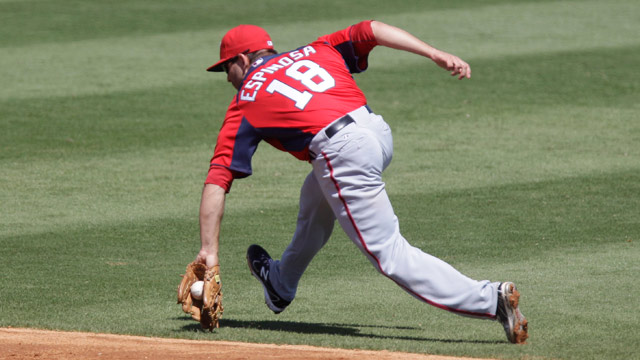
- c. Yes: 3rd rounder Danny Espinosa has his critics, but he’s at least a MLB backup or possibly more. 5th rounder Adrian Nieto has stuck with the White Sox after getting plucked in the Rule-5 draft last year and hasn’t been half bad.
- d. Yes: 10th rounder Tommy Milone has shown his capabilities as a MLB starter. d. 6th-10th: hope for at least one player to reach the MLB level. 6th rounder Paul Demny remains in the system (on the D/L in Harrisburg) but doesn’t seem like he’ll go much higher at this point.
- e. Yes: 16th rounder Tyler Moore has put in meaningful at-bats for the Nats for a few years now. And 19th rounder Steve Lombardozzi looks to be a solid utility/backup infielder in this league for years. Lastly I wonder if the team gave up on 15th rounder J.P. Ramirez too soon; he was paid like a 2nd round pick but was released prior to his MLFA period. He may have only made it to high-A, but his last season was somewhat decent.
- f. No: as far as I can tell, nobody of note came in rounds 20 or above from this draft.
2008: Failure: How would you judge this draft? We failed to sign the first rounder, which for me is a huge negative. The second rounder may or may not ever debut in the majors, which is also for me a huge negative because of the huge prevalence of 1st and 2nd rounders on MLB rosters. But we got four (5 counting Nieto) other MLBers out of the rest of the draft, including some very deep-dive picks that you rarely find (Moore and Lombardozzi, aside from Peacock, are the two lowest round picks to ever make it to the majors for this team).
2009: Owner: Lerner. President: Kasten. GM: Rizzo. Scouting Director: Brown. Drafting 1st overall. Total Bonus $ spent: $18,806,000
- a. Yes: no arguing about either first round pick here: both Stephen Strasburg and Drew Storen have pitched at all-star levels in their careers.
- b. No: 2nd Rounder Jeff Kobernus may have made his MLB debut, but he’s nowhere close to being a “regular” in the majors right now and doens’t seem to be trending that way either.
- c. No: 3rd round pick Trevor Holder was a gross over-draft (albeit with known reasons; the team committed an *awful* lot of money to the first two guys on this list) and was released in 2013. 4th rounder A.J. Morris looked quite promising for us, was flipped in the Gorzelanny deal, and this year is pitching effectively for Pittsburgh’s AAA squad after being taken in the minor league Rule-5 portion last off-season. And the Nats failed to sign their 5th rounder. So even if Morris pans out as a MLB-capable player, he’s doing it for someone else.
- d. Yes: 9th round pick Taylor Jordan was effective for the team last year and may yet figure in the team’s plans despite his mysterious D/L trip right now. And 6th round pick Michael Taylor has rocketed up the prospect lists for this team, is crushing AA pitching right now, is on the team’s 40-man roster and may very well get a look as 2015’s starting center fielder.
- e. Yes: 12th rounder Nathan Karns made the org look quite intelligent when he gave spot starts in 2013 after rocketing up the farm system after finally recovering from arm issues. I wonder if the success they had with Karns was the first impetus for Rizzo to take more gambles on high-end-but-injured arms. 13th rounder Patrick Lehman has bounced around as an org arm for years. 11th rounder Juston Bloxom played a couple years in AA before getting released this year. 16th rounder Sean Nicol is splitting time between AA and AAA this year. Finally, I wanted to note something I never knew before studying this: the Nats drafted Marcus Strohman in the 18th round out of HS; this is the same Strohman who went in the first round three years later to Toronto and who is currently holding down a rotation spot for the playoff-pushing Blue Jays. Wow. He’s listed as a SS on the draft-tracker but clearly is a MLB-calibre starter.
- f. Yes: 22nd rounder Danny Rosenbaum has been Syracuse’s “ace” for three seasons now. And a slew of guys drafted in the 20s stuck around for years as middle relievers (Mitchell Clegg, Matt Swynenberg, Evan Bronson, Rob Wort, and Shane McCatty). You just can’t ask for more out of your picks in rounds 20-30.
2009: Success: I’ll take a couple of misses in the 2nd and 3rd rounds given the amount of talent they picked up in the middle and late rounds. Great draft. 6 guys who have debuted in the majors with at least another one likely coming soon.
Note: from 2010 onwards, most of the judgement calls are still “in progress.” We’ll use projections and “small sample sizes” to pass judgement. It is what it is. Feel free to criticize in the comments about using projections and national pundit scouting reports to make judgements.
2010: Owner: Lerner. President: Kasten. GM: Rizzo. Scouting Director: Kris Kline. Drafting 1st overall. Total Bonus $ spent: $11,413,200
- a. Yes: 1st rounder Bryce Harper has turned into everything the hype suggested. Fun fact; when he went on an rehab assignment in Potomac, he was the 2nd youngest guy on the roster. Remember that when you criticize the guy for not being better than he already is: if he was “playing by the rules,” he’d be jsut finishing his junior year of college.
- b. No/Inc: 2nd rounder Sammy Solis has been one injury issue after another. He missed all of 2012 with Tommy John, came back slowly in 2013, but now sits on the AA D/L with another “elbow” issue. He was protected on the 40-man roster last fall, but you have to wonder what’s to come of him. He’s finishing his 5th pro season and he’s got exactly one start above A-Ball.
- c. Yes/Inc: 4th rounder A.J. Cole was paid like a late first rounder, and after some struggles he’s really come onto the scene this year. He was already really young for AA and “solved” it, and is now in AAA holding his own. The other guys in this category are less impressive: both Rick Hague and Jason Martinson are repeating AA and not really hitting well enough to push for promotions. This could be a side-effect of the huge amount of money committed to Harper and Cole.
- d. Yes: 9th round pick Aaron Barrett went from unknown/unrecognized prospect to the Nats 40-man roster last fall to being lights-out middle reliever in the major league pen this year. As a 9th round college senior pick. 8th rounder Matthew Grace may be next; after toiling as a mediocre starter, he became a reliever in 2013 and has been lights out in AA and AAA this year. And he’s not just a LOOGY: 56 IP in 33 appearances and he’s given up just 6 ER in that time.
- e. Yes: 15th round pick David Freitas, after getting traded to Oakland for Kurt Suzuki, got traded again to Baltimore and now is in AAA. 12th round pick Robbie Ray has made his MLB debut for Detroit after going over in the Doug Fister deal. 11th rounder Neil Holland toils in the Harrisburg pen admirably.
- f. Yes: 23rd rounder Colin Bates and 26th rounder Christopher Manno both are in the Harrisburg pen. 22nd rounder Cameron Selik made it to AA before hitting his ceiling and being released earlier this year. And 32nd rounder Randolph Oduber is a starting OF in Potomac with decent splits and a shot of moving up.
2010: Success: It may have been a no-brainer to take Harper, and it may have been an example of the “checkbook” winning in their picks of Cole and Ray, but you have to hand it to this team; they bought two high-end prep guys out of their college and they’re both looking like huge successes. And they got a MLB servicable reliever out of a college senior sign who they paid just $35,000 in bonus money. Great work.
2011: Owner: Lerner. President/GM: Rizzo. Scouting Director Kline. Drafting 6th overall. Total Bonus $ spent: $11,325,000
- a. Yes: 1st rounder Anthony Rendon was on everyone’s “all star snub” lists this year, while their other 1st rounder Alex Meyer remains one of the top pitching prospects in the game and seems likely to debut later this year. Their supp-1st rounder Brian Goodwin remains on every pundit’s prospect lists even if he seemingly has been passed on the organizational “future starting Center-fielder” depth chart. There’s no chance the team leaves him exposed in the upcoming rule-5 draft, so he’ll have at least three more years to prove he belongs.
- b. n/a: forfeited for Adam LaRoche signing.
- c. No/Inc: Right now our 3rd through 5th picks are looking iffy; 4th rounder Matthew Purke was paid like an upper first rounder and has been a massive disappointment. Right now he’s recovering from Tommy John and faces an uncertain future. 4th rounder Kylin Turnbull has gotten lit up in high-A this year, his second crack at the league. 5th rounder Matt Skole may be the most promising of the bunch; he crushed 27 homers in his first season of full-season ball only to miss all of 2013 because of a freak injury. Can Skole continue developing and make the majors on a full-time basis? Can Purke at this point?
- d. Yes: With the call-up of 6th rounder Taylor Hill earlier this year, this category is met. Which is good because the rest of the 6th-10th rounders from this year are struggling. Two are already released/retired, one is MIA and the lone remaining active player (Brian Dupra) is struggling as a starter/swing-man in AA. But Hill is a huge win; a college senior draftee on minimal bonus rocketing through the minors and forcing his way onto the 25-man roster.
- e. Yes/Inc: It is far too early to fully judge this category, but it is looking promising despite the fact that the team failed to sign SIX of its ten picks beween the 11th and 20th round. 11th rounder Caleb Ramsey is already in AA. 16th rounder Deion Williams is on the mound (not a SS as in the Draft Tracker) and is struggling in short-A. 18th rounder Nick Lee is struggling in Potomac this year but has shown a huge arm and seems like he’ll eventually convert to loogy (especially considering his undersized stature); I can see Lee making it far as a matchup lefty reliever with swing-and-miss stuff. The lone failure at this point is 12th rounder Blake Monar, sort of inexplicably released after a decent 2012 season in Short-A.
- f. Yes: 30th round pick Bryan Harper earned his way to Harrisburg. 45th round college senior pick Richie Mirowski also made it to AA, where he wasn’t half bad last year, though at the moment he’s back in Potomac. And there’s three other players drafted in the 20th or higher who are active on Potomac’s roster this year and who may get moved up. Decent production out of the bottom of this draft so far.
2011: Projected Success: As discussed before, I believe the selection of Rendon was a “no-brainer” based on a unique set of circumstances that occured on draft day, but credit the management team for having the stones to pick him when other GMs didn’t. I’m sure the Mariners (especially) would like a re-do on that draft (they picked 2nd overall, got soft-tossing local product Danny Hultzen, who was sidelined last year with all sorts of shoulder issues and is no sure bet to ever make it back. They rolled the dice with Purke and so far seem to be losing, but Purke was himself a 1-1 talent at one point (remember, he had his $4M+ deal with Texas pulled thanks to MLB-stewardship at the time) and was probably worth the risk. I’d like to see Skole reach the majors in some capacity before declaring this draft a full success.
Note: from here onwards, everything is a projection and is based on scouting the stat lines. I’m going to sound negative where others sound positive and vice versa. Hey, its better than writing nothing.
2012: Owner: Lerner. President/GM: Rizzo. Scouting Director Kline. Drafting 16th overall. Total Bonus $ spent: $4,503,500
- a. Yes/inc: 1st rounder Lucas Giolito (so far) has shown himself to be at full speed post TJ surgery and is mostly in the top 10-15 of every professional scouting pundit’s list for best prospect in the entirety of the minors. He’s got a #1 starter ceiling, a huge frame and three plus pitches. He’s projecting to be everything you’d hope for from an upper first rounder.
- b. No/inc: It is hard to squint at 2nd rounder Tony Renda at this point and project him as a future “MLB regular.” Sure he’s hitting .297 in Potomac, and sure his numbers at the plate have not varied much in his three pro seasons. Unfortunately he’s vastly undersized and he has no power in a time where pro middle infielders are expected to provide serious pop. Maybe he can forge a career like Jamey Carroll or like a Jose Altuve, but the odds are against him. I don’t mean to discount the guy because he’s 5’8″ but we all know there’s a significant bias in the industry towards undersized guys. Heck, a pitcher is considered “short” if he isn’t 6’2″ these days.
- c. No/inc: So far the guys picked 3rd-5th are also struggling. 3rd rounder Brett Mooneyham‘s struggles are well documented here. 4th rounder Brandon Miller continues to show great power but has missed much of this season with a hamstring injury (he’s on rehab in the GCL as we speak). Lastly 5th rounder Spencer Keiboom suffered a blown UCL that basically cost him the whole 2013 season. He’s got great numbers in low-A this year but is two years too old for the league. Keiboom’s talents more centered on his defense than his bat, so he may still push forward as a future backup catcher. But until he does, this category falls in the “no” side.
- d. Maybe/inc: The leading hope for some MLB success out of our 6th-10th round picks right now resides in one of two middle relievers: 7th round pick Robert Benincasa or 9th round pick Derek Self. You never know; one of these guys could turn into the next Aaron Barrett. 8th round SS Stephen Perez made the all-star team this year in Potomac and could feature as a future utility infielder. The team has already released its 6th round pick Hayden Jennings, and their 10th rounder (local Rockville product Craig Manual) was a college senior catcher who is backing up other catchers in the system for the time being). He may continue to hang around but unless he gets a starting gig he’s going to get replaced by someone newer.
- e. Yes/inc: 17th rounder Blake Schwartz has already made it to AA, where he struggled and he now sits back in Potomac (where he was great last year, go figure). 11th rounder Brian Rauh got a spot-start in AA last year but has bounced in and out of the Potomac rotation this year. 16th rounder Ronald Pena is working his way off injury but faces a long road to move up thanks to a lack of swing-and-miss stuff. The team has already released four of its 11th-20th round picks; the remaining out-field players (12th rounder Carlos Lopez and 19th rounder Bryan Lippincott) both seem to face long odds as college senior draftees still residing in the low minors to even make it up to AA at this point. To be fair, Lopez missed most of 2013 with an unknown injury, so we’ll give him a slight pass. Lippincott sits in XST right now.
- f. No/inc: 33rd rounder Mike McQuillan has hung around and currently serves as a utility guy/bench player for Potomac. A couple of relievers remain on squads: 29th rounder Leonard Hollins is hurt but is on a full-season squad, and 30th rounder Robert Orlan was with Hagerstown to start the season but is back in Auburn. The rest of the 20th round and up guys features carnage; eight college senior draftees already released to go along with 10 unsigned (mostly high schoolers) picks in the later rounds. One unsigned pick looks interesting; all-american freshman UNC player Skye Bolt may be a big-time 2015 draft pick. But otherwise, I’m predicting that we dont’ get even a AA player out of the last 20 rounds of this draft at this point.
2012: Projected Failure: Frankly, this is looking like it may be a one player draft. At this point, I don’t think you can look at *any* other player in this draft and project even a bench/fringe 25-man roster guy besides Giolito. Now ask yourself: if Giolito fulfills expectations and becomes an “ace,” a top 15-20 arm in the majors while the rest of this draft basically becomes high-A and AA filler, does that change your opinion of the draft success/failure?
2013: Owner: Lerner. President/GM: Rizzo. Scouting Director Kline. Drafting 30th overall. Total Bonus $ spent: $2,678,100
- a. n/a: No 2013 first rounder thanks to the supurfluous signing of Rafael Soriano. As noted at the time, the Nats missed out on players like Sean Manaea, Ryan Stanek or Ian Clarkin, all of whom were available at the time of their lost 1st rounder. Manaea in particular has flourished, rising up prospect list charts and sporting a healthy K/9 rate in high-A this year. I’d like to call this in and among itself a failure (given my reservations about paying for saves in general), but have to admit that Soriano has been pretty durn good this year.
- b. No/inc: 2nd rounder Jake Johansen thus far has not lived up to advance billing in his first year in full-season ball. He’s averaging just 4.5 innings per outing and sports a 5.00 ERA and less than a K/inning. I can understand the difficult adjustment to pro ball, but I don’t get how his vaunted velocity and size combination aren’t resulting in more swing-and-miss. He’s given no indication that he can avoid what scouts have been saying all along (that he’s destined for the bullpen), he’s way too wild and way too hittable.
- c. Yes/inc: the Nats collection of 3rd rounder Drew Ward, 4th rounder Nick Pivetta and now especially 5th rounder Austin Voth are making this management team look very smart. All Voth has done since forcing his promotion to High-A is give up 10 hits and ONE earned run in 33 innings over five starts. That’s just ridiculous. And he’s doing it while maintaining a 36/5 K/BB ratio. There’s zero reason for him to still be in Potomac at this point. I don’t know what Voth’s ceiling is, but its getting pushed.
- d. No/inc: Thanks to the new CBA’s rules, most 6th-10th rounders are throw-away/college senior picks these days. So it’ll be awfully hard to depend on one of them turning into a 25-man roster guy. The best bet out of this draft will be having either 6th rounder Cody Gunter or 7th rounder James Yezzo eventually matriculating to the majors. The other guys in this category were 15k bonus college seniors, one of whom (9th rounder Jake Joyce has *already* been released). Do we think either Gunter or Yezzo projects as a major leaguer? Not right now: Gunter’s struggling in short-A for the 2nd year in a row and Yezzo is an undersized 1B showing little power.
- e. Maybe/inc: Right now the pickings for the guys taken 11th-20th look pretty slim too. Three were senior signs who have already been released and we failed to sign our 16th round pick Willie Allen (though can’t fault the Nats for that: doing research on him for last year’s draft review showed all sorts of inconsistencies with him, including whether he’s even still playing baseball in college). But 11th rounder John Simms is looking like a great find; he’s already in the AA rotation and holding his own (though you could argue it was out of need, not performance). Among those left, 10th rounder Brandon Middleton and 15th rounder Isaac Ballou are starting and playing well in Hagerstown, 12th rounder Andrew Cooper is strugging in low-A, 13th rounder John Costa has yet to debut for the team thanks to TJ surgery, and 17th rounder Geoffrey Perrott was a senior catcher who got a grand total of 13 at-bats in 2013 and has remained in XST so far thisyear, perhaps to serve as a bullpen catcher for others remaining in Viera and perhaps because he was hurt most of last year and may still be recovering. If Simms continues to rise and we get a couple more longer-lasting prospects out of this crew, we’ll convert this to a success.
- f. Maybe/Inc: The Nats picked seven college seniors in the 21st round or above and so far they’re all with Hagerstown. Middle infielders Cody Dent (22nd rounder) and Willie Medina (31st rounder) both hit in the .220s last year, are hitting in the .220s (or worse) this year, and seem like they may not last the season. However the pitchers in this bunch are looking better and better. 28th rounder Joey Webb has a 2.53 ERA, 30th rounder Ryan Ullmann has as 3.10 ERA and got a high-A up-and-back call-up, and 34th rounder Jake Walsh dominated Low-A and earned a call-up to Potomac. Only 29th rounder Michael Sylvestri seems to be in trouble among these senior signs; after struggling in Short-A last year, he gave up a ton of runs in 6 mid-relief outings and is currently in re-assignment purgatory. What of the non senior-signs? 24th round pick Matthew Derosier is struggling in short-A and 23rd round outfielder Garrett Gordon seems like he’s a bench player in Auburn. But a revelation may be 25th round prep draft pick Travis Ott. He holds a 2.10 ERA through 6 starts in Auburn despite being quite young for the league. So, the trend seems good that we’ll get value out of the bottom part of this draft.
2013: Projected Failure: Sorry to say; no first rounder, a middle reliever out of your 2nd rounder, perhaps a 5th starter out of the 3-5 rounds, and some org filler from the bottom of the draft? How many players from this draft do you realistically project to make the majors?
2014: Owner: Lerner. President/GM: Rizzo. Scouting Director Kline. Drafting 18th overall. Total Bonus $ spent: $4,149,900
- a. Maybe/inc: 1st rounder Erick Fedde may project as a MLB rotation guy, but he’s not projecting as an ace level arm. So if he comes back from surgery 100%, if he keeps moving up the chain, if he makes the majors and if he has an impact we’ll give this a yes. Lots of ifs.
- b. n/a: we failed to sign our 2nd rounder Andrew Suarez.
- c. Maybe/inc: The hopes here fall on 3rd rounder Jakson Reetz and 4th rounder Robbie Dickey, since our 5th rounder was a senior lefty out of non-baseball powerhouse Duke. How do we dream on Reetz and Dickey? Maybe Reetz turns into our next Derek Norris while Dickey turns into the next Austin Voth. Lets hope so, because both so far have had rather inauspicious starts in the GCL (Reetz batting .220 and Dickey posting an ERA in the 12s). To be fair Reetz is a kid and Dickey isn’t much older, so we have a long way to go before passing true judgement.
- d. No/inc: We failed to sign the 8th round pick Austin Byler (and from reading the tea leaves, it didn’t seem like we were ever even close). Our 7th, 8th and 10th round picks were low-bonus college seniors with little hope of advancing. So this category falls squarely on the shoulders of 6th rounder Austin Williams, who looks ok so far in Short-A.
- e. Far too Early: most of these guys who did sign are 15 games into short seasons.
- f. Far too Early: most of these guys who did sign are 15 games into short seasons.
2014: Not promising: An injured first rounder, no 2nd rounder, really just a handful of non senior-signs elsewhere in the draft. As I opined in the previous post discussion, I just don’t like the looks of this class.
So. 5200 words later, I think I actually like my guidelines. I think though that the new CBA forces teams into making a bunch of “throw-away” picks in the 6th-10th rounds, so my criteria needs to be adjusted downward for that category in the last few years. Otherwise I think it holds.
What say you?
Editor’s Post-posting thoughts. Based on the analysis above, the franchise has 5 successes and 5 failures (or projected failures) in ten drafts. After up and down drafts the first four years, we had three straight successes in 2009-2011, but now I feel like we’ve had three successive failures from 2012 onwards. Here’s a sobering thought about those successes and failures: lets talk about bonus money spent.
- In the 5 drafts I call successes, the team spent (chronologically): $3,990,500, $7,619,300, $18,806,000, $11,413,200 and $11,325,000 in bonus money.
- In the 5 drafts i’m calling failures/projected failures: $5,222,000, $4,766,500, $4,503,500, $2,678,100, $4,149,900
See a pattern? With the exception of the unbelievable 2005 draft, the Nats have had successes when spending big money and failures when they don’t. Maybe its just that simple.
I think, to be fair, it is also worth nothing the three distinct “eras” of Nats draft philosophy:
- Era 1: 2005-2008: MLB hamstrung budgets and Lerner penny pinching era. 2 successes, 2 failures.
- Era 2: 2009-2011: Lerner’s realize the Tampa Bay way: spending through the draft is the best way to acquire talent. 3 successes
- Era 3: 2012-present: the new CBA spells out draconian draft bonus policies. 3 failures.
Era 1 may be just the way it used to go; sometimes you’d get wins in the draft, other times you’d strike out. Era 2 was the glory years of Nats drafting, though the cynic may point out that picking three consensus 1-1 talents and spending 8 figures in bonus money wasn’t that hard. Era 3 is more troubling: why has this management team not done better in the CBA/limited bonus era?