Nationals Arm Race

"… the reason you win or lose is darn near always the same – pitching.” — Earl Weaver

Archive for the ‘edwin jackson’ tag

September callups and the pending Nats Roster crunch

6 comments

Cole Kimball (remember him?) could be a victim of a roster crunch this off-season. Photo Rob Carr/Getty Images via zimbio.com

I took this discussion out of the comments section of the Giolito post in August and made it a separate discussion item, since the situation only got more “dire” with the 9/3/12 call-ups of both Christian Garcia and Zach Duke.

Before getting into the below analysis, let me say this: I’m absolutely supported all of the 40-man additions or the 9/1 call-ups; they were all required, important moves and, especially with the early-season catcher crunch, were vital to ensuring the continued success of the team through the September push.  Adding these two latest arms to a well-used bullpen, plus the 9/1/12 call-ups of of eventual 5th starter John Lannan, catcher depth in Sandy Leon and defensive replacement/pinch runner Eury Perez signal that this team used every avenue in its arsenal to win down the stretch and secure not only a playoff entry, but the #1 seed.

Garcia and Duke were new 40-man additions; to make room at the time the club put Henry Rodriguez on the 60-day dl (apropos since he just had season-ending elbow surgery).  The 40-man roster was filled to a full 40 active players, with an additional three on 60-day DL (Kimball and Ramos joining H-Rod on the 60-day list).

So, why am I worried about a future 40-man roster crunch?  Because with all these additions, we’re going to have to make some tough choices once it comes time to protect guys from the rule-5 draft.  Some have said that the expected Free Agents and Non-Tenders will immediately ease the roster crunch, but I’d counter that these players will have to immediately be filled through free-agency and aren’t going to offer the relief one may expect.

Lets do some analysis for the 43 guys (40 on 40-man plus 3 60-day DL) we’re talking about.   Here’s how these 43 guys are categorized in terms of contract status for next year:

  • Seven (7) guys under contract for next year.  Werth, Zimmerman, Morse, Gio Gonzalez, Maya, Tracy, Suzuki.
  • Eighteen (18)  guys who are pre-arbitration; Strasburg, Rendon, Purke, Harper, Espinosa, Ramos, Henry Rodriguez, Lombardozzi, Marrero, Mattheus, Kimball, Moore, Perez, Rivero, Solano, Garcia, Leon, Brown.  Some of these are non-tender candidates; we’ll get to them below.
  • Nine (9) guys who are arbitration-eligible but who are (in my opinion) not in Non-Tender jeopardy: Zimmermann, Clippard, Flores, Desmond, Storen, Bernadina, Detwiler, Stammen, Perry.  Both Perry and Storen may or may not actually hit Arbitration status per Cots, but the logic still stands that they’d be tied to the team regardless.  Are any of these guys non-tender candidates?  See below.  [Editor’s Note] we now know that Storen DID hit super-2 status, while Perry missed out on arbitration for the year.  Most of this post was written prior to this knowledge.
  • Four (4) pure FAs that immediately come off books: Mike Gonzalez, Jackson, Wang, DeRosa.
  • Two (2) more guys with mutual options that, as it turned out, declined their side and became free agents anway (LaRoche and Burnett).
  • Three (3) easy Non-tender guesses: I think the team non-tenders Gorzelanny, Lannan and Duke (but looks to bring Gorzelanny back as a long-man).  There are other possible non-tenders on this roster; we’ll talk about them later on.

So, on the day the FA’s clear and the 60-day guys get put back on the 40-man we’ll be at 43-6 FAs = 37 players.  So, assuming both 43-6 FAs=37 to start, perhaps down to 34 at the non-tender deadline. That leaves 6 spots opened up … but if my scenario plays out as described above with 6 FAs and 3 non tenders, that includes no less than FIVE of our primary 25-man roster all season. Which means most likely we’ll be active in the FA market looking for replacements for those five guys. First example: Who replaces Edwin Jackson? The next guys in line are Lannan and Wang; both likely gone. After that is perhaps Perry or Maya, both on 40-man but so far both proven not to be able to get out MLB hitters. So we’re going to be looking for another starter. Same goes with replacing Burnett and Gonzalez as lefties out of the pen, and replacing DeRosa as mlb-veteran utility infielder.

My point is that, yeah we have a lot of guys getting cut but we can’t just leave those spots open on the 40-man; we’ll need to immediately fill them with MLB deals in free agency. So we go from 34 open spots probably almost immediately to 38 or 39 with these eventual FA  replacement signings…. and boom, you have your roster crunch when it comes to rule5.

I have a draft version of the 2012 rule 5 pre-draft recommendations and it could get ugly, but to do some quick analysis here’s the Draft Tracker google xls: https://docs.google.com/spreadsheet/ccc?key=0AmkEIm1TLiXQdGhVRjRfNW81SG8xRlROQ1ZxZzNfbUE&hl=en#gid=0.  Yellow shaded cells are 2012 R5 eligible but don’t forget 2011 R5 guys who have stepped up and may need protecting. At first glance in the conversation to be protected has to include: Kobernus, Rosenbaum, Karns, Hood, and Demny. I’m not saying they all need to be protected, but some of them may.

My point is this; if the team wants to protect more than 1-2 guys, they’re looking at a one-for-one replacement on the 40-man roster.  Maybe they do DFA Marrero and Kimball, but they probably don’t want to.  Marrero is only 24.  Kimball was relatively successful before going down with shoulder surgery and is the kind of reliever that Rizzo loves.

This is the essence of the “roster crunch” that this team faces this off-season.
400th Post at nationalsarmrace.com

2 comments

Happy 400th post!

This post, if I trust my WordPress engine to tell me the right number of published articles, we have hit 400 posts in the history of this blog.

Here’s some useless information on the history of this blog and the nature of the posts.

Posts by year:

  • 2010: 82
  • 2011: 226
  • 2012: 92 (as of today)

I really got into the blog in 2011, and the post count was way up for rotation reviews of both major and minor leagues.  A new job curtailed my time immensely this year, though I had a good bit of time the last couple of months to post pretty regularly.

Milestone Posts

Other Random Blog milestones

  • 17th post: 8/9/10 “2011 Rotation Competition” First post where I started the formatting theme of bolding a proper name the first time it appears in a post.  I started this to highlight those players who I was specifically talking about.
  • 55th post: 10/20/10: “Contract Value for FA Starting Pitchers: The Cliff Lee Lesson to-be” First post where I started incorporating pictures into the blog posts.  I got the idea from Mark Zuckerman‘s blog, where he always uses a single picture at the top of each blog post.  I generally use images.google.com to find the images and then attempt to give proper photo credit.  Coincidentally, at some point in the past I did a ton of research on the use of photos on the internet and had a discussion on the subject (in the comments section of this May 2011 post).
  • 221st post:  8/25/11, “My Answers to Boswell’s Chat Questions 8/22/11 edition.”  This was the earliest post that I regularly started using “tags” for player names.  I started doing this after turning on the “tag cloud” along the right hand side.  The tags also serve as a nice searching method for a particular player.  (I’ve since gone through some effort to “tag” the posts prior to this one but am not entirely caught up to the history of the blog).
  • 243rd post: 9/25/11, “New Theme!”  I changed the look and feel of the blog from an out-of-the-box WordPress theme to a custom theme.  I was doing this primarily to figure out a way to get the blog slogan (the Earl Weaver quote at the top) to be more visible.

Count of posts by category: (note that these will add up to greater than 400 since some posts get multiple categories):

Category # of Posts
30 for 30 7
Baseball in General 117
Chat/Mailbag responses 37
College/CWS 1
Draft 16
Majors Pitching 142
Minor League Pitching 65
Minor League Rotation Reviews 17
Nats in General 154
Nats Rotation Reviews 28
Non-Baseball 16
Uncategorized 0
Weekly News 22

Top 10 player names mentioned (since I started typing them in as Tags; this is definitely weighted more towards the the past season than earlier, as catching up hundreds of posts with updated tags is not an effort worth finishing frankly)

  1. Stephen Strasburg: 73 mentions
  2. Ross Detwiler: 63
  3. Mike Rizzo: 58
  4. Jordan Zimmermann: 56
  5. John Lannan: 55
  6. Chien-Ming Wang: 49
  7. Bryce Harper: 48
  8. Gio Gonzalez: 44
  9. Jayson Werth: 42
  10. Brad Peacock; 38

Peacock gets a ton of mentions, since his call-up in 2011 and his subsequent excellent starts merited a ton of thought as to his future with the organization.  As we now know, he was traded away and struggled in 2012.  So far, it looks like we traded high.

#1 item I wish I still had time to do:

  • The rotational reviews, especially in the minor leagues.  I maintained these for the first half of 2011, but a vacation in July of 2011 left me a couple weeks behind and I just never could catch up.  I didn’t even attempt to try these for 2012.  Its unfortunate; the whole reason I started this blog was to study and be up on the minor league pitching, especially the starters.  I feel, and still feel, that developing quality starting pitching is the most important aspect of the farm system, and that a successful pre-arbitration pitcher is the most valuable commodity in the sport.  Wins on the free agent market are really expensive (if you get a win per $1M of FA dollars spent, you’re doing pretty well, as we saw with the $11M we gave Edwin Jackson for his 10 wins this year).

Other things I’d love to do a better job of doing:

  • The “Tom Boswell chat” responses.  I love doing those and seeing if I agree with Boswell’s take.  Same with the Bill Ladson mailbag posts, but I don’t recall him doing one of these in quite a while.
  • Reviews of pitching performances; this requires the time to sit down each night and watch the games … I love baseball, but I just cannot commit that kind of time.  I see that Ladson just released one, so I’ll get on that straight-away.

#1 item I wish I could incorporate: I’d love to do interviews of pitching coaches and pitchers at the various levels to talk about pitching strategy, mechanics and whatnot.  I briefly pursued getting a Nats press pass but got the impression that the team is less inclined to hand out press passes to blogs such as mine (which provide a heavy amount of opinion and commentary) versus blogs like Federal Baseball and DC Pro Sports Report (which act more like beat reporters and focus on doing pre-game and post-game reports).  Fair enough.

#1 technical issue I would like to change: I honestly have no idea how many people read this blog; I host the blog myself and have struggled to get the WordPress engine to work properly.  Thus it is out of date and a lot of plug-ins that would allow for simple things like counters and tracking are unavailable to me.  If anyone has a good WordPress hosting solution i’d be all ears.

I do know that I get nearly 100% of the traffic to the site via clicks from Mark Zuckerman’s blog, where i’m listed in his blog-roll and readers get to see when I have new content.  I’d like to get represented on the other major media outlet blogs at the Washington Post and Washington Times.  That would really help my readership too.

Thanks for reading!

Written by Todd Boss

October 23rd, 2012 at 1:36 pm

Roster Construction Analysis of 10 Playoff Teams; 2012 edition

5 comments

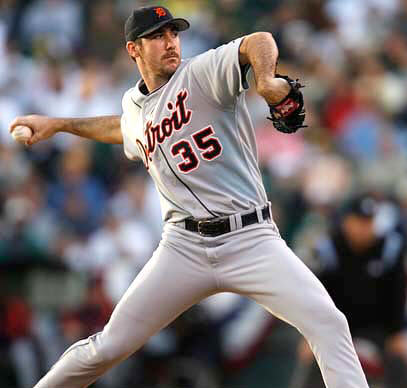
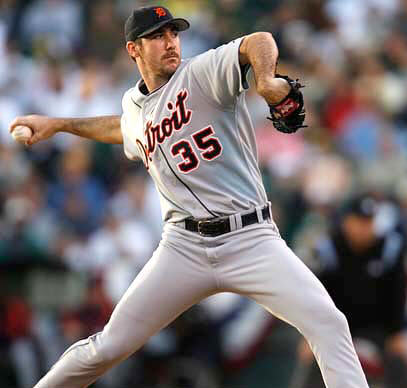
Justin Verlander is one of the most important home-grown players in the 2012 playoffs. Photo unk via rumorsandrants.com

Every year I do a bit of “Team Construction” analysis to kind of gauge the trends in roster construction.  Last year’s post is here, and the links to the side have the underlying spreadsheet of player acquisition methods so you can see the pure details.  This topic was also covered in-depth by John Sickels on his minorleaguebaseball.com blog for another viewpoint.

Borrowing from last year’s post, there are four main ways teams can acquire players:

  1. Draft: The player is with the original team that drafted him.  In the case of international free agents, if they’re signed as 16-year olds they are considered in this category as well (i.e., Ichiro Suzuki is not a developed player, but an international Free Agent).  It could be better defined as “Club developed players.”  Simple examples for the Nats: Stephen Strasburg and Bryce Harper.
  2. Traded MLBers: The player was acquired by the team by virtue of trading an established MLB player.  Most of the time these days, this means the player was acquired as a prospect (since most trades seem to be of the prospect-for-established player kind).  Example for the Nats would be Michael Morse, who was acquired by our trading an established MLB player in Ryan Langerhans for Morse while he was still (essentially) a minor leaguer.
  3. Traded Prospects: The player was acquired by the team by virtue of trading prospects.  This is essentially the reverse of #2.  The Nats key example is Gio Gonzalez.
  4. Free Agent: The player was acquired in free agency.  This category also includes two other types of acquisitions: waiver claims and cash purchases.  These three categories are lumped together since all three indicate that a team has acquired a player with zero outlay in terms of development or prospects.  Examples for the Nats: Edwin Jackson, Adam LaRoche.

Here is the summary of roster construction and “Construction Strategy Category” that we’ll talk about next.  Note that I only count the “core players” on a team for this analysis.  The core players is defined as the 5-man starting rotation, the setup and closer, the 8 out-field players, and the DH for AL teams.  I didn’t extend this all the way to the 25-man roster, figuring that these core 15 players are the main reasons teams win and advance.  That and huge chunks of the bullpen and the bench are either fill-in FAs or draftees and it would skew the analysis of how teams really got to the playoffs.  Here’s the summary (the table is sorted by count of Draftees):

Season Team Drafted/Developed Traded Prospects Traded MLBs FA/Waivers Ttl Constr Method
2012 Atlanta 11 1 3 0 15 #1
2012 St. Louis 9 0 2 4 15 #1/#4
2012 Washington 8 3 1 3 15 #2
2012 San Francisco 8 2 2 3 15 #2
2012 Cincinnati 8 2 3 2 15 #1
2012 New York Yankees 5 2 1 8 16 #4
2012 Detroit 5 5 2 4 16 #2/#4
2012 Texas 4 2 7 3 16 #3/#4
2012 Baltimore 3 1 8 4 16 #3
2012 Oakland 2 1 7 6 16 #3

So, what are the four construction methods I’ve identified? Again borrowing from last year’s version of this post, they are (with this year’s examples).  The complication this year is that some of the 10 playoff teams don’t fall neatly into one specific category.

Method #1: Build from within 100%: (Cincinnati, Atlanta).   Atlanta, amazingly, didn’t use a single Free Agent among its core 15 this year.  They made a couple of key trades to acquire a few starters, but the rest of their lineup is home-grown draftees.  That may change next year as they try to replace Chipper Jones, Michael Bourn and possibly Brian McCann, who may leave via free agency.  Meanwhile Cincinnati has just a couple of free agents and mostly rely on guys they’ve grown as well.

Method #2: Ride your developed Core and use your prospects to acquire big names: (Washington, San Francisco and Detroit to an extent): The Nats have transformed themselves over just a couple of seasons, relying less on FAs to plug holes caused by an awful farm system to having most of their core team developed at home (See the table further below to follow the transformation of our team over the past few seasons).  Those spots they couldn’t depend on have been filled by trades (three guys acquired by flipping prospects for them; in addition to Gonzalez Kurt Suzuki and Tyler Clippard also count here).  San Francisco has seen their payroll skyrocket as they extend their home-grown talent, but for the most part they have stayed true to the team development concept.  Their one major Free Agent (Barry Zito) is notoriously one of the worst contracts in baseball and it is somewhat surprising to even see him on the post-season roster.  He wouldn’t be if Tim Lincecum was pitching in 2012 like he has regularly done in previous seasons.  Detroit was entirely in method #2 until they decided to spend money like the Yankees; we’ll revisit in #4.

Method #3: Go Young and grow up Strong (Baltimore, Oakland and Texas to an extent): Baltimore acquired a massive chunk of their rosters by flipping major leaguers for prospects and watching them blossom into a surprise playoff team.  Oakland has made a habit of getting rid of guys before they hit arbitration; fully 7 of their squad was acquired this way.  The difference is that Oakland has been forced to buy a big chunk of their core group on the FA market, depending on cast-offs like Brandon Inge and Jonny Gomes to plug leaks and get production on the cheap.  I’m guessing that Oakland will transform more into Category #1 as the vast amount of prospects they’ve landed lately continue to matriculate.  Lastly Texas was entirely in this category before they dropped major money on the likes of Adrian Beltre and Yu Darvish, transforming them into a spending power to go with their still-excellent farm system.

Method #4: Spend what it takes to win: (New York fully with St Louis, Texas and Detroit partially here): The Yankees are the class-A example of this method (along with Boston and the Dodgers frankly), but the spending that St. Louis, Texas and Detroit cannot be overlooked.  The Yankees more and more are depending on expensive FA purchases to replace what their farm system is not developing, and the problem is only being brought into more focus this off-season.  Their 3 primary starters are FA acquisitions, their biggest FA is looking like a contract catastrophe, and their developed guys are not stepping up and taking over major roles (especially on the pitching staff).  The other three teams mentioned here are mostly built on home-grown talent, but have spent so much money on the FA market lately that they are broaching into the upper echelons of MLB payroll.  St. Louis is almost entirely built from within (as noted by other columnists doing this same type of analysis) but still has depended on a couple of key FAs to advance as far as they have.

Conclusions:

  • There’s no real formula to building a playoff team, as we see from the spread of the 10 teams among the four methods defined.
  • I think its safe to say that the most difficult methods to depend on are #1 and #3.  You need to have a very good farm system to depend on the #1 method to work for you, and over the past few years only a couple of teams really have had success using this method (Atlanta and Tampa Bay).  Kansas City has tried #1 for years and has gone nowhere.  The #3 method is also frought with issues, since it requires a ton of patience from your fan base and may not be sustainable.  Would anyone be surprised if both Oakland and Baltimore collapsed next season?  Probably not; you really need to build on a base of players once you’ve established yourself as a good team and continue to augment, either through trade or through FAs.  But even that can be dangerous; just ask Philadelphia this year, owners of the 2nd biggest payroll in baseball and just a 3rd place team.
  • Is Category #1 and #3 the same?  No, not really. #1 teams rely much more heavily on personally developed prospects, while #3 teams purposely set out to acquire prospects in trade to combine with their own development mis-fortunes.  If Baltimore had a better farm system, they wouldn’t have needed to jettison so many established MLBers to acquire prospects, and they’d probably be closer to a #2 team (a wealthy team who supplements developed players with key FAs, much like what Washington is doing).
  • Oakland is really a unique case; they do develop players but get rid of them because of a self-imposed incredibly restrictive salary cap.  Imagine what Billy Beane could do with that team if he could have purchased just $30M of players on the open market (which would have still left Oakland in the bottom third of payroll).
  • Buying your way to a team (method #4) can work, but only if you have nearly unlimited money and everything goes right for you.  There’s almost no excuse for a $175M payroll to get beat to the playoffs by a $55M payroll team (Oakland).  That is unless you overpay for poor FA targets, install the wrong manager and saddle yourself with the worst clubhouse in baseball.  In case you were wondering, the 2012 Boston Red Sox were a classic case of why money cannot buy happiness, and why unlimited funds do not necessarily guarantee playoff baseball.  The Angels are another example; owing most of their season’s turnaround and success to Mike Trout and his MLB minimum salary providing nearly 10 WAR despite having the 3rd largest payroll in baseball and having just purchased the games pre-emminent hitter in Albert Pujols.
  • Frequent commenter Clark has a good point; classifying Mark Teixeira and Raul Ibanez as the same type of player (acquired via free agency) is a bit mis-leading.  Clearly a $150M player isn’t the same as a $1M player.  But, for the purposes of analyzing how much of your team is “bought” versus “developed” the point remains the same whether its a bargain basement guy or a $20M/year player.

So, if I had just purchased a new team, what construction method would I follow?  I guess it depends; if I thought I had a patient fan base, I’d probably do exactly what is going on in Houston.  I’d gut the MLB roster, trade every tradeable asset and start over payroll-wise.  I’d follow strategy #1 until I was at least competitive, and then i’d probably switch over to a #2 strategy or a #3 strategy, depending on just how good my developed players were.  You hope for #3; it implies you’ve got so much in-house talent that all you need to do is keep extending your key guys and you’ll keep winning.

I don’t think #4 is a sustainable way of building rosters.  The Yankees have gotten away with it for years, but only because they initially had a banner crop of developed players (the “core four”) to depend on up their spine.  Would anyone be surprised if the Yankees fail to make the playoffs next year?  Alex Rodriguez looks incredibly old, Derek Jeter just broke his ankle, they’re losing a number of hitters to FA and they only have a couple of starters locked up.  Where’s their starting pitching for 2013?  And what happens if they finally get hit with injuries to their rotation to the extent that Boston did this year?  I think this is why you see $80M payroll teams beating out $170M payroll teams all the time; teams get bloated, they over pay their own players and suddenly are old, inflexible and unable to adjust financially to buy what they need.

Lastly, here’s what the Nats roster has done over the past few seasons:

Season Team Drafted/Developed Traded Prospects Traded MLBs FA/Waivers Ttl Constr Method
2010 Washington (end of 2010) 7 1 2 5 15 #2
2011 Wash (2011 opening day) 6 2 1 6 15 #2
2011 Wash (primary Roster for season) 6 2 2 5 15 #2
2011 Wash (end of season) 9 1 2 3 15 #2
2012 Washington (playoff roster) 8 3 1 3 15 #2

The team has been slowly replacing Free Agents with home-grown or acquired talent, and as we all know is well on its way towards a strong, home grown team.  This year’s core team only uses 3 pure FAs: Adam LaRoche, Jayson Werth and Edwin Jackson.  We could very well see LaRoche replaced outright with the home grown Tyler Moore, and if the team replaced Jackson with someone like John Lannan (not that we’ll possibly see that happen), we could be down to just one FA in the core squad.

Game 5 Recap: Leaky bullpen and a Gutwrenching Ninth

13 comments

Not the best outing for Storen. Photo Andrew Harnik/washingtontimes.com

What a gut-wrenching game.

It started out as great as you could hope; scoring 3 runs in the first inning and igniting the largest crowd in Nats history.  The offense finally strung together a series of big hits from the top of our order against the same pitcher (Adam Wainwright) who shut us down so easily in the first game of the series.  The Nats offense woke up again in the 3rd and bounced Wainwright (the same guy that pundits expected to completely shut the team down again).  You can’t blow a 6-0 lead, can you?  Here’s a stat; on the Season the Nats were exactly 45-6 when scoring 6 or more runs.  But they’ve also coughed up larger leads; they blew a 9 run lead in Atlanta in July in a game that looked eerily similar to last night’s game; get a big lead, your starter gives up a few innocuous runs, then the bullpen slowly leaks runs until its all over.

Gio Gonzalez wasn’t really that effective, all told.  His final line: 5ip, 5 hits, 4 walks and 3 runs (all earned).  In the first inning he honestly looked startled on the mound, scared to be there.  He scuffled through the first inning looking tentative and got bailed out by some slightly over-aggressive hitting from the top of St. Louis’ order.  He did pitch with better confidence the next couple of innings (who wouldn’t with a 3-0 first inning and 6-0 third inning lead?).   He was definitely commanding his curve ball far better than in game 1 and was keeping St. Louis at bay.  However a lead-off walk burned him in the 4th for the first run, and then a complete meltdown in the 5th from Gio turned into two more runs.   His 5th inning line is as ugly as it gets for a starter; Double-Single-Walk-run scoring wild pitch-walk-walk to force in a run before finally getting the 3rd out.

Here’s where the bullpen just failed to get the job done.  Edwin Jackson walks the lead-off guy and he scores, making it 6-4.  The Jordan Zimmermann experiment from game 4 couldn’t be replicated, costing the team a run.  I can’t second-guess the move though; it had worked so well the night before.  Tyler Clippard gives up a home-run to Daniel Descalso to make it 6-5.  And of course we know what happened to Drew Storen, who picked a really bad time to match his career worst outing, giving up 4 runs on 3 hits and 2 walks in the 9th.  And the big hits didn’t come from the middle of St. Louis’ order; it was Descalco and Pete Kozma of all people getting the clutch hits.

My dad pointed out an interesting question; Storen was sharp last night but not tonight; could it be because he threw three straight games?  Storen had appeared in 3 straight games twice before this season but didn’t pitch full innings each time.  In this series he threw an inning each in games 1, 3,4 and 5.  His pitch count by game?  10,11, 26, and last night’s 33 pitch debacle.  Dad’s specific complaint was about the use of Storen in the blow-out game 3.  Why waste an inning there when you pretty much well know you’re going to need your 8th and 9th inning stars both subsequent nights?   Is it possible that Storen was just a bit gassed from the cumulative effects of a 26 pitch outing the previous night AND having pitched three consecutive days?

Another pet peeve of mine; how do you let Descalso steal second base un-challenged in the 9th?  Yes there’s two outs, but that put him in scoring position to tack on an extra run on the subsequent single.  If you hold that guy on, maybe you throw him out and get the 3rd out right there before the Cards get the lead.  He certainly doesn’t score on a single to RF.  This isn’t a problem just with Storen; the Nats pitching staff is notoriously bad at holding runners.  In the end, that extra run didn’t really matter … but it could have mattered if Suzuki threw the guy out before the go-ahead single, right?

There’s not much else to say in the way of analysis; the Nats should have been able to hold onto a 6 run lead, and Storen just had a bad night.  The fact that it came in such an important game is a shame.  If we want to look at a critical issue with the pitching staff on the night, it is probably this; the Nats pitchers put the Cards lead-off guy on in SIX of the nine innings, and that runner scored 5 of those times.  They got the lead-off hitter on base every inning after the 3rd.  That’s just a failure to execute by your pitching staff.  Of course it’s also a testament to the hitting ability of this St. Louis team up and down the lineup.

There goes the season; I had tickets for Game 1 of the NLCS.  I guess we have to wait til next year.

Game 3 Recap: Jackson makes one mistake, offense misses in the clutch

5 comments

Jackson gets hit for 4 runs in 5 innings. Photo AP via wjla.com

The title says it all.  Edwin Jackson missed his target in the 2nd inning, it turned into a 3-run homer (from a #8 hitter no-less) and that was more than enough offense than the Cards needed en route to peppering the Nats pitching staff for 8 runs and 14 hits in a game 3 romp 8-0.  One mistake is all it took, but you can’t make a mistake middle-in with two guys on base to a professional hitter.  There was no need to watch the game after the 5th inning; it was clear this team wasn’t going to get to Chris Carpenter nor whoever else the Cardinals brought in after he hit his pitch limit.

Where is the Nats offense?  More to the point, where is all our clutch hitting?   We had the lead-off hitter on three times; a runner on first with none out has an Run Expectancy of about .84; meaning we’d expect that runner to score 84% of the time.  Instead we got 0 runs out of any of those situations.  The team has to get something out of that bases-loaded first inning, has to get something out of the third inning rally.  We went 0-8 with runners in scoring position, leaving 11 guys on base.  Where is Adam LaRoche this series?  Or Michael Morse?  We need these middle-of-the-order guys to produce if we’re going to win games.  The St. Louis #8 hitter was clutch yesterday; our guys havn’t been clutch (arguably) in 3 weeks.

It doesn’t matter if we still had Stephen Strasburg in the rotation if you don’t score runs.  We’ve scored 7 runs in 3 games, four of which were essentially meaningless as we were getting killed in game 2.  Meanwhile the Cards now stand at 22 runs and counting, an eerie repeat of the late September blasting we took in the 3-game series in St. Louis.

Ross Detwiler gets a shot in a do-or-die game tomorrow.  Lets hope he finally gets some run support.

Written by Todd Boss

October 11th, 2012 at 9:20 am

First “Wish we had Strasburg” story from National Media

6 comments

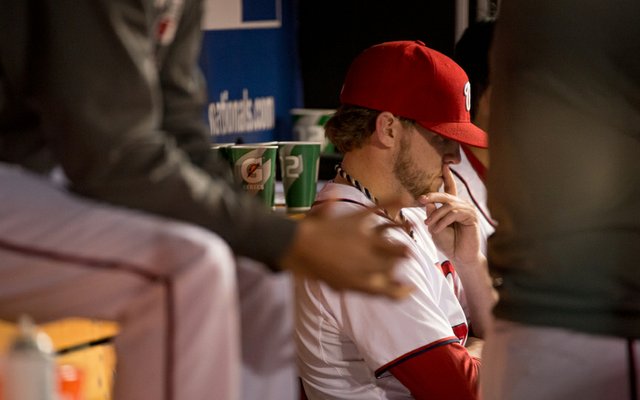
Strasburg sitting in the dugout during the NLDS, where he'll be for the rest of the playoffs. Photo Masn screen shot via nats enquirer blog

Rant on.  I couldn’t help myself today…

It was great to see that they couldn’t even wait until GAME THREE of the divisional series to post the first “Gee wish we had Stephen Strasburg” story.  Here’s the link, courtesy of Ken Rosenthal.  I’ll bet he had this article in the can weeks ago just waiting for a slow news day to post it.

Rosenthal quotes an anonymous player who doesn’t agree with the shutdown Situation, who said that “the team would be up 2-0″ if they had Strasburg.”   Such a gutless reporting technique; notice there was nothing other than a passing mention that there are clubhouse guys who agree with the shutdown.  Just cherry-picking opinions (of which there are dozens in a clubhouse) until he found one that enabled him to write the story he wanted to write.

He talks about how the Braves “handled” Kris Medlen so that he was still pitching in the post-season.  There’s no way Medlen-to-Strasburg comparisons are correct.  Medlen was absolutely not in the starting rotation discussion in Atlanta, and if he was he was 8th or 9th in line.  And there’s no way that Medlen was anything other than found gold to the Braves in terms of how good a starter he would turn out to be.  And there’s nobody who can tell me any differently.  Lastly, do you think perhaps the Braves would rather have used Medlen from the start of the season, had they known how dominant he’d be??  Do you think they would have finished in 2nd place in this division had they had Medlen all season?  Because last time I checked, the Braves lost their one-and-done WITH MEDLEN ANYWAY and are playing golf while the Nats are sitting pretty in the divisional series.

Nobody ever mentions this, but Strasburg was mediocre down the stretch.  He had a 4.14 ERA in his last 10 starts, a 4.50 ERA in his last handful of games, alternating between excellent and awful.   You could argue “arbitrary endpoints” but to me it sounds like a guy running out of gas, no?  Who is to say that the team wouldn’t have recognized that he was running on fumes anyway, and shut him down at the time they did regardless of an innings limit?  Why does nobody talk about this fact?  That’s because the National media narrative w/r/t Strasburg is LAZY.  Regurgitate the same stories, talk about the same platitudes of there being “no proof that shutting him down isn’t the best thing to do.”

Here’s my analogy; if  you had heart surgery and your cardiologist only told you to pitch 160 innings the next year, you’d do it and not complain about it right?  Well Strasburg’s ARM SURGEON advised the team on this limit after having ARM SURGERY, and the team followed it.  I don’t think we’d be hearing all these back seat pundits talking about how the Nats are idiots for resting a guy if it was his heart that was cut and not his elbow.  To say nothing of the fact that he’s young (24), under team control for at least four more years , and the team isn’t exactly looking like a one-year wonder right now, fielding the 3rd youngest pitching squad and the youngest hitting squad in the major leagues.   Every core player and pitcher is locked up or under team control for at least three-four years.  There’s NO reason to think that this team won’t be contending for years to come, irrespective of what any other team in the division does.

The Nats got a split in St. Louis.  That’s the best they could hope for against a dangerous opponent.  Wainwright isn’t going to strike out 2 batters an inning every time he goes out.  The Nats BLASTED Lohse this season.  Carpenter has what, three starts this year?  And the last time Jackson pitched against St. Louis at home, he went 8 shutout innings.  There’s more to this series than just Strasburg and St. Louis; the National media should try covering the Nationals for a change.

*sigh*.  So sick of hearing about Strasburg.  Can’t we talk about the Nats?!  They did have the best record in baseball after all.

/Rant off.  Stepping down from sandbox.

Written by Todd Boss

October 10th, 2012 at 10:49 am

Divisional Series Matchups – By the Starters

4 comments

Verlander has already given the Tigers a huge leg up in their divisional series. Photo unknown via rumorsanddrants.com

As we have already seen in the playoffs thus far, predicting these coin-flip games, or predicting the outcome of individual games, is usually fool’s gold.  The first four games of the playoffs featured four Road-team wins.  You can argue that the higher-seeded teams in the divisional series are “better” than the home teams and this was to be expected … except that we’re talking about divisional winners/90+ win teams all around.  So far, the results have been surprising.

What’s also been tough this year is the lack of “announced” starters.  The Tigers seem to know exactly who they’re throwing for all 5 games of the series … but nobody else does.  Baltimore’s only announced starter (Jason Hammel) hasn’t pitched since September 11th and they have a handful of guys to pick from.  In last year’s version of this post I was able to do match-up analysis.  This year i’ll just look at the breadth of the starters to see who has an upper hand.


Washington-St. Louis:

  • Washington’s likely starters: Gonzalez, Zimmermann, Jackson, Detwiler
  • St. Louis’ likely starters: Wainwright, Garcia, Carpenter, Lohse

I’ve already talked at depth about this series in my previous post.  Just looking at starters, its hard not to see the Nats as the favorite.  Our Ace Gonzalez goes twice in the series, St. Louis doesn’t hit righties as well.  Carpenter could be a difference maker.


Detroit-Oakland:

  • Oakland’s likely starters: Parker, Milone, Anderson, Blackley
  • Detroit’s likely starters: Verlander, Fister, Sanchez and Scherzer

Justin Verlander is as close to unbeatable as there is, again evidenced by his game 1 dominance. (7ip, 3 hits one solo home run).  If he’s set to go in game 4, Oakland basically has to win out.  The rest of Detroit’s planned starters all sport sub 4.00 ERAs and all of them have at least a 113 ERA+.  In fact, how exactly is this only an 88 win team?  They have three unbelievable hitters in the middle of their order and plus starting pitching.  Max Scherzer and his dominating fastball apparently has recovered enough from a post-game celebration injury and should take the ball in Game 4.  Anibel Sanchez has been pretty effective since arriving from Miami in a mid-season trade (is Sanchez an off-season FA target of the Nats for their 5th starter?) and should give the Tigers a great chance to win his game 3 start.

Meanwhile, Oakland has a slew of rookie starters to choose from, all of whom sport sub 4.00 ERAs (the worst season ERA on the staff is Travis Blackley, who may or may not feature in the post-season).  Jarrod Parker threw game one and was effective, just not effective enough.  I was surprised to see Tommy Milone slated as the game 2 starter (perhaps chosen by virtue of his home/away splits; 2.74 ERA at home, 4.83 ERA away).  After that I honestly have no idea who we’ll see.  Oakland named 5 starters to its post-season roster, but AJ Griffen was pasted in his last outing and may be a long-man/emergency starter.  Brett Anderson is clearly the staff Ace at this point but only returned in late August.  Oakland’s been on such a tear though, its hard to bet against them.

Prediction: Verlander already gave Detroit the huge advantage with a game 1 victory.  Oakland needs more magic to advance.


New York-Baltimore:

  • Baltimore’s likely starters: Hammel, Tillman, Chen, Saunders
  • New York’s likely starters: Sabathia, Pettitte, Kuroda, Phelps?

Baltimore’s only announced starter as of today is Jason Hammel, who (as noted above) hasn’t thrown in 3 weeks.  After that?  The Orioles used 12 different starters on the season and at one point demoted 3/5ths of their rotation in a week.  They seem set to roll out the above named guys after Hammel, but this leaves out both Miguel Gonzalez and Steve Johnson, who were effective down the stretch.  I can’t find a link for Baltimore’s named divisional roster as of the time of this writing; which would have helped.

Meanwhile, looking at New York’s options past the above named three guys, I would initially guess that New York is going to a 3-man rotation for the playoffs.  What would you rather do?  See three effective veterans going on 3 days rest, or to give post-season starts to the likes of Phil Hughes or Ivan NovaFreddie Garcia lost his starting spot in September when Pettitte returned but isn’t an option because of how ineffective he’s been all season.  Would you give a game-4 start to rookie David Phelps?  It seems amazing to me that the highest payroll team in the league can’t find an effective 4th and 5th starter (getting Pettitte out of retirement?  Giving Garcia 17 starts after signing him off the trash heap?) and I think it continues to be their downfall (only one World Series appearance in 8 years).

New York swept the Orioles in the first series of the season, split a 2-game set in mid-season, but lost EVERY other series exactly 2 games to 1 on the season.  Is there any reason not to think they’ll do something similar in this series?  I see a split in Baltimore and then New York struggling to win 2 of 3 in New York.  Does Sabathia struggle going on 3 days rest?  More importantly, does Pettitte??  He should be on a golf course right now, not pitching in October.  It should be interesting to see if New York uses a 4th starter.


San Francisco-Cincinnati:

  • San Francisco’s likely starters: Cain, Bumgarner, Vogelsong, Lincecum
  • New York’s likely starters: Cueto, Arroyo, Latos, Bailey

We’ve already seen some interesting mishaps with Cincinnati’s best laid plans; Cueto out with bask spasms after just 2 batters, planned game 3 starter Latos forced into action.  Now it looks like Cueto will go game 3, with Bailey either pushed to game 4 or skipped outright since Latos only threw 4 innings in game 1.  Or perhaps Bailey goes game 4 with Latos pushed to a possible game 5.  Either way, the wild-cards here are Cueto’s health and Arroyo’s effectiveness.  If Cueto returns for a game 3 start, with Cincinnati haven already “stolen” a game against SF’s ace, the Giants are in trouble.

Meanwhile, has San Francisco made a decision on its starters?  They’ve named all 5 (the above four plus Barry Zito) to the post-season roster with an unnamed player dropping to the bullpen.  I think they’ll go with supposed ace Tim Lincecum as the 4th starter despite Zito’s numbers being superior. Meanwhile, Ryan Vogelsong has been vulnerable down the stretch despite good numbers on the season.

I think the back-end of the Giant’s rotation is a huge question mark, and if the Reds have already stolen a game against Cain, this series may be short.

Washington vs St. Louis – A tale of two Series

2 comments

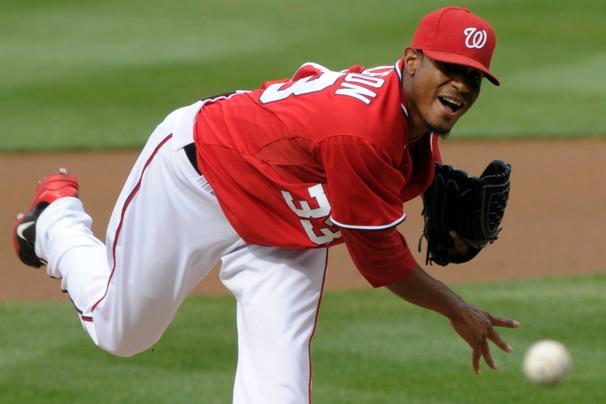
We need Edwin Jackson to perform against his former team. Photo Nats team official via espn.com

Ok, I’ll admit to being (as one commenter said recently) the “Eeyore” of Nationals fans.  I was scared of Atlanta and thought we would struggle to beat them in a short series starting on their turf.  I posted my baseball predictions and the two teams I thought would make the series both lost under sometimes interesting circumstances.  The unbeatable ace Kris Medlen got beat, losing a start for the Braves for the first time in 24 times (not that he really pitched badly; I’ll take a 6+ inning, 3 hit, 0 walk performance every day of the week.  Think about how difficult it is to give up 5 runs on 3 hits…).  So perhaps I’ll understand if you don’t really want to trust my opinion on predicting the divisional series.

Anyway.  So the Nats are traveling to St. Louis to start the NLDS.  If you’re looking for a guess as to who has the advantage by looking at the two meetings between the teams this year, you may find definitive proof wanting.

  • The Nats took 3 of 4 at the end of August from St. Louis, bombing them for 31 runs in four games and really roughing up three of St. Louis’ best starters (in order Jaime Garcia, Adam Wainwright and Kyle Lohse, tagging each for 5-6 runs).  Only Jake Westbrook kept the Nats offense at bay, and as far as I can tell he’s not going to be on the playoff roster.  The one loss in this series was in one of the more amazing games the Nats played this year; they blew a 4 run first inning lead, fell behind 8-6 on Jordan Zimmermann‘s worst outing of the year, rallied to take the lead only to have the bullpen blow the game.
  • The Nats then traveled to St. Louis the last week of the season and were pretty much bombed themselves, with St. Louis scoring 26 runs in three games while taking 2 of 3 with our guys Edwin Jackson and Ross Detwiler having nights they’d rather forget.

So, which series is more educational to help predict what may happen now?  As commenters have pointed out, momentum means nothing and a shutout yesterday indicates nothing for today.  Fair enough.  We have learned that both offense are capable of really putting runs on the board, fast.  But that wasn’t exactly news either; the teams were 2nd (Cardinals) and 5th (Nationals) in runs scored in the NL this year.

What is fair to say is that the Nats probably have a more dangerous opponent in St. Louis; they’re a better offense, though they clearly hit right-handed hitters better than lefties (a 113 wRC+ versus right handed hurlers versus 104 versus lefties).  And they’re getting back a grizzled post-season veteran in Chris Carpenter just in time for the playoffs.  Carpenter is probably on most people’s short list for “guys i’d trust to start Game 7” in this league, and now the Nats seem set to face him in Game 3.

Lets look at the pitching matchups (some of this is a guess; official starters havn’t been named all the way through the 5-game series but the below should be what we see);

Series GM# Date/time (EST) Home-Visitor Home Starter Visiting Starter Advantage
NLDS 1-4 1 10/7/12 3pm Stl-WAS Wainwright Gonzalez Wsh
NLDS 1-4 2 10/8/12 4:30pm Stl-WAS Garcia Zimmermann Wsh
NLDS 1-4 3 10/10/12 ?time WAS-Stl Jackson Carpenter Stl
NLDS 1-4 4 10/11/12 ?time WAS-Stl Detwiler Lohse Tossup
NLDS 1-4 5 10/12/12 ?time WAS-Stl Gonzalez Wainwright Wsh

The good news: Washington has shown it can blast St. Louis starters.  As mentioned above, the team put up very big numbers on 3 of the 4 starters they anticipate seeing in this series.  Meanwhile, St. Louis gets to see our Ace Gio Gonzalez twice; the last time they saw him Gio pitched a 5-hit shutout.  They also see Detwiler in game 4, meaning three of their five potential series games are against Lefties (whom they are weaker against).  Zimmermann’s home-away splits favor him on the road, and I think Jackson will be looking for revenge for his poor outing against them the last time out.

I’ll admit; I was scared of Atlanta.  And I’m wary of St. Louis, especially after the late season spanking.  But, they didn’t see Gonzalez in that series and now are set to see him twice.  The Nats offense isn’t going to be afraid of any St. Louis starter (perhaps outside of Carpenter, who a lot of them havn’t seen in a while), and should put runs on the board.

Prediction?  I think the Nats have the pitching matchup advantage in 3 of the 5 games and may only be a pitching “underdog” in the Jackson-Carpenter start.  The goal is to get a split in St Louis and Gonzalez-Zimmermann gives them a great shot in both games.  I like our chances.

Can we find a 5th starter for 2013 internally?

32 comments

Could Garcia's great stuff translate into a starting role in 2013? Photo unknown via federalbaseball.com

I’ve been thinking about the rotation  for 2013, reading some early 2013 Free Agent rankings, and steeling myself for the reality that this team is more than likely to lose Edwin Jackson to free agency.  Two primary reasons we probably lose Jackson:

1. He’s one of the best available starters in this coming off season’s FA market

2. He’s likely to command a multi year deal at more money than this team is probably willing to offer.

Considering our “core 5 starters,” Jackson ranks 5th out of 5 in terms of ERA and ERA+, and he’s 4th of 5 in terms of Whip and FIP, and 3rd of our 5 (barely) via xFIP and SIERA.  He’s been clearly out pitched this year by our 5th starter Detwiler and isn’t ahead of the big three in anyone’s eyes.  So the question is; will the Nats make its 5th starter its highest paid pitcher?

I just don’t think so.

So we’re likely looking for a 5th starter for 2013.  The FA market is pretty bareZack Greinke is going to command a massive deal for a guy who, honestly, has had one stellar season in 2009 and since has been no better than a 3rd starter.  I think the Nats should stay away from him.  The Nats should also stay away from promising starters in 2012 but who have injury or inconsistency issues (Dan Haren and Jake Peavy, both of whom likely have their 2013 options declined).  Who else is out there that fits the Mike Rizzo mold (hard thrower, high K/9 rates)?  Shawn Marcum?  Brandon McCarthy?  Also injury concerns.  How about Anibel Sanchez, Jonathan Sanchez and Ervin Santana?  All three guys have good seasons in their immediate past but blew up (or were at best inconsistent) in 2012.

Maybe the above paragraph is even more support for re-signing Jackson frankly; he’s got no injury issues, apparently is a good clubhouse guy and meets Rizzo‘s starter criteria for veteran, hard-throwing innings eater.  So maybe this whole article is going to be moot.

Here’s a different take (and the point of this article); some news items came out this week that caught my eye; perhaps the Nats can find a 2013 5th starter internally instead?  Christian Garcia has really impressed in 2012, from his stellar minor league numbers to his good performances out of the bullpen in September.  And now word has it that the team is considering looking at him as a starter.

I love Garcia’s stuff; he’s a 3 plus pitch guy with a ton of movement on his decent fastball.  Here’s some Pitch F/X data for him this year; 95mph average (peaking at 97.8mph), 10mph delta between his fastball and change, and a ridiculous amount of movement on his 12-6 curveball.  He’s getting nearly a 20% swing-and-miss rate across all his pitches.  Fangraphs.com even did a post specifically on Garcia based on his September performance, featuring an animated .gif of  his “stupid good” curve.

That features as a pretty good starter line to me.  Perhaps he needs a 4th pitch (his over-the-top delivery could lend itself to a sinking 2-seam fastball, a cutter or even a split-fingered pitch that he could add to his arsenal) to be truly effective as a starter.

Meanwhile, the team has already started the Ryan Perry conversion to starter experiment, and his AA starting numbers in 2012 were pretty good.  Pulling this text from my AA-in-review post:

Ryan Perry, astutely acquired for Collin Balester (who failed to impress in Detroit and was DFA’d earlier this year) in spring training and he competed for the MLB bullpen.  He featured briefly, was ineffective and was optioned to AAA.  The team took a look at his repertoire and decided to try to convert him to a starter in AA.  The results?  Pretty good; a 2.84 ERA and 1.11 whip in 13 AA starts.  Outlook for next season: here’s the problem with Perry; he’s out of options for 2013.  He was added to a 40-man roster in April 2009, and burned options in 2009, 2011 and this year.   So he has to either make the MLB club or be DFA’d at the end of spring training.  So look for Perry to compete for the #5 starter job or be considered trade bait in the off-season.

Can Perry continue his starter performance in spring training in 2013?  Could Garcia win the job?  Will the Nats pursue a starter on the FA market?  Or, as they did in the 2012 off-season will they shock us with a trade that comes out of nowhere?

Nats Playoff Rotation & Bullpen Decisions

4 comments

20-game Winner Gonzalez is our likely #1 starter in the playoffs. Photo Joy Absalon/US Presswire via usatoday.com

The Nats rotation has been incredibly stable this year; only a mid-season experiment with Chien-Ming Wang interrupted a near season-long quintet of starters unmarred by injury or poor performance.  The shutdown and playoff unavailability of Stephen Strasburg is well, well documented, so we won’t talk about him here.  But two important decisions await Davey Johnson in terms of his playoff roster construction: playoff rotation and bullpen construction.  Lets take these questions one-by-one:

1. What is your playoff rotation?  Here’s the evolution of our rotation this year:

  • The year started off with your starters in this order: Strasburg, Gonzalez, Zimmermann, Jackson and then Detwiler. The starters went R-L-R-R-L.
  • After the All Star Break, Johnson shuffled the starters and re-ordered them to go Zimmermann, Gonzalez, Strasburg, Jackson, Detwiler (still R-L-R-R-L), ostensibly to give Strasburg a bit more rest and extend his season a few days.
  • On August 3rd (around a double-header) Zimmermann and Gonzalez switched places.  Now you’ve got Gonzalez, Zimmermann, Strasburg, Jackson and Detwiler (L-R-R-R-L).  All three RHSPs are in order, as are the two LHSPs.
  • On August 15th around an off day, Detwiler and Jackson switched places, probably to keep Detwiler on regular rest and probably to fix the aforementioned issue of 3 RHSPs in a row (starters now Gonzalez, Zimmermann, Strasburg, Detwiler, Jackson for L-R-R-L-R).
  • On September 12th, John Lannan replaces the shut-down Strasburg in the rotation.  Now we’re Gonzalez, Zimmermann, Lannan, Detwiler and Jackson for L-R-L-L-R.

If we play out the rotation the rest of the season, barring any more rain-outs or injuries, the starters will be (Starting 9/21):

9/21: Jackson
9/22: Gonzalez
9/23: spot starter Wang, to give the rotation its regular rest.
9/24: Zimmermann
9/25: Lannan
9/26: Detwiler
9/27: Jackson
9/28: Gonzalez
9/29: Zimmermann
9/30: Lannan
10/1: Detwiler
10/2: Jackson
10/3: Gonzalez

At this point I’m going to assume that the Nats will win the division and go straight to the divisional series, which (per MLB’s playoff schedule) starts either Saturday 10/6 or Sunday 10/7.  Which day the Nats start will be critical; if the Nats are the #1 seed they’ll start Sunday; if they’re the #2 seed they’ll start Saturday.

But in either case I think we’re going to see some manipulation of the above schedule, because I think the team wants Gonzalez to start the opener.   And he cannot start an opener on 10/6 or 10/3 if he throws 10/3.   We may see him skipped on 9/28 and then throwing a start 10/1 (which I’d be happy for; that’s the last game I have tix for this year), which would put him on regular rest for either a 10/6 or 10/7 start.

After that though, there’s some decisions to be made.  The NLDS ridiculously gives the lower-seed the first two home games, so I think Johnson may want to have some options available to him for his 2nd, 3rd, and 4th starter (I think its a pretty basic assumption that Lannan is being left completely off the playoff roster; more on this later down when talking about the bullpen options).  Here’s the home/away splits of our 4 likely playoff starters (numbers as of 9/21/12).

Interesting; Zimmermann is far more effective away, Detwiler is far more effective at home, and Jackson is just about the same either way.  This seems to imply that Zimmermann is your best bet to take the 2nd start, away from home, then line up Detwiler-Jackson-Gonzalez (or some combination thereof) at home.

Here’s another take; Johnson likes to play match-ups with certain teams.  Will the Nats opponent factor into the equation?  Assuming the Nats are the #1 seed, your likely wild-card winners right now are Atlanta and St. Louis (its hard to see a scenario where St. Louis loses its current 3 game WC lead in the next 12 days, but it could happen, but for the purposes of this article we’ll assume these two teams hold on).  How do these teams fare against lefty versus righty starters?

  • Atlanta is hitting .247 as a team versus Lefties with an 86 wRC+.  That’s bad.
  • Atlanta is hitting .251 as a team versus Righties with a 97 wRC+.  That’s certainly better than they do versus lefties.
  • St. Louis is hitting .275 as a team versus Lefties with an 113 wRC+.  That’s basically 2nd in the majors behind the uber-hitting Rangers.
  • St. Louis is hitting .270 as a team versus Righties with a 104 wRC+.  That’s roughly a 10% difference in Run Creation.

So, it seems like if we play Atlanta, we want to load up on Lefties while if we play St. Louis we want to load up on Righties.  This would seem to indicate that, if Atlanta is our opponent we’ll want to go Gonzalez-Zimmermann-Detwiler-Jackson-Gonzalez again, meaning Atlanta has to face 2 lefties in the first 3 games plus 3 out of 5.  If we play St. Louis, you’d think that we’ll want to switch up Detwiler and Jackson so that St. Louis gets L-R-R-L-L.  The idea being that once we get home, even though we’re lefty-heavy we’ll have the advantage.

However, with the #1, #2 and #3 seeds far from settled with a week and a half to go, lets also look at the same logic for both Cincinnati and San Francisco, since its conceivable at this point we could be playing either of these teams (use the same links in the Atlanta links above to see these statistics):

  • Cincinnati is hitting .268 as a team versus Lefties with an 107 wRC+.   Both Tied for 6th in the majors.
  • Cincinnati is hitting .248 as a team versus Righties with a 89 wRC+.
  • San Francisco is hitting .268 as a team versus Lefties with an 96 wRC+.
  • San Francisco is hitting .270 as a team versus Righties with a 98 wRC+.

Conclusions?  Cincinnati matches up very well against lefties and struggles against righties, while San Francisco is a pretty well balanced team with no real weakness against either side.

One last factor is post-season experience, of which this group has very little.  Jackson is the sole guy with any post season experience, it being last year with potential opponent St. Louis.  I cannot see Johnson bumping any of the guys who are pitching better than him though, at least in a short series, based on this veteran experience (we’ll revisit this though in a 7-game series, where the identity of the 4th starter is incredibly important, as he only goes once in that series).

In any scenario, I think your first two starters away are going to be Gonzalez and Zimmermann.  After that will depend on the opponent.

2. What is your playoff bullpen?  By virtue of the fact that we don’t need a 5th starter, the team can carry an extra player.  Here’s the bullpen as it sits now, divided into “regulars” and 9/1 call-ups:

  • Regulars: Burnett, Clippard, MGonzalez, Gorzelanny, Mattheus, Stammen, Storen
  • Sept 1 callups: Duke, Garcia, Wang (and technically Lannan).

I think this decision is pretty simple; you keep the 7 “regulars” and add in power arm Christian Garcia, who has been lights out since arriving, as an extra middle-relief guy.  There’s no reason to have minor league starters Duke, Wang or Lannan on the post-season roster; the only function they’d have is as long-men, but the regulars include two such arms already in Stammen and Gorzelanny.

The possibility exists that Johnson will opt for an extra bench guy instead of an 8th bullpen arm, but I doubt he’d choose that route.  Your “extra” bench guys right now are Leon (3rd catcher), Brown and Perez (ofs), and one of either DeRosa or Tracy (technically it was DeRosa who got added off the DL after roster expansion; he likely would have been delayed in the minors had this happened earlier in the season).  I can’t see any reason to keep any of these guys on a post-season roster at the expense of an 8th reliever.  Tracy gets a few ABs a week and can only play 1B, while DeRosa can provide cover at multiple positions and seems to have more value.  I could be wrong though; Tracy continues to deliver timely pinch hits in the clutch (as he did this past weekend).

Man, it feels good to talk about playoff baseball!