Nationals Arm Race

"… the reason you win or lose is darn near always the same – pitching.” — Earl Weaver

Archive for the ‘jordan zimmermann’ tag

Are you concerned about the state of the Nats farm system?

26 comments

Will Giolito become the Nats #1 prospect? Photo Eric Dearborn via Win For Teddy blog

I know it seems silly to criticize the team with the best record in the NL, but I thought the question was worth asking, given a couple things I read this week prospects related.  Given the drain of prospects in the last 6 months (through the Gio Gonzalez trade and through graduation to the majors for several of the team’s better prospects), its safe to say that our cupboard is relatively thin right now.  This point was highlighted to me by two recent online articles;

1. ESPN’s Keith Law posted a mid-season review of farm systems on the Rise or Fall (sorry, insider only), and stated the obvious about our system.  His summary: Yes we got Lucas Giolito but it was essentially at the expense of any other high-end talent in the 2012 draft.  And, a lot of our high-end guys are taking significant tumbles on boards due to lack of performance or injury (see later on for a look at our top 10 prospect performances).

2. Baseball America’s Jim Callis posted an updated Midseason top 50 prospects post 2012 draft and included where he’d put the top-end talents drafted (including international signees) in his weekly Ask BA feature on July 16th.   Of note to me was the fact that Washington, even with the signing of the high-end Giolito, does not have a SINGLE player in his mid-season 50.   Luckily for us, our NL East competition didn’t fare too much better, with a grand total of 5 players between our divisional rivals.  This compared to teams like Seattle (5), Kansas City (4), and the rich-keep-getting-richer Rangers with 3 guys likely to become impact players within a year or two.

Why is this a concern if the team is in first place?  Two primary reasons:

1. If you’re not going to matriculate your prospects and depend on them for production, then you need to utilize them in trade to acquire needed talent.  There’s plenty of trade rumors right now mentioning the Nats desires for a starter to cover for Stephen Strasburg‘s innings limit.  But who are we going to trade to acquire said pitcher?   I’d go as far as saying that there’s not one guy on our 2012 top 10 prospect list (not including Harper and Lombardozzi of course) who, at this point in 2012, could be the centerpiece of a marquee acquisition.  Who is trading for our #1 prospect Anthony Rendon right now? 

2. This team has a LOT of money committed to players over the coming years, and won’t be able to depend on hefty production from salary controlled guys forever.  They will need a stream of up-and-coming players to offer cheap alternatives to free agents and players who have become too expensive.  For example; in the year 2016 the team has $47M committed to just THREE players right now, before considering at least that much in arbitration for just Strasburg, Bryce Harper and Jordan Zimmermann.  $47M is nearly the team’s payroll just a few years ago!  Yes we will naturally grow payroll and revenues with success and the renegotiation of the MASN contract, but constructing a 25 man roster is about making choices.  The last thing we want is to see this team become the 2012 Philadelphia Phillies; a bloated, old team with a ton of injuries and the 2nd highest payroll in the league at $175M, but mired in last place.

For context of this discussion, here’s a list of Baseball America’s top 10 prospects for this team for 2011 and 2012 (compiled after the Gonzalez trade), and a status of where they are as of now:

Year Nats Rank Name, pos Status
2011 1 Bryce Harper, of In majors
2011 2 Derek Norris, c Traded
2011 3 Danny Espinosa, ss/2b In majors
2011 4 A.J. Cole, rhp Traded
2011 5 Wilson Ramos, c Out for Season (two knee surgeries)
2011 6 Sammy Solis, lhp Out for Season (Tommy John)
2011 7 Cole Kimball, rhp 60-day DL (shoulder surgery)
2011 8 Eury Perez, of .299/.325/.342 in AA Harrisburg in his 6th pro season
2011 9 Chris Marrero, 1b 60-day DL (torn hamstring)
2011 10 Brad Peacock, rhp Traded

That’s 2 guys who are starters in the Majors, 3 traded for Gonzalez, 4 guys on long term DL stints and Eury Perez with his meager .667 OPS in AA, in his 6th pro season.  How about 2012’s list?

Year Nats Rank Name, pos Status
2012 1 Bryce Harper, OF In majors
2012 2 Anthony Rendon, 3B Out for Season (broken ankle, his 3rd major leg injury in 4 years)
2012 3 Brian Goodwin, OF .324/.438/.542 in low-A.  Stellar season so far
2012 4 Alex Meyer, RHP 7-4, 3.10 Era, 1.13 whip and 107/34 k/bb in 90IP in low-A Hagerstown.  Just promoted
2012 5 Matt Purke, LHP Long term DL (Shoulder concerns); hasn’t thrown in 5 weeks.
2012 6 Sammy Solis, LHP Out for Season (Tommy John)
2012 7 Steve Lombardozzi, INF In Majors
2012 8 Destin Hood, OF .223/.296/.313 in AA Harrisburg, in his 5th pro season
2012 9 Chris Marrero, 1B 60-day DL (torn hamstring)
2012 10 Michael Taylor, OF .225/.314/.333 in High-A Potomac in his 3rd pro season

2012’s list includes 4 major injury concerns, two guys under-performing (Hood and Taylor), and two guys matriculated to the majors.  The two players putting up good statistical seasons may come with astericks though; Alex Meyer was compiling his stats in low-A, going against guys 2-3 years younger than himself.  His promotion to High-A was overdue and should be telling, to determine if his future lays as a dominant 12-6 starter or a high-leverage reliever.  Brian Goodwin’s excellent season is a great sign of things to come … but again, in Low-A.  I know he was a Juco signee, but he’s 21 now, turning 22 in November and is the same age as college juniors getting drafted now.  If he continues to produce upon promotion to better competition, I’ll feel better.

Now, I know there’s guys in our system who are coming back from injuries (i.e. Nathan Karns), or who are putting up good numbers despite being lower draft picks (i.e. Matt Skole, Cameron Selik, Danny Rosenbaum), and we have some guys who we acquired through trades and who are having surprisingly good seasons in the minors (i.e., Zach Walters, Ryan Perry and Corey Brown) but are these kinds of players going to step up and either be a) next year’s top prospects or b) eventual productive major leaguers?  I know we all love Rosenbaum for example, but most scouts think he’s a marginal prospect at best (and his lack of inclusion on our top 10 lists reinforces that notion).

This sudden lack of depth was one of the reasons I wasn’t the biggest fan of drafting Giolito.  With the new draft rules and specific limits on bonuses, combined with the significant injury issues we’ve had with high end draftees Rendon and Purke in 2011’s draft, I thought the team should have gone the safer route.  Yes I’m sure Mike Rizzo did a ton of due diligence and was confident in Giolito’s long term health.  But missing on three first rounders (or in Purke’s case, a first round talent given a significant bonus and a 40-man deal) could lead to a significant hole in player development for this team right at a time a couple of years from now when they desperately need a MLB-minimum impact guy.
Nats all-star review (2012 edition)

6 comments

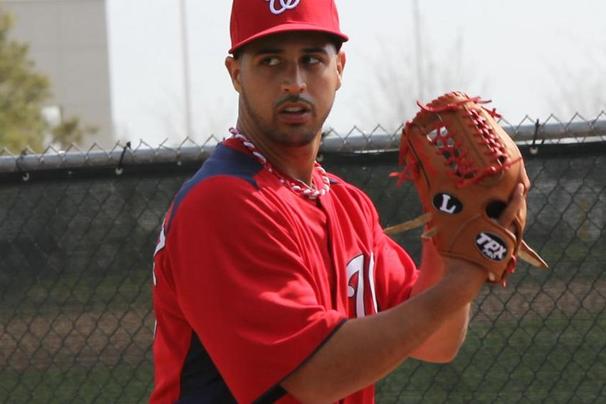
Gonzalez gets a very deserving NL All-Star selection. Photo unknown via WP.com

(Note: i’m copying a large chunk of 2011’s version of this post to give a running history of the Nats all-stars later on below).

MLB announced the 2012 all-star rosters and the Nats, for the first time in their history in Washington, have 3 representatives.  Here’s a discussion:

2012

  • Nationals All-Star representatives: Stephen Strasburg, Gio Gonzalez, Ian Desmond
  • Possible Snubs: Adam LaRoche, Bryce Harper, Craig Stammen
  • Narrative: The two starters Strasburg and Gonzalez were the obvious candidates, and my personal prediction was that they’d be the only two candidates selected.  The inclusion of Desmond is a surprise, but also a testament to how far he’s come as a player in 2012.  I entered the season figuring that Desmond would be closer to a demotion than the all-star team, and his power from the short stop position has been a huge shot in the arm to our challenged offense.  LaRoche has had a fantastic come back season but fared little shot against better, more well-known NL first basemen so his non-inclusion is not too surprising.  Stammen has been our best bullpen arm, but like LaRoche fared little chance of getting selected during a year when the Nats had two deserving starters.  Lastly Mr. Harper; he wasn’t on the ballot so fared little shot of being included, but has been put on the “last man in” ballot, up against a series of established veterans and future hall of famers.  We’ll see if celebrity wins out.  Before his slump the last two weeks he was clearly among the best hitters in the league despite his age.

(Editors Note: Harper was subsequently added on 7/7/12 to replace the injured Giancarlo Stanton).

Coincidentally, I thought Matt Kemp‘s decision to go public with his snub of Harper for the home run derby was both short sighted and disappointing.  If I was Bud Selig, I’d take the opportunity to make this year’s derby the most watched mid-season baseball event ever by forcing the inclusion of both Harper and uber-rookie Mike Trout.  Ask yourself this: 1) do you bother to watch the home run derby now?  And 2) if Harper and Trout were in it, would you watch this year’s version?  For me, even as an avid baseball fan I don’t bother to watch the event and wasn’t planning on it this year … but with these two guys in, it’d be must-see TV.  I hate it when Baseball misses such an obvious chance to showcase players and take advantage of the prevailing storylines of the season; it seems to happen year after year.

For a trip down Memory lane, here’s the Nationals all stars by year and talk about their selection, whether they were deserving, and who got snubbed each year.

2005

  • Nationals All-Star representatives: Livan Hernandez, Chad Cordero
  • Possible Snubs: Nick Johnson, John Patterson.
  • Narrative: The Nats went into the All Star break surprisingly in first place, having run to a 50-31 record by the halfway point.  Should a first place team have gotten more than just two representatives?  Perhaps.  But the team was filled with non-stars and played far over its head to go 50-31 (as evidenced by the reverse 31-50 record the rest of the way).

2006

  • Nationals All-Star representatives: Alfonso Soriano
  • Possible Snubs: Nick Johnson, Ryan Zimmerman
  • Narrative: Soriano made the team as an elected starter, the only time the Nats have had such an honor.  Our pitching staff took massive steps backwards and no starter came even close to meriting a spot.  Cordero was good but not lights out as he had been in 2005.  Soriano’s 40-40 season is a poster child for “contract year” production and he has failed to come close to such production since.  The team was poor and getting worse.  Johnson had a career year but got overshadowed by bigger, better first basemen in the league (a recurring theme for our first basemen over the years).

2007

  • Nationals All-Star representatives: Dmitri Young
  • Possible Snubs: Ryan Zimmerman, Shawn Hill (though I wouldn’t argue for either)
  • Narrative: Young gets a deserved all-star appearance en route to comeback player of the year.  Zimmerman played a full season but didn’t dominate.  Our rotation featured 6 primary starters, none of whom are still in the league now, though Hill showed flashes of dominance throughout the year.

2008

  • Nationals All-Star representatives: Cristian Guzman
  • Possible Snubs: Jon Rauch
  • Narrative: The first of two “hitting rock-bottom” seasons for the team; no one really merited selection.  Zimmerman was coming off of hamate-bone surgery in November 2007 and the team was more or less awful across the board.  Rauch performed ably after Cordero went down with season-ending (and basically career-ending) shoulder surgery.   Guzman’s selection a great example of why one-per-team rules don’t make any sense.  Guzman ended up playing far longer than he deserved in the game itself by virtue of the 15-inning affair.

2009

  • Nationals All-Star representatives: Ryan Zimmerman
  • Possible Snubs: Adam Dunn
  • Narrative: The addition of Dunn and Willingham to the lineup gave Zimmerman the protection he never had, and he produced with his career-best season.  His first and deserved all-star appearance en-route to a 33 homer season.  Dunn continued his monster homer totals with little all-star recognition.

2010

  • Nationals All-Star representatives: Matt Capps
  • Possible Snubs: Adam Dunn, Josh Willingham, Ryan Zimmerman, Steven Strasburg
  • Narrative: Capps was clearly deserving, having a breakout season as a closer after his off-season non-tender from the Pirates.  The 3-4-5 hitters Zimmerman-Dunn-Willingham all had dominant offensive seasons as the team improved markedly from its 103-loss season.  But perhaps the surprise non-inclusion was Strasburg, who despite only having a few starts as of the all-star break was already the talk of baseball.  I think MLB missed a great PR opportunity to name him to the team to give him the exposure that the rest of the national media expected.  But in the end, Capps was a deserving candidate and I can’t argue that our hitters did anything special enough to merit inclusion.

2011

  • Nationals All-Star representatives: Tyler Clippard
  • Possible Snubs: Danny Espinosa, Michael Morse, Drew Storen, Jordan Zimmermann
  • Narrative: While Clippard was (arguably) the Nats best and most important reliever, I think Zimmermann was a more rightful choice.  He was 10th in the league in ERA at the time of the selections and has put in a series of dominant performances.  Meanwhile Espinosa is on pace for a 28homer season and almost a certain Rookie-of-the-Year award (though a precipitous fall-off in the 2nd half cost him any realistic shot at the ROY), and perhaps both players are just too young to be known around the league.  Lastly Morse is certainly known and he merited a spot in the “last man in” vote sponsored by MLB (though he fared little chance against popular players in this last-man-in voting).

What are we going to do when Wang comes back?

8 comments

In a word: I have no idea.

While the rest of Nats nation talks about the fallout of Jayson Werth‘s broken wrist (most of this post was written before last night’s debacle), I had been thinking about this topic: when Chien-Ming Wang exhausts his 30 day rehab assignment, what in the world is this team going to do with him?

If I’m correct about rehab assignment rules while on the 15-day DL, players have 30 days once they appear in a minor league game.  Wang’s first ML appearance was in Potomac on Apr 29th, and then he pitched 6 innings on Friday night in Hagerstown.  As has been reported in both local media and national, Wang’s 6 inning stint represented a big step forward in the pitcher’s ability to return to the majors.  Now, perhaps this isn’t a problem for another month or so, but both these reports seemed to indicate that Wang was “nearly ready” to return to the majors.  Problem is, the Nationals really don’t have anywhere to put him.

As everyone knows, the Nats currently have the best pitching staff in baseball by most statistical measures.  We’ve rocketed out to an 18-10 start, winning 8 of our 9 series so far, on the strength of starting pitching.  And there’s no logical starter that we should replace right now.  Strasburg just won NL pitcher of the month, Gonzalez is making all the “Nats paid too much” pundits eat their words thus far with a stellar start, Zimmermann is allowing a miniscule .992 WHIP right now (even after counting for May 6th inflation), and Detwiler is pitching better than any of them now to little fan fare, with a 3-1, 1.59 era, .988 whip and a staff-best 241 ERA+.  Arguably the “worst” of our starters is also our most expensive: Edwin Jackson.  Of course, the word “worst” is only understood in context: if it weren’t for one first inning meltdown on April 19th, Jackson’s ERA would be 2.34 instead of its current 3.69.

If you’re Davey Johnson, you don’t possibly dare disrupt the existing rotation do you?  I wouldn’t.  But, Wang needs to go somewhere.  Can you put him in the bullpen?  Doubtful; he’s a starter coming off a shoulder injury and probably needs to be on a set schedule of throwing.  I doubt he’s able to jump up and be ready to enter a high-leverage reliever situation with 8 pitches to get ready.  Do you send Detwiler to the pen?  He’s the least experienced of the 5 starters we have; the other 4 have long since established their spots.  Do you move Jackson to the bullpen?  That’d make for an awful expensive middle reliever.  Wang has no options (nor does Detwiler or Gorzelanny for that matter, logical choices to move up or down to make way), so they all have to find room on the active roster.  I don’t think Wang is trade-bait; who would give up anything other than a marginal prospect for him based on his injury past?

Honestly, I’m expecting some 15-day DL hijinks to ensue if/when the situation comes to loggerheads.

Nats Rotation Cycle 2012 #1: good/bad/soso

9 comments

Surprise 5th starter Detwiler turned in your best outing of the first Rotation Cycle. Photo Cathy T via nationalsdailynews.com

It has been so long since I did one of these, that I nearly forgot that I used to do them 🙂

For the uninitiated, I try to do a quick recap of our starters each turn through the rotation, culminating in 33 “rotation cycle” posts that can be seen if you click on the “Nats Rotation Review” category tag to the right.  If I’ve seen the game, I’ll give more detailed analysis based on my observations.  Otherwise I’m recapping the box score and interpreting the stats to come to a conclusion.  The focus is on the starters, but there is a section for relievers and the offense.

The classifications are not very scientific; usually good, bad or mediocre/soso.  If someone is great or awful, we’ll note that as well.

Good

  • Stephen Strasburg looked healthy and in command on opening day 4/5 (box/gamer), getting a no decision after 7 complete innings.  His line: 7ip, 5 hits, 1 ER, 5K and 1BB.  More importantly he was only on 82 pitches through 7 innings, a very efficient work day.  A couple of these hits were relatively weak (one an infield pop fly that fell between 4 infielders, another a scoring issue that probably was a hit).  Its not difficult to look unhittable when its 41 degrees and the wind is blowing in, but Strasburg seems to be adopting the same strategy as his compatriot Jordan Zimmermann: pitch efficiently, pitch to contact, and keep your pitch counts down so you go deeper into games.  It may not be as flashy as a 14-K effort, but if it leads to wins everyone is happy.
  • Jordan Zimmermann‘s first start on 4/8 (box/gamer) was just as effective as Strasburg’s; unfortunately for Zimmermann he went up against a buzz-saw in Jeff Samardzija and his offense couldn’t help.  Zimmermann took the loss on a day when he went 7 complete innings on just 80 pitches, giving up 6 hits, 0 walks and one earned run.   This is the classic adage of why W/L records are misleading; if Zimmermann pitches this way all year as our #3 starter we’re going to go far.
  • Ross Detwiler‘s rotation spot won’t be going away any time soon if he continues outings like 4/10 (box/gamer).  5 innings, 2 hits and a walk with 6 Ks to earn the win.   Detwiler picks up where he left off last summer and gives immediate validation to the Lannan– demotion decision.

Bad

  • Yes, its bad when your marquee off-season acquisition Gio Gonzalez fails to get out of the 4th inning in  his debut start.  Gonzalez struggled with control and with effectiveness on 4/7 (box/gamer) and gave up 4 runs on 7 hits and 3 walks.  He did have 6 strikeouts in his 3 2/3 innings, so there’s that.  His fastball was hopping; 95mph in the first two innings, averaging about 93 on the day.  He threw mostly fastballs but wasn’t getting the swing-and-miss effect like he needed.  Of course, an outing like this isn’t helped in the analysts’ minds when Tommy Milone (the 4th best prospect sent the other way in the trade) pitched 8 shutout innings in his debut.  Lets hope this is first-start jitters.

Mediocre/Inconclusive

  • Edwin Jackson‘s 4/9 start (box/gamer) wasn’t bad, but it wasn’t as effective as we would have liked.  He was a victim of the long-ball, giving up 3 runs on 4 hits and a walk in 5 innings.  He did have 6 punchouts on a night where he threw a ton of off-speed stuff (only 42 of his 78 pitches were fast-balls; he threw a ton of sliders on the night).   The homer he gave up ended any chance of his getting a W on the night on a game that was more or less thrown away by replacement starter Henry Rodriguez.

Starter Trends

MLB Trends (through Detwiler 4/10 Cycle 1)

Strasburg    good
Gonzalez    bad
Zimmermann    good
Jackson    soso
Detwiler    good

Relievers of Note and other News

  • So far its looking like Brad Lidge may be the steal of the FA market.  He’s throwing well, his slider is back and he’s closing out save opportunities for just $1m.
  • So far, its looking like the “bad” Henry Rodriguez from 2011; a 0.00 ERA but a 2.25 whip and a loss by virtue of his own throwing error.
  • Ryan Mattheus isn’t doing himself any favors right now and may not be long for this bullpen.  Of course then again its looking like Drew Storen is closer to Tommy John surgery than returning to the field, having visited Dr. James Andrews this week.  Meanwhile, surprise 25-man roster includee Craig Stammen is performing decently in a swing-man role and looks to stick.

Thoughts on the offense

  • Adam LaRoche comes out on fire, a shock considering he’s usually a slow starter and the fact that he looked beyond awful in the first game, waving weakly at curveballs in the dirt.  Ian Desmond looks like the Desmond of September, which is great news.
  • Meanwhile, in a completely unsurprising development Roger Bernadina has started out the season 3-for-20.  Why aren’t we looking for a CF again?
  • Too bad Chad Tracy doesn’t have any OF flexibility; he’s looked great off the bench so far.

Overall Summary

Can’t argue with an away series win, despite the weakened nature of the opponent in Chicago.  We could get a second away-series win tonight if one stud young Ace (Strasburg) can beat one come-back Ace (Johan Santana).  That’s the way to go in baseball; play .500 on the road and play .600 ball at home and you’re a 90 win team in an era where 90 wins almost certainly guarantees post-season play.

Nats Franchise Trade history; biggest, best, worst

14 comments

Was getting Gonzalez the "biggest" trade the franchise has ever made? Photo Jed Jacobsohn/Getty Images via nydailynews.com

In response to a topic that came up in the comments section, I’ll do a 3-part series reviewing the biggest/best/worst moves by the franchise since arriving here in Washington.  We’ll differentiate between Jim Bowden and Mike Rizzo moves as we go through.  We’ll talk about trades, then draft picks, then FA signings.

First up: Trades.

The Nats have made dozens of trades since 2005, and by my records have traded with every team in the league save for three: Baltimore, Cleveland and the Los Angeles Angels.  In fact, the franchise has not done business with Baltimore in any capacity since the year 2000, a testament perhaps to the difficulties of dealing with Peter Angelos even before the team moved to Washington.  Now post-relocation, the conventional wisdom is that the two teams would never do business on the off-chance that one team ended up “winning” a trade with the other.

I’ll divide this post into into 3 sections: the “biggest” deal (not the most players, but the biggest impact/most news worthy), the “best” deal(s) and the “worst” deals.  For Rizzo, we’ll add a 4th category for “Too Early to Tell,” since the big off-season trade of last season probably won’t shake it self out for a few more years.

Jim Bowden Tenure: Nov 2004 – Mar 2009

Biggest Trades

  • 2005: Soriano deal
  • 2006: Kearns/Lopez deal
  • 2007: Milledge deal
  • 2008: Willingham/Olsen deal

The Alfonso Soriano move made all sorts of news; he wouldn’t move to LF, threatened not to play at all, then ended up putting in a 40/40 season in a pitcher’s ballpark and then resulted a host of national news as the team debated whether to trade him, re-sign him or let him go.  Bowden held firm on his demands in the trade market, never traded him and landed two compensatory draft picks (which the Nats turned into Jordan Zimmermann and Josh Smoker).

The Kearns/Lopez deal, in the end, was more about moving deck chairs than making progress for either team.  Bowden was obsessed with players that he knew from his Cincinnati days, and showed a proclivity to trade for or acquire them throughout his tenure here, and this deal was just the biggest example.  The only player in the deal who still remains with his original team is Bill Bray, and most of the players in the deal have become large disappointments for their careers or are out of baseball.  The Reds accused Bowden publically of selling them damaged goods (Gary Majewski got injured about 5 minutes after the trade was completed) and Kearns/Lopez never really lived up to anything close to their potential.

We’ll talk about the other two deals below.

Best Trades

  • 2007: Getting Tyler Clippard
  • 2009: Getting Michael Morse
  • 2008: Getting Willingham/Olsen

Bowden gets major credit for obtaining two core members of the current Nationals squad for almost nothing.  He obtained Tyler Clippard from the Yankees for Jonathan Albaladejo in a like-for-like trade of under-performing minor league relievers.  Of course we all know what’s happeend since; Clippard has become a super-star setup man, the 2011 league leader in holds.   Getting Michael Morse in return for sending the feeble Ryan Langerhans to Seattle in what most thought was a mercy trade at the time (i.e., trying to send good-guy Langerhans to a team that would actually play him) seems like one of the steals of the decade.  Nobody thought Morse had a fraction of the potential he’s now shown to have.

I include getting Josh Willingham and Scott Olsen as a win based on who we gave up: PJ Dean, Emilio Bonifacio and Jake Smolinski.  I’ve always had a soft spot for Willingham and thought his offense potential was the key to this deal; we got two major leaguers for two dead-end minor leaguers plus a backup infielder.  Luckily for the Nats, Florida was always ready to give up arbitration candidates to save a buck.

Worst Trades

  • 2007: Milledge deal

Honestly, I had a hard time really saying that I thought one of Bowden’s trades was egregiously bad.  Most of his deals (outside the deals mentioned above as biggest or best) were minor leaguer swaps or dumping veterans at the trade deadline.  Even the acquisition of Elijah Dukes wasn’t really that “bad” based on who we gave up (Glenn Gibson, who was released a couple years later by Tampa Bay and ended up back with us anyway).

However, the acquisition of Lastings Milledge for Ryan Church and Brian Schneider might be the one trade that I’d most quibble with.  Bowden showed his obsession with “toolsy” and “potential” players in this deal, acquiring the malcontent Milledge and giving the Mets two immediate starters.  At the time I certainly defended the deal; neither Church or Schneider were slated to be starters for the 2008 Nats so you could argue that we got a plus prospect for two backups.  I know I certainly argued that point.  Church seemed to be a brooding platoon outfielder who wouldn’t be happy unless he was starting and Schneider had lost his starting spot to Jesus Flores and was a relatively weak hitter.

As it has worked out Church was a very productive player for New York, Flores got hurt and left the team in a very serious catcher-dearth position, and Milledge turned out to be not nearly the talent that we thought we were getting.  By the time we flipped him to Pittsburgh in 2009 he was barely hitting his weight in AAA and was completely out of the picture for this team.

Mike Rizzo Tenure: Mar 2009 – present

Biggest Trades

  • 2011: Gio Gonzalez deal

  • 2009: Morgan/Burnett deal

  • 2010: Ramos for Capps deal

  • 2011: Henry Rodriguez/Willingham deal

  • 2011: Gorzelanny deal

You have to hand it to Mike Rizzo; he’s not been afraid to make deals.  In his 3 year tenure he’s made 5 significant deals that have vastly changed the way this team is constructed.  Two of those deals (Morgan/Burnett and the Willingham deals) were mostly about cleaning up the roster to get it more in his image of pro-clubhouse guys and pro-defense.  Trading away Milledge and Willingham succeeded in moving the team towards these goals.  The Gorzelanny and Gonzalez trades were about acquiring power arms to shore up the rotation, another tenant of Rizzo-constructed teams.

Best Trades

  • 2010: getting Wilson Ramos

Clearly Rizzo’s best move was stealing Wilson Ramos for a closer (Matt Capps) that we had ample candidates for internally.  The Twins panicked post-Joe Nathan injury and overloaded their bullpen with closer candidates.  Meanwhile Rizzo turned an astute FA signing (a minor league signing that turned into an All Star) into an even more astute trade by getting a nearly MLB-ready catcher in return for a guy who the team wouldn’t be re-signing anyway.  Great move.

Worst Trades

  • 2011: Gomes for Rhinehart/Manno
  • 2009: Bruney for ptbnl (eventually rule5 top pick Jamie Hoffman)

Most readers here loved Christopher Manno and the promise he was showing in A-ball.  Most were also aghast to see Manno go the other way to Cincinnati for a 4th outfielder Jonny Gomes.  At the time, the argument was that Davey Johnson wanted a bat off the bench and that the team needed some OF depth.  What really happened was that Gomes hit his way out of his type-B arbitration status and played so poorly the 2nd half of 2011 that the team couldn’t dare offer him arbitration to get a compensatory draft pick.  So we traded two decent prospects for a half season of awful production.  Not a good move.

Even worse, trading anything to acquire Brian Bruney.  The team acquired Bruney, promptly argued against him and beat him in arbitration, and then (unsurprisingly) Bruney vastly underperformed until being flat out released a few months into the 2010 season.  For me this is a lesson in what not to do with your arbitration eligible players.  It wasn’t so much what we gave up (the first pick in the rule-5 draft *could* have been used to acquire someone of value), it was what we got in return.

Too Early to Tell Trades

  • 2011: Gio Gonzalez deal

Pro-prospect pundits (anyone at Baseball Prospectus, Keith Law, etc) will already tell you that the Nats vastly overpaid for Gio Gonzalez.  That’s because they value the potential of prospects more than the proven commodity of the major league player.  But the fact is this; you KNOW what you’re getting in Gonzalez but you have no idea how a low-A prospect will play out.  The Nats rolled the dice that AJ Cole isn’t going to turn into the next incarnation of Justin Verlander and that Brad Peacock‘s promise will peak as a middle reliever.  The only way to tell how this trade turns out is to track the progress of those players we gave up versus what Gonzalez does for this team over the next 3-4 years.

Thoughts?  Any trades out there that stick in your minds that you thought should be mentioned?

NL East Rotation Preview

3 comments

Remember this guy? He’ll be 100% for next spring and may spell a changing of the guard in the division. Photo via AllansGraphics.com

With major moves being made this off-season for the rotations of the NL East teams, we seem set to be in store for some serious pitching duels intradivision in 2012.  How do the rotations stack up, right now?  If the season started tomorrow, here’s what we’d be looking at for rotations:

Philadelphia Atlanta Miami Washington New York
#1 Halladay Hudson Johnson Strasburg Santana?
#2 Lee Jurrjens Buehrle Gonzalez Dickey
#3 Hamels Hanson Sanchez Zimmermann Pelfrey
#4 Worley Beachy Nolasco Jackson Niese
#5 Pineiro Delgado Zambrano Wang Gee
In the mix Blanton, Kendrick, Willis? Minor, Teheran Vazquez?Volstad, LeBlanc Lannan, Detwiler, Gorzelanny Young? Schwinden?

By team, some observations:

  • Philadelphia plans on replacing Roy Oswalt‘s 2011 starts with a call-up who looked pretty good last year in Worley. Joe Blanton looks like the odd-man out and his $8.5M salary may be wasted by virtue of an underrated but saavy acquisition of Joel Pineiro.  The Oswalt trade didn’t give the team what it seeked (a World Series title) but it didn’t cost them a ton in prospects either (JA Happ didn’t exactly light it up for Houston).  They’ve signed Dontrelle Willis for rotation depth.  Still, you can’t argue with three Cy Young candidates at the top of your rotation, and this team remains the team to beat in the division despite injuries (Ryan Howard) and aging (every single projected starter not named Hunter Pence is 30 or older, and Pence will be 29).   The pitching staff was #1 in ERA in the NL and I can’t imagine them dropping far from that.    If Worley performs like he did in 2011, and if Pineiro returns to his St. Louis form, then this is just as tough a 1-5 as last year.
  • Atlanta should have won the wild card last year and seems set to roll out a rather similar rotation this year.  They’ll replace their worst starter Derek Lowe with starts from one of three up-and-coming rookies (I’ve got Delgado slated there now but likely Mike Minor wins the #5 spot in spring training) and should be improved.  Hudson is a year older and hasn’t missed a start in 2 years, but is slow coming back from off-season back surgery and may or may not be ready for opeing day.  The staff was #4 in the NL in team ERA and should do nothing but improve … but there’s some serious injury question marks.  Their incredible SP minor league depth should get them through.
  • Miami has a some major question marks, despite acquiring Mark Buehrle to slot into their #2 spot.  They will cross their fingers on Josh Johnson; if he’s not healthy this team will be really hurt.  Nolasco can be brilliant or awful from start to start.   We still don’t know if Vazquez is retiring or returning; my initial guess would have been that he was too good in 2011 (3.69 era, 106 era+) and too young (reportedly 34 but i’ve never heard of any age-questioning here) to retire.  To provide cover though, the team traded for the volatile but possibly still talented Carlos Zambrano to slot in at #5.  Which Zambrano will they get?  And will his notorious clubhouse antics gibe with new hot-head manager Ozzie Guillen? On paper, a 1-5 of Johnson, Buehrle, Nolasco, Sanchez and Zambrano spells an awful lot of power and a lot of Ks.  They could be tough.  They should improve on last year’s #10 team ERA ranking.
  • Washington just got a lot better, replacing 29 mostly awful Livan Hernandez starts with a healthy Stephen Strasburg and likewise replacing 35 combined mediocre starts out of Jason Marquis and Tom Gorzelanny with newly acquired power lefty Gio Gonzalez and power righty Edwin Jackson. They were 6th in the NL in team ERA, have mostly the same bullpen in place (5th best in the league in ERA in 2011) and seem set to improve.   Chien-Ming Wang seems set for the #5 spot, leaving John Lannan potentially being the most expensive pitcher in Syracuse.   The jeopardy the team now has is an utter lack of starting pitching depth; Peacock and Milone WERE our 2012 rotational safety nets; now we have just Detwiler, Gorzelanny and a couple guys who clearly seem to be AAA starters.  For this reason the team probably keeps Lannan around with the eventual goal of having him provide cover until our next wave of high-end pitching prospects develop.  Either way, this rotation and bullpen look to be improved from 2011.
  • New York faces a grim 2012, not only in the rotation but also in the front office.  We’re hearing reports that Johan Santana is still too hurt to make opening day (though he’s since spelled some of these concerns with his first spring training outing).  Converted knuckleballer R.A. Dickey spent his off-season in a nasty fight with management over his charity climb of Mt. Kilimanjaro.  All their other starters posted ERAs in the mid to upper 4’s (or worse) with ERA+ figures in the 78-82 range.  And there doesn’t seem to be help coming on the Free Agency front (since the team can’t afford to keep operations running without bank loans) or on the prospect front (a quick glance at their AAA and AA starting talent resulted in ONE starter who had a minor league era in the respectable range, an 18th rounder in AA).  I think this team is finishing dead last in 2012 and may lose 100 games despite their payroll.  And to add insult to injury, the owners were just forced to cough up $83 million in a pre-trial settlement over their Madhoff scandal involvement.  Tough times are ahead for the Mets.

What do you guys think?  In terms of Washington, more than a few pundits have stated that the addition of Gonzalez makes the Nats a wild card contender, right now, and that was before the Jackson move finally brought some plaudits from typically cynical national baseball writers when considering signings by this franchise.

Do you think the Nats have now supplanted the Braves as having the 2nd best rotation in the division (as ESPN’s Buster Olney is opining?)  I think they have; I think Atlanta’s starters may be taking a slight step back while our quintet looks to be a solid, young but relatively experienced core.

Ask Boswell 3/5/12

4 comments

Here’s Tom Boswell‘s weekly Monday chat from 3/5/12.  Of the baseball questions he took, here’s how I’d have answered them.  While lots of questions pertained to the recent Gregg Williams “bounty” issues and whether or not the Redskins partook during his time here, the starting of spring training has got Nats fans pretty excited.

As always, questions are edited for clarity and I write my own answer prior to reading his.

Q: What do you think the Nats w/l record will be?  Can they win 90 games?

A: For a team that won 80 last year (though their pythagorean W/L record was slightly worse), I don’t think its a stretch to assume they can improve another 10 games.  Mark Zuckerman did a nice little WAR analysis and showed that full seasons from Zimmerman, LaRoche and Strasburg, along with the new additions of Gonzalez and Jackson *should* give the team at least another 10 wins, perhaps a bit more.  That’s assuming basically that everyone else performs at the same levels they did last year, and it assumes that the WAR stat directly translates to wins on the field.  In reality, you have to plan for some people to step up while others step back.  Can we assume that Morse will hit 30 homers again?  Its a tough one to assume; he could break a leg and suddenly our offense is in tatters.

That’s why I’ve been a bit more conservative, predicting 8 more wins for this team and have them at 88-74 with this squad.  If the team is in the WC hunt, and they augment the offense, or if Harper comes up and produces … suddenly that’s a 90-91 win team.  Boswell didn’t really answer this question, just went off on Strasburg tangents.

Q: Who is your opening day starter?

A: barring injury it has to be Strasburg.  I think your initial 5-man rotation goes like this, in this order: Strasburg, Gonzalez, Zimmermann, Jackson and Wang.  This gives you a decent righty-lefty matchup at the top.  Perhaps you replace Wang with Lannan and have Jackson go out 5th to get a true R-L-R-L-R rotation.  Or perhaps Davey Johnson doesn’t care about lefty/righty matchups.  I’m more interested to see who the home opener starter is, since it happens 7 games into the season.  Right now it looks to be Gonzalez, which would be great, but early season rain-outs can greatly affect rotation orders.  Boswell says Strasburg but had a good caveat; if its 30 degrees and snowing in Chicago on opening day Strasburg probably won’t go.

Q: Where is this team’s Lenny Dykstra-esque scrappy mean streak player?

A: Honestly, the Mets-to-Nats comparisons may not ever bee 100%.   I don’t see a Dykstra type on this roster.  Mostly because this roster still does not have a center fielder/lead off type, which is exactly what Dykstra was.  Boswell says that Werth may still fill this role.

Q: Why didn’t the team keep Bixler and Nix?

A: Bixler is a good question; for reasons unknown the team designated him for assignment in the off-season while still possessing 40-man room (inexplicably; they did this a number of times, losing Kimball at one point but also losing two decent players in the Rule 5 draft).   Nix they probably thought was replaceable on the FA market … or at least obtainable for cheap.  There does always seem to be a number of halfway decent corner outfielders on the market who are available for less than what Nix got.  Boswell says Nix’s 2yr contract was the problem … the Nats want flexibility for 2014.  No mention of Bixler.

Q: If Tyler Clippard is our “MVP,” why isn’t he being paid more?

A: Two reasons; clearly the questioner doesn’t understand the whole arbitration process.  Just because Clippard is our best pitches doesn’t equate to him being the highest paid player.  Veterans always make more than pre-arb guys; don’t forget the players belong to a Union, and Union members reward longevitiy.  Secondly; Clippard unfortunately is a commodity player; he’s a non-closer reliever who doesn’t rack up saves and thus won’t ever be compensated like a Jonathan Papelbon or a Mariano Rivera, despite his value to the team.  Its an unfair world in some respects, and I just hope that the Nats do him right and keep paying him while he’s productive for the team.  Boswell mirrors my two thoughts but then also says that relievers are starting to become aware of newer stats like WPA that value Clippard highly (1st in the NL last year, above big name starters like Roy Halladay).

Q: What are your thoughts on the extra wild card?

A: Baseball purists may whine and complain, but the modern professional sports scene in this country, fortunately or unfortunately, places a ton of emphasis on playoffs versus regular season accomplishment.  Even with these two additional WC teams, Baseball still has the fewest of its teams reaching the regular season of any of the four major sports.  And, in a sport where payroll disparities may not determine the World Series victor every year they clearly help predict the playoff contendors (Yankees: one missed playoff appearance since 1994), having more teams in competition for the playoffs is good for the sport.  Frankly I’d like to see Baseball go to a 32-team/8-division structure similar to the NFL and adopt the NFL’s exact playoff structure.  The problem there is finding two more markets without cannibalizing the NY or LA market.  Boswell says “time will tell,” but also admits that he hated the first WC round initially but likes it now.  He also points out something I hadn’t thought of; the importance of your #3 starter with a new round of playoffs.

Q: Should the team just skip Strasburg’s start every few times to extend his 160IP limit until the end of the season?

A: It isn’t a bad idea; Zimmermann skipped one start and hit his 160IPs at roughly September 1st.  So skipping a few more starts for Strasburg would put him well into September.  But I don’t think he’ll be served well by jacking around his days rest.  Starters depend on getting into routines in order to pitch their best.  Honestly I think this situation may very well play it self out naturally; even in 2010 Strasburg had two separate DL stints; if he spends 30 days or so on the DL at various times we’ll get a full season out of him.  Boswell agrees with me on the not-skipping-a-start theory.

Q: How secure is Ramos as the #1 catcher?

A: I’d say he’s pretty secure.  Flores may have had a good winter, but winter leagues aren’t exactly MLB quality.  Flores’ injury history has more or less derailed his career, and that’s unfortunate.  The team has found a solid #1 in Ramos and will stick with him, with Flores getting his typical 1 or 2 starts a week.  The inclusion of Derek Norris in the Gonzalez package also spoke volumes about where this team thinks it is in terms of catcher depth, as does the 40-man addition of Maldonado, a journeyman catcher who now benefits from a distinct lack of upper-level minor league catcher depth.  Look for the team to make catcher a focus in the 2012 draft to start back up the catcher pipeline.  In the mean time, I doubt Flores will be trade bait even if he performs amazingly well, at least until we find another catcher in the wings.  Boswell says Ramos is as #1 as any #1 can be.

Q: Who are the best catchers ever?

A: For a combination of defense, calling games, arm strength as well as offense, i’d go with Johnny Bench.  But you also have to throw in Ivan Rodriguez in his prime.  Mike Piazza was notoriously bad defensively.  Jorge Posada was subpar defensively in his later years but was a monster bat.  I’d include other names from the past few decades like Carlton Fisk. Before Fisk and Bench, there was a dearth of HoF inductees from the catcher position for some 30 years, to Yogi Berra who is probably the benchmark for all-around catchers (with Bench).   Boswell says Bench as well, but mentions Varitek with Posada.  Interesting.

Q: What is the team going to do with Ian Desmond?

A: I’d guess that 2012 is the make it or break it year for Desmond.  If he’s hitting .220 at the all-star break without significant value proven at the SS position, the team may make a change.  Move Espinosa to SS, install DeRosa as starting 2B, look to move Desmond and perhaps make Lombardozzi the utility guy.  I also find it very interesting that Anthony Rendon is getting reps at both 2B and SS; if that kind of hitter can slot in at short stop on even an as-needed basis he could be even more of a dangerous prospect than he already is.  Boswell agrees; this is a big year for Desmond.

Q: If catcher is so important, why did we move Bryce Harper away from the position?

A: one word: longevity.  Yeah he was a catcher growing up but catchers get the crap beat out of them, have constant injury concerns, and the wear and tear of catching affects their hitting.  With such a bat potential, he needs to be on the field and playing 162 games.  That being said, I was slightly surprised that he didn’t at least try to stick at C for at least a little bit of his career … but understand the reasoning stated.  Boswell said the same things I said, but added that scouts didn’t really think he was a natural catcher anyway, so he got moved to the OF quickly.

Q: What would MLB’s response be to the same “bounty” scandal going on in the NFL?

A: Hard one; its not like purposeful bean-balls without context are common in the MLB.  And the game is just too random to purposely try to spike someone, or slide into them on purpose, or to purposely hit a catcher.  These plays are so bang-bang and so naturally occurring to baseball players who have played all their lives that they’re hard to script.  If it was found out to be happening?  Long suspensions.  Boswell thinks such a situation would be lifetime bans, if proven.

Q: Strasburg has never pitched more than 7 innings, at any level, ever.  Is this a concern?

A: I have a hard time believing this, but won’t challenge the questioner since I’m not entirely in a position to go searching through the guy’s college career.  Is it a concern?  eh.  Its modern baseball.  No more 150 pitch games, no more 38 start seasons.    Little leaguers have pitch count/innings limits, high school teams only play twice a week.  College rotations you go once a week.  I’d only be concerned if he showed any inclination of slowing down later in games, which he doesn’t.  Boswell isn’t concerned.

Updated Minor League Rotation Predictions for 2012

11 comments

Solis’ TJ surgery news thins our already-too-thin starting pitching minor league depth. Photo via Natsinsider blog/Mark Zuckerman

With Spring Training in full swing, most of the focus is on the Nationals 25-man roster and who may or may not make it.  Even with the additions to the major league roster, our minor league starter development is still incredibly important to this team for the long run.  Despite having Strasburg, Zimmermann and Gonzalez each locked up for many years (roughly, 2016, 2016 and 2018 respectively with options exercised), the rest of the rotation is not exactly set in stone for the long run.  Wang and Jackson are on one-year FA contracts and Lannan doesn’t seem a lock to be tendered this coming off season (where he’ll face arbitration for the third time and, if he stays here and puts in 30 starts, could be in line for something close to $8M in 2013).  That is, if Lannan is still even with the team in a year’s time (he seems surplus to requirements right now and may be a trade candidate).

Even more importantly, three key starters in our farm system went the other way for Gonzalez.  Our 2012 AAA starter safety net of Milone and Peacock is now set to be the 4th and 5th starter in Oakland, and our most electric younger arm (Cole) is now one of Billy Beane‘s best prospects.

That being said, lets talk about what the 2012 minor league rotations may look like, and where interest may lie with up and coming arms.  Experienced readers will note that, by and large, I only focus on minor league starters.  That is because, for the very large part, that pitchers rise up in the minors as starters and only get converted to be relievers upon failing as starters.  If you look at our current bullpen; Clippard, Rodriguez, Burnett, Gorzelanny, Detwiler and Lidge are all former starters, converted to being relievers either because of poor performance or for physical reasons.  Only Storen has grown up entirely as a reliever.  Therefore, the odds of a guy who is already pitching in relief in the lower minors rising up to be a part of the MLB bullpen is relatively slim.  Loogies?  Another matter, but still a difficult path (just ask someone like Josh Smoker).  Therefore, I tend to focus on Starters with occasional lip service given to closers per level and other relievers who are pitching their way into promotions.

Luke Erickson has posted some predictions (for AAA, AA, high-A and low-A), I put in an updated guess on Syracuse’s rotation post Gonzalez trade, and I had a series of posts at the end of last season wrapping up each level with predictions for 2012.  From all those posts, here’s my preliminary guesses on the rotations for the minor league rotations:

  • AAA: Stammen, Maya, Arneson, Ballard, Buschmann

I wouldn’t be surprised to see Erickson’s guesses of Atkins and Hernandez though replacing the last two; I’m guessing there’s going to be a wide-open competition for this rotation in this year’s spring training.  And, I specifically did not include John Lannan here; I just cannot believe the team is going to stick him in Syracuse by virtue of his option after signing on to pay him $5M.

First man promoted: I’d guess Stammen, who did have some successes in last year’s call-up, but it’ll take a swine-flu epidemic in the Nationals clubhouse for him to get called up to make some starts.  The MLB staff looks to have two former starters in their bullpen who will get the ball before Stammen gets a shot in 2012, and that doesn’t include the Wang/Lannan 5th starter conundrum.

First man demoted to the bullpen: Arneson; he’s bounced our system around like a pinball lately, and the team seems to use him as a multi-level handy-man instead of a starter prospect.

  • AA: Rosenbaum, Bronson, Demny, Gilliam, Olbrychowski

This list did have Sammy Solis until his TJ surgery was announced, and I put in Olbrychowski, who was halfway decent in a bunch of 2nd half starts in 2011.  I do think Roark is done being a starter in this system but I could be wrong.  Gilliam was the little-known make-weight player in the Gonzalez trade and I think he makes it to the Harrisburg roster.

First man promoted: Danny Rosenbaum, who aced Potomac last year and has the same make up as Lannan.  But, unfortunately there’s no top-10 stars on this list that could make an immediate impact.

First man demoted to the bullpen: Obrychowski, who started 2011 in the pen and may be on a short leash if someone in Potomac lights it up.

  • High-A: Purke, Meyer, Selik, Grace, Hill

I think Purke is advanced enough to start here, as is Meyer.  Of course, I also think Purke’s injury history could work against him and he ends up in extended spring for a bit.  Either way, I think both would be poorly served by sticking them in Low-A.  They’re both first round talents and need to be going against older, more advanced hitters right now.  This rotation is the future for the Nats; if they can’t find a 2014 starter out of this group, then we’ll be spending a ton in the FA pitching market for years to come.  This rotation is hurt by the loss of Taylor Jordan, who will be out the entirety of 2012 with TJ surgery after pitching very effectively for the first half of 2011 for Hagerstown.  Hill is the name i’m least confident in, only putting him here by virtue of his being a senior draftee in 2011, thus he’d be at least 3 years too old for low-A this year.

First man promoted: Cameron Selik; the phenom from 2011’s Hagerstown staff already has a ton of Potomac experience and could move up soon.  Despite their promise, I think both Purke and Meyers will be in Potomac for at least a half a season to get their professional legs.

First man demoted to the bullpen: Grace: he wasn’t entirely convincing as a starter in low-A, but his numbers were skewed by one or two really bad outings.

  • Low-A: Turnbull, Hansen, Ray, McGeary, Karns?

Maybe the 5th would be Karns, who if healthy could be a quick riser after so many injuries have derailed what was a promising young arm.  I think Ray starts here again with the idea of quickly promoting him, despite his success here last year.  He’s still young.  Of course, I could also see Ray and Hill switching places between low- and high-A.

First man promoted:  Robbie Ray: he out pitched AJ Cole last year without any of the Baseball America top 100 love.  I think he’s the next in a long line of lower velocity but higher result lefty starters that the system has been developing (see Lannan, Detwiler to a certain extent, Solis, Rosenbaum and McGeary for comps).

First man demoted to the bullpen: Karns, if he’s here.  I’m guessing Karns has this season to show that he continues to be a starter prospect, with a back-of-the-bullpen job waiting if he can’t show he’s durable enough to go 6 innings every 5 days.

  • Short-A: MRodriguez, Dupra, Baez and 2 draft picks.
  • GCL: Mieses repeating plus 4 guys from DSL and the 2012 draft.

There’s almost no point of trying to predict the short season rotations, but I do believe that the names listed here aren’t going to make the Low-A roster but are still worth keeping as starters in extended spring.  We had almost no starter talent in the GCL last season, with only Mieses making enough of an impression to keep him in that role.

Lastly, Taylor Jordan and Sammy Solis start the year on the DL, unfortunately, both with Tommy John surgery.  They would have both been prominent members of their rotations after great seasons last year, and their injuries further thin our starting pitching depth post Gonzalez trade.

Is there any Spring Training pitching competition for the Nats?

7 comments

Is it too early to guess who starts the Home Opener? My guess is newly acquired Gonzalez. Photo Thearon W. Henderson/Getty Images via cbssports.com

We’re getting reports of players getting to Viera early, and we’ve had a slew of off-season moves.  Beat reporters are starting to talk about the 25-man roster (here’s WT’s Amanda Comak‘s take).  The Nats pretty much took care of every off-season need the had:

  • Top-end Starting Pitcher: Gonzalez
  • Backup Outfielder: Ankiel and Cameron (though, apparently Cameron is retiring instead of competing for a spot…)
  • Lower-end Starting Pitchers: Re-signed Wang, signed Jackson
  • Utility Infielders to replace Cora, Bixler, Hairston: signed DeRosa, claimed Rivera
  • Bullpen arm depth (to replace Coffey, Kimball): signed Lidge, traded for Perry

The notable exception to the off-season shopping list, of course, is a lack of a proven center fielder.  Perhaps one could quibble that a shortstop should have been on that list; it seems the team is giving another year to the Ian Desmond experiment, hoping he builds on the strong end of 2011 (he hit .294 in Aug and Sep of 2011).  The backup infielders and backup outfielders listed here, to go along with a slew of minor league/invite to spring training signings, should be where most of the competition for roster slots occurs.

The big question for me is; Is there any real competition for pitching spots this spring?

Starters

We all know the narrative; we now have 6 starters with multi-million dollar commitments for 5 spots, and someone has to give.  The Edwin Jackson signing has pretty much made John Lannan the odd-man out of this rotation.  Mike Rizzo likes power arms, and has gone to great lengths to acquire guys who throw more than 89-90 to replace what he inherited in 2009.   Wang and Jackson can’t be moved until June 15th without his consent by virtue of the FA signing rules (as discussed in this article here), Gonzalez just signed a long-term deal, and Strasburg/Zimmerman are our future.  To me, there’s no mystery who’s going to be in the rotation, and frankly articles that say there’s going to be a competition for the 5th starter between Wang, Lannan, Detwiler and Gorzelanny are not really paying attention to the contract realities of the situation.  Barring injury, your opening day rotation will be (in this order):

  • Strasburg, Gonzalez, Zimmermann, Jackson and Wang.

Should someone go down with injury, Lannan steps in to take the 4th or 5th rotation spot (depending on whether Davey Johnson likes to mix up LHSP/RHSP in any fashion).  Otherwise, Lannan is trade-bait and should be moved during the spring.  There are plenty of teams that could be trade partners if we wanted to focus on a center fielder (see this article I did in November talking about the CF market for the whole of baseball for some thoughts).  Barring a trade, it seems inconceivable but Lannan does still have a minor league option left and could be sent down, but a $5M pitcher toiling in Syracuse (to go along with $2M bust Yuniesky Maya) could make the Nats AAA team the most expensive minor league rotation in the league.  (We won’t say “most expensive ever,” since the Yankees kept Kei Igawa and his $46M commitment in the minors for most of his contract).

Relievers

A recent post on option status at Nationalsprospects.com (the option status of every player is now kept on the Big Board, which is good for me since I did this work last year and its a nightmare to keep track of), as well as a question asked of Bill Ladson leads to this conclusion: there literally is no question right now who your 7 bullpen members will be.  Tyler Clippard, Sean Burnett, Henry Rodriguez, Tom Gorzelanny and Ross Detwiler ALL are out of options.  Brad Lidge can refuse a demotion based on his service time and Drew Storen is your closer.  There’s your 2012 bullpen; not much room for anyone else.

The only wiggle room may be with someone like Detwiler: he’s clearly a starter and seems set to be the first Spot starter to fill in for an injury (assuming we trade Lannan of course).  Does the team keep him in the bullpen, where he basically fills the exact same role as Gorzelanny (ex-left handed starter long man/spot starter in a pinch)?  Or does the team cash him in to fill a hole?

This configuration leaves newly acquired Ryan Perry, Ryan Mattheus and Atahualpa Severino in AAA.  Cole Kimball starts on the 60-day DL (and, frankly, probably stays there; the odds of him coming back from that shoulder injury are low).  Lastly Craig Stammen joins Maya in AAA as deep-need emergency starters.

So, here’s your bullpen:

  • Closer: Storen
  • Setup: Clippard
  • 7th inning guys: Lidge, Rodriguez
  • Loogy: Burnett
  • Long Men: Gorzelanny and Detwiler

What’s nice about this bullpen is that, despite my naming players to roles, there’s lots of flexibility.  Rodriguez on a good day has 8th or even 9th inning stuff.  Lidge is a former closer and clearly can do the setup or closing roles.  Clippard excels in the 8th inning role and doesn’t seem to aspire to replace Storen.  Burnett is far more than just a one-out guy, but can serve that role in a pinch.  Lastly both Gorzelanny and Detwiler can be anything from a one-out lefty to a 3-4 inning mop-up guy, given the day.  I like the way this sets up and I think we go into 2012 with a better bullpen than in 2011 (when, if you recall, we wasted a spot on Brian Broderick, had the failure of Doug Slaten in the loogy role and watched Chad Gaudin pitch horribly).

Who starts the Home opener?

Quick guess: based on the way the schedule plays out it looks like our home opener will be thrown by our #2 starter Gonzalez.  We play two 3-game series away to Chicago and New York, then open at home with what should be the #2 rotation spot up.  There’s only one off-day in between, meaning the starters most likely stay on normal rest.

Nats Off-season News Items Wrap-up 2/19/12 edition

2 comments

RIP Gary Carter, one of only two Montreal Expos enshrined in Cooperstown. Photo via garycarter.org

This is your semi-weekly/periodic wrap-up of Nats and other baseball news that caught my eye.  I try to publish this about weekly or if it gets up to about 1500 words, so that it’s not to voluminous.

Nationals In General

  • Mark Zuckerman writes about a favorite topic of mine w/r/t the current Nats 40-man roster and its construction.  See here for a similar discussion of the 2011 Nats (along with analysis of the 8 playoff teams) from last October.  Clearly the more players you’re using as your “primary 15” that were developed in house, the better you’re doing as a player development machine.  But there’s also the measure of cashing in those prospects in order to acquire resources.  (Coincidentally the “primary 15” of a team means its 8 starters in the field, 5 rotation members, setup man and closer).  By last year’s end, the Nats were starting 9 of these 15 as players developed in house and were down to just three acquired via FA/Waivers.  That’s a massive step up from just a few years prior, when most of the team was FA/Waiver pickups.  We’ll revisit this topic once the 25-man rosters for teams are finalized and play starts in April.
  • The Washington Franchise leads the league in employment of Negative WAR players over the past decade.   A staggering 31% of our players in this time have shown negative WARs per season.   This is not surprising given what we know of the construction of the first few iterations of the Nationals; Zuckerman has done studies in the past related to the staggering number of players the Nats have played at the MLB level who, after leaving us, never appeared in a major league game again.   The last time Zuckerman did this study that I could find was Nov 2010, when he identified 59 such players just since 2005.  I don’t know what percentage that is of all players who appeared for us in that time-frame, but it seems high.  (note: I just did some analysis and will return with a blog posting on this topic soon).
  • Back to the negative war topic, here’s a list of such negative WAR seasons for the 2011 iteration of the team: Alex Cora, Jesus Flores, Chris Marrero, Steve Lombardozzi, Matt Stairs, Livan Hernandez, Doug Slaten, Brian Broderick, Yuniesky Maya, Collin Balester and Chad Gaudin.  That’s 11 of the 44 players who appeared in the majors for us last year, or exactly 25%.  So we’re not exactly out of the woods yes; clearly we continue to employ a ton of players who end up hurting the team.  (For the record I used bWAR instead of fWAR for this, since its a bit easier to see that data.  But i’d guess the analysis would come out the same for either measurement method).
  • Another article on Edwin Jackson and pitch-tipping.  Is it possible that a player could play for years and never have a hitter teammate tell him he’s tipping his pitches?  I think it depends on what team the pitcher plays for.  Mike Mussina infamously was told he tipped his change up once he moved to the Yankees, and he made the adjustment that enabled his stellar 2006 season.  Maybe the team should have just kept its mouth shut about their thoughts and not told every reporter in every press conference that they think their new $11M pitcher is flawed.

Free Agents/Player Transaction News

  • Interesting thoughts on whether “4-A” players really do exist and how to quantify them from Fangraphs.com.  Read through the comments for some better thoughts.  For me, this issue touches on two opinions I’ve been growing.  1st; yes there does exist 4-A players; the Nats have shown to have a slew of them recently.  Guys whose minor league performance literally disappears upon reaching the majors.  I don’t know how to quantify it but there’s clearly guys who bounce freely between the two levels and seem destined to max out as such a 4-A player.  2ndly: Is AAA now a “lesser” league than AA?  Perhaps not with all systems (for example, Tampa Bay insists all their prospects play full seasons at each level, as does Atlanta), but for the Nats we’ve seen some interesting promotion behavior lately.  Stephen Strasburg got hit harder in AA than in AAA during his brief minor league apprenticeship, but the difference is rather slight.  But watching the games you got the distinct feeling that his AA competition was getting decent wood on the bat, while in AAA it was like he was pitching to little leaguers.  This goes to my theory that AAA is morphing into a “spare parts” league, where teams stash backup utility players (mostly catchers, middle infielders, relief pitchers) who are on the 40-man and can quickly be recalled to fill a spot, while AA is the place where your rising prospects play full seasons in preparation for promotion to the majors.  Jordan Zimmermann never pitched a AAA inning, rising from a full season in Harrisburg straight to our rotaton.  Strasburg probably could have done the same.  Will we see Bryce Harper jump straight from AA to the Majors or will the strategy of Mike Rizzo going forward be more Tampa-esque, requiring each prospect to “master” each level rising upwards?
  • A surprise team lands Yoenis Cespedes, namely the penny-pinching Oakland A’s in a 4yr/$36M deal.  4 years and $36M!?  That’s more than they will spend in payroll on their entire TEAM in 2012.  Maybe.  That’s a lot of cash for a completely unproven, if talented player who I’d say is not entirely MLB ready.

General Baseball News

  • Excellent article on the Demise of the Spitball and other Doctoring techniques from Grantland’s Jonah Keri, whose writing I’ve always liked and who is working on a historical retrospective on the Montreal Expos franchise.   Keri’s article talks about the Kenny Rogers pine-tar incident in the 2006 World series, but I don’t consider that “doctoring” the baseball.  That was simply using pine-tar to get a better grip on a cold, wet night.  Not that its legal; just different from the more conventional definition of a “spitball.”   Keri’s conclusion as to why the spitball has disappeared is attributed to the invention of the modern split-fingered fastball (attributed to Bruce Sutter) and to the lack of proper teachers (the craft of doctoring the ball has been handed down generation to generation by pitching coaches).  But honestly I believe the decline is more attributable to two other factors; the lingering stigma of getting caught being higher now post-PED era than every before, and the fact that the true “spitball” is damn difficult to throw (imagine trying to “throw” a baseball with the same motion you might use to squirt a pumpkin seed from your fingers?  That’s what throwing a spitball is like to a certain extent).
  • In typical modern day sabrematrician blogger nerd fashion, someone at a stats-oriented site goes about attacking another writer’s observation column.  In this case, it is someone at Baseball Prospectus attacking the Verducci Effect.  I can’t argue with his stats (other than to quibble with the lack of publication of his control group for comparison), but I suspect he misses the point.  I don’t think Verducci passes this list off as a statistical study; i think its passed off as a subjective list of candidate pitchers who HE THINKS may regress.  See, there’s the rub.  He’s already done the breakdown from the “control” group of pitchers who may be candidates for his study but whom he thinks may not be in jeopardy.  So I’m presuming that, because of this pre-selection and expression of opinion this is no longer a statistical study but an opinion piece.  I’d liken it to analyzing statistically the results of an amateur scout’s player recommendations; sure you could run one in order to judge a scout’s prognostication ability, but there’s so much variation in what happens to players once they sign that it wouldn’t be meaning ful.  I guess my take away is this: Verducci does a pretty durn good job of predicting red-flags for these pitchers (84% over the past 5 years), that maybe we should just recognize his study for what it is, and not overanalyze it to try to discredit it.
  • A nice article about another favorite topic of mine: the relationship between Wins and salary.  The familiar narrative is that payroll discrepancies are killing modern baseball, and to a certain extent I do agree; its no coincidence that the high payroll Yankees have only missed one playoff appearance in the nearly-20 years since the wild card era began.  But the ratio of wins to salary is dropping.  Why?  Because several teams have sacrificed several seasons to basically reset and start over.   Tampa Bay and Texas are the best recent examples, but we’re also seeing remnants of this theory here in Washington and starting anew in Houston and Chicago.
  • Nice little Intro to Sabremetrics from Espn-W.  The author doesn’t go into the real in-depth stats that a lot of people are gravitating to but does cover the basics.  OPS, Fip, UZr, wOBA, Vorp and WAR.  Now if we could only decide on a standard WAR.  🙂
  • Another classy move from baseball’s classiest organization; the Miami Marlins.  Yeah, lets un-retire the number of a former employee who died tragically since, well, he didn’t work for the current ownership group.

General News; other

  • Excellent article at Grantland.com on the Effects of CTE and the possible future (end?) of Football as we know it.  This is something I have been saying for a while and agree with; the increased awareness of concussions and their relationship to the longer term effects (the affliction known as Chronic Traumatic Encephalopathy or CTE) may soon start to really change the way that people think about the sport.  More to the point, as a parent does the thought of repeated concussions inflicted on your young football-playing son give you pause?  It would for me.  Read this article and it makes some very good points.  90,000 recorded pre-collegiate concussions per year?!