Nationals Arm Race

"… the reason you win or lose is darn near always the same – pitching.” — Earl Weaver

Archive for the ‘lucas giolito’ tag

Ladson’s inbox 12/2/13 edition

19 comments


The drumbeat to have Morse back continues.  Photo hardballtalk.nbcsports.com

The drumbeat to have Morse back continues. Photo hardballtalk.nbcsports.com

Happy Thanksgiving!  Apparently I didn’t realize how long between posts it had been (nearly 2 weeks).    I didn’t go anywhere or anything; just hunkered down for the holidays, entertained the in-laws, and found myself with very little non-work computer time to delve into hot-stove season issues.

Thankfully, we have a Bill Ladson inbox to get us going this week!  Dated 12/2/13.

(Note: I was mid-way typing this post when the Doug Fister news broke … so its a day later than I wanted it to be, and I edited this to be relevant).

As always, I write my response here before reading his and edit questions for clarity/conciseness.

Q: I’ve heard about so many big-market teams being out of the Robinson Cano sweepstakes. What about the Nats? They did swing a shocker of a deal in Jayson Werth, and Cano could be the signing that brings the World Series trophy back to the beltway.

A: Several national writers (including this latest, most comprehensive viewpoint from Paul Swydan on ESPN insider just this week) are making the same point.  In simple terms, sign Robinson Cano, move Anthony Rendon to third, move Ryan Zimmerman and his scatter-arm to first, and put Adam LaRoche out to pasture (or, more likely, a trade for 20 cents on the dollar).   I’d love the move in the short-term but would absolutely hate it in the long term.   Its really simple: the guy’s 30.  He wants to be paid for the next decade as if he’ll never age.   His anticipated 10 year $200-and something million dollar contract will immediately be at the top of the list of albatross contracts in the league.  You just can’t do it, not if you want to maintain finacial flexibility to extend the core of this team (Strasburg, HarperDesmond to name three) and maintain some sort of a budget.  (Oh, by the way, I have always maintained the Jayson Werth contract was a “statement contract” to the league, an overpay that legitimized this franchise as a FA player after years of being a laughingstock in the league under Jim Bowden and inept league ownership.  So, i’m not entirely sure I’d use Werth’s deal as any sort of predictor of Mike Rizzo‘s intentions).

Hey, it isn’t my  money.  If Ted Lerner‘s ok with spending $150M or more a  year … maybe i’d be on board.  But man, 3 or 4 years from now when Jayson Werth is hobbling around the outfield earning $20M plus, Zimmerman’s at $15M/year and possibly clogging a 1st base spot, each of Desmond, Gonzalez, Harper, Strasburg and Zimmermann earning 8 figure deals, a Cano $25M/year albatross is clogging your payroll, and the team starts telling its fans that they’re standing pat or depending on signing middling free agents to try to “win” next year (you know, like the Phillies), I think you’ll regret this contract.

Ladson thinks the team could be in on Cano, and could use Rendon as trade bait for a pitcher.  *sigh* well, we’ll see what happens.

Q: Do the Nats have any interest in a guy like Raul Ibanez to fill the fourth outfielder/power-left-handed-bat-off-the-bench role? He’s over 40, but a veteran with outstanding work ethic. His 2013 season’s numbers suggest that it might be worthwhile to take a gamble on him for one year, if he’s willing to accept a reasonable salary and less playing time. Your thoughts?

A: I just do not see it.  Would you trust a guy who suddenly spikes his performance at age 41?  Rizzo needs to go younger, not ancient.  Raul Ibanez makes sense to sign a series of one year deals with AL teams that can DH  him as long as he proves his worth until he’s retired.  Ladson says the nats need a 4th OF who can man center; a good point.

Q: With the way that Ryan Mattheus hurt his hand last year and then struggled mightily after being activated from the disabled list, is he in the Nats’ bullpen plans for 2014?

A: I think Ryan Mattheus may be on the outside looking in come April 1, 2014 after his performance and injury in 2013.  Without any other moves, you have to think right now the Nats bullpen has 4 locks (Soriano, Clippard, Storen and Stammen), one loogy (from within or outside), one long man (Ohlendorf or a 5th starter competition loser) and one spot up for grabs.  Mattheus is the current leader in the clubhouse for that spot .. but he’ll face competition.  Right now, if Christian Garcia is healthy he’s proven to be more effective than Mattheus.  If Garcia can’t go, then Mattheus probably has the spot locked up barring any more signings.  He could face some competition from guys in the minors like Nathan Karns (if the team decides he can’t find a 3rd pitch and converts him to a reliever… though this probably doesn’t happen until 2015 at the earliest), or possibly from new 40-man addition Aaron Barrett.  For right now i’d say he’s the 7th guy but he needs to produce at 2012 levels to keep his job over Garcia.  Ladson agrees with me, I guess.

Q: Just wondering, do you think No. 2 prospect Lucas Giolito will get an invitation to Spring Training with the big club?

A: Nope, not this year.  No point.  He’s yet to play a day in full-season ball; he needs to stay in the minor league section and get his full work, not languish on the MLB spring training bench getting an inning every other day.  Now, if he shoots up the system in 2014 and ends in AA, then yeah a spring training invite for 2015 could be in the works.  Ladson agrees.

Q: After reading all these trade rumors, I feel like the Nationals are going to make a huge move this offseason. Do you feel it would come as a bat or as a pitcher?

A: Even before the Fister deal, I still would have said a Pitcher.  Even though I don’t think pitching was our problem in 2013 (a tease for a draft blog post with some interesting stats that I have in progress).  The problem with trading for a Bat is this: there’s just no obvious place to upgrade.   Not unless you move a guy like LaRoche or Span (our two least productive bats last season) and make a hole for someone coming in.  Ladson really goes out on a limb and says ‘it could be both.’

Q: Why not bring back Michael Morse for the extra power on the bench and replacement forAdam LaRoche from time to time?

A: I think the book on Michael Morse has been written by now: he can’t stay healthy, he’s a liability in the field, and he needs to be able to DH.  He’s just not an NL player anymore.  A quick look at the depth charts in the AL shows a couple of teams that could take a flier on Morse.  The problem is that two of the teams with the most need for a DH (Seattle and Baltimore) both had Morse last year and he washed out.  Maybe his last shot could be with a team like Oakland or Houston, teams with limited budgets willing to give last-chances to guys like Morse to resurrect their careers.  Ladson repeats his last Morse answer; Morse wants to be an every-day player and at Washington he’d be  a bench player.

Q: With Stephen Drew being a Scott Boras client, could you see the Nationals signing him, having him or Ian Desmond transition to second base? It could solidify the middle infield with veteran stability, couldn’t it?

A: Why in the h*ll would you purposely take a plus defender shortstop (whether it be Stephen Drew or Desmond)  and waste him at second base?   That’d be dumb.  That’d kind of be like what Texas is doing to Jurickson Profar.  Despite the oft-repeated mantra that the “Nats are Scott Boras‘ b*tch” if you check the records we’re not even the team with the most Boras clients.   And most of our Boras clients were guys we drafted irrespective of who represented them.  I’m really tired of reading the cliche that any and all Boras clients are Nats targets because we for some reason feel obliged to deal with him.  I’ll tell you this; I’d rather be friendly with Boras than unfriendly; he represents serious talent in this game and if we can get access to his players more easily than an antagonistic GM, we’re in a better positions.  Ladson doesn’t think Drew would want to switch positions either.

What is the “ceiling” of various Nats pitching prospects? (Updated for 2013)

41 comments

Can Giolito live up to his potential? Photo unk via federalbaseball.com

Can Giolito live up to his potential? Photo unk via federalbaseball.com

Two off-seasons ago, I did an analysis piece discussing the “ceilings” of the various pitchers (focusing on starters in the system) on our major and minor league rosters.   That led to some good discussions in the comments about what the definition of a pitcher’s ceiling is, about what a “#3” starter is, etc.

Now that the 2013 season has ended, I thought it’d be a good topic to revisit and factor in recent performances and the last couple year’s worth of player movement in and out of the organization.

This post mostly focuses on the Starters we have in the organization.  There’s no real mention of guys who are already in the bullpen (either in the majors or the minors) unless we have heard rumors of them converting back to being starters at some point or another.


Some setup

What do I mean by a #1, #2, #3, #4 or #5 starter?  With some simple examples (from the 2011 post)

  • A #1 starter is a MLB-wide “Ace,” one of the best 15-20 pitchers in the league, someone who you’re genuinely surprised if he performs badly on a given day, opten mentioned in Cy Young conversations.   Guys like Clayton Kershaw and Justin Verlander.
  • A #2 starter is a  slight step down from your elite “Aces,” but still an excellent starter.  Can challenge for the top awards if they put everything together for a season, but remains consistently above average.   I see guys like Madison Bumgarner, Homer Bailey or James Shields in this category
  • A #3 starter is better than your league average pitcher, someone who is solid, consistent innings eater and who routinely gives you quality starts but not much more than that.   I think of guys like Mark Buehrle, Kyle Lohse, or John Lackey here.
  • A #4 starter is basically someone defined as someone who’s a slight step above the back-of-the-rotation guy, usually a veteran guy who knows how to pitch but doesn’t have the best stuff to really go much beyond or a younger guy who is establishing a foothold of a career.   Good examples from this year could include the likes of Kyle Kendrick, or Edwin Jackson or Bronson Arroyo.
  • A #5 starter is just good enough to fill out your rotation.  Starters at the back end who all you’re hoping for is 6 innings and keeping your team in the game.  Think of someone like Jason Marquis at this point in his career, or Ryan Vogelsong.

For clarity; if your team has three excellent pitchers, it does not mean that a league-wide ace is defined by these standards as a “#3” starter.  When the Phillies big 3 of Roy HalladayCliff Lee and Cole Hamels were all healthy and firing on all cylinders a couple of years back, all three were #1 starters in my book.  Just because Hamels pitched third in the rotation didn’t mean he was a “#3 starter.”

Also before getting going, a quick discussion on “ceiling” versus “predictions” and what I’m trying to do here.  As was pointed out when I posted on this topic in 2011, a pitcher’s “ceiling” is quite literally the highest level of capability that we can expect that pitcher to accomplish given a perfect set of circumstances.   Scouts routinely talk about player “ceilings” and “number X” starters as a convenient way to speak a common language when describing a pitcher.   I like to be a bit more grounded in predicting what may happen to pitchers, so this analysis is less about the perfect-scenario “ceiling” as it is a thoughtful prediction on where a guy may eventually fit in given his talents and his performances as compared to scouting reports and industry buzz.


Updated ceiling predictions for Nats pitchers post 2013 season:

Nationals Starter Ceilings (per scouting reports, personal observations).  I’m not going to include any MLFAs here, assuming that they’re all either 4-A or minor league starters as a ceiling.  I’m also only really going down to full-season ball guys, throwing in a couple of our higher-end prospects.  Its just impossible to really project guys in rookie ball unless you’re a professional scout.

  • #1: Strasburg, Giolito
  • #2: Gonzalez, Zimmermann
  • #3: Cole, Ray
  • #4: Jordan, Roark
  • #5: Detwiler, Solis
  • MLB bullpen: Purke, Karns, Ohlendorf, Garcia, Johansen, Treinen
  • 4-A starter: Hill, Mooneyham, Schwartz, Voth, Meyers
  • Minors starter: Rosenbaum, Maya, Gilliam, Rauh, Anderson, Encarnacion, Bacus, Turnbull
  • Minors bullpen: Perry, Demny, RPena

Discussion:

#1 Starters: Stephen Strasburg is already an “Ace” starter in this league, ranking up among the 15-20 best arms out there.   However he’s no longer considered in the same class as the likes of Kershaw, thanks to injury and a curious lack of dominance this year (have a draft post on this topic that i’ll expand on later).  Lucas Giolito is widely considered the Nats top prospect and an easy future #1 pitching prospect.  Big guy, big arm, and by all accounts has come back post TJ surgery.  The BA guys think that he could be the #1 prospect in the entire minors with another dominant 2014.  How quickly can he move through the minors?  Can he stay healthy?  Right around the time Giolito arrives, the Nats “3 big names” could all be at the end of their current contracts and an interesting conundrum could face the team; keep the band together?  Or let these guys go and re-load/re-build?

#2 Starters: Just as Gio Gonzalez made the leap to a #2 starter with his Cy Young challenging 2012, Jordan Zimmermann has made that leap by virtue of his near-20 win season in 2013.  I believe these two guys can stay as #2 starters for the next few years, until they hit the regression stages of their careers.

#3 Starters:  A.J. Cole has regained his mojo after bouncing around the California league and advanced to AA this year.  He features a significant fastball and but complaints in the scouting world about his secondary stuff lead him to a #3 starter prediction.  I think he should be a #2 ceiling, and perhaps a spring training working with the Nats staff can get him back where we thought he was when we drafted him.  I’m sure picking Robbie Ray to have a higher likely ceiling than his 2013 AA counterparts would be mocked.  But look at the evidence: he’s the same age and same draft class as Cole and has consistently out-performed him when they’ve been on the same team.  He’s lefty, he averaged well over a K/inning this year, and suddenly he’s 22 and he may be “done” with AA.  Why aren’t his credentials higher with prospect-watchers?  It isn’t has if he’s a soft-tosser; he throws decent stuff from the left side.  I continue to think he’ll move along with Cole and they’ll be promoted to the majors within a couple of weeks of each other, perhaps mid 2015.

#4 Starters: If you want to say I’m crazy for thinking that Tanner Roark can maintain his September pace as a starter for this team, I can understand.  I’m not personally convinced that he’s going to be a mediocre 6th inning reliever or continue to be a Kris Medlen-in-2012 anomoly who continues to get guys out.  For now, i’m rooting for the better story.  Meanwhile I’m also not convinced that I have Taylor Jordan pegged properly; I think honestly he could be a #3 pitcher in the league.  This lack of real punch-out capabilities is what’s holding him back for now.  That being said, guys don’t just come up to the majors and post a 3.66 ERA.  For now, a #4 ceiling sounds good.

#5 StartersI’ve come to believe that Ross Detwiler‘s reached his ceiling; his 2012 season is as good as we’re going to see him.  Not because of a lack of talent; its because he just can’t stay healthy.  I’ve seen and heard reports that Detwiler’s stuff is fantastic; that’s great on paper but he just can’t seem to translate that to the big club on a consistent basis.  I would not shed a tear if he headed to the bullpen, other than to think that its a waste of his talents.   I also feel like Sammy Solis will stay as a starter and continue to climb up the ranks, and tops out as a 5th starter just by virtue of his being left handed.  There’s just something to be said about being a lefty with decent stuff being able to hang around the league (think of someone like Eric Stults).  

MLB Bullpen: Right now i’m projecting a whole handful of our good minor league starters to eventually get transitioned to the bullpen.  Which is good and bad; good for this team as they continue to develop arms and continue to have quality guys in the pen.  But bad in that it predicts a severe thinning of the starting pitching corps.  First off, I think the Christian Garcia as starter experiment is over; he needs to focus on being a reliever so that he can stay healthy and contribute.   I believe that Ross Ohlendorf‘s time as a starter is over, but he should slot in nicely as the 7th guy/long-man/spot-starter that this team will need here and there in 2014.  The more I think about Nathan Karns, the more I think he’d make an excellent setup guy.  Big arm, big fast-ball, not really that much secondary stuff.  He got hit hard as a starter; in shorter stints he could dial it up more and focus on his limited arsenal.   Unfortunately I think Matthew Purke may be headed to the pen as well, but his gun-slinger action could make him an excellent later-innings pitcher, perhaps even a closer, if he can translate that to a bit more velocity.  Lastly the reported two biggest arms in the minors (Jake Johansen and Blake Treinen) project for now as bullpen guys.  Again, I hope I’m wrong, but so far the evidence seems to point at big velocity and little else.

What is a 4-A starter?  A guy basically who looks good in AAA but who, for whatever reason, can’t translate that success to the Majors.  They may get a call-up here and there but never pitch well enough to stick.  This is how I see a handful of guys ending up: Brad Meyers has been hanging around this status for several seasons and just can’t get a break.   I’ve also tagged some guys with good numbers in the lower minors but with fringy scouting reports with this for now, thinking that a lack of a dominant fastball means they’ll stay as a starter until they reach their peak.  Taylor HillBlake Schwartz, and Austin Voth all seem to fit this bill.  Lastly the curious lack of dominance of Brett Mooneyham lends me to believe he’ll end up in this predicament as well.  I hope I’m wrong here; I’d love to see these guys take the leap, or (save that) find success in the bullpen.

Career Minors Starter: Unfortunately, I think we’ve seen the best that Danny Rosenbaum and Yunesky Maya can give; they’ve both had shots at a major league roster and couldn’t stay.  I think they’ll retire as AAA starters.  The rest of these guys listed are mediocre-to-decent starters in the system who don’t seem to be listed as true prospects.  I’m specifically disappointed thus far in Kylin Turnbull, who couldn’t make the leap to high A and seems like he needs to make some sort of adjustment in 2014.

Career Minors Bullpen guys: When Ryan Perry passed through waivers off the 40-man roster, his chances of ever making it back to the majors took a huge dent.  Paul Demny‘s precipitous drop this season also seems to spell doom for his career.  And apropos of nothing else, Ronald Pena seems like he has achieved the dreaded “organizational arm” tag.


On the bright side, the top-heavy nature of this list gives fans optimism for the power of this rotation for years to come.  In 3 year’s time (if Giolito, Ray and Cole all matriculate as expected) you’d have two Aces, two #2s and two #3s to choose from for your rotation.  That’s significant, considering that lots of teams are scraping the bottom of the barrel for their 5th starter.  If Ray and Cole turn into servicable major leaguers, you could trade/let go a guy who gets too expensive (Gonzalez or Zimmermann) with an able, cheap replacement.  Maybe I’m too high on Ray and Cole (who are both youngsters) … but then again maybe i’m too low on Jordan and Roark (both of whom have already shown the ability get major league hitters out).

Agree/Disagree/Hate what I’ve written?  I’m open to criticism.


World Series Game 2 Pitching Matchup and Prediction

2 comments

Game 1 went as I thought; Adam Wainwright may be unbeatable at home, but he’s shown that he’s vulnerable on the road (see the Nationals’ destroying of him in last year’s Game 5 start).  Boston jumped on him early and cruised to an 8-1 victory.

(I don’t know what that green substance was on Jon Lester‘s glove … but i’m sure we’re going to a) be reading all about it and b) it won’t be there when he pitches again in Game 5).

Game 2: Michael Wacha vs John Lackey.   Without doing a bunch of analysis, as badly as St. Louis hits lefties is as well as they hit righties.  Wacha has been unbelievable this post season (a 0.43 ERA).  Lackey has been competent but not un-hittable.  I feel like St. Louis gets a split and goes home with the series tied 1-1.

I think Carlos Beltran will be fine.  I think all the nerves and errors we saw in Game 1 will go away.  St. Louis has been here before and should be able to rebound from the series of bone-head plays that led to many of Boston’s runs.

(btw; interesting piece in the Post today about Wacha, who was drafted a few picks after the Nats took Lucas Giolito.  Lots of second-guessing going on by everyone who skipped him in the 2012 draft.  It is what it is; you setup a draft board, and if you get to your pick and Giolito is ahead of Wacha you pick him.  Albert Pujols was a 13th round pick; sometimes you miss on amateur guys.   Per the story, if Giolito had been gone the team would have taken him).

Written by Todd Boss

October 24th, 2013 at 11:53 am

DC-IBWAA Poll results and my vote

2 comments

http://dc-ibwaa.blogspot.com/2013/10/dc-internet-baseball-writers.html
David Nichols does a great job getting all the Nats bloggers to participate in pre-season and post-season polls.  He got 18 voters this time around.  The link above is the results of the post-season poll.  Here’s his post-season survey questions, the poll results and how I answered them and why.

2013 DC-Internet Baseball Writers Association

POST-SEASON ACHIEVEMENT AWARDS BALLOT

 AWARD FIRST (5 POINTS) SECOND (3 points) THIRD (1 point)
Goose Goslin Most Valuable PlayerPlayer most valuable to the success of the Washington Nationals Werth Desmond Harper
Walter Johnson Starting Pitcher of the YearExcellent performance as a starting pitcher Zimmermann Strasburg Gonzalez
Frederick “Firpo” Marberry Relief Pitcher of the YearExcellent performance as a relief pitcher Clippard Stammen Roark
Sam Rice Hitter of the YearExcellence in all-around hitting, situational hitting and baserunning Desmond Span Harper
Frank Howard Slugger of the YearExcellence in power hitting Werth Harper Zimmerman
Joe Judge Defensive Player of the YearExcellence in fielding Span Desmond Espinosa
Mickey Vernon Comeback Player of the YearPlayer who overcame biggest obstacle in the preceding season to contribute on the field Jordan Ramos Werth
Josh Gibson Humanitarian Player of the YearPlayer who meritoriously gave of himself to the community Zimmerman
Minor League Player of the YearMinor league player most destined for big league success


Jordan 

Giolito

Burns 

Cole

Souza 

Godwin

  • Goose Goslin Most Valuable Player: Werth, Desmond, Zimmermann.  I went Werth, Desmond and Harper.  I don’t like voting pitchers for MVP; they have their own awards 🙂
  • Walter Johnson Starting Pitcher of the Year: Zimmermann, Strasburg, Gonzalez: Same way I voted.  I do like the few side-votes for Roark.
  • Frederick “Firpo” Marberry Relief Pitcher of the Year : Clippard, Stammen, Soriano: I voted Clippard, Stammen and then Roark.  Honestly I did not think Soriano really did that great a job this year.  He had a 0.9 WAR for his $15M salary (with deferred payments).  That just doesn’t cut it for me for a high-end closer.  I want Craig Kimbrel-esque dominance for that kind of money.  Roark on the other hand had a 2.0 bWAR in his limited time on the team.
  • Sam Rice Hitter of the Year: Werth, Desmond, Zimmerman.  I went Desmond, Span, Harper.  I dunno; I guess I got caught up on the definition, which included “baserunning” and “situational” hitting.  I think I just plain forgot how good a season Werth had here.
  • Frank Howard Slugger of the Year: Werth, Harper, Zimmerman: same way as I voted.  Maybe we should have put more thought into it besides just listing the team leaders in  homers.
  • Joe Judge Defensive Player of the Year: Span, Desmond, Ramos.  I went Span, Desmond and Espinosa.  Despite how bad his bat was, Espinosa was still awfully good in the field.  You always forget about the catchers when rating defenders.  I’m guilty here.
  • Mickey Vernon Comeback Player of the Year: Ramos, Werth, Ohlendorf.  I went Jordan, Ramos and Werth.  Remember, Jordan had Tommy John surgery and was buried in high-A to start the season.  That’s a heck of a comeback.  Fair enough on Ramos after his kidnapping ordeal and his injuries.
  • Josh Gibson Humanitarian Player of the Year: Zimmerman, Desmond, Gonzalez.  Honestly I only voted for Zimmerman; do the rest of these guys do events?  Maybe i’m just unaware of what the rest of the team is doing in the charity world, but clearly Zimmerman’s MS causes is well known.
  • Minor League Player of the Year : Giolito, Rendon, Cole: I voted Giolito, Cole and Goodwin, thinking that Rendon was “graduated.”  I have two lines of players because I wasn’t sure how to answer the question at first; was it “3 best prospects” or “3 best minor league players THIS season?”  Because the answer to the latter question clearly is not the same as the answer to the former question.

Survey Questions
1. Which players on the 40-man roster at the end of the season are least likely to return in 2010?    

I said Cedeno, Haren, Ohlendorf, Tracy (which were the top four answers among all the responses) but i’d like to change my mind on Ohlendorf.   I think the team is going to tender him and keep him around as a long man, considering that he can’t refuse an option until mid-next year.  I also think a couple of these random guys picked up on waivers late in the season (Tyler Robinson and Mauro Gomez) may not stick around for the long haul.  These two guys in particular never even got numbers assigned to them.

2. Will the Nats sign Ian Desmond and Jordan Zimmermann to long-term contract extensions before they reach free agency? 

I said “Desmond yes, Zimmermann maybe.”  Honestly, I feel the team can replace Zimmermann from within and may be better served to flip him for prospects if his price tag gets too high.  At some point the Nats are going to have to make tough choices like this (they are not going to be able to give 9-figure deals to everyone on this team who deserves them) in order to maintain their core group and contine to compete.  You already have two 9-figure deals, and you have to think that Desmond, Harper and Strasburg are going to merit them.  can you have a team with that much top-heavy payroll?  Now, if you got Zimmerman for Gonzalez prices (5  yrs $50M or so) then you have yourself a deal.

3. What player was the biggest surprise for the Nats this season?

I went with with Jordan, Roark, Werth.   The group went with Roark, Werth, Jordan.

4. Who was the biggest disappointment?

I went with Haren, Span, LaRoche.  The group went with Haren, Espinosa, Span.  Maybe I didn’t include Espinosa because I already had my doubts on him; frankly he didn’t disappoint me, he met my low expectations for him in 2014.

5. Who is your favorite professional Nats writer?

I went with Mark Zuckerman.  The survey results went Kilgore, Comak, Zuckerman and Wagner.  Coincidentally bon voyage to Comak, who is leaving The Washington Times Nats beat.

6. Who is your favorite non-professional Nationals writer?

I went with Luigi de Guzman, writer of the blog Natstradamus.  He doesn’t write that frequently, but when he does they’re usually thoughtful, well researched opinion pieces.  Though that’s no slight to Luke Erickson at Nationalsprospects.com, whose blog I absolutely depend on to write this blog.  I also really like Ryan Sullivan‘s NatsGM blog and its focus on prospects.  Generally speaking my preference in reading baseball writing on the internet leans towards opinion pieces.  I know that lots of blogs out there try to be replacement newspaper writers/beat reporters.  That’s not what excites me.  I want to see opinion pieces, criticism where criticism is due, etc.  Harper Gordek at Nationals Baseball is one that definitely writes opinion pieces and I look forward to his stuff too.  Unfortunately a lot of these guys have retired (Steven Biel, Chris Needham in particular were always good for a scathing piece when the team deserved it).  I know there’s a couple others out there who write good opinion pieces that i’m forgetting.

Yours truly got one vote!  That’s awesome, to whichever fellow blogger voted for me.


Ladson’s Inbox 10/4/13

4 comments

Wouldn't it be nice to see Price in a Washington uniform?  photo unk via strikesportsnetwork.com

Wouldn’t it be nice to see Price in a Washington uniform? photo unk via strikesportsnetwork.com

Nothing like a Bill Ladson inbox to start off your week!  This one is dated 10/4/13 and was posted late friday.  As always I write my response here before reading his and edit questions for clarity and conciseness.  Here we go.

Q: This past season, Adam LaRoche had a .403 slugging percentage, which might fly at shortstop, but not at first base. Do you think that Tyler Moore is good enough to be in a platoon with LaRoche, or should the Nats go after someone like James Loney to start most of the time?

A: Adam LaRoche‘s season was a disappointment for sure.  In addition to the noted poor slugging percentage, I’ll give you two more interesting stats.  He posted a bWAR of 0.9 for the year, which is only slightly better than the bWAR of 0.7 posted by Billy Hamilton during his two weeks of base-running terror in September.  And he ranked 20th of qualified first basemen in the league in terms of fWAR for the year.  James Loney put himself in a position to get a decent contract this year, with a nice slash line, a 118 OPS+ and a 7.2 UZR/150 at first.  But Loney’s problem is that he just doesn’t hit for enough power.  The Nats need LaRoche’s power, and I think at this point they stick with what they have for one more year and hope he rebounds.   I don’t think Tyler Moore is ready for prime time and will continue to be a power RH bat off the bench.  Lastly; who is taking LaRoche off our hands if we decide to replace him?  We’d have to pay most of his salary, get little in return, and I just don’t see this management team doing that.  Ladson agrees.

Q: How does Ross Ohlendorf fit in with the Nationals’ future plans? I see him as a great No. 4 or 5 starter.

A:  Ross Ohlendorf is in an interesting spot.   He was signed as a MLFA this past off-season, but did not accrue enough service time to get to 5 full years, so I believe he’s still tied to the club.  He should be arbitration eligible, and (per springfieldFan’s big board work) seems to have 2 options left.  So, on the one hand he pitched pretty well for us and I’d definitely tender him a contract for 2014; he’ll be relatively cheap even through arbitration.  I see him competing for the 4th/5th with the other obvious candidates (Karns, Jordan, Detwiler, Roark), but his longer term history as a starter in 2011 and 2012 does not inspire confidence.  His new motion helped him to a 3-1 record with a 3.52 ERA in 7 starts this year, but ultimately I see him settling into a long-man role similar to what he had this year.  Ladson agrees; he’s arb eligible but doesn’t seem like he can stick as a starter.

Q: I feel like the Nationals should go after center fielder Jacoby Ellsbury. How do you feel about that?

A: Nope.  Jacoby Ellsbury is a nice player, but I feel like he’s somewhat of a one-season wonder.  Look at his career homer records and tell me how he hit 32 in 2011 when he’s never hit more than 9 in any other season??  Doesn’t that outlier scream out PEDs?  Plus he can’t stay healthy; he missed 30 games this year, half of last year, basically all of 2010.  He’s a Scott Boras client who is already making noise about getting more for Ellsbury than he got for Carl Crawford.  Would you pay $150M for 7 years of Ellsbury??

But here’s the other thing; as with LaRoche, this team has a center fielder under contract for 2014!  If the Nats want to make a change in center they’ll be selling somewhat low on Denard Span.  Personally I wouldn’t mind putting Harper in center, acquiring a big bopper for left and adding some muscle to this lineup.  But I just don’t see Mike Rizzo doing that and admitting defeat on the Span acquisition.  Ladson points out that Span’s great finish means he’s clearly not in line to be replaced; organizationally they have to be hopeful that his 2014 will resemble more closely the end of 2013, not the middle.  Fair enough; I can get on that bandwagon.

Q: Have you noticed how similar the home run swings of Wilson Ramos and Andres Galarraga are? Every time Ramos goes yard, he reminds me of The Big Cat.

A: I had not noticed, but sure, whatever.  No real question here otherwise.  I like Ramos, and he’s finally showing signs of durability after an injury-plagued career.   This is the kind of hard-hitting question that Ladson is known for taking.

Q: Do you think the Nationals should go after another pitcher or two during the free agency period?

A: I think the Dan Haren experience may have scared them off the FA market for a bit.  And this coming off-season’s FA market for Starting Pitching is really thin.  After spending $13M each of the last two years for Haren and Edwin Jackson (and getting bWARs of -0.1 and 2.0 respectively) the Nats have to be thinking that there’s better ways to spend money.  I wouldn’t be surprised in the least to see another deal similar to the Gio Gonzalez deal, where we package a slew of close-to-the-majors players together for one decent-to-good pitcher.   The problem would be finding such a team; Oakland’s current slate of young starters mostly struggled this year and none of them are arb-eligible yet.  Maybe Tampa lines up; not only do they have to deal with David Price‘s rising salary but Jeremy Hellickson is arb-eligible for the first time too.  Hellickson took a major step back though in 2013; would Tampa use this to their advantage and keep him at a lower arb-number for one more year instead of selling low?   Would you trade, say, Karns, Roark and Kobernus for Hellickson?  Too much?  Too little?  Ladson says he could see them going after a pitcher either on FA or in Trade.

Q: Will Jhonatan Solano be the backup catcher out of Spring Training or will the Nationals try to bring in someone else? 

A: This is one of the bigger questions for this team this coming off-season: do the Nats go into 2014 with Ramos and a minor league call-up as his backup, or do they go for a veteran backup?  I’m guessing they may go the veteran FA route; there’s a ton of catchers on the FA market this year.  Jhonatan Solano may have peaked as a player: his AAA slashline as a 27 yr old this year was .214/.245/.279.   He’s been bouncing between AA and AAA since 2009.   Sandy Leon seemed like he was the future answer, but he bottomed out this year too after looking great in 2012.   I’d go with a veteran backup (Kurt Suzuki is a FA …) and wait out the kids one more season.  Ladson thinks FA route.

Q: Do you think a new manager will be able to change the hitting philosophy of the team and play more small ball instead of over-swinging and trying for home runs all of the time?

A: Is that the perception of this team’s offense in 2013?  That they over-swing all the time?  I think they just don’t hit well in the clutch.  Small-ball is a century old concept mostly debunked by modern stats in the game as being out-dated strategy.  Honestly, I want a manager who stands up for his players, who keeps them in line, who isn’t afraid to order a bean-ball when it is called for, and who doesn’t come across as a feeble old man (sorry Davey Johnson; that’s how I interpreted your last season).  Ladson says the hitting has settled since the firing of Rick Eckstein and the hiring of Rick Schu. 

Q: I think that left-hander David Price would be the ideal arm to add to the Nationals’ rotation. If he is willing to agree to an extension, do you think that he would be a good fit for the Nationals?

A: Price would be a great fit on every team in the majors.   Duh.  The problem is extracting him from Tampa.  Tampa is shrewd, drives a hard bargain, and wants to win every trade.  They’re not exactly the best team to try to negotiate with.  We’ve had this argument on this site many times; what would it really take to get Price out of Tampa?  Giolito, Jordan, Kobernus and Rendon maybe?  Would you make that deal or is that too much?

Of course, that being said … ask yourself this; was starting pitching *really* the reason this team failed in 2013?  No I don’t think it was.  Yes, the team was 10-19 in Haren’s starts … even if they’d finished .500 in Haren’s starts they were still out of the WC game.  No; this team took a significant step backwards offensively.  So the way to fix that should be to address the offense.  Problem is; all 8 starting fielders are under contract or under team control for 2014.  What do you do?  Get a couple of bench guys who can hit?  How does that help?

Ladson punts with his patented ‘lets see what happens’ line.


August-September 2013: Minor League Monthly Rotation Review

9 comments

Roark is our ML inspirational story of the year.  Photo via milb.com

Roark is our ML inspirational story of the year. Photo via milb.com

Here’s the final Minor League Rotation Review post for the season (Here’s April 2013May 2013, June 2013 and July 2013‘s posts for historical viewing).  Since the minor league seasons mostly end right after the Labor Day weekend, this post actually includes a few days in September for each non-playoff team.  We’ll also include the playoff starts for those teams that made it, which has pushed this post well into September (and very late) to include all the playoff starts for our many minor league playoff teams.

For each level, I’ll put out the rotation members, their “letter grades” per start for this month only, and then throw in a quick link to show their seasonal stats for context.  For each team there are 3 distinct groups of starters: the top group of 5-6 Starters per level is the “current rotation” as best as I can figure it, then the next section of pitchers are swing-men or spot-starters or guys who had “2nd start” or longer outings worthy of grading, followed by a 3rd group of guys who are generally no longer with the team (either by D/L, promotion, demotion or release).  I’ve only listed the third category if something transactionally has happened to the player this particular month.


AAA Rotation: click here for Syracuse Milb.com stats

  • Rosenbaum: A,D,D,C+,B+,C+,C-
  • Maya: A,C,B+,C+,B+
  • Mandel:B,A,A,A,D+,B+
  • Clay: A,C+,A,B+,C,A
  • Tatusko: F/inc,F,A-,D,D,D-,D
  • Robertson: A-
  • Kimball: B
  • Roark: B- -> promoted
  • Ohlendorf: B+ (rehab)
  • Hill: C-,C- -> demoted back down post spot starts

Discussion: Syracuse drug itself to the finish line of a disappointing season withat least some stability in the rotation.  The 5 guys standing at the end were basically the rotation for the entire month.  Tanner Roark was rewarded for a great season by getting called up to provide some long relief in the MLB bullpen and 6 weeks later is now 7-0 with the best ERA for any pitcher with more than 40 innings in the entire MLB.   Roark’s trade-mate Ryan Tatusko really struggled down the stretch and finishes with a 4.33 ERA and a 1.58 whip on the season.  Meanwhile, Caleb Clay continues his career resurgence and may have put himself in place to pick his spot in MLFA next year (well, unless the Nats hold onto him by putting him on the 40-man, not a bad idea).  Jeff Mandel and Yunesky Maya pitched well while playing out the string; both are MLFAs and both may choose to look elsewhere.


AA: click here for Harrisburg Milb.com stats

  • Karns: B+,A,D,A,C+,A,A+ (playoffs), F (playoffs)
  • Treinen: C+,A,F (playoff)
  • Cole: A+,C,C-,B-,A,C (playoff),C+ (playoff)
  • Hill: B -> up/down,A-,D,C+,A (playoff)
  • Ray: A,B,D,B-,D,A+,A+ (playoff)
  • Gilliam: D,D+,C-,D -> demoted to bullpen for Treinen?/spot starts?,A-
  • Swynenberg: D,B -> back to bullpen,B+

Discussion: Harrisburg played great down the stretch to reach the playoffs, then won a series before losing in the League Final.  Nathan Karns recovered from his to really pitch well in August and in the first round of the playoffs before getting hammered in the league final series.  Robbie Ray did nothing to damage his career advancement, pitching a gem in his playoff appearance.  Fellow HS phenom draftee A.J. Cole pitched well enough in the playoffs, good enough to get the wins each time.


High-A:  click here for Potomac Milb.com stats

  • Purke: B,A,B,B+,C,A,C (playoff)
  • Demny: B+/weird game,D+,C+,C+,A,C
  • Mooneyham: F,D,F-,C (playoff)
  • Solis: A,D,C+,B,B-,F,A (playoff),F (playoff)
  • Schwartz: A,D+,A-,B-,A+,C,A+ (playoff)
  • Rauh B+,A,D-,C- (lost rotation spot to Mooneyham?)
  • Fischer: -> D/L
  • Bates A-
  • Holt: B+ (abbr)
  • Dupra: D-,A-
  • Ohlendorf | | | | D (rehab)

DiscussionBlake Schwartz was the most consistent of the starters for Potomac this month (and this season really).  Mooneyham struggled after his promotion but saved his best game for the playoffs.  Matthew Purke pitched decently in the month but his seasonal numbers remain poor.  Sammy Solis had a couple of dud outings, including his playoff appearance, but on the whole I think his 2013 is a success coming off surgery.  Paul Demny seems like he’s bound for the bullpen soon; he’s shown multiple times he cannot compete as a starter above the high-A level.


Low-A: click here for Hagerstown Milb.com stats

  • Turnbull: B+,A-,A,B,B,A,B- (playoff),F (playoff)
  • Encarnation: C-,C,B+,B-,C+,B-,F,B (playoff)
  • Bacus: A,A+ (playoff long relief),D (playoff)
  • Voth: D+,A+,A (playoff)
  • Johansen: D,D,A (playoff)
  • RPena: B+,A-,A+ (playoff long relief)
  • Dickson: D-,D+,A,B+,A- -> demoted to bullpen for Bacus
  • Mooneyham: A,A+,A,A+ -> promoted
  • Lee: F,C+,A+,D,B+ -> d/l for Bacus

Discussion: I wonder how it played in the Hagerstown clubhouse that 3/5ths of their playoff rotation had been with the team less than 3 weeks?  Dakota Bacus especially; he was acquired, made one start and was a playoff starter.  Austin Voth and Jake Johansen were due promotions no doubt, but to immediately get thrown into the low-A playofs in place of guys who had worked longer and harder to get the Suns there seems, well, wrong.  Nonetheless, longer serving Sun pitchers such as Ronald Pena, Kylin Turnbull and Pedro Encarnacion (not Edwin, thanks to commenter Melissa) all finished off good seasons and will look at high-A next spring.


Short-A: click here for Auburn Milb.com stats

  • Orlan: | | C+,A,C- | F-,B-,A,A,F | B,A,A-,D+,D,B+
  • Giolito: | | | | A,A,B
  • Selsor: | | B-,F,C+ | B,D,D -> demoted to bullpen | A,B+,D+
  • Pivetta: | | | | D,D,D -> demoted to bullpen for Selsor?/maybe not,B+,A
  • Ullmann: | | | F,B+ | B,D-,B+,C-
  • Simms: | | | | D+,F
  • Barrientos: F,F,F -> demoted to bullpen for Simms
  • DWilliams: F -> demoted
  • Voth: B+,A+,A+ -> promoted
  • Treinen: A/inc (rehab start),A+ (rehab)
  • Johansen: A-,A,A+ -> promoted
  • Young: A (rehab)

Discussion: Lots of ugly pitching lines for Auburn this year.  Casey Selsor and Nick Pivetta struggled to stay in the rotation, the team struggled to replace the production they got out of promoted starters Voth and Johansen, and the results showed on the field.  Robert Orlan was the staff-leader in innings and seems like a good bet for a full-season starter’s job next year.  The rest of this motley crue of starters leaves Auburn with ERAs in the 4s and 5s (or higher) and likely bullpen roles going forward.


GCL: click here for GCL-Nationals Stats on MiLB.com

  • JRodriguez: B+,C,C,D/inc,A-,B+ (playoff)
  • Silvestre: A-,A,A,A-,A+ (playoff)
  • Suero: A,A+,A+ (playoff)
  • Ott: B,A,A,B/inc
  • DWilliams: B+,D-,A
  • KRodriguez: D-,C
  • Valdez: C,B+
  • DeRosier: C,B
  • Waterman: B,B-
  • Sylvestri: A-
  • Reyes: D
  • Pivetta: promoted
  • Giolito: A,A,A -> promoted
  • Young: 2-inning rehab

GCL’s trio of dominant pitchers (Jefry RodriguezWander Suero and Hector Silvestre) powered the team to an easy GCL victory after its record breaking season.   Most of the rest of the staff had graded outings of chunks of like 3-4 innings, so it was difficult to really pass judgement on the chances of sticking as a starter.  Lucas Giolito of course earned his promotion to short-A at the end of the season and seems a good bet to be a low-A migrating to high-A starter in 2014.


Season Statistical Review of all Nats 2012 draft picks

4 comments

Lucas Giolito still leads the line of the Nats 2012 draft class. Photo unk via federalbaseball.com

Lucas Giolito still leads the line of the Nats 2012 draft class. Photo unk via federalbaseball.com

I recently did a John Sickels style review of all our 2013 draft picks.  And I thought it’d be fun to do the same for our 2012 draft class one year in (see here for the 2012 version of the post).  Lets check in to see how these guys are doing in their 2nd pro seasons.

As always; the Big Board and the Draft Tracker are the two best Nats prospect resources out there.   Thanks SpringfieldFan for doing all that you do.  Stats are pulled from milb.com and fangraphs.com and are current as of the end of the regular minor league seasons.

Finally, at the end of each writeup i’ll put in a color coded trending line (my own opinion) for the player: Green for Trending Up, Blue for Trending steady, red for Trending Down.  


Round 1: (#16 overall) Lucas Giolito HS RH Starting pitcher: 2-1, 1.94 ERA with 39/14 k/bb in 36 2/3 innings, 28 hits mostly in the GCL.  All Nats prospect fans should know of Giolito’s status these days; he has come back from surgery, pitched effectively in the rookie league and was lights out in 3 starts in short-A (one run conceded in 14 innings).  Per comments and scouting reports his velocity is back, he seems healthy, and he could be just a season away from being breathlessly talked about as one of the best prospects in the game.  Should feature in full-season ball (likely starting in low-A with an eye for finishing in high-A) in 2014.  Trending Up.

Round 2(80) Tony Renda, Coll Jr 2B: .294/.380/.405 with 3 homers, 68 walks, 65 Ks in 521 ABs at Hagerstown.  Also was 30 for 36 on the basepaths.   Those are solid full season numbers.  I like that Renda makes a lot of contact; a K rate of just 12% on the year isn’t too bad.  Renda was a young college draftee (he turned 22 in January of this year), so he isn’t necessarily “too old” for Hagerstown.  He will continue to move up the food chain in 2014.  Trending Up.

Round 3(111) Brett Mooneyham, Coll Jr LH starting pitcher: 10-6, 3.19 ERA with 85/54 k/bb in 104 1/3 innings, 67 hits mostly for Hagerstown.  I was worried when Mooneyham couldn’t break the high-A roster, given his age and draft day pedigree.  He started out strong, endured a D/L stint, then dominated towards the end of the season, forcing a promotion.  In high-A?  Not so great; he had three awful starts to close out the season.  Mooneyham continues to “look” like a better pitcher than his numbers; he’s too wild, he doesn’t miss as many bats as you like, but he gets the job done (well, in low-A anyway).  Clearly he’s going to be in the Potomac Rotation for 2014; lets see how he does.  But i’m beginning to question his true “ceiling” in this organization; is he going to top out like a Danny Rosenbaum, a mediocre AAA starter?  Trending Steady.

Round 4: (144) Brandon Miller Coll Sr Corner OF: .255/.317/.457 with 20 homers, 41 walks, 164 strikeouts in 505 at bats splite between Hagerstown and Potomac.   His statline seemed to feature as a power hitting corner outfielder in Hagerstown: 18 homers in 103 games, a homer every 22 at-bats or so.  But then in Potomac he’s hit .300 with a .350 OBP and just two homers in 110 at-bats.  It could be a case of being slightly old for low-A: he turns 24 in a month’s time.  Either way, he really needs to cut down on the K’s; 164/505 equates with nearly a 33% strike-out rate.  That’s going to catch up to him unless he starts hitting 40 homers instead of 20.  Otherwise, he’s done nothing to jeopardize his continued rise up the system for 2014.  Trending Steady.

Round 5: (174) Spencer Kieboom, Coll Jr C: 6 at-bats in 4 games for the GCL Nats in late August; a lost season for Kieboom due to Tommy John surgery undergone in early 2013.  Since he’s not a pitcher, he returned to the field in less than a year’s time.  But he’s lost a year of development and now will compete with 2012 draftee catchers such as Geoff Parrott and rising DSL grads like Pedro Severino for playing time in the full-season A-ball teams in 2014.   Trending Down.

Round 6: (204) Hayden Jennings, HS OF/CF: .248/.313/.343 with 0 homers, 11 walks, 48 Ks in 137 at-bats while repeating the GCL in 2013.  Jennings struggled in his rookie league pro debut in 2012 and repeated the level, improving his OPS nearly 200 points.  He has improve upon a horrible strikeout rate but still is striking out 35% of the time.  That’s really not a good sign for the leadoff/CF guy he seems to project as right now; he needs to show a much higher OBP, put more balls in play, and do more on the basepaths (12 SBs in 44 games).   I think he gets moved up for 2014, but may really struggle in full-season ball.  Trending down.

Round 7(234) Robert Benincasa, Coll Jr. RH relief pitcher: 0-5 with 27 saves, 3.00 ERA with 64/14 K/BB in 51 IP, 45 hits split between Hagerstown and Potomac.  Benincasa has settled into a closer role, getting 10 saves for Hagerstown to open the season before earning a promotion to Potomac about halfway through the season and continuing as their closer.  His K/BB rate stayed high even with the promotion, though his ERA and hits/9 crept up a bit.  He seems set to move up to Harrisburg and could compete with Richie Mirowski for the AA closer role in 2014.  Trending up.

Round 8: (264) Stephen Perez, Coll Jr. SS: .248/.303/.326 with 4 homers, 11 walks, 40 Ks in 107 at-bats in low-A Hagerstown.  Wow; 107 strikeouts in 432 at-bats; 25%.  You just can’t have a 25% strikeout rate for a weak hitting, no power middle infielder.  These numbers were in line with his short-season numbers too.  He’s a college junior draftee from a very good baseball school (U of Miami) in low-A who looks like a draft bust right now.   Trending down.

Round 9: (294) Derek Self, Coll Sr. RH relief pitcher: 4-5 with 8 saves, 4.66 ERA with 49/16 K/BB in 56 IP, 64 hits split between Hagerstown and Potomac.  Self started in Potomac, had a 6.29 ERA in 23 apperances and was demoted mid-season to Hagerstown.  In low-A he had more respectable numbers but nothing eye-popping.  He was a low-bonus college senior draftee who’s struggling to make a mark in a league where he’s one of the older guys out there.  I could see him being a post-2014 spring training cut.   Trending down.

Round 10(324) Craig Manuel, Coll Sr C: .282/.364/.347 with 1 homer, 24 walks, 20 Ks in 170 at-bats mostly in low-A Hagerstown.  He missed a month mid-season, then was mostly the backup to Adrian Nieto in Hagerstown.   Unfortunately, a low-bonus college senior draftee who’s backing up guys in low-A probably isn’t long for the organization.  He may be a victim of the catcher numbers game at some point (though, that being said, the team only drafted one catcher in 2013; maybe he sticks around for a while).  Trending down.

Round 11(354) Brian Rauh, Coll Jr RH starter/reliever: 7-4, 4.50 ERA with 68/34 K/BB in 106 IP, 107 hits split between Hagerstown and Potomac.   An odd season for Rauh; he struggled in middle relief in low-A (posting a 5.21 ERA), then was promoted to Potomac, where he was installed as a starter.  He had 12 mostly mediocre starts (4.22 ERA) before being moved to the bullpen the last week of the season when Brett Mooneyham was promoted up.  Is he a starter?  Is he a reliever?  More time in the system is apparently needed; i’m guessing he begins in the bullpen in high-A next year.  Trending Steady.

Round 12(384) Carlos Lopez, Coll Sr 1B: .296/.441/.407 with 0 homers, 7 walks, 7 Ks in 27 at-bats in low-A Hagerstown.   Lopez went on the 7-day DL in mid-April after just 9 games and never came off.  I cannot find word of his injury.  But with newly drafted James Yezzo in the mix as a 1B-only draftee, Lopez has his work cut out for himself to retain his standing in the organization.   Especially considering that he was a College senior sign who is positionally limited and hasn’t shown much in the way of power at the professional level.  Trending down.

Round 13: (414) Elliott Waterman, Coll Jr LH reliever: 2-0, 2.96 ERA with 13/12 K/BB in 24 1/3 IP split between the two short season teams.  Waterman performed poorly in Short-A last year, did not make a full-season team out of camp, then got hammered again in his early outings for Auburn this year before getting demoted to rookie ball.  He pitched better in the GCL, eventually earning a call-back to Auburn but has not appeared since 8/31/13.  He’s still relatively young (does not turn 23 until November) and he’s a big tall lefty, but he’s putting too many guys on base and not getting enough swing and miss stuff to stick as a situational arm.  He may get one more spring training but it wouldn’t surprise me to see him cut loose if he doesn’t make a full-season team in 2014.  Trending down.

Round 14: (444) Jordan Poole, Juco-2 corner OF: .222/.278/.403 with 3 homers, 6 walks, 40 Ks in 72 at-bats split between the two short season teams.  I’ll repeat this metric: 40 Ks in 72 at-bats.   He struggled in Auburn and then got hurt in late July, missing 3 weeks.  He finished the season in Rookie ball, probably a combination rehab assignment/demotion.   He does feature some pop; his isolated slugging of .441 in Auburn shows some promise.  But that’s a lot of strikeouts.  He’s still very young (he turned 22 just this week) so he will continue in the system.  Trending down.

Round 15: (474) Brandon Smith, OF: Didn’t sign.  Hit .318/.370/.406 as a freshman corner outfielder at Division II Grand Canyon University.

Round 16: (504) Ronald Pena, Juco-2 RH starter/reliever: 4-3, 3.48 ERA with 55/34 K/BB in 88 IP for Hagerstown.  Pena started the season in the Hagerstown rotation, where he stayed mostly until the end of May.   He had a 4.70 ERA as a starter on the season; not good enough given the arms matriculating upwards.  From there he worked the bullpen, where in the same number of innings his Ks were up, his walks down and his hits allowed down.  It seems to me he’s bullpen-bound from here.   Trending Steady.

Round 17: (534) Blake Schwartz, Coll Sr RH Starting pitcher: 13-4, 2.51 ERA with 101/28 in 147 IP for Hagerstown and Potomac.  Schwartz started the year in the Hagerstown rotation and ended it in Potomac, getting the ball for their 2nd playoff game.  After striking out 21 guys in his first 14 low-A innings, he was quickly promoted up and threw 132 additional innings in Potomac.  His ERA was low upon promotion, he fared equally well against lefties and righties.  I’d like to see more K’s, but it is hard to argue with the results.  He had to be in the “player of the year” discussions for the organization.  So far looking like a great find this late in the draft from a small school.  Trending up.

Round 18: (564) David Fischer, Coll Sr RH reliever: 5-0, 4.06 era with 81/52 K/BB in 58 IP for Hagerstown and Potomac.   He got a quick bump up from Hagerstown after just 9 apperances and spent the bulk of the season in Potomac’s bullpen providing longer relief stints every few days.   He hit the D/L in mid August and never came back off of it.  This beanpole (6’5″ 175lbs) clearly has some strikeout type stuff (53 Ks in his 44 high-A innings) but he is also wild as hell (44 walks in 44 innings to go with 8 wild pitches and 5 HBPs in high-A).  It sounds like someone needs to coach Nuke LaLoosh up here.   Trending Steady.

Round 19: (594) Bryan Lippincott, Coll Sr 1B: .273/.346/.434 with 7 homers, 25 walks, 39 Ks in 198 at-bats split between Auburn and Hagerstown.  A small-college senior signee, Lippincott spent all of 2012 in the GCL (where he clearly was “old for the level.”).  In 2013, he waited for short-season to start, then slugged .464 in 44 games for Auburn before getting the call-up to Hagerstown to play for the team during the playoffs.  He struggled in 10 playoff games (understandible; they’re the best teams in the league) but otherwise had a nice season.  He’s seemingly set to compete for perhaps the 1B or DH in High-A for 2014.  Trending Steady.

Round 20: (624) James Brooks, Coll SR SS/3B: Released May 2013; he was a senior sign who played last season mostly in the GCL, save for a 2 week stretch where he went 1-32 in Short-A.  Apparently he didn’t make a team out of spring training and was released just before Short seasons started.

Round 21: (654) Austin Chubb, Coll Sr C: .200/.241/.238 with 0 homers, 2 walks, 12 Ks in 105 at-bats for Auburn.  Chubb was a part-time catcher, splitting time with others in Auburn, and followed up his generally poor 2012 GCL numbers with even worse numbers in 2013.  He had just two walks in 100+ plate appearances?  With no power to show for it?   Chubb may not be long for the organization, despite the positional scarcity.  Trending Down.

Round 22: (684) Will Hudgins, Coll Sr RH reliever: 3-2, 4.41 ERA with 28/21 K/BB in 32 2/3 innings, 25 hits split between low- and short-A.  Suddenly retired July 12th on Twitter.

Round 23: (714) Casey Selsor, Coll Sr LH Starter/Reliever: 0-6, 4.29 ERA with 30/14 in 42 1/3 innings, 56  hits for Auburn.  Selsor was drafted with 2-way capabilities but has only pitched for the Nats.  He started the season in Auburn’s rotation, got demoted to the bullpen after 6 starts, but eventually made his way back into the rotation in some sense by the time the season was over.  He gave up a ton of baserunners, but his babip was high.  Despite a 4.29 ERA his FIP for the year was just 3.15.  So he pitched better than his stats look.   Trending Steady.

Round 24: (744) Kevin Dicharry, Coll SR RH pitcher: 0-2, 14.54 ERA with 4/2 K/BB in 4 1/3 innings, 8 hits for Auburn.  Dicharry pitched very poorly in his first three Auburn appearances and then was released 7/1/13.   Without any knowledge of how well he recovered from the arm issues he had in college, this seems like an incredibly quick release considering how well he pitched (even if he was overaged) last year in the GCL.

Round 25: (774) Freddy Avis, RHP: didn’t sign.  Attending Stanford, where in 2013 he appeared in exactly one game and pitched 2 innings before suffering a season-ending injury.  Google research is spotty, but it seems like he aggravated the same knee which he had ACL surgery on in 2012 and which ended his HS career prematurely.

Round 26: (804) Skye Bolt, RHP: didn’t sign.  Attending UNC, where in 2013 he hit .349/.449/.550 as a freshman starter for one of the best teams in the nation.  That’s a pretty darn impressive slash line for a freshman in the ACC.  Those are 1st round pick numbers.

Round 27: (834) Cody Poteet, RHP: didn’t sign.  Attending UCLA, where in 2013 as a mid-week starter/weekend reliever he was 4-6, 4.84 ERA with 56/31 K/BB in 70+ innings for the CWS champions.  We don’t have advanced stats, but his BAA of .227 seems to indicate his ERA was incredibly unlucky.  He should be a weekend starter for UCLA next season.

Round 28: (864) Hunter Bailey, Coll Sr SS/2B: .182/.265/.205 with 0 homers, 4 walks, 11 Ks in 44 low-A at bats earlier this season.  Bailey was released May 2013.  The jump from GCL to full-season ball proved too much for Bailey and he was cut loose as an expendible backup middle-infielder in a system full of them rising quickly up the ranks.

Round 29: (894) Leonard Hollins, Juco RH reliever: 1-4, 2.91 ERA with 36/16 in 46 1/3 innings, 48 hits mostly for Auburn.   The submariner made a successful jump to short-A out of the GCL, and still has not given up a professional home-run.  All we have to do now is figure out if he’s “Leonard” or if he’s “L.J.” since milb.com and Fangraphs differ in their names for him.  Trending Up.

Round 30: (924) Robert Orlan Coll Jr LH Starter: 1-5, 3.65 ERA with 47/22 K/BB in 56 2/3 innings, 54 hits for Auburn.  Orlan was the leading innings-eater for Auburn in 2013 after missing the whole 2012 season following TJ surgery.   Orlan kept the ball down, pitched better than his ERA shows (3.38 fip) and shows no reason not to continue up the chain and compete for rotation jobs in full season ball next year.  As I said last year, he could be a great sleeper pick.  Trending Up.

Round 31: (954) Michael Boyden Coll Sr RH reliever: 0-0, 4.61 ERA with 15/14 K/BB in 13 2/3 innings, 17 hits for GCL.  14 walks and 17 hits equates with a balloned 2.27 whip for this 23-year old in the rookie league (which means he’s likely throwing against guys 4-5 years younger than he is).  It is hard to understand why he was back in the GCL after having shown he could handle Short-A last year.  Either way, his control issues from last year caught up with him in 2013 and I don’t think he’ll be long for the organization.    Trending Down.

Round 32: (984) Michael Mudron, Coll Sr LH reliever: 1-3, 6.82 ERA with 32/15 K/BB in 30 1/3 innings, 43 hits.   Great K/9 rates for a matchup lefty (reminder: milb.com lists him as a RHP when he’s actually a lefty).  His game-logs show what a weird season he had: of the 23 earned runs he gave up in his 30 innings, 20 of them came in four awful outings, highlighted by his 8/24/13 outing: he gave up 5 hits and 5 walks in an inning and a third, resulting in 6 earned runs.  These factors contributed to his FIP being just 2.77, a huge delta from his ugly ERA.  I’d imagine this stat line makes it hard for higher-ups to evaluate him.  Nonetheless, he should feature in a full-season bullpen in 2014.  Trending Steady.

Round 33: (1014) Mike McQuillan, Coll Sr 2B/3B: .277/.372/.367 with 2 homers, 40 walks, 66 K’s in 264 low-A at-bats (skipping 5 rehab games he did in the GCL).   As with last year, good average and great OBP, but little to no pop.  He missed 2 full months of the season with an injury that I cannot easily google.  Otherwise he continues to profile as an undersized, speedy 2nd baseman with good OBP capabilities.  He’ll move up to Potomac in 2014.  Trending Steady.

Round 34: Jake Jeffries, 2B: didn’t sign.  Attending Cal State Fullerton, where in 2013 he hit .260/.327/.360 as a starting middle infielder.  

Round 35: Corey Bafidis, LHP: didn’t sign but Washington picked him in 2013.  From the 2013 version of this post: Coll Sr LH relief pitcher.  2-0, 2.73 ERA with 22/13 K/BB in 26 1/3 relief innings mostly in Auburn, 18 hits.  He got pushed to low-A too early, settled into short-A where he probably belonged to begin with, and pitched relatively well for 20 innings.   Too many walks for a relief pitcher, though, he’ll have to work on that.   He mostly worked in 2 inning stints and never got any looks at starting.  Trending steady.

Round 36: Max Ungar, Cdidn’t sign.  Attending Division III Denison, where he does not appear to be playing baseball at all.  Seems to have quit the sport.  Was th is a “favor draft pick” to give someone’s friend’s kid some notariety?  

Round 37: Tyler Watson, LHPdidn’t sign.  Threw just 3 2/3 innings over 6 games for Kansas U as a freshman.

Round 38: Jarred Messer, RHPdidn’t sign.  Finished 6-4 with a 2.70 ERA his senior year at Malone University but then went undrafted, and as far as I can tell did not get picked up by either a MLB org or an independent league team.  He seems to be playing in the Ohio Tuscarawas County Class A league, an Adult baseball amateur league.

Round 39: Mitchell Williams, Cdidn’t sign.  Attended the Marion Military Institute in Alabama, for which I cannot find any current stats.

Round 40: Ricky Gutierrez, CFdidn’t sign.  Presumably playing football for U-Conn, as per the Draft Tracker.  I could not find any individual football stats for him in rudimentary googling.


Summary: our top end guys are doing well and we may have some finds in the later rounds.  On the downside, most of the rest of the first round picks are struggling.   Such is the nature of the new draft classes; picks 7-10 are more like 25th rounders while picks 11-15 are more like 6th-10.
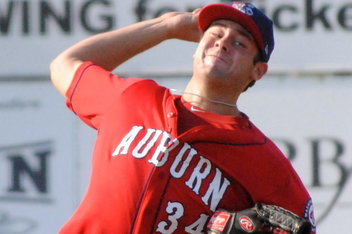
Great video of Lucas Giolito from GCL

18 comments

Giolito's comeback from TJ surgery has been great.  Photo Eric Dearborn via win-for-teddy blog

Giolito’s comeback from TJ surgery has been great. Photo Eric Dearborn via win-for-teddy blog

Courtesy of MinorLeagueBall.com’s John Sickels (who I’ve asked if he’s doing a player-by-player recap of this year’s draftees like he did last year, which I borrowed from for a good blog post last off-season, but have not heard back), here’s a posting with links to the blog BaseballInstinct, which has some good video of Lucas Giolito throwing during his time in the GCL earlier this month.

The videos are set to rather loud music, so hit mute if you’re at work or are annoyed by electronic/techno music.

The videos show POV from behind the catcher and then some from the side, have some MPH readings, have some slo-mo of Giolito’s mechanics for various pitches and at release points.

Observations/thoughts:

– He looks like a bigger kid than the photo above shows.  He has a good pitcher build, big legs, big strong body.  He’s listed as 6’6″ 230 so I’m not sure why I thought he was a little wiry kid.

– His motion looks like a cross between Cole Kimball with perhaps a little Roy Oswalt.  When he lands, his shoulder tilt and arm position are almost identical to Kimball’s, while his arm flail in regular speed seems like a throwback to Oswalt.

– 92-93 reportedly on the gun in these videos; it was from earlier this month, early in his recovery from Tommy John surgery.  But, this is a far cry from the reported upper 90s/100 he showed in high school (speeds per PerfectGame scouting reports).  I’m hoping this was just from a very early game in his rehab and he was holding back.

– Is it just me, or is his curve ball incredibly telegraphed?  His arm position seems way, way higher for his curve than it did for his fastball.  That and his hand position seems to be very simple to pick up.  We talked earlier this season about tipping pitches and I’m guessing this is something they’ll work on with Giolito.  If an amateur like me can see a difference that distinct, then a professional certainly can too.

– Likewise, later in the video his trailing leg finish is incredibly inconsistent.  Sometimes it comes across his body, sometimes he kicks the ground, sometimes it just trails behind.  It seems like he may need some mechanical fine tuning.  Does this make a difference in the pitch?  It’s too late to be a pitch tipping mechanism and could be because he was throwing from the stretch/trying to slide step a bit.

– He gets an incredibly long push-off the rubber (see the side-action video later in the link).  By the time he releases the ball, his foot is at least 12-15 inches in front of the rubber and his arm/release point has to be at least 7+ feet in front of the rubber.  Study the video; he’s 6’6″ and he’s clearly further off the rubber than he is tall.  We talk about how really tall pitchers (think Jon RauchChris Young and Randy Johnson) get an advantage because they’re releasing the ball closer to home, so the pitch looks faster than it is.  Giolito’s mechanics combined with his height give this same appearance.  If you combine this long push-off and the reported velocity he can achieve … wow, that’s a heck of a combination.  There’s no wonder that he was in the mix for 1-1 last year.

Any other thoughts?  I know there are readers out there who discount this kid as a prospect.  But I’ll say this; 10 shutout innings so far after being promoted to Short-A, which is basically a college league.  He’s only 19 and is recovering from injury.   If he starts next season in low-A before his 20th birthday and gets promoted up at some point, he’ll be well on his way to being one of the top prospects in baseball.

Written by Todd Boss

August 30th, 2013 at 10:58 am

Matt Harvey; just unlucky

7 comments

Harvey gets a really unfortunate diagnosis.  Photo: Brad Penner-USA TODAY Sports

Harvey gets a really unfortunate diagnosis. Photo: Brad Penner-USA TODAY Sports

What happened to Matt Harvey?
One of my friends speculated that his overuse at UNC may have contributed to his very unfortunate torn UCL/possible need for Tommy John surgery and drew a parallel to our own Stephen Strasburg in terms of young phenoms going down.  I don’t recall any accusations of overuse of Strasburg at SD State; in fact Tony Gwynn seemed to be hyper aware of the media outcry if there would have been overuse and handled him very carefully.   His workload in college was carefully monitored, the Nats brought him along very carefully and were hyper sensitive to any slight issues in his first pro years.  And Strasburg got hurt anyway.
UNC has a somewhat dim reputation among scouts for destroying pitcher arms (as does Texas, Rice, and a couple other programs), and you saw some evidence of that in this past CWS (where UNC’s “closer” suddenly was starting games and throwing 100s of pitches during the tournament after being a one-inning guy most of the year).  But Harvey left UNC in 2010.  A long time ago.
UCL tears are often point-source injuries; think about Strasburg’s torn UCL: he did it on one pitch.  Yes he probably “strained” the UCL before then (strain is medical term for “small tear” apparently, as we learned during the Lucas Giolito drafting), but it was very clear the exact moment Strasburg blew it out.  Meanwhile, shoulders seem to be more degenerative over time from overuse.  There doesn’t seem to be any video of a single pitch that blew out Harvey’s UCL, and I’m sure there’s arguments and counter-examples against this, but my observations seem to support this.  One day pitchers are healthy, the next day they have a blown elbow ligament.
What else could have caused Harvey’s injury?
Pitch counts?  Harvey’s game logs this year aren’t egregious: a couple of 120 pitch games (studies have shown that 120 pitches is about the threshold for pitches in the majors before workload effects are demonstratble in subsequent starts).  Lots of games in the 100-110 range.  But that’s to be expected; he’s a big guy, a workhorse, always has been.
Innings thrown?  Here’s a concern area.  96 college innings in 2010, 135.2 in 2011, 169.1 in 2012 and 178.1 in 2013 before this injury.  You generally don’t want guys to increase workloads more than 20% per year (the “Verducci effect,” so to speak)  He increased his workload 28% from college to his first pro year and another 20% from his first pro year to his second.  He was well on his way this year to another 20% increase and was set to be shut down before this injury.  He was definitely a risk for ramping up his innings too fast.
Mechanics: no evidence of any trouble spots; his mechanics have always been clean.  He threw hard but he wasn’t considered a “max effort” guy.  Too bad for the “inverted W” conspiracy crowd; they can’t have another poster child for their internet meme which is usually ignored by scouts and baseball professionals.  (as you can tell, I don’t believe in the inverted W b.s. as being anything other than coincidental.  For every pitcher with an arm injury and inverted W mechanics you can 1) find a pitcher with inverted-W who has NO injury history or 2) find a pitcher with impeccable mechanics who suffers the same type of injuries that the inverted W supposedly caused).
Is it the  Travel-league/year round baseball that prospects these days have grown up in?   If anything, you’d think that year-round baseball would help these kids, not hurt them, by building up arm strength and building up the muscles surrounding the critical points in a throwing arm (ucl, rotator cuff, labrum, etc).  This goes counter to recent advice from Dr. James Andrews, who advised that kids need an off-season from baseball to allow their arm muscles to rest and regenerate from the abuse that pitching causes.  Of course, you could also counter argue it and say that “the arm only has so many bullets in it” and each pitch is one pitch closer to an injury.
The “right” answer is probably some combination of all of the above, as well as genetic bad luck.  Some guys have absolutely perfect mechanics and get injured (Harvey), some guys have perfect mechanics and throw 10,000 innings (say, Nolan Ryan), some guys have crummy mechanics and get away with it for a long time (think Don Sutton or someone like that).
On the bright side; Tommy John surgery is now somewhere between 85-90% success rate.  And these TJ surgeries actually improve the arm action.  An amazing stat was tweeted by Rob Neyer in the wake of the Harvey injury; of the 360 pitchers who have started games this year, 124 have had Tommy John surgery.  124 of 360!  That’s one out of every three major league starters in the game.  Our own Nats experience exactly matches this: of the 9 guys we’ve had start a game this year 3 have TJ surgeries in their history (Strasburg, Jordan Zimmermann, Taylor Jordan).  The surgery doesn’t just repair, it improves the arm stability and strength.  TJ pitchers often come back with more break on their curve because the elbow has been improved.  They don’t just staple the tendon in place; they drill holes in the bones to attach the tendon so its got a stronger bond than what was naturally there.
In any case, it really is unfortunate to see such a great young guy suffer an arm injury so soon.  Hopeful for a full recovery.  The baseball world is a better, more fun place with young aces like Harvey out there every 5 days.

Ask Boswell 8/19/13 edition

7 comments

Arod, the greek tragedy figure. Photo John Munson/The Star-Ledger via nj.com

Arod, the greek tragedy figure. Photo John Munson/The Star-Ledger via nj.com

With somewhat of a lack of topics to write about lately, I turned to find a relatively deep Ask Boswell discussion on the Washington Post website 8/19/13.  Tom Boswell takes baseball questions, I provide my own answers.

As always, I’ll write answers here before reading his, and edit questions for clarity.  All stats quoted are as of 8/19/13.

Q: Leave it to the Red Sox to make A-Rod into a sympathetic figure!

A: Agree.  I wouldn’t normally have tuned into the expected 4.5 hour 8pm Sunday night game between Boston and New York, but just happened to see the first Alex Rodriguez at bat last night.  My immediate thought: Ryan Dempster‘s actions were pretty gutless and he should have been immediately ejected.   You throw at a guy once and miss?  You’ve made your point.  You had your chance to make a statement and missed.  But then throw two more balls inside then blatantly drill the guy on 3-0?  Sorry; that’s just bush league.  The umpires badly mismanaged that situation; Dempster should have been immediately ejected.  Joe Girardi had a very legitimate point at the time, and continued with very intelligent observations afterwards (where, paraphrased, he said that Dempster was a union rep, should have known better, and if he had a problem with the process of his own players’ union the time and place was elsewhere, not on a nationally televised game).

So, yeah, Alex Rodriguez did earn sympathy there.  How poetic was his home-run later in the game?  Were it me, I would have milked it for everything it was worth, making it a poster child for every egregious home-run celebration.  Bat flip, slow trot, kisses to the stands, fist pumps and multiple pointing to the sky.  But that’s just me.

Boswell doesn’t really say much about the question other than stating the obvious about the athlete and the situation.

Q: Wouldn’t it be better to show up the Braves by actually beating them once in a while, rather than throwing at them?

A: Not the point.  As I posted in this space over the weekend, there’s a code in the game that the Nats, for some unknown reason, were not keeping to.  Kudos to Stephen Strasburg for finally standing up for his own.  It has nothing to do with wins or losses on the field, it has to do with protecting yours.  Boswell says the Justin Upton plunking was done perfectly, but then questions the ejection for what a lot of people thought were just very wild pitches to Andrelton Simmons.

Q: Why did the Nats not keep Oliver Perez?

A: Who said it was just the Nats decision?  Oliver Perez piched as a starter for our AA team in 2011 and then signed another minor league deal with Seattle for 2012.  Only then he converted to a reliever and has had success since.  We don’t really know what happened; maybe the Nats offered to keep him but wouldn’t promise a AAA spot or a spring training invite.  Maybe Perez saw our rotation for 2012 and thought Seattle would give him a better shot at a MLB job.  Honestly I don’t remember a single word at the time indicating that either side wanted a 2012 deal.  Perez was good but not great in AA for us in 2011 (3-5, 3.09 ERA. 1.3 whip in 15 starts), far less than a guy who was once a very effective MLB starter.  Maybe we just though he was washed up.  Boswell questions whether a guy with a 4.25 ERA is even worth discussing.  Fair point

Q: Who would the Nationals “third-string” catcher be? If, for instance, Suzuki got injured and Ramos pinch-hit. -Who would be the preferred position player to pitch if they ran out of pitchers? 

A: Great question.  3rd string catcher?  I have no idea, maybe Steve Lombardozzi.  I do remember the team saying that despite Bryce Harper‘s youth position being predominantly catcher that he was not an option.  Pitcher?  Boy, another who knows.   I can’t remember a single positional player who has taken the mound for the Nats since they moved here.  The best guess would be a utility guy, either Lombardozzi or Scott Hairston.  Boswell guesses the same names I do.

Q: Do you think the Nats will make a serious effort to keep him next year? (I’m already writing off 2013) I’m sure he wants to play every day, but given Ramos’ physical issues that isn’t out of the question.

A: Kurt Suzuki is gone.  His $8.5M option for next year is way, way too much for what he has become; a once-a-week catcher.  Even given Wilson Ramos‘ fragility, you just can’t waste money at the backup catcher position.  Look for a 2014 spring training fight between Sandy Leon and Jhonatan Solano for the #2 catcher spot, and look for the team to add a lot of depth in the minor league ranks in the off-season.  Boswell notes the horrific catcher ERA of Suzuki compared to Ramos, and predicts a minor FA signing this coming off-season.

Q: Is there a more insincere human being in sports than A-Rod? Has he always been like this?

A: The above answer was my weekly quota of Alex Rodriguez discussion.  I will say this though; how do you really KNOW that A-rod is an “insincere human being?”  Do you know him personally?  Or are you just following the media narrative?  Boswell makes a good point; the damage he’s done to the game outweighs any sympathy you could have for him.

Q: You’ve said in the past the Nats would return to their career averages…eventually. Are the Nats reverting to their mean, or is this the new mean?

A: If 2012 was the high, maybe 2013 is the low.  Lets hope for somewhere in the middle for 2014.  Hell, i’ll settle for league average.  I did a quick little runs-scored analysis at the end of June that showed where the Nats record would have been if they had a league-average offense (tied for 1st place) or their 2012 offense (best record in majors).  You could quibble with the math, but I think we all know what has let down the team this year.  Boswell summarizes many of the same points I made … and then has some great stats isolating the bench’s collapse this year.

Q: Given Haren’s performance since returning from the DL, does Rizzo make him a qualifying offer for 2014?

A: Good question.  I just don’t see how you can give Dan Haren a qualifying offer.  The Q.O.  amount is going to increase; lets assume its $14M/year.  Would you give a guy with this stat line $14M?  7-11, 4.79 ERA?  Probably not (those are his season numbers).  His last 8 games (since coming off D/L?)  3-2, 2.25 ERA.   Yeah, that’s worthy of a Q.O.   Maybe the team avoids having to make a decision and flips him to someone needing a starter for September, since he passed through waivers.  That’d be advantageous to Haren too, meaning his signing next off-season won’t have compensation associated with it.  In any case, I think the performance of Taylor Jordan has clearly made Haren expendible, giving as good as or better performance for 1/26th the cost.  Use that $13M towards some hitting.  Boswell says no.

Q: When does Drew Storen replace Soriano as the Nats closer?  (After another blown save).

A: When Soriano’s contract is over.  You bought him, you’ve gotta use him.  Rafael Soriano‘s m.o. was always “good when he’s the closer, sullen underperformer when not.”  He was a poor signing when they got him, and continues to be wasted money.  But hey, its not my money.  Boswell agrees.

Q: When Magic Johnson’s group purchased the Dodgers, he was going to fire Mattingly, whom you said would be a very good manager. Does he still want to fire Donnie, now that the Dodgers have gone 42-8, the best MLB win stread in 100 years? Would you like to see him managing the Nats?

A: Well of course Don Mattingly isn’t going to be fired; he’s now neck and neck with Clint Hurdle for manager of the year.  I don’t have a good sense for what kind of manager he is; after Davey Johnson‘s laissez-faire attitude I know what kind of manager I do want; I want someone with some emotion.  Girardi proved a lot to me last night; lighting into an umpire who failed to control the game.  That’s the kind of emotion I want in my skipper.  Boswell gives some good managerial candidates.

Q: Who are the young pitchers the Nats thing are coming soon?

A: From AAA on downwards, here’s a few starters to keep an eye on: Nathan Karns, A.J. Cole, Robbie Ray, Taylor Hill, Sammy Solis, Matthew PurkeBlake Schwartz, Jake Johansen, Austin Voth and Lucas Gilioto.   Almost every guy on this list has performed well and/or earned a promotion in 2013.   Boswell points some of these guys out and then mentions that we need to produce some hitting too.

Q: Should I be worried that the Nats are going to become the new Caps, a talented team who just lacks the discipline to get it done when it matters?

A: No, because at its heart this is still the same basic team of guys who nearly won 100 games last year.  They need a new voice in the skipper’s office, one who reverses the course of Johnson and who properly motivates them.  Boswell says not to judge a team because of 3/4’s of one disappointing season.

Q: Zim’s surgically-repaired shoulder clearly affected his throwing this year — whether physically or mentally. However, his power numbers at the plate are down too, and we haven’t seen his usual late summer hot streak. Do you think his shoulder affected his hitting? If so, what’s the prognosis for next year for Zim’s hitting?

A: If his shoulder really is/was as bad as everyone seems to think, then yeah you can derive all sorts of bad performance indicators from it.  Next year?  Who knows; he should be healthy.  Of course, he was promised to be healthy by spring training of THIS year.  It takes me back to what I now perceive as disinformation from the team about the whole shoulder issue from the onset.  Either way, I think he’s playing 3B for this team in 2014 no matter what (well, unless the team somehow unloads Adam LaRoche).  Boswell shows some good stats showing Zimmerman’s consistency over the years, then goes on to rave about Jayson Werth.

Q: Will baseball be ruined by the addition of instant replay or have the times changed?

A: I think times have changed.  But from all accounts, the implementation will be typical of everything MLB does; half-done, ham-handed, inefficient and not going nearly as far as its counterparts.  Boswell isn’t a fan.

Q: With two years under his belt, he has a 3.00 ERA and a pretty good 27-19 record. He doesn’t hit 100 mph anymore. He hasn’t proven so far to be anything better than mediocre in the clutch. Not a bad track record, of course, but not anywhere near great. He’s 25 years old now. Is it time to adjust expectations?

A: Is this a baiting question?   Quotes ERA and W/L record as the sole ways to evaluate a pitcher (especially a pitcher who hasn’t yet pitched a full season).  What proof is there that he’s “mediocre in the clutch?”  He’s still the highest or 2nd highest average fastball of any starter in the league despite dialing it down, he’s still a league leader in K/9.  His ERA+ is still significantly above average both for this year and for his career.  What more do you want from the guy?  Ask any baseball pundit to give you a list of his top 5 starters in the league and he’s still on it.   Boswell gives some great historical stats, putting Strasburg in pretty elite company thus far.

Q: Why has Bryce Harper not made the 20 year old leap we expected him to? Did the collision with the wall in LA derail his entire season?

A: A fair point; everyone saw his splits pre and post-LA wall.  His lefty splits are abhorrent.  But he hasn’t been the second coming of Mike Trout.  Maybe we just need to appreciate him for what he is right now.  Boswell mirrors what I said.