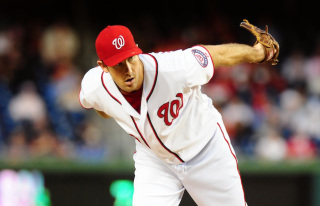
Nationals Arm Race

"… the reason you win or lose is darn near always the same – pitching.” — Earl Weaver

Archive for the ‘john lannan’ tag

Ask Boswell 11/26/12 Edition

22 comments

The Nats entire off-season plan revolves around what Adam LaRoche does. Photo Alex Brandon/AP via wp.com

I havn’t done a “how would I answer this chat question” from The Washington Post’s Tom Boswell in a while, but on the back of his 11/26/12 “Stay the Course” opinion piece in the Washington Post (where he basically advises that the team should stay out of the major FA market this off-season), I thought I’d chime in and read/respond to his 11/26/12 chat.

My opinion on Boswell’s piece; I don’t think you can stand pat in today’s baseball world.  Yes this team won 98 games last year.  But does anyone think we’ll win 98 games again by doing little to nothing to address the team’s needs?  Trying to replace Adam LaRoche and Edwin Jackson’s departures internally has a large chance of weakening the team, and I believe we need to explore a significant FA purchase (or a trade) this off-season.  Now, inarguably TV deals and the rising revenue streams are fueling the FA market, and we’re already seeing contracts that heretofore would have been immediately labeled as “over pays.”  Therefore, even if the Nats go after a 2nd or 3rd tier player in free agency, they’re going to be compensated far more than we ever thought their value represented.  But this is just the way the baseball world is going; we can no longer say that someone is “overpriced” … we need to remember that everyone is going to be “overpriced.”  Perhaps Jayson Werth’s $126M/7yr deal will look like a bargain in a few  years.

And this is before even addressing the impact that the amazing new Los Angeles Dodger’s TV deal, reportedly worth between $6 and $7 billion dollars over 25 years, will have on the baseball world.  Even at the low-end estimate, that’s $240M a year in RSN revenue.  $240M a year!  They could field a $200M team, pay luxury taxes and still have money to spare under this deal, and that’s before a single dollar in gate, game-day revenues, suites, parking or merchandising comes in.  To call this a “game-changer” is an understatement; I think this could be a serious issue facing Baseball in the coming years.  We’re already seeing what the new ownership group is capable of doing in terms of acquiring talent without much regard to payroll.  What happens if they also acquire the likes of Josh Hamilton and Zack Greinke this coming winter?  A quick check of Cot’s page shows that Los Angeles has $169.5M committed to its top 14 players right now, with three guys making > 20M and nine total with pay > $11M/year.  And they’re reportedly in the mix for the top FAs this off-season, potentially adding 20-30M more to that base number.  That’s amazing.  Just more revenue sharing for Jeffrey Loria to pocket I guess (Thanks Bud!).

Anyway, back to the chat responses.  As always, I write my response before reading his, and sometimes edit questions here for clarity/conciseness.  I’m only answering baseball-related questions, ignoring the slew of Redskins issues.

Q: Are the Nats positioning themselves to make a strong push in the next two drafts?

A: This is what I whittled down a long-winded, rambling “question” to.  The gist is that a comp pick from Adam LaRoche leaving, plus another potential comp pick if Michael Morse leaves next year could help re-stock the farm system.  I’d tend to say, “maybe.”  The Nats are no longer where they were in 2009 and 2010, getting franchise players by virtue of back to back awful seasons.  So the likelihood of finding an impact player is far less.  That being said, having multiple first and supplemental first round picks is a great way to find players and to get guys who “slipped” due to signability/injury issues (as Lucas Giolito did this year).

The Nats farm system has taken some hits in the last two seasons; one from trade (losing 4 top-10 players in the Gio Gonzalez trade) and then another from injury concerns for its top guys (Sammy Solis, Matthew Purke, Lucas Giolito, and Anthony Rendon all representing 1st and 2nd round talents who suffered either season-ending injuries or significant injuries curtailing their progression in the last calendar year, to say nothing of injuries to lower-level guys like Taylor Jordan who will provide depth rising up).  This thinned farm system may prevent Rizzo from making the kind of deal he made last summer, and he may want to focus on getting some more depth in the 2013 draft, as much as is possible from drafting so low.

Here’s the issue writing my own response before reading Boswell’s: he didn’t even talk about the draft portion of the “question,” instead talking about the FA pitcher angle.

Q: What do you think the team is planning on doing to replace Edwin Jackson?

A: I’d guess the team is working on two fronts: one looking at possible trade angles with teams that have surplus starting pitching (Arizona, Tampa Bay, Oakland, Los Angeles Dodgers and perhaps even Atlanta) and seeing if he can swing a deal.  Then I’d guess he’s looking at a 2nd tier of starters, looking to avoid the Greinke sweepstakes (despite his affinity for the hurler).  I do NOT think the team is going to tender John Lannan, instead looking to get a better pitcher for slightly more money than the $5M he’d likely earn at a minimum in 2013.  Of course, with the prices we’ve seen for lefties already perhaps we will tender Lannan and consider another $5M insurance policy a bargain.  Boswell scrolls through the same 2nd tier of starters, noting that there’s definitely someone out there who could work.  He also mentioned the team may look at re-signing Zach Duke, though I’d be surprised by that.  Why would we re-sign Duke but non-tender Lannan, if Lannan clearly is a better pitcher?

Q: Is the lack of a MASN deal hindering the Nats FA plans?

A: You have to think it is.  If the Nats knew what they were getting next year, they’d certainly have a better idea of how much they could spend.  The fact that Bud Selig has allowed Peter Angelos to hijack this MASN revenue negotiation for this long is deplorable.  Of course, by waiting this long with the negotiations Angelos has only cost himself money, as the price we can command as a franchise certainly skyrocketed between the end of 2011 and now.  So there’s that.  But its clear the team is getting a pittance as compared to other comparably sized markets (Houston, Philadelphia) and needs a larger share.  Boswell doesn’t think the lack of a deal is affecting the team’s plans, mostly because there’s not a $250M player on the market this year as there was last year.

Q: Were you invited to any of the seven off-season Nationals player weddings?

A: I wasn’t.  Boswell wasn’t either.  :-)

Q: Why did the MLB allow the Marlins trade to go through? It poisons Miami against baseball probably for a decade and will surely be seen as a cautionary tale for city governments for at least as long.

A: Simple reason: Selig is buddies with Jeffrey Loria and has enabled his crummy behaviors for nearly 2 decades.  More complex reason: on the face of it, from a purely baseball sense this trade was little different than the Boston-Los Angeles trade, and I’d guess you would have a hard time accepting one and denying the other.  Loria’s position with Miami is not Selig’s concern; he got the new stadium that Selig claims is necessary in every market and Loria clearly will continue to profit from the team.  To an owner, that’s the primary concern.  And Selig works for the owners.  All of us bloggers and columnists to deplored the trade and Loria in general (including me, in this space in September and again in November) and talk about the sanctity of the game are just blowing hot-air.  Selig doesn’t care.  Boswell didn’t really answer the question, just saying that baseball is dead in Miami for a long, long time.  Hey, it only helps the Nats to have a 110 loss team in the division, right?

Q: Is Adam LaRoche destined for the AL as an aging 1st baseman?

A: I don’t think so; the questioner compared LaRoche to Adam Dunn, who can DH and is more valuable in the AL.  Inarguably aging sluggers fare better in the AL … but LaRoche just won a gold glove for his defense at first base.  He isn’t exactly a plodding first baseman slowed by age.  He should be able to capably play the position for several more  years, through whatever contract he’s about to sign.  Boswell agrees that this is the trend, and says that Baltimore is a possible destination … but mentions nothing about LaRoche’s plus defense.

Q: Why aren’t the Nats making a bigger play for Edwin Jackson?

A: A good question.  I questioned the Nats lack of a Qualifying Offer being extended to Jackson and surmised it was because the team was afraid he’d take it (having a history of working on one-year deals).  So clearly the lack of the Q.O. indicates a new direction for the team.  I don’t think its related to his meltdown in the post-season; that can happen to anyone (see most of our pitching staff not named Ross Detwiler).  I’d guess that it relates somehow to Jackson’s maddening capabilities; shutdown power pitcher one night, gopher-ball machine the next.  I think they’re just going in a different direction.  Boswell says Jackson wants a 5-year deal … which if true even more reinforces my questioning of the lack of the Q.O.  I disagree with his sentiment that the team is “saving room” for the rising farm system arms; to me a prospect starter is not a solution until the day he arrives in the majors and gives you 30 starts.

Q: Why did Tampa extend Evan Longoria?

A: The team had him under baseball’s most team-friendly contract (6yrs, $17.5M with three team options, locking him to Tampa from 2008 til 2016).  One of baseball’s best players, he made just $2M and $4.5M in the last two seasons.  Which is just ridiculous.  I feel Tampa did the extension to show good faith to the player who was just so woefully underpaid.  Boswell didn’t really answer the question, just saying its a good move because hitters come back from injury better than pitchers.

Q: Should the team be worried about losing LaRoche and his lefty power?

A: Yes absolutely.  Which is why the team should either try to get him to sign a reasonable deal (3 years max) OR the team should let him walk and try to replace the lefty power on the FA market (perhaps in the form of someone like Nick Swisher, who won’t be cheap but also can stick in LF for a while and should fit in nicely to the clubhouse).  Or maybe the team swings a deal for a lefty outfielder in trade and sticks Morse at first.  Boswell agrees, thinking that LaRoche’s hot FA market will get him a 4 year deal for more money than the Nats are willing to pay.

Q: Is there any chance that MASN just cuts ties with the Nats and frees us from the awful deal?

A: No. Chance. In. Hell.  Angelos stands to get such massive, major profit from this deal that he’ll die before giving in.  There is just no way.  And more and more its looking like this pact with the devil, which enabled the team to move here, will be a limiting factor in the years to come.  People talk about how Atlanta has the worst TV deal in the MLB?  Well what about the Nats?  Boswell asked Selig about this and was told that “everything is on the table.”  I highly doubt that, but I’m not going to call Boswell a liar.  I’ll just say, “Don’t hold your breath” that the Nats will be allowed to extract themselves from MASN and create their own RSN.  This would be the absolute dream scenario, but I just cannot see Selig backpeddaling on this deal less than a decade after it was signed.

Q: Will the Nats learn the lessons heeded by other big-money teams who got saddled with old, expensive players?

A: Hopefully so.  Not giving LaRoche 4 years would be a signal to that end.  But it can be difficult; what happens when the whole core of our young team hits free agency?  That’s a lot of big checks to write, and the fan base will bemoan every star that is allowed to walk.  Boswell thinks LaRoche is consistent enough to warrant the contract, but also notes that he’s several years past the typical hitter prime.

Q: Is Morse really the better choice at 1B if it’s between him and Moore? Is he really just that bad in the OF?

A: I’m convinced this narrative is overplayed.  Morse was a shortstop coming up through the minors, so he’s not exactly immobile, and suddenly nobody remembers that Tyler Moore was a plodding minor league first-baseman who only tried LF for the first time in spring training of last year.  Now suddenly Morse isn’t the better LF option?  I don’t buy it.  Neither are great LF choices; Morse had a -23.3 UZR/150 in 493 innings while Moore had a -22.7 in 229 innings this past season (small sample sizes both).  So it seems they’re both awful out there.  But then again (as I’ve said many times) you can “hide” guys in LF if they’re big bats.  You take the lesser defense in order to get a middle-of-the-order hitter.  The last thing you want is a #8 hitter (think Xavier Nady) bumbling around in LF and hitting .190.  If we lose LaRoche, I think the team should put Moore back in his natural position at 1B and let Morse get one more season out there.  Boswell didn’t answer the question, instead rambling about something else.


Nats 2012 Rule 5 Protection Analysis

4 comments

Is Nathan Karns a 40-man roster addition candidate ahead of the rule-5 draft? Photo Potomac Nationals official via milb.com

In part I on this topic yesterday, we talked about the Nats Rule 5 draft history.  Today we’ll talk about Parts II and III: who the Nats may think about protecting ahead of this year’s Rule 5 draft, and what the team may be seeking if they participated and drafted a player or two in the Rule 5 draft themselves.

Part II: Nationals Rule-5 Draft Protection Candidates.

I kvetched a little bit about this topic in this space earlier this off-season, talking about the lack of roster space for the upcoming Rule 5 draft.  I suspected that as a result of MLB deals given to guys like Anthony Rendon and Matthew Purke, in addition to the glut of guys we had to add mid season, we may be seeing some guys not getting protected this year that would be in other years.  As of today, the Nats 40-man roster sits at 36 players with a bit of immediate room to spare (we could non-tender the likes of John Lannan, Tom Gorzelanny or Jesus Flores (speaking of Rule 5 additions) in a pinch, and I think Carlos Rivero may be imminently DFA’d), but we also have several 25-man roster spots departing via free agency that need to be filled, quickly filling back in those empty spots.  So, perhaps the issue isn’t as bad as I thought it might be.

That being said, here’s a look at some of our Rule 5 eligible guys that may warrant protection.  For “official” opinions here’s Mark Zuckerman’s Rule5 post, along with Adam Kilgore’s version of the same analysis.  This is a combination of first-time eligible guys for the 2012 draft (mostly, guys who were college junior draftees from 2009 or high school draftees in 2008), prior year eligible guys who have suddenly worked their way onto the radar, and any International FA signing from 2008 or before (they are treated the same way as high school age draftees).  Working off a list that Luke Erickson posted LAST november, along with his post on the same topic this week, and of course referencing the two great nats farm system resources maintained by “SpringfieldFan” (and formerly by Brian Oliver): the Nats Draft Tracker and the Nats Big Board, here’s some thoughts on protection candidates:

Stronger Candidates to protect

  • Nathan Karns: he finally had an injury-free season, and he put up numbers as expected when the team gave him an above-slot deal in 2009.  He is older, and only projects as a AA starter in 2013, but he is an intriguing starter prospect for the Nats in 2014.
  • Destin Hood: I don’t think the team is ready to give up on the long-term 2008 2nd round project.  His numbers have been increasing as he reportedly is learning the game better.  I suspect the team protects him to protect their investment.
  • Danny Rosenbaum; the “Ace” of Harrisburg this year, and our furthest advanced legitimate starter prospect, Rosenbaum projects more like a Tommy Milone or John Lannan right now.  I’d suspect that the team may protect him, thinking that someone could stash him as a loogy for a year.  I’m not sure his ceiling is in the Nats rotation, but he could be a good trade candidate.  He hit the DL late last year, which makes it slightly less likely that a team would take a flier on him, but his track record warrants his mention.
  • Patrick McCoy: he just repeated AA and despite already being Rule-5 eligible last  year he improved on his numbers in 2012.  Why protect him?  Because this team needs a Loogy, and McCoy may be the leading lefty reliever in our upper-minor leagues.
  • Jeff Kobernus has put up consistent numbers his whole career, but still projects as a power-less middle infielder.  Would the team protect him, thinking he has a chance to become the next Steve Lombardozzi?  Would the team protect him just to protect their bonus money?

Weaker candidates to protect

  • Trevor Holder: a 3rd round pick roundly criticized at the time of being an underslot money saver, Holder had decent peripherals in high-A and AA this year.  But, he doesn’t seem to project as the dominant right-hander he was in college and seems likely to top out as an org-arm.  Despite his 3rd round pedigree, I don’t see a team taking a flier on him in rule-5.
  • Pat Lehman; a local guy (GWU), but despite having good numbers in AAA he remains a very common commodity; a right handed minor league reliever.  Even if he’s drafted, it isn’t that great a loss because of the depth we already have at the position.
  • Paul Demny; despite making the AFL team this year, I don’t quite see Demny as being a draft risk.  His ERA this year and in years past has been substandard.
  • Robert Gilliam; only really mentioned here since we just acquired him last off-season in the Gio Gonzalez trade and the team probably doesn’t want to lose him, but his 6.37 ERA in AA makes it extremely unlikely someone grabs him in the Rule 5.
  • Erik Davis: technically rule-5 eligible last year, he stepped up this year and put up pretty dominant AA numbers.  As with Lehman, he’s a righty reliever in AA so the odds of his getting picked (or protected) seem slim.

Players not worth protecting for various Reasons

Now, there’s a bunch of “good names” that are Rule 5 eligible in our system but who are not listed here, including guys who toiled as high as AA last year.  Anyone not listed here is probably not going to be missed, even if they are drafted.  Plus, the likelihood of a decent pitcher prospect who has never played above A-ball being drafted in rule-5 is extemely slim.  Most of the guys above are mentioned because of their capability to be “stashed” on a MLB roster.  This includes:

  • last year’s departures Brad Meyers (coming off injury) and Erik Komatsu (clearly been passed on the organizational OF depth chart).  Yes they got picked last year, but both got returned and I’d be surprised to see them picked again.
  • higher profile draft picks Josh Smoker and Jack McGeary: neither has advanced far enough in their careers to realistically stick with a MLB team.
  • Jeff Mandel may be an accomplished AAA pitcher, but I don’t think he’s anything more than that.
  • Rob Wort hasn’t advanced far enough up the chain to be considered.
  • Justin Bloxom could be a dark horse prospect next year, but only made it to AA the second half of last year.

Who would I protect, If I was the GM?  I’d protect Karns, Hood, Rosenbaum and McCoy right now, filling the four current openings on the roster.  If a move needs to be made (a FA signing or a trade), then you make one-for-one DFAs or non-tenders as needed.  You have 40-man room; might as well use it.  My order of protection is probably Karns, McCoy, Hood and Rosenbaum (from most important to least important to protect).  Odds are that the team only opts to protect a couple of guys to give immediate roster flexibility heading into the winter meetings.

Part III: Might the Nats participate in the Rule-5 draft this year?

This year’s Rule 5 draft has some intrigue for the team; unlike last year, we have definite holes in the bullpen and on the roster which can be “more easily” filled via the Rule 5 draft.  We need a lefty out of the bullpen, we need a backup middle infielder and we need a 5th starter.  The odds of finding the latter in the rule 5 draft are very slim, but the odds of finding one of the first two are better.  If you look at the last couple of Rule 5 drafts, nearly every player drafted is either a Pitcher or a Middle Infielder.  Most teams carry a second backup middle infielder who gets very little playing time, ideal for “hiding” rule 5 draftees.  And of course every bullpen has a “mop up” guy who pitches once or twice a week in low-leverage situations, also a great place to hide a rule-5 guy.

Besides, the “penalty” for drafting a guy and returning him is pretty small in baseball terms: $25,000 net (it costs $50,000 fee to select a player, then if you “offer” them back the original team has to refund $25,000 of that fee).   So I’d be surprised honestly if the team didn’t roll the dice with at least a flier on either of the two needs mentioned above.

Personally, I’m not a big fan of the Rule 5 draft any longer.  It was created as a way to liberate players who were stuck in farm systems behind established players (much the way that minor league free agency rules attempted to do the same), but now seems to be a cheap method of teams to get an extended tryout of players.  I’ve now come to believe that the draft is not necessarily in the best interests of the players or the teams; just read below for the organizational transaction chaos that followed players.  It also seems like a high number of players who get drafted in rule-5 immediately suffer season-ending injuries; coincidence or correlation?  If you’re a rule-5 drafted arm, the drafting team knows you must perform at a MLB level to stay in the organization.  Wouldn’t that imply there’s added pressure to compete, leading to overthrowing and arm injuries?  Plus, teams that lose players often get them returned damaged and having lost a season of service time.  I suppose players are the ones that are pro-Rule 5 draft, in that it immediately means a promotion to the 40-man roster, MLB service time and higher pay.

In the end, it makes for a good reason to write a 2,500 word blog post, and it may result in our team having new prospects to evaluate and dream about, so perhaps I protest too much.

Ladson’s Inbox: 11/16/12 edition

2 comments

Werth; the most expensive lead-off hitter in the majors? Photo Mitchell Layton/Getty Images NA

Another edition of mlb.com Nats beat reporter Bill Ladson’s inbox for 11/16/12.  As always, I write my responses before reading his and edit some questions for clarity.

Q: Why are the Nats looking for a lead-off batter when Jayson Werth appeared to do the job very well in 2012? Do the Nats think someone can do that job better, or do they think Werth belongs elsewhere in the batting order?

A: A decent question, which the questioner answered him (her?) self, frankly.  From quotes I read from Davey Johnson at the time, when Jayson Werth came back from the wrist injury the team was missing any reasonable lead-off option and Johnson asked Werth if he’d do it.  He enthusiastically said yes.  My personal opinion is that Werth’s wrist injury probably wasn’t entirely healed to his liking, thus sapping his power stroke and making it easier for him to focus on contact hitting and OBP from the lead-off spot than it would be for him to return to his middle-of-the-order power.  He couldn’t have had a better lead-off hitter-esque split from his time there; .309/.388/.450 when hitting from the #1 position this season.  That is fantastic.  But realistically the Nats need to find another, proper lead-off hitter for two main reasons (one practical, one political); Practically; Werth is a bigger, better hitter than a lead-off guy and needs to be in the middle of the order, driving in runs with his power potential.  Politically; you don’t spend #126M on a lead-off guy.  I hate to say it, but it is what it is.  I wish the Nats had a better internal lead-off option; Danny Espinosa is the natural person to install there.  Switch hitter, a very good hitter in the minors.  But so far in his career he’s incredibly strike-out prone, his average is disappointing and his lefty/righty splits are awful (as addressed in a separate question further down).  The reason the “Nats want a lead-off-centerfielder” rumors won’t go away is directly tied to this fact.  Ladson agrees, mentioning frequent FA target Michael Bourn and Angel Pagan as options.

Q: Given Roger Bernadina’s improved hitting this past season, is there any possibility that the Nats may try him as a leadoff hitter?

A: Roger Bernadina absolutely turned a corner professionally in 2012, increasing his OPS+ figure fully 30 points from 2011 and posting a split line of .291/.372/.405.  Yeah, that’d be a fantastic line to have at lead-off.  I’ll freely admit that I thought Bernadina was closer to a DFA than he was to a valuable spot on this team last spring training.  We already know just how good a center-fielder he is defensively, and he’s lefty so he puts another lefty bat in the lineup and would allow the team to move Bryce Harper deeper into the order.  Imagine a lineup of Bernadina-Desmond-Zimmerman-Harper-Morse-Werth-Espinosa-Suzuki; LRRLRRSR, giving good lefty-righty balance through the lineup.  This lineup of course assumes Adam LaRoche departs as a FA (which I think is likely).  Now, do I think this is going to happen?  No.  I believe the team views Bernadina as a 4th outfielder, a super-sub, defensive replacement for later innings and he thrived in that role last year.  But that being said, if the FA market proves too costly (or if the Nats choose to go all-in on a SP and leave the batting lineup as-is), this is absolutely a viable option to try in 2013.  Ladson agrees with my sentiments; the Nats view Bernadina as a 4th outfielder.

Q: What do you think of Tony Beasley taking over as Nats manager after Davey Johnson calls it quits? Beasley has the experience. He just needs a chance.

A: Honestly I’d expect Mike Rizzo to bring on-board a more experienced skipper if/when Johnson hangs them up.  Perhaps someone from his Arizona days.  How many teams really promote from within for on-field management?  Ladson thinks Randy Knorr is the heir-apparent.

Q: Why don’t the Nats consider left-hander John Lannan a No. 4 or 5 starter in ‘13? Lannan showed he can pitch well in the past.

A: Man, how many times have I answered this question?  Lannan is a league-average pitcher, posting a career ERA+ of 103.  He isn’t a fireballer and rarely “dominates” a game.  Mike Rizzo wants power arms and just doesn’t rate Lannan.  He’ll look here and high for a harder-thrower for the 5th starter spot and is likely to roll the dice with hurlers Ryan Perry or Christian Garcia before he goes with Lannan next year.  Besides; Lannan would need to be tendered a contract and likely earns at least a nominal raise over the $5M he earned for toiling in AAA last year.  It just is not good value to pay $5M for a 5th starter when you’ve got MLB-minimum guys that can possibly do the job just as well.  Look for Lannan to get non-tendered and be pitching for a 2nd division team in 2013.  Ladson mirrors exactly what I wrote here.

Q: What are the chances of our GM, Mike Rizzo, going after a shutdown closer?

A: Zero.  Rizzo (rightly so in my mind) doesn’t rate closers on the open market as worthwhile investments.  I agree; I think relievers are fungible assets that are to be used and discarded as needed.  Now, if a former closer can be had on the open market cheap, Rizzo absolutely will bring them in.  He’s done this more than once in the past; Brad Lidge in 2012, Matt Capps in 2010.  Lidge didn’t work out at all but he only cost the team $1M.   Capps turned out fantastically, made the all-star team and was flipped for Wilson Ramos in what I think is Rizzo’s best trade (well, the Gio Gonzalez trade wasn’t half bad either).  The pickings on the closer FA market are slim, but I could see the team taking a flier on an injury reclamation project like Ryan Madson or Brett Myers.  Perhaps even re-signing Capps, who lost his closer role and could be inserted in middle-relief.  We do have bigger priorities though; namely replacing our 3 lefty specialists (Tom Gorzelanny is still tied to the club but isn’t a guarantee to get tendered).  Ladson says the team has a shutdown closer in Drew Storen and will focus elsewhere.

Q: Is Danny Espinosa really a switch-hitter? He is just horrible from the left side. Why doesn’t he just bat from the right side?

A: Great question, one that I’ve asked many times myself.  His career splits lefty/righty are pretty telling. .227/.306/.393 from the left side, .276/.346/.467 from the right.  He’s an all-star caliber hitter from the right-side only, posting a 124 OPS+.  I privately wonder if the team isn’t going to make the decision for him, and a full spring training just hitting from the right-side could be in order.  Of course, his value as a right-handed only hitter is greatly diminished.  Plus there’s a life-time of adjustments to be had; if you’ve been facing right handed arms from the left side your whole life, who is to say that you won’t similarly struggle once you’re seeing breaking pitches from the other side?  A tough call.  My gut says he sticks it out and the team shows the same patience with him that they showed with Desmond, who rewarded the team with a breakthrough 2012.  Ladson reports that Johnson has “all the confidence in the world” in Espinosa.  Looks like 2013 is a make-it or break-it year for  him.

Q: Can Zach Duke start for the Nationals? How does he compare with Zack Greinke?

A: Wow; comparing Zach Duke (a minor league FA signing this year with a career 49-74 record) to Zack Greinke (inarguably the top FA pitcher on the market with a Cy Young to his name) is sort of like comparing a fast-food joint to a steak-house.  There is no comparison; Duke is going to be lucky to get a guaranteed contract while Greinke is likely to get a nine-figure deal.  Can Duke start for this team?  Well, assuming the team resigns him (he’s a free agent) he’s not even as good as Lannan, who they could lock up for 2013 if they choose.  And (as discussed above) if the team doesn’t rate Lannan they certainly wouldn’t rate Duke.  I don’t think Duke even could feature as a LOOGY; he likely seeks another shot at starting in 2013 somewhere.  Ladson agrees, albeit without the hyperbole of my answer.

Q: What will the Nats do with Yunesky Maya? He appears he found himself while pitching a full season with Triple-A Syracuse.

A: I’d hardly say 11-10 with a 3.88 ERA in AAA is “finding himself.”  I’ll admit Yunesky Maya had some decent starts down the stretch, but he also had some awful ones.  Just like he did all season.  Maya got two shots in 2010 and 2011 to stick in the majors and failed both times.  I don’t think he’ll get a third.  Look for the Nats to obtain a 4th minor league option on Maya by virtue of his having fewer than 5 pro seasons and him spending 2013, his last of a 4yr $8M contract, as starter insurance in Syracuse again.  Ladson states that Maya is rule-5 eligible; Uh, perhaps you need to read up on the purpose of that draft Bill.  Its for NON 40-man roster guys.

Q: What’s up with Chris Marrero? Haven’t heard anything about him replacing Adam LaRoche at first base.

A: Another lost season for Chris Marrero, who spent a huge amount of time recovering from an off-season hamstring injury and ended up playing just 37 games in Syracuse after several rehab stops in the lower minors.  Zero home runs in AAA for the year.  I hate to say it, but Marrero has been passed by on the depth chart for first base, and the team would absolutely look at Michael Morse first and Tyler Moore second to man first base at the major league level before giving Marrero a shot.  His positional inflexibility really hurts him, in that he’s not showing the kind of power you need to at the position to get promoted upwards.  He’s still young though (born in 1988, he’s only 24).  Maybe he’s worth including in trade to another club.  Ladson didn’t say much; i’m not sure he really knows what the team plans for Marrero either.


Nats Arbitration Decisions; my predictions

8 comments

Tyler Clippard faces what could be a very interesting arbitration case this offseason. Photo Jonathan Newton/wp.com

Once the dust settled on this year’s Super-2 cutoff (and we discovered that Drew Storen will be arbitration eligible this year while Ryan Perry will not), the Nats will have no less than TEN arbitration-eligible players this off-season, setting the stage for some non-tender decisions, some possible contract extensions, and (hopefully not) some arbitration cases.  The Non-tender deadline isn’t until November 30th, but its never too soon to talk about what the team may do.

Here’s the 10 players eligible, a discussion as to what kind of salary they may obtain and whether or not the team will even tender a contract.  Note: the salary estimates are from mlbtraderumors Matt Swartz’s arbitration projections model, with my own thoughts adjusting up or down based on opinion and noted as such).  Arbitration salaries essentially try to project the full FA value of a player and then award 40%/60%/80% of that FA salary in each of the three typical arbitration years.  For guys getting a 4th, I generally assume they’re getting nearly 100% of their FA value in the last year.

Locks to get a Contract Tender

  • Ian Desmond. 1st year Eligible/$3.2M estimate: Breakout season in 2012 will earn him plenty of dollars in his first and subsequent arbitration cases.  $3.2M equates to nearly a $10M/year full FA value, probably fair for now but could escalate if Desmond continues to provide Gold Glove calibre defense to go along with middle-of-the-order power.  It may be slightly early to think about a longer-term contract extension for Desmond; I’d want to wait and see if his 2012 production continues into 2013.  Remember; he’s just one year removed from a time when most Nats fans wanted him replaced.
  • Drew Storen: 1st year Eligible/$1.7M estimate: Storen will get a 4th year of eligiblity by virtue of a quick call-up after getting drafted.  $1.7 over 4 arb years equates roughly to a FA value of $7M/year, which seems a bit low for a good closer.  I’d guess Storen could get slightly more money, though the team probably argues that his injuries in 2012 prevented him from giving full value, and is probably why he’s estimated at $1.7 instead of nearer to the $4M that Chad Cordero got his first arb year with this team.  Rizzo has dangled Storen in trade talks in the past, but seems likely to keep him (at the possible expense of Clippard) for the coming season.
  • Craig Stammen: 1st year Eligible/$900k estimate: Another super-2 guy who was incredibly valuable to the team this year.  I’d guess he’ll get more than 900k despite his role as a middle reliever, since 900k is barely more than the typical veteran minimum (which is roughly $800k, what Mark DeRosa made in 2012).  Though, 900k equates to roughly a $3.5M FA value, which seems high for the kind of middle relief right-hander that are a dime a dozen in this league.  I’d guess Stammen is the right kind of guy for the team to buy out a couple of arbitration years, much as they did with Sean Burnett a couple years ago.   But, being a fungible middle-relief arm, don’t look for anything other than a 2 year deal so the team is protected in case of injury.
  • Jordan Zimmermann: 2nd year eligible, $4.9M estimate: Another super-2 guy who will get a 4th year of arbitration, this estimate also seems low considering the season that Zimmerman just put in.  It also roughly equates his FA value at roughly $10M a year, which I’d guess is also undervaluing Zimmermann.  Ask yourself; if he was on the open market, you’d have to think he’s getting more than $10M/year (point of comparison: Kyle Lohse turned down a 13.3M qualifying option and may get 4/60; who would you rather have?)
  • Tyler Clippard: 2nd year eligible, $4.6M estimate: I see this estimate as high frankly, as being too much of a raise over his 2012 salary of $1.625 despite his being the closer most this year.  Clippard said it himself; its better to be the closer, get the saves and get the salary.  But $4.6M for a setup guy is way too hefty.  If Clippard comes in this high with his demand, look for an ugly arbitration hearing.  Honestly, I could see Clippard being a trade candidate and making this arbitration decision someone else’s headache, and the team goes into 2013 with Storen firmly entrenched as the closer with the likes of Mattheus, Garcia and Henry Rodriguez vying for the 8th inning role.
  • Ross Detwiler: 1st year eligible, $2.2M estimate: This seems right in line with what Jordan Zimmermann got last year ($2.3M in his first eligible year).  A successful young starter going through this process the first time.
  • Roger Bernadina: 1st year eligible, $1.1M estimate: A year ago I thought Bernadina was going to get DFA’d at the end of spring training.  Now I wonder if he’s got enough value to be flipped in trade after a standout season for this team as its 4th outfielder.  $1.1m is very reasonable for a 4th outfielder with his defensive skills, so don’t be surprised to see Bernadina remain in this role with the team for several years.

Most likely Non-Tender candidates

  • Jesus Flores: 4th year eligible, $1.2M estimate.  Flores represents an interesting test case.  Clearly he no longer has a 25-man catcher spot, having fallen behind both Wilson Ramos and Kurt Suzuki on the depth chart.  The team also has shown itself to have decent rising catcher depth in the likes of Sandy Leon and Jhonatan Solano.  And Flores really regressed this year both offensively and defensively, so much so that the team had to go out and acquire Suzuki late in the season.   So I completely understand those that think that Flores is a non-tender candidate.  BUT, you don’t just cut loose valuable commodities, and a healthy catcher who can serve as a backup in the majors is still worth keeping.  That being said (as I reported in an earlier post), Flores seems to have achieved 5 service years, meaning that despite his option availability he’d have to agree to be assigned to AAA.  Which means his flexibility is completely compromised for this team in 2013.  The only remaining reason to sign him would be as insurance in case Suzuki or Ramos get hurt in spring training.  If he doesn’t get traded in the next two weeks, look for a non-tender.
  • Tom Gorzelanny: 4th year eligible, $2.8M estimate.  I’m not sure I agree with the MLBtraderumor estimate here, because the likelihood of players getting pay DECREASES in arbitration is pretty slim.  Its not like Gorzelanny posted a 6.00 ERA in 2012 after all.  Gorzelanny made $3M in 2012, where he predominantly served as our long-man/mop-up guy out of the pen.   The question the team has to ask itself is this; is $3M too expensive for the last guy out of the pen?  I believe it is, and thus I believe Gorzelanny is destined to get non-tendered.  I believe the team likes him but his salary isn’t matching up to his role any longer, so I see him being forced to take a significant salary cut if he wanted to stay here.  Were I the Nationals, I’d rather take a shot at a MLB-minimum guy (or even a rule-5 guy) in that mop-up role.  The only thing that gives me pause in declaring that the team is ready to cut ties with a lefty reliever is the apparent sky-high cost of lefty relievers on the market; Jeremy Affeldt just signed a 3 year $18M deal to stay with San Francisco.  Would this contract convince the Nats management that perhaps Gorzelanny is a player worth hanging on to?
  • John Lannan: 3rd year eligible, $5M estimate.  There are two schools of thought with Lannan in the Natmosphere right now.  One group believes that the team will let Edwin Jackson walk, Lannan will naturally take his place as the 5th starter and the team won’t pursue any starter talent in trade or in free agency.  The other school of thought (and the one to which I subscribe to) states that Mike Rizzo values power arms and doesn’t rate Lannan at all, that $5M (which I think is a low estimate if he were to actually reach arbitration) is far too expensive for a soft-tossing 5th starter, and that the team will be actively searching for a 5th power arm to replace Jackson in the rotation.  I think the team would rather take that $5M+ and use it to pay an acquisition versus continuing to fund Lannan’s sub 100 ERA+ exploits.  This opinion ignores the rising cost of lefty starters, and the relative dearth of quality starts on the FA market, so perhaps the Nats hang on to him one more year.

Having so many arbitration eligible guys means that the Nats payroll will take a significant hit.  Assuming that the team tenders the above 8 players (including Flores), here’s what the payroll implication will be:

Player 2011 salary 2012 estimate
Desmond $512,500 $3,200,000
Storen $498,750 $1,700,000
Stammen $485,000 $900,000
Zimmermann $2,300,000 $4,900,000
Clippard $1,650,000 $4,600,000
Detwiler $485,000 $2,200,000
Bernadina $493,500 $1,100,000
Flores $815,000 $1,200,000
subttl $7,239,750 $19,800,000
Gorzelanny $3,000,000 $2,800,000
Lannan $5,000,000 $5,000,000

The team needs to plan on paying more than twice it did in 2013 for the services of the top 8 arbitration eligible players in 2012.  Most of that money can be made up by non-tendering both Gorzelanny and Lannan … except that those players would need to then be replaced on the roster.   Still, getting these 8 players for less than $20M a year while the Yankees owe Alex Rodriguez $28M for 2013 alone sort of puts things in context.  It is a good problem to have, having to pay your arbitration-eligible stars more and more each year.

Nationals Players’ Service Time and Option Status for 2013

15 comments

Jesus Flores achieved 5 full years of service time in 2012, complicating his roster status going forward. Photo Toni Sandys/Washington Post

In the process of opining on some preliminary Nats hot-stove moves this coming off-season, I found myself asking certain service-time/options questions about players on the 40-man roster.

So, I took the time to create a Spreadsheet of all Nats 40-man roster players with Options status for the coming season (well, actually update a version I had of this information from last year).  I also tried to update everyone’s service time to what it should stand at at the end of the 2012 season (though honestly some of the service time calculations, especially for someone bounced up and down this year like Corey Brown, can be tricky).

I know that Luke Erickson’s Nats Big Board has an “Options Status” tab, and I didn’t mean to circumvent the work there; i’m just not sure whether it has been updated for the coming season.  The big board Options tab also has some helpful links to decipher some of the options ramifications, especially the tricky 4th option (which will notably come into play for several of our guys very soon, as discussed below).

Nonetheless, if I have the Options statuses and Service time calculations correctly done, there are some interesting roster management moves on the horizon.  The below analysis includes a disputed 4th option for Ryan Perry; I’m pretty confident I’m correct in determining his option status but will caveat that opinion (and this whole article) by reminding the reader that I’m not in fact a professional baseball executive and may have a couple of these calculations wrong.

Here’s a full list of our current 36 40-man players (this is where we stand as of today, post FA declarations of our seven free agents plus the reverting of our former three 60-day DL guys to the 40-man roster).  I’ve got these players divided into four categories, with some discussion after each:

Category 1: Vets who can refuse demotion (5 or more years of service)

Players in this category and their service time at the end of 2012:

Name Svc Time First Added to 40-man Option Years Used # Ops Left
Gorzelanny, Tom 5.16 Sept 2005 2006, 2008, 2009 0
Flores, Jesus 5.079 Dec 2006 2008, 2011 1
Suzuki, Kurt 5.113 Jun 2007 none 3
Tracy, Chad 7.000 Nov 2004? ? ?
Zimmerman, Ryan 7.032 Sep 2005 none 3
Morse, Michael 5.114 Nov 2004 2005, 2006, 2007 0
Werth, Jayson 9.102 Nov 2002? ? ?

Discussion: Most of the guys on this list are no-brainer core pieces of the team in 2013 and beyond, but two names in particular raise interesting questions.  First Tom Gorzelanny has now achieved enough MLB time so that he cannot be sent down without his permission, but that was largely irrelevant based on his lack of options anyway.  He remains a non-tender candidate because of his expected raise from his 2012 $3M salary given his role as long-man/mop-up guy for the team (well, that is unless you’ve seen the price of left-handed relief on the FA market this off-season … maybe he’s NOT a non-tender candidate).  The bigger surprise on this list is Jesus Flores, who I believe achieved his 5th full service year in 2012 and now (despite having a minor league option left) can refuse an assignment to AAA.  This represents an interesting decision for the team, who clearly has Suzuki and Ramos as its #1/#2 catchers.  Most think he’s also a clear non-tender candidate for 2013, but I tend to think that he’s a valuable commodity worth tendering a contract.  Despite his poor batting in 2012 (slash line of .213/.248/.329) there is a market for backup catchers in this league, especially ones that once showed the hitting promise that Flores has (a slash line of .301/.371/.505 in the early part of 2009 prior to his injuries).  Maybe this service time issue becomes the straw that breaks the camel’s back of his tendering decision; if we tender him, we’ll immediately have to trade him because he’ll likely refuse an assignment and be declared a free agent if he doesn’t make the 2013 team.  Perhaps the team cuts bait on him before having their hand forced.

Category 2: Players with Options but who are entrenched on the 25-man roster for 2013

Name Svc Time First Added to 40-man Option Years Used # Ops Left
Gonzalez, Gio 3.162 Aug 2008 2009 2
Mattheus, Ryan 1.111 June 2011 none 3
Storen, Drew 2.140 May 2010 none 3
Strasburg, Stephen 2.118 Aug 2009 2010 2
Zimmermann, Jordan 3.154 Apr 2009 2010 2
Ramos, Wilson 2.047 Nov 2008 2009, 2010 1
Desmond, Ian 3.027 Nov 2008 2009 2
Espinosa, Danny 2.033 Sep 2010 none 3
Lombardozzi, Steve 1.023 Sep 2011 none 3
Harper, Bryce 0.152 Aug 2010 2011, 2012 1
Moore, Tyler 0.113 Nov 2011 2012 2

Discussion; the likelihood of seeing any of these guys optioned to the minors in 2013 seems slim; mostly they are starters and key players for the team going forward.  That being said, John Lannan’s surprise demotion in 2010 while he struggled was enabled by his options availability, and a struggling player like Moore or Lombardozzi could be sent down to make room if need be.

Category 3: Players whose Options almost guaranteed to be used in 2013

Name Svc Time First Added to 40-man Option Years Used # Ops Left
Kimball, Cole 0.138 Nov 2010 2011, 2012 1
Maya, Yunesky 0.070 July 2010 2010, 2011, 2012 1?
Perry, Ryan 2.142 Apr 2009 2009, 2011, 2012 1?
Purke, Matthew 0.000 Aug 2011 2012 2
Leon, Sandy 0.096 May 2012 2012 3
Solano, Jhonatan 0.092 Nov 2011 2012 2
Marrero, Chris 0.033 Nov 2010 2011, 2012 1
Rendon, Anthony 0.000 Aug 2011 2012 2
Perez, Eury 0.030 Nov 2011 2012 2

Discussion; This list is where some of the 4th option availability comes into play.  First Yunesky Maya has already used 3 options but clearly isn’t in the plans of the team for 2013 (the final year of his 4yr/$8M wasted contract).  But, if I read the options rules correctly his lack of achieving 5 professional seasons will give him a 4th option, which is likely to be used for 2013.  The same goes with Ryan Perry, who was drafted in 2008 but made the Tiger’s MLB roster in 2009, nearly out of Spring Training, meaning he’s just finishing his 4th professional season.  This means (as was pointed out by a reader a few posts ago) he’s eligible for a 4th option, which is likely to be used as Perry continues to remake himself as a starter.  (Note: the 4th option validity for Perry has been questioned here and there and revolves around 2010, when I don’t believe he was optioned).  I see him being in the AAA rotation and serving as injury insurance for the MLB rotation.  Marrero and Kimball are both in the same boat; they both missed all (or most) of 2012, burning an option in the process, and unless the organization makes the decision to designate them to make room on the 40-man they will each burn their last minor league option in 2013.  The rest of these players are working their way up the minor league system, or in the case of Matthew Purke, hopefully working their way back into 100% health.

Category 4: Players with Options available, jeopardizing their 25-man status in 2013

Name Svc Time First Added to 40-man Option Years Used # Ops Left
Christian Garcia 0.027 Sep 2012 none 3
Lannan, John 4.045 July 2007 2010, 2012 1
Stammen, Craig 2.160 May 2009 2009, 2011 1
Brown, Corey 0.059 Nov 2010 2011, 2012 1

Discussion: I probably should have put Stammen into the 2nd category of players, based on his breakout 2012 performance.  Lannan is a likely non-tender after getting the surprising option to Syracuse in 2012 and demanding a trade; however if he’s offered arbitration he can have the same thing happen to him again in 2013, serving as a multi-millionare AAA starter/insurance policy.  The question is whether or not the team wants to spend money in that fashion.  It remains to be seen what the team does with Garcia; numerous reports talk of him converting to a starter.  If so, his options availability would allow the team to send him to AAA to hone his craft were he to not be ready for a rotation spot out of spring training.  Lastly Brown seems stuck in 4-A status right now, having cleaned up in AAA but struggled at the MLB level.  Perhaps he’s also a “guarantee” to be optioned in 2013 and belonging in the 3rd category; I put him here only because the Nats outfield situation remains in so much flux.  If LaRoche walks, Morse likely moves to first, Moore likely starts in left (absent another FA outfielder signing or other acquisition), Bernadina continues as the 4th outfielder and the team may possibly need a 5th outfielder candidate.  Brown is a lefty though, and the team has already invested in a lefty bench bat in Chad Tracy, so perhaps this works against him.  There’s so much yet to be decided though, its hard to guess how it will shake out.

Category 5: Players with no options left

Name Svc Time First Added to 40-man Option Years Used # Ops Left
Clippard, Tyler 3.148 May 2007 2007, 2008, 2009 0
Detwiler, Ross 3.002 Sept 2007 2008, 2009, 2011 0
Rodriguez, Henry 2.114 Nov 2007 2008, 2009, 2010 0
Rivero, Carlos 0.000 Nov 2009 2010, 2011, 2012 0
Bernadina, Roger 3.146 Oct 2007 2008, 2009, 2011 0

Discussion: The main player that has a worry here is Carlos Rivero, claimed off waivers from Philadelphia and who burned his last option in 2012 without even getting a Sept 1 call up.  He had a decent season in AAA (.303/.347/.435) but seems to be without a position (he played 3rd primarily in AAA and doesn’t seem to have another position).  I’m guessing he’s DFA’d this off-season and the team attempts to re-sign him to a minor league contract.  Henry Rodriguez’s lack of options has resulted in some dubious DL-trips several times for this team, as he clearly could use some minor league time to fix his Jeckyl-and-Hyde performances.  But he can’t be optioned, so in some ways the team is stuck.  Honestly, I think its just a matter of time before they run out of patience and DFA him as well.

Thoughts?  Corrections?  Any and all feedback is welcome.

MLB 2012-13 Off Season calendar

2 comments

Just as an FYI, I’ve created a link to a spreadsheet of key events, dates and deadlines for this coming MLB off-season.   A quick summary of those dates is listed below.  With the new CBA and new rules regarding contracts and options, I still have some guesses as to when the exact date for some contract specific items are.  Feel free to comment/provide feedback if you know the exact date.

Bolded/Italicized Events are post-2012 season awards, official or otherwise.

Date Event Nats Specific Impact
Oct 19th, 2012 MLB Comeback Players of the Year AL and NL Adam LaRoche possibly getting some votes?
Oct 23rd, 2012 Sporting News Comeback Players of the Year AL and NL Dunn, Posey winners
Oct 25th, 2012 Fielding Bible Awards given
Oct 28th, 2012 Roberto Clemente Award given Zimmerman nominated
Oct 28th, 2012 Last actual day of 2012 World Series; official end of 2012 season n/a
Oct 29th 2012 Official start of FA period (12:01am the day after the last game of the WS) LaRoche, Jackson, Burnett, Gonzalez, Duke, DeRosa
October 30th, 2012 Rawlings AL & NL Gold Glove Announcements Desmond, LaRoche are finalists
Nov 1st, 2012 Team and player options must be decided three days after the end of the World Series.  10/31/11 at midnight LaRoche, Burnett have options from the Nats.
Early November? Clubs have to re-set their 40-man rosters, moving all 60-day DL players back to active.  Happened in the past about 11/9.  May be changed date w/ new CBA
Nov 2nd, 2012 5pm: Deadline to make Qualifying offers for your own Fas (average of top 125 salaries or $13.3M for 2012).  5 days after end of WS Nats likely to make Qos to both Jackson and LaRoche, neither of whom is likely to take the deal and thus guaranteeing the Nats draft pick compensation if we lose both guys.
Nov 2nd, 2012 HoF “Veterans Committee” releases ballot.  Officially announced12/3/12
Nov 3rd, 2012 5 days after WS ends: Free agent filing period and exclusive negotiating window ends at 12:01 a.m. ET. Free agents can sign with any team. LaRoche, Jackson, Burnett, Gonzalez, Duke, DeRosa
Nov 3rd, 2012 Free Agency granted to all eligible Minor League free agents (5 days after the end of the WS).  Eligibility done on service time; 6 years ML service for college draftees or 7 years ML service for HS draftees or free agents under the age of 18. http://www.baseballamerica.com/blog/prospects/2012/11/minor-league-free-agents-2012/ has full list; notable names include Arneson, Pucetas, Severino, VanAllen
Nov 4th, 2012 Wilson Defensive Player of the Year awards, given by MLB to best defensive player on each club. Adam LaRoche wins the award for the Nationals.
Nov 5th, 2012 MLBPA announces “Players Choice” awards: Player of the year, Comeback Player of the year, etc No Nats awarded MLBPA’s version of the BBWAA awards.
Nov 7th, 2012 BBWAA Award Nominees announced on MLB networks
Nov 7-9, 2012 GM Meetings, Palm Springs, California for 2012 Rizzo may be laying groundwork for big FA signings.
Nov 8th, 2012 Last day for players to accept arbitration from current club. Would the Nats offer arbitration to its Fas?
Nov 8th, 2012 Louisville Slugger Silver Slugger Awards LaRoche, Desmond likely candidates.
Nov 9th, 2012 12 Days after WS ends: Players must accept or reject Qualifying Options LaRoche only Natioanls FA to get a QO.
Nov 12th, 2012 AL, NL Jackie Robinson Rookie of the Year Awards Harper or Willey?  We’ll see if Harper’s great finish gets him the award.
Nov 13th, 2012 AL and NL Manager of the Year Johnson should get the NL manager of the year for the Nats winning 17 more games than 2011.
Nov 14th 2012 AL and NL Cy Young Gio Gonzalez in the discussion but likely to lose out.
Nov 15th 2012 AL and NL Most Valuable Player No real Nats MVP candidates; perhaps LaRoche gets some top 5 votes.
Nov 15-18th, 2012 WBC Qualifier #4, Taiwan (Chinese Taipei, New Zealand, Phillipenes, Thailand)
Nov 15-19th, 2012 WBC Qualifier #3, Panama City (Brazil, Columbia, Nicaragua, Panama)
Mid November, 2012 Sporting News Executive of the Year announced I think Mike Rizzo is NL GM of the year.
Mid November, 2012 Owners Meetings, ? Location for 2012
Nov 20th, 2012 Day to file reserve lists for all Major and Minor League levels.  In other words, Last day to add players to 40-man to protect them from the Rule5 Draft A host of rule-5 eligible decisions pending for Nats; Rosenbaum, Karns, Kobernus, Hood, etc.
Nov 30th, 2012 Midnight: Deadline for teams to Tender contracts to arbitration eligible players.  If not tendered, those players immediately become free agents. Lannan, Gorzelanny, Flores possible non-tenders here.
Early December, 2012 Last day to request outright waivers to assign player prior to Rule 5 Draft
Dec 3rd-6th, 2012 Winter Meetings, Nashville, TN for 2012
Dec 3rd, 2012 HoF “Veterans Committee” officially releases ballot that was made public 11/2/11.
Early December, 2012 Baseball America announces its Executives of the Year
Dec 4th, 2012 MLB Balloting results announced for Hall of Fame Ford C. Frick Award for excellence in baseball broadcasting
Dec 6th, 2012 Rule 5 Draft.  Occurs at Winter meetings Nats are likely to at least participate in the Rule5 draft, but their draft position leaves them picking last of the 30 teams.  A utility infielder or a bullpen arm could be had here.
Dec 31st, 2012 Deadline for BBWAA ballots for HoF voting.
Jan 9th, 2013 Hall of Fame BBWAA voting announced; the HoF class of 2013.
Jan 5-15, 2013 Salary arbitration filing period Nats could have as many as 10 arbitration cases to settle (but more likely 7 or 8).
Mid January 2013 Salary arbitration figures exchanged
Feb 1-21, 2013 Salary arbitration hearings (actual hearing date per player picked at random)
Mid February 2013 Mandatory Spring Training reporting date for Pitchers and Catchers
Mid February 2013 Voluntary Spring Training reporting date for non-pitchers and catchers
Early March 2013 Contracts of unsigned players who are not yet eligible for Arbitration may be renewed
Mar 2-5, 2013 WBC First Round, Pool B in Taiwan (Korea, Netherlands, Australia, tbd)
Mar 2-6, 2013 WBC First Round, Pool A in Japan (Japan, Cuba, China, tba)
Early March 2013 First Spring Training Game for the Nats
Mar 7th-10th, 2013 WBC First Round, Pool C in Puerto Rico (Venezuela, Puerto Rico, Dominican Republic, tba)
Mar 7th-10th, 2013 WBC First Round, Pool D in Phoenix (USA, Mexico, Italy, tbd)
Mid March 2013 Last day to place a player on unconditional release waivers and pay 30 days termination pay instead of 45 days.
Mar 17th-19th, 2013 WBC Championship round, San Francisco, CA
Late March 2013 Deadline to request unconditional release waivers without having to pay the player’s full salary
March 31st, 2013 2013 Season Opener
April 1st, 2013 Traditional Opening Day (Cincinnati) Nats open at home to Miami
April 15th, 2013 Jackie Robinson Day

Washington/MLB Pitching Staff Year in Review; 2012

leave a comment

The Nats staff was led start to finish by 21-game winner Gio Gonzalez, even if Strasburg was the lead story all year. Photo Joy Absalon/US Presswire via usatoday.com

This is the final post in a series of posts reviewing the Nats pitching staffs at various levels, and has been about 5 weeks in the making.  Since the minor league seasons end September 1st, all the minor league versions have already been posted.  Here’s links for the farm system: AAA is hereAA is hereHigh-A is hereLow-A is hereShort-A is hereGCL is here. Tomorrow I’ll post the organization-wide far-too-early predictions for who will be at what level (and in what role) in 2013, summarizing all of the “Outlook for Next year” points for every pitcher in the system.

Washington starters.  The rotation started the season with Strasburg, Gonzalez, Zimmermann, Jackson and Detwiler.  These 5 starters ended up making 150 of our 162 starts, a number that could have risen to somewhere in the 159-160 range had Strasburg not been shut-down and had the team resisted the Wang experiment.  This starter consistency is a huge part of why Washington was so successful this year.  Lets review each pitcher’s season:

  • Stephen Strasburg:  Somewhat lost in the season-long soap opera of “Shutdown-Gate” was the excellent return that Strasburg had.  Final season stats:  15-6, 3.16 ERA and 1.155 whip in 159 1/3 innings, good for a 125 ERA+.   His FIP and xFIP were 2.82/2.81 respectively, meaning his ERA was slightly unflattering on the season.  He dialed back his fastball a little bit as compared to the past two seasons, but can still throw a 95mph 2-seamer and an 88.7mph change-up with 8 inches of horizontal break, leading him to an 11.1 K/9 rate (which would have led the NL by nearly 2 K’s per 9 had he qualified).  Just a few stats for you in case you forgot just how awesome Strasburg can be.   He tired towards the end of the season (4.50 ERA in his last 5 starts combined, including a couple of downright ugly outings) and the shut-down probably came at just the right time.  Yes its too bad we don’t have him for the playoffs; we just have to hope this was the right decision and hope the team continues to make the playoffs. Outlook for next season: Washington’s 2013 opening day starter.
  • Gio Gonzalez came over in the much maligned trade in the off-season and promptly dropped his bb/9, increased his K/9 rates, dropped his ERA and finished the year leading the league in wins.  Final 2012 line: 21-9, 2.89 ERA, 1.129 whip.  He led the league (among qualifiers) in K/9.  He led the league in terms of fewest home-runs allowed.  He should get some consideration for the Cy Young (I’m predicting he comes in 3rd).  Just an all around fantastic debut for Gonzalez in Washington.  His goal in 2013 should be to improve on his post-season performances.  Outlook for next season: same as this year: Robin to Strasburg’s Batman.  Washington #2 starter.
  • Jordan Zimmermann toiled in the background of Washington’s two more well known aces and put up a season that had him being mentioned in Cy Young talks mid season.  Final numbers: 12-8, 2.94 ERA, 1.17 whip.  Some of his ancillary numbers were slightly worse in 2012 than in 2011 (his BB/9, his fip and xfip and his BABIP all trended the wrong way) and he seemed to drift on the mound in the latter part of the season.  It is perhaps explained by his increased workload two years removed from Tommy John surgery, or perhaps just the randomness that baseball is known for.  Either way, Zimmermann is tied to the club for at least 3 more seasons and forms the core of one of the best rotations in baseball.  Outlook for next season: same as 2012: #3 starter and underrated Matt Cain-esque performances for years to some.
  • Edwin Jackson was the man that Mike Rizzo wanted, and he got him, surprisingly signing a one-year deal for 2012 in the face of other multiple year offers and sliding into the Nats #4 starter role (despite being its highest paid pitcher).  Jackson’s military background and frequent moves seem to have led to his itinerant baseball career: he’s now pitched for 7 teams in 10 seasons.  The Nats got pretty much what was expected out of Jackson in 2012: hard-throwing MLB average production with flashes of brilliance (a 2-hit shutout against Cincinnati in April) and flashes of awfullness (8 earned runs given up in just 1 1/3 innings in St. Louis in September), and a .500 record inbetween.  Final year stats: 10-11, 4.03 ERA and a 1.218 whip.  Jackson switched agents this season, possibly indicating a disagreement over the way that Scott Boras has been handling his affairs, and seems set to finally cash in on his stability and fastball in a very weak starter market this off-season.  Which is what makes the team’s decision to NOT give him a Qualifying Offer this past week slightly curious; perhaps the team was worried that Jackson, having lived on year-to-year deals and seemingly comfortable gambling his long-term financial future by accepting these one-year deals, would have just taken them up on the $13.3M offer (it representing a nice raise from 2012’s $11M) and suddenly the Nats would be “stuck” with a guy they didn’t want.  That’s the only way I read the tea-leaves here.  Other than that, perhaps it just wouldn’t play well in the locker room to have the team’s highest paid pitcher as its 5th starter (though, that didn’t hurt the San Francisco Giants much as they won two of the last three World Series in the same boat).  Outlook for next season: pitching somewhere else.
  • Ross Detwiler surprisingly won the #5 starter job out of spring training, struggled in May, leading to his being replaced in the rotation by eternal experiment Chien-Ming Wang, then playing the good soldier and waiting out Wang’s inevitable injury relapse to regain his starting spot and keep it the rest of the way.  He pitched relatively effectively most of the season, resulting in a 10-8 record with a 3.40 ERA and 1.223 whip in 164 1/3 total innings.  Detwiler, after years of ineffectiveness and injury-prone disappointment, seemed to finally put things together for the team in 2012.  Unfortunately, a ridiculous 2007 call-up from Jim Bowden pre-maturely is forcing the Nats hand on Detwiler in terms of options status (he’s out of them) and arbitration pay (he’s a first time arbitration eligible player perhaps a couple seasons before he needed to be).  Nonetheless, even his escalating pay for next year will make him a bargain if he produces at this level again.  And we havn’t even mentioned the fact that he was the SOLE nats starter who redeemed himself in the post-season, a point that won’t be forgotten in subsequent years.  Outlook for next season: firmly entrenched as the #4 starter, pending any major subsequent FA or trade acquisitions.

Other guys who got spot starts here and there (non-rehab):

  • Chien-Ming Wang suffered a fortuitiously timed “injury” at the end of spring training and spent the first 6 weeks pitching in the minors on “rehab.”  He was recalled, replaced Detwiler in the rotation and gave the team four increasingly awful starts before the team realized that Detwiler was the solution all-along.  Wang hung around long enough to prove he was incapable of pitching out of the bullpen, had another injury, and spent the next two months touring Washington’s minor league affiliates (Wang ended up making no less than 15 minor league starts this year, more starts than he had major league appearances) before getting recalled for a few late-season outings.  I think it is safe to say that the Wang experiment, after 3 years, $7M in pay and probably nearly that much in airfare taking Wang to-and-from his various rehab assignments, is officially over in Washington.  Outlook for next season: Minor League Free Agent with another organization.
  • John Lannan was Washington’s starter insurance policy this year, surprisingly getting beat out for the #5 starter job in spring training (this, two years removed from being the Nats opening Day starter) and then spending most of the year pitching ineffectively in Syracuse.  Lannan made two double-header starts during the season and then four “replacing Strasburg” starts in September, finishing up with a 4-1 record, a 4.13 ERA and a 97 ERA+ for the year, numbers slightly lower than his career averages but pretty typical for Lannan.  Lannan is who he is; a softer-tossing lefty with a clean medical record (the only time I believe he’s ever missed was in 2010 when his elbow was sore; he never went on the DL and only missed one start).  Lannan just doesn’t seem to be Rizzo’s kind of starter, and the rotation will undoubtedly be weaker just replacing Jackson one-for-one with Lannan.  Plus, Lannan’s arbitration cost will certainly be north of his 2012 $5M pay, which virtually guarantees that Lannan will be non-tendered on or before November 30th of 2012.  Lannan stated publically he wanted to be traded when he was demoted in April, and his non-tender opens a clean path for him to sell his wares to another organization that would guarantee him a rotation spot.  Outlook for next season: I believe Lannan’s time in Washington is done; look for him to sign a 1yr, $3M offer to be a back-of-the-rotation starter on a rebuilding team (Houston, Kansas City, Chicago perhaps).
  • Tom Gorzelanny got a spot start the last week of the season to save Gio Gonzalez’s arm once the Nats clinched the NL East.  We’ll talk about Gorzelanny in the reliever section.

Washington Relievers: taking a look at the relief corps at the end of the season.  We’ll review from the back of the rotation “forward,” starting with the closers and ending with the mop-up guys.

  • Drew Storen missed the first 3 1/2 months of the season from surgery to remove bone spurs from his elbow (which may or may not be related to his inverted-W mechanics, a tease on a future blog post on the topic…).  Upon his return, he patiently waited for his chance while roommate Clippard struggled in the closer role and entered the post-season as the established closer.  We all know what happened in Game 5 of the NLDS unfortunately, but a 4-run blow-up looks like an aberration for Storen’s season in general: a 2.37 ERA and sub 1.00 whip in 30 1/3 mostly high-leverage innings.  His achieving super-2 status is worrisome for the team in perhaps 2015 when his salary has escalated, but for 2013, he will remain a relative bargain in the estimated $1.7-2M range.  Outlook for Next Season: unlike in previous seasons, I think Storen’s injury makes him less likely to be traded; teams would want to see a full injury free season.  He remains with the team as the established closer heading into 2013.
  • Tyler Clippard grabbed the reigns of the closer job after others failed to do so and stuck with it most of the season, collecting 32 saves in 37 save opportunities.  However, two losses and a bad blown save in September ballooned his ERA a full point in just 3 weeks and resulted with Clippard reverting to his 2011 role as 8th inning specialist.  He gave up a critical solo home run in the fateful game 5 NLDS loss but otherwise looked decent in the post-season.  The big decision the team now faces with Clippard is a large potential arbitration award; he will argue that he should be paid like a closer and will point at 32 saves as evidence that he’s a closer-quality player.  MLBtraderumors estimates Clippard’s salary rising from 1.625M to $4.6M on the strength of his season.  I suspect the team will return a far lower value and there could be an ugly arbitration hearing as a result.  Clippard’s decline in form from 2011 also cost him some trade value, though the Nats could still make the argument that he’s a closer-quality guy and look to move him to a team needing a closer.  Of course, that being said he’s an incredibly valuable member of this bullpen, a big reason the team won 98 games, and there’s no urgency to move him unless offered something great. Outlook for next season: Back in the 8th inning role, barring a surprise trade.
  • Ryan Mattheus’s first full season with the club resulted in an excellent find for the bullpen, providing great RHP middle-relief in the 6th and 7th innings.  Final results: a 2.85 ERA, 1.146 whip and a 139 ERA+ in 66 1/3 innings.   I think Davey Johnson will be rueing the decision not to use Mattheus in the NLDS game 5 middle-relief situation for the entirey of the off-season.  Outlook for next season: firmly entrenched in the MLB bullpen.
  • Craig Stammen’s conversion from 4-A starter to excellent middle reliever is complete; his 169 ERA+ showing in 88 1/3 2012 innings was fantastic.  As with a number of the Nats prominent bullpen arms, Stammen’s arbitration eligiblity may force the team’s hand at some point, but he seems set for a reasonable pay increase in 2013.  Outlook for next season: also firmly entrenched in the MLB bullpen.
  • Sean Burnett rebounded dramatically in 2012, returning to his excellent 2010 numbers and was an effective middle-to-late innings lefty reliever for the team.  2012 numbers: 2.38 ERA, 1.235 whip and a 167 ERA+ figure in 56 2/3 innings.  Burnett pitched out his contract year as best as could be expected, and subsequently declined his side of a mutual option for 2013.  This was an expected move; Burnett is arguably the best or 2nd best lefty reliever on the FA market (along with Jeremy Affeldt) and should look to cash in.  Will the Nats match his price on the open market or will they look elsewhere for solutions?  The team really doesn’t have much in the way of quality lefty relievers in either AAA or AA and face losing both Burnett and Michael Gonzalez this off-season.  Outlook for next season: Washington re-signs Burnett to a 3 year deal, possibly overpaying him but ensuring he remains with the team.
  • Mike Gonzalez was on the street in May, signed a minor league FA deal and ended up giving the Nats nearly a full season of high-quality lefty relief.  What a great signing.  Final 2012 numbers: in 35 2/3 innings he had a 3.03 ERA, greater than a K/inning, and a .179 BAA versus lefties.  I think it is safe to say Gonzalez made himself some money this season; apparently 10 teams have already inquired about his services.  Outlook for next season: Washington backs out of a FA bidding war for the 34-yr old and he signs a 2  year deal elsewhere.
  • Tom Gorzelanny served as the long-man/mop up guy for the year and continued his trend of excellent relief appearances (as compared to his numbers as a starter) in 2012.  He gave the team 72 innings, posted a 2.88 ERA and was constantly available for spot starts if needed.  The problem with Gorzelanny is the same problem the team probably will have with Lannan; he’s going to command more in arbitration than the team wants to pay.  Gorzelanny made $3M in 2012 and clearly will earn a raise after his 138 ERA+ season.  However, you just cannot pay mop-up guys that kind of money.  Look for the team to non-tender Gorzelanny on or before November 30th.  From there, once he hits the open market anything could happen, but teams know he’s no longer a starter.  Outlook for next season: Washington brings him back on a contract of similar value to the one he played under this year.
  • Henry Rodriguez continued his Jeckyl-and-Hyde career with this team, mostly on the “Hyde” side in 2012, pitching 29 1/3 mostly awful innings before hitting the DL to remove bone spurs from his elbow in August.  His injury report for 2012 is all over the road; he slammed his fingers in a bathroom door, then subsequently hit the 15-day DL for a strain in that same hand, then hurt his back (which is why he was on the 15- and then 60-day DL), then finally had the elbow procedure at the end of August.  Was his performance all related to his various maladies this year?  Possibly.  But it is safe to say that my patience has run out with H-Rod, and possibly management’s has as well.  He’s out of options and faces the competition of a slew of high-performing right-handers with great stuff and better control for the likely 5 bullpen spots in 2013.  Outlook for next season: Rodriguez fails to make the MLB bullpen out of spring training, gets stashed on the DL again, and eventually gets DFA’d as he shows a Steve Dalkowski inability to find the plate.

Other Relievers who appeared for the Nats in 2012

  • Brad Lidge signed a 1yr $1M deal in the off-season which I thought was a steal.  However, the 35-yr old wasn’t able to hold onto either the closer job or a bullpen job in general after posting a 9.64 ERA in his first 11 appearances.  Lidge was released in late June and (as far as I can tell) did not get picked up by another team.  Outlook for next season: Likely out of baseball and facing retirement.
  • Christian Garcia blew through the minors, earned a 9/1 call up after years of injury issues and pitched well enough to earn the 8th bullpen spot on the post-season roster.  That’s quite a rise from where Garcia was in July 2011, when the Nationals signed him as a minor league free agent after the Yankees gave up on the once electrifying prospect.   He threw well enough in his short MLB stint that the team has made noise about converting him back to a starter.  While I’d love to see Garcia’s stuff in a starting role, the odds of him converting back successfully are slim; he has twice had elbow surgery (2009 and 2010) and had an additional knee issue before that.   I think the team will take the safer route and keep him as a middle-relief candidate who throws his nasty stuff.  Outlook for next season: MLB middle reliever.
  • Ryan Perry was ineffective in 7 appearances in relief and was subsequently dumped to AA and converted back to a starter.  His AA season was reviewed here: he was good in AA, but how does that translate to his 2013?  His lack of options and probable lack of a 25-man roster spot may  conspire against him unless he gets an extra option.  A commenter here claims that Perry will get a 4th option because he got to the majors so quickly.  A quick google of the rule indicates this may be the case; the rule is explained here by BaseballAmerica’s Jim Callis, and Perry, by virtue of being drafted in 2008 and then making the majors by 2009 may indeed qualify.  Lets hope so.  Outlook for next season: (assuming he gets an extra option): AAA rotation.
  • Zach Duke was awareded a 9/1 call-up after an excellent season toiling in AAA for the club.  He was a minor league FA signee and seems to have done enough to earn another shot at a major league starting job.  Just not for Washington.  Outlook for next season: MLFA with another club.

Summary

The Nats pitching staff led the league in ERA while being its 3rd youngest squad.  The 5 core starters made 150 of 162 starts and we used just 8 starters all year, a fantastic turn around from the likes of 2010 (14 different starters) or 2009 (12 different starters).  Consistency in the rotation is a huge key to success for major league teams, and the Nats experienced just that in 2012.

Tweaks are needed for 2013.  We’re potentially losing all three of the lefties in the pen.  We have two closer-quality arms but only need one.  And we’re likely looking for a 5th starter.  Our AAA and AA teams aren’t quite ready to deliver replacements, so one-year deals may be in order.  Not much else to complain about after a 98 win season.

September callups and the pending Nats Roster crunch

6 comments

Cole Kimball (remember him?) could be a victim of a roster crunch this off-season. Photo Rob Carr/Getty Images via zimbio.com

I took this discussion out of the comments section of the Giolito post in August and made it a separate discussion item, since the situation only got more “dire” with the 9/3/12 call-ups of both Christian Garcia and Zach Duke.

Before getting into the below analysis, let me say this: I’m absolutely supported all of the 40-man additions or the 9/1 call-ups; they were all required, important moves and, especially with the early-season catcher crunch, were vital to ensuring the continued success of the team through the September push.  Adding these two latest arms to a well-used bullpen, plus the 9/1/12 call-ups of of eventual 5th starter John Lannan, catcher depth in Sandy Leon and defensive replacement/pinch runner Eury Perez signal that this team used every avenue in its arsenal to win down the stretch and secure not only a playoff entry, but the #1 seed.

Garcia and Duke were new 40-man additions; to make room at the time the club put Henry Rodriguez on the 60-day dl (apropos since he just had season-ending elbow surgery).  The 40-man roster was filled to a full 40 active players, with an additional three on 60-day DL (Kimball and Ramos joining H-Rod on the 60-day list).

So, why am I worried about a future 40-man roster crunch?  Because with all these additions, we’re going to have to make some tough choices once it comes time to protect guys from the rule-5 draft.  Some have said that the expected Free Agents and Non-Tenders will immediately ease the roster crunch, but I’d counter that these players will have to immediately be filled through free-agency and aren’t going to offer the relief one may expect.

Lets do some analysis for the 43 guys (40 on 40-man plus 3 60-day DL) we’re talking about.   Here’s how these 43 guys are categorized in terms of contract status for next year:

  • Seven (7) guys under contract for next year.  Werth, Zimmerman, Morse, Gio Gonzalez, Maya, Tracy, Suzuki.
  • Eighteen (18)  guys who are pre-arbitration; Strasburg, Rendon, Purke, Harper, Espinosa, Ramos, Henry Rodriguez, Lombardozzi, Marrero, Mattheus, Kimball, Moore, Perez, Rivero, Solano, Garcia, Leon, Brown.  Some of these are non-tender candidates; we’ll get to them below.
  • Nine (9) guys who are arbitration-eligible but who are (in my opinion) not in Non-Tender jeopardy: Zimmermann, Clippard, Flores, Desmond, Storen, Bernadina, Detwiler, Stammen, Perry.  Both Perry and Storen may or may not actually hit Arbitration status per Cots, but the logic still stands that they’d be tied to the team regardless.  Are any of these guys non-tender candidates?  See below.  [Editor's Note] we now know that Storen DID hit super-2 status, while Perry missed out on arbitration for the year.  Most of this post was written prior to this knowledge.
  • Four (4) pure FAs that immediately come off books: Mike Gonzalez, Jackson, Wang, DeRosa.
  • Two (2) more guys with mutual options that, as it turned out, declined their side and became free agents anway (LaRoche and Burnett).
  • Three (3) easy Non-tender guesses: I think the team non-tenders Gorzelanny, Lannan and Duke (but looks to bring Gorzelanny back as a long-man).  There are other possible non-tenders on this roster; we’ll talk about them later on.

So, on the day the FA’s clear and the 60-day guys get put back on the 40-man we’ll be at 43-6 FAs = 37 players.  So, assuming both 43-6 FAs=37 to start, perhaps down to 34 at the non-tender deadline. That leaves 6 spots opened up … but if my scenario plays out as described above with 6 FAs and 3 non tenders, that includes no less than FIVE of our primary 25-man roster all season. Which means most likely we’ll be active in the FA market looking for replacements for those five guys. First example: Who replaces Edwin Jackson? The next guys in line are Lannan and Wang; both likely gone. After that is perhaps Perry or Maya, both on 40-man but so far both proven not to be able to get out MLB hitters. So we’re going to be looking for another starter. Same goes with replacing Burnett and Gonzalez as lefties out of the pen, and replacing DeRosa as mlb-veteran utility infielder.

My point is that, yeah we have a lot of guys getting cut but we can’t just leave those spots open on the 40-man; we’ll need to immediately fill them with MLB deals in free agency. So we go from 34 open spots probably almost immediately to 38 or 39 with these eventual FA  replacement signings…. and boom, you have your roster crunch when it comes to rule5.

I have a draft version of the 2012 rule 5 pre-draft recommendations and it could get ugly, but to do some quick analysis here’s the Draft Tracker google xls: https://docs.google.com/spreadsheet/ccc?key=0AmkEIm1TLiXQdGhVRjRfNW81SG8xRlROQ1ZxZzNfbUE&hl=en#gid=0.  Yellow shaded cells are 2012 R5 eligible but don’t forget 2011 R5 guys who have stepped up and may need protecting. At first glance in the conversation to be protected has to include: Kobernus, Rosenbaum, Karns, Hood, and Demny. I’m not saying they all need to be protected, but some of them may.

My point is this; if the team wants to protect more than 1-2 guys, they’re looking at a one-for-one replacement on the 40-man roster.  Maybe they do DFA Marrero and Kimball, but they probably don’t want to.  Marrero is only 24.  Kimball was relatively successful before going down with shoulder surgery and is the kind of reliever that Rizzo loves.

This is the essence of the “roster crunch” that this team faces this off-season.

30 for 30 Review: “Broke”

leave a comment

I'll bet Mike Tyson wishes he still had some of this cash. Photo unknown via esquire.com

[Editor's note: Non-baseball, non-Nationals post.  Originally written in early October right after this show aired but saved until baseball season was over.  If you have some time, I highly suggest either getting it on-demand or find a re-run].

The fantastic 30 for 30 series is back on ESPN.   The great news was first published in May 2012 and the first installment of the new series aired on 10/2/12.  I like doing reviews of the 30 for 30 series (if you search for “30 for 30″ in quotes you can see some of the past reviews on this site), and I’ll try to do them for the new episodes.  If you’re interested in past looks at ESPN Films and my thoughts on the original series, you can click “30 for 30″ in the Category Tab to the right and get all posts on the topic.

First up in the new series, “Broke,” a 1.5 hour documentary by director Billy Corben about the amazing propensity for professional athletes to go bankrupt soon after retiring despite having made millions in career earnings.  This is essentially a documentary version of the seminal 2009 Sports Illustrated article on the same topic.  The film had some decent  interviews and covered several of the typical pitfalls that cause athletes to squander money.  In no particular order; blatant overspending on cars, jewelry and houses, financing your family, neighborhood and your entourage, poor choices in advisors, poor financial advice from these “advisors,” squandered business investment, predatory women and marriages, child-support payments that are tied to a player’s salary, and of course the most basic one; absolutely zero retirement planning.

(If you want to read some  highlight quotes from the documentary, click on thisBusinessInsider.com link here.  If you want to read Jason Whitlock’s op-ed piece inspired by the documentary, click here.  Lastly, a review from Hitfix.com on both Broke and the 2nd in the series is here; we’ll cover 9.79 in a separate post).

My quick review: liked the subject matter, didn’t like the presentation.

The subject matter continues to be topical, nearly every year we hear about guys who have gone broke.  The documentary listed dozens and dozens of them at the end of the film.  I’ve often wondered how these guys manage to go broke despite 10s of millions of dollars in guaranteed income, but in reality its relatively easy.  You can somewhat excuse it when a guy like Curt Schilling loses his baseball fortune attempting to start a software company, but its a bit more inexcusable when you hear about a guy who “makes it rain” in strip clubs with hundred dollar bills.  That being said, for every Magic Johnson (who has made a massive fortune owning/operating Movie Theatures and Starbucks franchises, of which he owns more than 100) there are dozens of tales of investments in Car Washes, Restaurants and Record Companies going bad.  The film prominently featured Jamal Mashburn, who has turned his lucrative NBA career into the next coming of Johnson; he’s followed Magic’s lead and purchased dozens of franchises in Kentucky; per wikipedia and the film he owns 34 Outback Steakhouses, 37 Papa John’s franchises and a number of car dealerships.  Just 40, he’s apparently amassed enough wealth to be in the discussion to purchase an NBA Franchise.

The most egregious examples of pro athletes going broke were not interviewed for the film; Allen Iverson (career earnings in excess of $200 million including salary and endorsements), Evander Holyfield (career earnings estimated at about $200M), Antoine Walker (career earnings of $110M before taxes), Vince Young (ALREADY broke despite a $26M guaranteed contract just 6 years ago!)  and the most ridiculous example being Mike Tyson (career earnings of $400M, all gone).   A bit of googling resulted in this interesting “Top 10 worst Financial Meltdowns by Athletes” and its a bit mind boggling.  The director noted that most of these guys who have been forced to declare bankrupcy for vast sums are far too embarassed to appear on the film, hence the rather random collection of on-screen athletes who did appear (among others, Bernie KosarAndre RisonKeith McCants, Sean Salisbury and Cliff Floyd).   I’d say that Rison was probably the closest we’ll see to the blatant modern-day squandering of money that we hear stories about, while Kosar and Salisbury befell some of the other classical bankrupcy issues mentioned above.

The section on predatory women was kind of sad really; the film interviewed a blogger whose site (Baller Alert.com, I kid you not) sends out alerts to female subscribers if/when they find out that basketball players are going to be at a certain location.  The blogger noted that one time she announced that an NBA player was at a club in DC and an hour later 1,000 women showed up.   This isn’t the first time I’ve read about this culture in the pro sports world; the book Andy Roddick Beat Me with a Frying Pan the author decided to find out how easy it was to bait a pro athlete into hooking up, so he recruited a former girlfriend, she got some “coaching” as to how to dress and act, and they inserted her into a bar situation where a known pro athlete was present.  Sure enough, the athlete sent over a handler and tried to press onwards with a relationship.

I was left with two overriding thoughts after watching the film:

1. It was really, really difficult to watch this film as a middle-aged white male and not pass judgement on the ridiculous spending exploits of predominantly young black males.  I alluded to salary just a couple weeks ago in this space, talking about how John Lannan was set for life on the basis of his $5M 2012 contract and how I didn’t necessarily feel sorry for the guy.  But the fact is that most athletes don’t see a singular payday this way.  The film certainly wasn’t apologetic for these guys getting into trouble; it merely analyzed what generally happens to these  young players.  They get paid, they spend money, they make mistakes, they have children out of wedlock and incur massive monthly payments, they buy 5 houses and 8 cars, they don’t plan for the future … and then suddenly they’re out of the game and they go from millions a year to Zero income.  It is a common tale.  This documentary certainly isn’t EXCUSING this behavior; it just explains how it happens.

2. I’m surprised that the pro sports don’t do more to heed this off.  The film showed Herm Edwards giving the incoming NFL rookies his speech at the Rookie Symposium … and then talked about how most rookies sleep through the sessions.  I’m surprised that the unions havn’t recognized this as a massive problem and forced some sort of IRA contribution out of their players upon entrance to the leagues.

From a “film critic” stand-point, while the subject matter was pretty interesting I wouldn’t rank this film with the upper echelon of 30-for-30 works (“The Two Escobars,” “Four days in October” being some of the best of the original run).  I thought it could have been done in an hour, I thought it should have done a better job focusing on the more egregious cases of players gone bankrupt, I thought they could have found better representatives to talk than guys like Homer Bush and Sean Salisbury (Homer Bush!?  I had to look him up on b-r.com: 409 career games?  And he’s talking about athletes squandering millions?  Well, he did manage to make $7.7M per his b-r page, so that’s not chump change.  Bush reportedly was not happy with the way he was portrayed in this film, as mentioned on Slate’s Hang Up and Listen podcast).  Lastly I thought having the SAME song playing for virtually the entire show got old, fast.  Critics didn’t like the “soundbyte after soundbyte” presentation, which lasted well into the film.

WC Pitching Matchup Analysis

one comment

Kris Medlen looks to get the WC win for his team. Photo unk via totalprosports.com

Here we go.  Baseball’s first wild card play-in games are set for tonight (at 5pm and 8:30pm eastern time), and its safe to say there was a surprise or two with the announced pitching matchups.  Lets look at the guys getting the starts and make some predictions on which team has the better chance based on the starter going.  I tried to do similar posts for the 2011 post season and, while they’re not always accurate, they’re fun to do and to read.

MLB Probable Pitchers are here, for tonight and the first few games of the playoffs.

1. St. Louis at Atlanta.  This is the game DC will be watching.  Match up: Kris Medlen (10-1, 1.57 ERA) versus Kyle Lohse (16-3, 2.86 ERA)

What more can we say about Medlen that we havn’t already said?  9 earned runs allowed in his 12 starts on the season, a 10-1 record with a 1.57 ERA.  He’s the modern day equivalent of Greg Maddux, a slight framed guy with beyond pinpoint control.   He achieved a bWAR of 4.4 despite getting just 12 starts on the year and pitching in middle relief until August.

Meanwhile, Kyle Lohse quietly had a great year.  Nobody’s mentioning his name in consideration of Cy Young despite a sterling record and great ancillary numbers (a 134 ERA+ is pretty good).  I think his selection is slightly surprising to go in this game; he’s probably the #3 starter on the team (behind Chris Carpenter and Adam Wainwright) but he’s clearly the best performer on the year.  As with Atlanta choosing Medlen over Tim Hudson, Cardinals Manager Mike Matheny is going with his hottest hand.

However, while Medlen is likely to pitch 6-7 innings of one-run ball, I think the Braves get to Lohse.  They’ve faced him once already this year and put 9 hits and 5 runs on him in May.  The Braves hit right-handers far better than lefties, but St. Louis really doesn’t have a great lefty starter choice.  Jaime Garcia may not even make the post-season roster (would you take Garcia ahead of Lance Lynn?).

The Pick: Atlanta in what could be a romp.


1. Baltimore at Texas.   Match up: Joe Saunders (3-3, 3.63 ERA after his trade to Baltimore) versus Yu Darvish (16-9, 3.90 ERA)

Saunders is another surprising pick for Baltimore, who has gotten by on smoke & mirrors all season when it comes to starting pitching.  The Northern Virginia Native Saunders (West Springfield HS and then Virginia Tech) is essentially a MLB-average starter for his career (a 103 ERA+) but pitched above his career stats in Baltimore.

Not to denigrate Saunders, but he’s essentially a less stable version of John Lannan.  He’s a softer tossing lefty who is about MLB average over his career, but with higher and lower extremes from season to season.  Would you trust a do-or-die situation in the hands of Lannan?  Problem is, who else would you go with if you were the Orioles?  I thought they’d go with the hot-hand Steve Johnson or their ace Wei-Yin Chen.  We’ll see if this gamble pays off; the Rangers hit left-handed pitching pretty well (108 wRC+, .285 BA).

Meanwhile, this is a national stage for high priced Japanese import Darvish.  He had a relatively effective season (16-9, a 116 ERA+) and got a ton of strike outs (221 in just 191 1/3 innings pitched).  The Orioles definitely have some higher-strike out guys in the middle of their order (Chris Davis, Mary Reynolds).    Darvish never faced Baltimore this season, but had a strong September and seems hitting his stride entering the playoffs.

The Pick: Texas in a struggle.