Nationals Arm Race

"… the reason you win or lose is darn near always the same – pitching.” — Earl Weaver

Archive for the ‘ross detwiler’ tag

Ask Boswell 5/20/13 Edition

13 comments

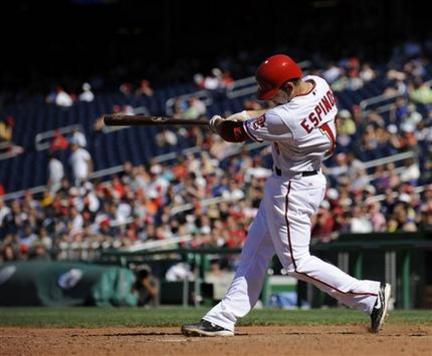
The drum is banging for Espinosa's benching. Photo AP Photo/Nick Wass

Another week, another set of disappointing results for our weary Nats (losing two games in San Diego?  come on), coupled with a troubling set of injuries, and Nats fans are a bit nervous.  Lets see what kind of questions Tom Boswell got in his weekly chat, 5/20/13 edition.

As always, I write a response here before reading his, and sometimes edit questions for clarity.

Q: You can have Stephen Strasburg or Jordan Zimmermann for the next eight years, but only one. Which do you pick?

A: Has it come to this for poor Stephen Strasburg?   As I pointed out in this space last week, Strasburg isn’t any worse or different of a pitcher right now; he’s just been really unlucky this year.  Despite Jordan Zimmermann‘s dominance so far in 2013, I still think Strasburg has better stuff and a  higher ceiling.  I’d still go with Strasburg.  Boswell also goes with Strasburg based on age and the last three years stats.

Q: Nick Markakis has proven to be a solid veteran but, possibly due to injuries, not the star the Orioles envisioned when they gave him the big contract extension. Do you think this may be Ryan Zimmerman’s fate?

A: Great question.  Nick Markakis has been injury plagued … but only the last two years.  Before that he was very solid, rarely missed a game, and had some really good numbers.   Ryan Zimmerman only has managed to play three full seasons and has missed significant time in 5 others.  Zimmerman is being paid a 9 figure salary but may not really be a 9-figure player honestly.  I’ll freely admit; after injuries and now his arm issue, i’ve really fallen off the Zimmerman bandwagon.  So yes, in a way I agree with the questioner.  Boswell sort of agrees too.

Q: Is it time to really worry about the Nats? The most errors in the majors, the hitting remains spotty at best, and they can’t score enough runs to win when their best pitchers give extra-quality starts.

A: I’m definitely worried.  They should have swept the Cubs.  There’s no dishonor in losing to two Aces in Los Angeles (Kershaw and Greinke), but then to come to San Diego and lose to a no-name journeyman in Eric Stults and a rookie in Andrew Cashner (no matter now promising he may be), is troublesome.  They now travel to San Francisco with no pitching advantage in any of the three games and look like they could easily get swept the way they’re hitting.  Of course, that being said, I must also remind myself of my 4/24/13 post that talked about our very tough early schedule … and remind myself that the Nats go 8 weeks in June and July without playing a playoff team.  So we just have to scuffle around .500 until then.   I’ll say this though; if we don’t go somthing like 20-8 in June, we’ll have different issues.  Boswell says its May 20th, relax (paraphrasing 🙂 )

Q: I’m puzzled by his use of the bullpen. Last year, every guy seemed to get an inning or two of work every few days. (Of course, last year every guy was also reliable.) The postgame analysis yesterday talked about how rusty they were and chalked it up to the starters going long. To me, it seems more about the relievers being brought in (or not) at all the wrong times. Thoughts?

A: Ah, a question after my own heart.  I have complained about Davey Johnson‘s management of the bullpen twice this year already, after both Detwiler and Gonzalez had excellent efforts wasted when they got pulled too early.  I’m just not getting the bullpen usage at all.  In Johnson’s defense, he just hasn’t had enough blowouts (wins or losses) in order to really get his fringe guys work.  Zach Duke has exactly 2/3s of an inning this entire MONTH.   Stammen may be our best reliever and he’s only getting one appearance a week right now.  Henry Rodriguez got only his second appearance in May in yesterday’s blow out.  So yes, that’s nearly half his bullpen that is inarguably rusty.  In some ways its a good problem to have; it means their starters have been going deep and there’s not been a need for 6th and 7th innings of work.   Rodriguez has brought his inactivity upon himself frankly, but I think Stammen needs some of these later inning stints right now.  Boswell agrees that the bullpen management has been poor this year.

Q: Is it acceptable for a manager or GM to tell a player that he is not a switch hitter at the big league level? Espinosa has always looked better from the right side of the plate. Career he is .221 from left side and .264 from right. Considering his struggles, maybe someone should tell him he’s a right handed batter. No shame in that after all.

A: A great question, one that continues to follow Danny Espinosa. He has not “turned the corner” in 2013 as some had hoped; instead he’s bottomed complete out.  A 90-100 OPS+ figure is ok if you’re hitting for power; this year he’s sitting at a 33 OPS+ with an embarassing slash line.  June 1st I think the hammer comes down and Espinosa goes to the bench in favor of Steve Lombardozzi. That being said, Lombardozzi isn’t exactly lighting the world on fire either right now, so maybe both guys sit in favor of Anthony Rendon or maybe even a call-up Jeff Kobernus, who has been hitting well in AAA.  As for the question in hand; can a GM “tell” a player to stop switch hitting?  Probably not; Espinosa has presumably never faced a top-level right hander from the right side; I’d have to think that forcing him to stop switch hitting would make him even worse.  At the very least that change happens in the off-season/spring training, not in the middle of a slump.  Boswell posts a very eloquent answer about what the team may do with Espy/Lombo but doesn’t answer the core question.  Maybe it isn’t answerable.

Q: Nats pitchers giving away Stolen Bases: This is getting ridiculous. It has been a serious problem since last year, known to everyone. Didn’t anyone of the pitching staff work on this in the off-season?

A: The coaching staff said they did.  I havn’t really noticed.  Lets runs some quick numbers out of Baseball-Reference.com:

2012 Starter SBs SBs CSs SB%
Strasburg 14 2 88%
Gonzalez 12 1 92%
Zimmermann 10 2 83%
Jackson 7 5 58%
Detwiler 3 2 60%

Yes, the rotation last year generally speaking was not holding runners on.

2013 Starter SBs to 5/20/13
Strasburg 5 1 83%
Gonzalez 2 2 50%
Zimmermann 5 1 83%
Haren 2 0 100%
Detwiler 1 0 100%
2013 Starter SBs extrapolated full season
Strasburg 18.3 3.7 83%
Gonzalez 7.3 7.3 50%
Zimmermann 18.3 3.7 83%
Haren 7.3 0.0 100%
Detwiler 3.7 0.0 100%

So, Strasburg isn’t appreciably improving in this regard, but Gonzalez has really worked on it.  Zimmermann looks about the same.  Haren is not quite as good historically as Jackson at holding runners, but the variations in the factors may have something to do with that as well.  All in all, I don’t think its as bad as it was last year.  Boswell’s answer verbatim: “They worked on it. They ain’t fixed it.”

Q: Just looking at Strasburg’s pitching in comparison to other elite speedballers in the league and I find one glaring item: the speed of his pitches in relation to the fastball . His off-speed pitches seem to hover too close to his fastball. Verlander, Wainwright, Kershaw, et.al., all throw 90’s fastballs, 70-85 curve and change-ups. Is this something that is missing from his arsenal?

A: Is this true?  Lets do a little Pitch F/X analysis.  All these numbers are average speeds for the pitch type for 2013 only for the pitchers named in the question plus a handful of other hard-throwers:

(Quick glossary lesson for pitch F/X: FA = 4-seam fastball.  FT = 2-seam fastball.  SI = Sinker, usually ends up being the same thing as a FT.  CU=Curve, SL=Slider, CH=Change up and FC = Cut-Fastball).

FA FT/SI CU SL CH FC FA-CU Delta FA-CH Delta
Strasburg 95.5 95.3 79.7 88.1 15.8 7.4
Samardzija 94.9 94.3 82.9 83.3 91.1 12 11.6
Harvey 94.7 94.4 82.3 89.1 86.4 12.4 8.3
Zimmermann 93.7 93.6 77 86 86.6 16.7 7.1
Verlander 93.5 93.3 78.7 85.3 86.7 14.8 6.8
Darvish 93 92.7 66.7 81.8 86.9 89.3 26.3 6.1
Kershaw 92.5 73.6 84.5 85 18.9 7.5
Hernandez 91.1 91.4 80.5 84.2 88.7 91.9 10.6 2.4
Wainwright 90.9 90.6 74.9 83.7 87.3 16 7.2

Strasburg’s delta between his curve and his fastball is 15.8.  That’s an almost identical delta to Wainwright and is better than Verlander.  Kershaw‘s delta is ridiculous, but his curve is also his signature pitch.  Meanwhile Darvish‘s curve is almost comedically slow and he rarely throws it.   Strasburg’s Fastball-Change up delta is also very consistent with the top pitchers in the league, and is “better” than the likes of Verlander and Darvish.

So, I’m calling BS on this question.  I don’t see any problem with Strasburg’s arsenal or the delta between his pitches.  He throws a ridiculous, unhittable 88 mph circle change that breaks a foot; ask yourself whether or not MLB hitters want to see that pitch right after the see him hump it up to 98mph.  Boswell says his stuff is fine and give some similar numbers, including some Vertical and Horizontal pitch F/x discussion that I only alluded to.

Q: What Logic did Davey have leaving both Haren and Mattheus in past their effectiveness. Haren? Well okay, sometimes he shapes up as the game goes on. HOWEVER! Leaving Mattheus in for that long when he kept getting pinged and dinged was ridiculous! Was this essentially a forfeit to save the bullpen for when Duke pitches tonight?

A: The chances of a team overcoming a 6-7 run deficit are astronomically low.  So much so that most teams just go into autopilot once a big enough lead is opened up by either team.  That’s why there’s so many “unwritten rules” regarding doing things with big leads; guys are mentally checked out and just trying to avoid the embarassment.  The same can be said for bullpen use.  Once one guy gets hammered, if the next guy does too you just kind of throw in the hat and just let guys work it out.  What use would it have been to replace Mattheus after the Padres had scored 12 runs?  You let the guy work on his craft, get some innings in, and move on to the next game.   Boswell says, yes this was basically Johnson giving up.

Q: Boz, my 13-year-old is convinced that the Nats are finished (and that he could play second base better than Danny Espinosa, but that is another story). Baseball seasons are long, and Dad is confident but quietly getting concerned with the way the records look in the NL that a second-place finish in the NL East will not result even in a wild card. At this point in the season, what things do we really know with certainty about this team?

A: What do we know?  I think we know the following:

  • We still have 4 very good starters (Gio will get it back and post another 120 ERA+ season).
  • We know Haren is a weakness
  • We know Harper is no one-season wonder and is improved.
  • But we also know that Harper has not been the same since his first injury scare about a month ago.
  • We know we have some issues on defense and in the bullpen, and have all year.
  • We know our schedule gets easier.
  • But we also know that the Braves have cooled off and despite our iffy run we’re just a couple games out of first place in our own division.
  • I don’t trust either Pittsburgh, Arizona or Colorado to continue to play even .500 ball, so I’m not worried about a 2nd wild card coming from a weird place.
  • And lastly, we know there’s a lot of baseball to be played.

Boswell talks about our starters and Harper, and the re-iterates my last point.  There’s 100 games to play!

Q: Did the addition of Soriano contribute to Storen’s struggles?

A: I think it had to; after a demoralizing game 5 loss the team replaces you and demotes you in the off-season.  Wouldn’t you struggle in your job if that happened to you?  I think we’ve talked about this before so I won’t go into great detail.  Boswell’s heart wasn’t in the answer either; he just noted that Storen’s first save since his Game 5 meltdown was this week.

Q: Seems like you left out what may be the sanest idea for the Nats’ offensive woes in your column: move Rendon to second base permanently and call him at the All Star break if he’s still mashing at AA and Espinosa still can’t hit a slow pitch softball.

A: He did, but I didn’t; see above.  Boswell admits this is eventually going to be an option.
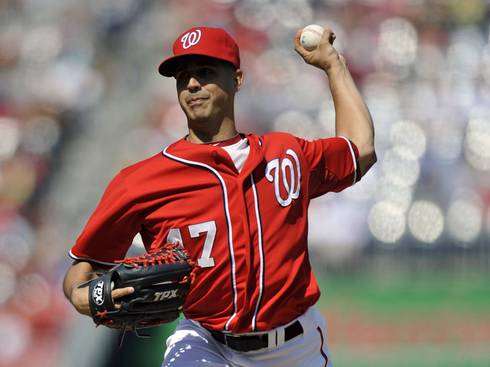


Davey Johnson: Over Manager

13 comments

If I'm Gonzalez today I'm having a serious conversation with my manager. Photo Joy Absalon/US Presswire via usatoday.com

A quote from MLB’s game recap of yesterday’s Nats 2-1 loss to the Cubs:

It’s just the way I manage,” Davey Johnson said of his decision [to remove Gio Gonzalez for a pinch hitter in the 7th]. “You can chalk it up to me. You don’t like it, chalk it up to me. It didn’t work out.

Well, this post is going to criticize that decision, because not for the first time this season Johnson removed a highly effective starter on a relatively low pitch count only to watch lesser pitchers blow the game.

If I was Gonzalez (or Ross Detwiler, whom Johnson did this too earlier in the season against the Braves and which I commented on in this space in mid April, or Stephen Strasburg, who got yanked on opening day after throwing just 80 pitches; a decision I defended at the time but now see as the start of a pattern), I’d be really pissed, and I’d be demanding a change.  Gonzalez was perfect through 6 innings, and was through 7 complete on just 85 pitches.  He had 7-8-9 coming up in the eighth inning.  What POSSIBLE reason was there to remove him from the game??

Johnson intimated that the reason he pinch hit for Gonzalez was because he “sensed an opportunity” to break open a close game.  What opportunity was that?  To bring up a cold, ineffective pinch hitter (as is most of the Nats bench right now) to feebly wave at 3 pitches instead of allowing Gonzalez to hit?  I can defend pinch hitting for your pitcher there … IF you have guys on base and if there’s a real scoring opportunity.  To lead-off an inning against a new, fireballing reliever??  No way.

Johnson’s job is to WIN GAMES.  Not to worry about whether the bullpen is getting enough work.  Hey bullpen guys; you want work?  Be better pitchers and become starters.  Or go play for a team with lesser starting pitching.  Otherwise sit in the outfield and wait your turn.

I’m tired of watching our crummy bullpen throw away golden starts, and i’m sure the starters are as well.  Yeah there was an error thrown in there.  Yeah there were bloop hits and some unlucky seeing-eye singles.  Doesn’t matter.  Johnson helped turn a W into an L.  That may not sound like much, but its only mid May and this has already happened more than once.  It only takes one extra loss to cost a playoff spot.

Written by Todd Boss

May 13th, 2013 at 10:06 am

Nats Starter Matchup Monthly Analysis

4 comments

Ross Detwiler has been helping to keep the team afloat all year. Photo: Photo by Marc Serota/Getty Images

In the same spirit of grading the Minor League starters from yesterday’s post, here’s letter grades for each of the starts in April for our MLB rotation:

MLB Rotation:

  • Strasburg: A,D-,A-,B-,C+,B-
  • Gonzalez: A,B+,F,D,A+,D-
  • Zimmermann: B,B+,A,B-,A+
  • Haren: F,D,D-,C-,B+
  • Detwiler: A,A-,A-,B-,C-

Discussion: Nats YTD Stats are here for reference

We’ve all been watching the games, so nothing surprising here.   Jordan Zimmermann has quietly been one of the best starters in the NL so far.  He’s working on a .861 WHIP and has 5 straight Quality Starts.  This is reflected in his grade scores above.   Meanwhile. Dan Haren‘s early struggles are slowly turning into workable outings.  Ross Detwiler‘s Sunday loss was “death by paper cuts” and his 11 hits allowed wasn’t as bad as it looked in the box score.  I’d like to see some more consistency out of Gio Gonzalez; is he an 8ip-1hit guy or is he 7 runs in 5 innings guy?  There really hasn’t been an in-between for him.  Lastly Stephen Strasburg hasn’t pitched that badly (one bad outing out of 6) but has gotten almost no run support, contributing to his ugly W/L record.


Now here’s some fun Starting Pitcher Matchup analysis.  I’ve been keeping track of the opposing starter we’ve faced each night and ranked them three different ways:

  • Their Rotation Order intra team: the opening day starter for a team is their “#1” and the other four guys are ranked 2-5 as they appear in the opposing rotation.
  • Their Ranked Performance intra-team: at the time of their series with the Nats, the 5 starters on a team are ranked 1-5 on pure in-season performance.  The guy with the best season stats at that time is ranked #1, the guy with the worst #5.
  • Their Subjective League-Wide “Rank” as a pitcher: a subjective look at whether the opposing starter is a league wide “Ace,” a near-Ace or #2, and the like.

I also kept track on a night-to-night basis a quick opinion on whether I felt the Nats had the Starting Pitching Advantage (or if it was an even-matchup, or if I felt the opposing team had the pitching advantage) and tracked how we did.

Here’s some analysis based on our opposing pitcher each night.  It provides some interesting insight into the team’s performance so far.


Rotation Order Stats

Starter # Record Opposing Starter in Wins Opposing Starter in Losses
1 2-4 Nolasco (2) Cueto, Hudson (2), Wainwright
2 2-3 Slowey, Peavy Maholm, Harvey, Garcia
3 5-0 Leblanc (2), Floyd, Hefner, Arroyo
4 1-3 Bailey Bailey, Sanabia, Gee
5 3-3 Leake (2), Axlerod Teheran (2), Miller
5+ 0-1 Cingrani

In other words, the Nats are 2-4 versus opposing team’s “Aces,” 2-3 against their #2’s, etc.

(Note: a “5+” pitcher means a starter who was not on the opening day roster for a team.  We’ll see a ton more 5+’s as more starters go down with injury and are replaced by minor league call-ups).

Not all #1 starters are made the same, nor are #5 starters.  The team has the expected losing record against other team’s #1s, but also has a relatively weak record against other team’s #4 and #5 starters.  Some of this is thanks to Haren‘s weak matchup as our #4 starter, and some of this is because guys like Homer Bailey, Shelby Miller and Tony Cingrani aren’t exactly bottom tier starters in this league (we’ll see this later on with the “League Wide Rank” table).


I initially started tracking this ranked-opposing starter analysis to prove to a friend that a team’s “Ace” doesn’t always go against another team’s “Ace.”  And you can see how quickly team’s rotations get mis-matched versus one another thanks to the unbalanced schedule and irregular off-days:

Strasburg Three vs #1, Two vs #2, One vs #5
Gonzalez Three vs #2, Two vs #3, One vs #1
Zimmermann Three vs #3, Two vs #4
Haren Two vs #4, Three vs #5
Detwiler Two vs #5, Two vs #1, One vs #5+

Detwiler’s #5 rotation spot is now matched up essentially with the #1 spot of a lot of his opponents (the one #5+ spot was Cingrani, who took Cincinnati’s #1 spot from Johnny Cueto when he hit the D/L), and has been since mid April.  Thankfully our #5 has been pitching like a #2 all year.

You can kind of tell what has happened to the Nats versus opponents in terms of schedule off-days just by looking at this list; clearly the Nats stayed on schedule with their opponents for at least the first three turns through the rotation, then jumped ahead a day for two turns,


Ranked Performance intra-team

1 2-3 Nolasco (2) Cueto, Maholm, Harvey
2 2-1 Peavy, Bailey Miller
3 2-4 Slowey, Floyd Hudson, Bailey, Wainwright, Cingrani
4 4-2 Leblanc (2), Hefner, Arroyo Hudson, Garcia
5 3-4 Leake (2), Axlerod Sanabia, Teheran (2), Gee

In other words, the Nats are 2-3 against opposing teams’ best pitcher at the time of the series, 2-1 against the opposing team’s 2nd best performing pitcher at the time of the series, etc.

As with the above, not all #1s are the same.  Ricky Nolasco is perhaps the 4th starter on a good rotation but he’s the best Miami has.  Believe it or not Adam Wainwright was only the 3rd best starter on St. Louis’ team at the time of our series (behind both Jake Westbrook and Shelby Miller), despite my believing him to be an “Ace” in this league (see the next table).


League-Wide “Rank”

Starter # Record Opposing Starter in Wins Opposing Starter in Losses
1 0-3 Cueto, Harvey, Wainwright
2 1-5 Bailey Bailey, Hudson (2), Miller, Cingrani
3 4-2 Nolasco (2), Peavy, Floyd Maholm, Garcia
4 1-0 Arroyo
5 7-4 Slowey, LeBlanc (2), Axelrod, Leake (2), Hefner Sanabia, Gee, Teheran (2)

In other words, the Nats are 0-3 against MLB “Aces,” 1-5 against MLB “near aces” or #2’s, etc.

This table really shows how the team has truly done against the elite pitchers in this league.  We can argue in the comments section about my subjective ranking of pitchers (is Matt Harvey truly an “Ace” in this league?  Probably not yet, but he sure is pitching like one.  Is Julio Teheran really a #5 pitcher in this league?  Not on talent, but certainly on performance thus far), but I’m happy with my rankings for pitchers overall.

For comparison purposes with our own team talent-wise, I have Strasburg as a league-wide #1, Gonzalez and Zimmermann as #2s, Detwiler as a #3 (but rising) and Haren as a #4 (but falling; he was a #2 just a couple years ago).

The Nats have managed just one victory over Aces or near-Aces in this league so far (and that was by virtue of Zimmermann‘s one-hitter victory over Homer Bailey: you don’t win 1-0 games in the Majors very often).  They’re 12-6 against everyone else.

The team’s bigger concern should be games dropped to the #5 pitchers.   For every loss to an Ace, you have to make up for it by beating up on the lesser starters in this league.  You just cannot lose to guys like Alex Sanabia or Dillon Gee.


Performace against Expectations by Advantage

By “Advantage” Record Matchups in Wins Matchups resulting in Losses
Wash 10-6 Stras-Hudson, Stras-Garcia, Haren-Sanabia, Zimm-Gee, Detwiler-Teheran, Stras-Teheran
Even 3-6 Zimm-Bailey, Detwiler-Nolasco, Haren-Leake Stras-Cueto, Stras-Harvey, Detwiler-Wainwright, Detwiler-Cingrani, Gonzalez-Hudson, Gonzalez-Maholm
Opp 0-2 Haren-Bailey, Haren-Miller

In games where I thought Washington had the clear starting pitching advantage head-to-head, we still managed to lose 6 times.  Those losses are listed above: three times we dropped games where Strasburg was pitching against lesser opponents.  You can quibble whether Strasburg-Tim Hudson is an even matchup or not, but certainly Strasburg vs Teheran or Jaime Garcia is a mis-match on paper.

In games where I thought the pitching matchup was even, the team still went just 3-6.  Again, Strasburg ended up with some tough matchups against other fellow “Aces,” while Detwiler ran into a couple of hot-hands.

The two games where I thought our opponent had the clear advantage heading into the game both involved Haren going up against near-aces from Cincinnati and St. Louis; we lost both games easily as expected.


April Conclusion: The Nats have faced some good teams with some good pitching thus far; they need to do a better job cleaning up against opposing teams’ #5 starters.

This analysis doesn’t even start to look at the offense; with better run support Strasburg may be 4-1 instead of 1-4.  And it doesn’t look at the bullpen or our defense of course; two areas that have turned Wins into Losses pretty quickly for the team.

Braves sweep shows some areas of concern

13 comments

Its a long season.  The Nats swept the Braves in Atlanta last year in May and the Brave still won 94 games.  This isn’t the end of the world.

However.

Each of the 3 losses this weekend exposed some very specific issues with the team and its manager that aren’t necessarily new, but which are coming to the foreground.  In order:

Friday’s Loss: Over-managing the Pitching Staff:  Once again Davey Johnson pulled a highly effective starter on a miniscule pitch count only to watch his bullpen blow up.  Worse, this is the second straight time its happened to Ross Detwiler, who now has given up exactly one earned run in 13 innings (on a solo homer) and has two No Decisions for his efforts.  No wonder he was visibly frustrated when told he wasn’t going back out.  I defended the decision to pull Strasburg after 80 pitches on opening day in various forums, but I cannot defend the decisions now, knowing that our bullpen was DEAD LAST in the majors in ERA heading into the weekend (I believe they’ve “improved” to 29th by the time of this posting).

I think Johnson has to start relying on his starters to go deeper into games until the bullpen sorts itself out.  Or, to put it differently, I don’t want to see a starter yanked unless he’s sitting on 115 pitches or the lineup is getting ready to turn over a 4th time.   It just does not make sense to pull an effective starter after 90 pitches right now.

Saturday’s Loss: Zimmerman’s Worsening Throwing Arm.  We’re 12 games into the 2013 season and Ryan Zimmerman already has 3 throwing errors.   His throwing error on Friday contributed to the collapse but his air-mailing the throw saturday on a simple, routine play directly led to two unearned runs and a deflating feeling for the Nats.   Opposing scouts are starting to openly question why the Nats are keeping Zimmerman at the position, after watching his throws.  I don’t know if he’s still hurt, if he’s got a Chuck Knoblock mental thing going on, or if he’s just spent far too much time trying to mechanically fix the issue instead of just being a natural athlete, but it isn’t working.  Strasburg‘s line on Saturday: 6IP, 5 hits, 7 Ks, 0 earned runs … and a Loss.  I know this game isn’t entirely on Zimmerman; you have to score to win, but giving a bulldog veteran like Tim Hudson (and his amazing career record when given a lead) 2 free runs is never a good idea.

Unfortunately, there’s nothing the team can really do about this.  You can’t sit your #4 hitter (despite how crummy he’s hitting; see the next point).  There’s no place to stick him now or in the immediate future thanks to the Adam LaRoche re-signing blocking 1B for the next two years.  And he’s a $100M player who clearly isn’t playing like one.

Sunday’s Loss: Where’s the offense?  I know the team generally is doing pretty well; we’re middle of the league right now in terms of Homers, BA, and OPS.  But most of that is thanks to Bryce Harper‘s fast start.  We have two key middle-of-the-order guys who are just not getting it done.  Specifically, LaRoche and Zimmerman.  You just cannot win consistently with your middle of the order guys hitting .147 and .220 respectively.   To make matters worse, there seems to be no hope in sight for Danny Espinosa, and with a MLB-ready guy who had a great spring and is lighting up AA in Anthony Rendon seemingly an able replacement, you have to wonder how long the team is going to let their #7 hitter continue to hit .175 with a known tear in his shoulder.  Paul Maholm is a decent pitcher … but he’s not Cy Young.  He went 7+ and gave up just four measly hits on the afternoon in a game where the Nats looked like they gave up frankly.  One more throwing error tossed in by Zimmerman for good measure.


We didn’t really even talk about how the Nats had the distinct Starting Pitching matchup advantage in all three games but lost them all.  Sometimes your aces just get whacked (Strasburg in Cincinnati, Gonzalez on Sunday); you have to roll with it and try to outscore your opponent in those games.

Nor have we talked about concerns with the bullpen; what is going on with Clippard and Storen?  But the Bullpen is one of those areas that can look really bad with a couple of small sample sized bad outings, so we won’t over-react too much.

But, I think there’s some concerns here that are a bit above those of the “well its just mid April” variety.

Nats Major & Minor League Pitching Staffs vs Predictions

leave a comment

First off, this is partly a post of self-flaggelation, to show how far off my various predictions of what the 2013 minor league staffs would look like by doing 2012 season-ending analysis.  Such is the nature of minor league pitching staffs in the modern day; they’re a combination of spare parts, rising stars and hangers-on and they can change rapidly with trades and spring training performances.  Every trade and every MLFA signing trickles down and fouls up predicitons.

Here’s my End of Season 2012 post with predictions for each of the 2013 minor league pitching staffs.   We’ll use that as a basis for the Opening Day 2013 rosters of the four full-season minor league teams.  Just for fun we’ll throw in (and start with) the MLB prediction.  Note that this early in the season we don’t really know who’s shaking out as starters and relievers necessarily for these minor league teams; i’m just going on first week usage right now.  As always, Luke Erickson and nationalsprospects.com, the Nats Big Board and the tireless work by “SpringfieldFan” is much appreciated here.


MLB Nov 2012 Prediction

  • MLB Rotation: Strasburg, Gonzalez, Zimmermann, Detwiler, FA or other acquisition
  • MLB Bullpen: Clippard, Storen, Mattheus, Stammen, Garcia, a FA left-hander (possibly Burnett), a FA long-man (possibly Gorzelanny).
  • MLB notables Out of Organization: Jackson, Burnett, Gonzalez, Lannan, Wang

MLB April 2013 Actual

  • MLB Rotation: Strasburg, Gonzalez, Zimmermann, Detwiler, Haren
  • MLB Bullpen: Clippard, Storen, Mattheus, Stammen, Duke, Rodriguez, Soriano
  • MLB notables Out of Organization: Jackson, Burnett, Gonzalez, Lannan, Wang, Gorzelanny

MLB Discussion: It wasn’t going to be that difficult to predict the 2013 Nats pitching staff make-up by looking at our staff and their FA status heading into the off-season.  The rotation filled its one spot with Dan Haren.  The bullpen was 5/7ths predicted correctly (if you count Zach Duke as a FA left-hander acquisition).  Christian Garcia‘s injury opened the door for one more season of Henry Rodriguez, and of course nobody could have predicted the Rafael Soriano purchase.  Lastly all 5 of the predicted departures occured, in addition to Tom Gorzelanny being let go.


AAA Nov 2012 Prediction

  • AAA Rotation: Roark, Maya, Broderick, Meyers, Perry
  • AAA Bullpen: Tatusko (swingman), Arneson (swingman), Severino (loogy), Davis, Lehman, Nelo (closer), Martin,  Mandel

AAA Apr 2013 Actual

  • AAA Rotation: Ohlendorf, Roark, Maya,Perry, Rosenbaum ( eventually Young)
  • AAA Bullpen: Tatusko, Mandel,  Davis, McCoy, Crotta, Abad, Romero, Bramhall
  • AAA D/L: Kimball, Bray, Meyers, Torra, West, Garcia (technically XLS), Accardo
  • AAA cut/released/FA: HPena, Mann, Zinicola, Arneson, Atkins, Ballard
  • AAA Missing: none

AAA Discussion

We were 3/5s correct on the rotation, and probably would have been 4/5ths right if Brad Meyers was healthy.  Ross Ohlendorf and (eventually) Chris Young are new faces here, both being former MLB starters who are taking the Zach Duke route of signing on for full seasons as AAA starter insurance for the big club in the hopes of rebuilding value and finding a MLB job for next year.  Brian Broderick is indeed back; its just that he’s starting for AA instead of AAA.  Lastly Danny Rosenbaum was returned to the team after his spring Rule-5 adventure and was put in AAA instead of AA, where (as we’ll see in a second) I would have predicted he would start.  Once Young is ready to go, I see Tanner Roark turning into the swingman/long-man.

On the bright side (pun intended), when was the last time a professional baseball team had TWO Ivy League alumni pitching in its rotation??  Both Young and Ohlendorf went to Princeton.  I wonder if they have NYTimes crossword puzzle competitions instead of (assumedly) video game competitions on off-days in the clubhouse.

As far as bullpen predictions go, next year I’m paying more close attention to who are 6-year free agents.  Arneson, Severino and Nelo were all MLFAs and have either signed on elsewhere or are facing forced retirement.  Tatusko, Davis and Mandel are onboard.  Lehman is (surprisingly?) in AA, perhaps a victim of the numbers game of the Nats signing (and keeping) a number of minor league lefty relievers this off-season.  I would guess, looking at the names in the bullpen, that Erik Davis is the closer but who knows what the usage will be like.  Lastly Bramhall was a MLFA signing over the off-season who just got placed on the AAA roster to replace the injured Accardo.


AA Nov 2012 Prediction

  • AA Rotation: Rosenbaum, Holder, Gilliam, Karns, Grace, Demny (swingman?) or MLFA?  Solis if he’s healthy?
  • AA Bullpen: Frias, McCoy, Selik (maybe high-A again), Holland (setup),  Wort (closer), VanAllen (loogy), Demmin (maybe high-A again), an org arm or two to fill in.

AA Apr 2013 Actual

  • AA Rotation: Broderick, Treinen, Demny, Clay, Karns
  • AA Bullpen: Holder, Frias, Holland, Wort, Barrett,  Krol,  Lehman, Swynenberg
  • AA D/L: Solis, RMartin, Olbrychowski, Selik
  • AA Cut/released/FA: VanAllen
  • AA Missing: none

AA Discussion

We got, well, not much of this right.  Of my starter predictions: Rosenbaum is in AAA, Holder is here but seems to be the long-man right now, Gilliam is hurt, Solis is still on the DL, and Grace is back in High-A.  We do seem to have at least gotten Karns and Demny right.  Broderick was a surprise FA signing, his being a favorite of the Nats organziation per our Rule-5 experiment with him a couple years back.  I’m surprised he’s not in the AAA rotation though.  Treinen was a trade-throw in from the Morse deal and takes a spot in this rotation, while Clay was a 2013 MLFA signing who (surprisingly?) made the rotation over the likes of other candidates.

The bullen prediction is all over the place: We got Frias, Holland and Wort right.  McCoy is in AAA, Selik is on the AA D/L and VanAllen and Demmin were MLFAs who were left unsigned (and per the big board are still unsigned).   I thought Barrett and Swynenberg would be in high-A instead of AA, I (and most others) thought Lehman would be in AAA, and Krol arrived as the PTBNL in the Morse trade.


High-A Nov 2012 Prediction

  • High-A Rotation: Swynenberg, Ray, Meyer (maybe AA?), Schwartz (maybe low-A), Rauh(maybe low-A)
  • High-A Bullpen Competition: Barrett (maybe AA) , Testa, Smoker (loogy), Hill, Meza(perhaps a starter?), Holt, Hawkins, Bates, Mirowski
  • High-A bullpen Release candidates: Olbrychowski, McCatty, Applebee

High-A Apr 2013 Actual

  • High-A Rotation: Ray, Jordan, Cole, Turnbull, Hill
  • High-A Bullpen Competition: Herron, Mirowski, Holt, Hawkins, Meza, Bates, Self, Grace
  • High-A D/L: Smoker, Applebee, Gilliam
  • High-A Cut/FA/Released: Demmin, Consuegra, Samuel, Testa
  • High-A Missing: McCatty, Olbrychowski

High-A Discussion

The Potomac rotation guess was already light; a couple of the guys I was guessing might be in low-A are indeed there (Schwartz and Rauh).  Swynenberg is in the AA bullpen.  Meyer was traded.  Only Robbie Ray returns.  I thought Jordan was going to repeat Hagerstown.   We got Cole back in the Morse trade and bumped up Turnbull from short season (over Mooneyham, interestingly) Lastly Hill seems to have beaten out Grace for the 5th starter spot.

The Bullpen prediction looks pretty good: 7 of the predicted guys are here (Smoker on the DL, Meza, Holt, Hawkins, Mirowski and Bates).  Barrett indeed is in AA.  Testa was released.  Of my release candidates McCatty is in XST, Applebee and Olbrychowski are on the DL.  Lastly both Samuel and Consuegra were off-season MLFA signings who didn’t pan out and have already been released.


Low-A Nov 2012 Prediction

  • Low-A Rotation: Turnbull, Jordan, Purke (if healthy), Monar, Mooneyham
  • Low-A Rotation Competitors: Hansen, Lee (loogy if not), Encarnation, McGeary (if finally healthy)
  • Low-A Bullpen Competition: Anderson, Estevez, Dupra, McKenzie, Henke, Davis, Boyden, Benincasa, Hudgins, Dicherry, Mudron

Low-A Apr 2013 Actual

  • Low-A Rotation: Anderson, Mooneyham, Pineyro, RPena, Encarnation
  • Low-A Swingmen: Rauh, Schwarz, Dupra
  • Low-A Bullpen: Fischer, Harper, Henke, Hudgins, Benincasa
  • Low-A D/L: Estevez, Purke, Simko, Mesa, Weaver
  • Low-A Cut/FA/Released: Kreis, Lucas, Upperman, Hansen, Monar
  • Low-A Missing: Hollins, Hicks

Low-A Discussion

Historically the hardest to predict, the Low-A team.  Of the guesses for the rotation last fall, we only got Mooneyham right.  Turnbull and Jordan were bumped up a level.  Purke is still hurt.  Of the “competitors” the team flat out released Monar and Hansen to my surprise.  Monar was really good in Auburn last year, and while Bobby Hansen wasn’t nearly as dominant as a starter, I thought he’d at least get a shot at being a loogy after so many years in the organization.  Jack McGeary was selected out of the org during the minor league phase of the rule-5 draft.  Lee is in XST limbo right now.

So who are these surprising Low-A rotation guys?  I thought Anderson would be relegated to the bullpen in Low-A; instead he’s the opening day starter.  I thought Pineyro would repeat short-season ball but he made the full-season team.  And lastly I thought Pena was destined for another season in short-A.

Rauh and Schwartz, after I thought they had shots in the rotation in high-A, seem to be taking the roles of “2nd starters” for now, each having gone multiple innings in relief of the starter.  I wouldn’t be surprised to see them becoming full time starters if one of the 5 guys ahead of them falter.

Most of the rest of the predicted bullpen are 2012 signees who are currently amongst a large group of extended spring training guys who will be battling it out for short-season jobs with 2013 signees.   And we seem to have a very large group of them; the big board lists in excess of 30 hurlers who are currently still in the organization, who are not on the D/L officially, but who are not assigned to one of the four full season teams.   That’s a lot of arms for just a handful of spots in short-A and the rookie league after the 2013 draft occurs.

Written by Todd Boss

April 11th, 2013 at 8:41 am

Posted in Majors Pitching,Minor League Pitching,Rule-5

Tagged with , , , , , , , , , , , , , , , , , , , , , , , , , , , , , , , , , , , , , , , , , , , , , , , , , , , , , , , , , , , , , , , , , , , , , , , , , , , , , , , , , , , , , , , , , , , , , , , , , , , , , , , , , , , , , , , , , , , ,

Are we too worried about pitch counts?

4 comments

Ohmygod Strasburg only threw 80 pitches on opening day what's wrong with him?! Photo: howtowatchsports.com

The Nats handling of Stephen Strasburg in 2012 certainly caused more than its fair share of discussion in the sports world, to the point where people (read, me) don’t really want to talk about it anymore because they’re too hunkered down into their own opinions on the matter.  Hence a sense of relief washed over Mike Rizzo defenders when 2013 rolled around, knowing that “the reins were off” (how many times have we heard that cliche so far this year?)

So what happens on Opening Day?  Strasburg gets lifted after 80 pitches and sets of another mini fire-storm of discussion (also witness here and here).   “Why’d he come out?  Is he hurt?  Are the Nats over-protective?  Are they limiting his pitches??”  *sigh*  No dammit; there’s about Zero good reasons to push any pitcher in April, the Nats have a strong bullpen that will need work, and if your guy isn’t going 9, why bother pushing him through 8 if you don’t have to?  Here’s an interesting observation for those who think he got pulled too early; check Strasburg’s 2012 game logs and look what happened on Opening Day 2012: he went 7 innings on 82 pitches and left.  Wow; its like deja-vu!  Except nobody heard a peep about it last year.  Baseball writers are such hypocrites sometimes (ok rant off).

Note: here’s a story on Grantland from last September from writer Rany Jazayerli, who writes the very good “Rany on the Royals” blog and who does possibly the best baseball podcast out there with Joe Sheehan, talking about pitch counts and the Strasburg situation.  I don’t want to bring back up the Strasburg shutdown situation (which he argues should have happened later than it did) but he has links to other studies on this topic.

Anyway; the situation got me thinking about an old draft post I had about Pitch Counts in general, that stemmed from a podcast conversation on the topic from months ago.  Just last week I posted about Johan Santana, who re-injured his surgically repaired shoulder in 2012 pretty much the day after he was allowed to go 134 pitches to complete a no-hitter.   The general consensus among baseball pundits and professionals is that 100 pitches per outing is a good “benchmark” for starters.  If you get much above 110-115 pitches in an outing you’re pushing it.

But do these pitch counts make sense?  In 2007 Little League established a new set of guidelines for youth pitching limits, going away from the old innings pitched per week limits and going by pitch counts.  Here’s the general guidelines for pitch count limits and for mandatory rest periods now in place for youth baseball:

Age Max Pitches per Day Mandatory Days rest if throw Max
7-8 50 2 days
9-10 75 3 days
11-12 85 4 days
13-16 95 4 days
17-18 105 4 days

Basically, if you throw 76 or more pitches in a day, you’re sitting for 4 days, and the max pitches you can throw gradually rises as you age, topping out at 105 pitches for 17-18 year olds.  There’s a graduating rest scale for throwing fewer pitches by the number and by age (see the above links for exact details if you’re interested).

But here’s the point of this list; If its “ok” for a 17 year old amateur to throw 105 pitches and then rest for four days …. are you really telling me that a Major League Starter, a professional athlete paid millions of dollars with access to the best coaching and training staffs available, a man who is conditioned and trains year round to do nothing BUT throw a baseball for a living … you’re telling me that this person also works more or less off of a 100 pitch limit??

Are we too worried about pitch counts?  If Strasburg hits 115 pitches, are we really going to start talking about how the world is ending and how Davey Johnson is abusing his pitcher?  What is a more realistic pitch count limit for professionals?

Research seems to show that there is a Pitch Count threshold at which even professionals seem to be affected.  And that limit seems to be right around 120 pitches per outing.  This Baseball Prospectus study in 2002 by Keith Woolner shows that a 120+ pitch outing will result in a distinct drop-off in subsequent pitching performances in pitchers for the next few weeks, supporting the notion that you can really “over-work” a pitcher to the detriment of his health (as we saw with Santana clearly; his ERA pre and post 134 pitch performance in 2012 was 2.75 and 8.27).  I just wish this research was updated: he based it off of stats from a decade ago and I feel like enough has changed in the game that the study needs revisiting.

I can’t find any “in-game” pitch count studies showing how much a pitcher’s performance dropped off after the 120th pitch, but the BP study mentioned here is really the concern.  If your performance is impacted for weeks after a long outing, that’s proof enough for me to yank a guy before he gets to 120 pitches in a game.

So perhaps we SHOULD be worried about pitch counts, but only if we get someone above 120 pitches.  Here’s a quick glance at the max pitches our 5 starters threw last year:

  • Strasburg: 119 pitches on June 8th in Boston, a season-high 13 Ks.
  • Gonzalez: 119 pitches on Aug 31st to finish off a 5-hit shutout against St. Louis.
  • Zimmermann: 112 pitches on Sept 29th against St. Louis, his final start of the regular season.
  • Jackson: 123 pitches on Aug 30th to complete 8 innings of 4-hit ball vs St. Louis.
  • Detwiler: 100 pitches on May 25th to labor through 4 1/3 in Atlanta.

and just for good measure:

  • Haren: 126 pitches on May 24th vs Seattle to finish off a 4-hit shutout with 14 Ks.

You can see how managers sometimes go against their better judgement to allow pitchers to finish off shutouts and no-hitters.  Two of these six pitchers had their highest totals trying to finish off shutouts.  How do you tell a guy with a shutout through eight innings that he’s done because he’s reached some arbitrary pitch limit?   Interestingly, Johnson allowed two of his guys to get their highest totals in the August show-down series with St. Louis.  What’s also interesting about the above numbers is just how little Detwiler was trusted; his MAX effort all year was 100 pitches; talk about being treated with kid gloves.  I wonder if he’s going to be trusted to go deeper into games this year.

Conclusion: I’ll now scoff anytime someone whines about a 100 or 110 pitch limit for a pro, but will go bananas if our guys broach 120 unless there’s mitigating circumstances.

(post-script: Counter point from Jeff Passan who talks about pitch count abuse done to the obscene in Japan).

My 2013 Fantasy Baseball Team

3 comments

Kemp reacts to being Boss' first round pick in my fantasy league for the 2nd year running. Photo unknown via ladodgertalk.com

Editor’s note: feel free to stop reading now if you don’t want to read 4,400+ words on my fantasy baseball team.  I won’t blame you for it.  For those of you who do play fantasy, as I made picks I wrote down who I was considering and who was available per each pick to try to give some context for the pick.  I’ll insert a “jump” line here so that RSS readers don’t have to see this whole massive post 🙂

Read the rest of this entry »

Ladson’s Inbox 3/14/13

5 comments

Mar 12, 2013; Miami, FL, USA; United States pitcher Gio Gonzalez (47) delivers a pitch against Puerto Rico at Marlins Park. Mandatory Credit: Scott Rovak-USA TODAY Sports

It’s been a while since Bill Ladson did an inbox; strange because you’d think with Spring Training in full swing he’d be getting a ton of emails.  Here’s his 3/14/13 edition.  Lets see if he takes a question on who will be the 2014 manager for the 5th consecutive time.

As always, I write my own answers before reading his, and edit questions for clarity as needed.

Q: Should the Nats be worried about sending their pitchers to the World Baseball Classic? Will there be pressure on them to pitch too many innings too soon?

A: Yes, this organization may be worried, as discussed in depth in Feburary in this space.  We’ve never had a pitcher throw in the WBC who hasn’t come back either injured or less effective, and league-wide studies show the same trend.  However I will say this: all 5 pitchers we’ve sent in years past were relievers.  This year we sent two starters in Gio Gonzalez and Ross Detwiler.  So maybe things will be different.  Yes the concern basically is that these guys are more interested in getting outs than getting ready for the regular season, causing them to overthrow, to not prepare as they normally would in the spring, to not focus on specific things that they would normally do in spring training games.  It is less about innings or pitch counts (which are strictly monitored).   Ladson says the team isn’t worried about their arms, but is worried about the lack of playing time Eury Perez is getting.  And they have a great point; Perez is sitting on the DR bench instead of getting ABs in spring training games.  His chances of making the team dropped to zilch and he’s already been re-assigned to AAA.

Q: Who are going to be the lefties for the Nationals by Opening Day?

A: I’m assuming he means the “Lefty relievers.”  At this point its looking like we’re going to break camp with just one lefty reliever in Zach Duke. Bill Bray needs more minor league time, Bobby Bramhall and Sean West are in minor league camp slated for AAA jobs, Brandon Mann got one inning and was awful, Pat McCoy got some innings but isn’t ready.  Only Fernando Abad has stuck with the big-league team and looks good.  But, if Henry Rodriguez is ready to go there’s no room for Abad.  I’m guessing Abad goes to AAA and bides his time.  Ladson agrees, and points out that our righties can get lefties out.

Q: With Tyler Moore on the big league roster, what do you think will happen to Chris Marrero?

A: I’m going to answer this my way, then i’ll predict what Ladson says.  Chris Marrero goes back to AAA, burns his last option in the process, and bides his time waiting for injuries to take out the likes of Adam LaRoche and/or Tyler Moore. That seems to be the only way he gets opportunities this year.  The team will hope for a strong AAA season to build up trade value and then will move him if they can.  Otherwise he’s looking at a waiver wire trip this coming off-season.  Now, before I read Ladson’s answer i’m going to guess that he says something along the lines of “The Nats will look to trade him for valuable assets” but he’ll neglect to mention that Marrero has zero trade value right now, having missed all of last year.  Lets see if i’m right: I stand corrected; Ladson has finally come around on his stance on Marrero and says he’ll be in AAA all year.

Q: Would the Nats ever consider adding Kyle Lohse to the roster?

A: Consider?  Perhaps.  Actually do it?  I don’t see it.   Kyle Lohse is becoming the poster child for the problem with the Qualifying Offer in the new CBA.  He foolishly declined it (on the advice of Scott Boras, who probably told him he could get 3-4 years guaranteed on the open market), and now sits unsigned 3 weeks from opening day.  Its amazing; this guy was 16-3 last year!  Lohse is seen as a product of his environment, a great coaching staff in St. Louis who do wonders with mediocre pitchers.  And make no mistake; 2012 aside Lohse is a career 97 ERA+ pitcher with a .500 record and a 4.45 ERA.  He doesn’t fit into the mold of what Mike Rizzo generally wants in a starter; power arm, high K/9 capabilities.  Now, if the team bus crashed and we lost our starting rotation to injury tomorrow … yeah i’m guessing we’d give him a call.  But there’s no way the Nats (or likely any other team) is going to give 3 guaranteed years to a 34-year old soft-tossing guy.  Boras really, really miscalculated here and it looks like its going to cost his client millions.  Ladson agrees.

Q: Please find out where Cole Kimball is in his rehab. I would like to know if he’s anywhere close to pre-surgery velocity.

A: I only saw Cole Kimball in one game, but his velocity was down.  Perhaps its ramped back up later into spring training.  In either case he’s bound for AAA to burn his last Option and await bullpen issues for his shot.  Ladson says he’s “close to throwing 95-mph.”  I wish more of these games were televised.

Q: Having heard earlier in the offseason that general manager Mike Rizzo feels Steve Lombardozzi and Danny Espinosa are both starters and not bench players, do you feel one of them will be traded prior to Opening Day? Lombardozzi was an extremely clutch pinch-hitter last year in my opinion.

A: Traded prior to Opening Day?  Almost impossible; nobody makes trades at this point in the season.  You make trades prior to spring training and then after a couple months are past in the season to address off-season or intra-season needs.  We’ll save the Espinosa vs Lombardozzi vs Rendon discussion; we all know it by heart by now.   Ladson says a trade is not coming.

Q: Considering he had a very good year with Triple-A Syracuse in 2012, what are the chances of outfielder Corey Brown making the team?

A: Zilch.  He may have hit in AAA, but he didn’t hit squat with Washington last September.  He’s at least 6th on the Washington OF depth chart (Werth, Harper, Span, Moore, Bernadina and then Eury Perez.  Perhaps even lower; I think the team would give Carlos Rivero and Erik Komatsu chances before Brown at this point.  And its just a matter of time before uber-prospect Brian Goodwin passes him by as well.  Brown’s looking at another year of AAA time, burning his last option, and then getting the MLFA treatment.  Ladson says no chance.

Hey!  No question on the 2014 Nats manager this time! I stand corrected.

One Positive to having our guys in the WBC

leave a comment

Mar 12, 2013; Miami, FL, USA; United States pitcher Gio Gonzalez (47) delivers a pitch against Puerto Rico at Marlins Park. Mandatory Credit: Scott Rovak-USA TODAY Sports

(Don’t you hate it when a pro writer totally scoops your blog post, and you find out 5 minutes before you go to post it?  Tom Boswell wrote on this exact topic in today’s Washington Post).

James Wagner of the The Washington Post touched on it in a 3/13/13 article, but I’ll repeat it here; we’re seeing both Gio Gonzalez and Ross Detwiler compete, and compete well, for Team USA right now.  Gonzalez threw 5 scoreless innings in the Round 2 opener against a tough Puerto Rico side, and Detwiler finished up the do-or-die win against surprising Italy by throwing 4 innings of 1 hit ball and earning the save (and the game ball; what a fantastic souvenir).

Now, I’m on record stating that having our pitchers (specifically) in the WBC is bad, both anecdotally from past experiences and statistically (see the linked post for statistical studies showing across-the-board regression among WBC pitchers).  However I wonder if there’s an upside to having (specifically) Gonzalez pitching in this competition.  I wonder if we aren’t getting some free “seasoning” of Gonzalez by exposing him to the same playoff atmosphere that he failed in last off-season.

Gonzalez may not have factored into either decision in last year’s NLDS, but nobody would argue that he pitched well.  In two starts he only lasted 10 total innings, had 11 walks, a 1.70 whip and was just wild.  110 pitches to get through 5ip in game 1, 99 in game5.  Cardinals players were quoted as saying he “looked scared” on the mound.  Is it all because it was his first time in the limelight?  Did the pressure get to him?

Well, the pressure didn’t get to him against Puerto Rico.  If Gonzalez has “grown up” a bit because of the WBC and can go back to being the Ace/Cy Young candidate in 2013’s playoffs, the Nats will be far better positioned to advance.

Written by Todd Boss

March 13th, 2013 at 10:56 am

Pitcher Wins on the Free Agency Market; an analysis

3 comments

Is Greinke's big new deal going to pay off for the Dodgers? We'll see. Photo Jeff Golden/Getty Images

One of my pet projects of recent years has been to track “major” Starting Pitcher free agent contracts and then to do analysis of how they turned out, on a Dollar per win basis.  This post is an analysis of this work along with some interesting conclusions to determine some of the “best” and “worst” free agent contracts ever awarded.

This is mostly an analysis of past performance; there’s plenty of pitchers right now on major contracts that are just too soon into the deal to really draw any conclusions.  I’ve included in the spreadsheet all the major contracts signed this past off-season and will continue to do so if these guys get significant deals.  But we’ll have to wait a year to see how the first year of the contracts play out.  For all contracts that are in the middle of being played out, I’ve calculated how that contract is faring thus far.

Some caveats to the data:  For ease of analysis, I depend on the Average Annual Value (AAV) of the contracts as opposed to trying to figure out exactly how many wins were earned in which year of a varying contract amount.  Therefore (for example), Gio Gonzalez‘s contract may have only paid him $3.25M in 2012 but I’m using the full AAV of $8.4M for the purposes of the analysis (it would just be far too difficult to calculate each pitcher’s dollar per win on an annualized basis otherwise).  Also, I focus on dollars per Win, despite the known limitations of the “Win” statistic.  I have gone through and added in Quality Starts to the analysis, but that stat is also flawed in some respects (though it does do a pretty good job of indicating whether or not the starter has done his job).  Unfortunately the $/QS doesn’t work out as nicely as $/Win, since Pitcher Wins are still so prevalent in our player analysis.  I mean, after all, the goal of the game is to WIN the game, right?

Here’s a quick cut-n-paste from the spreadsheet (which is also available in the Links section to the right and on Google Docs) of some selected fields.  See the Google xls for everything.  Apologies if this doesn’t present well online.  The table is listed in descending order of $/year AAV.  Blanks in the Wins and $AAV per win indicate that the contract has yet to begin.  I also threw in a couple of non-FA contracts at the end to show what a MLB-minimum successful starting pitcher looks like in comparison.

Last Name First Name Total Value (includes club options) $/year AAV Contract Term Wins $ AAV per win
Clemens Roger $28,000,022 $28,000,022 2007 6 $4,666,670
Greinke Zack $147,000,000 $24,500,000 2013-2018
Sabathia C.C. $122,000,000 $24,400,000 2012-16 15 $1,626,667
Lee Cliff $120,000,000 $24,000,000 2011-15 23 $2,086,957
Hamels Cole $144,000,000 $24,000,000 2013-18
Sabathia C.C. $69,000,000 $23,000,000 2009-11 59 $1,169,492
Santana Johan $137,500,000 $22,916,667 2008-13 46 $2,989,130
Cain Matt $127,500,000 $21,250,000 2012-17 16 $1,328,125
Lincecum Tim $40,500,000 $20,250,000 2012-13 10 $2,025,000
Halladay Roy $60,000,000 $20,000,000 2011-13 30 $1,333,333
Darvish Yu $111,700,000 $18,616,667 2012-18 16 $1,163,542
Zambrano Carlos $91,500,000 $18,300,000 2008-12 50 $1,830,000
Zito Barry $126,000,000 $18,000,000 2007-13 58 $1,862,069
Clemens Roger $18,000,000 $18,000,000 2005 13 $1,384,615
Peavy Jake $52,000,000 $17,333,333 2010-12 25 $2,080,000
Matsuzaka Daisuke $103,000,000 $17,166,667 2007-12 50 $2,060,000
Beckett Josh $68,000,000 $17,000,000 2011-14 20 $1,700,000
Weaver Jered $85,000,000 $17,000,000 2012-16 20 $850,000
Lackey John $82,500,000 $16,500,000 2010-14 26 $1,903,846
Burnett A.J. $82,500,000 $16,500,000 2009-13 50 $1,320,000
Verlander Justin $80,000,000 $16,000,000 2010-14 59 $813,559
Sanchez Anibal $80,000,000 $16,000,000 2013-17
Schmidt Jason $47,000,000 $15,666,667 2007-09 3 $15,666,667
Hernandez Felix $78,000,000 $15,600,000 2010-14 40 $1,170,000
Wilson C.J. $77,500,000 $15,500,000 2012-16 13 $1,192,308
Hampton Mike $121,000,000 $15,125,000 2001-08 56 $2,160,714
Brown Kevin $105,000,000 $15,000,000 1999-05 72 $1,458,333
Lowe Derek $60,000,000 $15,000,000 2009-12 49 $1,224,490
Hamels Cole $15,000,000 $15,000,000 2012 17 $882,353
Kuroda Hiroki $15,000,000 $15,000,000 2013
Mussina Mike $88,500,000 $14,750,000 2001-06 92 $961,957
Oswalt Roy $73,000,000 $14,600,000 2007-11 61 $1,196,721
Buehrle Mark $58,000,000 $14,500,000 2012-15 13 $1,115,385
Peavy Jake $29,000,000 $14,500,000 2013-14
Buehrle Mark $56,000,000 $14,000,000 2008-11 54 $1,037,037
Martinez Pedro $54,000,000 $13,500,000 2005-08 32 $1,687,500
Halladay Roy $40,000,000 $13,333,333 2008-10 58 $689,655
Martinez Pedro $92,000,000 $13,142,857 1998-04 117 $786,325
Danks Jon 65,000,000 $13,000,000 2012-15 3 $4,333,333
Park Chan Ho $65,000,000 $13,000,000 2002-06 33 $1,969,697
Dempster Ryan $52,000,000 $13,000,000 2009-12 48 $1,083,333
Haren Dan $13,000,000 $13,000,000 2013
Jackson Edwin $52,000,000 $13,000,000 2013-16
Colon Bartolo $51,000,000 $12,750,000 2004-07 46 $1,108,696
Carpenter Chris $50,800,000 $12,700,000 2008-11 44 $1,154,545
Arroyo Bronson $25,000,000 $12,500,000 2009-10 32 $781,250
Dickey R.A. $25,000,000 $12,500,000 2013-14
Perez Oliver 36,000,000 $12,000,000 2009-11 3 $12,000,000
Silva Carlos $48,000,000 $12,000,000 2008-12 15 $4,000,000
Millwood Kevin $60,000,000 $12,000,000 2006-10 52 $1,153,846
Kuroda Hiroki $12,000,000 $12,000,000 2011 13 $923,077
Pettitte Andy $12,000,000 $12,000,000 2013
Haren Dan $47,750,000 $11,937,500 2009-12 54 $884,259
Kuroda Hiroki $35,300,000 $11,766,667 2008-10 28 $1,260,714
Arroyo Bronson $35,000,000 $11,666,667 2011-13 21 $1,666,667
Lincecum Tim $23,000,000 $11,500,000 2010-11 29 $793,103
Mussina Mike $22,141,452 $11,070,726 2007-08 31 $714,240
Dreifort Darren $55,000,000 $11,000,000 2001-05 9 $6,111,111
Meche Gil $55,000,000 $11,000,000 2007-11 29 $1,896,552
Lilly Ted $33,000,000 $11,000,000 2011-13 17 $1,294,118
Jackson Edwin $11,000,000 $11,000,000 2012 10 $1,100,000
Harrison Matt $55,000,000 $11,000,000 2013-17
Carpenter Chris $21,000,000 $10,500,000 2012-13 0 (0 wins)
Ryu Hyun-Jin $61,700,000 $10,283,333 2013-18
Neagle Denny $51,000,000 $10,200,000 2001-05 19 $2,684,211
Lilly Ted $40,000,000 $10,000,000 2007-10 54 $740,741
Darvish Yu $60,000,000 $10,000,000 2012-18 16 $625,000
Kuroda Hiroki $10,000,000 $10,000,000 2012 16 $625,000
Pavano Carl $39,950,000 $9,987,500 2005-08 9 $4,438,889
Wolf Randy $29,750,000 $9,916,667 2010-12 31 $959,677
Johnson Josh $39,000,000 $9,750,000 2010-13 22 $1,329,545
Greinke Zack $38,000,000 $9,500,000 2009-12 67 $567,164
Washburn Jarrod $37,000,000 $9,250,000 2006-09 32 $1,156,250
Igawa Kei $46,000,000 $9,200,000 2007-11 2 $23,000,000
Cain Matt $27,250,000 $9,083,333 2010-12 41 $664,634
Lowe Derek $36,000,000 $9,000,000 2005-08 54 $666,667
Matsuzaka Daisuke $52,000,000 $8,666,667 2007-12 50 $1,040,000
Beckett Josh $42,000,000 $8,400,000 2007-10 55 $610,909
Gonzalez Gio $42,000,000 $8,400,000 2012-16 21 $400,000
Guthrie Jeremy $25,000,000 $8,333,333 2013-16
Ortiz Russ $33,000,000 $8,250,000 2005-08 7 $4,714,286
Schmidt Jason $40,000,000 $8,000,000 2002-06 71 $563,380
Buchholz Clay $30,000,000 $7,500,000 2012-15 11 $681,818
Lester Jon $43,000,000 $7,166,667 2009-14 58 $494,253
Hamels Cole $20,500,000 $6,833,333 2009-11 36 $569,444
Wainwright Adam $36,000,000 $6,000,000 2008-13 64 $468,750
Ryu Hyun-Jin $36,000,000 $6,000,000 2013-18
Webb Brandon $28,000,000 $5,600,000 2006-10 56 $500,000
Lee Cliff $23,000,000 $4,600,000 2006-10 67 $343,284
Igawa Kei $20,000,000 $4,000,000 2007-11 2 $10,000,000
Jimenez Ubaldo $23,750,000 $3,958,333 2009-14 53 $298,742
Jimenez Ubaldo $10,000,000 $2,500,000 2009-12 53 $188,679
Price David $9,750,000 $1,950,000 2007-11 41 $237,805
Buchholz Clay $555,000 $555,000 2011 6 $92,500
Buchholz Clay $443,000 $443,000 2010 17 $26,059

Here’s some interesting facts, that come out of this analysis (some of these points can also be seen at the amazing Cots Salary database, now at Baseball Prospectus, and are confirmed in my spreadsheet tracking the same):

  • Largest total Starting Pitcher Contract ever signed: Felix Hernandez‘s brand new 7 year, $175M extension, beating out the previous record-holder CC Sabathia (7yrs/$161M in 2009).   Zack Greinke‘s just signed 6yr/$147M would be the 2nd biggest ever signed, and Cole Hamel‘s 6yr/$144M contract the third.  Will our own Stephen Strasburg come close to broaching these limits when he hits the FA market?  We’ll see.
  • Largest Single-Season AAV: Roger Clemen‘s 1yr/$28M deal in 2007.  The next closest are Hernandez’s $25M/year, Greinke $24.5M/year and Sabathia’s $24.4M figures.

(A couple of quick caveats to the above lists: CC Sabathia subseqently opted out of his 7/161 deal, so it basically got turned into a 3yr/$69M deal.  And, techncially Hernandez’s deal ripped up the last two years of his previous deal to replace it with the 7/175 deal; lots of people are looking at the new deal as a 5  year extension with an even higher AAV.  I don’t see it the same way; I see it as a replacement of the existing contract years).

What are some of the worst deals ever made?

  • Worst Ever Starting Pitcher Contract: Kei Igawa‘s 2007 deal with the Yankees, which was 5yrs/$20M but included a $26M posting fee, is the worst $AAV per Win contract ever signed.  Igawa went 2-4 in 13 starts over the life of this 5 year deal, equating to $23M per win for his team.  He spent the last two seasons of this contract buried in AAA.
  • Worst non-Posting fee Starting Pitcher Contract: Jason Schmidt‘s 3yr/$47M contract with the Dodgers.  Schmidt made 10 total starts and went 3-6, equating to $15.6M per win.

Other names on the “Worst Starting Pitcher Contract” category include Oliver Perez ($12M/win), Darren Dreifort (6.1M/win), Russ Ortiz (4.7M/win), Carl Pavano ($4.4M/win) and Carlos Silva ($4M/win).   Most of these contracts are well known to baseball fans and are commonly thrown around when talking about the worst historical FA contracts.

How about some of the “Best” Contracts ever signed?  Lots of players have signed small one year deals and won double-digit games, so those really cannot count.   Starting with an arbitrary floor of a $50M free agent contract, here’s the best value FA contracts ever signed:

  1. Pedro Martinez: 7yr/$92M, during which he went 117-37 for the Red Sox for a $786k/win total.
  2. Justin Verlander: He’s in the middle of a 5yr/$80M contract and for the first 3 years he’s 59-22 for $813k/win.
  3. Mike Mussina went 92-53 in his 6yr/$88.5M contract for $961k/win.

Jered Weaver and Yu Darvish deserve some mention here; they’re both in the first year of $50M+ contracts and are easily earning their pay in terms of $/win.


So what does this data mean?  Here’s some conclusions.

  1. It used to indicate that if you got about one (1) pitcher Win per million dollars spent on a player in the Free Agent market that you were doing great.  Look at our own Edwin Jackson in 2012: we signed him for $11M, he went 10-11 for us, equating to $1.1M/win.  Good value frankly.
  2. If you’re getting anything between $1.25M and $1.5M/win, there may be some complaints about the value of the contract.  Not always, but most of the time it indicates that either the pitcher is underperforming or is overpaid.
  3. Anything over $2M/win is usually considered a bust.  Nearly every contract in the $2M/win in AAV and above has been mentioned and criticized as being a bad contract; the list of “worst ever” above starts at $4M/win and goes higher.
  4. If you pay a starter anything more than about $18M/season,  you’re really going to have a hard time getting value back.  There’s only been a handful of 20-game winners over the past 5 years or so, but paying a starter $24M like Greinke is getting is almost certainly going to be regretted at some point.  An injury or a lost season completely blows the $AAV/win.
  5. It illustrates more clearly than anywhere else the value of a top-notch, pre-Arbitration starter.  Take Clay Buchholz for example; in 2010 he was 17-7 while earning the league minimum of $443k.  That equates to $26,059/win on the same staff that was busy paying Daisuke Matsuzaka $2.06M per win (when adding in the $52M posting fee).  Buchholz has struggled since then, but teams that depend on these pre-arb starters (Tampa, Oakland, Washington to a certain extent) save untold amounts of FA dollars as a result.
  6. Lastly, and this is the hard part, this analysis is getting nearly impossible to do across baseball eras because of the general inflation of contracts and especially because of the bonanza of FA dollars being thrown out there right now.  Pedro Martinez at the top of his game signed a 7yr/$92M deal.  Imagine what he’d get today?  It could be twice that.  He was coming off a 1997 season in which he struck out 305 batters, had a 1.90 ERA, a 219 ERA+ and won the Cy Young award.  So perhaps going forward a general $1.25M/win is a more accurate barometer for whether or not a pitcher has “earned” his contract.  But there’s no easy way to draw a line in the free agency sand and say that before yearX $1M/win was a good barometer while after yearY $1.25M/win is a good barometer.
  7. A caveat to the $1M/win benchmark; there are different standards for obtaining wins.   If you sign a $3M 1 year deal and then subsequently go 3-12 with a 6.00 ERA … while it looks like you reached the $1m/win threshold in reality you were, well, awful.  This analysis only really holds up for major FA contracts paying in excess of $10M/year.

Lastly, for comparison purposes, here’s the above analysis looks for the 2012 Nationals pitching staff.  Keep in mind that the $/win figures for pre-arbitration pitchers vastly skew the analysis.

Last Name First Name Total Value (includes club options) $/year AAV Starts QS Wins $ per QS $ AAV per win
Strasburg Steven $15,100,000 $3,775,000 45 28 21 $539,286 $719,048
Gonzalez Gio $42,000,000 $8,400,000 32 22 21 $381,818 $400,000
Zimmermann Jordan $2,300,000 $2,300,000 32 24 12 $95,833 $191,667
Jackson Edwin $11,000,000 $11,000,000 31 17 10 $647,059 $1,100,000
Wang Chien-Ming $4,000,000 $4,000,000 5 0 2 #DIV/0! $2,000,000
Detwiler Ross $485,000 $485,000 27 12 10 $40,417 $48,500
Lannan John $5,000,000 $5,000,000 6 2 4 $2,500,000 $1,250,000
Maya Yunesky $8,000,000 $2,000,000 10 1 1 $6,000,000 $6,000,000

The counting figures for Starts/QS/Wins/Losses are cumulative for the life of whatever contract the player is on.  So for Strasburg, he was basically in the 4th year of his original 4 year deal, hence the 45 total starts in those 4 years.  For guys like Zimmermann and Detwiler, the analysis is just for 2012 since they were playing on one-year deals.

The 2012 Nats have $AAV per win values all over the road:

  • Detwiler‘s $48k per win in 2012 is an amazing bargain; he got 10 wins while pitching for basically the MLB minimum.  And, Zimmermann‘s 12-win season while on a first-year Arbitration salary also represented about 20% of what those wins would have cost on the FA market.
  • Jackson produced almost exactly at the expectations for a FA starter; $11M contract, 10 wins, and $1.1M per win.  In 2013 if we get 12-13 wins from Dan Haren, we’ll be doing alright.
  • Lannan provided just on the borderline of bust production, as you’d expect for someone who got paid $5M to give the team 6 starts.
  • Wang: $4M salary, 5 starts, zero quality starts, 2 wins and a $2M/win price tag.  Yes; he was a bust.
  • Lastly Mr. Yunesky Maya.  The team has now paid him $6M over three years.  In that time he’s gotten 10 MLB starts and has produced exactly one Quality start and one win.  That’s $6M the team has paid for each win, in the range for one of the worst dollar-per-win contracts ever signed.  Of course, the Nats only signed him for $8M (not the $46M contract Igawa got), so the downside is limited.  But it does illustrated just how badly this deal has gone for the team.